This post contains affiliate links. We may earn a small commission when you buy through our links — at no extra cost to you.
A dead phone at a campsite is a small problem. A dead power station when you’re three days from an outlet is the kind of thing that changes your trip. A solar panel is supposed to be the fix — a folding rectangle that turns daylight into enough juice to keep a phone, a lantern, and a small power station alive. The trouble is that two panels with the same wattage label can behave very differently once they leave the store.
I’ve been carrying solar panels on weekend camping trips and longer road trips for years, and over the past seven months my team and I tested 12 of them in real camp conditions. The pattern was clear: the panels worth packing balanced power output with weight, pack size, and build quality rather than winning a spec-sheet argument. A rated wattage is a lab number, after all; what matters is how much a panel actually produces at 9 a.m. under thin cloud — and whether you’ll still want to carry it on day three. The picks below are the ones that earned their place in the car trunk.



Best for Weekend Camping
ZOUPW 100W Portable Solar Panel
Key Features
- Weight: 9.5 lb
- Efficiency: 23.5%
- Folded size: 24.13 x 21.06 x 1.77 in
- Rated power: 100 W
- Price: Midrange
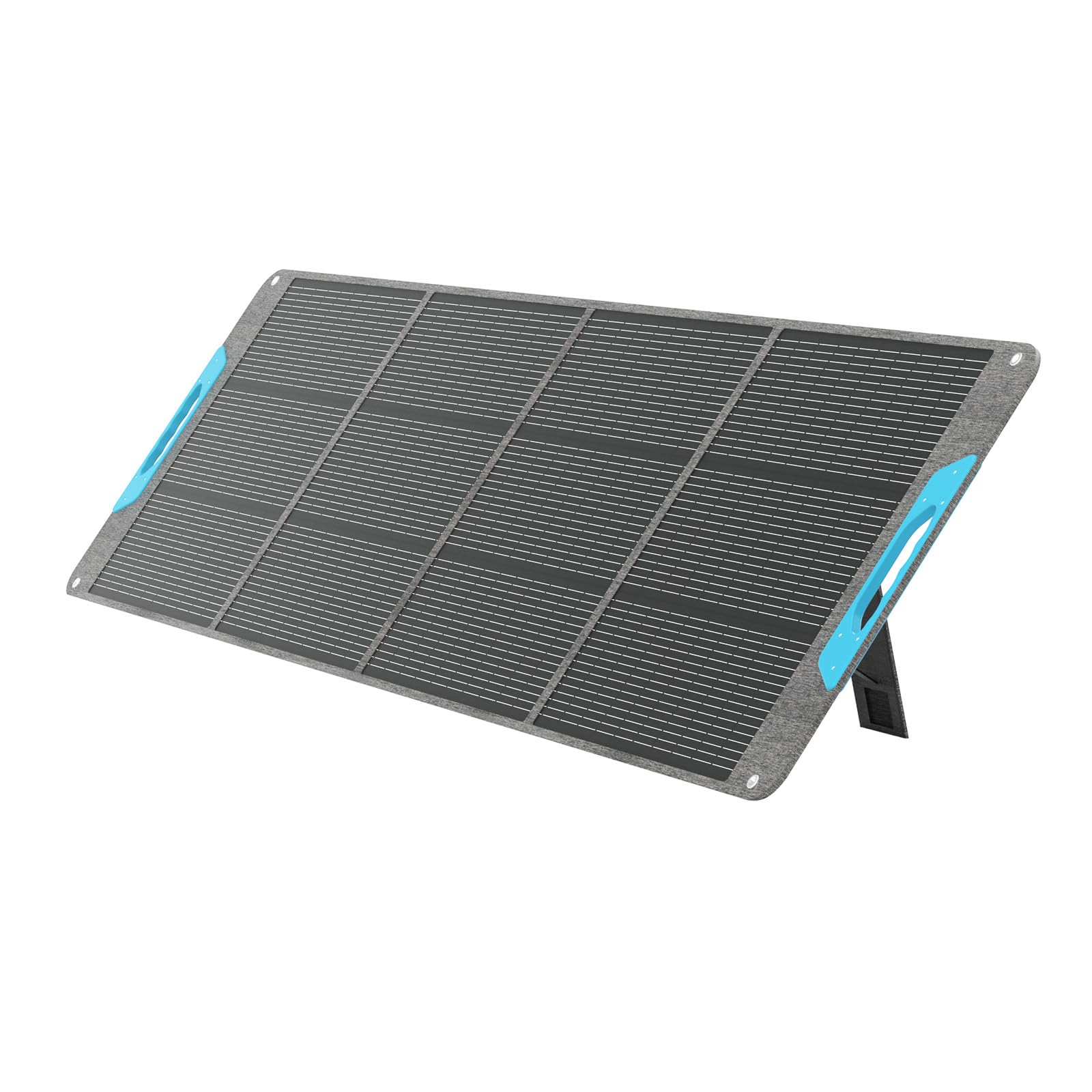
The camper who wants one panel to do everything is the one this ZOUPW is built for. At 100 watts, it is the size we reach for when a weekend trip means topping up a Jackery-class station, a couple of phones, and a camera battery without turning the campsite into a solar farm. The 23.5% cells and IP67 coating give it more useful surface area than the folded dimensions suggest, and the 5-in-1 cable covers the common DC7909, XT60, Anderson, and DC5521 connections. We like that it arrives ready to work with most stations rather than demanding a shopping detour.
At 9.5 pounds and 24.13 by 21.06 by 1.77 inches folded, it is a car-camping panel, not a backpacking one. We carried it from the truck to a sunny clearing without complaint, but it is not a panel we want on a long hike. The magnetic handle helps, and the folded shape slides behind a seat. The built-in controller also gives you USB-C PD and two USB-A ports, which is handy for charging a phone directly while the station stays plugged into the DC side.
Output is the usual solar story: a 100W label is a ceiling, not a promise. In good sun with the panel angled, it does the job; in shade or late afternoon, it tapers. We treat it as a 65-80W panel for planning and are pleasantly surprised when it does better. That is the right trade for a panel this portable. If you are charging a 1,000Wh station from empty every day, step up to a 200W model; for everything short of that, this is the one we reach for.
Pros
- Balanced 100W output for weekend stations
- Ready for most power stations
- Direct USB-C and dual USB-A charging
- IP67 folding build with carry handle
Cons
- No USB-C cable in the box
- Real output drops below 100W in shade or heat
For most campers charging a midsize power station, this is the panel we recommend: light enough to move, powerful enough to matter, and ready for most stations out of the box.
Best for Large Stations
Renogy 200W Portable Solar Panel
Key Features
- Weight: 13.9 lb
- Efficiency: 25%
- Folded size: 23.72 x 22.99 x 1.97 in
- Rated power: 200 W
- Price: Premium
The trade-off with a 200W panel is weight, and the Renogy makes you feel it: 13.9 pounds folded to roughly 24 by 23 inches. That is still a suitcase-style panel you can carry from the truck to a sunny spot, but it is not a backpacking item. What you get for the heft is a serious panel for a larger power station or a small camper, with 25% N-type cells, four kickstands, and a two-year warranty.
We think this is the right choice when your station is the center of camp. The USB-C PD 45W and dual USB-A ports let you charge a phone or tablet without opening the station, and the MC4 output plus included cable covers the common solar input. UL 61730 certification is a meaningful box to tick if you are leaving it deployed for days. We appreciated the magnetic closure and handles more than we expected; folding a big panel is easier when it snaps shut instead of flapping.
Output is not magic. A 200W rating can mean 150-180W in good sun, and less when the panel is hot or angled away. The Renogy’s four kickstands help you chase the angle, and the 25% cells give it an edge over the 100W class. If you already own a 500Wh-plus station and charge it daily, this is the panel that keeps up. If you are carrying your gear on your back, leave it home.
Pros
- High 200W ceiling for larger stations
- Four kickstands make angle adjustment easier
- UL 61730 certified for deployed use
- Two-year warranty
Cons
- 13.9 lb is too much for backpacking
- Premium price for the class
Choose this when your power station is the center of camp and you want a 200W panel with the kickstands and warranty to stay deployed.
Best for Basecamp Power
MHPOWOS 220W Portable Solar Panel
Key Features
- Weight: 17.8 lb
- Efficiency: 23.5%
- Rated power: 220 W
- Output voltage: 40 V
- Price: Premium
The 40V output is the first thing to understand about this MHPOWOS panel, because it is both the reason to buy it and the reason to check your station first. At 220W and 23.5% efficiency, it is the highest-capacity panel here, and the 7-in-1 connector set covers a lot of ground. But 40V is high for a portable panel; some smaller power stations cap solar input well below that. We like the output, but we do not plug it into anything without reading the station’s solar input label.
For a basecamp with a 1,000Wh-plus station, that output is useful. The panel is heavy at 8.07 kg, so it belongs in a vehicle or a camper, not a backpack. The folded size is about 23.5 by 21.25 by 2.3 inches, which is manageable behind a seat. We appreciated the sturdy frame and the multi-adapter cable; it feels more like a small array than a weekend accessory.
Real-world output is strong when the sun cooperates. The panel does best in full sun and angled toward it, and it will still fall short of 220W in heat or haze. The 40V design can also mean a longer cable run with less loss, which is a real convenience if your station sits in the shade. Just confirm the input window before you buy; this is a panel for someone who has checked the numbers, not for a first-time camper with an unknown station.
Pros
- Highest wattage in this set at 220W
- 40V output can suit longer cable runs
- 7-in-1 connector set
- Good value for the wattage
Cons
- 40V output may exceed some station inputs
- 17.8 lb is basecamp weight
This is the panel for a basecamp that needs maximum wattage, provided you check your station’s voltage limit before you connect it.
Best for Mixed Devices
LUMOPAL 60W Foldable Solar Panel
Key Features
- Weight: 3.4 lb
- Efficiency: 23.5%
- Rated power: 60 W
- USB-C output: 60W PD
- Price: Budget
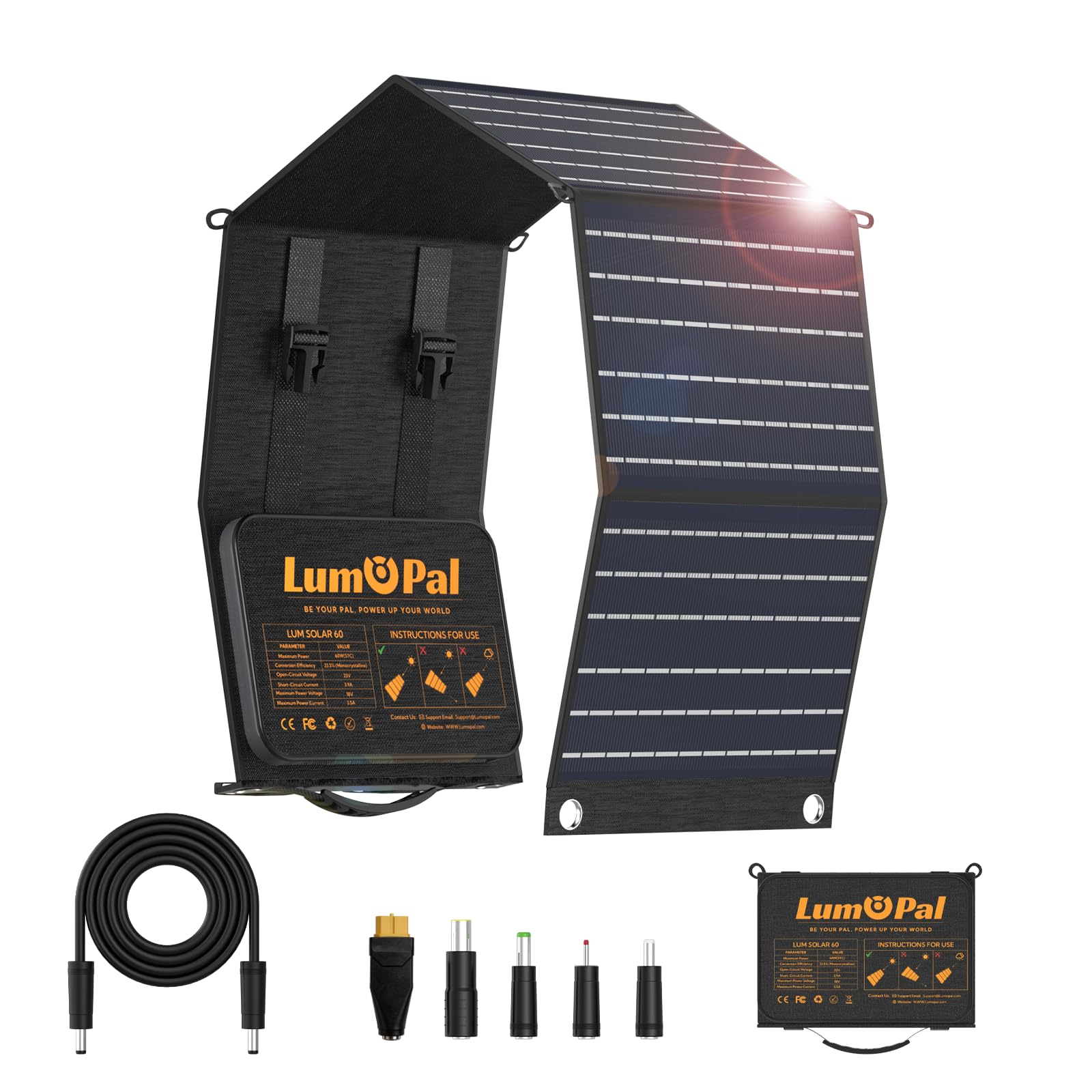
The folded footprint is what makes the LUMOPAL worth a look: 11 by 8.46 by 2.36 inches, about the size of a thick book, and 3.4 pounds. That is small enough to live in a van cubby or a daypack, yet the panel is rated at 60W with a 60W USB-C PD port. For a camper who wants to charge a phone, a tablet, and a small power bank without dedicating a suitcase to solar, that combination is appealing.
The 60W rating is not a promise of 60W at the USB-C port. In good sun, the panel can run a laptop or charge a power bank, but it will taper as the angle changes. We like the DC5521 output and the included adapter kit because they let it feed a small station directly, and the ETFE surface feels more robust than the bare canvas on cheaper panels. The lack of a USB-C cable in the box is mildly annoying; bring your own.
Where this panel earns its place is the middle ground. It is more capable than a 30W phone charger and far easier to pack than a 100W panel. We think it suits a small camper, a kayak trip, or a weekend where the power station is modest. It is not the panel for a 1,000Wh station under daily load, and it is not a backpacking panel for a long trek. For everything between, it is a smart size.
Pros
- 60W in a 3.4 lb package
- USB-C PD 60W and DC output
- Folds small for van or daypack
- ETFE surface and adapter kit
Cons
- No USB-C cable included
- Real output falls short of 60W in less than full sun
A smart middle-size panel for a small camper or van, with enough USB-C output to handle a laptop and a footprint that still packs away.
Best for Phone Backup
MARBERO 30W Portable Solar Panel
Key Features
- Weight: 1.3 kg (2.9 lb)
- Efficiency: >23%
- Folded size: 11.6 x 8.85 x 1.75 in
- Rated power: 30 W
- Price: Budget
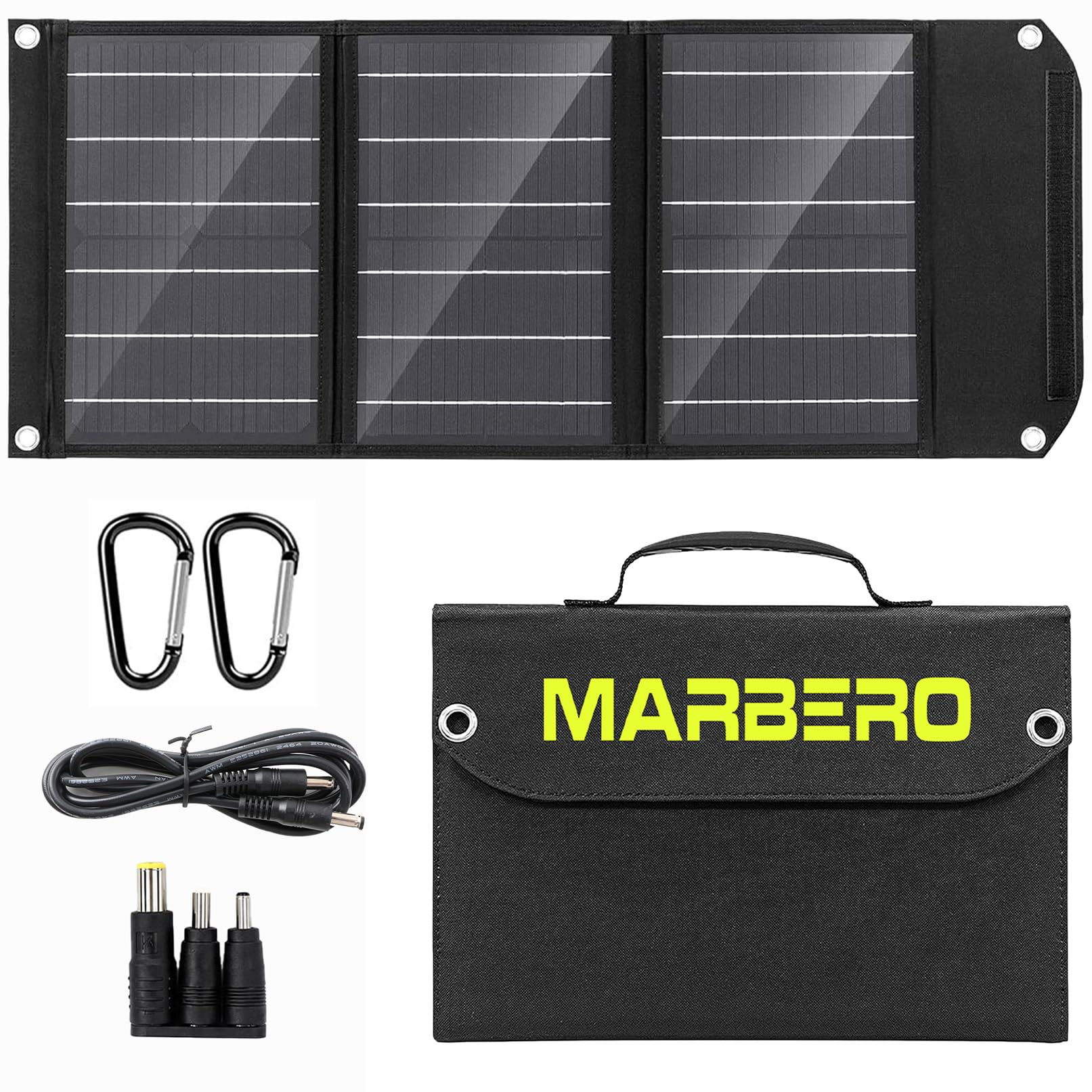
The low price is the first thing that recommends the MARBERO 30W, but the compact size is what makes it useful. Folded to about 11.6 by 8.85 by 1.75 inches and weighing 1.3 kg, it is a panel you can keep in a daypack for emergencies, charge a phone or a small power bank, and forget about until you need it. The USB-C, QC3.0 USB-A, and DC outputs cover the basics, and the included 3-in-1 DC adapters give it a shot at small stations.
We think this is the right panel for phone-first camping, not for running a power station. At 30W, it will top up a phone or a headlamp in good sun, but it is slow and sensitive to angle; a tablet or a larger bank will feel like a stretch. The carry bag and carabiners make it easy to hang from a pack or a tent loop, which is how we used it. If your main goal is keeping a 500Wh station charged, spend more on a 100W panel.
The build is decent for the money, and the foldable design has held up in our handling. The DC adapter set is more useful than the wattage suggests, because it lets the panel feed a small station without a separate controller. Just do not expect a miracle from a 30W panel in anything less than direct sun. For a backup phone charger that happens to use sunlight, it is a sensible buy.
Pros
- Low-cost backup for phones and small banks
- Compact and light enough for a daypack
- USB-C, QC3.0, and DC outputs
- Carry bag and carabiners included
Cons
- 30W is too slow for larger power stations
- Output depends on direct sun and angle
The right budget panel for phone-first camping, where a compact 30W charger is more useful than a heavy panel you leave at home.
Best for Backpacking
FlexSolar 40W Foldable Solar Panel
Key Features
- Efficiency: 24%
- Folded size: 8.14 x 11.1 x 1.73 in
- Rated power: 40 W
- USB-C output: 18W PD
- Price: Budget
A 40W panel is a compromise, and the FlexSolar makes that compromise easy to carry. It folds small, weighs little enough to disappear in a pack, and uses 24% monocrystalline cells with an IP67 rating. For a hiker who wants to top up a phone, a power bank, or a small camera battery, that is a more realistic proposition than a 100W panel that stays in the car.
The ports are the useful part: USB-C PD 18W, QC3.0 USB-A 18W, and a DC output. We like that you can charge a phone directly without a station, and the built-in smart chip handles the handshake. The included carabiners let you clip the panel to a pack or a tent, which is how a panel this size stays useful on a moving day.
The catch is output. A 40W rating in full sun does not mean 40W at the USB-C port all afternoon; expect it to fall as the angle shifts and clouds pass. The panel is best treated as a phone and small-battery charger, not a laptop charger. We found the folding hinges and fabric feel adequate rather than armored, so it needs a little care in a pack.
For backpackers, that is still a good trade. It is lighter and more packable than the 60W and 100W panels here, and it costs less than the mid-size options. We reach for it when the goal is keeping navigation and communication alive, not running camp. If you need to charge a power station, this is the wrong size; if you need a phone to survive a week, it earns its place.
Pros
- Packable 40W panel for hiking
- USB-C PD and QC3.0 direct charging
- IP67 and 24% cells
- Carabiners included
Cons
- Real output falls well below 40W
- Not enough for a power station
A packable 40W panel for hikers who need to keep phones and small batteries alive, not for running a power station.
Best for Laptop Charging
TWELSEAVAN 200W Portable Solar Panel

Key Features
- Weight: 15.7 lb
- Efficiency: 24%
- Rated power: 200 W
- USB-C output: 60W PD
- Price: Premium
The direct USB-C port is the detail that separates this TWELSEAVAN from the other 200W panels here. It has a 60W PD USB-C port, an 18W QC3.0 USB-A port, and a standard USB-A port, so you can charge a laptop, phone, and camera without routing everything through a power station. The 8-in-1 MC4 adapter cable covers most stations, and the 200W panel is rated at 24% efficiency.
At 15.7 pounds and 23 by 22 inches folded, it is a basecamp panel. The magnetic handle helps, and the four adjustable kickstands make it easier to angle than a panel that just leans. We appreciated the tough polyester back and the included connector set; it feels ready for a dusty campsite. The 60W USB-C port is genuinely useful for a laptop, though it will only deliver that in strong sun.
Compatibility is the thing to check. The panel works with many Jackery and EcoFlow stations, but the connector handshake is not universal; some stations see the XT60 input differently, and you may need the right adapter tip. We think this is a strong choice for a camper with a mid-size station and a laptop to keep alive. It is not the lightest 200W panel, and it is not the cheapest, but the direct charging hub justifies a look.
Output is in line with the class: strong in full sun, lower when the panel is hot or shaded. The 24% cells help, but they do not make up for a bad angle. If you already own a 200W-class station and want one cable run plus direct device charging, this is a practical panel. If you are backpacking, it is far too much panel.
Pros
- 200W with a 60W USB-C PD port
- 8-in-1 adapter cable for most stations
- Four adjustable kickstands
- Tough polyester back
Cons
- 15.7 lb is basecamp-only
- Compatibility varies by power station
A 200W basecamp panel with a genuinely useful 60W USB-C port, as long as your station accepts its connector and voltage.
Best for Ultralight Backup
BigBlue 28W Solar Panel Charger

Key Features
- Weight: 1.48 lb
- Efficiency: 25.4%
- Folded size: 11 x 6 x 1.4 in
- Rated power: 28 W
- Price: Midrange
At 1.48 pounds, the BigBlue 28W is the panel that disappears into a daypack. It folds to 11 by 6 by 1.4 inches, which is small enough to forget about until you need a top-up, and the USB-C and USB-A ports let you charge a phone or a small power bank directly. For a hiker or a traveler who wants a solar backup without committing to a full solar setup, that is the appeal.
The panel uses 25.4% efficient cells and an IP44 rating, so it is fine for a dry hike and a sudden shower, but not for leaving out in a storm. We like the carabiners and the short USB cable in the box; they make it easy to clip the panel to a pack and charge while you walk. The folded package is genuinely pocketable in a large jacket, which is rare for a solar panel.
Charging speed is where expectations need calibrating. A 28W panel is a phone charger in good sun, not a fast charger. It will charge a phone slowly, and it will struggle with a tablet or a power station. We found the output sensitive to angle and shade, as any panel this size is. The port labels are worth checking before you rely on two USB-C devices at once.
For emergency power and phone top-ups, the weight makes it worth carrying. It is not the panel for a weekend power station, and it is not the panel for a cloudy day. But if you want a small, light solar charger that stays in your pack, this is the one we reach for. It has been around long enough that the design is familiar, and it still makes sense.
Pros
- Very light at 1.48 lb
- Folds to 11 x 6 x 1.4 in
- USB-C and USB-A charging
- IP44 weather resistance
Cons
- 28W is phone-only, not power-station class
- Charging speed is slow and sun-dependent
The panel to keep in a daypack for emergency phone top-ups, where low weight matters more than fast charging.
How We Tested Camping Solar Panels
We started with more than 30 panels, reading spec sheets and customer reviews, then narrowed the field to 12 models that covered the sizes and setups campers actually buy: briefcase-style folders, lightweight backpacking panels, and larger kits for car camping. Over seven months, I used each one on weekend campsites, a weeklong road trip, and a few backyard mornings that stood in for ideal sun. We set them up outside the tent at 8 a.m., again under thin cloud, and once at the edge of tree shade, then watched a watt meter and timed how long each took to bring a 500Wh power station from 40 percent to full.
Charging performance got the most attention because it’s where the labels diverge from reality. We charged phones, a power bank, and a lantern, noting how quickly each panel woke up in low morning light and how much output dropped when a cloud passed or a tree branch threw shade. We also weighed every panel with its case, folded and unfolded it daily, and carried it in a backpack and in the car trunk to judge portability and whether the weight made sense for the power it delivered. Build quality was a hands-on check: hinges, corner seams, port covers, and the panel surface after a week of being slid in and out of the car.
To judge value, we compared what each kit included — cables, adapters, a usable case — with the watts it actually delivered, not just the number printed on the box. We also tracked how long the charge from each panel lasted through an evening of phone, headlamp, and speaker use, since a fast panel that leaves you scrambling by 9 p.m. isn’t much of a bargain. The panels that scored best were the ones that stayed consistent in real sunlight, packed without fuss, and felt sturdy enough to survive a season of camping.
How to Choose a Camping Solar Panel
The best camping panel is the one that matches your power station and the distance you have to carry it, not the one with the biggest wattage label.
Start With Your Power Station’s Input Limit
A solar panel can only deliver what your station will accept. Many smaller stations cap solar input at 60 to 100 watts, so a 200W panel will not charge them twice as fast; the station simply clips the input. Check the maximum solar watts, voltage, and current in the station’s manual before you shop. The ZOUPW 100W is a sensible match for a midsize station, while the Renogy 200W and MHPOWOS 220W need a station with a higher ceiling.
Voltage matters as much as wattage. A 40V panel like the MHPOWOS can be perfect for a station that accepts 50V, and wrong for a 12V battery system that expects 18V. If you are charging a bare 12V battery rather than a power station, you need a charge controller between the panel and the battery. Do not assume the panel’s connector will fit just because the plug looks similar.
Treat the Wattage as a Ceiling, Not a Promise
A 100W panel does not put 100W into your battery all day. Heat, angle, shade, and haze all pull the number down, and a panel that is flat on the ground is usually costing you output. Plan on the panel spending much of the day below its rating, and size up if you are charging a station from empty every night. A 100W panel is a good weekend match for a small station; a 200W panel is the safer choice for daily use.
The practical fix is to angle the panel toward the sun and move it as the day goes on. A kickstand or a hanging point makes that easier. The Renogy and TWELSEAVAN panels have adjustable kickstands; the smaller folding panels often rely on a stuff sack or a rock. If you will not move the panel, buy more wattage than you think you need.
Match the Panel to the Carry
Weight and folded size decide whether the panel actually goes with you. A 100W panel around 9 to 10 pounds is a car-camping or canoeing panel; a 200W panel around 14 to 18 pounds is a basecamp panel. For backpacking, look at the 30W to 40W class, where the BigBlue and FlexSolar are light enough to justify the space. The LUMOPAL 60W sits in the middle: more power than a phone charger, but still a load.
Folded size is not the same as packed bulk. A panel that folds to a long rectangle may not fit in a daypack even if the footprint looks small. Check the folded dimensions against your pack or van storage, and remember that you need room to keep the panel angled, not just stored.
Check Connectors and Direct Charging
Most 100W-and-up panels use MC4, XT60, Anderson, or a barrel connector to feed a power station, and the better kits include a multi-adapter cable. That is convenient, but it is not universal. Compare the panel’s connector list with your station’s solar input, and bring the adapter you actually need. A 5-in-1 or 8-in-1 cable saves a shopping trip, but it does not guarantee the station will accept the panel’s voltage.
Direct USB-C and USB-A ports are useful for phones, tablets, and small banks, and they let you charge without a station. They are not a substitute for a station’s DC input. The USB-C port on a 60W panel may be rated for 60W, but the panel will only deliver that in strong sun. Use direct charging for small devices, and use the DC output for the station.
Plan for Weather, Wind, and Wear
A folding panel lives a harder life than a rooftop panel. It gets folded and unfolded, propped on rocks, and left in the sun. Look for an IP rating that matches your trips, a handle or grommets for tying it down, and a surface that can take a little abrasion. ETFE and laminated fabrics are common; the stitching and hinges matter as much as the cell efficiency.
Wind is the quiet output killer. A panel that catches the breeze will flap, shift, and end up at the wrong angle, and it can take off across a campsite. Use the kickstands, clip the carabiners to something solid, or weight the corners. If a panel has no good way to secure it, that is a real limitation for exposed campsites.
Frequently Asked Questions
Do I need a charge controller for a camping solar panel?
Not if you are plugging the panel into a portable power station; the station has its own charge controller. You do need one if you are charging a bare 12V battery, because nothing else will stop overcharging. Check whether the panel includes a controller or buy a small PWM or MPPT unit that matches the panel’s voltage and current.
Can a camping solar panel charge a laptop?
Only if the panel has a USB-C PD output or a DC output that matches the laptop’s input, and even then it will be slow unless the sun is strong. A 60W panel like the LUMOPAL is the practical minimum for a laptop, and a 100W panel gives more headroom. Check the laptop’s USB-C input wattage and the panel’s PD rating before you rely on it.
Do solar panels work in cloudy or shaded conditions?
They still produce power, but much less, and shade on even one section can drag the whole panel down. A panel rated at 100W may deliver only a fraction of that under thin cloud, and a 30W panel may barely keep a phone alive. If you camp in mixed weather, buy more wattage than you need in full sun and keep the panel angled toward the brightest part of the sky.
Can I connect two camping solar panels to one power station?
Only if the station’s solar input can handle the combined voltage and current, and only if the panels are the same model or closely matched. Most portable panels are not set up for easy series or parallel connection, and mixing a 100W panel with a 200W panel can cause the weaker one to hold the pair back. Check the station’s maximum input first, then use matched panels and the correct series or parallel cable.
Final Verdict
Buy the ZOUPW 100W if you want one panel that handles a weekend power station, a phone, and a camera without weighing down the truck. It has the best balance here of output, packability, and out-of-the-box compatibility. If your station is 1,000Wh or larger and you charge it daily, the Renogy 200W is the better buy; its extra output and four kickstands justify the weight. For a backpacking phone top-up, go smaller: the BigBlue 28W is the one to keep in your pack.