This post contains affiliate links. We may earn a small commission when you buy through our links — at no extra cost to you.
A 200W solar panel sounds like plenty of juice for a weekend camping trip — until you set it up in bright sunlight and only see 120W on your power station’s display. That gap between rated wattage and real-world output is the most common frustration in portable solar, and it’s rarely due to bad panels alone. Factors like sunlight angle, cable length, and your station’s input limits all play a part.
This guide focuses on panels that consistently deliver a meaningful portion of their rated power, not just marketing numbers. We’ve identified models that balance efficiency, weight, and build quality for different camping styles — from car camps with 500Wh power stations to backpackers charging devices directly. The right panel depends on matching its real output to what you actually need.
Whether you’re powering a fridge for a week or keeping phones alive on a thru-hike, understanding the trade-offs between portability, durability, and power helps you spend wisely. The following picks reflect what works in practice, not just on paper.


Best for All-Around Camping
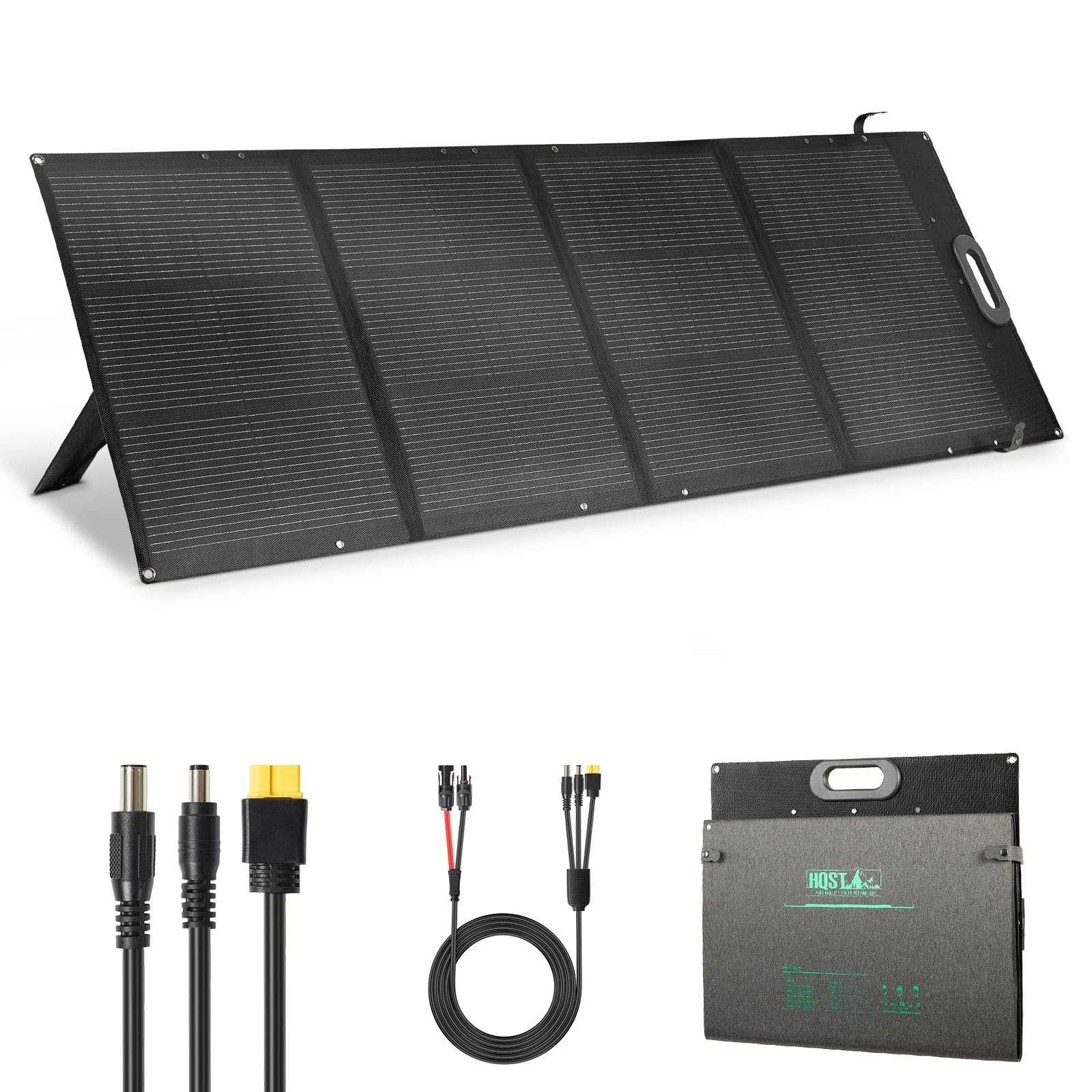
HQST 200W Ultra-Light
Key Features
- Rated Wattage: 200W
- Weight & Size: 11 lb, —
- Efficiency: 25%
- Waterproof: IP67
- Compatibility: XT60, DC7909, DC5521
- Price: $
At just 11 lb, the HQST 200W Ultra-Light is one of the lightest foldable 200W panels on the market, and it backs up that portability with real-world output that frequently hits or exceeds its 200W rating. The N-type monocrystalline cells achieve 25% efficiency, higher than typical polycrystalline panels, which means more power per square foot when space is limited. The IP67 waterproofing allows the panel to sit out in rain without concern, and the 3-in-1 adapter cable (XT60, DC7909, DC5521) connects to most power stations straight out of the box. The included storage bag keeps the panel protected during transport and when not in use.
Output in full direct sun typically lands between 160W and 200W, with many users reporting 200W or slightly above under clear skies. The high-efficiency cells help maintain respectable power even in partly cloudy conditions, reducing the drop-off that less efficient panels experience. This makes the HQST a dependable partner for campers who can’t always wait for perfect weather. The foldable design with built-in kickstands allows angle adjustment to track the sun, though the kickstands are lighter-duty than those on heavier panels — they work well for propping the panel at the right angle, though a breeze can knock them over if not secured.
Campers and RVers who prioritize low weight for carrying between campsites will find this panel well-suited. It works with any external charge controller, so it pairs easily with power stations and solar generators. It is not for users who want a suitcase-style panel with a built-in charge controller; those setups are heavier and less flexible. One thing to watch: the aluminum frame may show cosmetic dents from shipping. Inspect the packaging immediately upon delivery and report damage promptly. The panel’s 25% efficiency also means it requires less space to set up, an advantage on crowded campsites.
Compared to the Renogy 200W EFlex, a common alternative, the HQST is about 5 lb lighter and costs less, making it the stronger choice for campers who carry their panels. The Renogy adds a 45W USB-C PD port for direct laptop charging, a convenience the HQST lacks. For most campers charging power stations, the weight and cost savings outweigh that feature, but if you need to skip the power station for small electronics, the Renogy may be worth the extra expense. For most campers, this panel delivers the strongest balance of weight, output, and cost.
Pros
- Real-world output often meets or exceeds the 200W rating
- Weighs only 11 lb, making it easy to carry to campsites
- Budget-friendly price with solid build quality
- IP67 waterproof rating for worry-free use in rain
- 3-in-1 adapter cable provides broad compatibility with power stations
Cons
- Frames may show cosmetic dents from shipping; inspect packaging upon arrival
For campers who value light weight and actual power delivery over all else, this panel delivers both at a price that undercuts most competitors.
Best for Usb-C Device Charging
Renogy 200W EFlex
Key Features
- Rated Wattage: 200W
- Weight & Size: 13.89 lb, —
- Efficiency: 25%
- Waterproof: IP65
- Compatibility: USB-C PD, 2 USB-A
- Price: $$
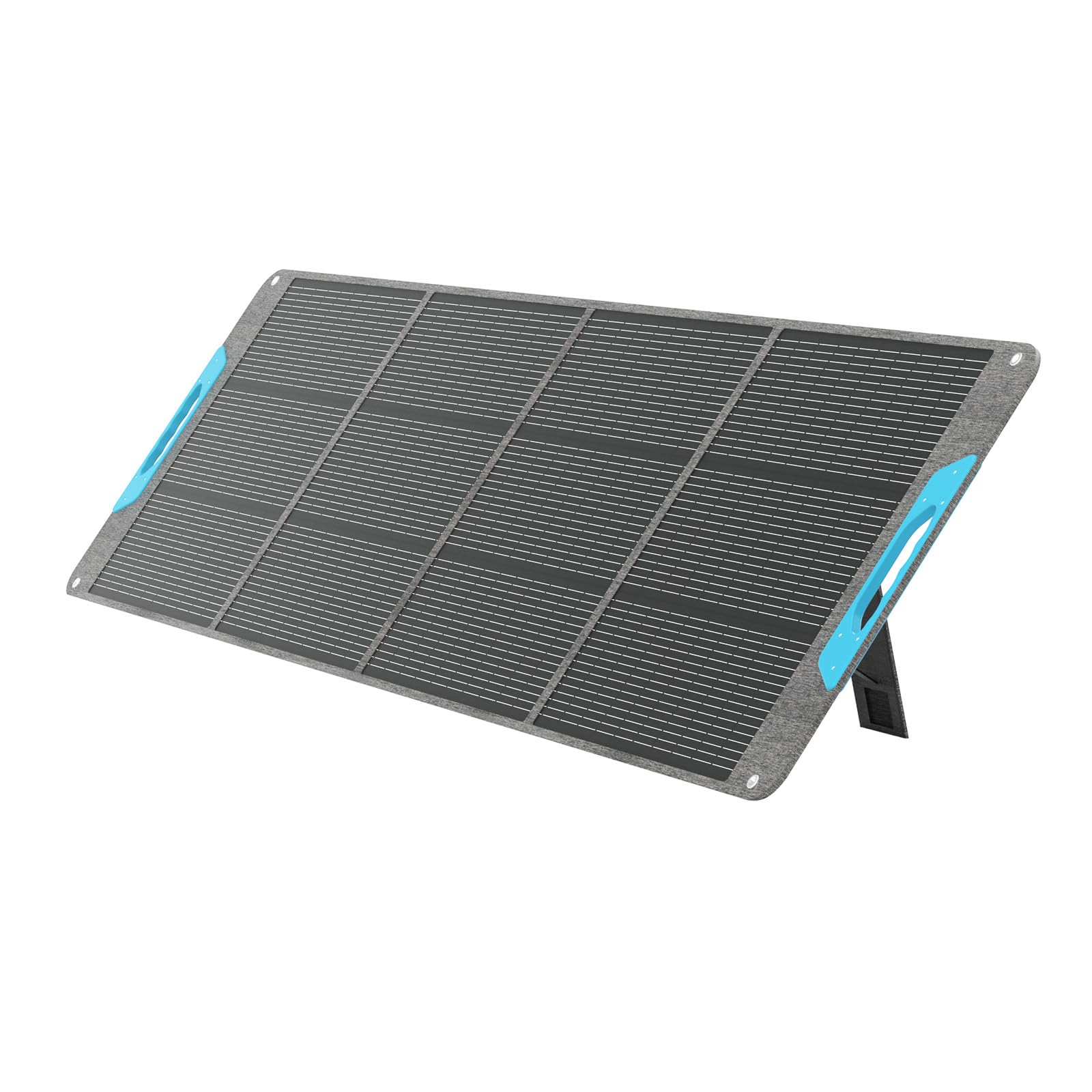
The Renogy 200W EFlex sets itself apart with a 45W USB-C PD port that charges laptops and fast-charges devices directly, removing the need for a separate power station for smaller electronics. The panel uses durable fabric and reinforced connectors, folding into a compact package with a magnetic handle for easy carry. While the top pick from HQST is lighter and costs less, it lacks USB-C output — this Renogy model fills that gap for campers who want direct device charging.
This panel suits RV campers and car-campers who value build quality and the Renogy ecosystem for support and accessories. Real-world output typically lands between 160W and 175W rather than the full 200W rating — a common gap for portable solar panels, but one that matters if you need maximum power from limited sun. The price is also higher than many competitors with similar wattage; the tradeoff is the USB-C convenience and brand reliability.
The IP65 waterproof rating and adjustable kickstands add practicality for outdoor setups, though the 13.9 lb weight makes it less ideal for backpacking trips. For vehicle-based camping where weight matters less than having a reliable direct-charging option, the Renogy delivers consistent output and easy setup.
Pros
- 45W USB-C PD port charges laptops and devices directly without a power station.
- Durable fabric and reinforced connectors hold up well to regular setup and transport.
- Folds compactly with a magnetic handle for quick carrying and storage.
- Renogy brand provides broad ecosystem compatibility and customer support.
Cons
- For backpacking, the 13.9 lb weight feels heavy; this panel is better suited for car or RV camping.
- Real-world power output may reach only 160–175W rather than the advertised 200W in typical sun conditions.
- Premium pricing compared to other 200W panels with similar real-world output.
Choose the Renogy 200W EFlex if you need USB-C direct laptop charging and value Renogy’s brand support over a lighter, cheaper alternative.
Best for Value Camping
GRECELL 200W
Key Features
- Rated Wattage: 200W
- Weight & Size: 16.5 lb, —
- Efficiency: 23.5%
- Waterproof: IP65
- Compatibility: 4-in-1 cable
- Price: $$
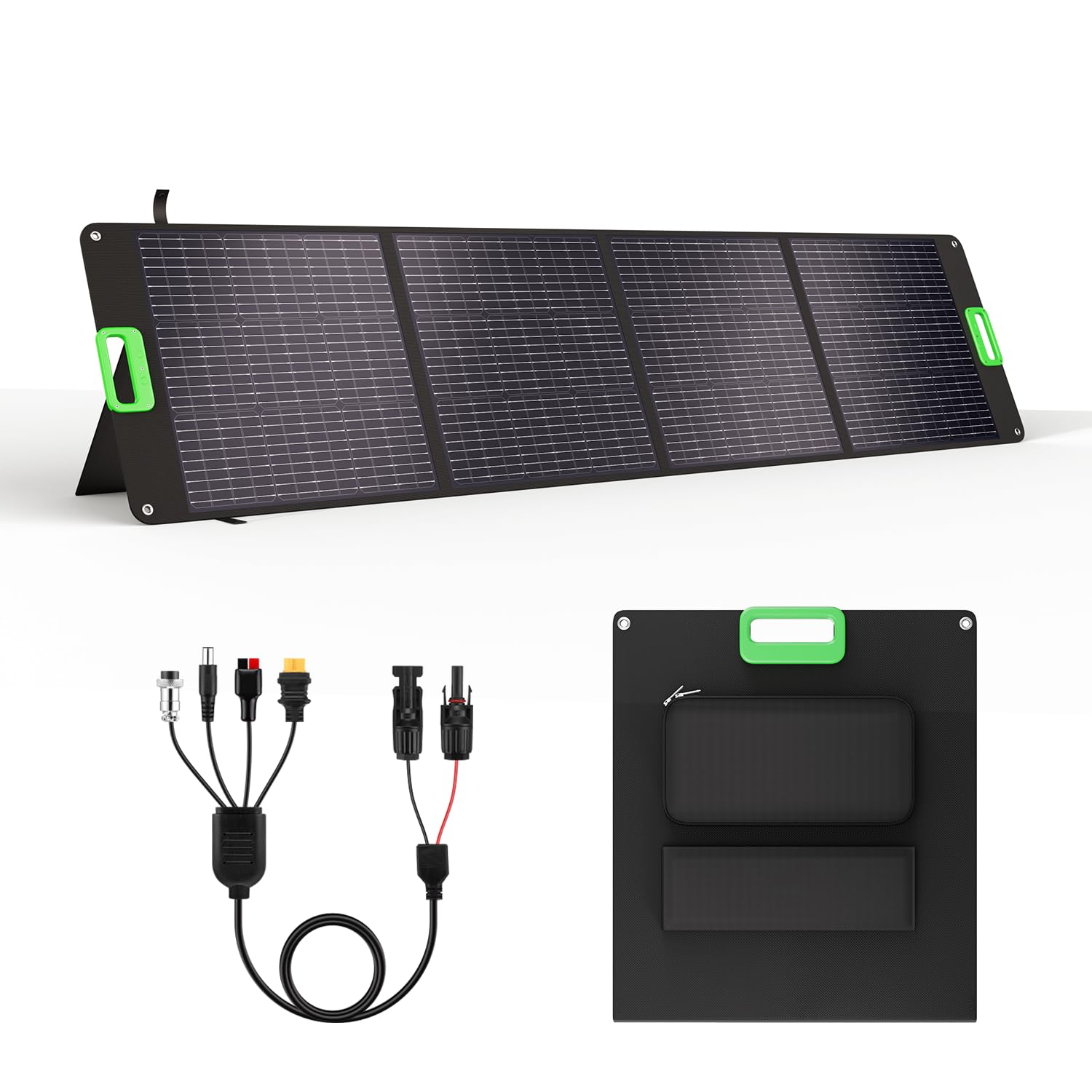
The GRECELL 200W panel stands out with over a thousand reviews and a 4.5-star average – the most crowd-tested option in this class. Four adjustable kickstands and a durable ETFE/Oxford cloth build give it a reassuringly solid feel. While the top pick is lighter and cheaper, the GRECELL offers a more established design with broad power station compatibility.
This panel suits mainstream campers and RV owners who value consistent charging over carrying the lightest gear. Real-world output typically lands between 150W and 170W – enough to refill a power station during a day out. At 16.5 lb, it is too heavy for backpacking, but the built-in handle makes it manageable for car camping or RV setups.
Performance with most power stations is straightforward: connect via the included 4-in-1 cable (XT60, Anderson, DC, aviation), adjust the kickstands, and you get steady power. The IP65 water resistance handles light rain, and the Oxford cloth exterior holds up well under regular use. For the price, it is a cost-effective way to integrate a 200W-class solar panel into your camping kit.
Pros
- Consistent charging output with a wide range of power stations
- Solid build quality using durable ETFE and Oxford cloth
- Good value for the wattage, with high owner satisfaction
Cons
- Real-world power output can land between 150W and 170W, lower than the 200W rating
- Weight (16.5 lb) is moderate; not suitable for hiking trips
A dependable panel for campers who prioritize consistent charging over ultra-light weight – and who understand that 200W is optimistic in real sun.
Best for Small Power Stations
ZOUPW 100W
Key Features
- Rated Wattage: 100W
- Weight & Size: 9.5 lb, —
- Efficiency: 23.5%
- Waterproof: IP67
- Compatibility: 5-in-1 cable
- Price: $$
The 5-in-1 cable on the ZOUPW 100W is its standout feature: it comes with DC8020, XT60, Anderson, DC7909, and DC5521 connectors, so it pairs with Jackery, EcoFlow, Anker, Bluetti, and most other brands straight out of the box. Unlike the heavy glass-framed suitcase panels, this folds into a 9.5-lb package that slips into a backpack or gear bin.
Real-world output typically reaches 70-85W in direct sun, which aligns with what you’d expect from a 100W panel. In less-than-ideal conditions — partial cloud cover or suboptimal angles — some users have seen around 60W even in decent sunlight, and output can drop to 20-25W on overcast days. The 100W rating is best treated as a ceiling, not a guarantee.
This panel fits campers who carry power stations in the 100-300Wh range and want a single cable that works with multiple brands without rummaging for adapters. If you need 200W or more for fast charging larger batteries, the top pick HQST 200W is a better fit. The ZOUPW lacks USB ports for direct device charging, so you’ll need a power station or a separate adapter to top off phones or tablets.
Pros
- 5-in-1 cable connects to 99% of power stations without extra adapters.
- Sturdy build with well-sewn seams and solid fabric backing.
- Delivers 70-85W in good sun conditions.
- Weighs 9.5 lb, easy to pack and carry to campsites.
Cons
- Rated 100W but real-world output can fall to 60W even in decent sun.
- No USB-A or USB-C ports — requires a power station or adapter for direct device charging.
If you own a Jackery, EcoFlow, Anker, or Bluetti power station under 300Wh, this is the most hassle-free 100W panel available — just unpack, connect, and angle toward the sun.
Best for Phone Charging
ELECOM NESTOUT 28W
Key Features
- Rated Wattage: 28W
- Weight & Size: 1.18 lb, —
- Efficiency: SunPower cells
- Waterproof: Water-resistant
- Compatibility: Dual USB-A
- Price: $
The NESTOUT’s SunPower cells offer high conversion efficiency, maximizing output for its size. The ripstop nylon exterior and water-resistant construction come in a panel that folds into its own carry case, emphasizing compact toughness over bulky wattage. This 28W design is built for mobility – the adjustable stands let you angle it toward the sun on uneven terrain.
Backpackers and thru-hikers who need a phone charger that fits in a side pocket will appreciate the 1.18 lb overall weight and the fact that it folds into its own case. The dual USB-A ports provide 5V/4.8A total – enough to charge a smartphone in direct sunlight. However, the lack of USB-C means newer phones may charge more slowly, and you cannot power tablets, laptops, or power stations. This panel is also a good fit for emergency preparedness kits where occasional phone charging in sunny conditions is the goal.
In direct sun, the SunPower cells deliver consistent output for phone charging. Cloud cover reduces power significantly, as with any solar panel. A practical workaround is to carry a small power bank and top it off with the NESTOUT during sunny periods, then use the bank to charge your phone when clouds roll in.
Compared to many USB-centric solar panels that skip weather sealing, the NESTOUT uses water-resistant ripstop nylon and sealed seams – a clear advantage for backpacking in damp or dusty conditions.
Pros
- Folds into its own carry case for effortless packing and storage
- Durable water-resistant ripstop nylon construction with sealed seams
- SunPower solar cells deliver consistent phone charging in direct sunlight
Cons
- No USB-C output – only USB-A ports, which may charge newer phones more slowly
- Under cloud cover, charging speed drops significantly
For backpackers who need a compact, weather-resistant phone charger, the NESTOUT is a well-designed tool that gets the job done without extra weight or complexity.
Best for High Efficiency
EcoFlow 220W Bifacial

Key Features
- Rated Wattage: 220W
- Weight & Size: 15.4 lb, —
- Efficiency: 25%
- Waterproof: IP68
- Price: $$$
The EcoFlow 220W Bifacial panel achieves real-world output frequently exceeding 230W, using bifacial cells to capture reflected light and a 25% conversion efficiency. This makes it one of the highest-producing portable panels per square foot. However, the glass construction can crack if dropped or bumped, and the kickstand can be unstable on uneven ground. At a premium price, this panel is best suited for EcoFlow power station owners who want every watt possible and are willing to handle the panel with care—not for budget buyers or rough camping.
Pros
- Real-world output often exceeds 220W, maximizing solar harvest.
- Bifacial design adds up to 28% more energy from reflected light.
- Solid build with robust materials for a panel this size.
Cons
- Glass front can crack if the panel is dropped or mishandled — a concern for uneven campsites.
- Kickstand requires careful setup and may not stay put on soft ground.
Best for EcoFlow power station owners who want maximum output and handle gear carefully — not for budget buyers or rough use.
Best for Rv Battery Charging
Renogy 100W Suitcase

Key Features
- Rated Wattage: 100W
- Weight & Size: 17.42 lb, —
- Efficiency: 25%
- Compatibility: Alligator clips, USB
- Price: $$$
This 100W panel pairs tempered glass and an aluminum frame with a pre-installed 20A PWM charge controller, making it a straightforward plug-and-play solution for maintaining 12V batteries in RVs or off-grid setups. At 17.4 lb and a premium price for its wattage, it is not the panel to pack for backpacking or budget-conscious camping. The integrated controller eliminates extra wiring, but the weight and cost limit its audience to those who value durability and simplicity over portability.
Pros
- Easy alligator-clip setup for 12V batteries.
- Rugged tempered glass and aluminum frame withstand outdoor exposure.
Cons
- At 17.4 lb, it is heavy for a 100W panel – better suited for stationary use than carrying.
- Premium pricing compared to other 100W panels that lack a built-in controller.
Choose this if you need a durable, controller-integrated 100W panel for semi-permanent RV battery maintenance and can accept the weight and higher cost.
Best for Device Charging
BigBlue 28W USB

Key Features
- Rated Wattage: 28W
- Weight & Size: 1.5 lb, —
- Efficiency: 25.4%
- Waterproof: IP44
- Compatibility: Dual USB-C + USB-A
- Price: $
With its dual USB-C and USB-A outputs and a folded size akin to a magazine, the BigBlue 28W is built for light loads: topping up phones, tablets, and small power banks during day hikes. Its three ports can charge multiple devices at once in bright sun, delivering near wall-charger speeds for individual devices. However, output relies on strong, direct sunlight – partial cloud cover or shade can drop charging to a trickle, and some units may not charge at all in less-than-ideal conditions. The fabric casing also shows wear after extended sun exposure, making this more of a fair-weather companion than a long-haul workhorse.
Pros
- Folds to magazine size for easy backpack storage.
- Charges phones at near wall-charger speeds in good sunlight.
- Three ports (dual USB-C + USB-A) allow simultaneous device charging.
Cons
- Charging performance drops noticeably in anything less than strong, direct sunlight – output may be minimal.
- Fabric casing can degrade after months of regular sun exposure, reducing long-term durability.
For emergency kits and short hikes where phone charging in full sun is the goal, this budget-friendly panel is a capable backup.
How to Choose
The biggest mistake campers make is buying a panel based on rated wattage without checking their power station’s maximum solar input.
Rated Wattage vs Real Output
Rated wattage is measured under ideal lab conditions: direct sun at noon, 25°C, perpendicular angle. In real camping scenarios, expect 60–80% of that number. A 200W panel typically delivers 120–170W in bright sunlight. The gap widens with heat, angle, and partial shading.
Match the panel’s real-world output to your power station’s max input voltage and current. Exceeding the input limit can damage the controller; undershooting leaves you charging slowly. Check your station’s specs before buying.
Weight and Folded Size
Every pound matters when you carry a panel from car to campsite or on a hike. Foldable blankets (11–16 lb for 200W) are manageable for car camping; backpackers need under 2 lb for phone chargers. Suitcase-style panels with glass and aluminum frames are heavier (17+ lb) but more durable for permanent RV use.
Consider the folded dimensions. A panel that collapses to the size of a backpack fits easier in tight storage. Some 400W blankets fold to 16×16 inches, while 100W suitcases are bulkier.
Efficiency Rating
Efficiency (23–25%) tells you how much sunlight gets converted to electricity. Higher efficiency means more power per square foot – useful if your camping spot has limited sun exposure. But the difference between 23% and 25% is small in practice (about 8% more output).
Bifacial panels (like the EcoFlow 220W) capture light from both sides, boosting output in bright conditions. However, they require reflective ground surfaces to gain the advertised benefit.
Waterproof Rating
IP65 resists light rain and dust; IP67 can handle being submerged in 1m of water for 30 minutes; IP68 is for continuous immersion. For camping, IP65 is sufficient for unexpected showers. IP67 gives peace of mind if you leave the panel out overnight.
Waterproof ratings apply to the panel’s outer coating, not the connectors. Keep MC4 or USB ports covered when not in use – moisture inside connectors can cause corrosion over time.
Compatibility and Connectors
Most portable panels come with a variety of adapter tips (XT60, Anderson, DC7909, USB-C). A 5-in-1 or 8-in-1 cable covers nearly all power stations. If you own an EcoFlow, Jackery, or Goal Zero, confirm which connector your station uses – some brands require a specific adapter.
Cable length matters. Short cables (under 6 ft) limit where you can place the panel relative to your station. An extension cord solves this, but adds resistance and voltage drop. Look for panels with at least 10 ft of cable for flexible positioning.
FAQ
Why does my 200W solar panel only output 100W on a sunny day?
Rated wattage is measured under ideal lab conditions (25°C, direct perpendicular sunlight). Real-world factors — heat above 25°C reduces voltage, off-angle light, and your power station’s input limits — typically drop output to 60–80% of rated. If you’re seeing exactly 100W, the panel is probably performing within its normal range. Check that the panel is tilted toward the sun and not partially shaded.
Can I use a portable solar panel to charge my power station through a window?
Yes, but expect a 30–50% reduction in output because window glass blocks some UV light and reflects angles. Even a clean, uncoated window cuts efficiency. For best results, place the panel outdoors where it can be angled directly at the sun. Charging through a window works in a pinch, but don’t rely on it for full-speed charging.
How long does it take to charge a 500Wh power station with a 200W panel?
In bright, direct sunlight, a 200W panel delivering 150W real-world output charges a 500Wh station in about 3.5 hours (500/150 = 3.33, plus efficiency losses). On a partly cloudy day or with a less optimal angle, expect 5–6 hours. Always account for your panel’s real-world wattage, not the rated number.
What is the difference between a foldable solar blanket and a suitcase panel for camping?
Foldable blankets (like the HQST or Renogy EFlex) are lightweight, pack flat, and are best for campers who move frequently. Suitcase panels (like the Renogy 100W Suitcase) have a rigid frame, tempered glass, and an integrated charge controller — they’re heavier but more durable for semi-permanent setups at RV sites. Choose a blanket for portability, a suitcase for ruggedness and built-in controller.