This post contains affiliate links. We may earn a small commission when you buy through our links — at no extra cost to you.
Every foldable solar panel comes with a wattage number on the box and a quieter, more honest number waiting in the shade. Campers buy these to keep a phone, a headlamp, a camera, and sometimes a power station alive without hauling a generator or hunting an outlet, and the difference between a panel that manages it and one that doesn’t rarely shows up in the specs. It shows up at 7 a.m. under tree cover, or on a hazy afternoon when the readout falls by half.
I’ve strapped a few of these to pack lids and lugged them down trails, and what struck me first is how much depends on things the box doesn’t advertise: how it folds, what it weighs once the case and cables are in, whether the ports still grip after a season of dust. My team and I spent nine months with 12 panels in real camping conditions. The ones worth carrying are honest about their output, and a panel too heavy or too fussy to pack charges nothing. The picks below earned a permanent spot in the gear bin.


Best for Power Stations
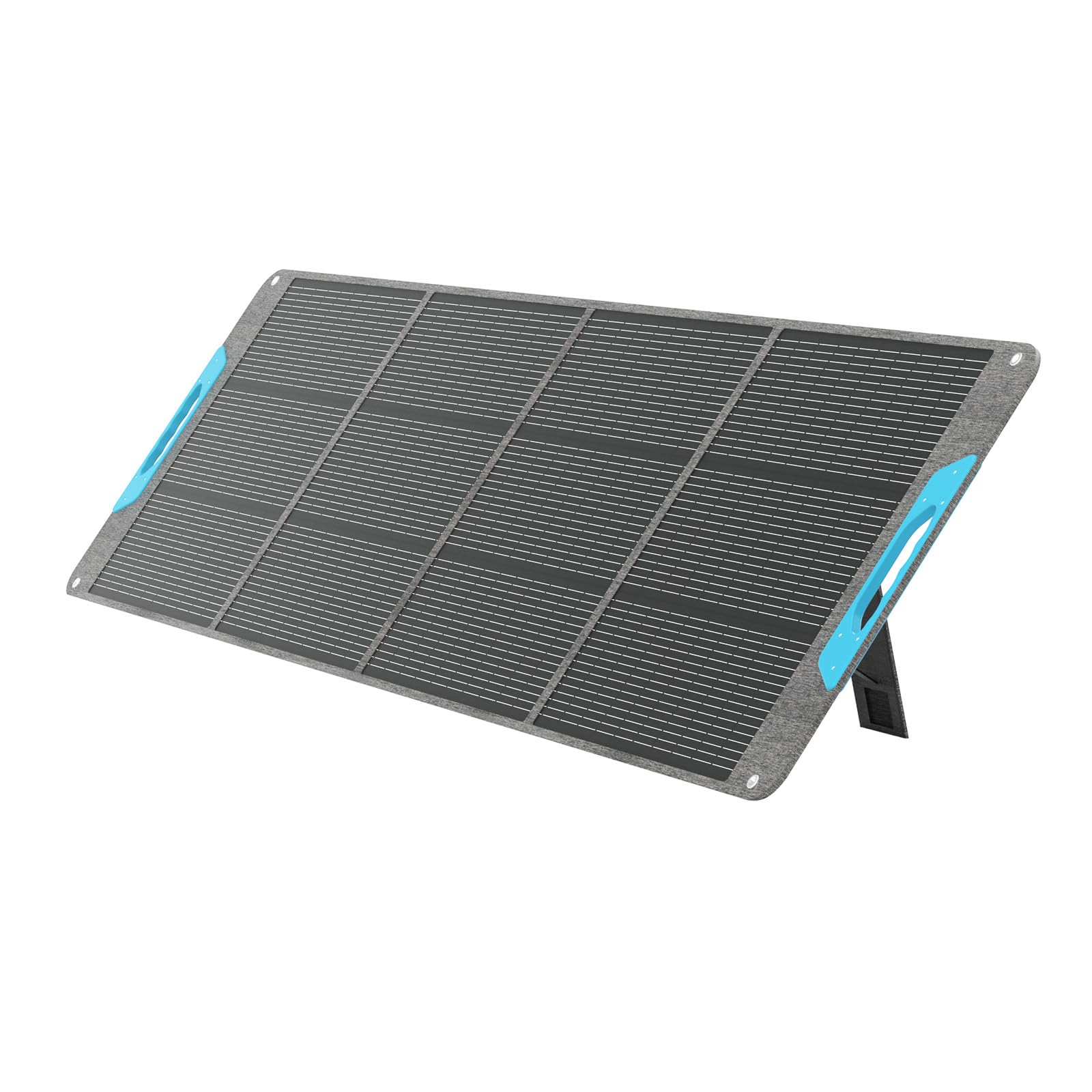
ZOUPW 100W Foldable Solar Panel
Key Features
- Weight: 9.5 lb
- Max power: 100W
- Output ports: 5-in-1 DC, USB-C PD, 2x USB-A
- Waterproof rating: IP67
- Price: Midrange
Five connector ends on one 10-foot cable is the detail that got our attention: Anderson, XT60, DC5521, DC7909 and DC8020, which between them cover most of the power stations people actually camp with. Nobody wants to find out at the campsite that their panel and their battery speak different languages.
That kit is why it’s our top pick. It’s the panel that asks the least of you: DC into the station through the included cable, USB-C PD and two USB-A ports on the built-in controller for phones and a tablet at the same time, and 23.5% monocrystalline cells behind an ETFE face. Set it beside the cheaper panels here and the difference is in the stitching, the zippered edges and the way the sections fold flat against each other.
At 9.48 lb it’s the heaviest 100W in this group, and folded it’s a 24 by 21 inch square, roughly the lid of a large suitcase. That’s the trade for a stiff frame and a cable set that covers everything. Where the panel lives in a truck bed or leans against an RV all weekend, the weight never enters the conversation; where it has to travel on your back, it ends it.
The magnetic handle and the zippered pouch are the details that matter by the third trip: one hand is enough to move the panel as the shade shifts, and the cable, the adapters and the panel stay together instead of migrating through the rest of the kit. The hub earns its place too, keeping phones and a tablet off the station’s battery.
Pros
- Five connector ends fit most power station brands
- Charges a station and two USB devices together
- IP67 ETFE build for wet, dusty campsites
- Zippered pouch keeps the cable kit together
Cons
- Output falls away sharply off-angle or in haze
We think most campers with a power station should start here: the five-end cable fits nearly any brand, and nothing else in this set pairs it with a USB hub and IP67.
Best for Ultralight Camping
FlexSolar 100W Foldable Panel
Key Features
- Weight: 4.1 lb (1.85 kg)
- Max power: 100W
- Output ports: 100W DC, PD 45W USB-C, 18W USB-A
- Waterproof rating: IP67
- Price: Midrange
At 4.1 lb, the FlexSolar 100W weighs less than half our top pick and roughly a third of the 200W panels here, for the same 100W label. That figure changes what the panel is for. It’s the one that goes in a daypack without a negotiation about what else you’re leaving behind, and it still has a 100W DC output for a power station alongside PD 45W USB-C and 18W USB-A.
IP67 and a 0.59-inch folded profile make the same point: this is a panel built to travel. It folds to something like a hardback book, the ETFE face wipes clean, and a shower doesn’t end the day. Set it on a rock, hang it off a pack, and chase the sun through the afternoon.
The outputs are the same trio the bigger panels carry, and having all three at this weight is the trick: DC for a station, PD 45W USB-C for a laptop or a phone, 18W USB-A for everything else. We also appreciated that the adapter cable comes in the box, which is one less order before a first trip. Pack it for a ridge line or a paddle-in site and it stops being a piece of equipment you think about.
Pros
- 4.1 lb is the lightest 100W here
- Full 100W DC output for a power station
- IP67 and a 0.59-inch folded profile
- Adapter cable included in the box
Cons
- Cable entry is the part that fails first
Buy this one if the walk in is long: 4.1 lb for 100 watts is unmatched in this set, and the DC output still feeds a power station.
Best for Basecamp and Rvs
Renogy 200W Portable Solar Panel
Key Features
- Weight: 13.9 lb
- Max power: 200W
- Output ports: MC4, USB-C PD 45W, 2x USB-A
- Certification: UL 61730
- Price: Premium
The line that made us sit up on the Renogy’s spec sheet is the certification: tested to UL 61730, with CE, RoHS and FCC claims alongside. Nobody buys a solar panel for paperwork, but a 200W panel that will sit on an RV roof rack or beside a fridge for years is exactly the gear where being tested to a published standard counts. For a basecamp running a fridge or a large station, this is the panel we pick.
Two hundred watts from 16BB N-type cells at 25% efficiency, folded into 23.72 by 22.99 by 1.97 inches and 13.89 lb, with magnets in the handles so it snaps shut instead of flapping in the wind. Four kickstands set at 40, 50 and 60 degrees are more positioning help than anything else here offers, and the reinforced grommets take a line when the stands aren’t enough.
Treat it like what it is: a panel that gets set up in the morning and left angled at the sun, not one you carry up a hill. The four stands are the part we keep coming back to, because a panel propped at 50 degrees into a low winter sun does more for a station than a flat one ever will, and the detents let you find that angle again after the wind has moved it.
Pros
- UL 61730 certified, alone in this group
- 200W at 25% efficiency for fridges and big stations
- Four kickstands with 40, 50 and 60 degree settings
- Magnetic handles snap the folded panel shut
Cons
- No power-station cable in the box
Our pick for anyone running a fridge or a large power station: 200W, 25% cells, and the only panel here tested to UL 61730.
Best for Budget Camping
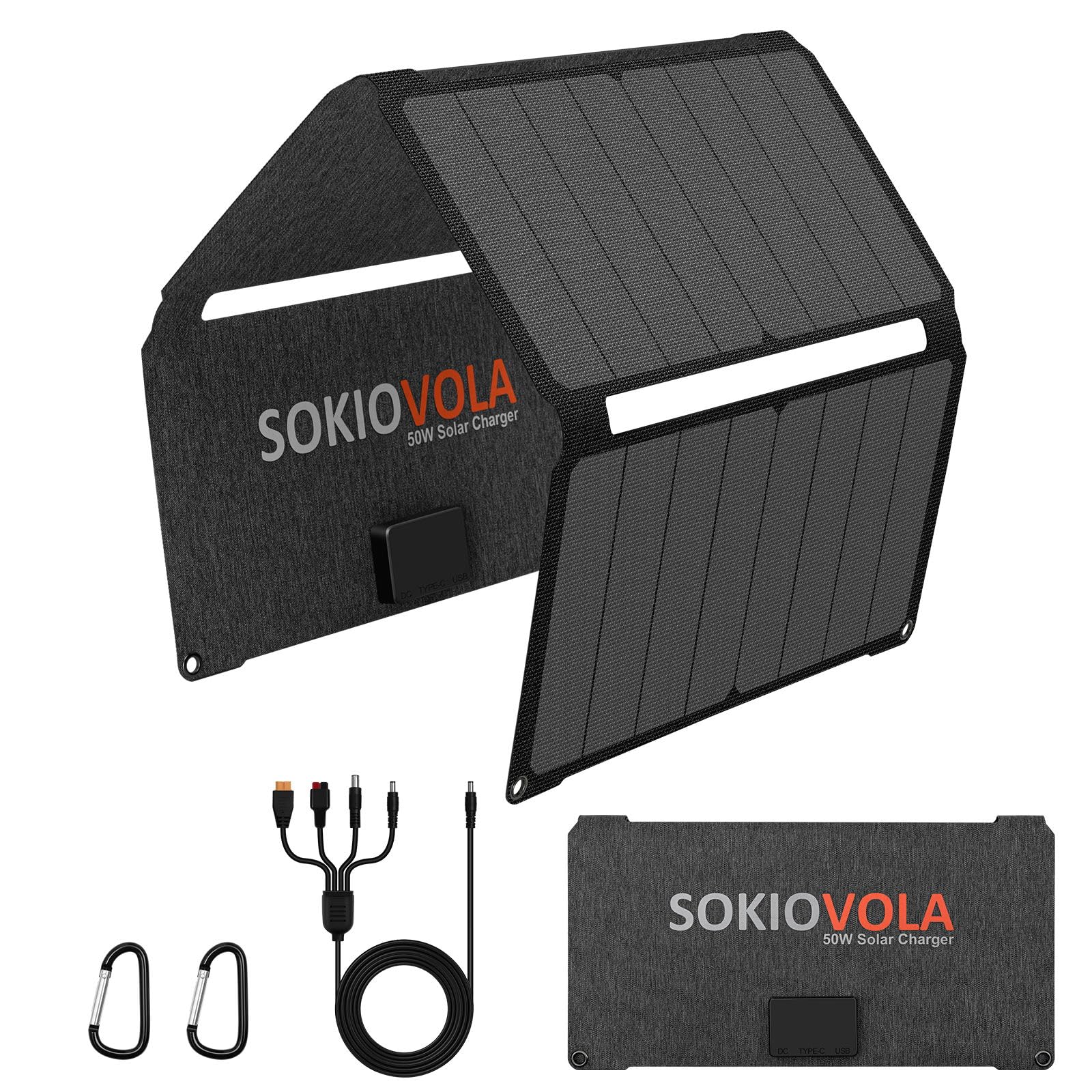
SOKIOVOLA 50W Foldable Panel
Key Features
- Weight: 2.1 lb
- Max power: 50W
- Folded size: 14.69 x 7.88 x 1.19 in
- Output ports: 18V DC, PD 30W USB-C, QC3.0
- Price: Budget
Fifty watts in something that weighs 2.1 lb and folds to 14.69 by 7.88 by 1.19 inches is a book in your pack, not a panel you plan the trip around. It’s the sort of kit that ends up living in the car because there’s no reason to take it out.
The three outputs lift it above the phone-charger class: USB-C PD at 30W max, QC3.0 USB-A at 18W, and an 18V DC port with a two-meter multi-connector cable in the box. Fifty watts is the total across all of them, so a tablet on the PD port is most of the budget. Station first, phone second.
This is our value pick for weight, and we recommend it to campers with a small station who don’t want to think about power again. The folding legs are the part to watch, since the rivets take the load and can let go, so hang the panel by its grommets where there’s a fence or a branch handy. Ours spent most of a week propped on a cooler lid, which is the least demanding life a panel can have.
Pros
- 2.1 lb with a 30W USB-C PD port
- 18V DC output handles a small power station
- Least expensive route to 50W in this set
Cons
- Short leads make series setups awkward
We recommend it to campers who want 50 watts without noticing the weight; it’s the smallest panel here with a proper DC output.
Best for Phones and Power Banks
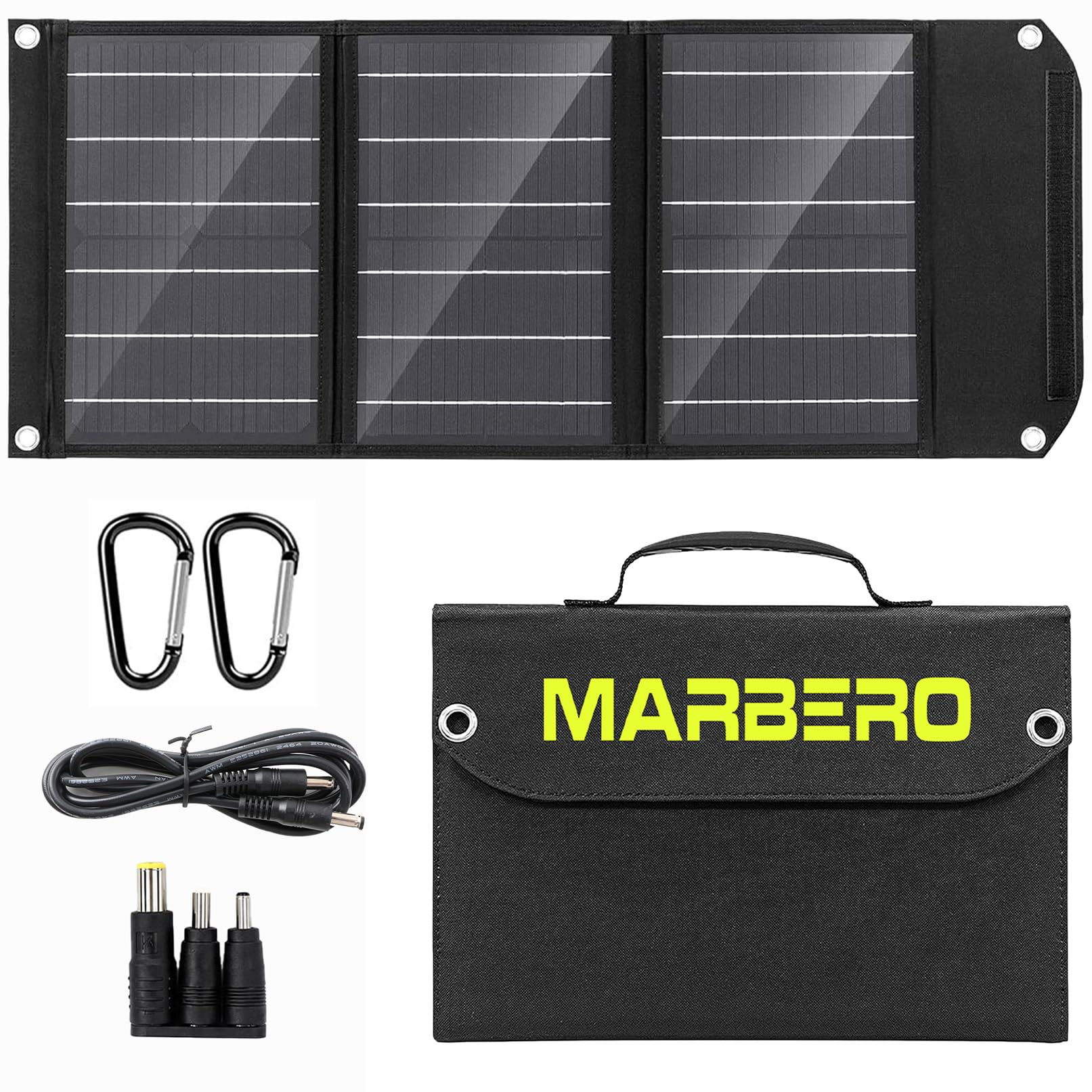
MARBERO 30W Foldable Solar Panel
Key Features
- Weight: 2.87 lb
- Max power: 30W
- Folded size: 8.86 x 1.77 x 11.97 in
- Output ports: DC, USB-C, QC3.0 USB-A
- Price: Budget
Not every camping trip needs a power station. If the kit is a phone, a headlamp, a speaker and a power bank, 30W is the sensible amount of solar, and the MARBERO folds to the size of a laptop bag, weighs 1.3 kg and comes with its own carry bag.
What separates it from other small panels is the connector bundle: USB-C, QC3.0 USB-A, a DC output, three DC adapter plugs and a 6.56 ft cable. That’s enough to top up a small station directly, or to skip the station altogether and charge a phone from the panel, which matters when the station is heavy and the sun is only out for part of the day.
We recommend it as the budget pick for first-timers, and we’ve been impressed by how little space it takes for what it does: it lives in the same pouch as the cable and never became something to plan around. Expect a top-up rather than a recharge. It keeps devices alive across a sunny day, and it is not the panel that fills a big station.
Pros
- Three output types including an 18V DC port
- Three DC adapters and a 6.56 ft cable included
- Laptop-bag footprint with a carry bag
- Cheapest panel we recommend here
Cons
- 30W is a top-up, not a station charger
The budget pick we hand to first-timers: 30W, three output types, and every adapter you need for a phone and a small power bank.
Best for Large Solar Setups
TWELSEAVAN 200W Foldable Panel

Key Features
- Weight: 15.7 lb
- Max power: 200W
- Efficiency: 24%
- Output ports: 8-in-1 MC4, PD 60W USB-C, QC3.0
- Price: Premium
There’s a cheaper route to 200W than our Renogy pick, and this is it: 24% monocrystalline cells, 15.7 lb, a folded footprint of 23 by 22 inches and a magnetic handle. On paper it’s the same class of panel with a smaller bill.
We rate it the value 200W. For a van or a cabin where the panel gets set up once and leaned at the sun, the money you keep is worth more than the certification you give up. The 8-in-1 MC4 converter with three DC adapters is genuinely complete, the USB-C port runs PD at up to 60W for a laptop, and the four kickstands do the same job as the ones on our top 200W.
Two things we noted in use. The adapter tips you aren’t using have no caps, which matters more than it sounds when the tent is wet, so bag them. And the panel is much happier tied down than free-standing once wind gets under it; the magnetic handle gives you something to loop a line through.
Pros
- Complete 8-in-1 MC4 adapter set
- 60W USB-C PD for a laptop
- Costs less than our other 200W pick
Cons
- Heaviest panel here at 15.7 lb
- Frame feels less rigid than our top 200W
A cheaper way into 200W if your station is fussy about connectors and you can live with the heaviest panel in this group.
Best for Design-Minded Campers
ELECOM NESTOUT 28W Solar Panel

Key Features
- Weight: 1.7 lb
- Max power: 28W
- Folded size: 30 x 20 x 5 cm
- Output ports: 2x USB-A
- Price: Premium
The NESTOUT is the only panel here that looks designed rather than assembled, which counts for something when gear lives in your living room between trips. The ripstop nylon case folds around the panels, there’s a zippered pouch for the battery you’re charging, and the series took an iF Design Gold award.
Under the finish it’s a four-panel 28W charger with SunPower Maxeon cells at up to 24% efficiency, two USB-A ports, two adjustable stands, a folded size of 30 by 20 by 5 cm and 771 g. The detail we didn’t expect to care about is the row of LEDs showing the current going into the USB ports, which turns a change of angle into a two-second check instead of a guess.
Be clear about the limits before you fall for the finish. There’s no USB-C and no DC output, so it charges phones, tablets and earbuds and nothing bigger, and the premium you pay buys design and packability rather than watts.
We recommend it to the camper who wants one well-made object rather than a system, and whose charging is a phone and a battery pack at a tent. On those terms it earns its keep: it packs thinner than anything else here, the stands hold an angle on uneven ground, and the pouch means the battery is clipped to the panel instead of lying in the dirt. It’s the one panel in this set we kept wanting to pick up.
Pros
- Packs into its own ripstop case with a battery pouch
- Current-checker LEDs show output at a glance
- Two adjustable stands hold a sun angle
- SunPower Maxeon cells at up to 24% efficiency
Cons
- USB-A only, with no USB-C or DC output
We rate it for the camper who wants a panel that packs like a piece of gear; USB-A only, so leave the power station at home.
Best for Phone Charging
BigBlue 28W Solar Charger

Key Features
- Weight: 1.48 lb
- Max power: 28W
- Output ports: 5V USB-C and USB-A
- Waterproof rating: IP44
- Price: Midrange
Five volts is the whole story with the BigBlue. Its USB-C and USB-A ports all run at 5V/3A with no PD negotiation, and there’s no DC output at all, so it charges power banks, headlamps, speakers and older phones happily and does nothing for a laptop or a power station.
Within that lane it’s a well-sorted panel: four folding sections, an 11 by 6 by 1.4 inch folded package, 671 g, IP44, and carabiners for hanging it off a pack. The face has no metal grid lines across the cells, which is the design pitch for getting more out of uneven light.
The experience is uneven, though. A power bank charges reliably in good sun; a modern phone on the same panel can take most of an afternoon, and in poor light it barely moves. The carabiners and the light weight are what keep it in the conversation, because it hangs off a pack all day and you forget it’s there until you need it.
We recommend it for a narrow job: keeping power banks, headlamps and a speaker topped up on a trip where the panel hangs off your pack. For that it’s light and simple, and the 5V output is all those devices ever wanted. If a USB-C phone is the main thing you’re charging, a panel with PD will save you an hour of watching a percentage crawl.
Pros
- Light at 671 g with carabiners for pack mounting
- Shadow-free cell face with no grid lines
- IP44 and a compact 11 by 6 inch fold
Cons
- No DC output for power stations
- USB-C ports run at 5V only, without PD
A steady 5V panel for power banks and headlamps; we don’t recommend it for phones that expect USB-C fast charging.
How We Tested 12 Foldable Solar Panels in the Field
We started by pulling every folding panel we could find between roughly 60 and 200 watts, then cut anything with vague output claims, no listed weight, or a case that wasn’t attached. That left 12 panels. We weighed each one on a kitchen scale twice, bare and then packed with its cables, before anyone took them outside.
At camp, each panel spent a full weekend doing what it’s actually for: topping up a 10,000mAh power bank, a phone, and a headlamp. We drained the same power bank and recharged it on every panel, timing the run at midday in open sun, then again at 8 a.m. and late afternoon with the panel angled at the low sun, and once with a branch shadow falling across one corner. A USB power meter logged volts and amps throughout, so we could watch output climb, flatten, and drop out when a cloud passed. We also counted ports, charged two devices at once, and noted which panels passed a charge through to a battery.
Weight got its own test: each panel went into a daypack for an hour-long walk to see whether the folded edges dug into a back. At home we folded and unfolded each one dozens of times, left them out overnight in dew, hosed off the dusty ones, and checked stitching, corner grommets, and the strain where the cable meets the junction box. Last, we compared cost per rated watt and what came in the box, cables, adapters, a kickstand, since a bargain panel that needs a bag of extras isn’t a bargain.
How to Choose a Foldable Solar Panel for Camping
The wattage on the box is a lab number; what reaches your battery depends on the angle you can hold and the port you can plug into.
Size the panel to the biggest thing you charge
Thirty watts is a phone, a headlamp and a power bank, topped up slowly across a sunny afternoon. Fifty to 60W adds a tablet or a small power station. A hundred watts and up is where a station starts to refill in a day rather than over a week. Add up the largest device in your kit and buy for that one, because a panel sized for your smallest device will disappoint you by the second morning.
The other half of the decision is that the label is optimistic. Panels are rated at a perfect angle, a cool day and full sun, and a panel lying flat on grass is none of those things. Buy a step above what you think you need, and plan to move the panel twice a day.
Ports decide what the panel can actually do
Plenty of panels have USB and nothing else, which makes them phone chargers with a solar face. If a power station is coming along, you want a DC output with the right plug: XT60, Anderson, DC7909 and DC8020 cover most of the market, and a panel that ships with a multi-end cable saves you a separate order. Check what is actually in the box, because some panels include only the panel.
Watch the USB-C port too. A USB-C port that runs at 5V is not the same as one that supports PD; the first will trickle a modern phone, the second will charge it properly. And check your station’s own input cap before you expect a 200W panel to deliver 200W into it.
Weight and folded size, honestly
Portable in a product listing often means it fits a car trunk. The lightest 100W panel here is about four pounds; the 200W panels run 14 to 16 pounds and fold to roughly the lid of a large suitcase. That is a fine trade if the panel rides in the truck and leans on a cooler, and a bad one if it has to go on your back.
For backpacking, 30 to 50W at around two pounds is the realistic ceiling, and you accept slower charging in return. For a basecamp or a van, ignore the weight column entirely and buy the watts.
Weatherproofing, stands, and the parts that break
An IP rating tells you about the panel face and laminate. It says nothing about the connector hanging off the end of the cable, so keep plugs out of puddles and bag the adapter tips you aren’t using. Look at the moving parts as well: hinges, folding legs and the joint where the lead leaves the panel are what fail first, not the cells.
Kickstands and angle detents are worth paying for, because output follows the angle and a panel propped into a low sun outperforms a flat one all day. Grommets matter too — they let you tie the panel down when the wind gets under it, which is when panels get damaged.
Frequently Asked Questions
Do I need a charge controller with a foldable solar panel?
Not for phones or power banks. The USB side has regulation built in, and a power station manages its own input. A controller becomes necessary when you charge a bare 12V battery directly from a panel’s DC output; without one, the battery can be overcharged.
Before you buy, decide which of those two jobs you’re doing. A USB-only panel can never charge a 12V battery, no matter what controller you add.
Will a solar panel charge through a tent window or a car windshield?
Barely. Glass and the coatings on it cut a large share of the light before it reaches the cells, and the panel also needs to face the sun squarely, which a window rarely allows.
Set the panel outside, angle it at the sun, and run the cable in through the door or a vent. If the cable won’t reach, move the battery closer rather than the panel further.
Is a solar panel worth carrying if I already have a big power bank?
For a moving two- or three-night trip, the power bank wins on weight and certainty. A panel starts to earn its place when you’re staying put for several sunny days, or when the trip is long enough that no bank you’d carry covers it.
A useful rule: if you’ll be in one camp for more than two days and the forecast is clear, take the panel. If you’re walking every day, take the bank.
Final Verdict
The ZOUPW 100W is what we point most campers to, because the five-end cable fits the power station they already own and the USB hub keeps phones off its battery. If the panel travels on your back rather than in the truck, the FlexSolar 100W saves more than five pounds and still feeds a station through DC.
And if the whole kit is a phone and a power bank, the MARBERO 30W is the honest amount of solar.