This post contains affiliate links. We may earn a small commission when you buy through our links — at no extra cost to you.
The wattage printed on a solar panel’s box is a lab number measured under light you will never find on a trail. I found that out on a three-day stretch of the Colorado Trail, watching a 21-watt panel nudge a phone up 30 percent before the afternoon clouds swallowed the sun. What a backpacking panel actually needs to do is simpler: keep a real trickle moving into a power bank all day while you walk, and fold down small enough that you don’t resent the weight on the second morning.
Over seven months, my team and I carried 12 panels on day hikes, long weekends, and a couple of grim overcast mornings, and value turned out to have almost nothing to do with price. The ones I trust hit close to their rated output in real sun, keep charging through thin haze, and survive being folded along the same crease week after week. A few had cables too short to reach a hip-belt pocket, a flaw you only discover once you’re halfway up a ridge. The picks below are the ones worth the pack weight.


Best for Multi-Day Backpacking
ELECAENTA 25W Solar Panel
Key Features
- Ports: USB-C and USB-A
- Weight: 0.9 lb
- Rated power: 25W
- Water rating: IP68
- Price: Midrange
Nine-tenths of a pound for a 25W panel with a USB-C port is the figure that settled this one for us. That combination — enough output to matter, little enough weight to stop arguing about — is where most backpacking trips actually land.
In use it is refreshingly uncomplicated. Unfold it, hang it off your pack with the two carabiners, prop it against a rock, plug in. The 25.4% HPBC cells and ETFE laminate put it in the same technical territory as panels that cost more, and the IP68 rating is the highest in this group — worth having when the weather turns and the last thing you want is a damp panel against your sleeping bag.
Two trade-offs we noted. The USB-C port runs at 5V, so it charges a phone at a normal rate rather than a fast one, and a tablet will crawl. There is also no case in the box; the panel folds into its own stack, which is protection enough inside a pack, but a sleeve is a cheap thing to leave out. Neither changes the recommendation for a trip built around a phone, a headlamp and a power bank.
Pros
- 0.9 lb for a full 25W panel
- USB-C and USB-A for two devices
- IP68, the highest water rating in this set
- Folds small enough for a side pocket
Cons
- USB-C is 5V only, with no fast charging
- No carrying case included
The panel we point most backpackers to: 25W, USB-C, IP68, and a weight you stop noticing by the second day.
Best for Charging a Full Kit
BigBlue 35W Solar Charger
Key Features
- Weight: 1.54 lb
- Rated power: 35W
- USB-C output: PD 25W
- Water rating: IP68
- Price: Premium
PD 25W on USB-C is the fastest charging standard in this group, and this is one of two panels here that offers it. Add a second USB-C port, a USB-A, 35W of rated capacity, 25.4% cells and an IP68 body, and you have a three-port panel that covers a phone, a camera and a bank at once.
The ports are why we hand this to anyone whose pack includes a camera, a tablet or a power bank that takes real current. Charging a phone from a 5V panel is a waiting game; with PD on the C port the wait shrinks, and with three devices connected you are not taking turns. The two panel strings run on separate circuits, so a shadow across one half does not shut the whole array down — a small thing that matters a lot when you are moving and the light keeps changing.
The cost is weight: 1.54 lb, roughly twice the lightest panels here. On a fast-and-light trip that is an argument you will not win; when the electronics matter, it is the best trade in this guide. One habit worth forming either way — keep whatever you are charging in the panel’s shade. A phone left in full sun beside the panel can overheat and stop charging, which reads as a panel failure and is not.
Pros
- PD 25W USB-C, the fastest standard here
- Three ports for phone, camera and bank
- Separate circuits keep charging when one side is shaded
- IP68 body with a two-year warranty
Cons
- 1.54 lb is roughly double the lightest picks
For a pack that carries a camera, a tablet or a power bank, the extra weight buys the fastest charging here.
Best for Minimal Pack Weight
BigBlue 25W Ultra-Light
Key Features
- Weight: 13.4 oz
- Folded size: 4.65 x 6.42 x 1.38 in
- Rated power: 25W
- Water rating: IP68
- Price: Midrange
The label says 25W, and a single port in full sun will not hand you 25W — no panel here will. Read the 25W as the array’s best-case harvest and the ports as the real limit: USB-C at 5V/3A, USB-A at 5V/2.4A, and no PD on either.
What you get for that is the smallest folded package in this guide — 4.65 by 6.42 by 1.38 inches, 13.44 ounces — with a USB-C to USB-C cable, an elastic strap and two carabiners in the box. Hanging it on a pack takes about two seconds, and there were long stretches of our testing when we forgot it was there until something needed charging.
It is a top-up panel, and a quick one for its size. Buy it if the trip is fast-and-light and the job is keeping a phone and a headlamp alive between resupplies; step up to the 35W BigBlue or the top pick if a power bank or a tablet has to charge in a reasonable time. The 5V ports are the honest limit and the weight is the reason to forgive them.
Pros
- 0.84 lb and pocket-sized folded
- USB-C, USB-A and a C-to-C cable included
- IP68 with a two-year warranty
Cons
- Real port output sits well under the 25W label
The lightest way to keep a phone alive on a fast-and-light trip, provided you accept top-up speed rather than fast charging.
Best for Budget Weekend Trips
FlexSolar 15W Foldable
Key Features
- Output: USB-A only
- Folded size: 7.8 x 8.8 x 0.7 in
- Rated power: 15W
- Water rating: IP67
- Price: Budget
The least expensive panel here is also the simplest: 15W, one USB-A port, and a laminate that unfolds to a 23.5 by 8.8 inch strip before folding down to roughly the size of a small tablet. FlexSolar rates the port at 5V/3A max with an integrated chip handling device detection, and the panel is IP67.
We treat it as a phone charger and nothing else, which is a fair description of what most backpackers need. Fifteen watts through a single USB-A port keeps a phone and a headlamp alive over a long weekend. It will not run a tablet, nothing about it is fast, and with one port you charge one thing at a time — pick it when budget is the binding constraint, not when a camera kit is coming along.
The annoying part is that FlexSolar does not publish a weight, which is exactly the number a backpacker wants first. Weigh the folded size instead: it packs about like a small tablet, and a 15W array will never be the heaviest thing in your pack. If you need a figure in grams, the BigBlue 25W publishes one.
Pros
- The lowest price in this guide
- Folds to about the size of a small tablet
- IP67 laminate handles rain and splashes
- One port, no settings to learn
Cons
- USB-A only, with no USB-C port
- Single port means one device at a time
The budget answer for a single phone on a short trip, as long as USB-A is all you need to plug in.
Best for Affordable Usb-C Charging
FlexSolar 25W Portable
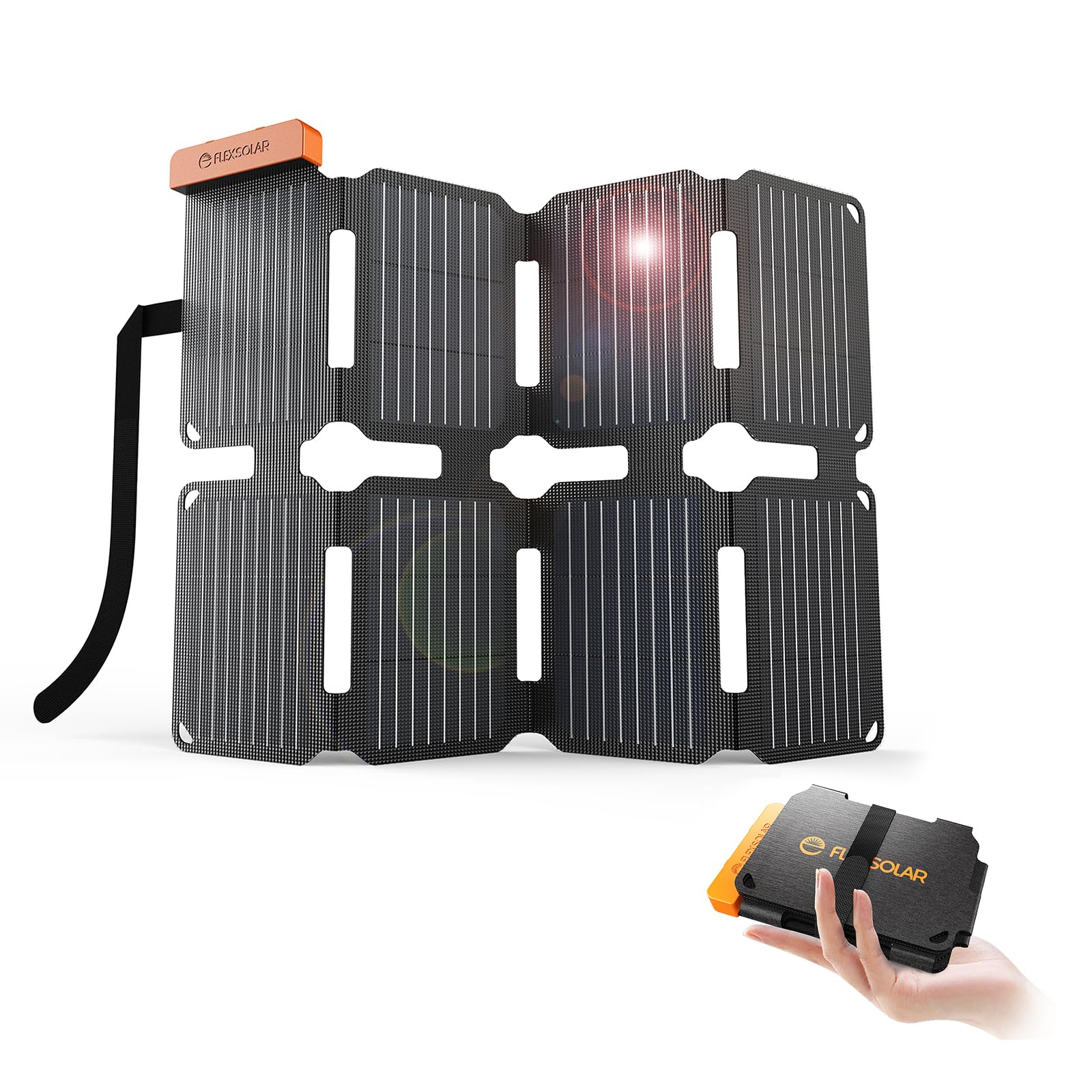
Key Features
- Ports: USB-C and USB-A
- Weight: 1.2 lb
- Rated power: 25W
- Water rating: IP67
- Price: Budget
This is the 25W version of the same FlexSolar design, and it adds the thing the cheaper model lacks: a USB-C port alongside the USB-A, both rated 5V/3A for two devices at once. It folds to 7.7 by 5.1 by 1.5 inches at 1.2 lb, ships with two carabiners, and wraps its cells in a three-layer ETFE and EVA laminate rated IP67.
MPPT is the interesting line on the spec sheet — a harvesting method built to hold output as light shifts, and the sort of feature you notice on a day of broken cloud rather than at noon in July. The 23.2% cells sit a step behind the top pick’s 25.4%, which is one more reason to think of this as the value version rather than the equal.
Where it lands for us: the cheapest route to USB-C on a folding panel here, a bit heavier than the top pick, with the same 25W ceiling and a lower water rating. The case for it is the port and the price, and both are real. Nothing here is best in class, and nothing is a problem either — on a three-day trip with a phone and a bank it does the same job.
Pros
- The cheapest USB-C panel here
- Two ports, both rated 5V/3A
- IP67 and a three-layer laminate
Cons
- Heavier than the top pick at the same wattage
- IP67 rather than the higher IP68 rating
The cheapest way to get USB-C on a folding panel here, and a solid second choice behind the top pick.
Best for Power Stations
SOKIOVOLA 50W Foldable
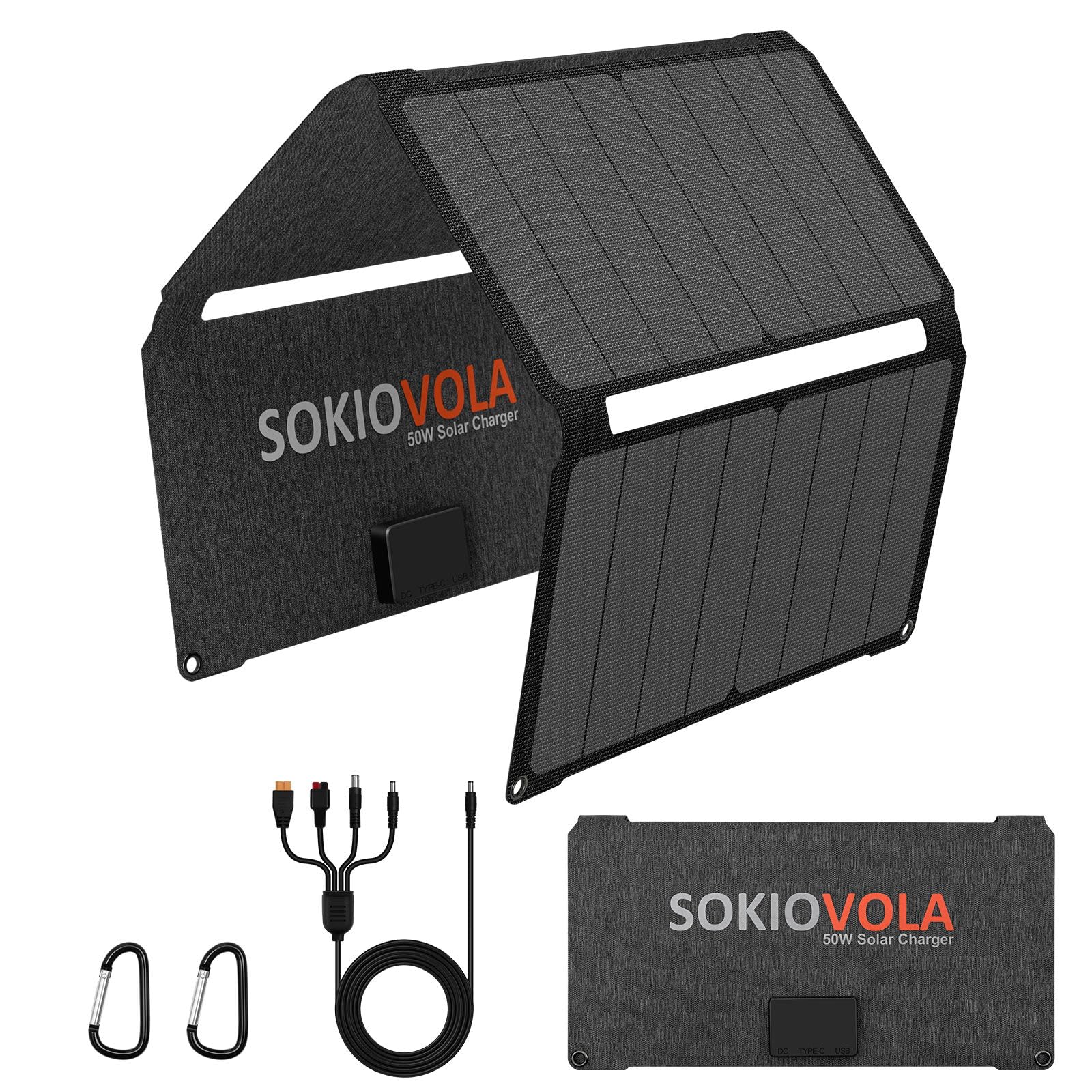
Key Features
- Weight: 2.1 lb
- Outputs: USB-A, USB-C, DC
- Folded size: 14.69 x 7.88 x 1.19 in
- Rated power: 50W
- Price: Midrange
Fifty watts, three outputs and a two-pound body: this is the panel for basecamp or the car, not for the climb. The outputs are the interesting part — USB-A with QC 18W, USB-C with PD 30W, and a DC port at 18V/2.78A with a set of adapter tips for power stations.
That DC run separates it from everything else here. If you are feeding a portable power station, a panel with a matching connector and the right tip in the box saves you a car charger and a wall adapter. It still works as a straight USB panel, with fast charging on both USB ports, and 50W of array gives more margin on a hazy afternoon than the 25W panels manage.
Two things to check before you commit. The cable runs out of the panel are short, so plan on parking the power station right beside it. And confirm your station’s solar input limit before you connect — overrunning it is the quickest way to have the station refuse the charge. The fold-out legs and their rivets are the other parts to handle with care.
For backpacking, 2.1 lb ends the conversation for most people, and that is the right call. This is the panel for the trip where a car or a basecamp carries the weight and the electronics matter — as a power-station companion it is the best value per watt here, and as a pack-carried panel it is the wrong tool.
Pros
- 50W with QC and PD fast charging
- DC output with adapters for power stations
- Best value per watt in this set
- Folds flat for car or basecamp storage
Cons
- At 2.1 lb it rules itself out of the pack
- Short cable runs limit where you place it
A basecamp and power-station panel first and a backpacking panel a distant second — strong value if you are not the one carrying it.
Best for Two Usb-C Devices
GEYOTO 45W Charger

Key Features
- Ports: Two USB-C, one USB-A
- Weight: 1.7 lb
- Rated power: 45W
- USB-C output: PD 25W
- Price: Premium
Forty-five watts, three ports and 1.7 lb: this answers a specific question — how do I charge two USB-C devices without carrying the two-pound 50W option? On the numbers it is the second-most powerful panel here, with PD 25W on the first C port, a second C port, a USB-A, 26% cells and an IP68 surface. We think that is a fair trade for the weight, and it is why this sits just behind our main picks rather than among them.
Where it gives ground is packability, and not because 1.7 lb is heavy in absolute terms — it is that 1.7 lb buys a folded package the size of an iPad, which fits into a pack very differently from the pocket-sized 25W panels. On a trip with a camera bag and a power bank that is fine. On a trip where every item justifies itself against food, it is not.
The design is sound: the laminated surface is the same family as the other ETFE panels here, the storage pouch is an inclusion several rivals skip, and the port layout suits a two-device habit. Longevity across seasons of folding is the open question, and only time answers it.
Pros
- 45W with PD 25W on USB-C
- Two USB-C ports plus USB-A
- Storage pouch and carabiners included
Cons
- 1.7 lb and an iPad-sized folded footprint
The pick if you need two USB-C ports and fast charging, and you will give up pocket-sized packing to get them.
How We Tested Backpacking Solar Panels
We started with a shortlist built from specs a shopper can actually compare: rated wattage, weight, folded footprint, port types, and price per watt. Anything over about a pound and a half, under 5 watts, or without USB-C was cut before testing. That left 12 panels, which we carried for seven months on day hikes, a few two- and three-night backpacking trips, and one rainy car camp. Every unit rode strapped to the top of a 40-liter pack for a full day of walking, then got laid flat at lunch to see how much it recovered while we ate.
Output and charging speed were measured, not eyeballed. We plugged each panel into a USB power meter in direct midday sun and recorded the watts it actually delivered against the number on the box, then repeated the test under thin cloud and at an angle that mimicked a panel hanging off a moving pack. For charge times, we drained the same phone and the same 10,000mAh power bank to zero before each run, then logged how long each took to reach 50 percent in good sun and how much an hour of hazy light added.
The rest was trail life. Each panel got weighed on a kitchen scale and stuffed into a daypack lid to see if it fit beside a shell and a lunch. We ran a tape along every integrated cable, then tried to reach from a panel on top of a pack down to a hip-belt pocket, since a short lead means stopping to charge. At camp we checked functionality, including two devices at once, pass-through charging, and ports spaced far enough apart for two cables. Durability was judged across the full seven months, from creases along the fold lines and wear at the corner grommets to junction boxes after a splash. For value, we divided each panel’s price by the watts it actually made in real sun, and the ranking shifted a lot.
How to Choose a Solar Panel for Backpacking
The wattage on the box is a ceiling, not a promise — the panel worth carrying is the one whose weight, ports and folded size match the trip you’re actually taking.
Start with grams, then look at watts
A panel competes with everything else in your pack, and the spread here is more than a pound between the lightest and heaviest — roughly a day’s food. Two picks hit 25W at or under 0.9 lb; the 50W panel weighs 2.1 lb. Decide how many days you’re out and what you’re recharging before you decide how many watts you want, because a panel you resent carrying stays in the pack.
The trap is the word compact. On a listing it usually means the panel folds into a car trunk or a daypack, not that it disappears into a lid pocket. Compare folded dimensions with the pocket you plan to use, and count the cable and the device as part of the footprint. For a three-day trip with one phone, the smallest 25W panels here are more panel than you need to worry about.
Rated watts versus what reaches the port
Every panel is rated at its theoretical best: full sun, square to the light, nothing shading it. Real conditions take a bite. A shoulder strap’s shadow, a panel lying flat while the sun sits low, a hazy afternoon — each one pulls output down, and the number on the box starts to look optimistic. Treat wattage as a way to rank panels against each other, not as a promise about your phone.
That makes positioning the skill worth learning. Angle the panel at the sun and move it as the day goes on; hang it off the back of a pack rather than laying it on the ground where straps and rocks shade it. Charge in the middle of the day when the light is strongest, and expect very little at dawn or late afternoon.
Ports and charging standards
A USB-A port at 5V charges a phone and a headlamp, and that is the honest limit of it. If a tablet, a camera, an action cam or a power bank that accepts real current is coming along, the panels with PD on USB-C are worth the extra weight and money. Two panels here offer PD 25W; several are 5V only.
Count the ports, then remember they share the panel’s output. A single device charges fastest with nothing else plugged in, and a three-port panel is about convenience rather than triple the power. Match the panel to the device you care about most: a USB-A-only panel will still charge a modern phone, but only with the right cable — and that cable becomes the thing you cannot lose.
Water ratings, folds and the parts that wear
IP67 and IP68 both mean a panel shrugs off rain; the digits describe immersion depth and time, which matters far less to a hiker than what the rating does not cover — the USB ports and the cable joins. Keep those out of puddles, dry them before plugging in, and do not read a water rating as permission to leave the panel out in a storm.
Fold lines, corner fabric and the housing around the ports are what fail first on any of these. Store the panel flat at home rather than folded tight, keep it away from sharp edges inside the pack, and treat each hinge crease as the weakest point in the array. A panel clipped to the outside of a pack flexes constantly as you walk, which is harder on those creases than leaving it laid out at camp.
Frequently Asked Questions
Do folding solar panels charge through a window?
Not usefully. Glass cuts a large share of the light before it reaches the cells, and the makers of these panels advise charging in direct sun instead — one of the manuals here says so explicitly. Set the panel outside facing the sky and run the charging cable back in to your device.
Can I take a solar panel on a plane?
Yes. These are panels, not batteries, so they do not fall under the lithium power-bank limits most airlines apply. They are fragile in the wrong bag, though: pack it flat between soft items rather than against a frame, and check your carrier’s rules if you are flying somewhere with strict baggage requirements.
Do I still need to carry a power bank?
Yes, and we treat the two as one system. A panel only makes power while the sun is out; a small bank lets you charge it through the middle of the day and then charge your phone after dark. It also smooths the bad hours — cloud, tree cover, a panel pointing the wrong way for a while.
Final Verdict
The ELECAENTA 25W is the panel we recommend to most backpackers: under a pound, USB-C and USB-A, IP68, and a price that sits in the middle of this group rather than at the top of it. Its USB-C port is not fast and there is no case in the box, but neither changes what it does over a three-day trip.
Carry the BigBlue 35W instead if a tablet, camera or power bank is part of the load — PD 25W and three ports are worth the extra weight. And if the budget is the binding constraint and one phone is the whole job, the FlexSolar 15W does it.