This post contains affiliate links. We may earn a small commission when you buy through our links — at no extra cost to you.
A solar panel doesn’t so much pour power into your phone as negotiate with it. Output rises and falls with every cloud and shadow, and the device in your hand decides how much of that it will accept. Get the pairing right and your headlamp, phone, and satellite messenger stay alive through a four-day trip; get it wrong and you spend a sunny afternoon coaxing a dead battery to 30 percent.
The number printed largest on the box is the one that matters least. Rated wattage assumes overhead sun on a cool day, so real-world output is a fraction of it, and panels with identical ratings can differ wildly in what they actually deliver. My team and I have carried 12 of these over the past eight months — strapped to packs, propped on rocks, hung from tent loops — weighing each, folding and refolding it, and timing how fast it brought a dead phone back. The keepers are compact, solid at the cable junctions, and simple enough to set up one-handed; the picks below are the ones that stayed in my pack all season.


Best for Multi-Day Trips
BigBlue 35W Solar Charger
Key Features
- Weight: 1.5 lb
- Max power: 35 W
- Folded size: 8.29 × 4.84 × 1.89 in
- Water resistance: IP68
- Price: Premium
Twenty-five watts of USB-C PD is the number we check first on any panel, because it decides whether the thing can do something useful with a modern phone or power bank. Plenty of chargers in this group still push plain 5 V over USB-C and leave your phone sipping a trickle all afternoon; this one negotiates a fast-charge profile with PPS, so a long sunny stop actually puts a real dent in a battery. That matters more than the headline 35 W, and it is the main reason this is the panel we recommend first.
The trade is weight. At 1.5 lb, folded to about 8 by 5 by 2 inches, it is the panel you carry when charging matters more than counting grams. What you get back is a design built to keep working when one half slides into shadow — the two strings run on parallel circuits — plus IP68 sealing that handles a proper rain shower instead of sending you scrambling for a dry bag.
Rigging takes seconds: clip it to the top of a pack with a carabiner and it charges while you walk. We learned to hang the phone or bank behind the panel rather than beside it, because a device baking in direct sun gets hot and stops accepting charge — a small habit that turns a frustrating afternoon into a productive one. And like every panel here it stores nothing, so the energy is only as good as what you plug into it.
Treat 35 W as a ceiling. In clean overhead sun there is enough output to support fast charging; in anything less it drops back, and we plan for noticeably less than the label on an ordinary day. If you want a lighter pack and accept slower charging, the 25 W BigBlue below is the same idea stripped down; if maximum panel area for the money matters more than sealing, FlexSolar’s 40 W costs less. This one sits in the middle where most trips land.
Pros
- 25 W USB-C PD with PPS enables real fast charging
- Parallel strings keep output up in partial shade
- IP68 sealing and a two-year warranty
- Carabiner mounting and an 8.29 in fold
Cons
- 1.5 lb is heavy for a gram-counting trip
The panel we point most backpackers toward: 25 W USB-C PD output, IP68 sealing, and enough real charge to refill a phone or bank on a multi-day route.
Best for Value and Output
FlexSolar 40W Solar Panel
Key Features
- Outputs: USB-C PD 18 W, USB-A QC 18 W, DC
- Max power: 40 W
- Folded size: 8.14 × 11.1 × 1.73 in
- Water resistance: IP67
- Price: Midrange
Forty watts for less than the 35 W BigBlue is the arithmetic that earns this panel its place. Nothing else here gives you as much rated panel area for the money, and it is the one we suggest when someone wants maximum charging capacity without paying premium prices for it.
Where it does its best work is feeding a battery rather than a phone. Plugged into a large power bank in clean sun, it has the panel area to keep the input busy; wired straight to a phone, the 18 W USB-C PD and USB-A QC ports are plenty but the panel rarely has that much to give. We also appreciate the DC output — carry a small power station and you get a second route in that none of the other panels here offer.
Build suits the trail: an ETFE face, IP67 sealing and a fold that holds its shape when strapped to a pack. Folded it is roughly 8 by 11 by 2 inches — wider than the BigBlue when packed, but flat against a back panel. Weight is the figure to confirm before a long carry, since this is a bigger sheet of panel than the 35 W. And expect it to fall short of 40 W into a phone, as every folding panel here does.
Pros
- Most rated power for the money in this group
- USB-C PD and USB-A QC ports at 18 W each
- DC output for small power stations
- IP67 and an ETFE face that packs flat
Cons
- Real output falls well short of the 40 W rating
Our value pick — the most rated panel area here for the least money, with PD, QC and a DC output for small power stations.
Best for Ultralight Packing
BigBlue 25W Ultra-Light
Key Features
- Weight: 0.84 lb
- Outputs: USB-C 5V/3A, USB-A 5V/2.4A
- Max power: 25 W
- Folded size: 4.65 × 6.42 × 1.38 in
- Price: Midrange
At 0.84 lb and a folded footprint of 4.65 by 6.42 by 1.38 inches, this is the panel that disappears into a pack. We clipped it to the outside of a daypack and stopped thinking about it, which is the point of an ultralight solar setup — you aren’t buying speed, you’re buying a power source that costs you almost nothing to bring.
What you give up is pace. Think of it as a maintainer: it holds a phone steady, or slowly fills a small power bank across a long sunny day, and it will not rescue a dead battery before dinner. Two ports let you split that trickle between a phone and a headlamp, which matters more than it sounds on a five-day trip.
The detailing is where this one earns its keep. The cells are printed without metal lines across the face, the ETFE surface and IP68 rating take a scrape or a shower, and BigBlue backs it with a two-year warranty that is rare at this size. It folds and unfolds without fuss, and the elastic strap keeps it shut in a pack.
Set it beside the 35 W panel above and the trade is clean: about a third less rated power, roughly half the weight, less money. If your phone is your camera, your map and your emergency contact, carry the bigger panel. If you’re out for a weekend with a power bank already packed, this is enough and you’ll be glad of the grams.
Pros
- 0.84 lb and pocket-sized when folded
- Two ports split a trickle between devices
- IP68 sealing and a two-year warranty
Cons
- USB-C is 5 V only, with no PD
- Output runs far below the 25 W rating
For gram-counting trips, this is the one: 0.84 lb folded to pocket size, and content to be a maintainer rather than a fast charger.
Best for Shared Charging
GEYOTO 45W Solar Charger

Key Features
- Weight: 1.7 lb
- Outputs: USB-C PD 25 W, three ports
- Max power: 45 W
- Water resistance: IP68
- Price: Midrange
Three ports on a folding panel is unusual, and on a trip where two people are queuing for a socket it is the feature that decides the purchase. The GEYOTO gives you two USB-C and one USB-A, with the first USB-C running 25 W PD — enough to fast-charge a phone while a power bank and a headlamp take what is left.
The rest of the sheet reads well: 45 W of monocrystalline panel at a claimed 26% conversion, IP68 sealing, a storage pouch, a USB-C cable and two carabiners in the box, plus a two-year warranty. Folded it is a 12.5-inch-wide slab at 1.7 lb, so it is the biggest thing here when packed and the one you’ll notice on a small pack. Sealing plus warranty is the strongest combination of the two in this group.
Our reservation is track record. This is the newest design in the guide, with the least real-world history behind it, and the price sits in the middle of the group rather than undercutting anything. On paper it is the most capable panel here — highest rated wattage, most ports, best ingress rating. The case for it is a two-person trip or a family camp where three ports end an argument. Plug your own phone into the USB-C port on day one to confirm it negotiates the fast charge you paid for.
Pros
- Three ports, including a 25 W USB-C PD output
- 45 W is the highest panel rating in this group
- IP68 sealing with a two-year warranty
Cons
- Wide 1.7 lb slab when folded
Buy it when several devices need charging at once: three ports, 25 W PD and the best ingress rating here, if you accept a wide pack footprint.
Best for First Panel
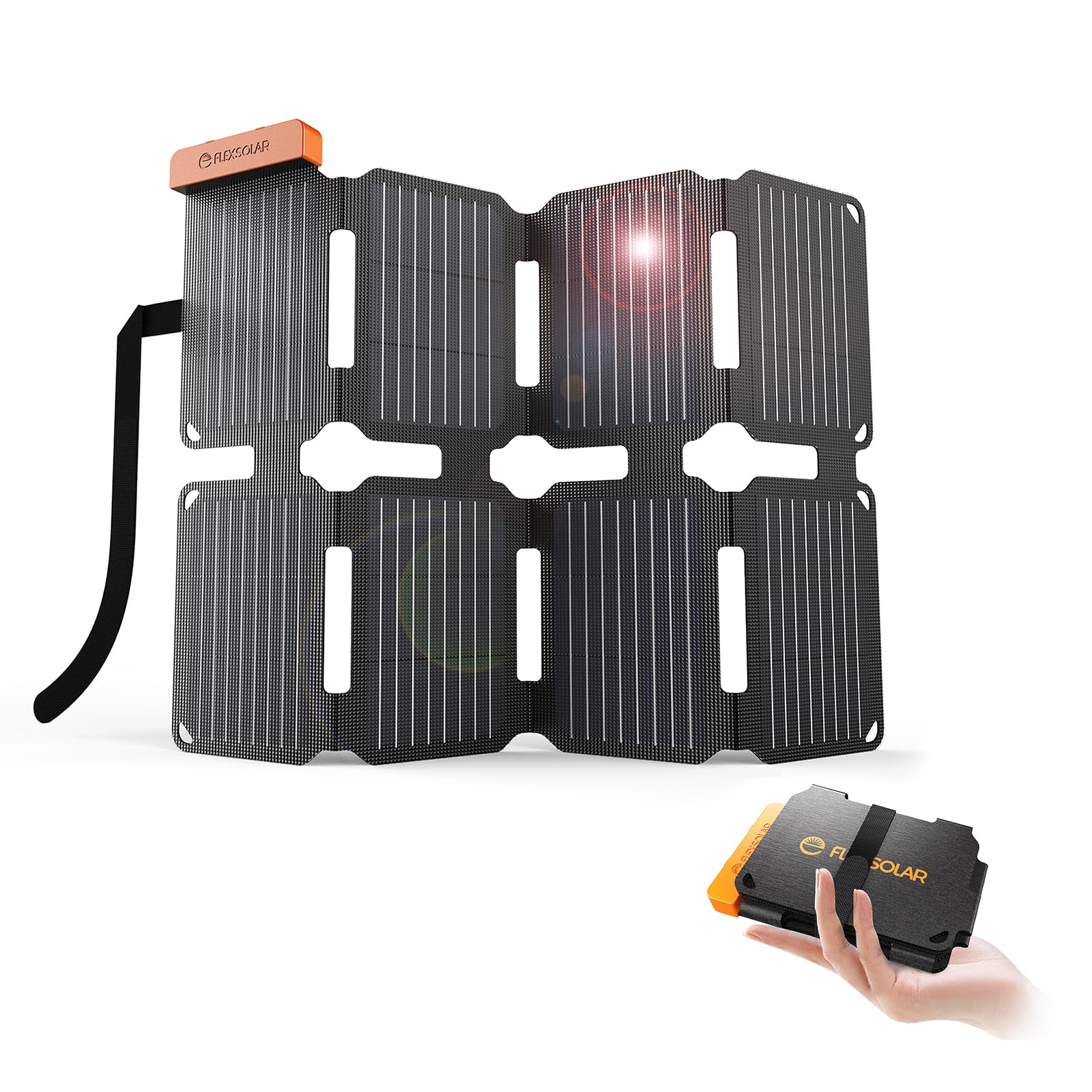
FlexSolar 25W Solar Panel
Key Features
- Weight: 1.2 lb
- Max power: 25 W
- Folded size: 7.7 × 5.1 × 1.5 in
- Water resistance: IP67
- Price: Budget
The cheapest route into a real folding panel in this guide, and for plenty of readers that settles it. Twenty-five watts, two ports, IP67 sealing — this is a legitimate backup panel rather than a stocking filler, and it folds into something you can forget in a pack lid.
We think of it as the spare-tire pick. At 1.2 lb it is not the lightest 25 W option — the BigBlue above is lighter and better sealed — but it costs a good deal less, and its MPPT circuitry hunts for the best voltage and current pair as the light shifts, which helps it keep harvesting rather than sitting at a fixed point while the sun moves.
Both ports run 5 V, so there is no fast charging; expect this to fill a power bank over a sunny day rather than a phone in an hour. Folded at 7.7 by 5.1 by 1.5 inches it drops into a lid pocket, and the two included carabiners let you hang it off a pack or a tent loop. For a first panel, or a second one to leave in the car, that is a fair trade.
Pros
- Lowest price here for a folding 25 W panel
- IP67 sealing and MPPT charge tracking
- Folds into a pack lid pocket
Cons
- 1.2 lb is heavy for its output
- No PD; both ports are 5 V
The cheapest sensible way into a folding panel — modest output, but IP67 sealing and a fold that fits a lid pocket.
Best for Base Camps
SOLUPUP 30W Solar Panel

Key Features
- Weight: 2.4 lb
- Outputs: USB-A and USB-C, 15 W max
- Max power: 30 W
- Water resistance: IPX5
- Price: Midrange
Two and a half pounds is the first thing to know, and in a backpacking guide it is close to a disqualification. That is nearly three times the weight of the BigBlue 25 W and heavier than the 35 W panel we recommend, which is a lot of grams for a device whose job is to save you from hunting outlets.
Set that aside and it is a decent camp panel: 30 W of monocrystalline cells, USB-A and USB-C outputs limited to 15 W, IPX5 against splashes, and a build that feels sturdier than its price suggests. The carabiners and folding design make it easy to hang off a tailgate, a tent loop or a canoe thwart, and the setup is simple enough that nobody needs the manual.
Output is the familiar story. A 15 W port ceiling means even in perfect sun the charging is slow, and a modern phone will fill at a crawl. The panel’s real advantage over the compact picks is that it stays put, with enough surface area and mass to sit still in a breeze instead of flapping itself out of the light.
Where it makes sense is a permanent spot: lashed to a vehicle rack, a dock box or a shed roof, trickling into a battery kept there. Folded in a cupboard it is tidy and easy to store. Carried on your back for three days, it is the item you’ll resent by the second morning.
Pros
- 30 W of panel with dual USB outputs
- Sturdy build and IPX5 splash resistance
- Folds flat for storage and travel
Cons
- 2.4 lb is a lot to carry on trail
- USB output is limited to 15 W
A sturdy camp panel for people who drive to their pitch; at 2.4 lb it costs far too much weight for a real backpacking trip.
Best for Phone Top-Ups
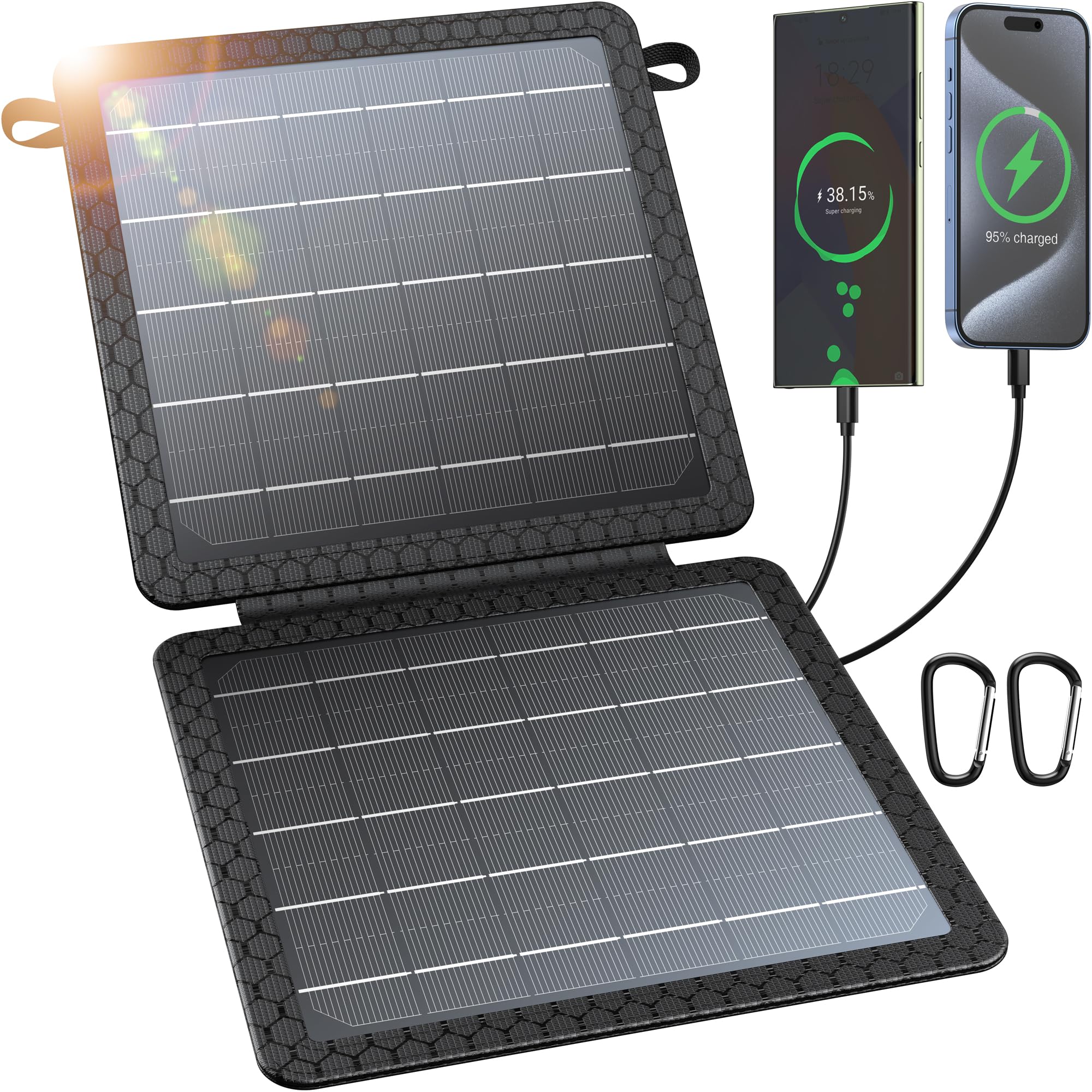
BLAVOR 10W Solar Charger
Key Features
- Weight: 0.81 lb
- Max power: 10 W
- Folded size: 7.4 × 7.5 × 1 in
- Water resistance: IPX4
- Price: Budget
There is a real job for a 10 W panel, and it is narrower than the marketing suggests: keeping a phone alive on an overnight, or adding a little to a power bank you already carry. Nothing more.
At 0.81 lb with a 7.4 by 7.5 by 1 inch fold, an ETFE face and IPX4 splash resistance, it is the smallest and lightest thing in this guide. Two ports, USB-C and USB-A, let you split the trickle between devices, and the oxford cloth backing shrugs off being stuffed into a pack. For the money, the build is better than we expected.
Most backpackers should walk past it anyway. Ten watts is close to a rounding error against a modern phone’s appetite, 5 V/2 A means no fast charging at all, and plugged into a big power bank it is a slow top-up rather than a refill. What it does do is stop a device dying while you sit at camp, and it costs roughly half what our top pick does.
The boundary is anything that needs real energy — a camera battery, a tablet, a five-day carry with no resupply. There, 10 W is a promise the panel can’t keep. The awkward comparison for it is the BigBlue 25 W: barely more weight, well over twice the panel, and a much better chance of a full battery at the end of the day.
Pros
- 0.81 lb and the smallest fold here
- Two ports and IPX4 at a low price
Cons
- 10 W is a trickle, not a charge
- 5 V/2 A means no fast charging at all
Worth it only as a trickle charger for an overnight — the lightest panel here, but 10 W won’t refill much.
How We Tested Solar Chargers for Backpacking
We started by gathering every solar charger a backpacker might realistically carry — folding panels light enough to forget about, panels with built-in batteries, and a couple of pocket-size trickle chargers — then narrowed the field to 12 based on rated output, stated weight, port count, and price per watt. Each one went on real trips across eight months: day hikes with the panel strapped to the outside of a pack, quick overnights, and longer stretches where it was the only power source for a phone, a headlamp, and a satellite messenger.
At camp we laid panels flat, propped them at an angle, and hung them from tent loops, watching how output shifted as the sun moved across the sky. On trail days we timed how long each took to bring a dead phone to 50 percent, then repeated that on hazy mornings and under partial tree cover to see which ones kept working in less-than-perfect light. A USB power meter gave us numbers instead of impressions, and we noted how often a panel dropped a device mid-charge when a cloud rolled through.
We weighed every panel on a kitchen scale, with and without its case, since a stated weight and a packed weight are two different numbers. Each got folded and unfolded dozens of times, jammed into side pockets, and left hanging in wind; we checked for frayed cable junctions, stiff hinges, and sleeves that let the panel slide around or walk off a rock. For models with an internal battery, we charged them up and left them sitting a week to see how much they held. Ease of use came down to small things — whether the ports stayed reachable with the panel folded, whether a cable could be routed without stressing the connector, and whether it took one hand or two plus a flat surface to get the thing pointed at the sun.
How to Choose a Solar Charger for Backpacking
The wattage on the box is measured in perfect sun, so the useful question isn’t how much a panel is rated for — it’s how much of that rating you’ll actually see, and what carrying it costs you.
Rated watts versus what reaches your phone
Every panel here will sit well under its rating in real conditions: a poor angle, thin haze, a strap of shadow from a shoulder, and the output drops. What separates a good panel from a disappointing one is how it behaves in that middle ground. Several strings on parallel circuits, as on the BigBlue 35 W, keep producing when one section is shaded, while a single-string panel takes the whole loss.
We pick for honest midday output rather than the biggest number on the label. A 25 W panel working well beats a 40 W panel fighting the light, and a panel that keeps a trickle going through broken cloud will do more for you over a day than one that only performs at noon.
Weight and packed size decide whether it comes along
A folding panel is only useful if it’s in your pack on the day the sun is out. Folded dimensions matter as much as grams when you’re packing around a bear can: a flat panel slides against your back, a thick folded stack doesn’t. In this group the floor is about 0.84 lb for a 25 W panel and 1.5 lb for a 35 W one.
Our rule is simple: if the panel weighs more than the power bank it’s meant to fill, it probably stays home on the long trips. That’s why the 2.4 lb panels here suit a base camp far better than a carry.
Ports: USB-C PD is the feature worth paying for
Watts get the attention, but the port standard decides whether your phone can use them. A 45 W panel with 5 V/3 A outputs is stuck slow-charging; a 25 W panel with USB-C PD can hand a phone a fast-charge profile in good sun. Look for PD on the USB-C port, QC on USB-A, and a DC output only if you carry a small power station.
The trap is assuming PD on the label means fast charging on the trail. A panel can offer the handshake and still not sustain it in weak light, so match the port to the panel’s realistic output rather than its peak.
Water, dust and heat on the trail
Ingress ratings tell you how much weather the panel tolerates — IPX5 handles splashes, IP67 and IP68 handle rain and a dunking — but the weak point is usually the port flap rather than the panel face, so close it when you’re not plugged in.
Heat is the bigger practical problem. A phone left in full sun while charging will throttle or stop, and a black power bank on a hot rock is worse. Hang the device behind the panel in its shade and you’ll get more charge from the same sun.
Nothing is stored, so budget for a power bank
A panel produces only while the sun is on it. Bank that energy and you can spend it after dark, which is why the best backpacking setup is a panel plus a bank rather than a bigger panel alone. A 10,000 mAh bank is the usual pairing for a phone and a headlamp; the panel’s job is to refill it by evening.
If you’re choosing one first, buy the bank. A modest panel feeding a good bank will keep you running indefinitely in sunny weather; a big panel with nothing to store into just means you charge at lunchtime.
Frequently Asked Questions
What size solar panel do I need for backpacking?
Twenty-five to 40 W is the useful range for a phone and a power bank. Below about 20 W you’re buying a maintainer — enough to hold a phone steady or add a trickle to a bank, not enough to refill one.
The 25 W panels here weigh under a pound, so there’s little reason to go smaller unless the panel is pure emergency kit.
Can I charge a tablet or a laptop from one of these?
A tablet is realistic on the higher-output panels with USB-C PD, provided you’re in clean sun and not in a hurry — expect a slow, partial charge rather than a fill.
A laptop mostly is not. Most draw more than a folding panel can supply, so the battery drains anyway. Charge the laptop from a power bank that the panel has refilled.
Can I fly with a folding solar panel?
A panel with no battery inside isn’t subject to lithium rules, so it travels in hand luggage or a checked bag without drama.
The power bank you pair with it is the part with restrictions: most airlines require those in the cabin and cap their capacity. Check your carrier’s limit before you fly, and keep the bank in your carry-on.
Can I charge through a window?
No, and this catches people planning to sit a panel on a dashboard or behind a balcony window. Glass filters the part of the sunlight a panel needs, and output falls to a trickle that won’t run a charger.
Put the panel outside, even just a few feet, and angle it toward the sky instead of laying it flat.
Final Verdict
For most backpackers, the BigBlue 35 W is the one to buy: enough output, delivered over USB-C PD, to refill a phone or a power bank on a multi-day route, with sealing that survives real weather and a design that keeps working when one half of the panel falls into shadow.
Weight is the requirement that changes our answer. Counting grams and already carrying a bank to charge from after dark? The 0.84 lb BigBlue 25 W does the same job slowly. Camping near the car? The FlexSolar 40 W gives you more panel for less money.