This post contains affiliate links. We may earn a small commission when you buy through our links — at no extra cost to you.
Camp should be quiet. Instead, the last hour of daylight disappears into a familiar scramble: a phone at 4 percent, food that needs actual refrigeration, a lantern already dim. A portable power station fixes that — a battery big enough to run a camping fridge, a CPAP, or a laptop overnight, small enough to pull out of the trunk one-handed, and rechargeable from a wall outlet, a car, or a solar panel. It buys you a campsite that doesn’t run on a generator’s schedule.
The catch is that almost every listing leads with a big number and buries the caveats. Watt-hours don’t tell you whether a station will start a fridge compressor, and a 300-watt output rating won’t run a 500-watt appliance no matter how much capacity sits inside. Over nine months we’ve run eight of these through camping weekends, backyard blackouts, and tailgates, and the spec-sheet-to-reality gap is real. Weight and capacity pull in opposite directions, and price doesn’t reliably follow quality — the list below is organized around which trade-off fits your kind of trip.



Best for Tent Camping
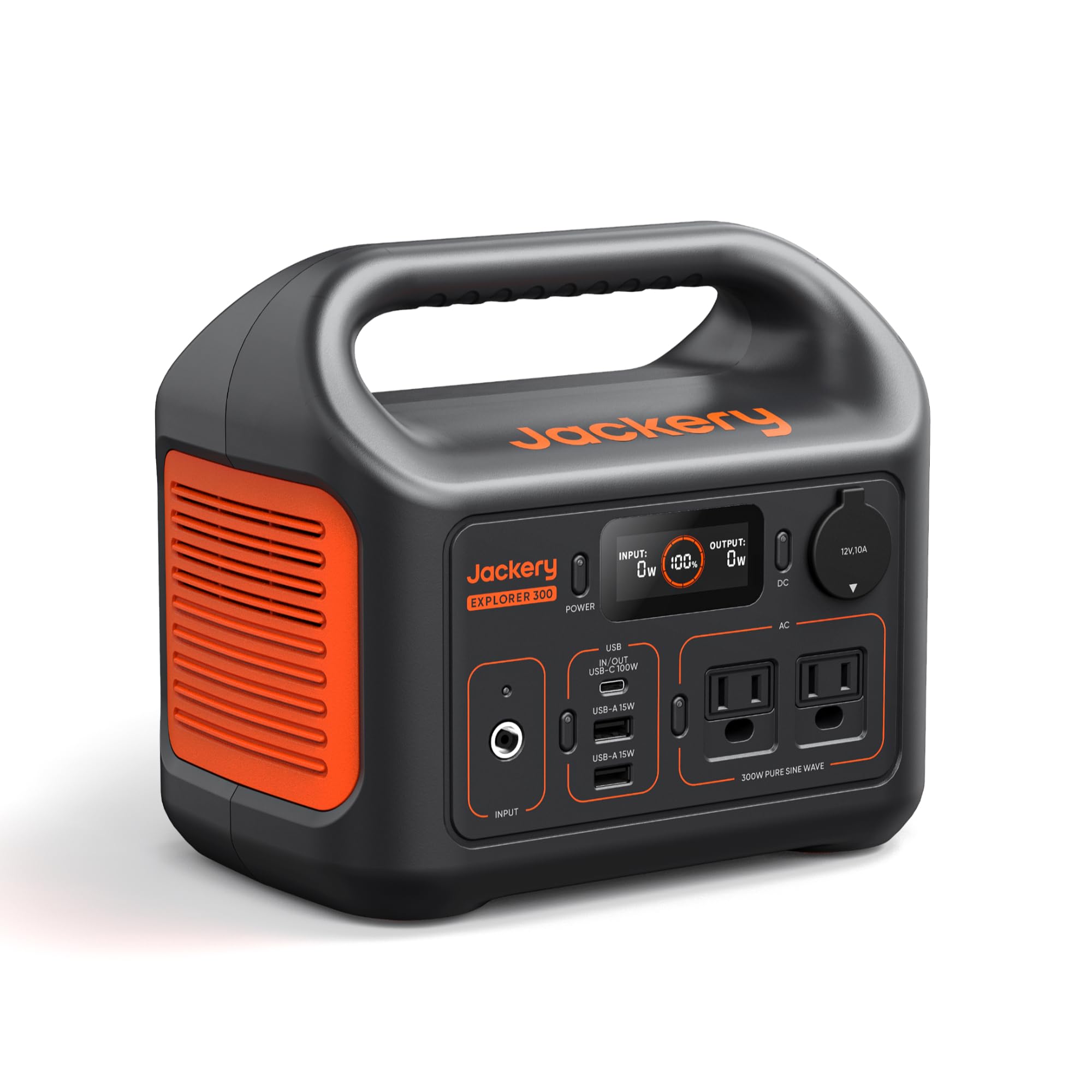
Jackery Explorer 300
Key Features
- Weight: 7.1 lb
- Capacity: 292Wh
- USB-C output: 100W
- Continuous AC output: 300W
- Price: Midrange
The first thing we check in a camping power station is whether one person can carry it from the car to the tent without a second trip. At 7.1 pounds, the Explorer 300 passes that test, and its 292Wh capacity is enough for phones, a laptop, lights, and a camera battery over a weekend.
Two AC outlets, a 100W USB-C port, two USB-A ports, and a 12V car socket cover the small stuff well. We especially like the 100W USB-C for a laptop, because it avoids firing up the AC inverter for every top-up. The pure sine wave AC output is the safer match for sensitive electronics, too.
The 300W continuous rating is the limit. It runs lights, fans, a small TV, and most laptop chargers; it does not run a coffee maker or an electric kettle. That is the trade-off for the weight, and for tent camping it is the right one.
The layout is simple enough to hand to someone who has never used a power station. The display shows the basics, the handle is integrated, and there are no extra modes to learn before you plug in a phone. We also appreciate that the AC outlets are separate from the USB cluster, so cables do not pile up in one spot.
What settles it for us is the balance: light enough to move, big enough for a weekend, and simple enough to live with. If your camp needs a 600W appliance, step up; otherwise this is the default for tent camping.
Pros
- 7.1 lb makes it an easy one-person carry
- 292Wh covers a weekend of small devices
- 100W USB-C and two AC outlets
Cons
- Solar panel sold separately
For most tent campers, the Explorer 300 is the easy default: light enough to carry, with enough capacity and outlets for a weekend of phones, lights, and laptops.
Best for Higher-Draw Gear
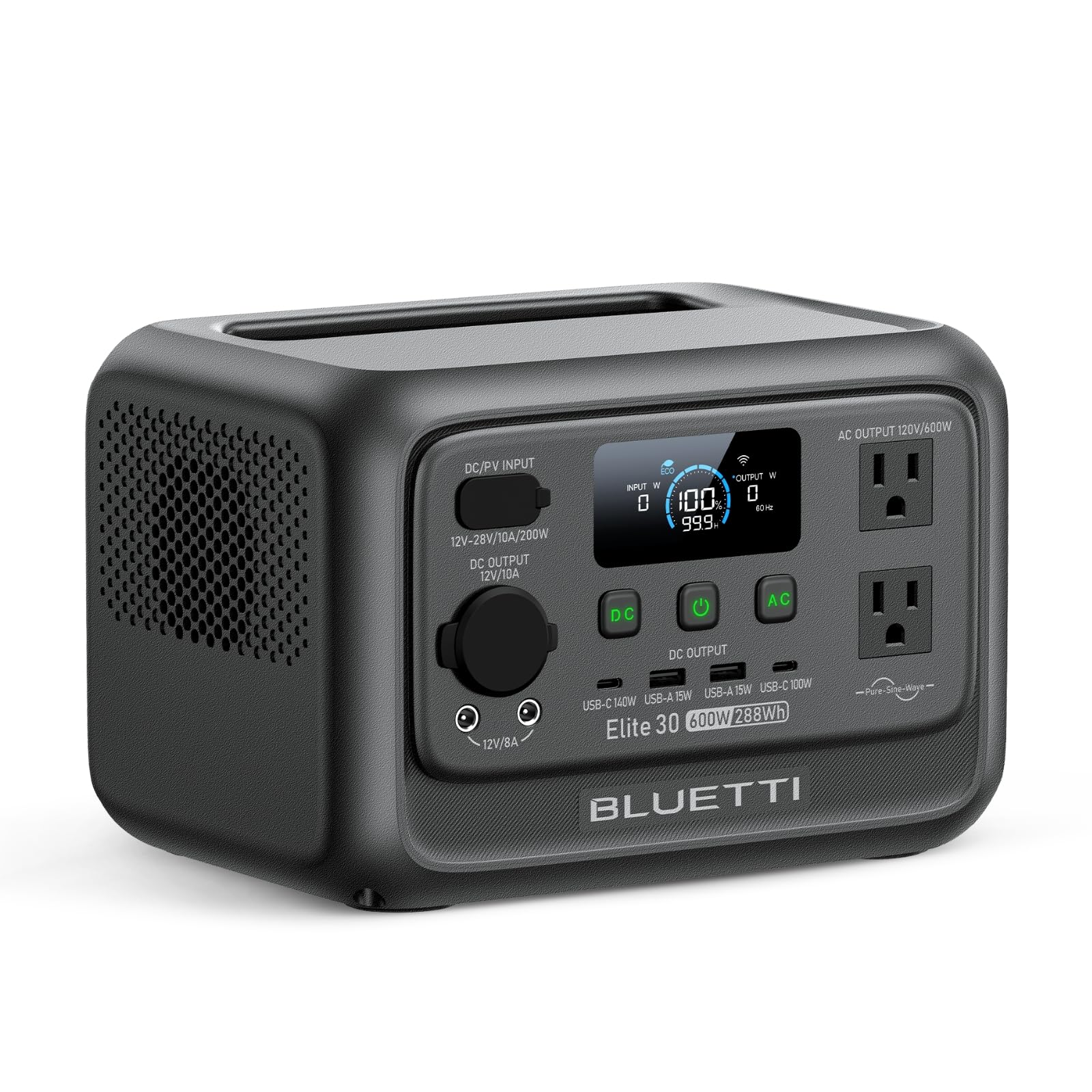
BLUETTI Elite 30 V2
Key Features
- Weight: 9.5 lb
- Battery: LiFePO4
- Capacity: 288Wh
- Continuous AC output: 600W
- Price: Midrange
A 600W continuous AC output changes what a camping power station can do. The Elite 30 V2 pairs that inverter with a 288Wh battery and nine outlets, so it can run a small induction burner, a blender, or a shop fan that can trip a 300W unit. We think the headroom is worth paying for if your camp cooking or gear goes beyond phones and lights.
The 10ms UPS mode and 140W USB-C port make it useful at home too, and the 45-minute run to 80% keeps downtime short. The catch is capacity: under a 600W load, 288Wh is a short burst, not an all-night supply. For a weekend of small appliances, that is a fair trade; for a CPAP or a fridge, step up.
Pros
- 600W continuous output runs small appliances
- Nine outlets including 140W USB-C
- 10ms UPS backup for home gear
Cons
- 9.5 lb is heavier than 300W rivals
If your camping kit includes a small appliance, the Elite 30 V2 earns its place: 600W of output in a still-portable body, with enough ports for everything else.
Best for Basecamp Power
Jackery Explorer 1000 v2
Key Features
- Weight: 23.8 lb
- Capacity: 1070Wh
- Total outlets: 7
- Continuous AC output: 1500W
- Price: Premium
The Explorer 1000 v2 is the point where a camping power station stops being a phone charger and starts being basecamp power. Its 1070Wh battery and 1500W AC output can run a small fridge, a CPAP, or a laptop all weekend, but the 23.8-pound body makes it a car-camping tool rather than a backpacking one.
We like it for group trips and vehicle-based camps where the station stays near the tailgate. The one-hour recharge claim depends on emergency mode in the app, but even the normal wall charge is quick enough to top up between outings. Seven outlets, including three AC and two USB-C, mean you can leave the power strip at home.
App connectivity is the weak spot in the experience; pairing can fail, and you do not need it for basic use. If you want a big battery for a cabin or a long weekend, this is the right size. If you have to carry it any distance, the smaller units are the better call.
Pros
- 1070Wh runs a fridge or CPAP for a weekend
- 1500W AC output with three AC outlets
- Fast wall recharge including a one-hour mode
Cons
- Solar panel sold separately
For car campers who need to run a fridge or a CPAP through the weekend, the Explorer 1000 v2 has the capacity and output to do it.
Best for Fast Recharge
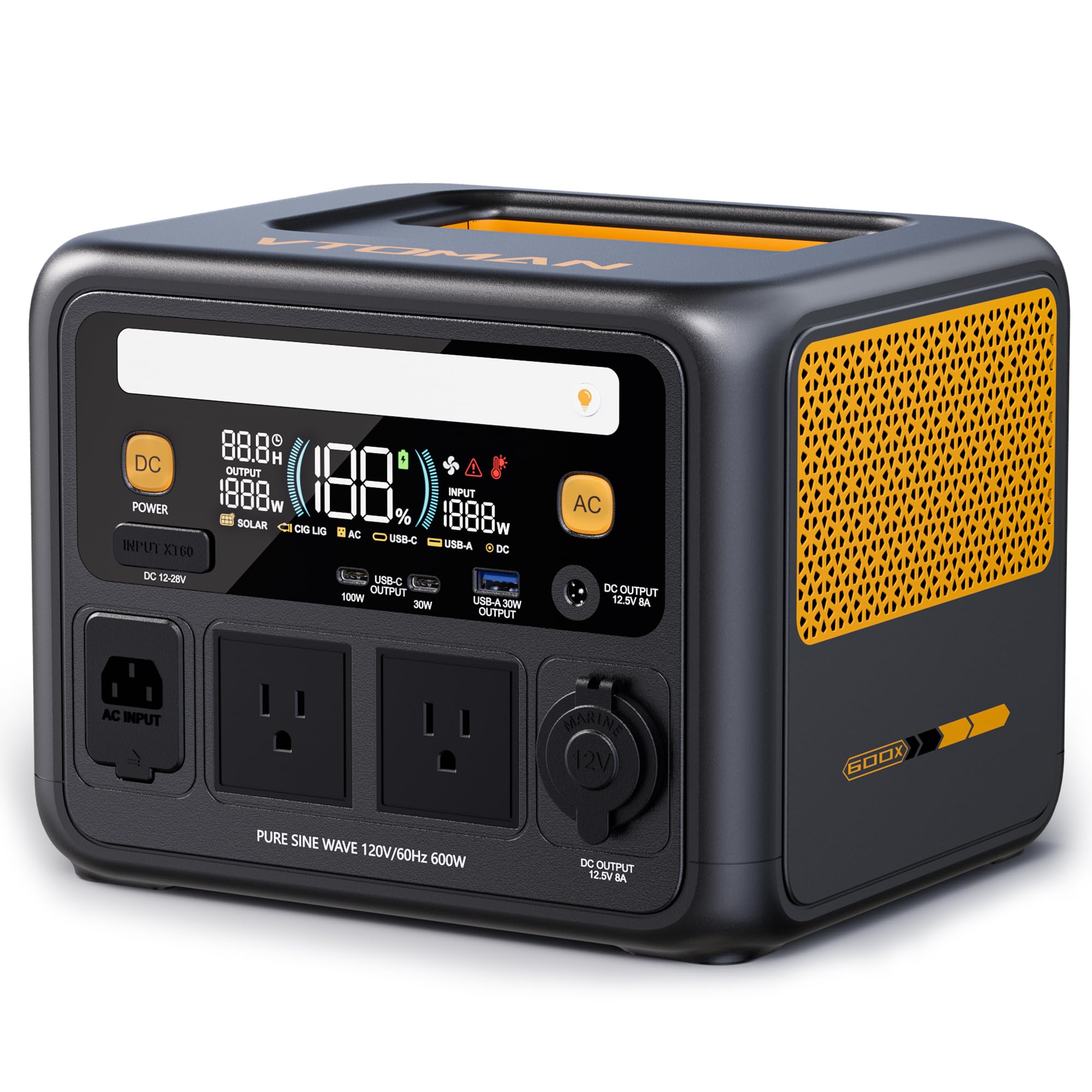
VTOMAN Jump 600X
Key Features
- Weight: 9.9 lb
- Capacity: 268.8Wh
- Recharge to 80%: 50 min
- Continuous AC output: 600W
- Price: Midrange
The Jump 600X is built around one idea: spend less time tethered to an outlet. VTOMAN rates it to reach 80% in 50 minutes and 100% in 75 minutes, which is quick enough to make a lunch-stop recharge realistic. It pairs that speed with a 268.8Wh LiFePO4 battery and 600W continuous AC output, so it can run a small appliance and still top up phones and lights.
We see it as the camping pick for people who move every day and do not want to plan around a long wall charge. The 9.9-pound body is manageable for car-to-tent trips, and the 100W USB-C port is strong enough for a laptop. The trade-off is capacity: 268.8Wh is modest for a 600W inverter, so high-draw cooking or heating is a short burst. For weekend camping with a mix of small devices, that balance works.
Pros
- 80% recharge in about 50 minutes
- 600W output with LiFePO4 battery
- 100W USB-C for laptops
Cons
- Two-year warranty trails the five-year picks
The Jump 600X suits campers who move daily and value a fast recharge; its 600W output and LiFePO4 battery make it a strong midrange choice.
Best for Budget Camping
GRECELL EB300
Key Features
- Weight: 7.3 lb
- Capacity: 230.88Wh
- AC outlets: 1
- Continuous AC output: 330W
- Price: Budget
The EB300 is the budget option we reach for when the trip is more about phones, lights, and a laptop than appliances. It lists a 230.88Wh battery, 330W output, and a 7.3-pound body, with one AC socket and a USB-C PD 60W port.
The USB-A ports cover the rest, and the built-in MPPT controller makes a solar panel a reasonable add-on. The display is basic but readable, and the 330W output is enough for a lamp, a fan, or a laptop charger. The car socket is useful for a 12V cooler or a dash accessory.
We think the EB300 makes the most sense as a first power station or a second one for short trips. The low weight is easy to live with, and the simple setup leaves room for a panel. Just match it to small loads; the 330W ceiling is the real limit.
Pros
- 330W output for small camping gear
- 7.3 lb is easy to carry
- Built-in MPPT for solar charging
Cons
- Only one AC outlet limits shared use
A sensible first power station for tent campers on a budget, as long as one AC outlet and a 330W ceiling match the gear you bring.
Best for Solar Bundle
ZeroKor R200
Key Features
- Weight: 5.1 lb
- Capacity: 280Wh
- Continuous AC output: 300W
- Included solar panel: 60W
- Price: Budget
The R200 is the only pick here that bundles a 60W solar panel, which is why it belongs in a camping roundup. The panel and a 280Wh battery make a self-contained kit for a sunny weekend, and the 5.1-pound station is easy to move between the car and the tent. We think the bundle is most useful for campers who want a backup without buying panels separately.
The catch is charging speed. The panel is small for the battery, and solar charging is slow and weather-dependent; plan on a wall charge before you leave and treat the panel as a top-up. The 300W output handles lights, phones, and a laptop, but not a high-draw appliance. If you want a solar kit in one purchase, this is the value play; if you need faster recharge, look at the VTOMAN or Bluetti picks.
Pros
- 60W solar panel included
- 5.1 lb is easy to carry
- 280Wh covers small devices
Cons
- One-year warranty is short
The R200 is the easy solar-bundle pick for sunny, low-draw camping trips, with a light body and a panel in the box.
Best for Lightweight Backup
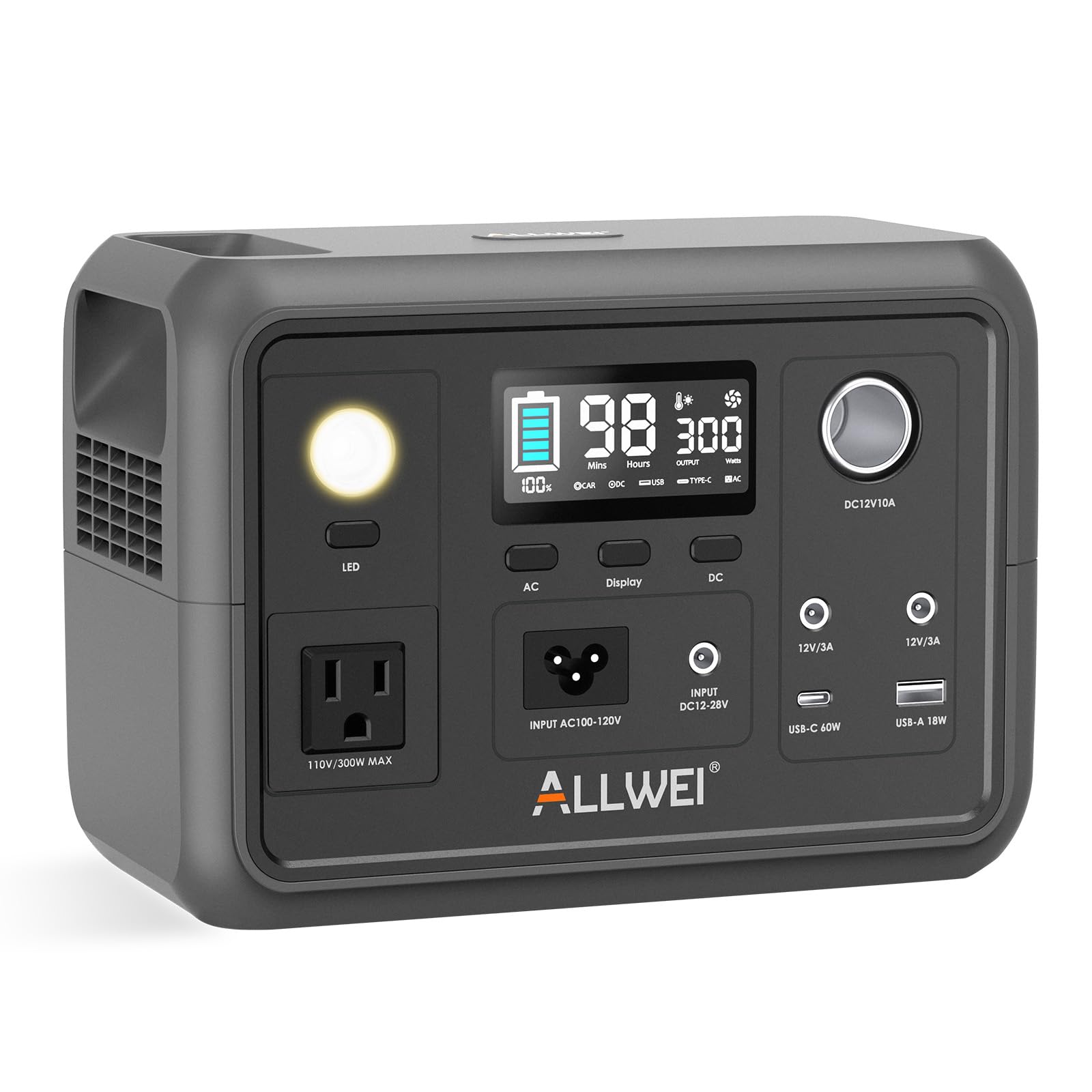
ALLWEI PPS300-4
Key Features
- Weight: 6.4 lb
- Capacity: 256Wh
- AC outlets: 1
- Continuous AC output: 300W
- Price: Budget
At 6.4 pounds, the ALLWEI PPS300-4 is one of the lighter 300W-class stations here, and that is the reason to notice it. The 256Wh LiFePO4 battery and 300W output cover phones, lights, and a laptop, and the five-year warranty is longer than most budget picks offer.
The port selection is simple: one AC outlet, two DC5521 ports, a car socket, one USB-A, and one USB-C. A solo camper or a couple charging mostly by USB is well served. A family with two AC devices needs a different station or a power strip.
Recharging is flexible: wall, car, or solar, with a full wall charge listed at 3.5 to 4 hours. The display is simple, and the LiFePO4 battery is a better long-term bet than the vague lithium-ion listings on some budget units.
We like the PPS300-4 as a light, simple station for one person’s weekend kit. The single AC outlet keeps it from being the default for group camping, but the low weight and long warranty make it a solid alternative to the bigger budget boxes.
Pros
- 6.4 lb is light for a 300W station
- LiFePO4 battery with a five-year warranty
- Wall, car, and solar recharging
Cons
- Only one AC outlet
The PPS300-4 is a light, long-warranty pick for solo campers who can live with a single AC outlet and 300W of output.
Best for Compact 300W
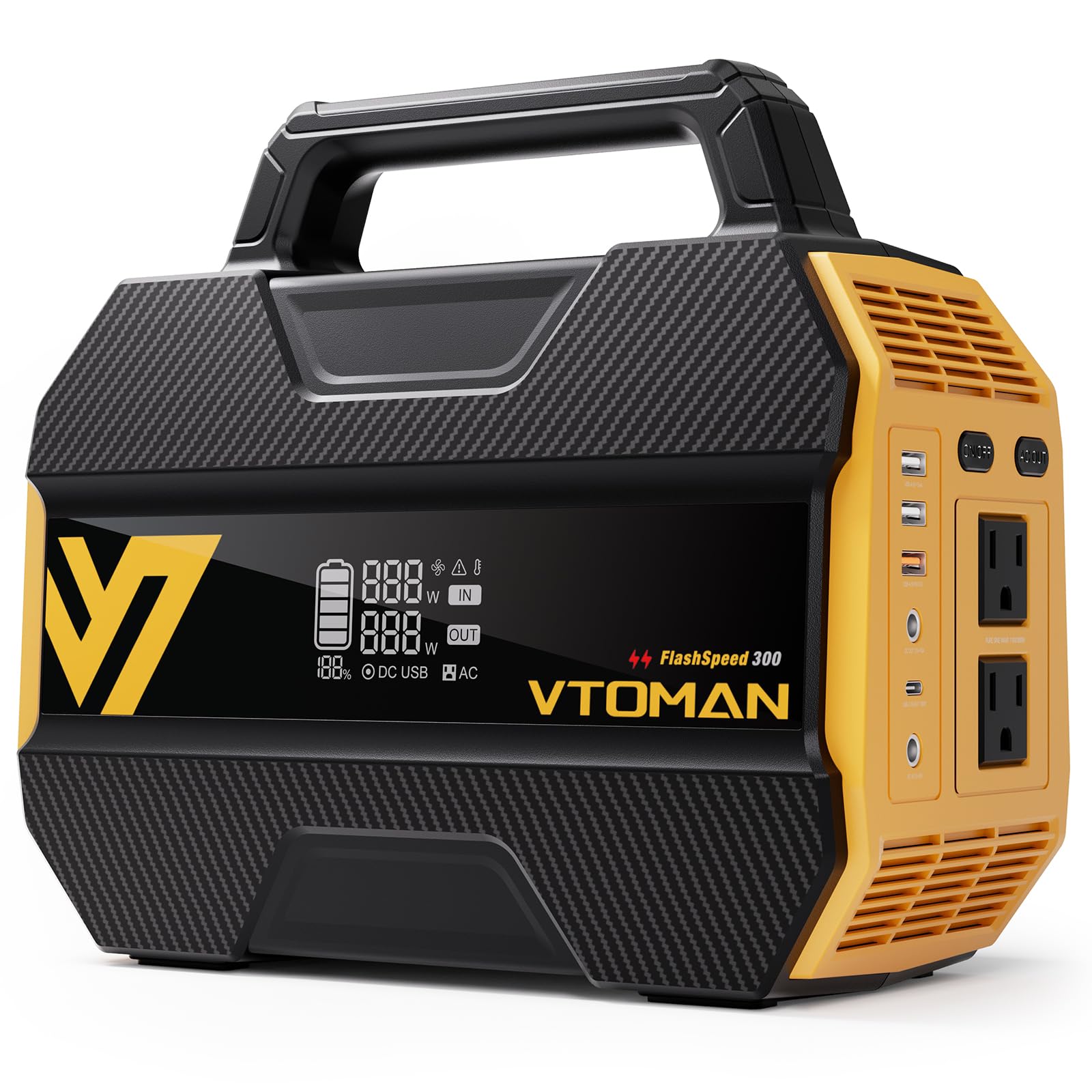
VTOMAN FlashSpeed 300
Key Features
- Battery: LiFePO4
- Capacity: 230Wh
- USB-C output: 100W
- Continuous AC output: 300W
- Price: Budget
The FlashSpeed 300 is a compact 300W station with a LiFePO4 battery, two AC outlets, and a 100W USB-C port. At the budget end, that combination is rare in this set, and it is why the unit stays on our list.
The feature set is aimed at campers who want a little more flexibility than a phone-only power bank: seven outlets, a built-in light with three modes, and four recharge methods. The 300W continuous output runs lights, laptops, cameras, and a fan.
We prefer its port mix and LiFePO4 battery to the older lithium-ion budget boxes, and two AC outlets make it more flexible than the one-outlet GRECELL. It earns a place as a compact alternative, not as the default; the 300W ceiling is the limit to accept.
Pros
- LiFePO4 battery at the budget end
- Two AC outlets and 100W USB-C
- Seven outlets and a three-mode light
Cons
- 300W output rules out kettles and coffee makers
The FlashSpeed 300 is a compact, budget-friendly 300W station with LiFePO4 and two AC outlets, as long as your camp loads stay small.
Best for Phone and Camera
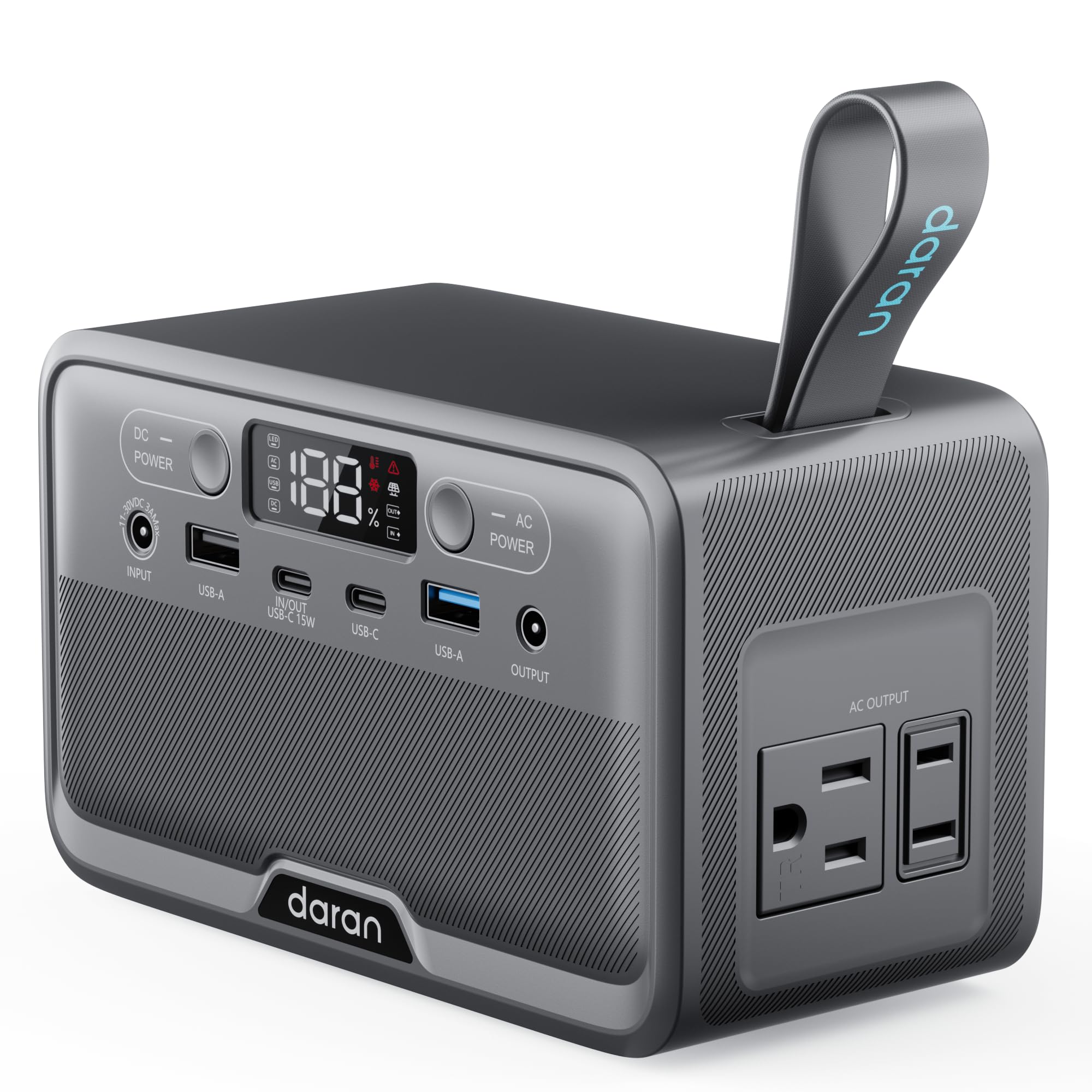
DaranEner 89.6Wh
Key Features
- Weight: 2.54 lb
- Capacity: 89.6Wh
- AC outlets: 2
- Continuous AC output: 100W
- Price: Budget
The DaranEner is smaller than most camping power stations: 89.6Wh, 100W output, and a 2.54-pound body that fits in a backpack. It is not a weekend basecamp battery. It is the unit we grab for a day hike, a festival, or a camera bag when the goal is keeping a phone, a watch, and a laptop alive.
Two AC outlets, a 100W USB-C port, and a built-in four-level light give it more flexibility than a standard power bank. The LiFePO4 battery is a plus at this size, and the fanless design means no whirring in a tent.
The 89.6Wh battery and 100W output are sized for personal electronics; the AC outlets are there for short, small loads. The capacity is the limit, not the port count.
We see it as a companion battery, not the main power station for a camping trip. If you already have a larger unit and want something pocketable for day trips, the DaranEner is the one we reach for; if this is your only power source, start at 250Wh or more.
Pros
- 2.54 lb and backpack-friendly
- Two AC outlets and 100W USB-C
- LiFePO4 battery and fanless operation
Cons
- Too small for overnight CPAP or fridge use
The DaranEner is a pocketable companion battery for phones, cameras, and laptops, not a replacement for a full camping power station.
How We Tested These Power Stations (and What Gave Out)
We started with a list of roughly 30 models and cut it down by reading spec sheets the way a skeptical buyer would: usable watt-hours, continuous and peak output, cell chemistry, weight, port count, and price per watt-hour. That narrowed the field to eight stations spanning the sizes a camper might realistically haul. Then we lived with them for nine months.
Each one rode in a trunk to a weekend campsite at least twice. On those trips we ran a 12-volt fridge for two days straight, charged phones and a laptop, and ran a CPAP overnight inside a tent, then checked the display in the morning to see what was left. At home we plugged in an electric kettle and a small air compressor to find out which units tripped their surge limit, and we timed a full wall recharge plus a solar recharge off a 100-watt panel on a clear afternoon, then again under thin cloud.
Weight went on a luggage scale, and we carried each station from the car to the picnic table and up a flight of stairs by its handle, which is where the flimsy ones announced themselves. We paired every app, walked until the Bluetooth dropped, and checked how legible each screen was after dark. For battery life and reliability, we logged delivered watt-hours with an inline meter at the start and again after months of charge cycles, noting any unit whose fan kicked on loudly enough to hear from a sleeping bag. Value came last: what a station actually ran, divided by what it cost.
How to Choose a Camping Power Station
The right camping power station is the one you can carry and that can carry your gear’s actual load, not the one with the biggest printed number.
Start with watt-hours, then subtract reality
Capacity in watt-hours tells you how much energy the battery holds; the AC rating tells you how fast it can deliver it. A 292Wh station like the Explorer 300 is a weekend charger for phones, lights, a laptop, and a camera. A 1,070Wh unit like the Explorer 1000 v2 is basecamp power for a small fridge or a CPAP. Add up the watt-hours of what you plan to run, then leave at least a quarter in reserve. Cold nights and aging batteries eat into that margin.
Read continuous watts before appliance dreams
Continuous watts are the ceiling for anything with a compressor or heating element; surge ratings only cover the first moments. A 300W station handles lights, fans, laptops, and a small TV. A 600W unit like the Bluetti Elite 30 V2 or VTOMAN Jump 600X opens the door to a small induction burner or a blender, but only in short bursts. Check the appliance’s startup draw as well as its running wattage. If the label is close to the station’s limit, assume it will trip.
Weight decides how often it leaves the car
A 7-pound station is easy to move from the trunk to the tent; a 23.8-pound unit is a two-hand lift and a car-camping commitment. We look at the handle and the shape as much as the number, because a compact box carries better than a wide one. The Explorer 300 is the light default; the Explorer 1000 v2 is the one that stays near the vehicle. If you plan to walk any distance, pick the smaller unit and bring a USB power bank for phones.
Plan recharge speed and solar honestly
Wall charging is the fast, predictable option; solar is the slow top-up. A 50-minute run to 80% on the VTOMAN Jump 600X changes a road-trip lunch stop, while a 60W panel on the ZeroKor R200 is best for keeping a weekend battery topped up in good sun. Panel wattage and weather both matter, and a small panel can take most of a day. Bring the wall charger even if you pack a panel.
Check the outlet mix for your actual gear
Count AC outlets and USB-C PD ports before you buy. One AC outlet is enough for a solo camper with a lamp and a laptop; two or more matter when a family shares the station. A 100W USB-C port can charge a laptop without draining the AC inverter, which is more efficient. For a powered cooler, check whether it has a 12V option; it can stretch runtime compared with the AC outlet, and units with a car socket make that easier.
Frequently Asked Questions
Why not just bring a power bank?
A power bank charges USB devices; a power station adds an AC inverter and a much larger battery. If your kit is only phones, a watch, and a camera, a high-capacity USB bank is lighter and simpler. Once you need a laptop charger, a fan, a lamp with a plug, or a CPAP, the AC outlets earn the extra weight. The DaranEner is the smallest station here that still gives you two AC outlets.
Can a camping power station run a CPAP all night?
It can, but the station needs enough watt-hours and the right output. Check your CPAP’s power draw and whether it has a 12V adapter, which is more efficient than the AC brick. A 300Wh station may not last a full night with humidification on; a 1,000Wh unit like the Explorer 1000 v2 is the safer starting point. Test the setup at home before you rely on it.
Can I use a power station inside a tent?
Yes, because these are battery stations with no exhaust, but keep the vents clear and the unit dry. Don’t charge it in a puddle or leave it in a hot car; heat shortens battery life. For overnight use, put it on a flat, stable surface where you won’t kick it and where the display is visible. If you use a fuel generator instead, that one stays outside.
Final Verdict
For most campers, we recommend the Jackery Explorer 300. It is the rare station that feels light enough to carry without thinking and still has the outlets and capacity for a weekend of phones, lights, and a laptop. The 300W ceiling is the line: if your camp cooking depends on a kettle or an induction burner, it is not enough.
Step up to the Bluetti Elite 30 V2 for 600W in a still-portable body, or the Jackery Explorer 1000 v2 if you need to run a fridge or a CPAP through a car-camping weekend. For a solar bundle on a budget, the ZeroKor R200 is the simple answer.