This post contains affiliate links. We may earn a small commission when you buy through our links — at no extra cost to you.
My phone dropped to 3 percent somewhere over the middle of the country, and the seat-back outlet was dead. By the time we landed I was reading gate numbers off a stranger’s screen. A power bank is the small, unglamorous insurance policy against that exact feeling — enough juice to pull up a boarding pass, call a rideshare, or find your way home when the outlet you counted on isn’t there.
The catch is that the bank that saves you is the one you actually remember to put in your bag, so the pocketable ones quietly win more often than the biggest bricks. We spent the past three months living with 16 of them through commutes, a couple of flights, a camping weekend, and one very long conference day. The spec sheet also won’t tell you that most banks hand your phone only about 60 to 70 percent of their rated capacity once conversion loss is figured in — speed, honest capacity, and bag-survival are what separate the keepers from the drawer filler.


Best for Multi-Day Trips
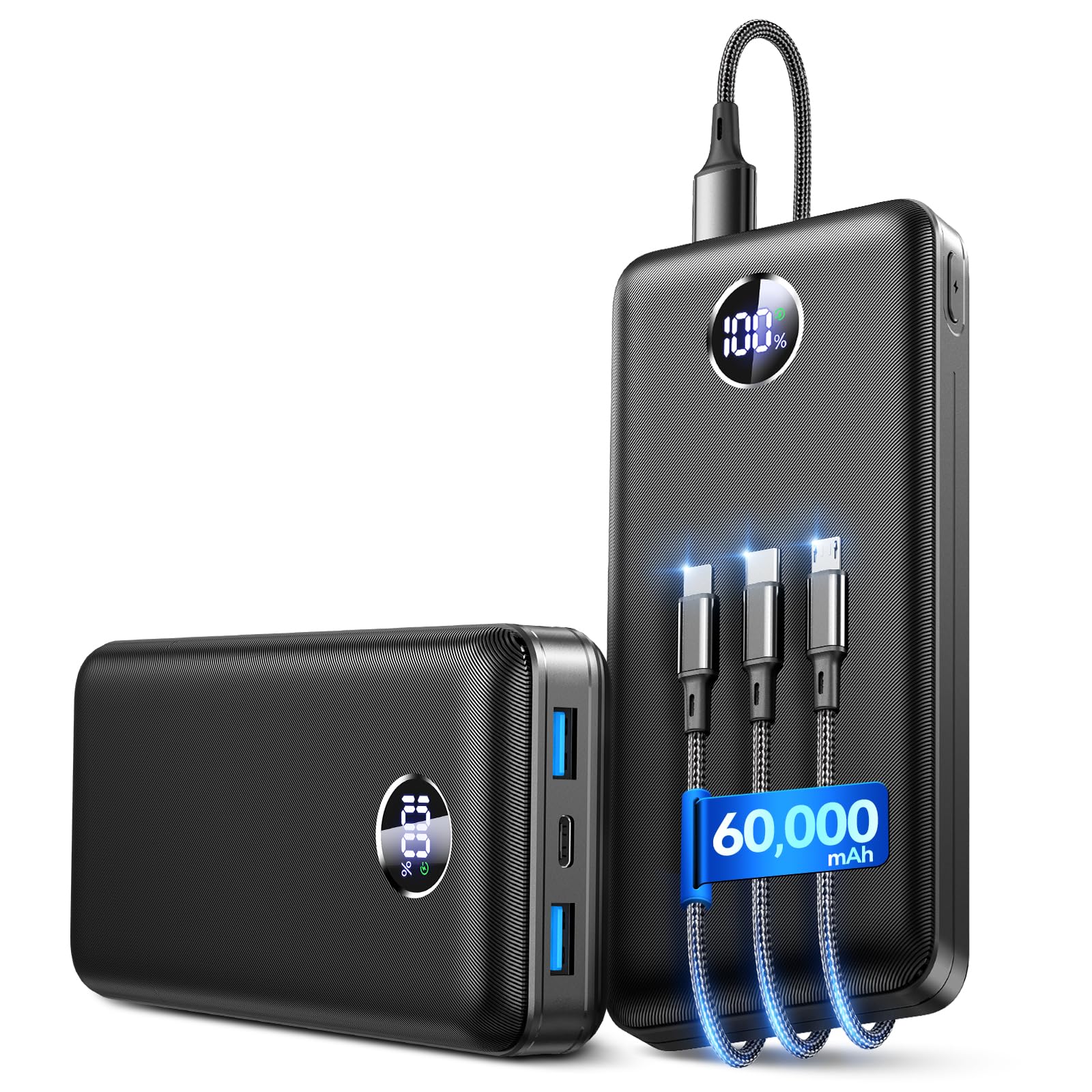
IAPOS P1 Pro 60,000mAh
Key Features
- Weight: 15.5 oz
- Max output: 22.5 W
- Charges at once: 5 devices
- Battery capacity: 60,000 mAh
- Price: Midrange
Two days into a trip with no outlet, the question stops being how fast your phone charges and becomes whether anyone still has a bar of signal. That is the trip the IAPOS P1 Pro is built for, and it is why this is our top pick: a 60,000mAh cell covers a long weekend of maps, photos and evening calls without a wall socket in sight.
The headline number is cell capacity, and some of it disappears in conversion, but the useful output runs to four or five full phone charges — enough to keep your own phone and tablet alive, or to hand out top-ups to a group. Three ports and a built-in three-in-one cable (USB-C, Lightning and micro-USB) let five devices hang off it at once, and that cable is the detail we appreciate most: an iPhone, an Android and a headlamp all charge without anyone unpacking a bag.
The percentage display is the other thing we notice when we go back to a cheaper pack — knowing there is 34 percent left is a different feeling from guessing at four dots — and the three-year warranty is among the longest here. What it costs you is weight. At 15.52 ounces and 1.1 inches thick it lives in a rucksack rather than a hip pocket, and refilling a battery this size is an overnight job, not a lunch stop.
Pros
- Four or five full phone charges per fill
- Three ports plus a built-in 3-in-1 cable
- Charges five devices at once
- Three-year warranty
Cons
- Heavy 15.52 oz pack, not a pocket carry
- Slow to refill; plan on overnight
For trips where a dead phone actually costs you something, this is the pack we hand people: days of capacity and enough ports for the whole group.
Best for Pocket Carry
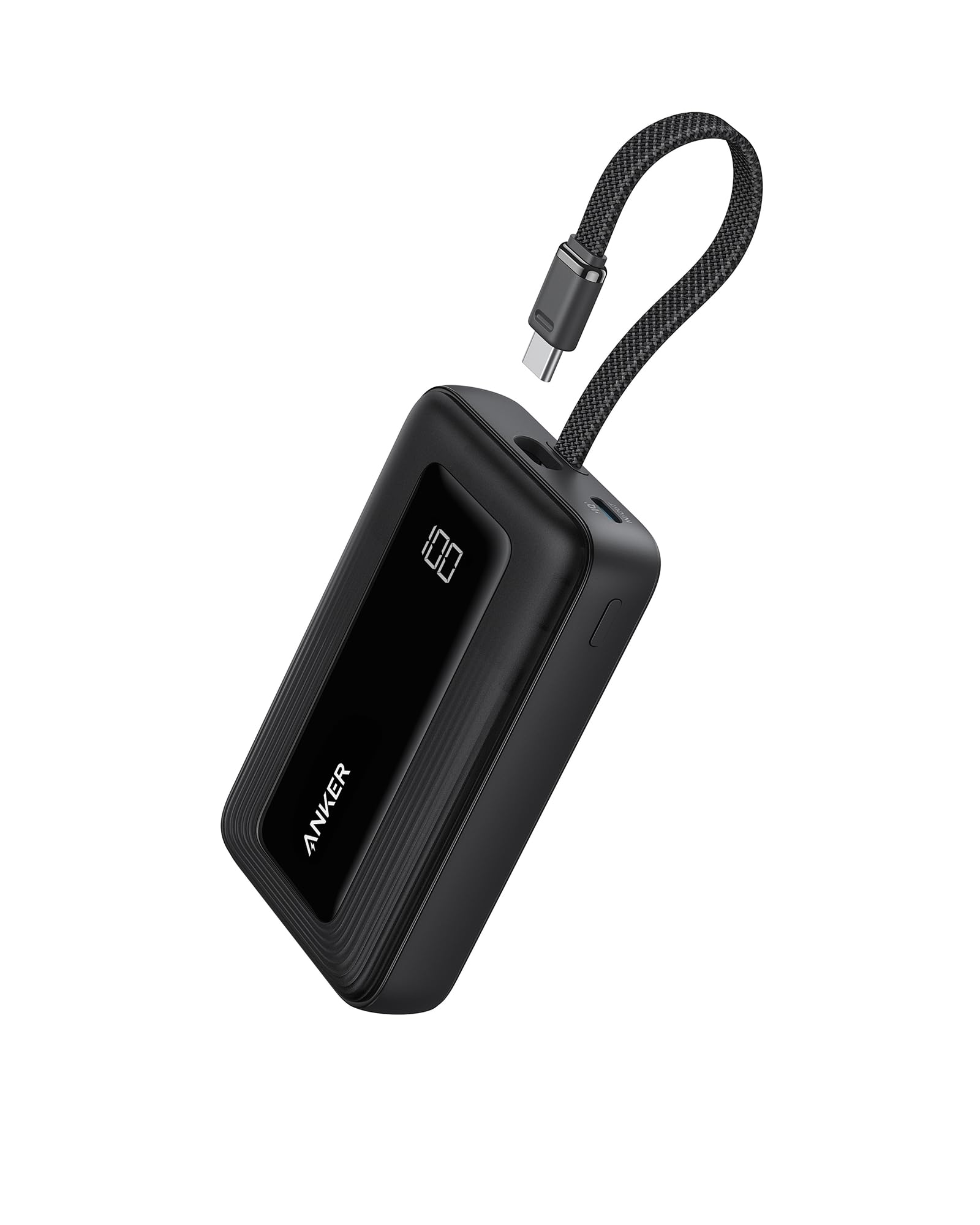
Anker Zolo 10K
Key Features
- Weight: 7.87 oz
- Max output: 30 W
- Built-in cable: 5.4 in USB-C
- Battery capacity: 10,000 mAh
- Price: Budget
At 4.32 by 2.58 by 0.98 inches and 223 grams, this is the pack that disappears into a jacket pocket and stays there until you need it, which is the whole argument for carrying one every day. We take it on day hikes and commutes ahead of the bigger packs for exactly that reason. The built-in USB-C cable is 5.4 inches long and rated for 10,000 bends, and it curls into a loop you can hook onto a strap so nothing is loose in the bottom of a bag.
Thirty watts of output and 20W of input is the right balance at this size: quick enough to be useful, and fast to top up from a laptop or a car charger. Two full phone charges is the realistic ceiling, so this is a day pack rather than a weekend one — for a long trip, look at the IAPOS or the 25K Anker instead. Longevity is where our confidence is lowest: on packs like this the built-in cable is the piece that gives out first, and here you still have the spare USB-C port to fall back on when it does.
Pros
- Pocketable at 223 g and under an inch thick
- Built-in USB-C cable loops onto a strap
- 30W out and 20W in
Cons
- Only about two full phone charges
This is the pack we reach for on a day hike: 223 grams, a cable you cannot leave behind, and 30W that takes a phone to half in under half an hour.
Best for Laptop Power
Anker Laptop 25K
Key Features
- Ports: 3 USB-C, 1 USB-A
- Weight: 10.6 oz
- Total output: 165 W
- Battery capacity: 25,000 mAh
- Price: Premium
This one sits at the top of the price range, and it is the only pack here that will run a laptop properly. Three USB-C ports rated at 100W each, 165W in total, and a 25,000mAh cell mean it can hold a MacBook Air, a phone and a tablet at the same time — the sort of thing a remote worker notices on the first morning of a trip.
We recommend it only if a laptop is genuinely coming with you. For phones alone it is overkill: 6.18 inches long, 1.92 inches thick and 300 grams, it sits in a jacket pocket like a small brick, and the strap-and-handle design is doing its best to make that forgivable. If you edit photos from a tent or take calls where wall power is unreliable, though, nothing else here does the job.
The cable arrangement is the clever part. One 0.98-inch USB-C cable doubles as a carry handle, and a second retracts to 2.3 feet and is rated for 20,000 retractions, so the pouch and the dongles can stay at home. Refilling takes about two hours on a 100W charger, which is quick for this capacity. The retractable mechanism is where a pack like this tends to go wrong first, and the 18-month warranty is shorter than the three years the IAPOS carries.
Pros
- Three 100W USB-C ports, 165W total
- Two built-in cables, one retractable
- Refills in about two hours on a 100W charger
Cons
- Large and heavy at 300 g
- 18-month warranty is short at this price
We recommend it only if a laptop is coming with you: three 100W USB-C ports, two built-in cables, and enough capacity for a working day away from an outlet.
Best for Two-Day Trips
NOBIS 20K 45W
Key Features
- Weight: 13.8 oz
- Max output: 45 W
- Recharge time: 2 hours
- Battery capacity: 20,000 mAh
- Price: Budget
Twenty thousand milliamp-hours is the sensible middle of this group, and the NOBIS is the one for a two-day trip where a phone, a watch and a camera all need topping up. The 45W USB-C port is quick enough for a tablet or a small laptop, four ports cover a group, and the percentage display means you leave camp knowing exactly what is left rather than guessing.
Forty-five watts in both directions is the feature we care about most: pair it with a 45W wall charger and the pack refills in about two hours, which makes it far easier to live with than a big battery that needs a whole night. Our hesitation is consistency — the real capacity can come in below the 20,000mAh label, and charging pace varies between units. Set against a pack that takes all night to refill and gives no readout, the two-hour turnaround is worth more than the missing capacity for most short trips.
Pros
- 45W in both directions
- Refills in about two hours
- Four ports and a percentage display
Cons
- Real capacity can fall short of the rating
- Heavier and thicker than a pocket pack
The middle of the range done well: 20,000mAh, 45W in both directions, and a display that tells you what is left — the pack we take on two-day trips.
Best for Budget Basecamp
Moihosso 50K

Key Features
- Size: 6.5 × 3.5 × 1 in
- Max output: 22.5 W
- Built-in cables: USB-C and Lightning
- Battery capacity: 50,000 mAh
- Price: Budget
The flashlight and the two built-in cables are the details that make this pack more useful than its price suggests. Cables stow in channels down the sides instead of dangling loose, there is a digital readout on the face, and the case measures 6.5 by 3.5 by 1 inch — big for a pocket, unremarkable for a 50,000mAh pack.
Fifty thousand milliamp-hours works out to four or five full phone charges, and 22.5W fills most phones at a decent clip without demanding a special charger. Three ports plus the USB-C and Lightning cables mean a family can run phones, earbuds and a headlamp at the same time — the sort of thing that matters at a campsite with one socket between six people.
What keeps it out of the top tier is not a fault we found; it is that this pack has not been in enough hands for long enough to know how it behaves after a year, and we will not pretend otherwise. Early signs are good — quality and charging speed both read well — and a three-year replacement policy hedges the risk better than most. Treat the first few trips as the audition.
Pros
- 50,000mAh for multi-day trips
- Built-in USB-C and Lightning cables
- Three-year replacement policy
- Flashlight and digital display
Cons
- Chunky at 6.5 × 3.5 × 1 in
Big capacity, built-in cables and a flashlight for budget money — a basecamp spare we are comfortable recommending, as long as you know the long-term record is thin.
Best for Light 45W
TRKOY 20K 45W

Key Features
- Size: 3.98 × 1.26 × 2.79 in
- Max output: 45 W
- Built-in cables: 2 USB-C
- Battery capacity: 20,000 mAh
- Price: Budget
On paper this looks like the value pick of the group: 45W fast charging and a 20,000mAh cell in a body listed at 3.98 by 1.26 by 2.79 inches, with two braided USB-C cables built in and a digital percentage display.
Forty-five watts is the number that matters. It is the same output as the NOBIS in a smaller package, enough to charge a tablet or a handheld console at a useful rate rather than just trickling into a phone. The braided cables are rated for 20,000 folds and plug cycles, and having two of them means you and a companion can charge without taking turns.
Our hesitation is the track record: the model is new enough that nobody can tell you how those cables hold up after a full season, and the warranty behind them is the shortest in this group. The specifications, though, are the right ones for a hiker — real wattage, useful capacity, and no dongles to lose.
Where it earns its place is as the pack that lives in a daypack: light enough to forget, fast enough to be worth pulling out, and cheap enough that you do not baby it. Buy it expecting to replace it in a couple of years rather than to hand it down.
Pros
- 45W and 20,000mAh in a small body
- Two braided USB-C cables built in
- Digital percentage display
Cons
- One-year warranty is the shortest here
The smallest way here to get 45W and 20,000mAh, with two braided USB-C cables built in — a pick we like for anyone comfortable with a one-year warranty.
Best for Camping Spare
Luvknit Solar 20K

Key Features
- Size: 7 × 3.22 × 1.02 in
- Max output: 22.5 W
- Built-in cables: USB-C, Lightning, micro-USB
- Battery capacity: 20,000 mAh
- Price: Budget
The solar panel is the reason to look at this pack and the reason to be careful with it. A panel that size trickles charge into the battery over a sunny day; it will not refill a 20,000mAh pack, and anyone planning to leave the wall charger at home because there is a solar side is going to be disappointed.
Set that aside and the rest is sensible: 20,000mAh, 22.5W PD output, three built-in cables (USB-C, Lightning and micro-USB) so nobody in the group needs to bring one, and a dual LED flashlight that is genuinely useful around camp after dark. Five connections in total mean it can share the load between devices.
It is large for its capacity at 7 by 3.22 by 1.02 inches, and the 22.5W rating depends on a compatible PD device at the other end — an older phone or a thick case can drop it to a slow trickle, which is worth knowing before you rely on it for a quick top-up.
Where we see it earning its keep is a glovebox, a boat locker or a basecamp box, places where a slow solar top-up is a bonus and the pack is never the only plan. As the single battery you carry on a hike, the size and the uneven pace make it hard to choose over the Anker at about the same money.
Pros
- Three built-in cables cover most phones
- Dual LED flashlight
- Solar top-up for basecamp
Cons
- Solar only trickles, never refills
- Large for a 20,000mAh pack
A glovebox and basecamp spare we like: three built-in cables, a genuine flashlight, and a solar panel that slows the drain without ever refilling the pack.
How We Tested Portable Power Banks
We started by gathering every power bank we could find that cleared three baseline requirements: at least 10,000mAh of rated capacity, a USB-C port that supports fast charging, and a price that stayed out of laptop-battery territory. From roughly 40 candidates we cut anything with a pattern of swelling complaints, anything over a pound, and anything stuck at 5W output. That left 16 banks, ranging from slim pocket sticks to 20,000mAh packs with built-in cables.
For three months those 16 lived in our bags. They rode commutes, took two flights, spent a weekend at a campsite with no outlets, and sat through a full conference day of photo-taking and map-checking. Each time, we started with a phone drained to zero, timed how long it took to reach 50 percent, and ran a USB power meter in line to see how much of the advertised capacity actually came out the other end.
We weighed every unit on a kitchen scale and did the jeans-pocket test, because a bank you leave at home is money wasted. Built-in cables got plugged and unplugged repeatedly until we found the ones fraying at the strain relief, and each unit took a waist-high drop onto concrete followed by a week in a bag with keys and a water bottle. We also checked charge level after two weeks in a drawer, since a pack that’s dead when you need it is worse than no pack at all. At the end we set price against the number of real phone charges each bank delivered, and that ratio decided the winners.
How to Choose a Portable Power Bank
The right power bank is the smallest one that covers your longest ordinary trip away from an outlet — everything above that is weight you carry for a journey you probably won’t take.
Start with days away, not milliamp-hours
The number on the box only means something once you turn it into charges. A 10,000mAh pack is a phone and a bit; 20,000mAh covers a weekend of maps, photos and calls; 50,000mAh and up is a multi-day or group pack. Work out how many full charges your longest trip needs, add one, and buy that.
The trap is buying the biggest pack just in case. A brick left in the car because it is too heavy to carry has protected nobody, and the packs here that hold days of power are all heavy enough to notice in a daypack.
Watts decide how fast it fills and how fast it empties
Twenty watts is plenty for a phone; 45W is where a tablet or a small laptop charges at a useful rate; 165W is laptop territory. Input matters just as much: a 20,000mAh pack on a 45W charger refills in about two hours, while a 60,000mAh pack on a phone charger takes most of a night.
If you buy a big pack, budget for a matching wall charger, and pay attention to a percentage readout. Four dots tell you very little at the start of a summit day, and almost every pack worth carrying here now shows an exact figure.
Built-in cables are convenient until they are not
A built-in cable means nothing to forget, and on some packs it curls into a loop you can hang the battery from a strap. It is also the part that fails first, so check whether there is a spare USB-C port to fall back on before you commit.
Multi-device packs with a three-in-one cable cover an iPhone and an Android in one go, which matters when you are charging for a group. If everyone you hike with is USB-C, a single built-in C cable keeps the pack smaller and lighter.
Weight, cold and where the pack lives
Under about 250g a pack disappears into a jacket pocket; 350-450g is one you keep in the lid of your rucksack; anything thicker than an inch is not a pocket item whatever the product photos suggest. Match the shape to where it will actually spend the day.
Cold is the other thing hikers notice. Lithium cells give up capacity faster in freezing weather, so keep the pack you are relying on inside a layer rather than in an outer mesh pocket, and expect a phone to charge more slowly at altitude in winter.
Frequently Asked Questions
Can I take a 50,000mAh power bank on a plane?
Airlines count lithium batteries in watt-hours rather than milliamp-hours, and the usual carry-on ceiling is 100Wh — about 27,000mAh at 3.7V. A 50,000 or 60,000mAh pack is well past that, so it needs the airline’s approval before it flies, and it has to travel in the cabin with you, never in checked baggage.
If a flight comes before the hike, a 20,000mAh pack stays comfortably inside the limit and still gives you a weekend of charges.
Why do I get fewer charges than the number suggests?
The figure on the box is cell capacity, not what comes out of the USB port. Converting the cell’s voltage to what your phone accepts loses a share as heat, and the phone loses a little again as it charges, so the useful output is always lower than the arithmetic promises.
If one full charge is critical — a rescue call, a day of GPS — size up rather than trusting the headline, and top the pack up whenever a socket appears.
How do I make a power bank last more than a year?
Top it up every few months instead of leaving it flat for a season, keep it out of hot cars and direct sun, and pull it off the charger once it is full. Cables are the usual casualty: pull the plug, not the cord, and avoid bending a built-in cable back on itself.
If a pack swells, gets hot while idle or stops taking a charge, retire it. A swollen lithium cell is not something to repair or keep in a rucksack.
Final Verdict
Buy the IAPOS P1 Pro if your trips run long. It is the only pack here that covers a multi-day hike without a wall socket, and it keeps a phone, a camera and a headlamp going on one fill. If you want something you will never notice, the Anker Zolo 10K is the one that lives in a jacket pocket; just accept that it holds a day of power rather than a weekend’s.