This post contains affiliate links. We may earn a small commission when you buy through our links — at no extra cost to you.
Power banks promise plenty: 20,000mAh, 100W output, built-in cables. But on the trail, the real test is how much weight you’re willing to carry in exchange for that extra charge. A 1.3-pound brick that can charge your laptop three times is useless if it stays at the bottom of your pack on a day hike.
Many hikers discover the hard way that advertised capacity is often 30% lower in real-world use, and built-in cables – while convenient – become the first failure point after a few months. The right power bank isn’t the one with the biggest number on the box; it’s the one that fits how you actually hike: distance, device load, and willingness to carry extra ounces.
This guide focuses on the balance that matters most for outdoor use – capacity vs. weight, charging speed vs. cable durability, and real-world reliability vs. marketing specs. No single bank works for every trip, but the right one will keep your phone and camera alive without becoming a burden.



Best for Power Users
UGREEN Nexode 20K 130W
Rating: 4.6 ★ | Price: $$ | Capacity: 20000mAh | Max Output: 130W | Ports: 2C+1A | Built-in Cable: No | Weight: 1.06 lb
The UGREEN Nexode delivers 130W total output (100W per USB-C port) that charges a MacBook Pro 16” to 43% in 30 minutes, along with a clear TFT screen showing real-time wattage and remaining capacity. That’s 43W more than the top pick’s maximum output, and the display gives you the same live data hikers want for rationing power on multi-day stretches. The tradeoff is a missing built-in cable — you carry a separate USB-C cord rather than having one attached to the bank itself.
This power bank suits tech-savvy hikers who pack a laptop and value real-time power data over the convenience of a tethered cable. At just over a pound, it’s a few ounces heavier than the top pick — noticeable if you’re trimming every gram, but fine for a day pack or base camp use. The occasional reports of battery capacity loss over time are worth checking against your charger’s warranty policy rather than a reason to skip it outright.
Pros
- Charges a 16-inch MacBook Pro to 43% in 30 minutes.
- Solid shell and consistent performance across charge cycles.
- TFT screen shows voltage, current, and estimated run time at a glance.
Cons
- No built-in cable — requires carrying a separate USB-C cord.
- Slightly heavier than the top pick; matters for ultralight packing.
- Battery capacity may degrade over time; worth keeping an eye on.
The right call for hikers who want the most power per dollar and a live display — just pack a cable and don’t expect the lightest load.
Best for Budget Hikers
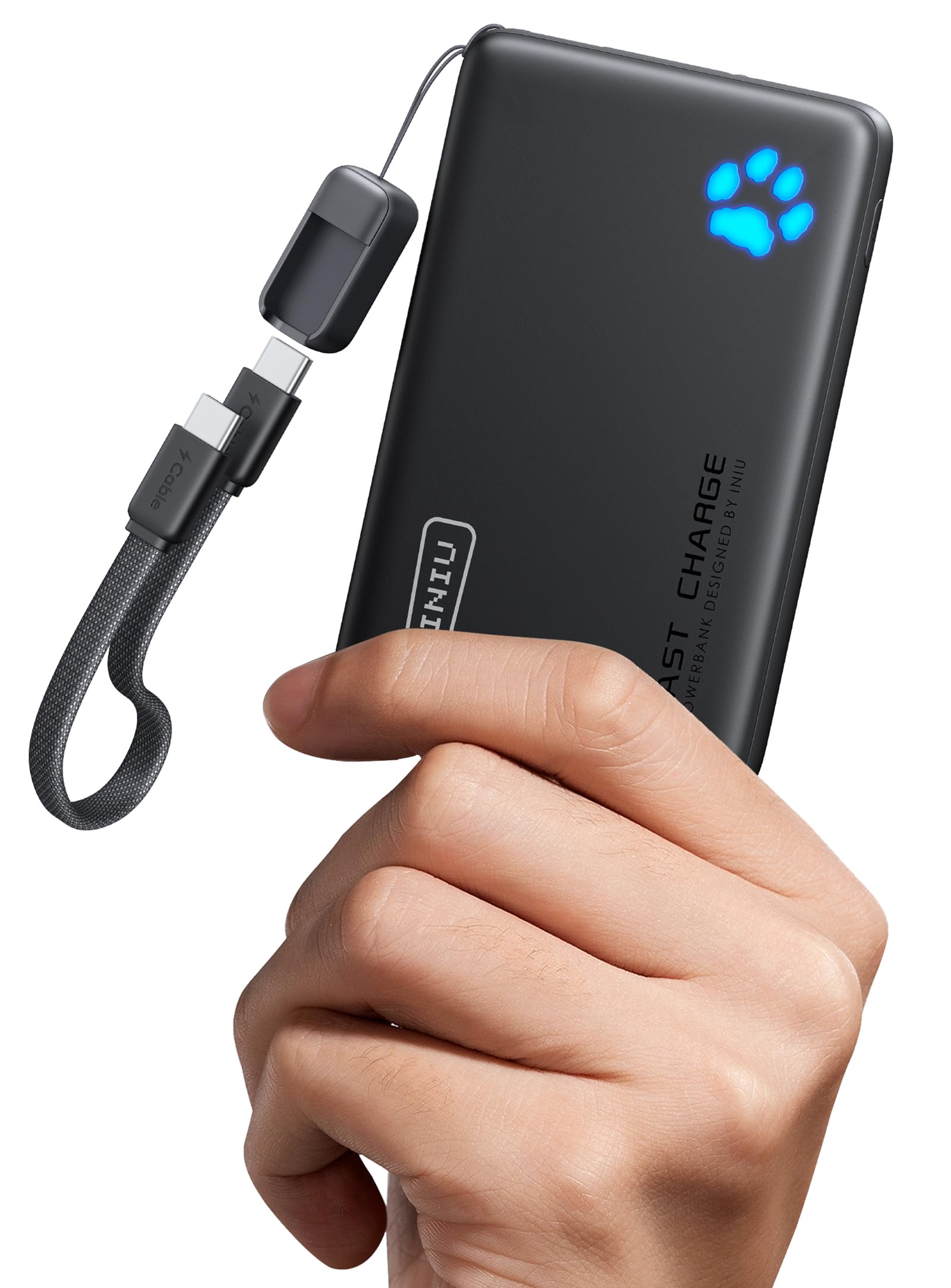
INIU 45W 10000mAh
Rating: 4.5 ★ | Price: $ | Capacity: 10000mAh | Max Output: 45W | Ports: 2C+1A | Built-in Cable: Detachable | Weight: 182g
At 182 grams and about the size of a deck of cards, this is the most compact 10,000mAh power bank we’ve tested that still delivers 45W fast charging. Compared to the top pick with its 20,000mAh capacity and built-in cable, you gain pocketability and a lower price, but you give up overnight endurance and the convenience of a permanently attached cable. The detachable USB-C cord reduces the tangle risk of a separate cable, though it’s not as durable as a fixed one.
This is the right choice for day hikers, commuters, or anyone who wants to top off a phone without adding bulk to a pocket or sling bag. The tradeoff: capacity limits you to one or two full phone charges, and some capacity decline over months has been noted – a factor to consider if you plan to keep it for years without replacing it. Budget-conscious buyers who prioritize weight over raw power will find the value hard to beat.
Pros
- Ultra-compact and lightweight design
- Fast charging for phones
- Solid build quality
Cons
- Capacity insufficient for overnight trips or laptop charging – best for day use only.
- Detachable cable may wear out after repeated use.
For day trips where every gram counts, the INIU delivers fast charging at a price that’s hard to beat – just keep an eye on long-term battery health.
Best for Minimalist Travelers
Anker Nano 3-in-1

Rating: 4.6 ★ | Price: $$ | Capacity: 10000mAh | Max Output: 30W | Ports: 2 USB-C | Built-in Cable: Yes | Weight: 8.82 oz
The Anker Nano 3-in-1 solves the problem of carrying separate wall chargers and cables for short trips. It charges an iPhone at 30W directly from the outlet, then doubles as a 10,000mAh power bank for a second top-up on the go. That capacity is enough for a full day of typical phone use, but won’t cover multi-day hikes or laptop charging. The built-in cable is convenient until it isn’t – the flex point near the connector can show wear over time. This works best for frequent flyers or everyday carry where weight matters and you’re rarely away from a wall outlet for long.
Pros
- All-in-one design replaces a separate wall charger and cable
- Compact enough to fit in a palm for flights and daily bags
- 30W output charges an iPhone to 50% in about 30 minutes
Cons
- The built-in cable may wear at the connector point over months of use
- 10,000mAh capacity covers a single phone for a day, not multi-day trips
Ideal for minimalist travelers who want one device to cover wall charging and backup power, provided the capacity limits and cable longevity fit your usage pattern.
Best for Budget Laptop Users
UGREEN 25K 145W

Rating: 4.4 ★ | Price: $$ | Capacity: 25000mAh | Max Output: 145W | Ports: 2C+1A | Built-in Cable: No | Weight: 1.11 lb
For laptop users on a budget, this UGREEN offers 140W USB-C PD 3.1 output — enough to charge a MacBook Pro 16" to 56% in 30 minutes — and 25,000mAh capacity for multi-day trips. The unit is relatively compact for its power class. However, long-term durability is a question: some units show capacity loss after months, and quality control is less consistent than the smaller 20K version from the same brand. That makes it best suited for short-term use or as a travel companion rather than a daily driver for years.
Pros
- Charges a MacBook Pro 16" to 56% in 30 minutes via 140W USB-C PD 3.1.
- Holds enough power for multi-day trips while still fitting in a backpack.
- Smaller than most 25,000mAh packs, reducing bulk for its capacity.
Cons
- At 1.11 lb, the weight is noticeable in a day pack – fine for laptop bags but not ultralight hikes.
- Long-term capacity retention varies; occasional reports of degradation after months of use.
Best suited for budget-conscious laptop users who need high power for short trips or occasional use, but not for those seeking a long-term daily charger.
Best for Wireless Charging Fans
Anker MagGo 10K
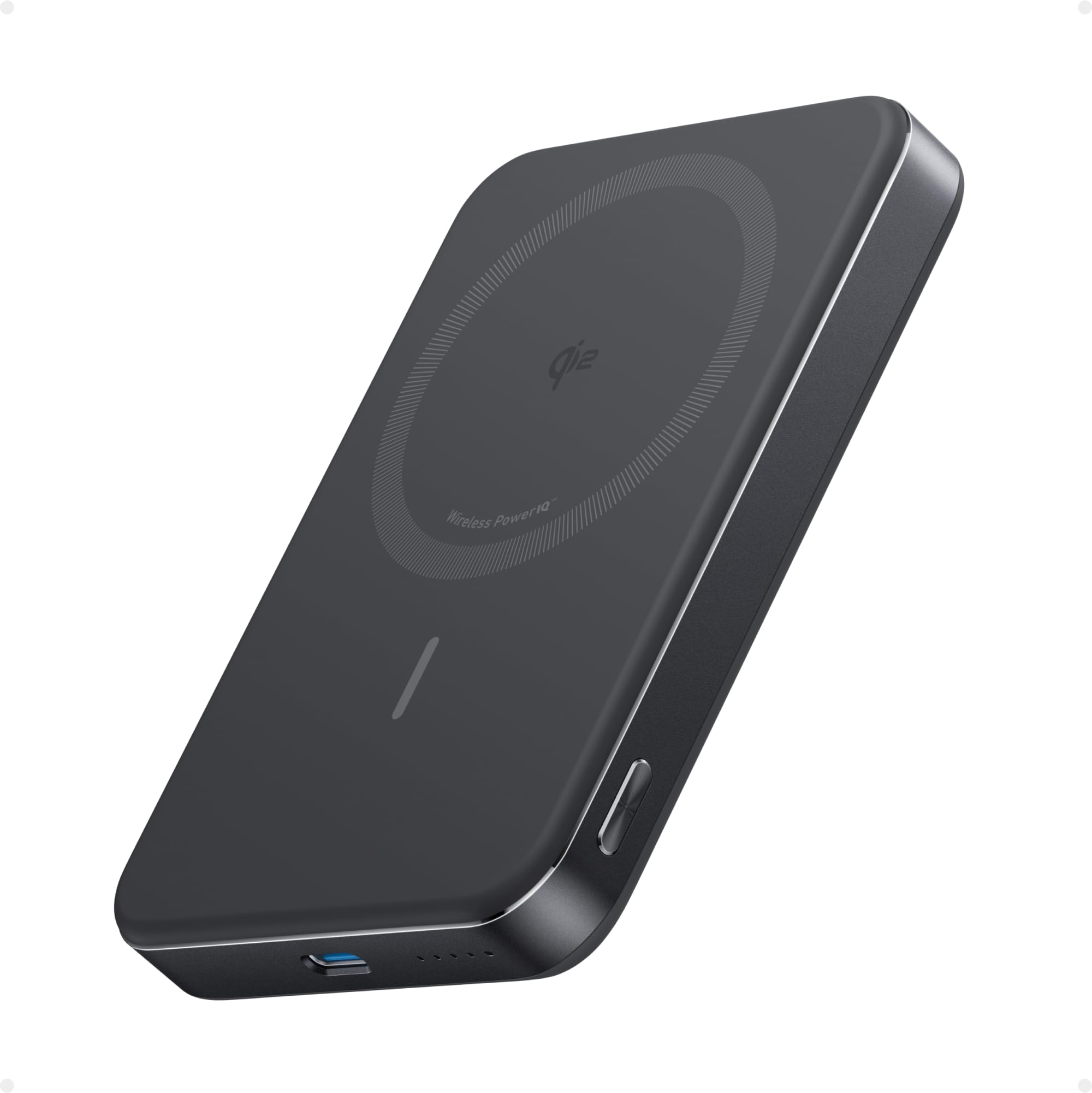
Rating: 4.5 ★ | Price: $$ | Capacity: 10000mAh | Max Output: 30W | Ports: 1 USB-C | Built-in Cable: No | Weight: 199g
The Anker MagGo Power Bank pairs a slim 199g design with strong magnetic attachment and Qi2 certified 15W wireless charging, making it a tidy companion for iPhone users who want to ditch cables around the home or office. Wireless charging generates enough heat to slow the charging speed, so this unit is better suited for topping off during short trips or at a desk rather than extended outdoor use. Its 10,000mAh capacity provides a single full charge for most iPhones — enough for a day out with light phone use. Those who need faster charging or higher capacity should consider a wired power bank, but the MagGo delivers on its promise of convenient, cable-free power.
Pros
- Ultra-slim and lightweight — easy to slip into pocket.
- Reliable magnetic attachment — strong magnet holds phone securely.
- Qi2 certified fast wireless charging — charges iPhone 15 to 50% in 44 minutes.
Cons
- Heavier than expected for a 10K wireless unit — some find it bulky on phone.
- 10,000mAh capacity is modest — may not fully charge larger phones or multiple devices.
Best suited for everyday wireless charging at home or the office where convenience matters more than speed — not for extended outdoor use where heat is a concern.
Best for Car Campers
OHOVIV 50K 22.5W
Rating: 4.5 ★ | Price: $ | Capacity: 50000mAh | Max Output: 22.5W | Ports: 4 built-in cables | Built-in Cable: Yes | Weight: 1.07 lb
The OHOVIV 50K packs a 50,000mAh battery and four built-in cables (Lightning, USB-C, Micro, USB-A) at a price that undercuts most competitors. Compared to the top pick Anker 20K, you get more than double the capacity and no need to carry separate cables, but the tradeoff is a slower 22.5W charging speed and a hefty 1.07 lb weight. This is a power bank for situations where battery life matters more than speed.
This power bank is best suited for car campers, group trips, or as an emergency power stash. If you’re packing for a weekend at a campsite with multiple devices to charge — phones, tablets, maybe a handheld game — the 50,000mAh capacity will keep everyone powered for days. However, the slow 22.5W output means it’s not ideal for quickly topping up a modern phone or laptop. The weight and bulk also rule out day hikes or backpacking. And expect to leave it plugged in overnight to recharge — it takes many hours to fill the massive battery.
Given the capacity per dollar, this is one of the most cost-effective options on the market. The built-in cables add convenience that standalone units lack. Just keep expectations around charging speed in check — it’s a slow and steady provider, not a quick booster.
Pros
- Enough capacity to charge a phone over ten times on one full charge.
- Built-in cables for Lightning, USB-C, Micro, and USB-A remove the need to carry separate cords.
- Low price per mAh makes it a budget-friendly choice for high capacity.
Cons
- Self-charging the 50,000mAh battery takes many hours — plan to leave it plugged in overnight before use.
- At 1.07 lb, it’s too heavy for day packs or hiking — better suited for car camping where weight isn’t a concern.
- 22.5W maximum output is slow for modern phones and laptops — expect top-ups to take longer than with faster chargers.
For car campers and group trips where capacity matters more than speed, the OHOVIV 50K delivers unmatched value with built-in cables — just don’t expect fast top-ups or a lightweight pack.
Best for Cable-Mess Haters
Anker Nano Retract

Rating: 4.6 ★ | Price: $$ | Capacity: 10000mAh | Max Output: 45W | Ports: 2C+1A | Built-in Cable: Retractable | Weight: 8.2 oz
The Anker Nano Portable Charger delivers 45W fast charging through a built-in 2.3 ft retractable USB-C cable, making it one of the most cable-friendly power banks for pocket or bag. The compact shape fits easily in a hand or small pouch, and the 10,000mAh capacity provides a full charge for most phones. However, the 8.2 oz weight feels dense for its size, and the retractable mechanism may wear over extended use – a trade-off for the convenience. This is a capable day-trip companion but not a solution for multi-day trips or laptop charging.
Pros
- Built-in retractable cable eliminates cable clutter
- Compact and easy to slip into a pocket or small bag
- Fast 45W charging tops up iPhone 16 Pro to 50% in 27 minutes
Cons
- At 8.2 oz, the dense build is noticeable in a pocket – less of an issue in a bag
- The retractable cable mechanism may weaken with repeated use over months
Best for daily commuters and travelers who prioritize cable organization over maximum capacity – not a multi-day or laptop charging companion.
Best for All-Around Hiking
Anker 20K 87W
Rating: 4.6 ★ | Price: $$ | Capacity: 20000mAh | Max Output: 87W | Ports: 2C+1A | Built-in Cable: Yes | Weight: 15.5 oz
The Anker 20K 87W gives portable-power buyers the mix that matters most: enough capacity for extended phone use, enough output for smaller laptops, and one fewer cable to pack. Its built-in USB-C lead is the practical differentiator, especially for travel and hiking setups where loose cables are easy to forget or bury in a bag.
The 87W total output gives it more range than basic phone-first power banks. A 65W single-port ceiling puts it in the useful zone for devices like a MacBook Air, iPad, Android tablet, or fast-charging phone, while the extra ports let you split power when topping off more than one device.
The 20,000mAh capacity keeps it in the sweet spot for portable battery packs under the travel-oriented threshold. It can cover multiple phone charges or add meaningful runtime to a light laptop without moving into power-station territory, which is the line this category should not cross for hikers and carry-on travelers.
Build quality is a major part of the appeal. The shell, cable integration, and charging behavior give this model a more confidence-inspiring feel than bargain multi-cable banks, where convenience can come with weaker long-term durability. The built-in cable also reduces the chance of carrying the wrong cord for a USB-C-first kit.
This is for hikers, commuters, and travelers who want one mid-range power bank that can handle phones, tablets, and lighter laptops without packing a separate cable. It weighs 15.5 oz and does not support pass-through charging, so ultralight packers and anyone who wants to charge the bank and a device from one wall outlet at the same time should choose around those boundaries.
Pros
- Carries enough capacity for multi-device travel without becoming a power station.
- Fast enough for phones, tablets, and light USB-C laptops.
- Built-in USB-C cable reduces the need to pack a separate cord.
- Sturdy construction supports regular travel and outdoor carry.
- Mid-range pricing gives strong value for 20K capacity and laptop-capable output.
Cons
- Pocket carry feels bulky at 15.5 oz; bag carry suits it better.
- Overnight outlet sharing is less convenient without pass-through charging.
The Anker 20K 87W is the right call for buyers who want one portable battery pack for phones, tablets, and light laptops, with cable convenience built in rather than added as an accessory.
Best for All-In-One Cables
charmast 10K Built-in

Rating: 4.6 ★ | Price: $$ | Capacity: 10000mAh | Ports: 3 built-in, 3 ports | Built-in Cable: Yes | Weight: 240g
The charmast 10K Built-in is the convenient all-in-one option for portable phone charging when cable clutter matters more than raw output. Its built-in Lightning, USB-C, and Micro cables make it useful for families, travel bags, and mixed-device households, while the slim 240g body keeps it easy to carry. It sits below the higher-output options here because charging speed is limited to basic 5A shared output, and battery charge can drain while idle. That makes it better for everyday backup power than for heavy power users or anyone expecting laptop-class charging.
Pros
- Built-in cables reduce the need to pack separate cords.
- Slim body fits easily into purses, pockets, and travel organizers.
- Multiple outputs help charge mixed device types from one pack.
Cons
- Modern phones may charge slower than buyers expect from a current power bank.
- Stored charge may drop over a few days between uses.
This is a practical mid-range power bank for travelers and households that value built-in cable convenience over high-output charging.
How to Choose
The single most important buying insight: The advertised capacity is not the usable capacity – expect 60-70% real-world efficiency due to conversion losses and voltage step-up.
Capacity (mAh)
Higher capacity means more weight and longer self-charge time. A 10,000mAh bank typically charges a modern phone 1.5–2 times, while 20,000mAh covers 3–4 charges plus a tablet. For day hikes, 10,000mAh is plenty; overnight trips demand 20,000mAh or more. Beyond that, the weight penalty grows faster than the capacity benefit – a 50,000mAh bank weighs over a pound and takes 8+ hours to recharge itself.
Max Output (W)
Wattage determines how fast your device charges, but only if the device supports that speed. Most phones peak at 20–30W, so a 100W bank doesn’t charge a phone any faster than a 45W one – it only benefits laptops and tablets. For hiking, 30–45W is sufficient for phones; if you carry a USB-C laptop (like a MacBook Air), look for 65W+ single-port output.
The trade-off: higher wattage banks are often larger and heavier due to beefier circuitry. Don’t pay for 100W if you only charge a phone – the extra weight and cost buy nothing useful on the trail.
Ports
More ports let you charge multiple devices simultaneously, but total output is shared. A bank with two USB-C ports may split 65W into 45W + 20W when both are in use. For hiking, two ports (one for a phone, one for a headlamp or camera) is usually enough. Avoid banks with only a single port unless you’re fine with sequential charging.
Built-in cables effectively add a dedicated port without needing a separate cable. However, if the built-in cable fails, you lose that port – a detachable cable or separate ports offer redundancy.
Built-in Cable
Built-in cables eliminate the need to carry a separate charging cable – a real convenience when packing light. However, they become the first failure point: cables fray, connectors loosen, and the bank becomes useless until repaired. Detachable built-in cables (like on the INIU) mitigate this, but fixed cables are a gamble for long-term durability.
For hiking, a built-in cable is a trade-off: less clutter vs. higher risk. If you’re rough on gear (e.g., stuffing in a pack with cookware), consider a bank with a detachable cable or no built-in cable at all.
Weight and Size
Weight is the most overlooked spec for hikers. A 10,000mAh bank weighs 180–240g (0.4–0.5 lb) – that’s a water bottle’s worth. A 20,000mAh bank jumps to 400–500g (0.9–1.1 lb). For ultralight trips, every ounce matters; a 10K bank is the limit for pocket carry. For base camp or car camping, weight is less critical, and higher capacity is justified.
The shape also matters: a slim, flat bank fits in a hip pocket, while a thick brick stays in the pack. Consider how you’ll store it – on the move, a bank you can reach quickly is more useful than one buried in your backpack.
FAQ
Why does my power bank lose capacity after a few months?
Lithium-ion batteries degrade with charge cycles and heat. Most banks use 18650 or pouch cells rated for 300–500 cycles before hitting 80% capacity. If you charge your phone daily from the bank, you’ll notice a drop after about a year. Heat accelerates this – storing a power bank in a hot car or using it while charging in direct sun can cut lifespan in half. Expect ~20% capacity loss after 1–2 years of regular hiking use.
Can a 10000mAh power bank charge a laptop?
Generally no. Laptops require around 45–100W of input, and most 10,000mAh banks max out at 18–30W. Even if the wattage matches, the voltage needs to be 20V (USB-C PD), which smaller banks often don’t support. Some ultra-low-power laptops like the MacBook Air can trickle-charge from a 30W bank, but it will be slow and may not keep up during use. For reliable laptop charging, choose a bank with at least 20,000mAh and 45W+ output.
Is it safe to use a power bank while hiking in hot weather?
Yes, but with precautions. Lithium-ion batteries perform best between 0–35°C. In direct sun or against a hot backpack, internal temperature can rise above 50°C, causing the battery management system to throttle charging or shut down. Heat also permanently degrades capacity. Keep the bank in the shade, inside a pack pocket away from your body, and stop charging if the bank feels uncomfortably hot to touch. Wired charging generates less heat than wireless.
Why does my magnetic wireless power bank get so hot?
Wireless charging is inherently less efficient than wired – typically 70–80% vs. 90–95%. The lost energy dissipates as heat. Additionally, the battery itself heats up during discharge, compounding the warmth. On a magnetic bank that sits directly against your phone, that heat has nowhere to go. This slows charging speeds (the phone may reduce wattage to protect itself) and can degrade battery health over time. For outdoor use where temperature is a concern, wired charging is the safer, faster choice.