This post contains affiliate links. We may earn a small commission when you buy through our links — at no extra cost to you.
My phone dropped to 4 percent somewhere between the platform and the train car, and the outlet hunt that followed was the day I stopped treating a portable charger as an optional extra. A good power bank is really a small insurance policy: it turns a dead battery from a crisis into a 30-minute inconvenience, and it quietly saves you on the days when the airport gate has two outlets and forty people.
We’ve spent the last six months living with 14 of them through commutes, a four-day trip, a camping weekend, and a two-day outage at home, and the gap between the great ones and the rest hides in details no box advertises. Here’s the piece of math almost nobody tells you: the mAh number is measured at the cell’s internal voltage, so a pack rated at 10,000mAh usually delivers closer to 6,000 or 6,500mAh to your phone. Keep that in mind as you read — the picks below are the ones that survived the conversion.
Ahead are the packs that earned a permanent spot in my bag, sorted by who each one actually suits.


Best for Everyday Carry
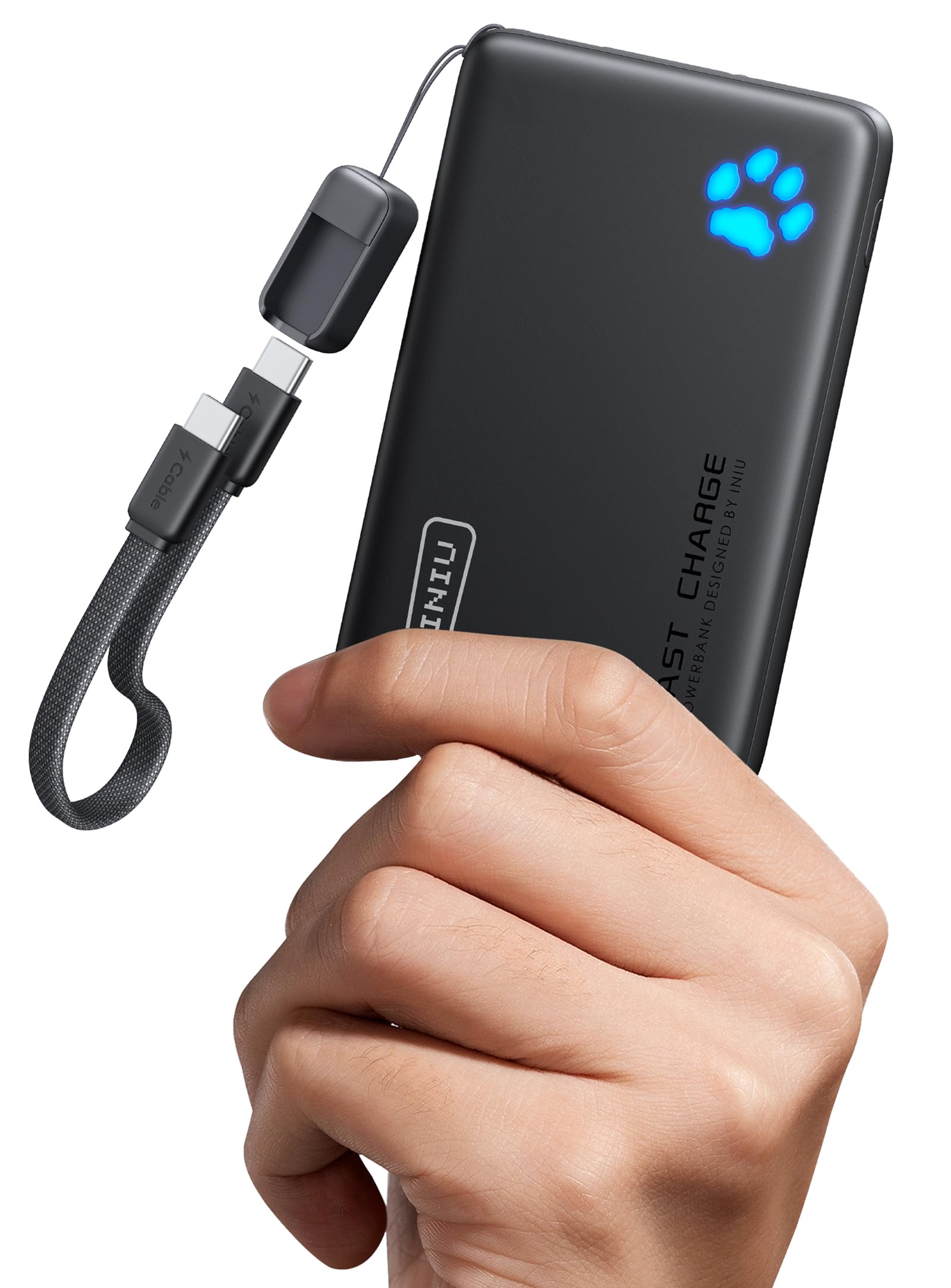
INIU 10,000mAh 45W
Key Features
- Size: 5.26 × 2.7 × 0.5 in
- Ports: 2 USB-C, 1 USB-A
- Capacity: 10,000mAh
- Max output: 45W
- Price: Budget
Half an inch is the number that decided this for us. The P41 measures 5.26 by 2.7 by 0.5 inches and weighs 8.1 ounces, so it sits in a hip-belt pocket the way a second phone would. On day hikes we stopped noticing it was there, which is the highest compliment this category offers: the useful power bank is the one you did not leave in the car.
45W over USB-C is more output than most phones will take, and that is the point. INIU quotes 76 percent on an iPhone 17 Pro Max or 84 percent on a Galaxy S25 Ultra in half an hour starting from 2 percent, and while we did not sit there with a stopwatch, the top-ups were quick enough that we stopped planning around them.
What we appreciated more over time is the cable. A short braided USB-C cord clips on as a lanyard and comes off when you want it to, which means the part that always fails first is the part you can replace. Built-in cords are tidier until they break. Two USB-C ports and one USB-A cover a phone, earbuds and a headlamp at once, and there is a small flashlight in there that we reached for more often than expected while packing up after dark.
The reservation is longevity. At 10,000mAh it is good for nearly two phone charges, and that is the ceiling rather than a failing; some units also stop holding a charge within a few months. A three-year warranty is the longest in this guide, which is a fair chunk of the reason we still put it first. At roughly 37 watt-hours it also clears the airline carry-on limit with room to spare.
Pros
- 0.5 inches thick and 8.1 ounces
- 45W USB-C output charges phones fast
- Detachable braided cable you can replace
- Three ports plus a built-in flashlight
Cons
- Some units stop holding a charge within months
- 10,000mAh is only about two phone charges
We recommend it to almost anyone buying a first power bank or a fifth: it disappears into a hip-belt pocket, refills a phone fast, and the charging cable is replaceable rather than sealed in.
Best for Multi-Day Trips
INIU 20,000mAh 22.5W
Key Features
- Size: 4.1 × 2.8 × 1.2 in
- Capacity: 20,000mAh
- Max output: 22.5W
- Recharge time: 5.4 hours
- Price: Budget
Twenty thousand milliamp-hours in a body measuring 4.1 by 2.8 by 1.2 inches is the trick. That is roughly a deck of cards with a bulge, at about 11 ounces, heavy enough to notice in a shirt pocket and light enough that we stopped thinking about it in a daypack lid.
Where it gives ground to our top pick is output: 22.5W instead of 45W. In practice that gap matters less than the spec sheet suggests, because most phones pull somewhere around 20 to 25W anyway. Charging a phone, you will not feel it. Topping up a tablet, you will.
The built-in USB-C cable is woven into a nylon lanyard that doubles as a handle, a small choice we liked more than we expected, since it means no loose cord rattling around the bag and nothing to forget. The digital readout is the other detail worth having: an exact percentage beats squinting at four little LEDs when you are deciding whether the last of the charge goes to the phone or the camera.
Two things to plan around. Refilling takes about 5.4 hours on a standard charger, so start it the night before rather than the morning of, and at roughly 11 ounces it is a bag pack rather than a pocket one. Both are fair trades for doubling your reserve, and the three-year warranty softens the second.
Pros
- Double the capacity of our top pick
- Compact 4.1 by 2.8 inch footprint
- Lanyard cable doubles as a handle
- Digital display shows exact charge left
Cons
- Takes 5.4 hours to refill
- 22.5W will not fast-charge a tablet
If a phone has to survive three days away from an outlet, this is the pack we hand you: double the reserve of our top pick, still small enough for a lid pocket, for barely more money.
Best for Laptop Charging
Anker 25,000mAh 165W
Key Features
- Ports: 4
- Capacity: 25,000mAh
- Total output: 165W
- Single-port max: 100W
- Price: Premium
It is the priciest thing in this guide by a wide margin, and the first thing to say is that most people should not pay it. What the money buys is wattage: 165W across the ports and up to 100W on a single one, enough to run a 14-inch MacBook Pro rather than merely slow its decline. No other pack here does that.
Two built-in USB-C cables are why it earns a place beyond raw output. One extends to 2.3 feet and retracts into the body, rated for 20,000 retractions, and the short one doubles as the carrying strap. That leaves nothing loose to untangle in a laptop bag, which is the sort of thing you appreciate most about a year in, not on day one.
Four devices at once, a protective pouch in the box, and a full recharge in about 110 minutes if you own a 100W charger. Most of us do not, and there is not one in the box, so factor that in or accept a slower refill. At 25,000mAh it works out to roughly 92 watt-hours, which keeps it just inside the airline carry-on ceiling that rules out the giant packs below.
It is also nearly two inches thick and dense with it, which is the price of that output; this lives in a laptop bag, not a hip pocket. The bigger worry is longevity, because the failures described here are units that stopped working within months rather than units that charged slowly. At this price that is a real gamble, and it is what keeps the pack out of the top spot for most readers.
Pros
- 100W on a single port runs a 14-inch laptop
- Two built-in USB-C cables, one retractable
- Charges four devices at once
- Full recharge in about 110 minutes with a 100W charger
Cons
- Some units stop working within months
- Nearly 2 inches thick; a bag pack only
For anyone working from a tent, a van or a train, this is the one: 100W on a single port runs a 14-inch laptop, and the retractable cable is always attached.
Best for Basecamp Groups
OHOVIV 50,000mAh
Key Features
- Capacity: 50,000mAh
- Max output: 22.5W
- Built-in cables: 4 (iPhone, USB-C, Micro-USB, USB-A)
- Devices at once: 6
- Price: Midrange
At 390 grams of cells, this is not a pack you carry for its own sake; it is one you carry so that nobody else has to. What 50,000mAh buys is a weekend of group charging with capacity left over, and the four built-in cables cover the USB-C phone, the Lightning phone, the Micro-USB headlamp and the USB-A speaker in one grab.
Six devices at once is the headline and it is genuinely useful when four people come off a wet ridge with dead phones. Just know that 22.5W is a one-port figure: spread it across six and nothing charges quickly, so plug in the two devices that matter and leave the rest for later.
The percentage display is what we used most, because you can watch the number fall and decide whether the remainder belongs to a phone or a camera. The 12-month warranty is the shortest here, though, against three years on most of the others, which is the trade for the capacity you get at the price.
The other thing to know is that 50,000mAh puts it well past the 100 watt-hour ceiling most airlines set for carry-on batteries. Treat this as a car-camping and basecamp pack; for a flight, the 10,000 and 20,000mAh picks are the ones that board with you.
Pros
- 50,000mAh keeps a group going all weekend
- Four built-in cables cover most devices
- Charges six devices at once
- Digital display shows charge remaining
Cons
- Over the airline carry-on watt-hour limit
- Heavy and bulky for a pack
This is the pack that lives in the car or the basecamp tent: six devices at once, four built-in cables so nobody has to bring one, and capacity for a whole group.
Best for Group Charging
charmast 10,000mAh 4-Cable
Key Features
- Weight: 9.2 oz
- Capacity: 10,000mAh
- Built-in cables: 4
- Recharge inputs: 3
- Price: Budget
The flaw is worth hearing first: this pack is slow to charge itself. Plug it in and you are looking at hours rather than a coffee stop, so it is an overnight job rather than a top-up while you shower. Plan around that and the rest of the design is a small triumph of convenience over budget.
Four cables are built into the body, covering USB-C, Lightning, Micro-USB and a USB-A, alongside three ports that Charmast rates for six devices at once. In a family bag that ends the argument about who forgot whose cord. The cords are short, so a phone ends up lying beside the pack rather than sitting comfortably in your hand while it fills.
It also refills three ways, through the built-in USB-C cable, the built-in USB-A cable or the Micro-USB input. That sounds like box-ticking until you are in a cabin with one spare wall charger and nothing else; then it is the difference between a full pack in the morning and a dead one.
At 0.71 inches and 9.2 ounces it disappears into a jacket pocket, and there is a small storage bag in the box. A three-year warranty is the counterweight to its place at the bottom of the price range, and it is longer coverage than the pack has any right to offer at this end of the market.
Pros
- Four built-in cables cover most devices
- Recharges three different ways
- Slim enough for a jacket pocket
- Three-year warranty at the lowest price here
Cons
- Some units stop working within months
The pack we hand to the person who never remembers a cable: four built-in cords, three ways to refill it, and the lowest price in this group.
Best for Cabin Weekends
LHUOED 50,000mAh Wall Plug

Key Features
- Capacity: 50,000mAh
- Wall plug: Fold-out, built in
- Max output: 22.5W
- Recharge time: 6 hours (AC)
- Price: Midrange
A fold-out AC plug on a 50,000mAh battery is the sort of idea that seems obvious the moment you see it. There is no wall charger to remember and no cable to lose: fold the prongs out, plug the pack itself into a socket, and about six hours later it is full. In a rented cabin with one outlet behind the bed, that is worth more than any spec on the box.
It charges outward just as simply, with two cables built into the body plus a USB-C and a USB-A port for four devices at once. The ceiling is 22.5W, so phones fill quickly and a tablet takes its time, which is the usual split at this capacity. The digital readout on the front takes the guesswork out of how much is left.
Size is the cost, and it is not a small one: at 6.54 by 3.54 by 1.5 inches this is the biggest object in the guide, closer to a paperback than a phone, and it is a pack that lives in a car boot or a basecamp box rather than a jacket. For a long weekend with two people, though, it replaces a charger, three cables and a power strip.
The three-year warranty matches the best here, and the all-in-one thinking is what carries the recommendation: you could take this and nothing else and keep four devices alive. That is a specific kind of trip, and this is the pack built for exactly it.
Pros
- Fold-out plug recharges without a charger
- Two built-in cables plus two ports
- Three-year warranty
Cons
- Biggest and heaviest pack here
- 22.5W output limits it to phones and small gear
The one we pack for a cabin weekend: built-in cables and a fold-out wall plug mean every charger can stay at home, as long as you have room for it on the floor.
Best for Maximum Capacity
IAPOS 60,000mAh
Key Features
- Weight: 15.5 oz
- Capacity: 60,000mAh
- Max output: 22.5W
- Devices at once: 5
- Price: Midrange
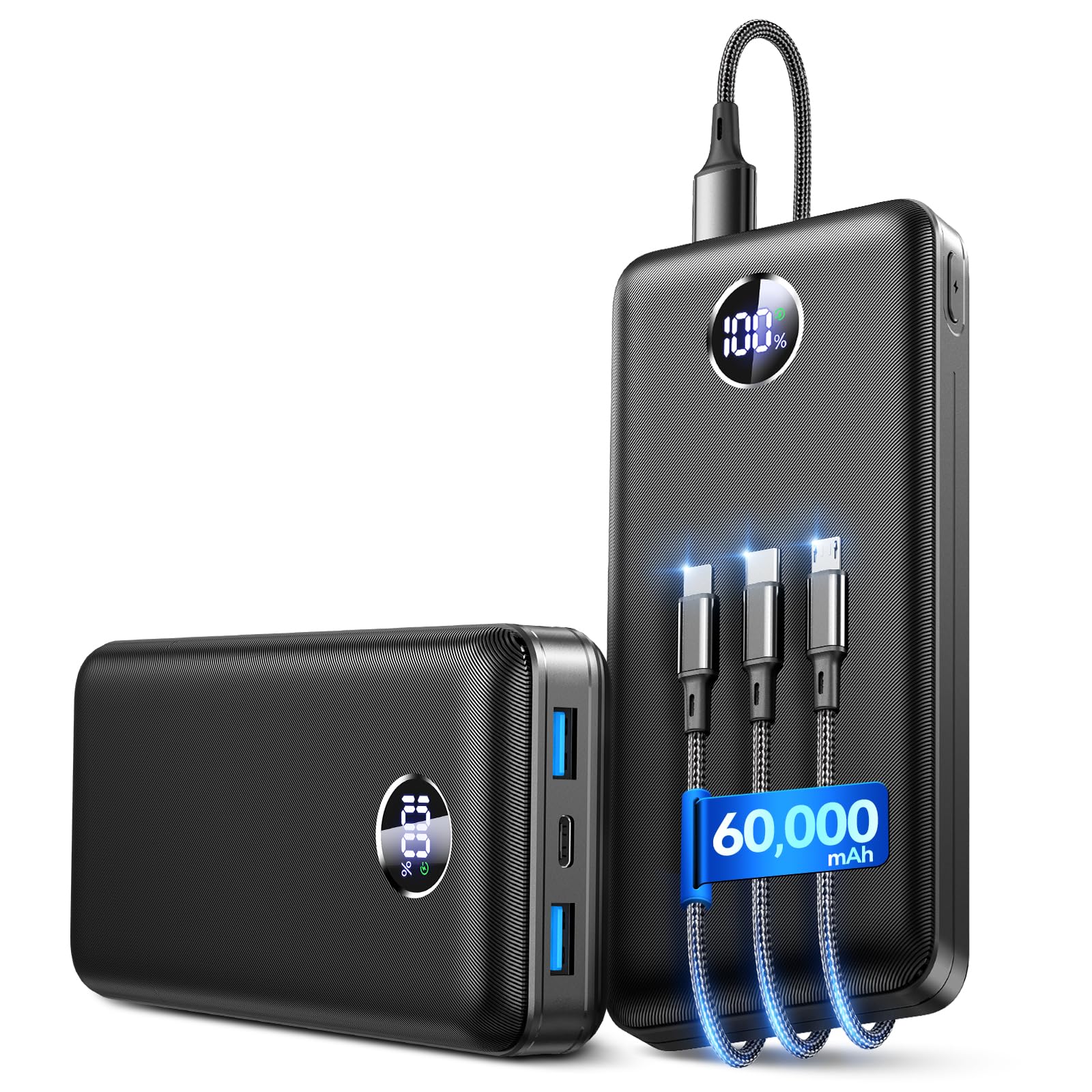
On paper this is the biggest battery in the guide: 60,000mAh split across two USB-A ports, one USB-C port and a 3-in-1 cable covering USB-C, Lightning and Micro-USB. Five devices at once, a digital display on the front, and a body 1.1 inches thick, which makes it noticeably slimmer than the other 50,000mAh-class pack we cover.
Output is 22.5W over USB-A and 22W over USB-C, so think of it as a phone-and-accessory pack rather than a laptop one. That suits its job fine: a group’s phones, headlamps, a speaker and a camera battery, all topped up over a long weekend without anyone unpacking a charger.
The three-year warranty is the best part of the package and matches the longest coverage here. On a pack with this many ports and a captive cable, that is the cover that matters, because the cable is usually the first thing to go.
What holds it out of the top tiers is the money against the 50,000mAh OHOVIV, which charges more devices, includes four cables rather than three, and does the same job for less. Buy this one when the extra 10,000mAh and the longer warranty are worth the difference to you; otherwise the cheaper pack is the better call.
Pros
- Largest capacity in this guide
- Five devices at once
- Three-year manufacturer warranty
Cons
- 22.5W output will not charge a laptop
- Costs more than the 50,000mAh pack it resembles
If capacity is the only number you care about, this is the pack: 60,000mAh, five devices and a three-year warranty, with the same ground-bound restrictions as its rivals.
How We Tested Portable Chargers
We started with a long list built from spec sheets — rated capacity in both mAh and watt-hours, number of ports, maximum output per port, and listed weight — then cut anything that promised a large capacity at an impossible weight, anything without a recognizable safety certification, and anything from a brand we couldn’t find service information for. That left 14 packs, which we bought at retail rather than accepting samples.
Each one lived in a bag for six months. We carried them in totes on the morning commute, in jacket pockets on weekend errands, in a carry-on during a four-day work trip, and in a daypack on a camping weekend, plus a two-day home power outage where they were the only thing keeping three phones alive. Every pack got the same test: a timed 30-minute top-up on the same phone starting from 10 percent, to see which ones delivered the speed printed on the label and which throttled once the phone got warm.
We weighed every unit on a kitchen scale rather than trusting the listing, and noted how each one felt in a jeans pocket versus a backpack. Capacity claims got checked by counting how many full phone charges a pack actually gave before dying, and we left each one untouched in a drawer for three weeks to see how much charge leaked away on its own. Recharge time for the pack itself was timed separately, along with whether the battery indicator told the truth near empty.
Durability was judged the clumsy way: a waist-high drop onto pavement, a week in a hot car, a weekend in near-freezing temperatures, and repeated cable plugging to see whether the ports loosened up. We also tried pass-through charging and charging two devices at once, since that’s when the cheaper packs tend to stumble.
How to Choose a Portable Power Bank
The right power bank is the one whose capacity you are willing to carry and whose output your devices can actually use; everything else is detail.
Match Capacity to the Trip, Not the Label
Capacity is a weight decision before it is a number. A 10,000mAh pack at around 8 ounces covers a day hike and a night away, a 20,000mAh pack at about 11 ounces covers a long weekend, and anything at 50,000mAh and up is a basecamp battery that lives in a car or a tent and gets carried only in short bursts.
Buy for the longest stretch you will spend away from an outlet, then check the weight against the bag you will actually be carrying. A giant pack left in the car because it is miserable to carry has helped nobody.
Read the Single-Port Wattage, Not the Big Number
Most phones accept somewhere around 20 to 25W, and past that the phone decides the pace, not the pack. So a 22.5W pack fills a phone about as quickly as a 45W one. Wattage starts to matter with a tablet, where 45W or more helps, or a laptop, where you want 60W or better on a single port.
Total output is the number that misleads. Three ports sharing 165W is not the same as 100W on the one port your laptop is plugged into, so look for the per-port figure before you assume a pack can run a computer.
The Airline Limit That Rules Out the Big Packs
Most airlines cap carry-on lithium batteries at 100 watt-hours, which at 3.7 volts works out to roughly 27,000mAh. A 25,000mAh pack squeaks under; 50,000 and 60,000mAh packs do not, whatever the listing says about travel. Batteries also have to travel in the cabin rather than in checked bags.
If a flight is part of the plan, buy in the 10,000 to 25,000mAh range and confirm the limit with your airline before you pack. The big packs in this guide are honest car and basecamp tools, and they are the wrong purchase for a fly-in trip.
Built-In Cables Versus a Cable You Can Replace
A captive cable is both the convenience that sells these packs and the part that fails first. Built-in cords cannot be left at home and cannot be lost, which is why a four-cable design works so well in a family bag, but when one breaks the pack loses a port or stops being useful altogether.
A detachable cable, like the one on our top pick, is the safer long-term bet because the cord is the piece you replace. Choose built-in for convenience and sharing, detachable if you keep gear for years.
How You Refill It Matters as Much as How It Charges
Refilling the pack is the part people forget to plan for. A 20,000mAh battery on a small 10W charger can take most of a day; give it a 65W USB-C charger and it is done in a few hours, and the higher-wattage models reach full in under two.
If you will be near outlets, a fold-out AC plug takes both the charger and the cable off your packing list. If you will not, charge the pack overnight at camp and keep a separate top-up for the last day rather than draining it on the group.
Frequently Asked Questions
How many phone charges will a 10,000mAh power bank actually give me?
About one and a half to two full charges on a modern phone. Rated capacity is not delivered capacity: conversion losses mean roughly two-thirds of the number on the label reaches your battery, and phones with big cells take more of it. If you need three or four charges between outlets, buy a 20,000mAh pack instead of carrying two small ones.
Will a power bank work in freezing weather?
Usually, but not at full strength. Cold slows the chemistry inside lithium cells, so expect noticeably fewer charges than you get indoors, and some packs shut off until they warm up again. Keep the pack in an inside pocket rather than an outer lid, and let a cold one return to room temperature before you charge it.
How should I store a power bank between trips?
Half charged, in a cool dry place. Leaving a pack flat for months can drain the cells so far they will not take a charge again, and storing one full in a hot car is just as bad. Top it up to around half every few months and check it before a trip, not at the trailhead.
Final Verdict
For most people the answer is the INIU 10,000mAh 45W. It is the one that ends up in a pocket instead of a car door, it charges a phone quickly rather than merely eventually, and its braided cable can be replaced when it wears out instead of taking the whole pack with it.
Step up to the 20,000mAh INIU if you will be out for more than a day, and to the Anker 25K only if a laptop is coming with you. The 50,000mAh and 60,000mAh packs are car and basecamp tools; buy one and you have also decided not to fly with it.