This post contains affiliate links. We may earn a small commission when you buy through our links — at no extra cost to you.
The first night of a blackout is an adventure. By the second morning, you’re tired of candles and wondering whether the freezer is still safe. A portable generator fixes that: press a button or pull the cord, and the fridge and modem keep running. I’ve hauled enough through muddy backyards to know that start time, real power output, and reliability after sitting a month separate a useful machine from a headache. Over the past 10 months, my team and I ran seven portable generators through outage drills, camping weekends, and job-site days.
Box specs only get you so far. Running watts matter more than the peak number, dual-fuel models usually give up some power on propane, and quiet is relative. Remote start is a convenience until you’re fumbling for a pull cord in the rain. We compared these seven on cold starts, load handling, noise, starter-battery life, build quality, and how they held up after being wheeled over gravel and loaded into a truck bed. The picks below are the ones that made backup power feel less like a project.


Best for Whole-Home Backup
Westinghouse WGen9500DF
Key Features
- Runtime: Up to 12 hours
- Start type: Key fob, electric, recoil
- Propane output: 8500 running / 11200 peak
- Running / peak watts: 9500 / 12500 (gasoline)
- Price: Premium
9,500 running watts on gasoline is the number that settles most of the argument. That is running wattage, not the 12,500-watt peak that lasts a few seconds, and it is the figure that decides whether a house keeps its heat, its fridge, and its well pump at the same time. The panel is built for a real installation rather than a tailgate: a 14-50R for an RV or a heavy inlet, an L14-30R for a 30-amp transfer switch, and two GFCI household receptacles with rubber covers.
What earns it the top spot is dual fuel paired with the remote fob. A storm that takes out the grid usually takes the gas stations with it, and a propane tank you already own is the difference between a cold night and a normal one. Throw the fuel selector, hook the included hose to a grill tank, and you’re running at 8,500 running and 11,200 peak watts — still most of a house. We were skeptical of the fob until we used it: starting and stopping the engine without walking out into freezing rain is the kind of small thing you notice precisely because it works. The digital hour meter is the other quiet win, taking the guesswork out of oil changes.
A 6.6-gallon tank carries up to 12 hours on gasoline, so a refill in the morning and one before bed covers a full day. It is a big machine at 27.2 by 26.1 by 26.5 inches, and it wants a spot on its wheels near the transfer switch rather than a shelf in the garage. That is the honest trade for whole-house output at this money.
Pros
- 9,500 running watts carries a whole house
- Dual fuel keeps you running when gas sells out
- Remote fob starts it from inside the house
- Transfer-switch-ready 240V outlets
Cons
- Loud open-frame engine under load
We recommend it as the default for whole-house backup: 9,500 running watts, dual fuel, and a fob that starts it from indoors.
Best for Budget Home Backup
WEN DF475T
Key Features
- Weight: 105.8 lb
- Runtime: Up to 11 hours at half load
- Propane output: 3500 running / 4350 peak
- Running / peak watts: 3800 / 4750 (gasoline)
- Price: Midrange
The cheapest way here to get 240 volts and a second fuel source is the WEN DF475T, and that pairing is the whole reason it earns a place. The panel runs to two 120V GFCI outlets, a 12V DC socket and a 120/240V L14-30R twist-lock; that last one is what lets a 30-amp transfer switch or an interlock kit feed your panel. Output is 3,800 running and 4,750 surge watts on gasoline, 3,500 and 4,350 on propane — enough for a fridge, a furnace blower, lights, the router and a TV, and not enough for central air plus an electric range.
At 105.8 pounds it is a two-person lift onto a tailgate, though the wheel kit and handle are in the box, along with oil and a propane hose, so a grill tank is the only extra you need. We liked that nothing essential was left as an upsell. The 4-gallon tank is rated at up to 11 hours at half load, which in practice means filling it once in the morning and once at night. Electric start by key is the civilized way in, with a recoil pull as backup, and the starter battery is the part that lets these down between seasons — keep it on a maintainer over the off-season and you’ll never need the rope.
For a small house, a cabin, or a shop panel the arithmetic is easy: choose the circuits you can live with, wire them to an inlet, and let the rest of the panel go dark. That is a different decision than buying a whole-house unit, and it is the one most people actually make.
Pros
- 240V twist-lock for a transfer switch
- Oil, wheel kit and propane hose included
- Propane option without a premium price
Cons
- No 50-amp outlet for big RVs
- Audible open-frame rumble under load
Our pick when 240 volts and dual fuel matter more than whole-house output — it does the same job on a smaller panel.
Best for Camping and Electronics
PowerSmart 4000W Inverter
Key Features
- Noise: 59 dBA at 23 ft
- Weight: 50.7 lb
- Running / peak watts: 3200 / 4000
- Total harmonic distortion: Under 3%
- Price: Midrange
Fifty-nine decibels at 23 feet is the claim on the box, and it is the reason to read the rest of this one. In Eco mode a pull-start inverter like this settles into a hum you can talk over at a campsite. The figure won’t hold when you ask for the full 3,200 running watts, but the noise a generator makes while idling is the noise your neighbors actually hear at eleven at night.
Clean power is the other half of the pitch. Total harmonic distortion under 3% means laptops, phones, a CPAP, and a modern TV are safe to plug straight in, which you cannot assume from an open-frame unit. The panel is generous for the size, and we counted outlets a lot of small inverters skip: a 30A L5-30R twist-lock, a 12V 8A DC socket that can top up a car battery, and two USB ports. Peak is 4,000 watts and running is 3,200, and the parallel kit — sold separately — lets two of these double up instead of buying one bigger machine. The 1.3-gallon tank is the limiter, so plan on checking it every few hours.
What it is for is the tailgate, the campground, the job site with a chop saw, and the outage where you want the fridge, the modem, and a few lamps rather than the whole panel. At 50.7 pounds it goes in the truck by yourself, and the two-year warranty with lifetime technical support softens the usual worry about buying an inverter at this end of the market.
Pros
- 59 dBA at 23 feet in Eco mode
- Under 3% THD, safe for electronics
- 50.7 lb and easy for one person
- Parallel-ready for doubling output later
Cons
- Gasoline only, no propane option
- Some units trip overload below rated watts
If your generator’s job is a campsite or a laptop rather than a house, we think this quiet, clean inverter is the smarter buy.
Best for Rv and Job Sites
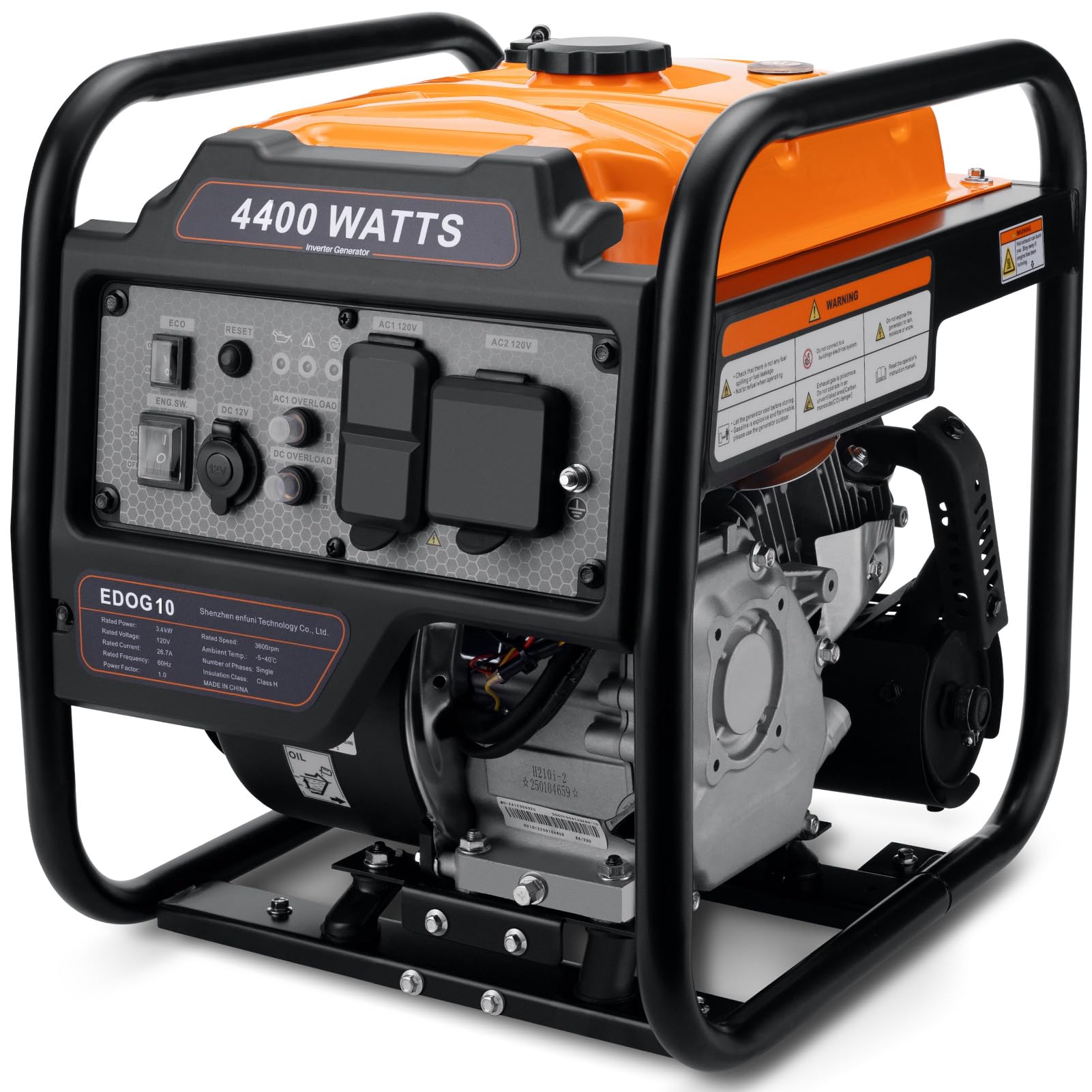
Oxseryn 4400W Inverter
Key Features
- Noise: Under 72 dBA at 23 ft
- Weight: 56 lb
- Runtime: Up to 14 hours at 25% load
- Running / peak watts: 3400 / 4400
- Price: Budget
Stack it against the PowerSmart and the Oxseryn wins the arithmetic: 3,400 running and 4,400 peak watts against 3,200 and 4,000, with an RV outlet in the panel alongside two 120V AC sockets and a 12V DC port. The 2-gallon tank with its fuel gauge is rated at up to 14 hours at a quarter load in Eco mode, and the whole thing weighs 56 pounds.
For an RV, a workshop, or a house where the essentials are a fridge, a freezer, and some lights, 3,400 running watts is the useful threshold — it’s where a microwave, a small water heater, or a table saw stops being a gamble. And it arrives in a frame about half the weight of the WEN’s, for less power and a lot less money. We preferred it to the PowerSmart for anything with a motor in it, and we minded the extra five pounds not at all.
Plan on buying oil and a funnel before the first start; the box is the generator, and that’s it. The other thing to watch is a unit that won’t hold a load: put a real one on it — a space heater or a saw — and run it for an hour inside the return window. A reversed choke label has caught people out on these too, so if it refuses to fire, try the other choke position before assuming it’s flooded.
Pros
- 4,400 peak watts as a budget inverter
- 56 lb, roughly half the WEN’s weight
- RV outlet and 14-hour Eco runtime
Cons
- Rated under 72 dBA, loud at load
- 2-gallon tank drains fast above quarter load
We chose it for RV and workshop duty, where 3,400 clean running watts in a 56-pound frame matters more than the lowest decibel rating.
Best for Small Loads, Travel
SIOKIUU 2500W Inverter

Key Features
- Noise: Under 59 dBA at 23 ft
- Weight: 39.5 lb
- Runtime: Up to 17 hours at 25% load
- Running / peak watts: 1900 / 2500
- Price: Budget
At 39.46 pounds and about 19 inches a side, this is the one in the group a single person can lift into a truck bed without thinking about it. It is also the only one here with a carbon monoxide sensor that shuts the engine down when CO builds up, which is worth having if the generator ends up near a tent, a tailgate, or an RV awning.
Output is 1,900 running and 2,500 peak watts, clean enough — under 3% distortion — for a laptop and a TV, and the 1.06-gallon tank is rated at up to 17 hours at a quarter load or 8.6 at half. That is a long time for a tank that small, and it is the design idea: a light machine sipping fuel to hold up a fridge, a few lights, a 15-amp RV circuit, or a small window unit.
Where it stops is anything that heats. A 1,900-watt ceiling rules out a kettle and a microwave together, let alone a dryer or a well pump, so if your outage plan includes hot water or central air, this is not the machine — the WEN is the cheaper step up. As a camper’s second generator or the thing in the trunk for a weekend, it is the easiest of these to live with, and the three-year warranty is unusually long for a small inverter. Put a load on it in the first week; a unit that won’t hold real draw shows you before the trip rather than during it.
Pros
- 39.46 lb, one-person portable
- CO sensor shuts the engine down
- Up to 17 hours at quarter load
- Three-year warranty on a small inverter
Cons
- 1,900 running watts is a low ceiling
- Recoil start only, no electric start
We kept this one in the roundup for the buyer who has to carry the generator alone and only needs to hold up the essentials.
How We Chose and Tested These Portable Generators
We started with a shortlist of portable generators that could be moved by one person, had at least one 120-volt household outlet, and came from brands with accessible service and parts. I filtered out models that were too heavy for a truck-bed ramp, too loud for a campsite, or priced far above what their features justified. That left seven units, which we tested over 10 months.
Testing happened where generators actually get used: a backyard during a scheduled outage drill, a campsite with an RV, a job site with work lights, and a tailgate. We timed cold starts with a stopwatch—from turning the key or pressing the remote to the outlets going live—and repeated them after each unit sat for two weeks. On dual-fuel models, we ran the same load on gasoline and propane and noted the drop in power and any harder starting. We loaded each generator with a fridge, modem, fan, and work light, then added a small space heater or circular saw to see how it handled surge and whether the overload tripped.
Noise got measured with a sound meter at 25 feet and judged from a normal conversation distance. We checked starter-battery life by leaving each unit idle for a month, then trying the electric and remote start before touching a pull cord. Build quality and durability came down to wheel bearings, handle flex, outlet covers, and whether anything rattled loose after being loaded into a truck bed and rolled over gravel. To judge value, we compared what came in the box—wheel kit, cover, remote, fuel hose—against the price and the fuel each unit burned during a four-hour run.
How to Choose a Portable Generator
Every generator is sold on two wattage numbers, and the smaller one is the only figure that decides whether your furnace, fridge, or well pump actually runs.
Start With Running Watts, Not Peak
Peak, or surge, watts cover the second or two a motor takes to spin up. Running watts are what the machine sustains hour after hour, and that is the number to add your loads against. A fridge, a furnace blower, lights, and a router land inside what a 3,800-watt unit like the WEN handles; a well pump, central air, or an electric range push you toward the Westinghouse’s 9,500.
Write the list down with starting watts included, then leave yourself margin. Generators dislike running at their ceiling for hours, and a propane derate or a cold night can eat the headroom you thought you had.
Gasoline, Propane, or Both
Gasoline gives more watts per tank and you can refill it almost anywhere. Propane never goes bad, which matters when the tank has sat in the shed for two years, and a spare grill tank can carry you through a long outage after the stations have gone dry. The catch is the output derate: both dual-fuel units here lose roughly ten percent on propane — 9,500 down to 8,500 running on the Westinghouse, 3,800 down to 3,500 on the WEN.
Compare your load against the propane figure, not the gasoline one, if propane is your backup plan. Running a 9,000-watt load on a machine that only makes 8,500 on propane is how a breaker trips at the worst moment.
Open Frame or Inverter
An open-frame conventional generator is the most watts for the money and shrugs off motor loads, but it is loud and its power is rougher. An inverter — the PowerSmart, the Oxseryn, the SIOKIUU — produces power clean enough for laptops and modern TVs, sips fuel at part load, and generally weighs less. You pay for that in watts per dollar, and small inverters often skip 240-volt output entirely.
The trap is the label. A unit rated near 72 dBA is a yard machine for backup and job sites, not a campground generator, whatever the marketing copy suggests. If quiet hours and tent neighbors are part of the plan, start from the decibel figure and work backward.
Noise, Placement, and Neighbors
Decibel ratings are quoted at 23 feet and usually at part load, so read them as a comparison between units rather than a promise about your yard. Sound falls off with distance, which means the cheapest fix for a loud generator is a longer cord and a spot further from the house — provided it is still outdoors and clear of doors, windows, and vents.
Check campground quiet hours and local rules before you build a trip around one, and keep the machine out of a garage or an enclosed porch even with the door open. Siting is the part of ownership people get wrong first, and it is the part that cannot be fixed with a better generator.
Frequently Asked Questions
Can I plug a portable generator into my house?
Not into a wall outlet. Backfeeding a receptacle puts voltage on lines a utility crew may be working on, and it can damage your panel. The safe route is a transfer switch or breaker interlock installed by an electrician, fed from the generator’s 240-volt twist-lock or 14-50R outlet through a matching inlet box — which is what the Westinghouse and the WEN are set up for.
If you rent or aren’t ready for that work, run extension cords to individual appliances, keep the big loads off, and treat the panel as off limits.
How long will a generator run on one tank?
The published figures — up to 12 hours on the Westinghouse, 11 on the WEN at half load, 14 to 17 at quarter load on the small inverters — assume you are not pulling anywhere near the machine’s ceiling. At full output, plan on something close to half of that.
In practice: refill in the morning, refill before bed, and always shut the engine down and let it cool before opening the cap.
Does a generator need maintenance if it only runs during outages?
Yes, and skipping it is what causes most spring no-starts. Run it under load once a month or so, change the oil on the hour-meter interval, keep the starter battery on a maintainer, and either drain the fuel or treat it with stabilizer before storage.
If it turns over but won’t catch after sitting, stale fuel in the carburetor is the first thing to check — and the recoil pull on the WEN and others will get you started while you sort it out.
Final Verdict
Most buyers land on one of three. With a transfer switch and somewhere to park a big machine, the Westinghouse is the pick: 9,500 running watts, propane when the stations are dry, and a fob that starts it from the kitchen. If 240 volts matters but a whole-house budget doesn’t, the WEN does the smaller version of that job for far less.
And if the generator’s real work is a tent, a tailgate, or a fridge and a laptop during an outage, the PowerSmart’s 59 dBA and clean output beat raw wattage every time.