This post contains affiliate links. We may earn a small commission when you buy through our links — at no extra cost to you.
A phone at 3 percent two miles from the trailhead is its own kind of modern panic, and it’s usually the moment someone starts shopping for a power bank. What you need isn’t simply the biggest battery on the shelf. It’s one that holds its charge through a cold night, survives being crammed into a pack next to a camp stove, and refills your phone fast enough that you’re not stuck sitting by the tent for two hours.
I’ve carried a power bank on every camping trip for the better part of a decade, and the ones that let me down all failed the same way: dead by morning, or so slow I gave up and rationed my phone instead. Over the past eight months my team has put 12 of them through real campsites, and the gap between a good one and a mediocre one is wider than the spec sheets let on. That capacity number is measured at the cell, not at the port, so expect to lose a real chunk of it to heat and conversion before it ever reaches your phone. The picks below are the ones we’d actually zip into a pack.



Best for Wet, Rough Trips
ELECOM NESTOUT 15000mAh
Key Features
- Output: 32W USB-C PD
- Weight: 12.8 oz
- Capacity: 15,000 mAh
- Water resistance: IP67
- Price: Midrange
Only one pack here carries an IP67 rating, and that is why the NESTOUT leads this list. Dust-tight, able to survive a dunking, and wrapped in a silicone cushion inside a hard shell, it is built for the life a battery actually has on a wet trip: rattling in a pack, dropped on granite, rained on while everyone eats dinner. The port covers need a firm push to seat, and that push is the whole point, because a waterproof rating means nothing with a lid half closed.
The numbers are sensible rather than spectacular: 15,000mAh, 32W over USB-C Power Delivery, three ports, 364 grams. That covers a long weekend of phone, headlamp and earbuds, with a tablet charged at a reasonable pace, and it is not enough for a laptop. What we noticed in use is how little attention it needs. There is no pouch to pack, no careful handling, no checking whether the cable survived the bottom of the bag.
One thing to know before comparing capacities: the milliamp-hour figure is measured at cell voltage, so every pack here delivers less than the label suggests once it is converted to the 5 volts a phone wants. The NESTOUT is no exception. Weigh it against a 20,000mAh plastic brick and you are trading some charge for a battery you never have to think about.
Where it stops making sense is a campground with a hookup and a car nearby, where a cheaper, lighter 20,000mAh pack keeps more devices fed and never sees a drop of rain. The NESTOUT earns its place on trips where the battery has to survive the trip, not just power it. That is a narrower brief than it sounds, and it is exactly the brief a lot of campers have.
Pros
- IP67 waterproof and dustproof
- Shockproof hard shell, silicone cushioned
- 15,000mAh at a carryable 364 g
- Three ports with USB-C PD output
Cons
- 32W output rules out laptop charging
- Noticeably heavier than a pocket 10,000mAh pack
For wet, rough, off-the-grid trips the NESTOUT is the power bank we recommend: waterproof, shockproof, and sized for a long weekend rather than a phone top-up.
Best for Multi-Day Basecamps
Anker 20000mAh 87W
Key Features
- Cables: Built-in USB-C, retractable
- Output: 87W total, 65W single port
- Weight: 15.2 oz
- Capacity: 20,000 mAh
- Price: Midrange
Two USB-C cables are built into this Anker, and the long one retracts into a loop you can hook a finger through. That sounds like a gimmick until you have packed for a trip and realised the cable you own four of is nowhere to be found; this pack arrives at the trailhead with everything it needs attached. Twenty thousand milliamp-hours and 87W across three ports is the most useful all-round combination here, and it is the one we take on a multi-day basecamp.
A single port gives a phone 65W, the capacity covers a couple of days of heavy phone use plus a tablet, and the pack refills in about an hour and a half from a 65W charger. Split the 87W across three devices and each one slows down, which is a shared budget rather than a fault. It is a big battery, and it behaves like one.
Longevity is the part to go in eyes open about: a pack with two retracting cables tends to fail at the cable or the port before it fails at the cells, and eighteen months of hard use is where some of them stop taking a charge. The convenience is real and worth the risk, but buy it somewhere with an easy return.
Pros
- Two built-in USB-C cables
- 87W total, 65W to one device
- Refills in about 1.5 hours
- 20,000mAh covers a long weekend
Cons
- No wall charger included
- 15.2 ounces is not pocketable
Twenty thousand milliamp-hours, 87W and two built-in cables make this the pack we take on a multi-day basecamp.
Best for Ultralight Day Hikes
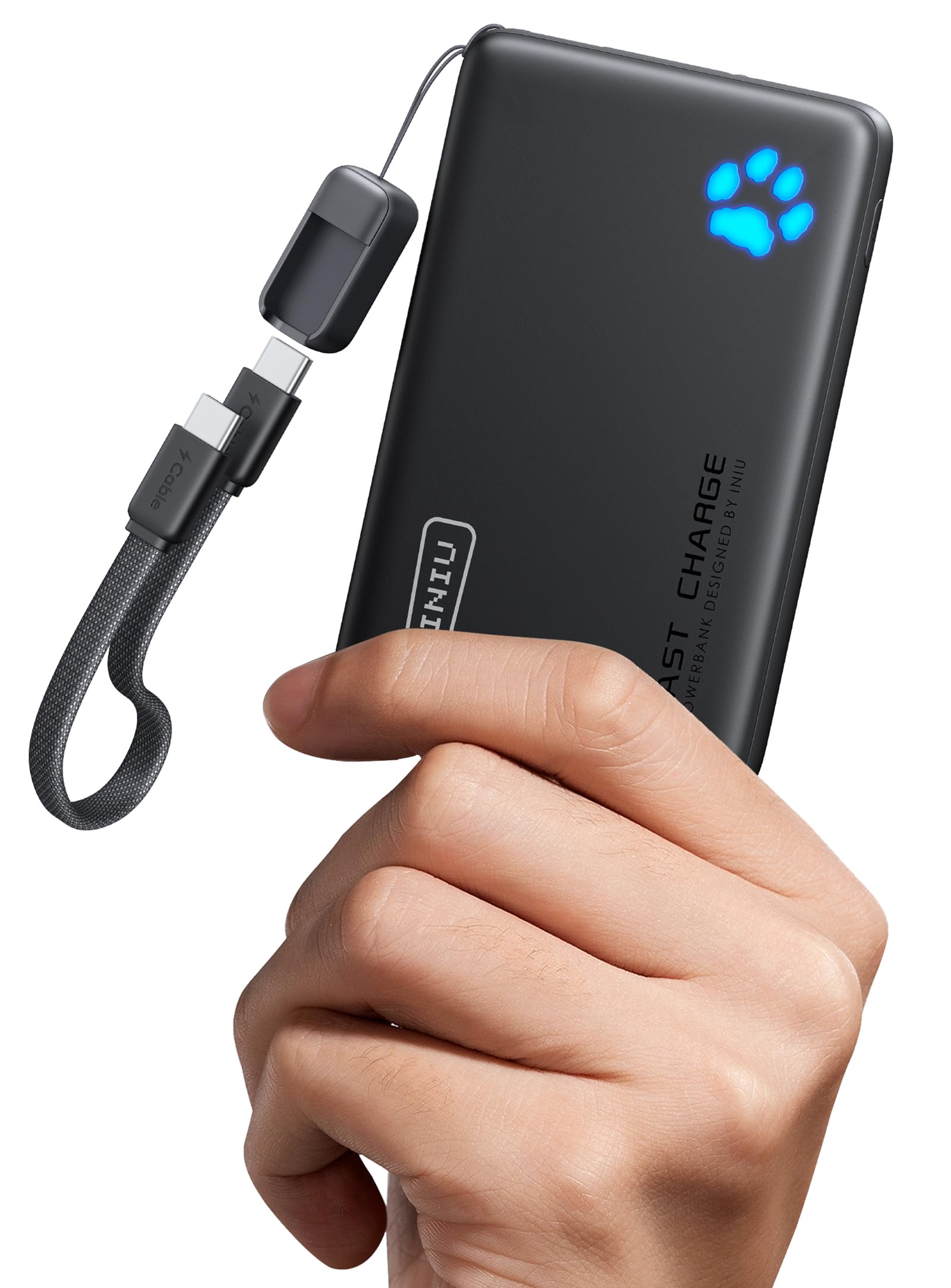
INIU 10000mAh 45W
Key Features
- Output: 45W USB-C
- Weight: 8.11 oz
- Capacity: 10,000 mAh
- Thickness: 0.5 in
- Price: Budget
Half an inch thick and about five inches long, the INIU is the one that disappears: into a hip-belt pocket, a chest rig, the lid compartment where the map used to go. It is also the cheapest way here to get 45W over USB-C, the sort of speed that makes a twenty-minute sit-down worth plugging in. The 10,000mAh is a personal reserve rather than group power, and for a day hike that is exactly the right trade.
The 0.4-foot braided cable detaches and doubles as a lanyard, so the pack carries its own lead, the same idea as the Anker above minus the bulk. At that length the phone ends up in the same pocket as the battery, which is fine on the move and awkward at a picnic table; bring a normal cable for camp and keep the short one for the trail. Three years of warranty is more cover than most of this group offers.
Pros
- Half an inch thick and pocketable
- 45W USB-C fast charging
- Three-year warranty
Cons
- 10,000mAh will not cover a multi-day trip
The ultralight pick: 45W charging, a lanyard cable and a half-inch body, for day hikes where a dead phone is the only real risk.
Best for Laptop Camping
Anker 25000mAh 165W
Key Features
- Ports: 3x USB-C, 1x USB-A
- Output: 165W total, 100W per port
- Capacity: 25,000 mAh
- Recharge time: 2 hours
- Price: Premium
165 watts is not a phone-charging number. Spread across three USB-C ports, up to 100W from any one of them, it is enough to run a 14-inch laptop while a phone and a camera battery charge alongside, which is a different job from everything else here. This is the pack for a working camp: a van, a cabin, a festival where you are answering email between swims.
The rest of the design follows the same logic: a retractable USB-C cable that pulls out to 2.3 feet, a second short one that doubles as a carry handle, and a screen showing an actual percentage rather than four dots. Anker quotes a two-hour refill with a 100W charger, fast for a battery this size, and again dependent on a charger that is not in the box.
Whether it earns its price comes down to one question: does your camp include a laptop? If it does, nothing else here keeps up, and the built-in cables mean nobody is hunting for a 100W-rated lead at eleven at night. If it does not, this is a lot of money and a lot of pack space for capacity a simpler battery covers, and the retracting mechanism is one more moving part to wear out.
Pros
- 165W total, 100W from one port
- Two built-in cables, one retractable
- Percentage readout instead of dots
- Two-hour recharge with a 100W charger
Cons
- The most expensive pack here
- Nearly two inches thick, no water-resistance rating
If you bring a laptop, this is the one: 165W across three USB-C ports keeps real work devices running far from an outlet.
Best for Week-Long Trips
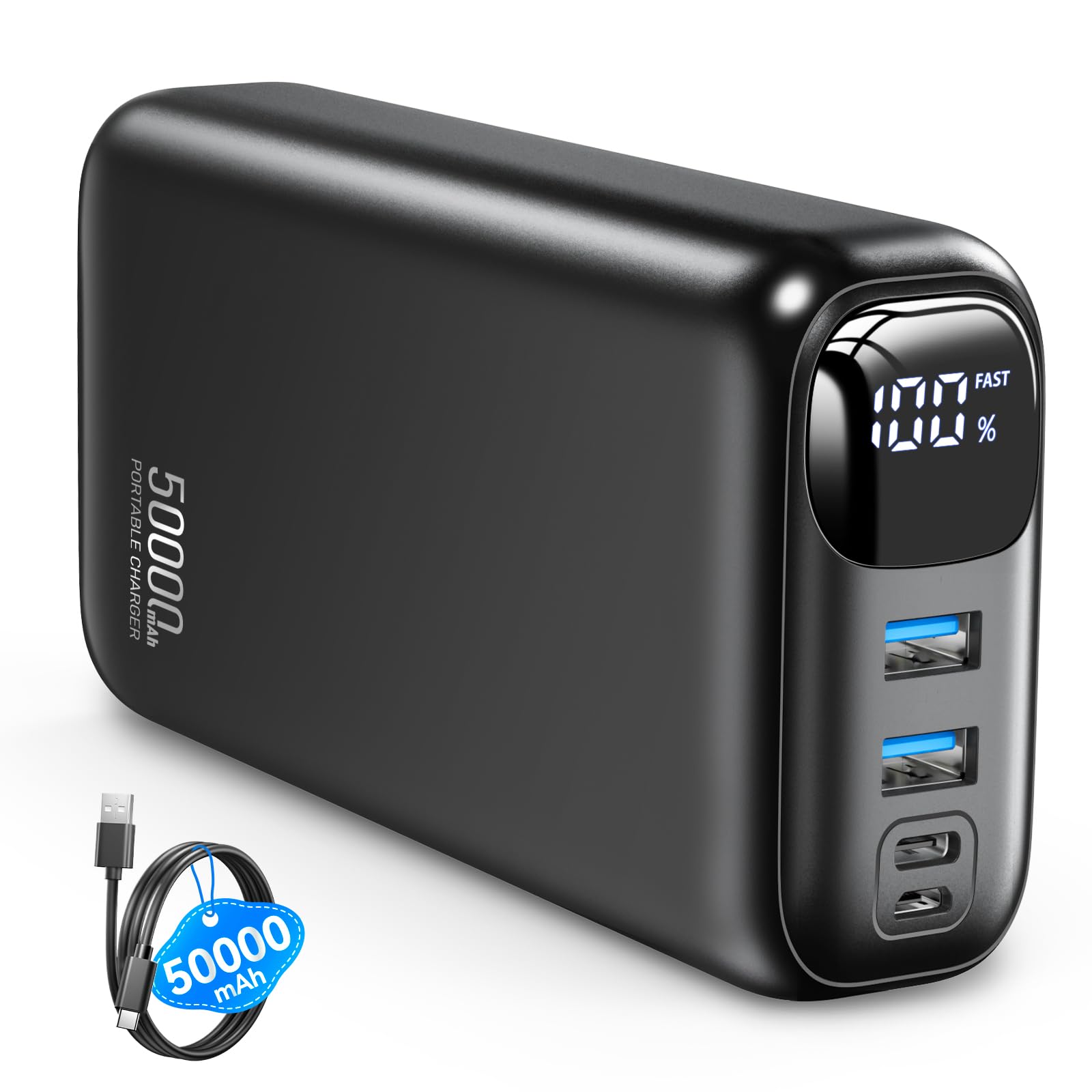
OHOVIV 50000mAh 22.5W
Key Features
- Output: 22.5W
- Weight: 1.43 lb
- Display: LED percentage
- Capacity: 50,000 mAh
- Price: Budget
50,000mAh is a different scale of purchase. This is not the pack for a day hike; it is the one left in the tent for a week while four people’s phones, a headlamp, a speaker and a set of earbuds rotate through it. When your trips are long and the nearest outlet is a two-hour drive, capacity stops being a specification and becomes the reason you bought anything at all.
What makes it our big-capacity pick is the combination: 50,000mAh, three devices at once, and a percentage readout instead of four unlabelled dots, for the lowest price of the big packs here. The trade is weight and bulk. At 0.65 kg and 1.6 inches thick it lives at the bottom of a pack, and you feel it on the walk in.
Refilling is the part people underestimate. The input is 18W, so a full charge takes the better part of a day, and the 50,000mAh figure is a cell-voltage number, which means fewer full phone charges than the label implies. Charge it at home the night before rather than at camp, and treat a low reading on the display as your reserve for the drive out.
Pros
- 50,000mAh for long trips
- Charges three devices at once
- Percentage display rather than dots
- Cheapest of the big-capacity packs here
Cons
- 0.65 kg at the bottom of the pack
- 18W input means a very slow refill
A week of group charging from the cheapest big-capacity pack here, as long as you can live with the weight.
Best for Big-Capacity Solar
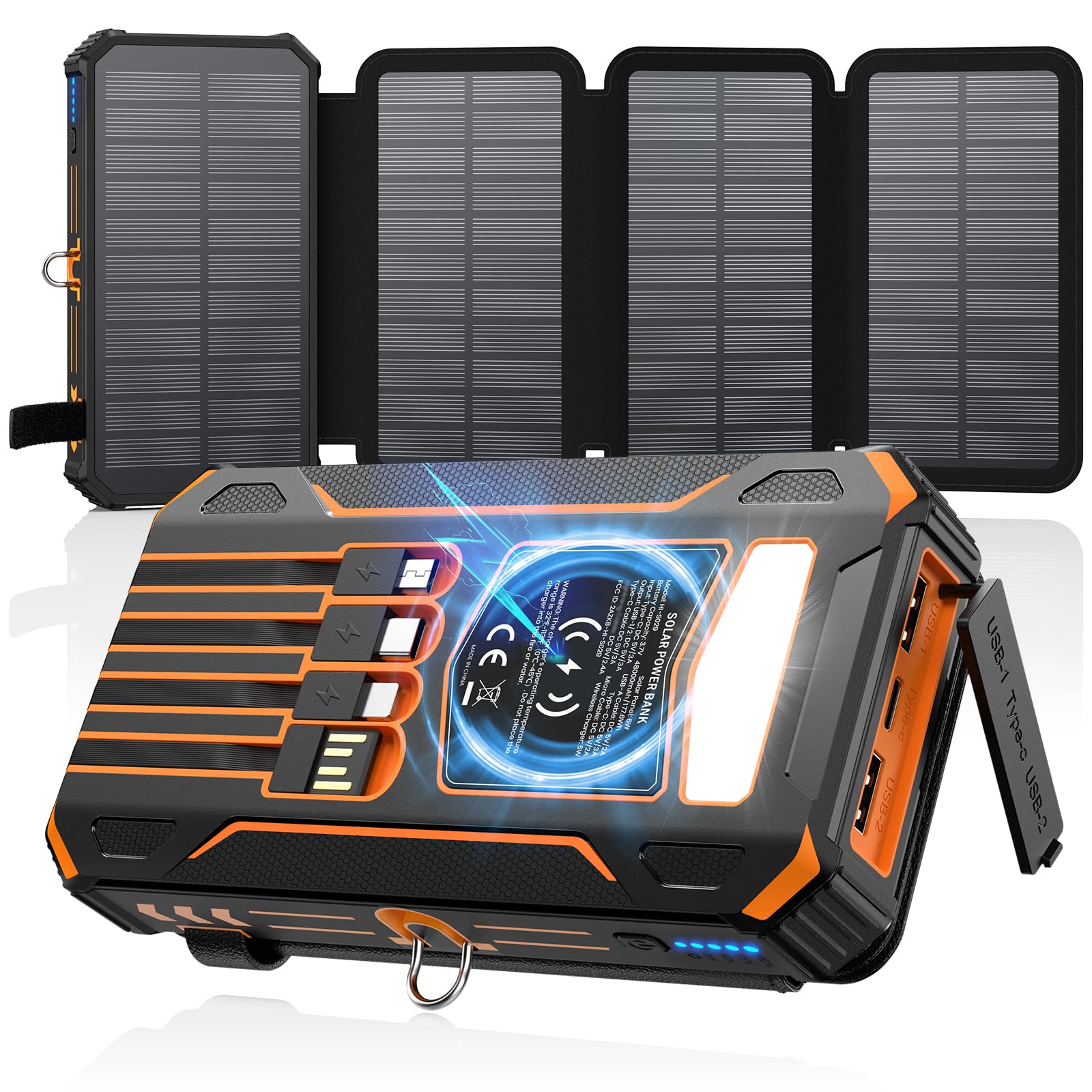
SOARAISE 48000mAh Solar
Key Features
- Solar: 4 panels
- Output: 5V/3A USB-C
- Capacity: 48,000 mAh
- Dimensions: 6.38 x 3.43 x 1.57 in
- Price: Midrange
Six and a third inches long, an inch and a half thick, and heavy enough that you notice when you pick the pack up by one strap, the SOARAISE announces itself before you have plugged anything into it. That is the price of 48,000mAh in a body that still fits a daypack, and it is worth knowing before the box arrives.
For everyone who has the room, there is a lot here: 48,000mAh, four built-in cables, a wireless pad you can drop a phone onto in the dark, and a folding solar panel. The wireless charging is the part we rate, because it turns the pack into a tent nightstand, while the panels are a trickle at best and a day of direct sun puts back nothing close to a full charge. Buy it as a big battery with a free wireless pad and treat the solar as emergency-only.
Pros
- 48,000mAh with four built-in cables
- Wireless charging pad
- Three ports plus wireless
Cons
- Bulky and heavy for a daypack
A big battery with a wireless pad for the tent, if you leave room in the pack and ignore the solar panel.
Best for Shared Group Charging
NOBIS 20000mAh 45W

Key Features
- Ports: 4
- Output: 45W in and out
- Weight: 13.8 oz
- Capacity: 20,000 mAh
- Price: Budget
Four ports, two USB-C and two USB-A, on a 20,000mAh pack puts the NOBIS in the sweet spot for a group: everything gets plugged in at once and nobody argues about the order. It also moves 45W in both directions, so the pack refills quickly instead of sitting on a charger all night.
The screen shows a percentage, the body is a reasonable 392 grams for the capacity, and there are 18 months of manufacturer warranty behind it. What it does not have is the finish of the Anker it undercuts: the plastic feels like plastic, and the ports need a firm push to seat a cable.
The question mark is capacity. Some units come up short of the 20,000mAh label, and conversion loss does not explain all of it, so this is not the pack to buy for a trip with no margin. A weekend at a site with a car nearby, yes; a five-day walk with no resupply, no. As a second battery for the car or one to lend out, it makes a lot of sense.
Pros
- Four ports for a group
- 45W in and out
- 392 g for 20,000mAh
- 18-month manufacturer warranty
Cons
- Some units fall short of the stated capacity
- Plasticky finish next to the Anker
Four ports and 45W for a lot less than the Anker: a sensible second pack, not the one for a five-day walk.
How We Tested These Camping Power Banks
We started by gathering more than 40 power banks sold for camping and hiking, then narrowed the field by capacity, port selection, weight, and price to a workable 12. Those 12 went through eight months of testing: weekend car-camping trips, one three-day backcountry loop, a rainy pack-out that soaked everything at the bottom of my bag, and a stretch of near-freezing shoulder-season mornings. Between trips they lived in car trunks and gear bins, which is where most power banks actually spend their time.
Charging speed got a stopwatch, not a spec sheet. I drained a phone to zero, timed how long each bank took to reach 50 percent, then counted how many full refills it delivered before quitting. Repeating those cycles across the eight months showed which ones held their capacity and which faded noticeably by midsummer.
Every bank was weighed on a kitchen scale and jammed into a hipbelt pocket to see whether it was genuinely carryable on a long day. Durability meant drops off a tailgate onto gravel, a dusty weekend in an open truck bed, and a light shower with the port cover closed. The solar models got an honest test too: direct sun on a clear afternoon, then an overcast one, logging how much charge the panel actually added. At the end I divided each price by the number of full phone charges it produced, since value here is per charge, not per milliamp-hour.
How to Choose a Camping Power Bank
The number on the box is not the number of charges you get, so start with how many nights you are packing for and how much weight you will tolerate, and the rest follows.
Read capacity as weight, not charge count
There is no honest way to turn milliamp-hours into a number of phone charges. Ratings are taken at cell voltage, converting to the 5 volts a phone wants loses a chunk of it, and a cold night takes more. What the figure really tells you is how much the pack weighs and how long you can stay out.
Around 10,000mAh covers a phone and a headlamp for a day. Twenty thousand carries a long weekend for one person. Past 45,000mAh you are buying a basecamp battery shared across a group, which is a different purchase with a different carry.
Decide where the pack will live
Choose the riding position before you compare specifications. A half-inch, 230 g pack goes in a hip-belt pocket and actually gets used. A 650 g brick lives at the bottom of the bag and comes out at camp. Neither is wrong, but buying a big battery you resent carrying is how people end up leaving it in the car.
If you want one pack for both jobs, the 20,000mAh class is the compromise that keeps two or three days of phone and tablet power in something you will still carry.
Water ratings and the port-cover problem
IPX5 means jetted water. IP67 means dust-tight and able to survive a dunking, and that is the rating worth paying for on a trip where everything gets wet. A shockproof shell matters too: the failure you are guarding against is a drop onto rock, not a gentle set-down on grass.
The weak point on every waterproof pack is the lid. A cover half seated turns an IP67 rating into a puddle, so look for covers that seat with a positive click, and dry the port before you plug in.
Solar panels are a trickle, not a plan
A panel small enough to sit on a power bank produces very little, and even a full day of direct sun on a four-panel unit puts back a fraction of what the battery holds. That is not a reason to avoid a solar pack. It is a reason to buy one for its capacity, its cables or its wireless pad and treat the panel as a bonus.
Plan your refills around a wall socket or a car outlet before you leave. Solar is for emergencies and for the satisfaction of watching the indicator blink.
Output, ports and refilling the pack
Twenty watts keeps a phone topped up; 45W gets a tablet moving. More ports matter less than the numbers suggest, because three devices sharing one budget each charge slowly. Built-in cables are worth real money: a pack that carries its own USB-C lead is one less thing to forget.
Then look at the input side, which is where camping packs disappoint. A 20,000mAh battery on a basic 18W charger needs most of a day to fill, while one that accepts 45W or more is ready before breakfast. Pair the pack with a charger that matches its input.
Frequently Asked Questions
Can I take a camping power bank on a plane?
Carry-on only, and most airlines cap lithium batteries at 100 watt-hours, which is roughly 27,000mAh. Anything larger usually needs the airline’s approval, and it never goes in checked baggage. The 48,000mAh and 50,000mAh packs here are ground travel only.
To check a pack, multiply its mAh by 3.7, divide by 1,000, and compare the result with your carrier’s limit before you pack it.
Will a power bank survive a freezing night in a tent?
It survives, but it stops performing. Cold lithium cells deliver less and can shut down, which is why a pack that looked full at noon can read half empty at six in the morning. Keep it in a jacket pocket or a sleeping bag liner overnight, and let it warm up before you trust the percentage on the screen.
Can I charge a laptop from a camping power bank?
Only if the pack offers USB-C Power Delivery at 45W or more, and even then a laptop drains a 20,000mAh battery quickly. The 87W and 165W Ankers here will run a thin laptop; a 22.5W pack will barely hold one at idle.
Check your laptop’s USB-C charging wattage before you count on it, and expect to leave the pack charging while you work.
Final Verdict
For most camping trips, the ELECOM NESTOUT is the pack to buy. It is the only one here built to be rained on, dropped and shoved wet into a pack, and 15,000mAh with 32W USB-C covers a long weekend of phones, lights and earbuds.
If your trips are drier and you want more charges per gram, the Anker 20,000mAh is the alternative we point people to: more capacity, more output and two built-in cables, at the cost of a heavier pack with no weather rating. Counting grams instead, the 10,000mAh INIU is the one that vanishes into a pocket.