This post contains affiliate links. We may earn a small commission when you buy through our links — at no extra cost to you.
A wood fire is a commitment: you buy the logs, you build it, you babysit it, and you smell like it for two days. A propane fire pit trades all of that for a knob — instant flame on a deck, at a campsite, or off the back of a truck, then instant off. The catch is that plenty of them make a flame you can look at but not feel, and that’s when the blanket starts doing the actual work. What a good one fixes is that gap: heat you can sit in, ignition that catches on the first push, and a finish that still looks presentable on the patio in July.
My team and I have spent the past eight months with 12 propane fire pits — backyard evenings, a few cold campsites, one stubbornly windy tailgate — and the spread was wider than I expected. Here’s the piece of wisdom I’d hand any first-time buyer: the Btu number on the box is not the same thing as heat at your shins. Burner size, flame shape, and how well the unit shields itself from wind decide whether you’re warm or just watching. The picks below are the ones that actually kept us outside after the sun dropped.


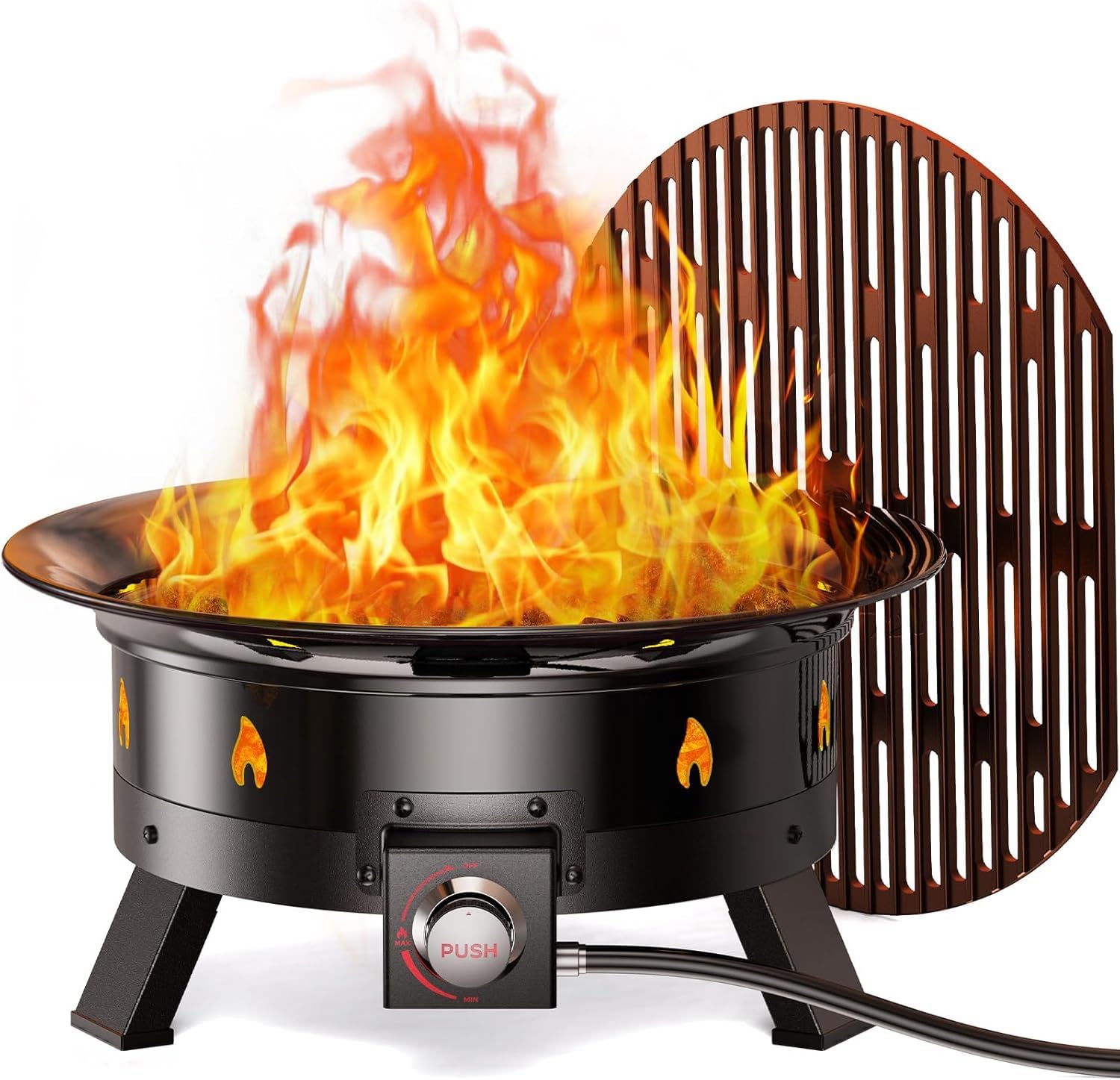

Best for Camping and Patios
Outland Living 893 Firebowl
Key Features
- Weight: 23 lb
- Heat output: 58,000 BTU
- Hose length: 10 ft
- Bowl diameter: 19 in
- Price: Midrange
A 10-foot hose is the least glamorous thing in the box, and it is the detail that makes the 893 work. It comes pre-attached, so the tank can sit behind a chair or under the trailer instead of beside your knee, and the included stabilizer ring keeps the cylinder upright when someone backs into it. That, plus a 23-pound body you can lift one-handed, is why this is the propane fire pit we recommend first: it is the same unit on a deck and on a campsite.
The heat is real. 58,000 BTUs through a stainless burner, with 4.4 pounds of lava rock on top, gives a flame that glows rather than merely burns, and the control knob runs from a low summer flicker to something you lean toward on a cold night. What we noticed first is how little there is to think about: no wood to buy, no ash to shovel, no smoke in your clothes the next morning, and a fire you can shut off and walk away from.
Where it gives ground is size. A 19-inch bowl makes a fire for four people sitting close, and if you routinely host eight, the 24-inch Flame King below is the better buy. It also asks more money than the budget bowls here, which do much the same job. What keeps it on top is the completeness of the kit: hose, cover, carry strap, rock, and nothing standing between you and a lit fire.
Pros
- 58,000 BTUs from a 19-inch bowl
- 10-foot hose keeps the tank clear
- Arrives assembled, rock and cover included
- Works on most banned-fire campsites
Cons
- Costs more than the budget firebowls here
For most people shopping for a propane fire pit, this is the one: serious heat, a 23-pound body, and a carry kit that makes camping realistic.
Best for Bigger Group Camping
Flame King 24-Inch Firebowl
Key Features
- Weight: 27.3 lb
- Ignition: Piezo self-igniter
- Heat output: 58,000 BTU
- Bowl diameter: 24 in
- Price: Midrange
Two inches of diameter does not sound like much until you are the one at the edge of the circle. The Flame King is 24 inches across against the Outland’s 19, and that extra ring of glowing rock is what keeps the fifth and sixth chair in the warmth instead of leaning in. It stands 12 inches tall and weighs 27.3 pounds — still a one-person lift, but you know you are carrying something.
The piezo igniter is what we appreciate most. Push, turn, and it is lit, with no kneeling over the rocks with a lighter, which is the difference between using it on a Tuesday night and not bothering. Setup needs no tools, the 10-foot hose gets the tank out of the circle, and a cover and carry strap come in the box.
The trade-off is weight: 27.3 pounds is about as much as you want to carry any distance from the truck, and the Ciays 24-inch below is heavier still. It also cools down quickly after shutdown, which matters when you are packing the camper the next morning. One thing to know before you count on a fix: the manufacturer warranty runs 30 days, the shortest in this group, so open the box and light it the day it lands.
Pros
- 24-inch bowl covers a wider circle
- Push-button piezo ignition, no lighter needed
- Hose, stabilizer ring, cover, and strap included
Cons
- 27.3 pounds is a two-hand carry for some
If your evenings put six or eight people around the fire, the 24-inch bowl and push-button ignition make this the better buy, and you pay for the reach in weight.
Best for Camper and Tailgate
GasBRUH 19-Inch Fire Pit
Key Features
- Weight: 18.7 lb
- Heat output: 60,000 BTU
- Hose length: 10 ft
- Bowl diameter: 19 in
- Price: Budget
Eight and a half kilograms is the number that decided this one. That is roughly 19 pounds, lighter than either the Outland or the EcoNook, and light enough that getting it out of the truck is not something you negotiate with yourself about. The bowl is 19 inches across, the same footprint as the top pick, and the lid turns and locks so the lava rock stays put while you drive.
It is rated at 60,000 BTUs, more heat than a 19-inch bowl strictly needs, and the 10-foot hose is braided stainless rather than rubber — a detail that matters when it is coiled in a hot truck bed. The finish is built to cope with rain and the odd wet night, though no painted steel bowl stays new forever, and a carry handle and cover come with it.
What settles it is the lid. A bowl you can close and carry by the handle is a bowl you will actually take to a tailgate or a campsite, and the adjustable flame runs from marshmallow-low to a proper fire. Nothing else here is lighter, and the whole kit assumes you will be moving it, which is exactly the right assumption for a second fire.
Pros
- Lightest bowl in this group
- Latching lid keeps rock in for travel
- Braided stainless 10-foot hose
Cons
- 19-inch bowl suits four or five people
The lightest bowl here, with a lid that locks the rock in for the drive and enough heat for a small yard or a tailgate.
Best for Camp Cooking
Ciays 24-Inch Fire Pit with Grate
Key Features
- Grate: Cast iron grill grate
- Weight: 37 lb
- Heat output: 58,000 BTU
- Bowl diameter: 24 in
- Price: Midrange
Most propane fire pits will hold a marshmallow on a stick over the rock. This one has a cast iron grate across the top, so the same burner takes a kettle, a foil packet, or a pan of anything that does not need a hard sear. For camping that is a different category of usefulness: breakfast happens on the fire you are already sitting around.
The rest of the camping kit is what we like as much as the grate. The legs fold, collapsing the bowl toward a 19-by-10-inch package that slides behind a seat; the piezo igniter needs no battery; and a flameout sensor cuts the gas if the fire is blown out, the sort of thing you are glad exists on a ridge in a crosswind. 58,000 BTUs through a 24-inch bowl matches the Flame King for output.
What it costs is weight. At 37 pounds it is the heaviest of the portable bowls here, and the cast iron and steel tank holder are most of that. Folding legs help it pack; they do not help you lift it into a truck bed, and that is the honest price of a fire you can cook on.
Pros
- Cast iron grate for simple camp cooking
- Folding legs pack down small
- Flameout protection shuts off the gas
- 58,000 BTUs with no tools needed
Cons
- 37 pounds is a two-hand lift
The camping pick for people who cook: a cast iron grate over a 58,000 BTU burner, and legs that fold flat for the drive home.
Best for Hosting on a Patio
Ciays 51-Inch Fire Table
Key Features
- Weight: 68.5 lb
- Tabletop: 50.79 x 23.03 in
- Wind guard: Glass, included
- Heat output: 60,000 BTU
- Price: Premium
The feature we did not expect to care about is the one we now think every fire table should copy: a slide-out tray on wheels that carries the 20-pound tank. On most tables, changing a cylinder means lifting a lid, kneeling on the deck, and wrestling 20 pounds of steel into a cabinet. Here it rolls out, you swap the tank, and it rolls back. That small piece of engineering removes the worst chore of owning a fire table, and it is why this one leads our table picks.
Around that tray is a genuinely useful table. The top runs 50.79 by 23.03 inches, long enough for plates at one end while the fire burns at the other, and the lid converts the burner into a dining, coffee, or side surface — four configurations by Ciays’ count. The glass wind guard is the other piece worth having: it shelters the flame so a breeze does not flatten it, which is exactly what happens to unprotected burners on an exposed deck.
Two things to plan for. It weighs 68.5 pounds and arrives flat, so give it an afternoon and a second pair of hands for the cabinet; this is furniture assembly, not a five-minute unfold. And at 60,000 BTUs it warms the people around the table rather than a whole crowd, so do not expect it to stand in for a patio heater on a freezing night.
Pros
- Slide-out tank tray on wheels
- Glass wind guard steadies the flame
- Lid converts it to four table setups
- 60,000 BTUs across a 51-inch top
Cons
- 68.5 pounds plus a real assembly session
The table to buy if you host: 51 inches of surface, a glass wind guard, and a tank tray on wheels that makes swaps painless.
Best for Cold-Weather Patios
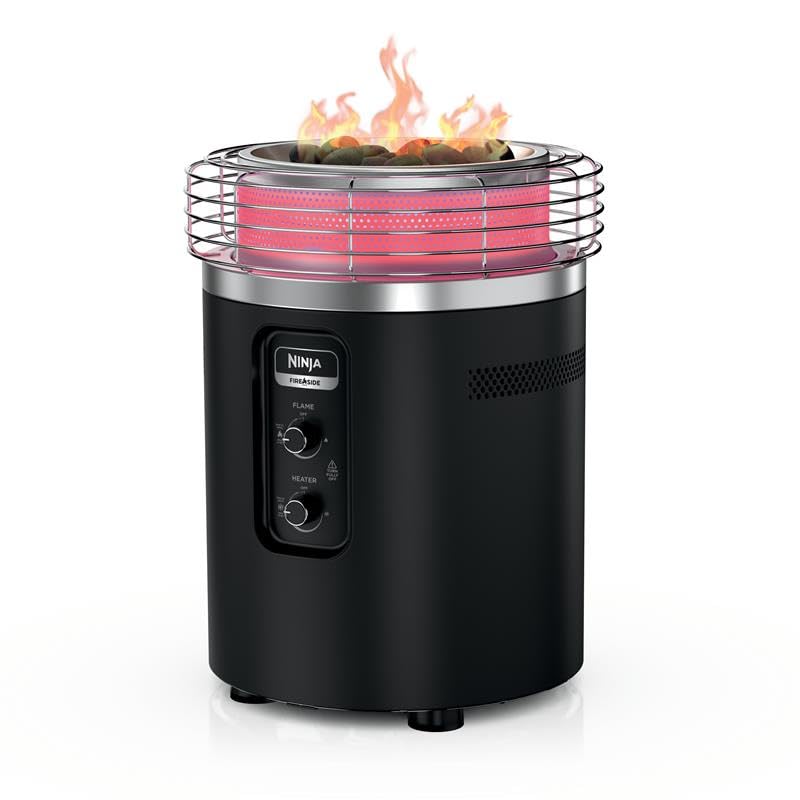
Ninja Fireside360
Key Features
- Modes: Flame, heat, or both
- Weight: 40 lb
- Footprint: 21.8 x 21.8 in
- Heat output: 80,000 BTU
- Price: Premium
Most fire pits are a flame you sit near and hope for the best. The Fireside360 is a patio heater with a fire pit on top, and it is the only thing here that will warm a porch rather than a circle of knees. At 80,000 BTUs it has more output than anything else in this group, and not by a little.
The three modes are the trick. Flame only gives you a summer-evening fire with no heat behind it; heat only turns the unit into a heater you would run in November; both together is what most people will actually use. One dial lights it, adjusts it, and shuts it off, and the pedestal sets the burner at 28.8 inches — above knee height, where radiant warmth does the most for a seated group.
It is not a table. There is no surface for a drink and no lid that converts, so on a deck that doubles as an outdoor room you are giving up the thing a fire table does best. The heat is concentrated too: up close it feels like standing in front of a heater, because that is what it is, so give it clear space and keep cushions and anything plastic out of the column.
Which makes this the pick for one specific buyer: someone with a deck, a chilly season, and more interest in being warm than in watching logs. As a fire pit it is the most expensive thing here and it skips the table trick entirely; as a way to add a month to each end of your patio season, it is the most capable unit on the page.
Pros
- 80,000 BTUs, the most heat here
- Flame-only, heat-only, or both
- Rated for grass, stone, and wood decks
Cons
- No table surface or lid conversion
- Most expensive pick in this group
The only unit here that is a heater first: 80,000 BTUs of 360-degree warmth that makes a cold deck usable, with the flame optional.
Best for Large Decks
Bali Outdoors 42-Inch Fire Table

Key Features
- Glass: 15 lb blue glass
- Weight: 78.5 lb
- Tabletop: 42 x 24 in ceramic
- Heat output: 60,000 BTU
- Price: Midrange
With the lid on, this reads as a low ceramic coffee table, and that is the point: it is the best-looking table here with the fire off. The top is real ceramic with a grain you can see, the fifteen pounds of blue glass throws light back at you instead of swallowing it, and the black steel base sits low enough not to fight the furniture around it.
Assembly is a screwdriver job rather than a project, and the lid covers the burner to create a 42-by-24-inch dining surface. The tabletop is the reason to pick this over a bowl: drinks, plates, and a lantern all have somewhere to go while the fire is lit, and the fire itself is a proper one — 60,000 BTUs, adjustable, with the sort of flame you sit and watch rather than glance at.
Two things to know going in. The piezo ignition can take a few attempts to catch, so keep a long-nose lighter nearby. And the body is heavy enough that moving it across a deck is a two-person job, which matters if you rearrange your patio with the seasons.
What tempers our enthusiasm is the steel under the ceramic. Rust around the base and the lid is the thing to watch on this one, and it can arrive early enough that a fitted cover stops being optional. Buy it for the surface and the looks, plan for the cover, and check the base after the first wet season; do that and it is a lot of table for the money.
Pros
- Ceramic top with real surface area
- Fifteen pounds of blue fire glass
- Lid turns it into a full dining table
Cons
- Rust can appear on the base and lid
- Piezo ignition can take a few attempts
The best-looking table in this group with the fire off, a 42-inch ceramic top, and a price that undercuts the big tables.
Best for Small Patios
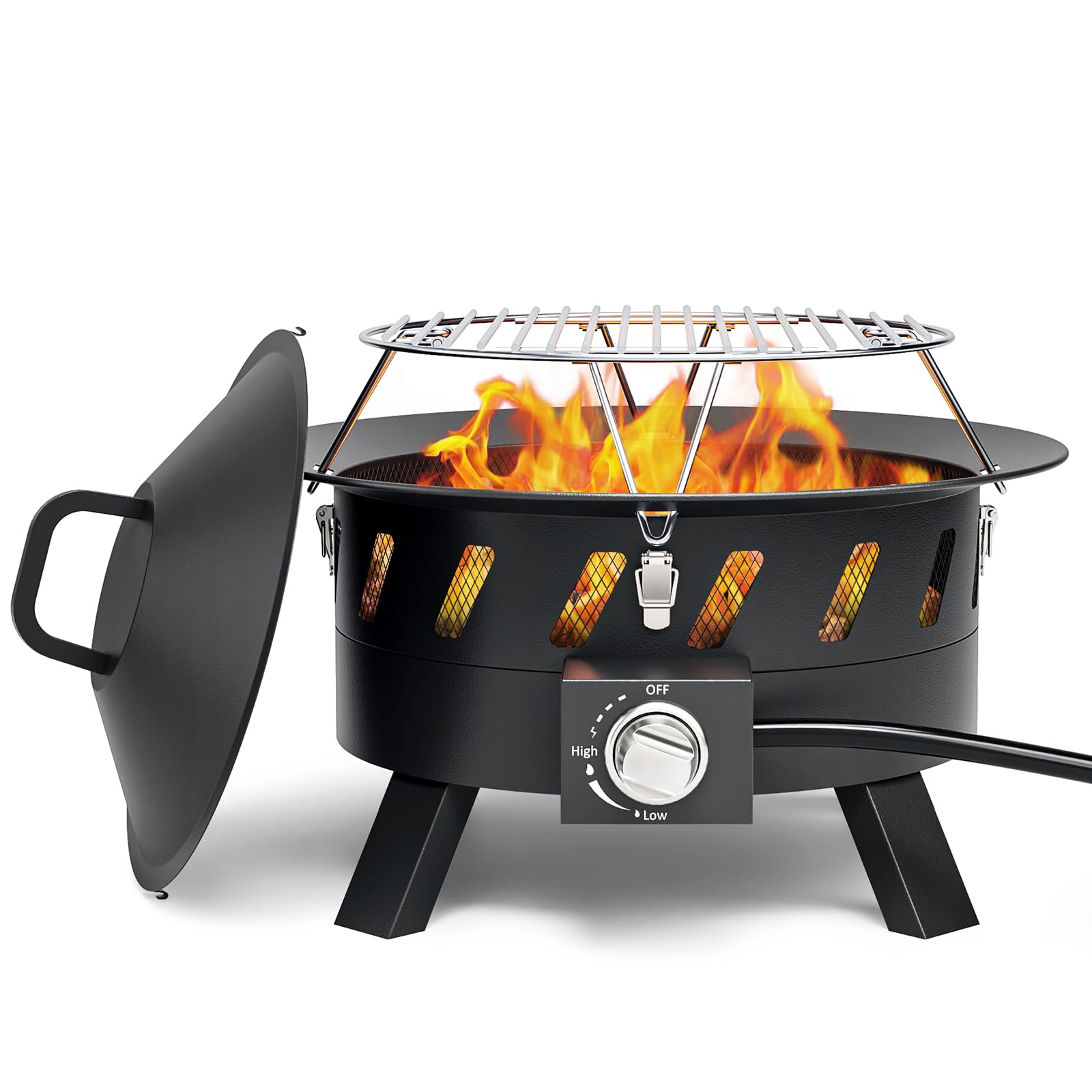
EcoNook 20-Inch Fire Pit
Key Features
- Lid: Latching lid with handle
- Weight: 25.7 lb
- Hose length: 8.5 ft
- Bowl diameter: 20 in
- Price: Budget
This is the least expensive route into a propane firebowl here, and it does not read that way: a 20-inch stainless bowl, a lid that latches down and doubles as a handle, and a mesh screen for sparks. For a small patio or a first fire pit, that combination is more appealing than a bigger bowl you light twice a season.
The hose is 8.5 feet, a foot and a half shorter than the Outland’s, so the tank sits closer to the fire than you might want on a tight deck — work out the layout before you commit to a spot. The lid latches for travel so the rock stays put, and there is no assembly beyond dropping the rock in and connecting a tank.
The trade-off for the price is in the details: the 20-inch bowl is a fire for four, and at 25.7 pounds it is no lighter than bowls that cost more. For a patio that sees a fire a few nights a month, that is a fair trade; for a camper that goes out every weekend, the extra money for the Outland or the GasBRUH buys a tidier build.
Pros
- Cheapest full firebowl kit here
- Latching lid doubles as a carry handle
- Mesh spark screen included
Cons
- Piezo igniter is the weak point
The cheapest way into a smokeless firebowl here, with a latching lid that makes it a genuinely portable kit.
How We Tested the Best Propane Fire Pits
We started with more than 60 propane fire pits sold at major retailers and cut the list to 12 by size, fuel source, price, and what came in the box. A full-size unit for a patio and a tabletop model for a tailgate solve different problems, so the shortlist had to carry both.
Each one went through eight months of ordinary evenings on a patio, a wooden deck, a campsite, and a driveway before a game. On nights in the 45-to-55-degree range we noted flame height at low, medium, and high, held a thermometer at seat height about three feet out, and recorded the setting where we could finally take a jacket off. On breezy nights we watched whether the flame leaned, sputtered, or quit entirely.
We counted igniter clicks and attempted the first light of the evening in wind with no match as backup. Portability got a real test: every pit was weighed, carried one-handed up a flight of stairs, and loaded into a trunk beside a cooler. For rust resistance, several stayed outside through rain and two weeks of lawn sprinklers, after which we checked burners, fasteners, and paint seams. Build quality came down to wobble — full tank, a nudge, and whether the frame or a table ring shifted.
Value was less about the sticker and more about what came in the box: a cover, lava rock, a folding lid, a stable place to set a 20-pound tank. We also asked whether each unit looked like it would survive three seasons rather than one.
How to Choose a Propane Fire Pit
Start with where the thing will sit rather than with the BTU number — a firebowl and a fire table solve different problems, and every other decision follows from that one.
Firebowl or fire table
Bowls are for moving. A 19- to 24-inch bowl weighs somewhere between 19 and 37 pounds, runs off a standard 20-pound tank, and disappears into a shed or a camper between outings. Tables are furniture: 68 to 79 pounds of steel and ceramic with a lid that turns the burner into a coffee or dining surface.
Choose a table if the pit will sit in one spot and you want somewhere to put a drink. Choose a bowl if it travels, or if your patio is small enough that a 42-inch top would eat it. The practical difference nobody mentions up front is assembly — a table is an evening with a screwdriver, a bowl is a hose and a bag of rock.
What BTU actually buys you
BTU measures fuel burned, not comfort delivered. A 58,000 BTU bowl and an 80,000 BTU heater are closer in feel than the numbers suggest, because most of a bowl’s output is radiant: it warms what faces it, and a breeze takes a share before it arrives.
Sit close to a modest bowl and you will be warmer than sitting across a patio from a big one. Turn any burner down and heat and fuel use fall together. If the goal is warmth on a cold, breezy night rather than a fire to look at, spend on output and a wind guard before you spend on bowl diameter.
Bans, hoses, and where the tank sits
Most units here are CSA listed and sold as usable during campfire bans, but the rules belong to the landowner or the fire service. Confirm before you light, and do not assume a listing covers every restriction.
In daily use the hose decides how livable the pit is. Ten feet puts the tank behind a chair and out of the circle; the EcoNook’s 8.5 feet is fine on a small deck and tight on a big one. Stand the cylinder upright, use the stabilizer ring where one comes in the box, and check the hose for chafing where it rubs the bowl.
Weight, packing, and setup
For anything that travels, pounds matter more than inches. The bowls here run from roughly 19 to 37 pounds. A latching lid and a carry strap are worth more than a slightly smaller bowl, because they are what actually get it into the truck.
Folding legs shrink a 24-inch bowl toward a 19-by-10-inch package, which is the difference between riding beside the cooler and taking a seat. For a table, plan on an hour of assembly and, for a 51-inch cabinet, a second pair of hands.
Frequently Asked Questions
How long will a 20-pound propane tank last?
A full 20-pound cylinder holds roughly 430,000 BTUs of propane. Run a 58,000 BTU burner wide open and that works out to about seven hours; turn it to half and you roughly double it. An ordinary evening around the fire uses a fraction of a tank unless you are running it as a heater on a cold night.
If you plan to stay out late in cold weather, bring a spare cylinder. Swapping one at nine in the evening beats rationing the flame for the last two hours.
Do propane fire pits smell or give off smoke?
There is no smoke, no ash, and no wood smell in your jacket the next morning, which is the main reason people switch. You may catch a whiff of propane at startup or when a tank is nearly empty; the odor is added to the gas deliberately so leaks announce themselves.
If you smell gas with the valve closed, shut the cylinder off and check the connection before you light anything.
Can I leave a propane fire pit outside in the rain?
Yes, with a cover and a little attention. Painted and powder-coated steel sheds water while the finish is intact, but standing water in a bowl pits the finish and rusts the burner, and ceramic-topped tables are the ones that show it first.
Tip the cover so it drains instead of pooling, dry the bowl before it goes into storage, and keep the propane cylinder outdoors, upright, and out of the weather.
Final Verdict
The Outland Living 893 is what we point most people to: 58,000 BTUs, a 23-pound body, a 10-foot hose, and a carry kit that arrives with nothing to assemble. Buy the Flame King instead if six or eight people regularly sit around your fire, or the Ciays 51-inch if the pit is staying on a patio and you want a table with it.
If warmth rather than flame is the whole point, the Ninja is the only unit here built for that job, and it is worth the premium over adding a separate patio heater.