This post contains affiliate links. We may earn a small commission when you buy through our links — at no extra cost to you.
A campfire is wonderful right up until you crawl into the tent and realize your breath is fogging the ceiling. That’s the moment a camping heater earns its spot in the truck — the difference between a night spent shivering in a jacket and one where you actually sleep. It’s also the moment a bad one shows itself: a unit that blasts heat for 20 minutes and then quits, or one that leaves you quietly worried about what’s happening inside a sealed tent. The right heater holds a steady temperature overnight, sips fuel or battery, and lets you forget it’s there.
Over the past nine months I’ve rotated 12 heaters through backyard tent nights, a van build, a pop-up camper, and a garage during an ice-storm outage, with my team logging fuel and battery draw at every stop. The thing that surprised me most is how little a published heat output tells you on its own. A radiant panel and a fan-forced unit with matching ratings feel completely different at 3 a.m., and propane brings a moisture tradeoff that almost no listing mentions. The picks below are the ones that stayed warm, stayed safe, and stayed worth what they cost.
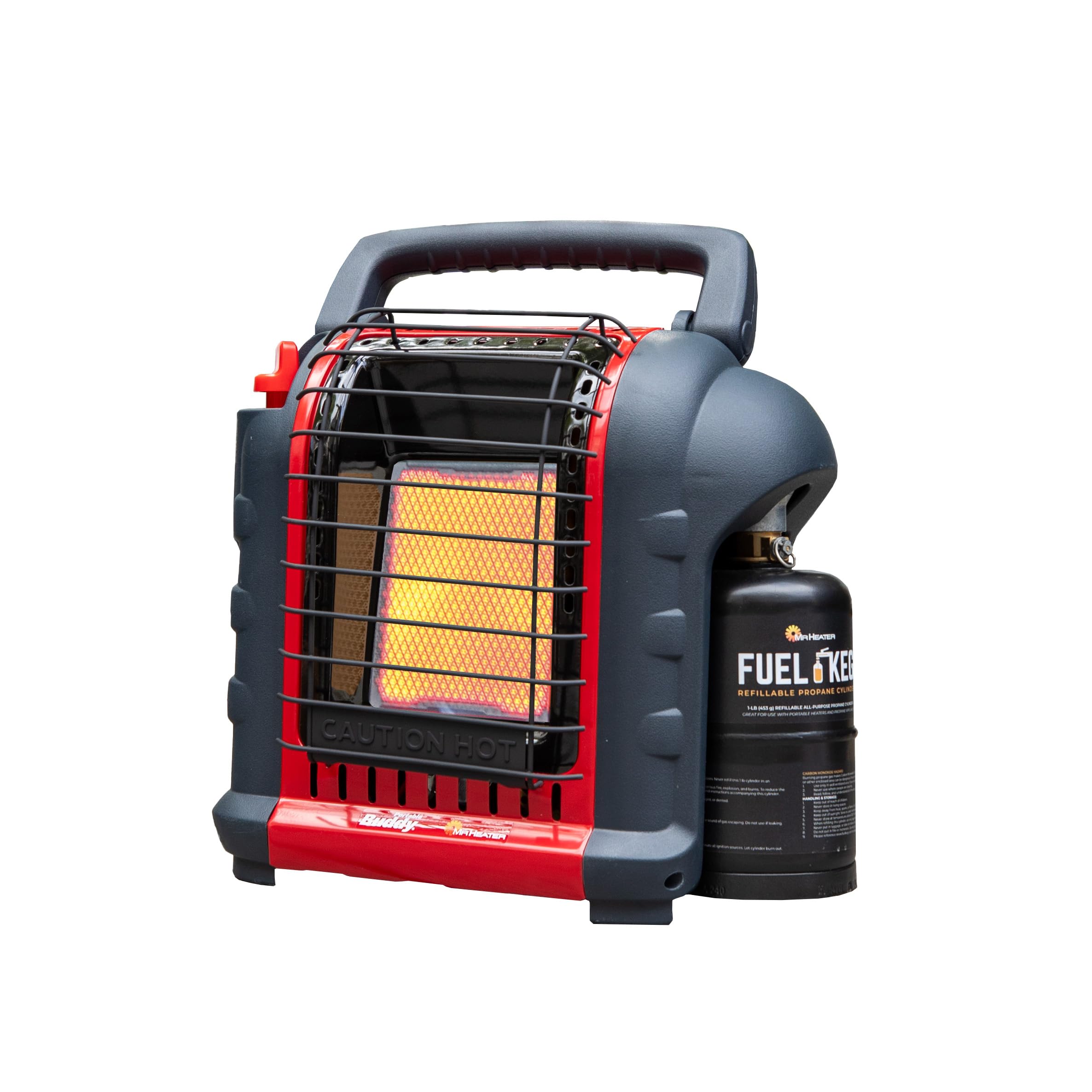

Best for Tent Camping
Mr. Heater Portable Buddy
Key Features
- Weight: 7.1 lb
- Heat output: 4,000 or 9,000 BTU/hr
- Heat settings: 2 (low, high)
- Heating coverage: 225 sq ft
- Price: Midrange
Four thousand BTU is the number that decides this one. That’s the Portable Buddy’s low setting, and it’s gentle enough to leave running in a small tent without turning the place into a sauna; the high setting doubles it to 9,000 BTU for a screen room, an ice shelter, or a garage. Mr. Heater rates the heater for roughly 225 square feet, which we read as a space you’re sitting in rather than a whole cabin.
The approval matters as much as the output. This is a heater designed and approved for indoor and outdoor use, with an oxygen-depletion shutoff and a tip-over switch behind that claim — the two features we look for first in anything that burns fuel inside a tent. Radiant heat is directional, though: it warms what it faces, not the air, so aim it at your seating and expect the far corners of a big tent to stay cool.
Fuel is the part of ownership the box doesn’t explain. Out of the box it runs on a 1 lb cylinder, which covers an evening or two but not a full cold night on high; the hose for a 20 lb tank is sold separately, and it’s the first accessory to buy with the heater if your trips run longer than a weekend. At 7.1 lb, shifting it from the tent to the picnic table is a one-hand job.
Pros
- Tent-friendly 4,000 BTU low setting
- Approved for indoor and outdoor use
- Oxygen-depletion and tip-over shutoffs
- 7.1 lb and easy to move around camp
Cons
- One-year warranty is short for the money
- Piezo igniter can stop sparking over time
We recommend the Portable Buddy for most campers: its 4,000 BTU low setting suits a small tent, and it’s approved for indoor use with oxygen and tip-over shutoffs.
Best for Rvs and Cabins
Mr. Heater Big Buddy Pro
Key Features
- Weight: 14.1 lb
- Heat output: 4,000 / 9,000 / 18,000 BTU
- Heat settings: 3 (low, medium, high)
- Heating coverage: 450 sq ft
- Price: Premium
The fan is what you’re paying for, and it’s the thing to think about before you commit. Mr. Heater’s dual radiant-and-convection design pushes warmed air through the unit instead of only radiating it off a hot face, and that’s the difference between heating the person in front of the heater and taking the chill off a whole wall tent.
Eighteen thousand BTU on high is a different class of heat from our top pick, and Mr. Heater rates it for 450 square feet — the kind of output that makes a garage or an insulated shop usable in January as well as a tent. The three settings matter as much as the top end. Low is 4,000 BTU, the same as the Portable Buddy’s low, so a big heater doesn’t have to run flat out in a small room. It’s approved for indoor and outdoor use and covered for three years.
Fuel is where the bigger unit pays you back. With the optional hose, Mr. Heater lists up to 216 hours on low from two 20 lb tanks, and even allowing for a little optimism in a spec sheet, that’s a season of evenings from one fill. This is a heater that lives in the trailer, the cabin, or the wall tent for the week rather than one you carry to a fire ring, and in that role nothing else here reaches as far into a cold space.
Pros
- Fan spreads heat through a large space
- 18,000 BTU high with a 450 sq ft rating
- 4,000 BTU low keeps it usable in small rooms
- Three-year limited warranty
Cons
- Fan runs on batteries and drains them fast
- Fan failure takes the convection with it
Eighteen thousand BTU and a fan make this the pick for a big tent, an RV, or a cabin — as long as you accept battery-hungry airflow and a heavier box.
How We Tested Camping Heaters in Real Cold
We started with a shortlist of roughly 40 heaters from brands that outdoor retailers and camping forums actually keep in stock, then filtered by heat source (propane, butane, electric, battery), footprint, price, and whether each model carried a tip-over switch and an oxygen-depletion shutoff. That left 12 units, which we ran for nine months across backyard tent nights, a van build, a pop-up camper, and a garage during a two-day power outage.
Every heater went into a night near 35 degrees with one thermometer at bunk height and another on the floor. We recorded how long it took to lift the space ten degrees, how evenly it spread that heat, and whether the warmth survived someone opening the door. A carbon monoxide monitor sat in every enclosed space we tested in. We also lit or switched on each model more than 20 times, half of those with gloves on in the dark, because a bleary 2 a.m. restart says more about reliability than a sunny first impression ever will.
For camping-friendliness, we weighed each unit packed, timed the setup, and listened to fan noise from inside a sleeping bag. Battery and fuel life came from running each model on high until it quit, then repeating the whole thing on low. Durability got checked the unglamorous way: dropped from tailgate height, rattled around a truck bed, and jammed into a duffel with the rest of the gear. We noted which ones still lit cleanly afterward, and which came back with scratched casings, loose knobs, or a fan that had started to whine.
How to Choose a Camping Heater
The right camping heater comes down to two things: the lowest setting it offers and whether it’s approved for the space you’ll put it in.
Pick the low setting before the high one
Output gets the attention, but the number that decides whether you can live with a heater in a tent is the bottom of the dial. Four thousand BTU is about right for a three- or four-person tent, 9,000 will carry a screen room or a bigger tent in real cold, and 18,000 is trailer, cabin, and workshop territory. A single-setting heater at 3,800 BTU works in a small tent and frustrates you anywhere else, because you can’t turn it down.
Radiant heaters warm surfaces rather than air, so the coverage figure only tells you so much — the same heater feels very different depending on whether you’re sitting in front of it or across the tent from it.
Check what it’s approved to heat
Camping doesn’t automatically mean tent. Plenty of powerful propane heaters, tank-top models especially, are outdoor use only, and no amount of cold makes one safe inside a tent or an RV. Look for a unit described as indoor and outdoor, and treat an oxygen-depletion sensor and a tip-over shutoff as the baseline.
Those sensors shut the heater off when a tent gets stuffy or the unit gets knocked, which is the system doing its job rather than a defect. Put a carbon monoxide alarm in your kit either way.
Decide how you’ll feed it
A 1 lb cylinder is the easy start: no hose, no regulator, no big tank in the car. It’s also the expensive way to buy propane, and it won’t hold a cold night on high, so it suits weekenders and backup use. For a week of basecamp, a trailer, or a cabin, a 20 lb tank and the manufacturer’s hose is the better setup.
The hose is usually sold separately and often isn’t in the box with the heater, so budget for it with the heater rather than discovering it at the campsite.
Weigh radiant against fan-forced heat
A radiant heater is silent and draws no power, but it aims warmth at whatever is in front of it. A fan model moves air and evens out the temperature in a larger space, which is what you want in a wall tent or a trailer. The fan is a part that can quit and batteries to replace, so it’s worth paying for only if the space is big enough to need it.
Frequently Asked Questions
Is a camping heater worth it if I already have a good sleeping bag?
They solve different problems. Your bag keeps you warm; a heater makes the tent a place you can sit up, get dressed, and eat without your hands going numb. If you only camp in high summer, put the money into the bag. If you camp in shoulder seasons and spend evenings sitting up, the heater earns its place.
Should you leave a camping heater running all night?
Most campers don’t. The workable routine is to run it while you’re awake — dinner, cards, getting changed — then shut it off when you get into your bag and relight it before you get out in the morning. A tent holds some of that heat for a while. Overnight running only makes sense in a space with real ventilation, which a zipped-up tent isn’t.
Why does my propane heater put out less heat on the coldest nights?
Propane pressure falls as the cylinder gets cold, so a 1 lb bottle that ran fine on a mild evening can feel weak on a hard freeze, and the faster you draw gas the colder the bottle gets. Set the cylinder on something insulating rather than frozen ground, and move to a bigger tank for serious cold — it holds pressure better than a small one.
Final Verdict
For most people the decision is settled by the low setting. The Mr. Heater Portable Buddy warms a tent without cooking you out of it, it’s approved for indoor use, it carries the oxygen and tip-over shutoffs we want anywhere near a sleeping bag, and at 7.1 lb it goes in the car without a second thought. That’s our default camping heater.
Choose the Big Buddy Pro instead when the space is bigger than a tent — a trailer, a cabin, a wall tent — and you want the fan pushing heat into the corners. Budget for batteries, and enjoy the three-year coverage that the smaller heater doesn’t offer.