This post contains affiliate links. We may earn a small commission when you buy through our links — at no extra cost to you.
The first genuinely cold night of fall is what sells a fire pit, not the photos of one glowing on a patio. That’s also the night you learn whether it smokes in your face the moment it lights, whether it scorches the grass underneath, and whether portable means you can actually carry it to the car or just that it has handles. A good portable fire pit gives you a real fire on an ordinary weeknight without pouring a permanent ring in the yard, and it breaks down small enough to earn a spot in the trunk on camping weekends.
I’ve built backyard fires that were mostly smoke, and I’ve hauled pits that weighed more than my cooler. Over eight months, my team and I burned through 12 portable fire pits on patios, in driveways, and in the back of a hatchback headed for a campsite, and the gap between the good ones and the rest came down to airflow first, weight second. The cleanest burns came from secondary air vents and double-walled bowls, not from piling on more wood. The picks below are the ones we’d load up again.


Best for Camping and Patios
Outland Living 893 Deluxe
Key Features
- Fuel: Propane
- Weight: 23 lb
- Burn area: 19 in diameter
- Heat output: 58,000 BTU
- Price: Midrange
The first thing we check before a camping trip is whether the campground allows a wood fire. The Outland Living 893 Deluxe is the one we pack when the answer is no. It comes out of the box assembled, takes a bed of lava rocks, and connects to a standard 20-pound tank through a pre-attached 10-foot hose. The cover doubles as a carry kit, so the bowl, rocks, and hose stay together between trips.
What makes it our top pick is how completely it solves the ban-season campfire problem. The 19-inch bowl and 58,000 BTU burner throw a bright, adjustable flame without smoke, sparks, or ash, and the shutoff is immediate when the evening ends. We also like that the flame sits low enough to feel like a campfire rather than a patio heater. At 23 pounds it is manageable for one person to move from the truck to the site, though it is not a hike-in item.
The trade-off is the tank. A 20-pound cylinder is not included, and it takes up space in the vehicle and adds weight once filled. Wind can also make the heat feel weaker than the BTU number suggests, so give it a sheltered spot. Those are the costs of the convenience; the kit itself is ready to go. Against the cheaper propane bowls here, the Outland feels more finished: the lid fits, the hose is long enough to keep the tank out of the way, and the carry kit is genuinely useful.
Pros
- Complete propane kit with cover and carry bag
- 58,000 BTU and 19-inch bowl for small groups
- Smoke-free, spark-free operation
- No assembly and instant shutoff
Cons
- Premium to basic propane bowls
We recommend the Outland Living 893 Deluxe as the best default for campers and patio hosts who want a complete, smoke-free propane pit that is ready to go.
Best for Budget Propane
GasBRUH 19-Inch Propane
Key Features
- Fuel: Propane
- Weight: 18.7 lb
- Burn area: 19 in diameter
- Heat output: 60,000 BTU
- Price: Midrange
The GasBRUH 19-Inch Propane is the propane pick we reach for when the budget is tighter but we still want a full-size bowl. It looks like a familiar firebowl until you notice the lid turns and locks, which keeps the lava rocks in place and makes the unit easier to carry. The 60,000 BTU burner is at the top of this group on rated heat output, and the 19-inch bowl is the same size as our top pick.
Setup is simple: no tools, a pre-attached 10-foot braided hose, and a standard 20-pound tank connection. We like the locking lid more than we expected, especially when the pit rides in the back of a vehicle. The carry kit and cover are included, so it does not need a separate bag.
The caveats are the usual propane ones. The 60,000 BTU rating can drink fuel faster on high, and wind can make the heat feel less even. But as a value option for RV pads and campsites with fire restrictions, it covers the essentials without the premium of the Outland. If you already own a propane tank and want a bigger flame for less money, this is the one we point to.
Pros
- 60,000 BTU output
- Locking lid keeps rocks in place
- Cover and carry kit included
- Easy tool-free setup
Cons
- Needs a separate 20-pound tank
- 8.5 kg is heavy for one-person carry
We see the GasBRUH as the value propane pick for buyers who already own a tank and want a full-size bowl with a locking lid.
Best for Large Gatherings
Flame King 24-Inch Propane
Key Features
- Fuel: Propane
- Weight: 27.3 lb
- Burn area: 24 in diameter
- Heat output: 58,000 BTU
- Price: Premium
Twenty-four inches across is the number that matters with the Flame King. The bowl is noticeably wider than the 19-inch propane pits here, so it throws heat over a larger circle and gives a group more room to gather. The 58,000 BTU burner, self-igniter, cover, carry straps, and tank stabilizer ring are all part of the package.
We found the setup straightforward: the unit is preassembled, the hose is pre-attached, and the controls are easy to work with one hand. The stabilizer ring is a small thing that makes a difference when the tank and hose are on uneven ground.
The reason to choose it is the size. Around a 24-inch bowl, we can fit more chairs without everyone leaning into the smoke path, and the flame feels less concentrated than on the smaller bowls. The cost is weight: at 27.3 pounds, it is a two-hand carry for most people, and it takes up more room in a vehicle. For a patio or a tailgate where the pit stays close to the car, that trade is easy to accept. For a solo camper or someone with limited storage, the smaller Outland or GasBRUH makes more sense.
Pros
- 24-inch bowl for a larger circle
- 58,000 BTU heat output
- Self-igniting piezo system
- Carry straps and tank stabilizer included
Cons
- Needs a separate propane tank
We recommend the Flame King when a wider 24-inch bowl matters more than packability and you want a self-igniting propane pit for a group.
Best for Smokeless Wood Fires
Solo Stove Bonfire 2.0
Key Features
- Fuel: Wood
- Weight: 21.8 lb
- Included: Stand and carry case
- Burn area: 19.5 in diameter
- Price: Premium
The Solo Stove Bonfire 2.0 is the heaviest and priciest wood option here, and it makes no apology for it. The 19.5-inch stainless pit comes with a stand, a removable base plate and ash pan, and a nylon carry case. It is built for backyard fires and car camping, not for carrying any distance.
What we like is the smoke control. The airflow design burns the smoke off before it leaves the top, so once the fire is hot, we can sit around it without playing musical chairs. The ash pan is a real convenience, too: cleanup is a lift-out rather than a scoop-and-scrape job. For a wood fire that feels social instead of smoky, this is the pick.
The limitations are real. It needs dry fuel and a little patience to get going, and the fire area is small for a big group. But if your fire pit lives at home or goes car camping with a dedicated spot in the vehicle, the Bonfire 2.0 earns its keep. It is the one we choose when the point of the evening is a wood fire and we do not want to smell like one afterward.
Pros
- Low-smoke wood burning
- Removable ash pan
- Stand and carry case included
- 19.5-inch stainless bowl
Cons
- Wood only, so banned in many dry periods
We choose the Solo Stove Bonfire 2.0 for a low-smoke wood fire at home or car camping, where its weight and premium price are easier to accept.
Best for Packable Wood Fires
Fireside Outdoor Pop-Up 24
Key Features
- Fuel: Wood
- Weight: 8 lb
- Burn area: 24 in square
- Packed storage: Zippered carry bag
- Price: Midrange
The Fireside Outdoor pit disappears into a bag. It opens to a 24-inch square and 15 inches tall, then folds down into a zippered carry bag that weighs about 8 pounds. That is the lightest full-size wood pit here by a wide margin, and it is the one we think of first for a small car, a trailer, or a river trip.
The pop-up frame goes together without tools, and the mesh body is designed to pull air through the fire so it burns hotter and with less smoke. We like the height: it lifts the fire off the ground, which helps on a campsite where you do not want to scorch the grass. The carry bag is sturdy enough to keep ash and soot away from the rest of the gear.
The mesh is also the weak point. The edges can cut bare hands, so we keep gloves with the bag, and a side can melt if a hot fire sits against it. Those are reasons to treat it as a packable camp pit rather than a leave-it-out patio fixture. For the buyer who wants a real wood fire from a package that fits behind the seat, it is worth the care.
Pros
- Packs into a zippered bag at about 8 lb
- 24-inch square burn area
- Tool-free pop-up setup
- Raises the fire off the ground
Cons
- Heat shield not included
We recommend the Fireside Outdoor for campers who need a real wood fire in a package that packs small and carries light.
Best for Tabletop S’mores
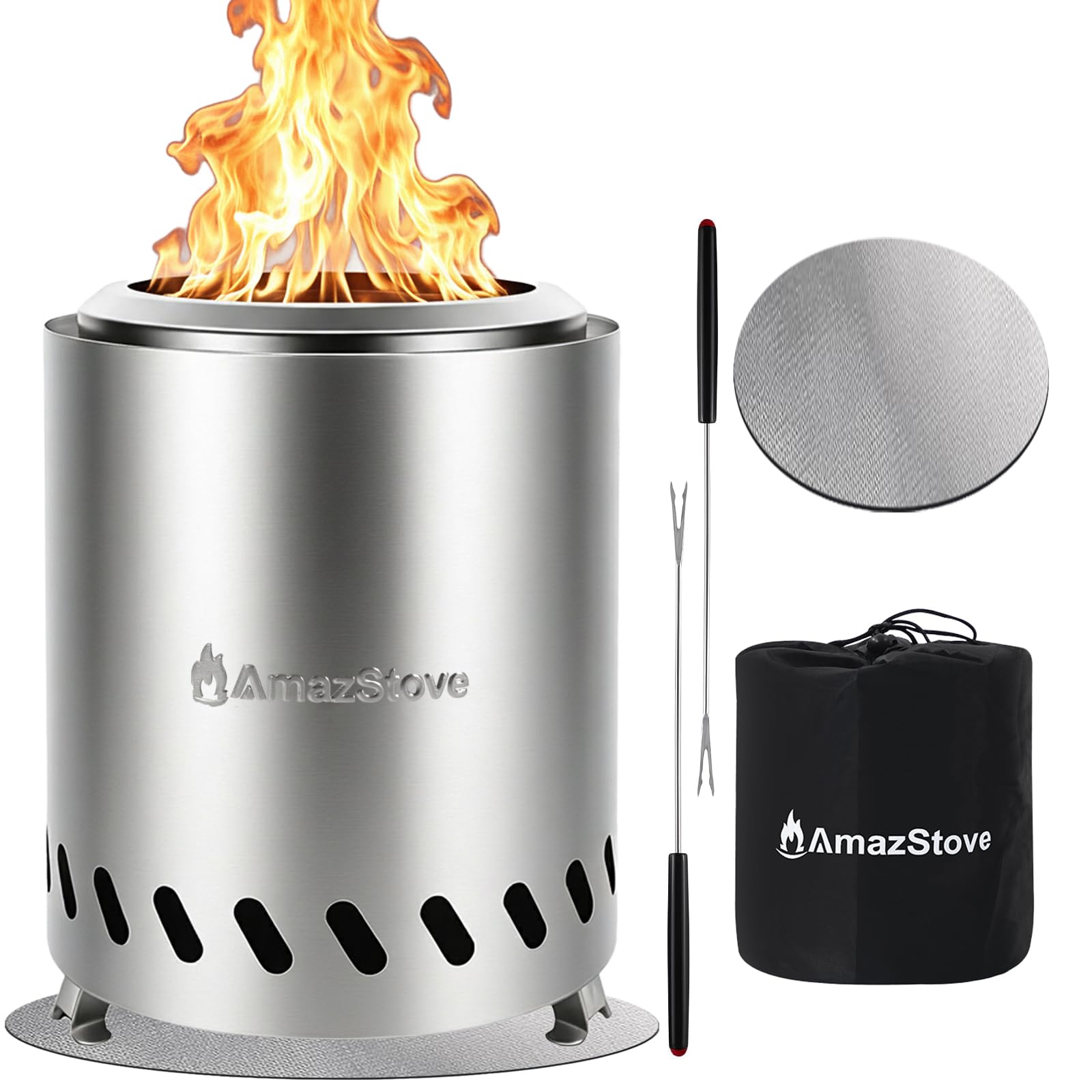
AmazStove Tabletop Fire Pit
Key Features
- Fuel: Wood or pellets
- Weight: 2.8 lb
- Burn area: 9.7 x 7.1 in
- Carry bag: Included
- Price: Budget
This is not the fire pit you gather around on a cold night, and we mean that as a compliment to its lane. The AmazStove is a 9.7 by 7.1 inch tabletop burner that weighs 2.8 pounds, runs on pellets or small wood, and comes with a travel bag. We think of it as a s’mores centerpiece for a patio table or a picnic, not a campfire replacement.
It lights quickly with no assembly, and the stainless body feels more substantial than the price suggests. The size is right for a couple of people or a few kids around a table, and it is easy to store when the season ends. It is also a good way to bring a little flame to a balcony or a small patio where a full-size pit is overkill.
The limits show up once the fire is going. Smoke can be inconsistent until the fire is hot and the airflow is right, and it does not throw meaningful heat beyond the table. If you want a fire to sit around for hours, this is the wrong tool. For quick s’mores and a bit of tabletop atmosphere, it is a fun little piece of gear.
Pros
- 2.8 lb and packable
- Runs on pellets or small wood
- No-assembly lighting
- Good for tabletop s’mores
Cons
- Tiny burn area needs frequent refueling
We like the AmazStove as a compact tabletop s’mores maker, not as a fire pit for warming a group.
Best for Cooking and Warmth
Ciays 19-Inch Propane
Key Features
- Fuel: Propane
- Burn area: 19 in diameter
- Grill grate: Included
- Heat output: 58,000 BTU
- Price: Midrange
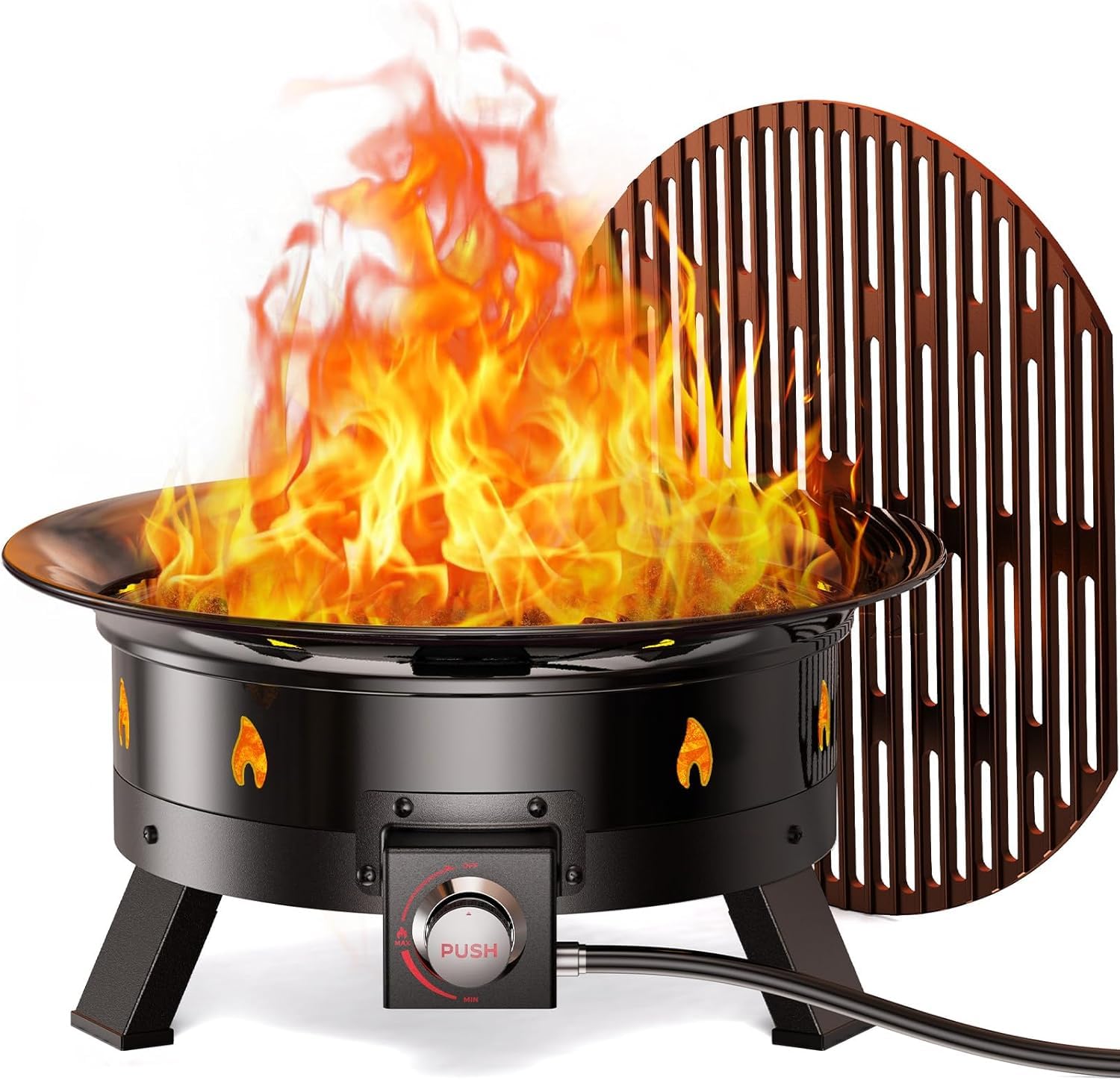
Ciays adds a grill grate to the familiar 19-inch propane bowl, which changes how we think about it. The 58,000 BTU burner, folding legs, hose hooks, propane tank holder, cover, and carry strap are all included, along with flameout protection and a piezo igniter. It is a feature-rich package for the money.
The folding legs are the detail we appreciate most. They make the pit easier to store and keep the bowl stable on uneven ground, and the tank holder gets the cylinder off the dirt. Setup is tool-free, and the 10-foot hose gives you room to keep the tank out of the seating circle.
The grill grate is best for hot dogs, marshmallows, and a quick sear, not a full camp-cook session. It sits close to the flame, so food needs watching, and the lava rocks are still the main event. The flameout protection is a sensible addition for a portable gas appliance, and the folding legs keep the whole thing easier to pack than a fixed-frame bowl.
That said, this is the propane pit we point to when someone wants a little cooking utility without stepping up to a dedicated grill. The flameout protection and folding legs make it feel more considered than its price suggests, and it covers the basics for camping and patio use.
Pros
- Cast-iron grill grate included
- Folding legs and tank holder
- 58,000 BTU output
- Flameout protection and piezo ignition
Cons
- No carry bag, just a strap and cover
We point to the Ciays for budget-minded propane buyers who want a grill grate, folding legs, and a tank holder in one package.
Best for Camp Cooking
CAMPINGMOON MT-2 Grill

Key Features
- Fuel: Charcoal or wood
- Carry case: Included
- Cooking area: 14 x 13.4 in
- Grate material: 304 stainless steel
- Price: Budget
If dinner is the point, the CAMPINGMOON MT-2 makes more sense than a bowl-shaped fire pit. The 14-inch stainless grill gives you a 14 by 13.4 inch cooking grate, two height settings, and the option to run it as a charcoal grill or a small wood fire. It folds into a carry case and weighs little enough to live in the car.
We like the two-level grate. The lower position is for a stronger sear, and the upper position gives you more control for sausages or vegetables. The raised coal bed and ash tray make airflow and cleanup easier than a flat firebox, and the stainless body feels sturdy.
It is not a propane pit, so it will not get you around a fire ban, and you need charcoal or dry wood. The upside is that it does both jobs: a grill for dinner and a small fire for afterward. The 304 stainless grate is the right material for cooking, and the carry case keeps soot away from the rest of the gear.
For car camping, a cabin, or a small patio where cooking matters as much as ambiance, this is the one we recommend. It is a specialist, but it is a good one.
Pros
- Two-level cooking grate
- Grill or wood-fire setup
- Folds into a carry case
- 304 stainless grate
Cons
- Small fire area for two or three
We recommend the CAMPINGMOON MT-2 when cooking is the main event and you want a compact grill that can also burn a small wood fire.
How We Tested Portable Fire Pits
We started by gathering every model a single adult could reasonably move, which meant a practical ceiling of around 40 pounds plus handles or a carry bag, and then narrowed by fuel type, packed size, and whether the manufacturer claimed a secondary burn. That left us with 12 fire pits, and we spent eight months living with them rather than lighting each one once.
Every pit got the same first night. On a cool evening we timed from opening the box to the first sustained flame, then watched which way the smoke drifted and whether it pushed into the face of whoever sat downwind. We let each fire burn down completely and checked whether we were left with fine ash or half-charred logs that needed constant prodding, and we walked a hand around the outside of the bowl to judge how much heat reached the person sitting closest.
Portability we checked the boring way: each pit went on a luggage scale, got carried across the yard one-handed, and was loaded into a hatchback trunk. At the campsite we set them up on uneven ground, cooked over a couple of them, and packed them back into their bags the morning after a burn, when everything was sooty and heavier than it started.
Durability had the longest window of all. Several pits stayed outside through rain and a cold snap, and we checked bowls, legs, and painted surfaces for rust and blistering at the end. Then we weighed the whole package against what it cost, asking whether the budget models demanded noticeably more tending and whether the spendier ones earned the difference.
How to Choose a Portable Fire Pit
Start with where you can legally burn and how much weight you are willing to carry, because those two answers narrow the field faster than a BTU number.
Start With Fuel and Fire Rules
A propane pit such as the Outland Living or GasBRUH needs a separate 20-pound tank, but it starts and stops instantly, produces no ash, and can be used during many fire bans. A wood pit such as the Solo Stove or Fireside gives you a real fire, but you need dry wood, a place to put the ash, and a campsite that allows it. If your trips revolve around ban-season camping or an RV, propane is the safer default.
Check the current restriction wording before you buy. Some bans allow gas appliances with a shutoff valve; others do not. A propane pit is not automatically legal just because it has a knob.
Size the Burn Area, Then the Packed Size
A 19-inch bowl is the sweet spot for a few chairs and a couple of people; a 24-inch bowl gives a larger group more room but weighs more and takes up more storage. Tabletop pits are a separate category: the AmazStove is fun for s’mores, but it will not warm a circle of adults. Do not let the word compact do the work for you.
Measure the space where the pit will ride, not just the footprint on the patio. The Fireside packs into a bag at about 8 pounds; the 24-inch Flame King is 27.3 pounds and wants a bigger shelf. A pit that does not fit the vehicle is not portable, however good the flame.
Check the Carrying Kit and Cleanup Routine
A lid that locks, a carry strap, or a zippered bag is not a luxury if the pit lives in an RV or truck. The Outland’s cover and carry kit and the GasBRUH’s locking lid both keep lava rocks and soot contained. For wood, an ash pan or a flip-out base makes cleanup much less messy.
Think through the whole ritual: where the hose runs, where the tank sits, how you will dump ash, and whether the lid can come off with gloves on. The easier that sequence is, the more often you will actually use the pit.
Match Heat and Burn Time to the Trip
BTU is a measure of maximum output, not a promise that everyone will feel warm. Wind, air temperature, and where you sit matter more than the difference between 58,000 and 60,000 BTU. A higher setting burns propane faster, so a smaller flame is the fuel-saving setting on any of these.
Wood pits have the opposite rhythm: the Solo Stove burns efficiently but still needs dry fuel and attention, while the Fireside is best with a small, hot fire. Plan for the fuel you will actually carry, and do not buy a bigger pit than your trips need.
Frequently Asked Questions
Can I use a portable fire pit on a wood deck?
Only with a noncombustible pad or heat shield underneath and plenty of clearance above and around it. Propane models still radiate heat downward, and wood models can drop embers. Set the pit on concrete, stone, or a fire-rated mat rather than directly on decking, and check the manufacturer’s clearance and your local rules before lighting. Some wood-burning models, including the Fireside, do not include a heat shield.
How long does a 20-pound propane tank last?
A full 20-pound tank holds about 430,000 BTU. At the 58,000 to 60,000 BTU high setting on most full-size pits here, that is roughly seven hours of full-output burn; on low, you will get much longer. Carry a spare tank for a weekend or plan to refill, and expect wind and high settings to shorten the real-world number.
What should I burn in a wood-burning portable fire pit?
Use dry, split hardwood that fits the firebox, and avoid wet or resinous wood if you want less smoke. Pellets are for tabletop burners such as the AmazStove, not a full-size bowl. The Solo Stove and Fireside are designed for wood, while the CAMPINGMOON can run on charcoal or wood depending on whether you are grilling or making a fire.
Final Verdict
For most people, the Outland Living 893 Deluxe is the portable fire pit we recommend first. It arrives assembled, carries like a kit, and turns a ban-season campsite into a real fire without smoke, ash, or a lighter-fluid ritual. The 58,000 BTU burner is more than enough for a small group, and the cover and carry kit are why it stays packed and ready.
If you want a wood fire and smoke control, the Solo Stove Bonfire 2.0 is the upgrade; if you need something that fits behind the seat, the Fireside is the packable choice. The right answer depends on whether your priority is convenience, atmosphere, or space.