This post contains affiliate links. We may earn a small commission when you buy through our links — at no extra cost to you.
A backyard fire is the part of the night when everyone finally stops checking their phones — right up until the wind shifts and the whole group plays musical chairs to escape the smoke. A well-built wood fire pit handles that with airflow: secondary vents and a double wall burn the smoke off instead of pushing it straight into your face. What it really buys you is a reason to stay outside past sunset without a jacket-and-blanket negotiation.
I’ve spent the past seven months with 11 fire pits on my patio and a neighbor’s gravel pad, and the differences showed up fast — one finish blistered at the rim after a single hot burn, a couple of spark screens never sat flush, and assembly ranged from ten minutes alone to an entire afternoon. Size matters more than product photos suggest, and value comes down to what’s actually in the box. These are the ones that earned a permanent spot out there.



Best for Everyday Backyard Fires
Solo Stove Bonfire 2.0
Key Features
- Weight: 21.7 lb
- Included: Stand, ash pan, carry case
- Fire bowl: 19.5 in diameter
- Smoke design: Secondary-airflow smokeless
- Price: Premium
We judged every pit on this page by one thing first: how much smoke ends up in your face. The Bonfire is the one that changed the evening. Get the fire established and the airflow design burns most of the smoke off above the logs, so nobody shuffles a chair when the wind moves and the conversation keeps going. It’s the cleanest burn in this group, and that is the entire case for it.
The rest of the design holds up. The bowl is 19.5 inches across and the whole pit weighs a little over 21 pounds, so it lifts off the patio and travels — the stand and a carry case come in the box. Cleanup is the other quiet win: the base comes away with the ash pan, so you tip the ash out in one go instead of scooping around a bowl.
Build quality is the slower argument. 304 stainless steel under a high-heat ceramic coating is a different proposition from the painted steel under most of the cheaper bowls here, and the fit shows when you take it apart to clean. The stand also keeps the base off the patio surface, which matters on a wood deck.
It’s a four-to-six-person fire, so a household that fills the yard with a dozen people should look at the bigger Sunnydaze instead. For everyone else who wants a fire on a Tuesday, this is the one we keep coming back to.
Pros
- Smoke drops away once the fire is hot
- 304 stainless with a ceramic coating
- Ash pan and base lift out for cleanup
- Stand and carry case included
Cons
- Costliest pick in this group
- Cooking and deflector accessories are extra
We recommend the Bonfire to anyone who lights a fire most weekends: it’s the cleanest-burning pit here, with the build to match.
Best for All-Weather Patio Pit
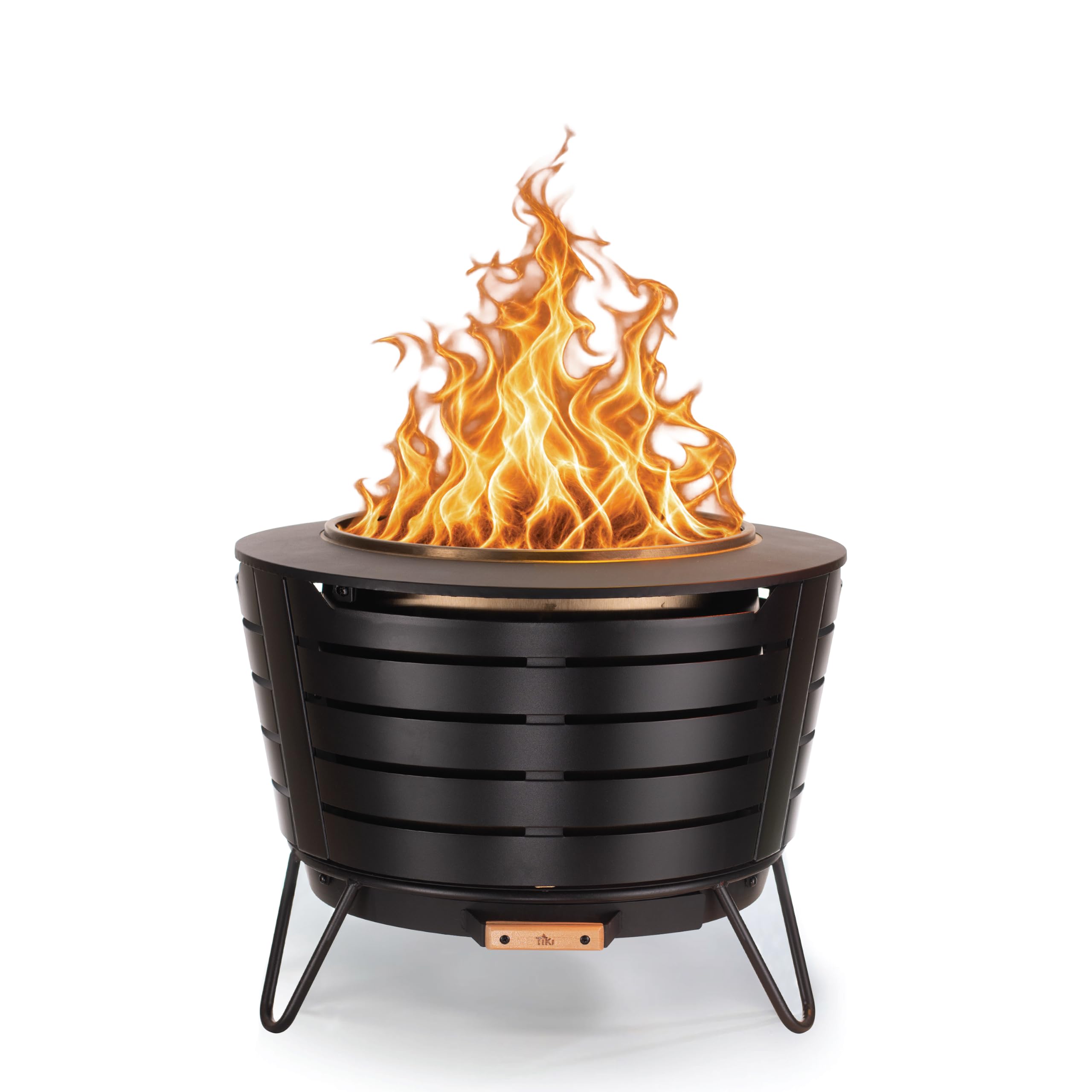
TIKI Patio 25-Inch
Key Features
- Weight: 45 lb
- Included: Cover, stand, ash pan
- Heat radius: 4 ft
- Overall diameter: 24.75 in
- Price: Premium
The TIKI asks for top-pick money and answers a different question: what if everything came in the box? Cover, stand and ash pan are all included, which is the exact list of things you otherwise buy one at a time, and the black powder coat over 16-gauge stainless reads as patio furniture rather than a campfire ring.
We came away thinking of it as the all-weather option. It’s built to sit out through fall and holiday entertaining, and at 45 pounds it stays where you set it down instead of drifting in a gust. The four-foot heat radius in the specs isn’t optimistic either — you can sit back in a chair and still feel it on your shins.
Smoke is where the two smokeless designs part company. This one runs clean once it’s hot and the fuel is dry; before that, expect the same plume any bowl gives you. A hot start with seasoned wood settles it quickly, and then it behaves.
Then there’s the bowl. The 25 inches is the outer shell, and the fire area inside is much smaller, so full-length splits want cutting down. TIKI’s own wood packs are sized for it and are the path of least resistance — one of the few times a branded consumable genuinely makes a product easier to live with.
Pros
- Cover, stand and ash pan in the box
- Four-foot heat radius really reaches chairs
- 16-gauge stainless under a powder coat
Cons
- Smoke returns until the fire is fully hot
- Heavy enough to rule out carrying it
Our pick when the pit lives outside year-round: cover, stand and ash pan come with it, and the finish holds its looks.
Best for Large Group Bonfires
Sunnydaze Crossweave 36-Inch
Key Features
- Steel: 24-gauge
- Weight: 23.8 lb
- Included: Spark screen, poker, cover
- Outer ring: 36 in
- Price: Midrange
Thirty-six inches of ring is the whole argument. This is the biggest fire in the group — a real bonfire bowl rather than a four-person kettle — and it’s the one to choose when the yard fills up on a Saturday night. We also appreciate that the spark screen, poker and cover arrive together, because a cover is the accessory that actually decides how long a steel bowl lasts.
The crossweave cutouts are wrapped in mesh and open all the way around, so the fire draws air from below and takes hold fast; the built-in log grate does most of the work on a stubborn start. Assembly is four steps and one person can manage it, and at 23.8 pounds it’s light enough to drag around the yard while you decide where it lives.
What you’re not buying is thickness. The bowl is 24-gauge steel with high-temperature paint, and the bottom is the part that goes first: damp ash sitting in it through a wet winter is what eats through. Tip the ash out while it’s dry and put the included cover on between burns, and it holds up far better than the same pit left out bare.
Pros
- Largest fire of any pick here
- Spark screen, poker and cover included
- Light enough to move at 23.8 pounds
Cons
- Thin 24-gauge bowl dents under a hot fire
Choose the Crossweave when the yard fills up: it’s the largest fire in this group and it arrives with the screen, poker and cover.
Best for Cooking and Fires
Hykolity 35-Inch 3-in-1
Key Features
- Weight: 30.1 lb
- Included: Charcoal pan, log rack, poker
- Cooking grates: 18.5 in and 15 in
- Outer diameter: 35 in
- Price: Midrange
The charcoal pan is the part that makes this more than a fire pit with a grate balanced on top. Drop it in, load it with charcoal, and you have a working grill; lift it out and the two grates — 18.5 and 15 inches — sit over a wood fire for marshmallows, hot dogs, or a cast-iron pan. It’s the only pick here with that dedicated charcoal layer.
The rest is equally practical: 35 inches across, a log rack underneath for airflow, a lid that turns the bowl into a table when the fire’s out, and a poker that stores with everything else. At 30.1 pounds it feels planted without becoming a two-person lift, and assembly is a straightforward bolt-together job.
It’s the most useful cooking setup here, and it covers the fire-pit job properly as well — four or five chairs around a good-sized blaze. Just know the finish is the weak point: interior paint can peel and the hardware can rust, so a cover and a dry spot between fires are worth the trouble.
Pros
- Charcoal pan enables real grilling
- Two cooking grates included
- Lid turns the bowl into a table
- Stable 35-inch footprint
Cons
- Interior paint can peel and screws rust
We point anyone who wants to cook over to the Hykolity: the charcoal pan and two grates make it the most useful cooking setup here.
Best for Portable Patio Fires
OutVue 19.5-Inch Smokeless
Key Features
- Weight: 22 lb
- Included: Tote bag, fire poker
- Material: Stainless steel
- Fire bowl: 19.5 in diameter
- Price: Budget
It ships as a stack of nesting rings and goes together without a tool, which is the kind of claim we take with salt — and it held up. The pieces nest flat for storage, and the tote bag means the whole pit travels to a campsite or a friend’s patio without a fight.
Size is the surprise. At 19.5 inches it’s not the biggest fire you’ll sit around, but the stainless body throws more heat than the diameter suggests, and the secondary burn does the same job the expensive pits do: once it’s hot, the smoke drops away and the wood burns down to a fine ash you can tip straight out.
Set against the Bonfire, this is where we land: it delivers most of the smoke-free experience in a smaller, plainer package, and it’s what we’d hand to someone who wants a portable fire without the premium. Two things to accept — it wants splits cut shorter than a full log, and the ash tray can warp and stick after a run of hot fires.
Pros
- Tool-free assembly, nests flat for storage
- Tote bag included for travel
- Low smoke once the fire is hot
- Stainless body at a budget price
Cons
- Ash tray can warp and stick
- Thin stainless can corrode with heavy use
We hand this one to anyone who wants a travel-sized smoke-free fire without paying premium money for it.
Best for Budget Grilling Combo
BALI Outdoors 32-Inch

Key Features
- Weight: 16.3 lb
- Assembly: About 30 minutes
- Cooking grate: 360° rotating, height adjustable
- Outer diameter: 32 in
- Price: Midrange
If you want fire and a grill without buying two things, this is the least expensive route to both here — a 32-inch bowl with a cooking grate that swings a full 360 degrees and moves up and down on its handles. The manufacturer’s estimate for assembly is around half an hour, and at 16.3 pounds it’s easy to shift out of the wind.
The grate is the bit we actually enjoyed. Being able to swing it clear without reaching across the flames makes a real difference when you’re feeding a group, and the bowl takes a good-sized log for a pit in this class.
The catch is the steel. It’s thin, and the bowl and grate are the parts that go first once the weather gets in; a pit left out uncovered is a pit on borrowed time. Treated as a value option rather than an heirloom, it does what it promises.
Pros
- Rotating grate adjusts over the fire
- Large 32-inch bowl for the money
- Light enough to reposition easily
Cons
- Rust shows up fast on bowl and grate
- Thin steel flexes under load
A fair buy if a rotating cooking grate matters more to you than a bowl that will still look good in a few summers.
Best for Small Patio Tables
Panovue 32-Inch Square

Key Features
- Weight: 18.5 lb
- Included: Mesh lid, poker, wood grate
- Fire bowl: 23 in wide, 4.8 in deep
- Footprint: 32 in square
- Price: Budget
A square, low fire pit does two jobs. At 14 inches tall the Panovue sits at patio-table height rather than knee height, so it slots in among your outdoor chairs, and the mesh lid gives you a flat surface between fires.
The bowl is the number that matters: 23 inches wide and 4.8 inches deep, which holds more wood and burns longer than the shallow trays in the same price range. The legs get triangular metal plates top and bottom, which is the sort of reinforcement that usually goes missing at the lower end.
Assembly is a bolt-together job, and water is the thing to watch — the single drain hole is small, so tip it out after rain rather than let it stand in the bowl. A cover between uses is worth the few dollars it costs.
Our read is that it’s a good small-space fire pit and a genuinely useful table the rest of the time, and the deep bowl is what separates it from the shallower trays on this page. Give the legs a once-over during assembly and it settles down.
Pros
- Deep 23-inch bowl burns longer
- Doubles as a patio table
- Legs reinforced with triangular plates
Cons
- Legs flex and bolt holes can misalign
Worth it for a small patio where the pit has to double as a table, as long as you’re ready to fettle the frame.
Best for Simple Classic Bowl
Amazon Basics 27-Inch

Key Features
- Weight: 17.6 lb
- Included: Spark screen, poker
- Fire bowl: 23 in diameter
- Overall size: 27.4 in diameter x 25.6 in high
- Price: Midrange
The lattice cutouts are why this one gets a second look. From across a yard it reads as a pricier pit than it is, and the mesh sides open the fire to every chair — you get the full 360-degree view rather than staring at a solid steel wall.
Twenty-seven inches overall and a 23-inch bowl put it in the three-to-four-person class. At 17.6 pounds it’s light enough to move yourself while you work out which corner of the patio the wind allows, and the spark screen and poker come in the box.
The paint on the inside is where the weather gets in. Leave ash and rainwater standing in the bowl and it blisters and rusts inside a season. Empty it after every fire and throw a cover over it, and it will look after you for a good while longer.
We think it’s the right call for a first fire pit or a rental patio where you don’t want to think hard about it. The screen ring takes a little patience to seat, and the legs are the lightest parts in the box — worth a check on arrival.
Pros
- Lattice sides show the fire from all angles
- Spark screen and poker included
- Light and easy to reposition
Cons
- Legs and screen ring feel flimsy
For a plain, good-looking bowl that does the basic job without fuss, the Amazon Basics is the sensible spend.
How We Chose and Tested Wood Fire Pits
We started with roughly 40 wood-burning pits sold at national retailers and specialty fireplace shops, then trimmed the list by firebox size, material, and price — dropping anything with a bowl too thin to hold heat and anything whose listing wouldn’t tell us the gauge of the steel. That left 11 pits, ranging from simple bowl-shaped models to heavier welded designs that cost several times as much. Each one lived on a backyard patio or a gravel pad for the full seven months, through spring rain and a couple of light snows.
Every pit was assembled by one person with a socket wrench and a phone timer running, and we noted which ones finished in under fifteen minutes and which sent us back to the parts bag twice because two bolts looked identical. Once built, we rocked each one on uneven ground, leaned on the rim to see if it shifted, and measured both the firebox opening and the overall footprint so we could judge how many chairs fit around it without knees colliding.
Then we burned. Each pit saw at least four fires with seasoned hardwood, and on breezy evenings we logged which way the smoke drifted, whether it hung low, and how often we had to move our chairs. We watched how the finish looked after the first hot burn and where rust appeared first after leaving the unpainted ones out through a week of rain. Because a pit is only a good deal if the extras come with it, we counted what was actually in the box — screen, poker, grate, cover — before calling anything a value.
How to Choose a Wood Fire Pit
The number in a fire pit’s title is usually the outer ring, not the fire you actually get, and smokeless is a design rather than a label you can trust on its own.
What Smokeless Actually Means
A smokeless pit feeds air into the fire from underneath and burns much of the smoke off above the logs, which is why the Solo Stove and the OutVue let you keep your chair where it is and a plain bowl doesn’t. Two conditions come attached: the fire has to be hot, and the wood has to be dry. Expect smoke in the first few minutes and with damp splits, and don’t buy a smokeless pit expecting to skip that entirely.
If you light a fire a few times a summer, a plain bowl is the cheaper way in and nobody will complain. If it’s a weekly habit, the premium buys back your evening — and it’s the one upgrade here we think is worth paying for.
Measure the Bowl, Not the Ring
The 36 inches on the Sunnydaze is the outer safety ring; the fire sits in a bowl inside it. That gap decides log length and how big a fire you can build, and it’s the number product pages tend to leave out. A 23-inch bowl takes a decent stack of standard splits. The compact bowls want wood cut shorter, or a branded wood pack sized to fit, which is exactly the kind of recurring nuisance worth knowing about before delivery day.
So read both numbers — footprint for the circle of chairs, bowl for the fire itself — and pick which one you care about more.
Steel Gauge and the Rust Question
Almost every rust story in this category ends the same way: the bottom of the bowl. Thin painted steel, ash left sitting damp, and a pit that never gets covered add up to a hole within a couple of seasons. Heavier gauge and stainless buy you time; so do two cheap habits, emptying the ash once it’s cold and putting the cover on.
That makes an included cover worth more than it sounds. The TIKI and the Sunnydaze Crossweave both ship with one, and on a painted bowl it’s the difference between a pit that stays presentable and one that stains your patio.
Bowl, Table, or Grill
Height decides which chairs work. A low bowl, roughly 14 to 18 inches, sits right with lounging chairs; a taller ring around 24 inches suits dining-height furniture. Square table-style pits such as the Panovue earn their place by becoming a surface between fires, though they generally hold less wood than a deep round bowl of the same footprint.
If cooking matters, look for a grate that swings or lifts clear of the flames and, better still, a charcoal pan — the Hykolity’s tray is what turns a fire pit into a grill. A bare grate over an open wood fire is for marshmallows and hot dogs, not dinner.
Frequently Asked Questions
Can I put a wood fire pit on a wooden deck?
Yes, with a non-combustible base under it — concrete pavers or a stone pad — and clear space to the railings and anything overhead. Embers travel further than people expect, so the spark screen matters more on a deck than on a lawn.
Check your building or rental rules before you buy. Some prohibit open flame on decks outright, and a table-height pit on a stone pad is the setup most likely to be allowed.
Can you burn pellets or charcoal in a wood fire pit?
Pellets work in a bowl built for airflow and burn hot and fast; the OutVue is listed for wood or pellets. Charcoal needs somewhere to sit, which is why the Hykolity’s charcoal tray is the feature that makes it the cooking pick here.
Stick to the fuel the pit is listed for. A bare painted bowl loaded with charcoal is a quick way to blister the finish and shorten the bowl’s life.
How hard is it to put one of these together?
Most are bolt-together jobs of four steps or fewer, and the flat-pack models go together well under an hour. Leave every bolt finger-tight until all the holes line up, then tighten — that one habit is what saves the pits with fussier frames.
The OutVue needs no tools at all: the pieces nest and lift apart, so there’s nothing to assemble before a fire.
Final Verdict
The Solo Stove Bonfire is the one we recommend, and the reason is narrow and practical: it takes the smoke out of the evening, and it does it with better materials than anything else in this group. If you light a fire most weekends, that combination is worth the top of the price range.
Want the cover and stand bundled with the pit? The TIKI is the close alternative and the one that looks most at home on a patio. If your yard fills up, the Sunnydaze Crossweave puts the biggest fire here in front of the most chairs for a good deal less than either smokeless design. Between those three, most buyers will find their answer.