This post contains affiliate links. We may earn a small commission when you buy through our links — at no extra cost to you.
A parking-lot tailgate is where a portable charcoal grill either earns its keep or ruins the afternoon. I’ve watched a folding grill wobble so badly on uneven asphalt that we cooked hot dogs in shifts, and I’ve hauled a so-called portable model across a campground that somehow weighed more than my tent. What a good one actually fixes is simple: real charcoal flavor and usable heat control in something you can carry in one hand and have set up before the coals are ready.
So this spring my team and I gathered 12 portable charcoal grills and cooked on them for seven months — tailgates, campsites, backyard Sundays, and one memorably windy beach lot. The pattern that emerged surprised me: overall size mattered less than vent design and how low the firebox sits. A grill that folds flat but chokes its own airflow or dumps ash every time you open it is just a heavier cooler. Every pick below survived all of that, and the differences between them are the reason this list exists.



Best for Camping for Two
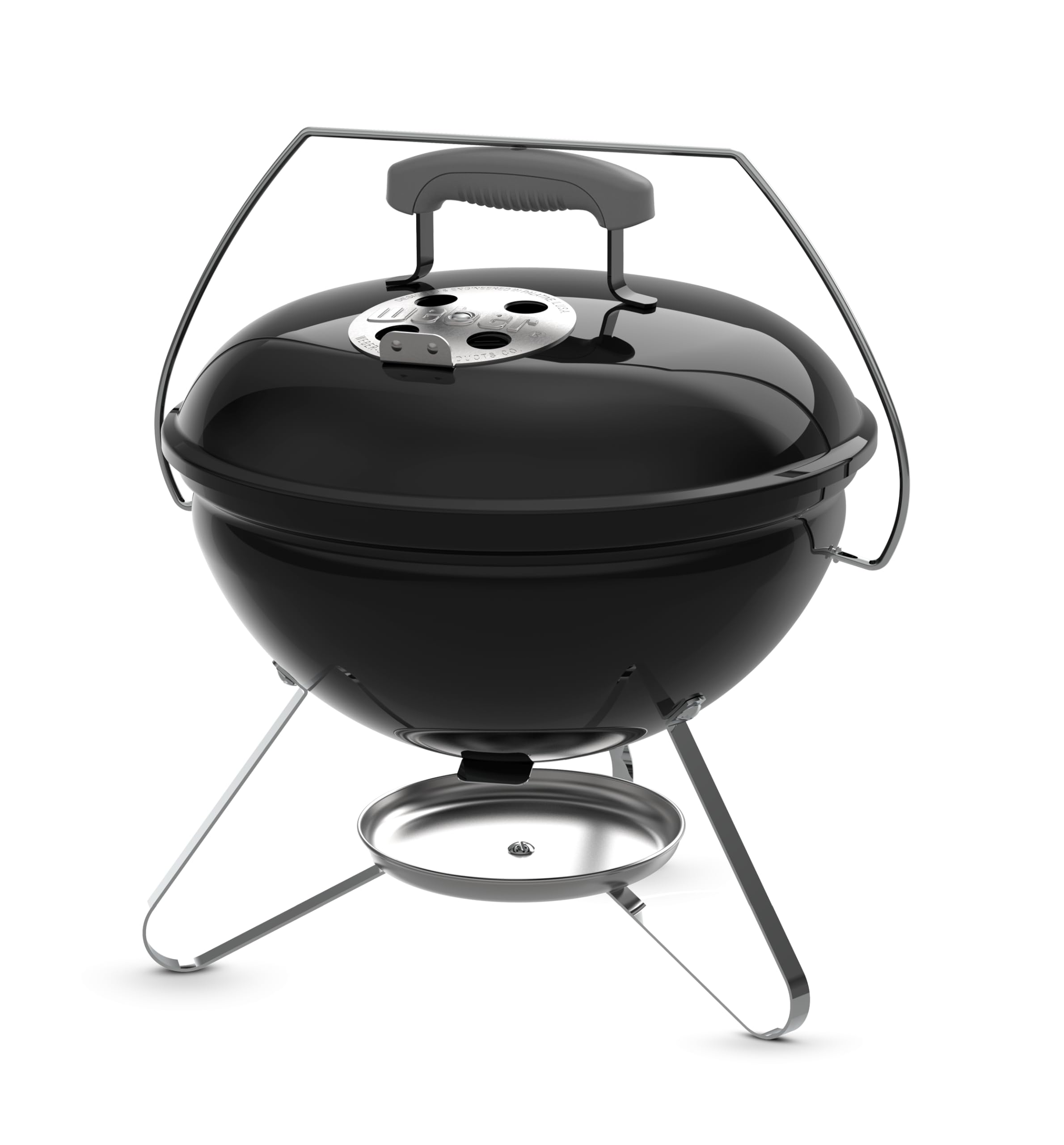
Weber Smokey Joe 14-Inch
Key Features
- Weight: 8.4 lb
- Capacity: 6 burgers
- Warranty: 10-year limited
- Dimensions: 16.5 x 14.2 x 17 inches
- Price: Midrange
At 8.4 pounds the Smokey Joe is light enough to carry in one hand with a bag of charcoal in the other, and that is the entire argument for a portable kettle. It’s 14 inches across, it has a real lid, and it takes up less trunk space than a cooler.
We think it’s the best default in this group, and not because it out-cooks everything here — the Oklahoma Joe’s and the Jumbo Joe both beat it on capacity and heat control. It wins because it’s the grill you’ll actually unload at the campsite. Six burgers fit on the grate with a press, which is generous for two and workable for four.
The Tuck-N-Carry lid lock is the detail we appreciated most. It clamps the lid down for the drive, then flips over to hold the lid out of the way while you turn the food, so you’re not balancing a hot dome on the grass. Porcelain enamel on the bowl and lid, an ash catcher, and a 10-year limited warranty are what put it ahead of cheaper kettles that look the same in photos.
Where it runs out is a crowd: six burgers is close to the honest ceiling, and chicken for six means two rounds. It also doesn’t collapse — this is a 17-inch-tall kettle, so it takes a corner of the trunk rather than sliding under a seat. For a couple or a small family who packs the car a few times a summer, neither is a real problem.
Pros
- Light enough for a one-handed carry
- Lid lock doubles as a lid holder
- Enamel finish with a 10-year limited warranty
- Fits six burgers on a 14-inch grate
Cons
- Grate suits two comfortably, four at a push
- Doesn’t collapse for storage or packing
We recommend the Smokey Joe to anyone who wants a real charcoal kettle they can carry to a picnic table — light, tough, and the most trustworthy small grill of the ones covered here.
Best for Feeding a Family
Weber Jumbo Joe 18-Inch
Key Features
- Weight: 18 lb
- Dimensions: 19.75 x 20.5 x 19.75 inches
- Cooking area: 240 square inches
- Grate diameter: 18.5 inches
- Price: Midrange
Four more inches of grate sounds like nothing until you’re feeding six people off a 14-inch kettle. The Jumbo Joe’s 18.5-inch grate and 240 square inches make it the grill we hand to families, and the 18-pound weight is exactly why it’s the runner-up rather than the top pick: it’s a two-handed lift from the car, not a carry down to the water.
What the size buys is a proper two-zone setup. Push the coals to one side, set a whole rack of ribs over the cool half, and the lid and aluminum dampers hold a low temperature for a long cook; spread the coals and the same grate sears for six to eight. The ash catcher is rust-resistant aluminum, which matters on a grill that spends its life outside.
The frame is the part to think about. Steel legs on a painted finish are what age outdoors, and a grill left on a patio through a wet winter can show rust starting at the leg sockets before the enamel ever gives trouble. Cover it between trips and it behaves; leave it out in the rain and the frame tells you about it.
Pros
- 240 square inches feeds six to eight
- Kettle shape allows real two-zone cooking
- Lid lock and rust-resistant ash catcher
Cons
- Two-hand, 18-pound lift from the car
Buy the Jumbo Joe if the guest list runs past four and the car does the carrying — it’s the most useful family-sized kettle here, at a weight you’ll feel on the lift.
Best for Backpacking and Picnics
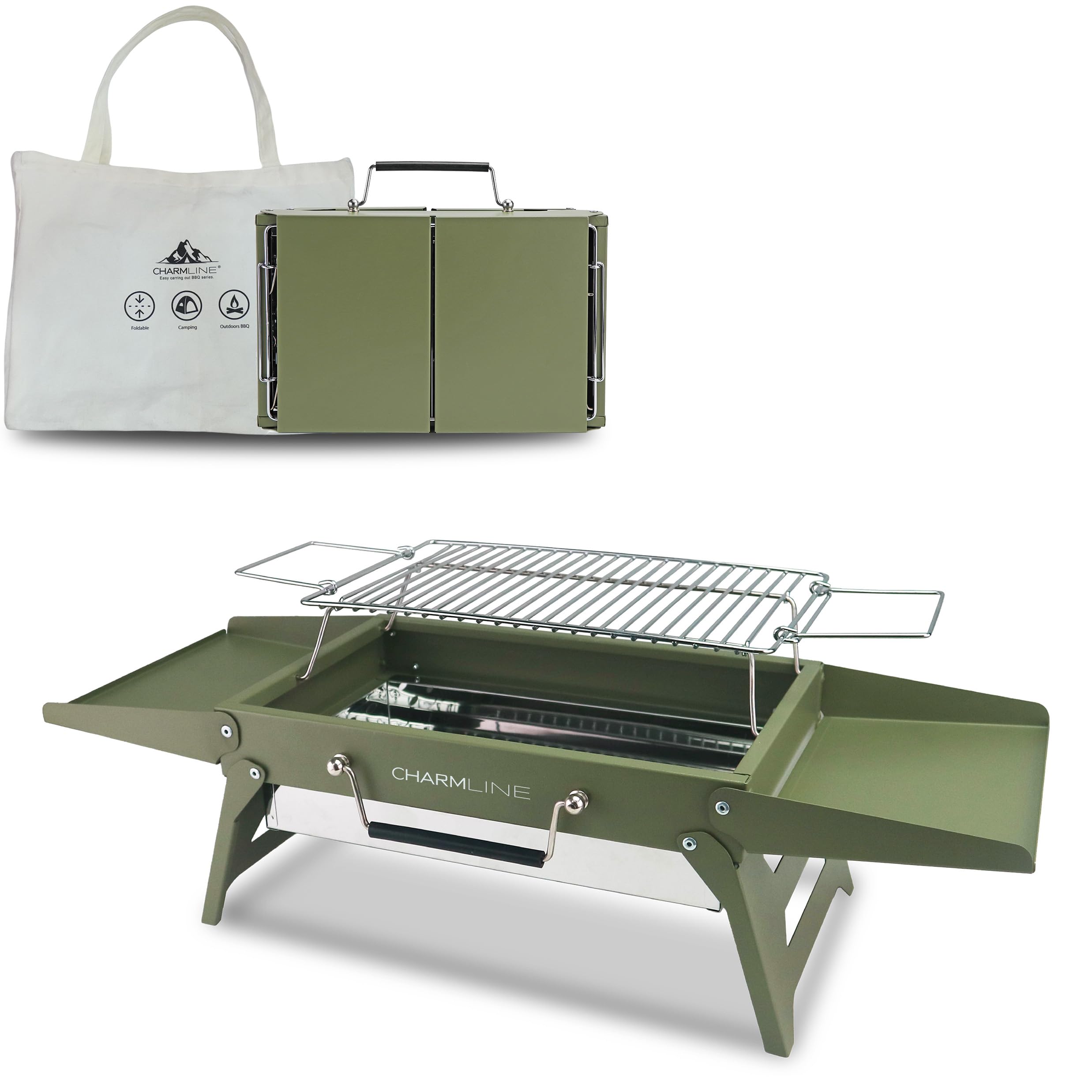
Charmline Folding Grill
Key Features
- Setup: No assembly required
- Weight: 5 lb
- Capacity: 1 to 3 people
- Cooking area: 110 square inches
- Price: Budget
Nothing to assemble: the Charmline arrives as one hinged piece that opens like a book, and it folds back down to roughly the footprint of a sheet of paper. At 5 pounds it’s the grill here that goes in a tote bag rather than a trunk.
The cooking area is 110 square inches, which the maker rates for one to three people and which we found honest for two. The grate lifts out so you can add charcoal without tipping the whole thing, there’s a small well for a sauce bowl once it’s unfolded, and the package includes a carry case. Alloy steel with a powder coat, and a two-month warranty.
We like it for exactly what it is: a two-person grill for a beach, a picnic table, or a balcony where storage is the real constraint. Plan the menu around food that cooks fast and uncovered — burgers, skewers, fish — and the small grate stops mattering. Buy it as a picnic grill with a few seasons in it rather than something to hand down.
Pros
- Arrives fully assembled and folds flat
- Five pounds with a carry case
- Grate lifts out for adding charcoal
Cons
- No lid, so no covered or indirect cooking
- Two-month warranty is the shortest here
The Charmline is the one to buy when the grill has to disappear into a bag afterwards — five pounds, no assembly, and honest about feeding two.
Best for a First Grill
GasOne 14-Inch Portable
Key Features
- Lid: 3-point locking
- Dimensions: 14.5 x 14.5 x 15 inches
- Cooking area: 150 square inches
- Temperature gauge: Built-in
- Price: Budget
A built-in thermometer and a three-point locking lid on the least expensive grill in this group is not what we expected. The GasOne is a 14-inch tabletop model with 150 square inches of grate, dual vents, and an ash catcher tucked underneath.
We think it’s the sensible first charcoal grill. It’s inexpensive enough to leave at a campsite without flinching, small enough to live on a shelf between trips, and it has the two things budget grills usually skip: a gauge in the lid and a lock that keeps it shut in the car. Steaks and vegetables for two fit comfortably, with room to move them around.
The limit is the grate. Feeding four means cooking in relays, and a full breakfast for two uses most of it. Two people and a couple of steaks is the sweet spot, and at this size that’s the whole job.
Pros
- Locking lid keeps it shut in transit
- Built-in lid thermometer
- Dual vents and an ash catcher
- The lowest-priced grill in this group
Cons
- Comfortably feeds two, not four
- One-year warranty
For a first charcoal grill or a second one for weekends away, the GasOne gives you a locking lid and a lid thermometer for less than anything else on this page.
Best for Larger Cookouts
Royal Gourmet CD1519
Key Features
- Weight: 25.4 lb
- Fire grate: 3-level adjustable
- Cooking area: 303 square inches
- Warming rack: Chrome-plated steel wire
- Price: Midrange
The front charcoal door is the feature that sold us. Slide it open, drop in briquettes, close it, and you’ve added fuel without lifting a hot grate or dumping the heat you spent twenty minutes building.
Everything else is sized for a campsite rather than a backpack. The 303 square inches are split between porcelain-enameled wire grates and a chrome warming rack, and the tabletop footprint of 18.58 by 27.76 inches means it wants a picnic table or a tailgate, not a tent pad. Two side handles make the lift manageable.
Heat control is where it earns its place: a three-level fire grate you raise or lower, one damper in the body and one in the lid, and a lid thermometer to tell you what any of that did. The ash tray slides out for cleaning, and there’s a bottle opener on the front.
We think this is the pick for car camping with six or eight people to feed — 25.4 pounds is a two-hand lift, not a hike. Set it up at home first, because assembly is a sit-down job with a screwdriver rather than a five-minute unfold. After that it’s a grill that lives on a picnic table for a weekend and doesn’t ask much of you.
Pros
- Front door for adding charcoal mid-cook
- 303 square inches with a warming rack
- Three-level fire grate and two dampers
- Ash tray slides out for cleanup
Cons
- Paint can bubble on the lid and vents
Pick the CD1519 when the grill stays near the car and the crowd runs to eight — the front charcoal door alone makes a long cook easier.
Best for Serious Charcoal Cooking
Oklahoma Joe’s Rambler

Key Features
- Weight: 48.5 lb
- Cooking area: 218 square inches
- Charcoal tray: Height-adjustable
- Cooking grates: Cast iron
- Price: Premium
Forty-eight and a half pounds settles the question before you get to the cooking: we think the Rambler is the best grill in this group and the worst one to carry, and both come from the same heavy-gauge steel.
What the weight buys is control. The charcoal tray cranks up and down under the grate, so you can move the fire well below a steak for a hard sear or bring it close for a low-and-slow cook, and the cast iron grates hold heat through a whole batch of burgers. The lid thermometer has glow-in-the-dark accents that are genuinely useful once the light goes.
The 218 square inches are rated for six burgers, six steaks, or a dozen bratwursts, and the removable ash pan makes cleanup a lift-and-tip rather than a scoop. Grates, lid, and other parts carry a two-year warranty.
Where it stops making sense is anywhere you have to carry it more than a parking lot’s length. Set beside a truck or on a patio, though, it holds temperature like a much bigger grill, and the adjustable tray gives you two-zone cooking without a second chimney of charcoal.
Pros
- Height-adjustable charcoal tray for heat control
- Cast iron grates hold heat well
- Heavy steel holds temperature on long cooks
Cons
- 48.5 pounds rules out carrying it far
- The most expensive grill covered here
The Rambler is the best cooker here and the worst one to carry; buy it if the grill lives beside a truck or on a patio, not if it goes on your back.
Best for Tight Storage
Innochef Foldable Tabletop

Key Features
- Dimensions: 24 x 20.47 x 5.1 inches
- Grate size: 18.12 x 11.14 inches
- Cooking area: 201.9 square inches
- Side shelves: Two, removable
- Price: Premium
Folded, the Innochef is 5.1 inches tall — flat enough to slide behind a car seat or stand on a shed shelf. It opens tool-free into a suitcase-shaped grill with a locking lid and an integrated carry handle, and the two side shelves clip on once it’s up.
The grate runs 18.12 by 11.14 inches for 201.9 square inches, which is two to four people in our reading, and the body is stainless steel with a powder-coated finish. A slide-out ash pan handles cleanup, and the airflow dampers are adjustable at both ends of the cook.
We think the fold-flat design earns its price for anyone whose real constraint is storage: a balcony, a hatchback, a shed with no floor space. The side shelves are the detail we appreciated most — somewhere to put a plate of raw patties and a pair of tongs while the grate is full — and they lift off so the whole thing nests back down flat.
Pros
- Folds to 5.1 inches tall
- Two removable side shelves
- Locking lid and slide-out ash pan
Cons
- Costs more than any other folding grill here
If storage is the thing standing between you and a grill, the Innochef folds to five inches and gives you two side shelves worth having.
Best for Campfire Cooking
Odoland Folding Grill

Key Features
- Fuel: Wood or charcoal
- Weight: 9.41 lb
- Carry bag: Included
- Dimensions: 15.75 x 11.81 x 8.27 inches
- Price: Budget
This is a fire pit that also grills, which changes who it’s for. Drop wood or charcoal into the tray, set the stainless grate on top, and you have a campfire with a cooking surface; lift the grate off and it’s a small fire pit with a screen that keeps sparks and embers in.
The packability is the impressive part. The panels stack flat the way a collapsed box does, and the whole 4,270 grams goes into the included carry bag — which is why it ends up in the car on trips where a kettle would be left behind.
The cooking surface is small and the grate is the weak point. It’s a 304 stainless grate over an open fire, and it can warp enough that it stops seating in its slots after a few hot burns; you can still cook on it, but the flat-pack neatness suffers.
We think it earns its place for campers who want an evening fire and a grill over the same coals, or for a beach trip where a kettle is more grill than you want to carry. It’s a fire first and a grill second, and the people happiest with it are the ones who wanted the fire anyway.
Pros
- Burns wood or charcoal as a fire pit
- Folds flat into an included carry bag
- Inexpensive way to add fire and grill in one
Cons
- Grate can warp out of its slots
- Small cooking surface for four people
Buy the Odoland for the fire as much as the food — it packs flat, burns wood or charcoal, and grills over the same coals you were going to light anyway.
How We Tested (and Hauled) a Dozen Portable Charcoal Grills
We started with more than 40 models from brands known for camping gear and backyard grills, then narrowed the field using published packed dimensions, listed weight, charcoal capacity, and whether the manufacturer sells replacement grates and legs. Anything without some form of ash management, or that packed out heavier than a full cooler, came off the list. We also compared what came in the box — lid lock, ash pan, side shelf, carry bag — against what each grill cost, since a bargain that needs a separate bag and a new grate isn’t a bargain. That left 12.
In the driveway, we timed assembly out of the box using only the included tools and noted whether the instructions were written steps or just line drawings. Each grill got carried 100 yards by its handle, or by the body if it had no handle, and weighed on a luggage scale once packed into its bag. We folded and unfolded every model a dozen times to see whether hinges loosened, latches caught, or legs needed two hands to lock.
For cooking, we lit a full chimney of coals in each and ran the same sequence: burgers with the lid off, chicken thighs with the lid on, then a vent adjustment to see how quickly the fire responded. We laid sliced bread across the grate to map hot spots and timed how long each grill held a steady medium heat before the coals faded. After every trip the grills were hosed out, left to dry overnight, and checked for rust at the welds, wobble in the legs, and ash that stubbornly stuck in the corners. Seven months in, the ones still standing are the ones we recommend.
How to Choose a Portable Charcoal Grill
Weight and packed size decide where a grill can go, so settle those first — then spend what’s left on heat control and a lid that fits.
Start with the carry, not the cook
Work backwards from how far you’ll carry it. A five-pound folder like the Charmline goes in a tote for a hike-in picnic; a 14-inch kettle at eight or nine pounds is a one-hand carry from trunk to picnic table; anything near 20 pounds is a two-hand lift for a short walk; and a 48-pound tabletop only makes sense beside a vehicle. Be honest about the middle of that range, because the difference between an 8-pound grill and an 18-pound one is often the difference between taking it and leaving it in the garage.
Kettle, suitcase, or flat pack
Kettles hold heat and give you indirect cooking because the lid seats properly — that’s both Webers here, and in miniature the GasOne. Suitcase and flat-fold grills pack to a fraction of their working size, which is what you want in a packed car or on a balcony, but several of them have no lid at all. If your menu is burgers, skewers, and fish, that’s fine. If you want ribs, a roast, or cheese melted over the coals, buy a lid.
Watch the word compact in a listing, too. It usually means the grill fits a trunk, not that it fits a pack — check the folded dimensions against the space you actually have.
How much grate you actually need
Square inches become useful once you know the conversion. Around 110 feeds two; 200 to 240 covers four to six; 300 and up handles a crowd, especially with a warming rack. Our rule is to count the people, add one, and buy for that. A 14-inch kettle that fits six burgers feeds four politely and six slowly, and no amount of technique fixes a grate too full to turn anything on.
Heat control is the upgrade you feel
Two things separate a grill you fight from one you cook on: dampers you can adjust at both the lid and the base, and a charcoal tray that moves. A tray that raises and lowers — the Oklahoma Joe’s and the Royal Gourmet both have one — lets you sear over a hot fire and then drop the coals to finish a thick piece of meat without chasing the temperature with the vents. A lid thermometer is a nice extra; adjustable airflow is the one that changes results.
What wears out first
Enamel outlasts paint. A porcelain-enameled bowl and lid resists rust and wipes clean, while painted steel can bubble and peel around the lid and vents after a few hot cooks. The other parts that fail are the ones that touch ash: legs, ash pans, and the base of the firebox, where moisture sits. Warranty length tracks how long the maker expects it to last, and the spread here is wide — ten years on the Smokey Joe, two months on the Charmline.
Frequently Asked Questions
Is a portable charcoal grill worth it if I already have a gas grill?
For flavor and for where it lets you cook, yes; for speed, no. Charcoal needs lighting and a wait before the first burger, where gas is ready almost immediately. What you get back is high searing heat, real smoke, and a grill that goes to a beach or a campsite.
If you only ever cook on your own deck, gas is the easier tool. If you want to cook outdoors away from home, charcoal is the one that travels.
What can I set a hot charcoal grill on?
Not a wooden picnic table, a deck rail, or dry grass. Set it on gravel, concrete, or a metal tray, and leave room above the lid to open it. Embers drop through the vents, so an ash catcher matters more than the surface underneath.
On a balcony, check the building’s rules and the local fire code before you light anything, and keep the grill clear of railings and anything overhead.
How do I keep a small grill from rusting between trips?
Empty the ash the day you get home — wet ash is what eats through pans and legs — then wipe the inside dry and rub a little cooking oil on the grate. Store it covered, and if it lives outside, get it off the ground so water drains away from the legs.
Enameled grills tolerate this routine easily; painted ones need it. The legs and ash pan are the first places to look when you pull it out in spring.
Do I need a chimney starter for a small grill?
It helps more than any other accessory. A chimney gets a full load of coals to gray ash without lighter fluid, and you can pour them to one side for two-zone cooking.
You don’t need the biggest one — a small chimney matches a 14-inch kettle, and half a load is plenty for a quick meal for two.
Final Verdict
The Smokey Joe is the grill we point people to first: 8.4 pounds, a locking lid that doubles as a lid holder, enamel that survives seasons, and a 10-year warranty.
If your trips involve a car and more than four people, the Jumbo Joe is the same idea with an 18.5-inch grate. And if cooking matters more than carrying, the Oklahoma Joe’s Rambler is the one to buy — and the one to leave beside the truck.