This post contains affiliate links. We may earn a small commission when you buy through our links — at no extra cost to you.
There’s a tradeoff baked into every camping grill: the smaller and lighter it is, the harder it is to get a real sear on anything. Go big for heat output and you’re wrestling a heavy box in and out of the trunk; go small for portability and you end up with hot spots, flare-ups, and burgers that cook unevenly no matter how you rearrange them. A good camping grill is the fix — real heat and even cooking in a package you can carry to a picnic table with one hand.
I’ve cooked on campfire grates, foil pans, and a cast-iron grate balanced on three rocks, so I know how fast a bad grill turns dinner into a chore. The difference comes down to heat distribution, how quickly the grill recovers when you open the lid, and whether the grates scrub clean the next morning. Over the past eight months my team has cooked on 12 camping grills on real trips, and the ones worth the trunk space assemble without swearing, pack down small, and still put a proper char on a steak. Value matters, but only when a grill survives a season of being loaded in and out of a car. The picks below are the ones I’d pack again.


Best for Two-Zone Camp Cooking
Cuisinart CGG-306 Two-Burner
Key Features
- Weight: 22 lb
- Burners: 2, 20,000 BTU total
- Ignition: Electronic
- Cooking area: 275 sq. in.
- Price: Premium
Two knobs, two burners, 20,000 BTU between them — that is the whole argument for this grill. With independent control on each side, we could run the left burner wide open for a crust and keep the right one low enough to hold a batch of burgers without turning them to leather. Across 275 square inches, that is a genuinely useful way to cook at a picnic table, and it is what the single-burner grills here cannot do at any price.
It also travels like luggage rather than like a grill. The lid locks down, the legs fold and the handle sits where a suitcase handle would; at 22 pounds we moved it from the truck to the table one-handed, lid latched, grate in place. The thermometer lives in the lid so you are not guessing at the top end, and the stainless grates lift out for cleaning without a fight.
The weak spot is the bottom of the dial. Even on low these burners throw real heat, so fish or a butterflied chicken wants one burner shut off and the food parked on the unlit side. The steel is thinner than the price suggests, and the internals are the parts that suffer when a grill lives outside between trips — dry it, cover it, and the burners are the last thing to go rather than the first.
For a camper who cooks more than burgers, this is the one to buy. Where the Royal Gourmet GT1001 asks you to shuffle food between hot and cool spots, this grill lets you move the heat instead, and that is the difference worth paying for.
Pros
- Two burners allow searing and holding at once
- Latching lid and folding legs travel well
- Lid thermometer takes the guesswork out
- Stainless grates lift out for cleaning
Cons
- Burners run hot even at the lowest setting
Our pick for most campers, because two burners let you sear on one side and hold dinner on the other — and it still carries like a suitcase.
Best for Steaks and Searing
Char-Broil Grill2Go X200
Key Features
- Burner: Infrared, single
- Ignition: Push button
- Warranty: 5 years, burner and lid
- Cooking area: 200 sq. in.
- Price: Premium
Infrared changes how a tabletop grill behaves. The Grill2Go’s single burner heats a perforated grate until it glows, and the heat lands on the food fast and hard — we had a proper dark crust on a steak before a conventional grate this size would have finished warming through. If red meat is why you haul a grill out of the truck, this is the one we hand you.
The body is cast aluminum, firebox and lid both, with stainless latches and a handle on each side, so it takes being thrown in with the cooler without the rust that eats steel tabletops. It sits stable on wide feet and the lid seats squarely. Char-Broil covers the burner and lid for five years, the longest gas coverage in this group.
The trade is control at the bottom end: it runs hot and stays hot, so chicken and fish want the lid open or a spot at the edge of the grate. The narrow slots in the cooking grate are the other annoyance, because grease and ash collect in them. Two hundred square inches holds about eight burgers, which makes this a two-to-four-person grill rather than a party grill.
Pros
- Infrared grate sears faster than the gas rivals
- Cast aluminum body resists rust and knocks
- Longest gas warranty here
Cons
- Grate slots clog with grease and need brushing
Buy it if steak is the reason you bring a grill: the infrared grate hits hard, and the cast aluminum body shrugs off life in a truck bed.
Best for Value Gas Grilling
Royal Gourmet GT1001
Key Features
- Lid: Lockable with thermometer
- Burner: 10,000 BTU
- Weight: 17.8 lb
- Cooking area: 285 sq. in.
- Price: Midrange
Folding legs, a lid that latches shut, a thermometer set into that lid and a stainless tray that slides out: the GT1001 is built around the trip rather than around the patio. It weighs 17.8 pounds, light enough to take in one hand at the handle with the lid locked and the grate still inside.
For the money this is the gas grill we keep coming back to. The 285 square inches split into a 214-square-inch grate and a 71-square-inch warming rack, and the stainless frame and grates feel sturdier than the price implies. This is the pick when you want a full-width cooking surface and a lid that closes properly without paying premium money for a brand name.
What you give up is a second heat zone. One burner means one temperature, so you cook in waves: burgers down, then up onto the warming rack while the next round goes on. The knob is coarse at the low end too, running from hot to hotter with no gentle simmer in between. The sliding grease tray makes the dirty end of the evening quick, which counts for a lot when the nearest sink is a tap on a campsite wall.
Pros
- Full-width grate with a warming rack above
- Locking lid makes transport secure
- Removable stainless grease tray
Cons
- Single burner gives one heat zone
We keep recommending it for value: 285 square inches, a lid that locks for the drive, and 17.8 pounds to lift off the tailgate.
Best for Basecamp and Family
Coleman RoadTrip 285
Key Features
- Weight: 46.7 lb
- Burners: 3, 20,000 BTU total
- Mobility: Quick-fold legs, 2 wheels
- Cooking area: 285 sq. in.
- Price: Premium
At 46.7 pounds this is a grill that lives in the truck bed and rolls out of it. Quick-fold legs snap it into a stand-up frame at cooking height, so you cook upright instead of crouched over a picnic table, and it folds flat enough to slide in under the cooler and the camp chairs.
What the weight buys is three burners across 285 square inches and 20,000 BTU. It heats quickly and runs hot — two burners on high is more heat than most camp dinners need — and with three knobs you can keep one side going through a long cook and shut the others down. The lid thermometer reads the chamber, and the grease tray is a proper tray rather than a cup.
A family on a week-long basecamp will cook more comfortably on this than on anything else here, and it is the one we set up once and leave standing. The parts we would keep an eye on are the side-table hinges and the carry handle, which is where a folding grill of this shape wears first.
Pros
- Three burners across 285 square inches
- Rolls and folds instead of being carried
- Cooks at standing height
Cons
- The most expensive grill here
- Side-table hinges and handle are wear points
The basecamp choice for families: three burners, wheels, and cooking height, for people who set up beside the truck rather than hike in.
Best for Budget Charcoal Trips
GasOne CG-15F Charcoal
Key Features
- Fuel: Charcoal
- Warranty: 1 year
- Carry bag: Included
- Folded size: 15.7 x 11.5 x 8.2 inches
- Price: Budget
Folded, this thing is roughly the size of a laptop and about as easy to fit into a loaded car. Legs, body and grate come apart and stack flat, the carry bag takes the whole lot, and setting it up is a couple of minutes rather than a couple of tools. For a charcoal grill at the bottom of the price range, that is the entire pitch, and it holds.
It cooks better than its size suggests. The body is vented so the coals draw evenly, and with a modest fire you get a real bed of heat across the grate for four people’s worth of sausages and corn. There is no ignition, so bring a lighter, and no thermometer, so you judge by hand over the coals — which is how most people cook on charcoal anyway.
Treat it as a season-at-a-time grill. The metal is thin, and a pile of raging coals will warp the grate and the base; bank the fire and keep it moderate and it stays square. What we like is that the cheap option is also the one that disappears into the trunk, so it comes on trips a heavier grill would sit out.
Pros
- Packs flat into its own carry bag
- Vented body burns coals evenly
- Cheapest way into charcoal here
Cons
- No ignition, so bring a lighter
Our budget charcoal pick — it folds to laptop size, costs the least here, and asks for nothing but a match and a modest fire.
Best for Classic Charcoal Cooking
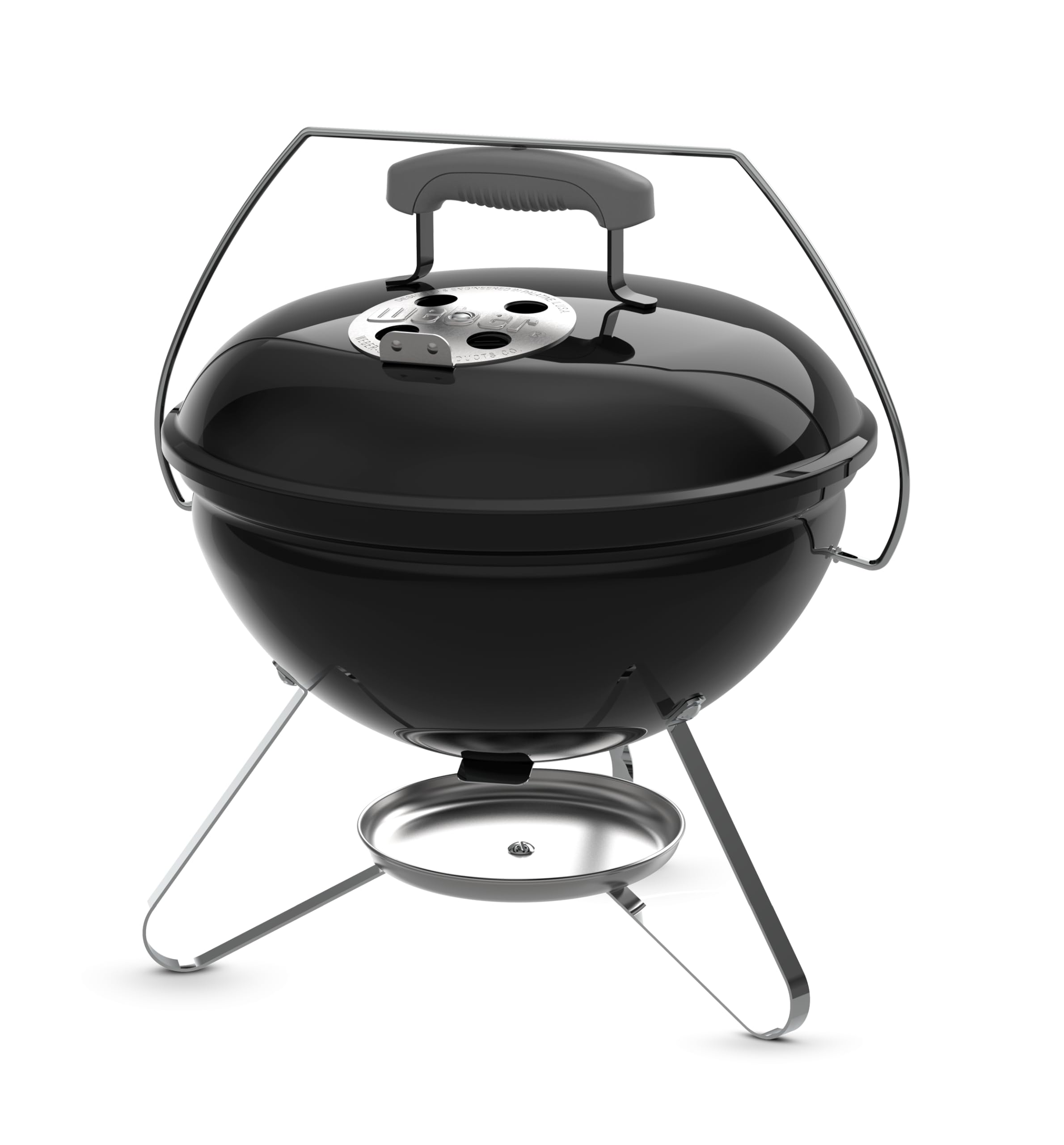
Weber Smokey Joe 14-Inch
Key Features
- Fuel: Charcoal
- Weight: 8.4 lb
- Warranty: 10 years
- Grate size: 14 inches
- Price: Budget
The kettle shape is doing quiet work. A round bowl with a lid that seats over it, an ash catcher underneath, and a lid lock that doubles as a holder so the hot lid has somewhere to go that is not the ground or the picnic table. At 8.4 pounds it is the lightest grill in this roundup, and the porcelain enamel wipes down instead of scrubbing up.
It is charcoal only, and it makes you earn dinner. Fourteen inches holds roughly six burgers, banking the coals to one side is the only route to two heat zones, and there is no thermometer to tell you what the fire is doing. What you get back is heat that behaves like charcoal heat, which is the reason people refuse to switch to gas in the first place.
This is the one we point charcoal people to, and the ten-year limited warranty is the reason. Compare it with the folding GasOne: that one packs smaller and costs less, and the difference you are buying is a kettle that will still be round and square after several seasons rather than a thin grate that has warped.
Pros
- Lid lock doubles as a hot-lid holder
- Lightest grill in the roundup
- Ten-year limited warranty
Cons
- No lid thermometer or warming rack
For charcoal purists we point to this kettle: 8.4 pounds, a 14-inch grate, and a 10-year warranty behind the enamel.
Best for Feeding a Group
Megamaster 820-0065C

Key Features
- Burner: 11,000 BTU
- Weight: 14.4 lb
- Warranty: 5 years
- Cooking area: 360 sq. in.
- Price: Midrange
Three hundred and sixty square inches on a 14.4-pound body is the reason to look at this one. That is the largest single-burner cooking surface in this group, wide enough for six burgers with room to move them, and it still folds down and carries under one arm with a lid thermometer and a warming rack along for the ride.
The catch is that one 11,000 BTU burner spread across a grate that wide is not a level cooking surface. Expect to rotate food rather than trust a spot, and give it time to come up before the first round goes on. If you want an even bed of heat for a big batch of chicken, the two-burner grills here handle that better. The push-button ignition is the other thing to watch — when the button gets tired, a long match through the side slot lights it fine.
Where it earns its place is a group that mostly cooks one kind of thing: a pack of burgers, a row of corn, a pile of skewers. The five-year warranty is longer than most of the gas grills here, and the foldable legs mean it can live in a cupboard between trips rather than under a cover on a patio.
Pros
- Biggest single-burner grate in the group
- Light for its cooking area
- Five-year warranty
Cons
- Heat is uneven across the wide grate
We rate it for space: 360 square inches on a 14.4-pound frame, for cooks who would rather have room than a second burner.
Best for Griddle Breakfasts
Royal Gourmet PD1305H

Key Features
- Output: 29,000 BTU
- Weight: 32.7 lb
- Cooking area: 364 sq. in.
- Cooking surfaces: Griddle, grill, pot rack
- Price: Midrange
Half of this grill is a griddle, and that changes breakfast. A 211-square-inch porcelain-enameled flat top sits beside a 153-square-inch grill grate, so eggs, pancakes and bacon can work on one side while burgers sit on the other. That is the cooking surface we reach for when a campsite morning has to feed four people at the same time.
The third burner is the sleeper feature: a 12,000 BTU side burner with a lid that folds down into a ten-pound shelf. Coffee, beans, a pot of pasta — all of it happens off to the side while the main surface keeps working, which means one appliance covers a whole camp kitchen.
The wide surface runs unevenly, hottest over the two main burners and cooler at the far corners, so plan on moving food around rather than finding one perfect spot. The grease cup is small for what a griddle produces, and we empty it mid-cook on a bacon morning rather than at the end.
Set against the Cuisinart, you are trading two-zone gas control for a flat top and a side burner, on a grill that stays in the truck bed and gets carried to a table with both hands. If camp cooking means eggs and smash burgers, that trade is a good one; if it means steaks managed across two zones, it is not.
Pros
- Griddle and grate work at the same time
- Side burner with a lid that becomes a shelf
- 29,000 BTU across three burners
Cons
- Grease cup fills fast when griddling
The truck-camp answer: a griddle and a grate on one 32.7-pound tabletop, plus a side burner for the coffee pot.
How We Tested 12 Camping Grills Over Eight Months
We started by gathering every camping grill we could find that was actually in stock and plausibly sized for a car trunk, then narrowed the field by price, fuel type, and whether the manufacturer published packed dimensions and weight. That left 12 grills, which we bought ourselves so no brand had any say in the outcome. Each one came out of the box on my driveway first, where I timed assembly and setup working alone — no second pair of hands — and noted exactly where the instructions got vague or the hardware fought back.
Then they went on real trips: car camping weekends, a tailgate, park picnics, and a handful of Tuesday-night burgers at home when dragging out the big grill felt like too much. We weighed every grill packed, checked whether it fit in the trunk beside a cooler, and carried it from the car to the picnic table one-handed to see how the handles and latches held up. Size got judged against real cargo space, not spec sheets.
Cooking was the bulk of the work. We ran burgers, chicken thighs, and sliced vegetables on each grill, moving food around the grate to find hot spots and reading grate temperatures at all four corners with an infrared thermometer. We watched how quickly each grill came back up to heat after the lid came off, whether fat dripped into the fire and flared, and how much scrubbing the grates and drip tray needed the next morning. After every trip we checked for rust, wobbling legs, and loose hardware, and kept a running tally of what each grill cost against what it actually delivered.
How to Choose a Camping Grill
Three things settle the choice before brand ever comes up: the fuel, the size of the grate, and how far you have to carry the thing.
Gas or charcoal comes first
Charcoal gives you hotter, smokier heat and a fire to sit around, and it charges for that with twenty minutes to coals, ash to deal with, and a grate that stays hot long after dinner. Gas gives you a knob and a match-free start. Campground rules often decide it for you, since some sites ban open-flame cooking in dry season while allowing a gas tabletop.
On cost, a refillable tank beats a stack of one-pound canisters over a season if you cook often, so check what the grill’s regulator connects to before you commit to canister life. Our charcoal picks are the Smokey Joe and the folding GasOne; the Royal Gourmet GT1001 carries the gas side.
Match the grate to the number of people
Cooking area in this set runs from 130 to 364 square inches. A workable rule: 200 square inches holds about eight burgers, which feeds four people who are also eating corn and salad, while 285 is comfortable for five or six. Two people can live happily on 200.
The trap is judging by the photograph. A wide lid over a small grate looks generous, and a warming rack counts toward the advertised total without giving you anywhere to sear. Count the flat grate area, not the headline number.
Burners decide how you cook, not how hot it gets
BTU is input, not delivered heat. A lid that seals and a heavy grate hold temperature better than another few thousand BTU, which is why a modest burner under a good lid can beat a bigger one that leaks. What actually changes dinner is the number of independent burners.
One burner means one temperature and a lot of shuffling food between hot and cool spots. Two lets you sear on one side and hold on the other, and it is the single biggest upgrade in this category. Three is for people feeding a crowd. If you cook one thing at a time, take the single burner and the smaller bill.
Decide where it lives before you weigh it
Portable in a listing means it fits in a trunk, not that it fits in a backpack. Our lightest pick is 8.4 pounds and our heaviest is 46.7 with wheels, and both are honestly portable — to different trips. A tailgate or a basecamp rewards stand-up cooking height and side tables; a hike-in site wants something you carry in one hand beside the cooler.
Check the table as well. Legs need something flat, a hot lid needs somewhere to go that is not the ground, and a grease tray that slides out is worth more than it sounds when the nearest sink is a quarter mile away.
Frequently Asked Questions
What is the difference between a camping grill and a camp stove?
A grill cooks on a grate over open heat — burgers, steaks, corn, anything you want marked. A stove puts a controlled flame under a pot for boiling and frying. If solid food is most of what you cook outdoors, buy the grill, and a model with a side burner or pot rack like the Royal Gourmet PD1305H covers some stove duty too.
Can you use a camping grill in the rain?
Outdoors, yes — rain on its own will not stop a gas or charcoal grill. Never under a canopy, in a tent, or in a garage, because carbon monoxide has nowhere to go. Wind is the bigger practical problem: it steals heat and can blow a burner out, so set up on the sheltered side of a vehicle and keep the lid down between batches.
How do I keep food from sticking to a new grill?
Oil the grate, not the food, and do it while the grate is hot by wiping it with an oiled paper towel held in tongs. Preheat properly, then leave the food alone for the first couple of minutes so it releases by itself. New porcelain and stainless grates improve after a few cooks; scrub them while warm, not cold.
Final Verdict
Buy the Cuisinart CGG-306 and you get the one thing the cheap tabletops cannot give you: two heat zones on a grill you can lift with one hand. If you cook one thing at a time and want to keep the outlay down, the Royal Gourmet GT1001 offers the same cooking area with a single burner. And if charcoal is the reason you go, the Smokey Joe is the grill that will still be square in ten years.