This post contains affiliate links. We may earn a small commission when you buy through our links — at no extra cost to you.
A bivy sack is a weatherproof sleeve for your sleeping bag, with a small hoop holding fabric off your face — which explains why backpackers swear by them and why everyone else finds them slightly suspicious. What it fixes is the arithmetic of a trip: no tent body, barely any poles, no footprint to find, so any flat patch of ground becomes a bed. What it costs you is space and airflow, and the wrong one will leave your bag damper at dawn than it was at bedtime.
I’ve slept in bivies on ledges where a tent would have been a joke, and in a humid meadow where I regretted everything. Over the past eight months my team and I have slept in nine of them, from stripped-down alpine shells to mesh-topped shelters barely bigger than a stuff sack. The thing first-timers miss is that ventilation and zipper quality matter more than the fabric coating — a bivy that can’t move air soaks you from the inside. Below are the ones worth carrying, whether you’re thru-hiking or just want a light backup at the bottom of the pack.


Best for Sleeping Out
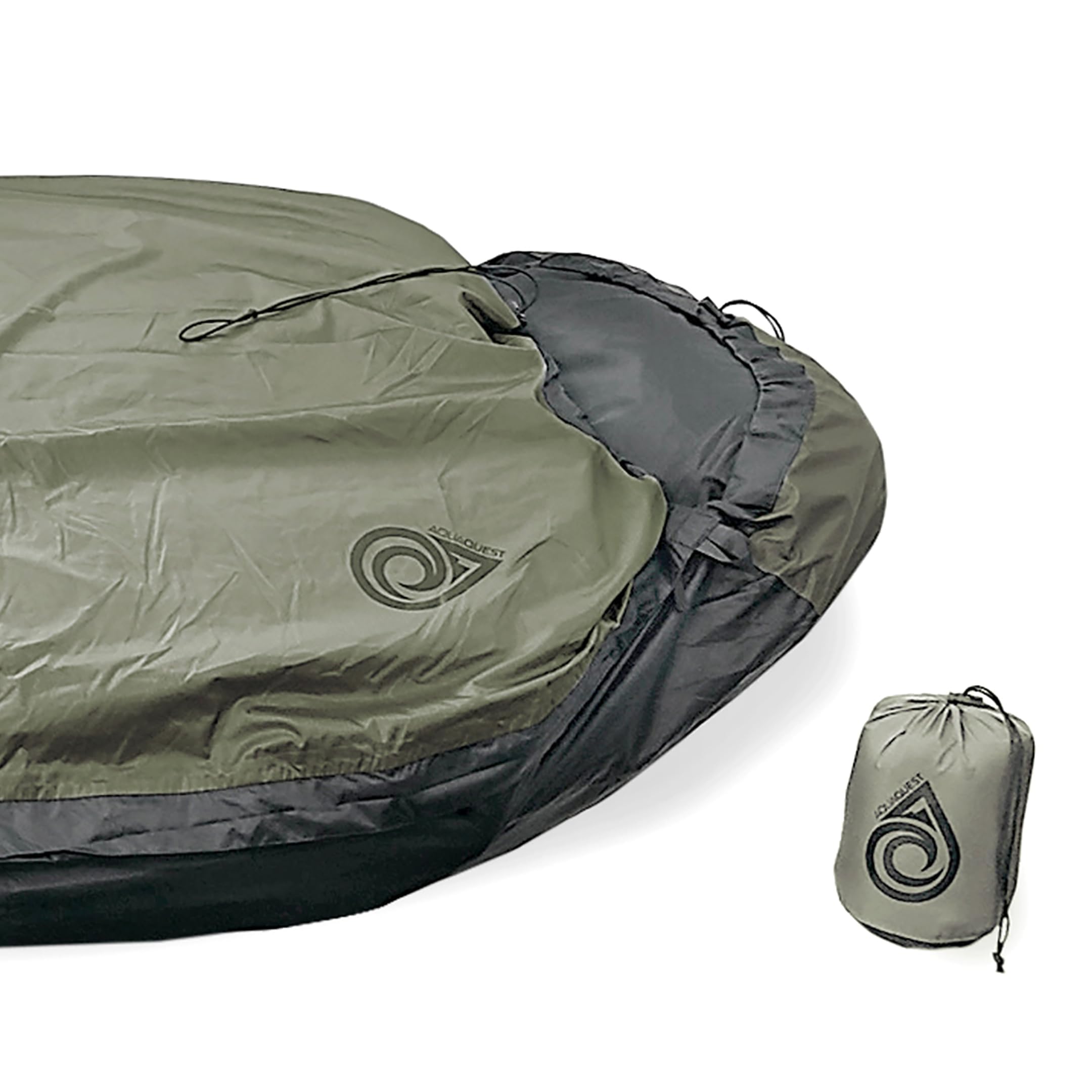
AquaQuest Pharaoh Bivy Sack
Key Features
- Fits: Up to 6 ft 6 in
- Weight: 1.1 lb
- Breathability: 10,000 g/m2/day
- Waterproof rating: 10,000 mm
- Price: Premium
A waterproof shell that doesn’t breathe turns your sleeping bag into a damp sack by morning, and the Pharaoh is the pick here that takes that problem seriously: a 10,000 mm waterproof rating paired with a 10,000 g/m2/day moisture vapor transmission rating, so rain stays out and vapor has somewhere to go.
That pairing is what earns it the top spot in this set. Plenty of covers keep the weather off; the breathable ones are the ones you can sleep in night after night, and this is the most convincing laminate of the group. The mummy cut fits sleepers up to 6 ft 6 in, with two-way zippers on both sides so you can reach a bottle or a headlamp without opening the whole bag to the night.
At 1.1 lb including its own 9 by 5 inch stuff sack, it costs you about the weight of a water bottle, and we like that the elasticated hood closes around your head so you’re not breathing into a loose flap of nylon. The mummy shape also leaves less dead air to warm than a rectangular bag.
One thing to plan for: the nylon is slick, and on a smooth sleeping pad it slides. A textured pad or a couple of straps sorts that out. Small annoyance, easy fix, and everything else about the design holds up.
Pros
- Breathable 10,000 mm laminate resists condensation
- 1.1 lb with a built-in stuff sack
- Fits sleepers to 6 ft 6 in
- Two-way zippers on both sides
Cons
- Highest price of any pick here
For anyone who plans to sleep in it, we recommend the Pharaoh: a breathable 10,000 mm shell, 1.1 lb packed, and enough length for a 6 ft 6 in sleeper.
Best for Budget Weather Shell
Mil-Tec Trilaminate Cover
Key Features
- Shell: Trilaminate polyester
- Weight: 2.93 lb
- Closure: Two-way side zip
- Open size: 88.58 x 33.5 in
- Price: Midrange
If the Pharaoh’s price sits badly, the Mil-Tec trilaminate cover does most of the same work for less. It’s a sleeping bag cover rather than a standalone shelter — you zip your bag inside it — and the three-layer fabric is waterproof and breathable in the same way, so you’re not trading away the thing that matters. We think that’s the sensible trade for a first shell or a spare.
The cut is generous: 88.58 in long and 33.5 in wide, enough to swallow a bulky synthetic bag and a pad without a fight. The two-way side zip opens from either end, and the fabric dries quickly after a wet night, which is more than you can say for a lot of coated nylon.
What the generosity costs you is weight. At 1.33 kg, roughly three pounds, it’s a lot to carry when lighter shells exist, and the side zip stops short of the foot, so getting in is a shuffle rather than a step. Neither matters if the cover lives in a truck, a base camp or a boat; both matter on a long carry.
Pros
- Waterproof-breathable trilaminate for less than our top pick
- 88.58 in cut fits bulky bags and pads
- Two-way side zip opens from either end
- Dries quickly after a wet night
Cons
- 1.33 kg is heavy for backpacking
We point to the Mil-Tec cover when the budget is fixed and the load isn’t: waterproof-breathable protection and a roomy cut for about three pounds.
Best for Car Emergency Kit
Go Time Gear Life Bivy
Key Features
- Weight: 5.6 oz
- Includes: 120 dB whistle, 20 ft paracord
- Material: Polyethylene film
- Heat reflection: Up to 90% of body heat
- Price: Midrange
The Life Bivy is the one that lives in the car. Packed, it’s about the size of a fist, so it disappears into a glovebox, a lid pocket or a jacket and you stop thinking about it until the night you need it.
What you get for 5.6 oz is a reflective polyethylene bag that throws body heat back at you, plus a 120-decibel whistle and 20 feet of paracord worked into the stuff sack. We rate the cord above the whistle: it’s what lets you rig a line, lash the bag over you, or replace a broken guy line.
It is an emergency bag, not a tent. There’s no breathability to speak of, so a mild night leaves condensation inside by morning, and the film is thin enough that boots, sharp ground and a lot of turning can open a seam. Get in without your boots and put something under you.
We keep one in the pack anyway. For a few ounces it’s the simplest insurance against a night that goes wrong, and the reflective material does what it claims: you’ll be warmer than in the open, though not warm like a sleeping bag.
Pros
- Packs to fist size at 5.6 oz
- Reflective film returns body heat
- Whistle and 20 ft paracord included
Cons
- Thin film won’t survive many nights of real use
For a just-in-case layer that never leaves your pack, the Life Bivy is our pick: fist-sized, 5.6 ounces, and warm enough to get you through one bad night.
Best for Survival Kits
Survival Frog Tact Bivvy 2.0
Key Features
- Fits: Up to 7 ft
- Weight: 4.8 oz
- Includes: Whistle cord and para-tinder drawstring
- Open size: 84 x 36 in
- Price: Midrange
The drawstring on the Tact Bivvy’s stuff sack is para-tinder, the cord doubles as utility line, and a whistle sits on the closure. That reads like gimmick territory until you’re the one who needs a signal or a length of cord in the dark.
The bag underneath is 84 by 36 inches of HeatEcho reflective film — the same footprint as most of the mylar bags here, long enough for a tall adult and snug across the shoulders once you’re in a puffy layer. At 4.8 oz it’s a touch heavier than the plain bags, which is a fair trade for the pouch and the cord.
What we appreciate is that the kit builds itself: one purchase covers shelter, signaling and cordage, and it all goes back into a pouch small enough for a jacket pocket. The film tears as readily as any other here, so treat it as a one-night bag; the extras are what you’re paying for, and they’re the part that lasts.
Pros
- 4.8 oz with pouch, whistle and paracord
- Reflective film rated to return 90% of body heat
- 84 x 36 in fits most adults
Cons
- Costs more than a bare mylar bag
The Tact Bivvy is what we hand someone building a first survival kit: whistle, cord and a warm reflective bag, all in a bundle that fits a jacket pocket.
Best for Two Packs
Zmoon Emergency Sleeping Bag 2-Pack
Key Features
- Fits: Up to 180 cm
- Material: Mylar foil
- Open size: 78 x 47 in
- Pack count: 2
- Price: Budget
Forty-seven inches of width is what separates the Zmoon bags from the rest of the mylar crowd here. Most of these sacks are 36 inches across — fine while you lie still, cramped the moment you want to turn over or bring a pack in with you. The extra foot gives you room to roll and to sit up, and you get two bags in the pack, one for your rucksack and one for the car.
The catch is length. At 78 inches it’s the shortest bag here, rated to 180 cm, which is fine for most adults and tight if you’re over six feet and want the bag over your head. We see it as a kit-builder’s bag rather than a tall hiker’s primary shelter: two shelters, wide enough to be comfortable, easy to leave one in the boot.
Pros
- Two bags in every pack
- 47 in width leaves room to turn over
- Compact folded bundle for a car kit
- Holds up better than most film bags
Cons
- 78 in length is short for tall sleepers
Two roomy bags for the price of a single narrow one is the appeal: the Zmoon is the comfortable mylar pick for anyone under six feet.
Best for Tall Sleepers
AKMAX Military Bivy Cover

Key Features
- Fits: Up to 7.2 ft
- Shell: Three-layer nylon
- Weight: 2 lb
- Open size: 86 x 36 in
- Price: Premium
If you’re 6 ft 4 in and every shell leaves your head pressed against the fabric, the AKMAX is the one built for you: 86 inches long, 36 wide, and rated for users up to 7.2 feet.
It’s a military-pattern cover — three laminated nylon layers, waterproof and breathable, with a hood and a zip that buttons to a modular sleeping bag. Two pounds is heavy for a shell, but that’s the weight of a three-layer fabric and a roomy cut rather than padding.
We rate it the specialist of the group. For a base camp, a truck bed or a very tall sleeper it makes sense; for a long carry, the extra pound over our top pick is hard to justify, and the multi-terrain pattern is harder to spot if you ever need to be found. Neither is a dealbreaker, but both tell you who this cover is for.
Pros
- Fits sleepers up to 7.2 ft
- Three-layer waterproof-breathable nylon
- Hood and zip work with modular bags
Cons
- Two pounds is heavy for backpacking
- Camo pattern is harder to spot in an emergency
Tall sleepers and military-kit fans should look here first: 86 inches of room and a three-layer shell, as long as you’re not counting ounces.
Best for Family Vehicles
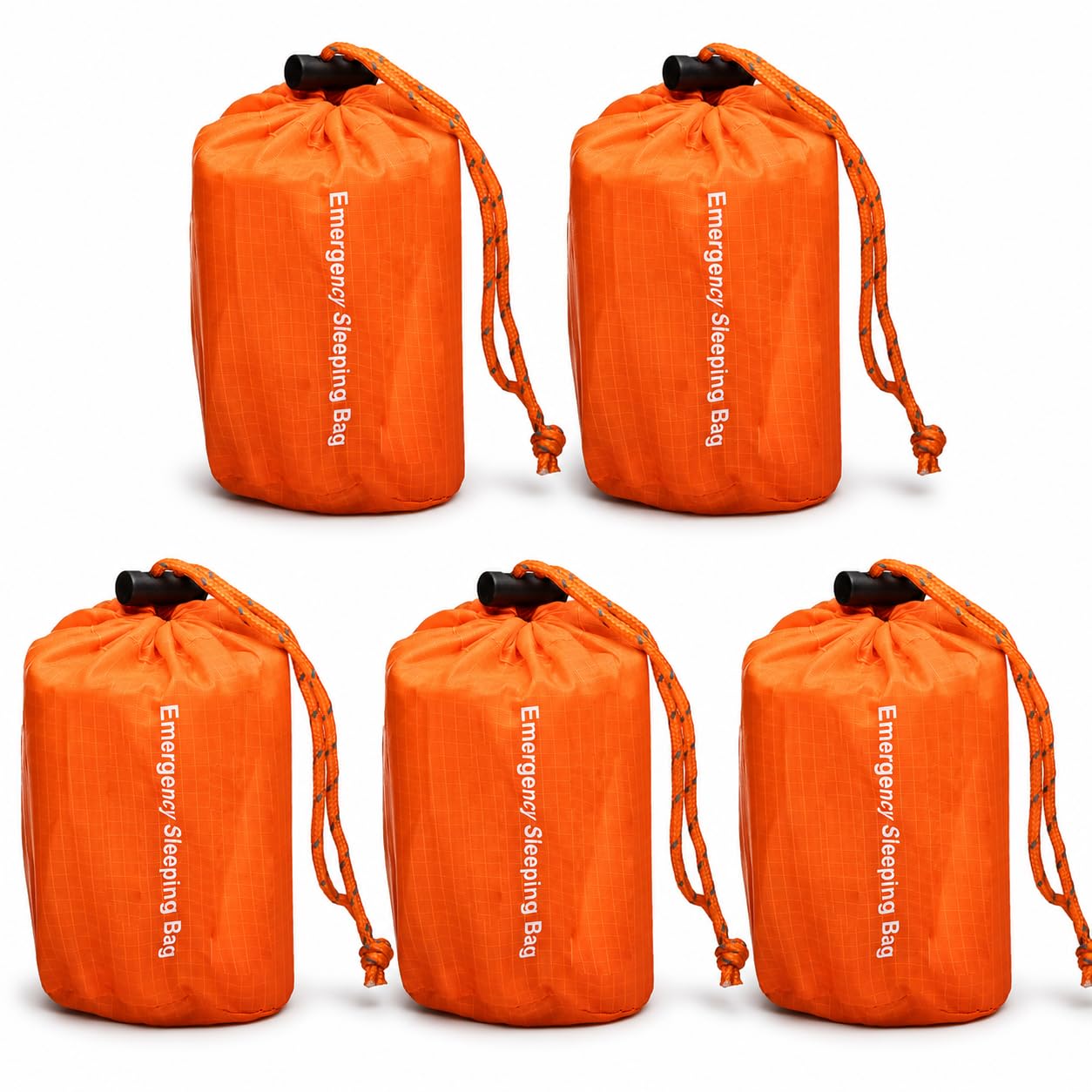
NovaMedic Emergency Sleeping Bag 5-Pack
Key Features
- Fits: Up to 72 in
- Weight: 16 oz
- Open size: 84 x 36 in
- Pack count: 5
- Price: Midrange
Five bags in one order is the reason to look at the NovaMedic. If you’re putting a shelter in two cars, a boat, a cabin and a hiking pack, buying them singly means five separate orders, and you end up with the same bag in every place you might need one.
Each bag is 84 by 36 inches of reflective mylar — the standard size and the standard construction. That’s warm enough to stop a bad night getting worse, and not a substitute for a sleeping bag. The whole five-pack weighs 16 oz, so the one you keep in your pack costs you almost nothing in weight.
The limitation is at the top end of the height range. NovaMedic rates the bags to 72 inches, six feet, which is shorter than most of the bags here and will leave a tall sleeper’s head or shoulders out in the cold. Below that height, we think it’s the most practical way here to make sure every vehicle you own has something in the trunk.
Pros
- Five bags in a single pack
- 84 x 36 in standard footprint
- Whole pack weighs 16 oz
- Lowest cost per shelter here
Cons
- Rated to 72 in, short for tall adults
- Sold without a warranty
The NovaMedic pack is how you stop rationing: five standard-size emergency bags at the lowest cost per shelter here, ready for every car and pack you own.
How We Tested Nine Bivy Sacks Over Eight Months
We started by pulling specs on every bivy we could find — from sub-pound shells to roomier hooped models with mesh panels — then cut the list down by packed weight, floor dimensions, and price, leaning on long-term user reviews to flag the ones that leaked at the seams or delaminated early. Nine made the cut. We tested them for eight months, from late-summer overnights through a frosty night in the shoulder season.
Most of that testing happened where bivies actually live: weekend backpacking trips, two nights camped above treeline, a soggy night in a humid meadow, and a run of backyard sleepouts in the rain so we could check condensation without a long drive home. We weighed each sack on a kitchen scale with and without its stakes, then stuffed it back into its stuff sack and set it next to a one-liter bottle to judge packed size honestly. On every trip we timed setup in the dark, noted whether we could sit up to change layers, and checked at dawn where the moisture had gone — onto the fabric, into the foot of the bag, or onto us.
Durability and zippers got their own abuse. Each bivy spent nights pitched on granite, duff, and gravel, and we stuffed and unstuffed every one more than a dozen times to see whether the coating cracked along the folds. We opened and closed the zippers one-handed, in the dark, wearing gloves, paying attention to snags at the shoulder curve where a bad zipper announces itself. Last, we compared what actually came in the box — stakes, poles, bug netting, a real stuff sack — against price, because a budget bivy that needs extras to function isn’t the bargain it looks like.
How to Choose a Bivy Sack
The first decision isn’t weight or price — it’s whether you’re buying a shelter you’ll sleep in or an emergency bag you hope never to open.
A shell and an emergency bag are different purchases
A bivy shell such as the AquaQuest Pharaoh or the Mil-Tec cover is a waterproof, breathable envelope you put your sleeping bag inside; you can sleep in one for a week and wake up dry. An emergency bag is a thin reflective film you climb into when something has already gone wrong. Both get sold as bivy sacks, and mixing them up is the most common mistake in this category.
If you plan nights out, buy the shell — the film bag will leave you wet with condensation by morning. If you’re building a car or bug-out kit, the film bag wins on size, weight and outlay, and a shell is overkill.
Weight and packed size decide where it lives
Backpacking shells here run from about a pound to three, and that spread is a real slice of your base weight. Emergency bags are on a different scale entirely: 4 to 6 ounces, small enough to live in a daypack and be forgotten about until the night it matters.
The trap runs both ways. An emergency bag used as your camping shelter will soak you, and a three-pound military cover sitting in a trunk is weight doing nothing. Buy the weight that matches the job the bag actually has.
Fit: length, width and what goes underneath
Most sacks here measure 84 by 36 inches, with outliers at 78 by 47 and 86 by 36. Length matters most above six feet: a bag that’s too short puts your head against the fabric, which is exactly where condensation gathers first. Width is comfort — 47 inches lets you turn over and pull a layer in with you.
Underneath, you still need a pad. A bivy keeps the weather off; it does nothing to stop the ground stealing your heat, and a cold sleeper who blames the bag usually needed a better pad.
Entry, venting and the condensation problem
Every bivy traps some moisture; the question is where it ends up. A breathable laminate moves vapor out through the fabric. A sealed film bag doesn’t, so a mild night leaves water inside by morning. Look for a side zip you can crack open for venting, and camp where air moves — under the edge of a tarp rather than in a hollow.
Dry a film bag out and wipe it down before you fold it away, or it goes back into the pouch damp and stays that way until the next trip.
Frequently Asked Questions
Do you need a bivy sack if you already carry a tent?
A bivy is what you take when you want to leave the tent behind: fast solo trips, tarp-only camps, or a clear night when the view is the point. It also covers the broken-pole scenario. If you never camp without a tent, a small mylar bag at the bottom of your pack handles the emergency case for a few ounces.
How do you get into a bivy sack without tearing it?
Boots off first, then a groundsheet or pad underneath, then sit down and slide in feet-first. Crawling in on your knees is what splits seams. Keep keys, a knife and a stove out of the bag with you, and don’t fight the fabric once you’re inside — film bags tear at the seams when you thrash against them.
Will a bivy sack keep you warm in freezing weather?
A shell adds wind and splash protection, not insulation; the warmth still comes from your sleeping bag and pad. Reflective emergency bags return some body heat, but they’re a night’s grace rather than a winter sleep system. If the forecast drops below your bag’s rating, take a warmer bag rather than a warmer bivy.
Final Verdict
The AquaQuest Pharaoh is the bivy sack we recommend to most people, because it’s the one here that behaves like a shelter: a breathable 10,000 mm laminate, 1.1 pounds packed, and enough length for a 6 ft 6 in sleeper.
If you want the same kind of protection for less money and don’t mind carrying about three pounds, the Mil-Tec cover is the value call. And if the bag is only ever going to sit in a car, the Go Time Gear Life Bivy does that job for a fraction of the outlay.