This post contains affiliate links. We may earn a small commission when you buy through our links — at no extra cost to you.
Magnification is the number everyone checks first, and it’s the one most likely to disappoint. Past about 10x, every extra step costs you field of view, brightness at dusk, and steadiness — a shaky 12x image is worse than a rock-solid 8x. What good long-distance glass actually buys you is that half hour before sunset, when a shape on the far treeline either sharpens into a hawk or stays a brown smudge, and that comes down to the optics and how precisely the two barrels are aligned, not the number on the box.
I’ve hauled binoculars up hills and left them on porch rails for years, and over the past six months my team and I have lived with 10 pairs, from pocket compacts to full-size models. We used them the way people actually do — braced on a fence post, propped on a car roof, flat on our backs in the dark. The keepers share a few things: clean, bright glass, a focus wheel you can turn with cold fingers, and a field wide enough to find a bird before it’s gone. Everything below earned its place.




Best for All-Round Long Range
Celestron SkyMaster 15×70
Key Features
- Weight: 3.3 lb
- Field of view: 4.4 degrees
- Magnification: 15x
- Objective lens: 70mm
- Price: Midrange
Four point four degrees of field of view is the number that decides this one. Point a 15x binocular down a valley and that wide window is what lets you find a shape, follow it, and then read detail without losing it; the 20x options here give you more magnification and a much narrower tube to hunt through. Fifteen power is about as much as most people can use, and Celestron pairs it with 70mm of glass and a 4.7mm exit pupil, so the last hour of daylight is not wasted.
We recommend it as the default for long-distance viewing because nothing else in this set balances reach, brightness and price as cleanly. The BaK-4 Porro prism and multi-coated lenses give a sharp, high-contrast image with only a trace of color fringing on a hard edge against a bright sky, the kind of flaw you notice when you look for it and forget when you are watching a bird. Focus is quick and stays where you put it, and 18mm of eye relief keeps the eyecups usable with glasses on.
The tripod adapter in the box is the detail we appreciate most, and it is the reason this one edges ahead. At 15x, hand-holding turns detail into a shimmer within seconds; a ¼"-20 socket, plus the case, the strap and Celestron’s limited lifetime warranty, means you can be set up and steady without buying anything else first. It weighs 3.3 pounds, which makes it a two-hands-out-of-the-case instrument rather than something you hook over a shoulder and forget.
Where it stops being the right answer is on the move: 3.3 pounds plus a tripod is a station, not a walk. Set it up on a ridge, a balcony or the tailgate of a truck and it will out-resolve anything else we covered at the same money.
Pros
- Widest field of view of the big binoculars here
- 70mm lenses and 4.7mm exit pupil stay bright late
- Tripod adapter, case and strap all included
- Quick center focus and 18mm eye relief
Cons
- Heavy at 3.3 pounds for anything but a short carry
This is the pair we hand most people: 15x is genuine reach, the 70mm lenses stay bright into dusk, and the tripod adapter comes in the box. Nothing else here does the whole job as cleanly.
Best for Maximum Reach
Celestron SkyMaster 20×80
Key Features
- Weight: 4.8 lb
- Field of view: 3.7 degrees
- Magnification: 20x
- Objective lens: 80mm
- Price: Premium
Same family, same shape, one step further out. The 20×80 is the 15×70 with the magnification turned up and the glass enlarged to match, and the difference on a far treeline is obvious: everything sits a third closer. The 4mm exit pupil is still usable at dusk, though the image dims noticeably before the 15×70 does.
Where it separates from the rest of the group is aperture. Eighty millimeters gathers more light than any other pair we covered, and the gap shows on star fields, where clusters the 70mm options leave as smudges resolve into individual points. It is also heavy, 4.8 pounds with the mass up front, so a tripod is not an optional extra here. It is the operating mode.
We think it is worth the extra money only if the binoculars have a fixed home. On a balcony, at a window, on a rest at the edge of a field, it is the most capable long-distance instrument in this set; carried in a pack, it is a penalty you feel by the second mile. Give it a stable mount and decent sky and it will show you the crescent of Venus or a hull below the horizon line without straining.
Pros
- 20x through 80mm pulls the most detail at range
- Brightest low-light view in this group
- Strong value for a giant astronomy binocular
Cons
- Narrower 3.7-degree field than the top pick
- Collimation can arrive out of alignment
More reach than anything else here: 20x through 80mm lenses pulls detail out of a distant ridge. Buy it if the binoculars live on a tripod and you want the deepest view.
Best for Weatherproof Astronomy
Sogries 18×70
Key Features
- Weight: 4.7 lb
- Magnification: 18x
- Objective lens: 70mm
- Water resistance: IPX7
- Price: Premium
Weather sealing is usually the first thing cut to hit a price, so it was the first thing we checked here. The Sogries 18×70 carries a metal barrel, IPX7 sealing and a rubber-armored shell, and it is the only pair in this group built that way, a difference we noticed every time the weather turned.
Optically, 18x is a smart compromise: more reach than 15x, with a 4.7mm exit pupil that keeps the image bright as the light goes. The BaK-4 Porro prisms and fully multi-coated lenses produce the sharp, high-contrast view we look for on a distant ridge, and 18mm of eye relief works with glasses. The included smartphone adapter is a genuinely useful extra rather than a box-filler: brace the binoculars and you can grab a record shot of whatever you have been watching.
The metal body has a cost and it is measured in pounds, since this is the heaviest binocular we handled for this guide; the neck strap does not change that. We minded it on the walk out and stopped minding the moment it was sitting on a tripod, which is the honest summary of who it suits. A deck, a window, a hide, a shooting rest: anywhere you set up rather than stroll.
Pros
- IPX7 sealing and a metal chassis
- 18×70 optics with a bright 4.7mm exit pupil
- Smartphone adapter included for record shots
Cons
- Heaviest binocular in this group
The one we take when the forecast is wrong: IPX7 sealing, a metal chassis and 18×70 optics, plus a phone adapter. It is the heaviest here, so think of it as a fixed-position instrument.
Best for Zoom Versatility
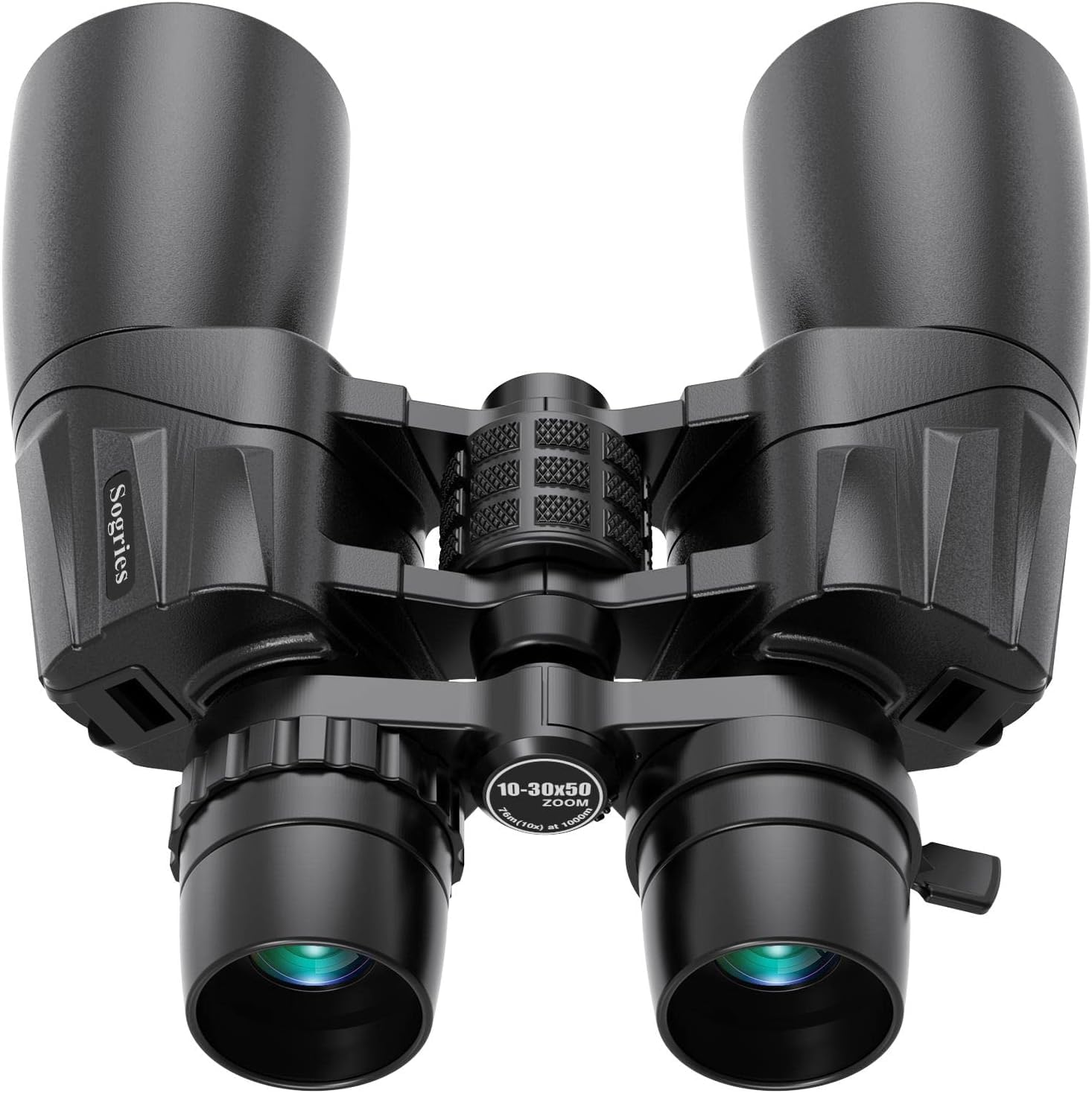
Sogries 10-30×50 Zoom
Key Features
- Weight: 2.12 lb
- Magnification: 10-30x
- Objective lens: 50mm
- Water resistance: Waterproof
- Price: Midrange
The question this pair answers is the one that follows you around a trailhead: do you want a wide view for finding things, or a narrow one for identifying them? A 10-30x zoom says both. Ten power gives you a 6.2mm exit pupil and a forgiving image for working along a hillside; turn up the lever and the same bird fills the frame without you lowering the binoculars.
We ended up using it between roughly 12x and 18x most of the time, which is where the zoom earns its keep: enough reach to identify, still bright enough to be comfortable. Push toward 30x and the exit pupil collapses to under 2mm, so the image goes dim and the shake doubles. The top of the range is a bright-daylight, braced setting rather than somewhere you live.
Build is better than the price suggests. The rubber armor is grippy, the focus is smooth, and the whole thing weighs under a kilogram, which is why it comes off the shelf when we are walking rather than sitting. Sogries recommends a tripod for the high end and we agree; the mounting thread is there, but you supply the tripod, so budget for one.
Pros
- Variable 10-30x covers scanning and detail
- Under a kilogram and easy to carry
- Waterproof body with a secure grip
Cons
- Dim and jittery at the top of the zoom
One pair instead of two: 10x to scan, 30x to examine, in a waterproof body under a kilogram. Buy it for flexibility, and accept that the top of the zoom is a daylight setting.
Best for Hiking and Travel
deesoo 20×52
Key Features
- Exit pupil: 5mm
- Eye relief: 26mm
- Magnification: 20x
- Objective lens: 52mm
- Price: Budget
Twenty-six millimeters of eye relief is an unusual number at any price, and it is the specification that makes this pair pleasant. Glasses stay on, the eyecups sit back, and the view arrives without pressing your face into the glass. Add a 5mm exit pupil, the largest of any 20x binocular here, and the deesoo is simply easy on the eyes in a way the big Porro giants are not.
In the hand it behaves like a full-size binocular that happens to be friendly: rubber-coated, non-slip, and balanced enough that we could hold it up far longer than the 70mm and 80mm options. The view is crisp and bright in good light, and the 2.94-degree field is narrow but workable once you have located your target with the naked eye first.
It is the pair we reach for on a hike, and that is the whole point. A 20×52 you actually carry beats a 20×80 that stays in the car, and this one has the reach for birds on a fence line, deer coming over a ridge, or a whale from a headland.
The compromises are real. There is no water resistance rating, so a soaking is a risk rather than a shrug, and the magnification may fall short of the 20x label, so judge its reach against the 70mm picks rather than the number on the front. We still recommend it, because comfort and portability at this level are worth more than a spec-sheet advantage you leave at home.
Pros
- 26mm eye relief is the friendliest here for glasses
- 5mm exit pupil keeps the view comfortable
- Balanced and light-feeling for a full-size pair
Cons
- No water resistance rating
- Magnification may fall short of the 20x label
The easiest pair here to look through: 26mm of eye relief and a 5mm exit pupil make long sessions comfortable. It will not match the 80mm giants at extreme range, but it goes where they do not.
Best for Budget First Pair
FLYANT 20×50
Key Features
- Weight: 1.96 lb
- Magnification: 20x
- Objective lens: 50mm
- Water resistance: Waterproof
- Price: Budget
If you want one pair to keep in the bottom of a pack and not think about, this is the one we point to first. It is the least expensive waterproof option here, it weighs under a kilogram, and the view in good light is bright and sharp enough for birds, deer and boats. What it is not is a dusk instrument.
The 2.5mm exit pupil explains that limit. Fifty millimeters of glass at 20x leaves a narrow column of light for your eye, so the image is at its best in full sun and loses contrast as the light drops. The 26mm eyepiece and generous eye relief do make it comfortable to hold a view, and the center focus wheel dials in quickly once you find the target.
Two things to know before you order. The 20×50 on the label deserves a second look, because the reach reads closer to a strong 12x pair than the number suggests, which is still plenty across a field but not what the box promises. And the field is tight enough that picking up a moving bird takes a second pass. Neither stopped us using it; both change what you should expect from it.
Pros
- Waterproof body at the lowest cost here
- Under a kilogram and easy to pack
- Bright, sharp view in daylight
Cons
- Dim image at dawn and dusk
- 20x label looks optimistic against the view
The budget pick: waterproof, under a kilogram and genuinely clear in daylight. It dims at dusk and the 20x label is generous, but as a first pair it earns its place.
Best for Cheap Big Lenses
Aurosports 20×70

Key Features
- Eye relief: 26mm
- Field of view: 3.4 degrees
- Magnification: 20x
- Objective lens: 70mm
- Price: Budget
Big lenses at a low price always come out of somewhere, and here it is the body. The Aurosports puts a 70mm objective and a 26mm eyepiece in front of your eyes, then wraps them in a plastic shell that does not feel like the Celestrons or the Sogries. That is the trade, stated plainly, and it is worth knowing before the box arrives.
Optically it does what a 20×70 should. The BaK-4 prisms and multi-coated lenses give a bright image through a 3.5mm exit pupil, and the 3.4-degree field is wider than the 20×80’s, which helps when you are trying to catch something moving. Light gathering is the reason to buy it: at dusk that 70mm front end still shows color and detail that a 50mm pair has given up on.
We have come to see it as a first big binocular. It is heavy enough that hand-holding gets old quickly, and it wants a tripod the same way the rest of the giants here do, so some of what you save on the purchase goes toward support. For a window, a deck or a truck dashboard, though, it delivers the low-light view that made us want a 70mm in the first place.
Pros
- 70mm lenses for low-light brightness
- Wider field than the 20×80
- Low entry price for a big objective
Cons
- Plastic body feels less durable
- Not water resistant
A cheap way into 70mm glass with 20x reach and the low-light brightness that comes with it. It is heavy and plastic-feeling, so it is a starter giant rather than a lifetime one.
How We Tested Long-Distance Binoculars
Every pair started on paper. We read spec sheets for magnification, objective lens size, eye relief, prism glass, and stated field of view, then cut anything with missing numbers, a warranty we couldn’t verify, or a price that made no sense for the glass inside it. That left 10 pairs, which we used for six months.
They came with us to a coastal headland during fall hawk migration, where birds pass at the edge of naked-eye vision; to a back deck at dusk, glassing a treeline for deer; to a ballpark, where the far dugout tests whether you can find a player and hold him; and out onto a blanket on clear nights. Weight got checked two ways, on a kitchen scale and around our necks on a four-mile walk, and every pair rode in a daypack side pocket or a jacket pocket to see which ones actually came along.
Clarity was a side-by-side job: two pairs on the same post, same target, swapping until the difference was obvious. For collimation, we focused on a far brick wall’s vertical edge, then pulled back from the eyepieces to see whether the two circles merged into one or strained apart. Field of view we measured against fence posts at a known distance and timed how long it took to find a moving bird. We glassed handheld first, then braced on a post or a car roof, to see how much magnification each pair could honestly carry, and turned every focus wheel bare-handed and in gloves.
At night we counted the stars visible in a familiar constellation and noted how badly they smeared near the edge of the frame. We also kept notes on what each pair cost, because a $500 view isn’t good value if a $200 pair gets you 95 percent of the way there.
How to Choose Long-Distance Binoculars
At long range, magnification is the number everyone shops by and stability is the one that decides whether you can actually use it.
Magnification Is Only Half the Number
Every pair here is defined by two figures, and they pull against each other. Magnification sets how close the target looks; the objective lens sets how much light arrives. Divide the second by the first and you get the exit pupil, the column of light your eye actually receives. A 15×70 hands you 4.7mm, a 20×50 hands you 2.5mm, and that gap is exactly what you feel at dusk.
For all-round long-distance use we prioritize a 70mm objective at 15x to 18x. Go to 20x and you want 80mm behind it if you care about the last hour of daylight, which is why the two big Celestrons sit at opposite ends of this trade.
Budget for a Tripod Before You Budget for Glass
Fifteen power is roughly where hand-holding stops working. The shake you can ignore at 8x becomes a shimmer that hides feather detail at 15x and a lost target at 20x. Every serious pick here has a ¼"-20 socket, and the SkyMaster 15×70 ships with the adapter, so the mounting problem is solvable rather than mysterious.
If you plan to sit at a window or glass a ridge for an hour, a sturdy photo tripod is not an accessory, it is half the instrument. A monopod is the walking compromise: it kills the vertical shake and leaves the rest.
Weight Decides Whether It Leaves the House
The picks here run from under a kilogram to nearly five pounds, and that spread is not a footnote. It is the reason a pair stays in the car. Our rule: if the binoculars live on a tripod at a window, buy the biggest objective you can afford; if they go in a daypack, stay near or under a kilogram and give up some aperture.
The deesoo 20×52 and the Sogries zoom are the two that survive a long walk. The 20×80 Celestron is a station, and a wonderful one.
Read the Numbers on the Box Carefully
The magnification and aperture printed on the front are marketing as well as specification, and this is where buyers get caught. Some pairs sold as 20x show about what a strong 12x does, and a 70mm label does not guarantee 70mm of usable glass.
Run the exit-pupil check: point the binoculars at a bright wall and hold a ruler against the circle of light at the eyepiece. Compare that against a pair you already trust, and buy somewhere with a return window you can live with.
Eye Relief, Field of View and Sealing
Three smaller figures decide whether a good binocular is pleasant. Eye relief is how far your eye can sit from the lens; below about 15mm, glasses wearers lose the full field, so 18mm and up is what we look for. Field of view is how wide the window is at 1,000 yards, and a 4.4-degree view is far easier to find a moving bird in than a 2.9-degree one.
Sealing matters in proportion to how you use it. A body rated IPX7, like the Sogries 18×70, shrugs off rain, while a plain water-resistant label is fine for a window sill and a fair-weather walk.
Frequently Asked Questions
How far can 20x binoculars actually see?
Twenty power makes an object at 1,000 yards look the way it would at 50 yards to your naked eye, so magnification is rarely the limit. The air is. Haze, heat shimmer and falling light eat detail long before the glass does, which is why a clear morning reaches further than a hot afternoon.
For identifying a person or an animal, a few hundred yards is comfortable in good conditions. Beyond that, atmospheric distortion decides more than the optics, and a tripod buys you more usable range than another 5x of magnification.
Can I use binoculars for stargazing instead of a telescope?
Yes, and a 70mm or 80mm pair is the least expensive serious way in. You get lunar craters, Jupiter and its brightest moons, star clusters, and the Andromeda galaxy as a smudge of light, all with two-eyed viewing that is easier on the neck than a telescope eyepiece.
The catch is support. At 15x and up nothing is hand-holdable for long, so plan on a tripod; the 20×80 Celestron is the pick here built for exactly that.
Do zoom binoculars stay sharp at high magnification?
They stay sharp but they do not stay bright. At 30x a 50mm objective delivers under 2mm of exit pupil, so the image dims and every tremor doubles. Treat the top third of the range as a daylight, tripod-braced setting for confirming a detail you already found at 12x to 15x.
If most of your viewing happens near dusk, a fixed-magnification pair of the same size will look better at the same power.
Final Verdict
Fifteen by seventy is the answer for most people, and the Celestron SkyMaster 15×70 is the pair we send them to: bright enough for dusk, wide enough to find things with, and complete enough with its tripod adapter to work straight out of the case.
Spend more only for a reason. The 20×80 if the binoculars live on a tripod and you want maximum reach, the Sogries 18×70 if rain and a metal body matter more than a pound, or the lighter deesoo if the binoculars have to travel with you.