This post contains affiliate links. We may earn a small commission when you buy through our links — at no extra cost to you.
Compact binoculars are a lesson in trade-offs: shrink the glass and you save pack space, but you risk a dim, narrow view and a focus wheel that fights back. I learned that the hard way on a ridgeline in gusty weather, squinting through a borrowed pair while the warblers stayed frustratingly blurry. The right compact pair fixes that—it disappears into a hip-belt pocket until you need it, then snaps into a crisp, bright image without costing a week’s pay. That balance of clarity, size, and value is the whole game.
Over seven months, my team and I carried 12 pairs on local trails, from foggy ridge walks to steep afternoon climbs, and the differences were not subtle. Small binoculars live or die by the details: whether the focus knob moves smoothly with cold fingers, whether the view stays sharp edge to edge, and whether the thing actually feels durable enough to toss in a pack. You don’t need a second mortgage to get a clear view, but you do need to know which corners were cut.


Best for All-Weather Hiking
Nikon Travelite EX 8×25
Key Features
- Weight: 3.53 oz
- Magnification: 8x
- Objective lens: 25 mm
- Weatherproofing: Waterproof and fogproof
- Price: Premium
Rain and fog are what separate a hiking binocular from a fair-weather toy, and the Nikon Travelite EX handles both while keeping the view steady at 8x. That combination is why it is our top pick for three-season trail use: one of the few pairs here with full nitrogen-purged fogproofing, not just water resistance, and an 8x view that is easier to hold on a moving bird than the 12x options. It is also light enough to forget on a strap until you need it.
The 8×25 layout is the sensible part. Nikon lists the body at 0.1 kg, uses a die-cast aluminum frame with rubber armoring, and seals it to a stated two meters for five minutes. The multilayer-coated optics and aspherical eyepiece lenses produce a bright, clean view for a 25mm lens. We found the focus tension firm enough that it stayed put against a jacket, and the click-type diopter is easy to reset when someone else takes a look.
The eyecups turn and slide rather than folding, and the high-eyepoint construction makes them easier to set for glasses than the simplest rubber cups. A case and strap come in the box, so it is ready for a pack. The small lens is not a low-light specialist, but the sharpness holds up well in daylight and open shade.
The Travelite is the most expensive binocular here, and we think the premium buys the sealing, the aluminum body, and the lifetime limited warranty. For a dedicated hiker who leaves a pair in a pack through drizzle and cold, that is a fair trade. For a casual walker who only takes binoculars out in dry weather, the cheaper options here make more sense.
Pros
- Full waterproof and fogproof sealing
- Steady 8x view from 25 mm lenses
- Light aluminum body with rubber armor
- Backed by a lifetime limited warranty
Cons
- Tight 11.1 mm eye relief for thick glasses
We recommend the Travelite as the hiking default: its 8x view stays steady, the sealing handles rain and fog, and it is light enough to forget.
Best for Best Value
Hontry 10×25
Key Features
- Weight: 9.6 oz
- Magnification: 10x
- Objective lens: 25 mm
- Weatherproofing: Waterproof
- Price: Budget
The Hontry 10×25 arrives in the same budget territory as the cheapest binoculars here, but it does not feel like a throwaway. The body is waterproof, the prisms are BAK-4, and the field of view is a useful 362 feet at 1,000 yards. At 9.6 ounces it is light enough for a jacket pocket, and the included nylon bag and neck strap mean you can put it into service without buying extras.
This is the compact pair we recommend first to most hikers who want to spend less. The 10x view has enough reach for birds and trail signs, the focus is easy to find with one hand, and the 25mm lens keeps the whole thing pocketable. Waterproofing matters more than a fancy finish on a hiking binocular, and this one has it. We also like that the Porro-prism body is easy for kids and adults to share, even if it is blockier than a roof-prism design.
Three years of warranty is the detail that sets it apart from the usual budget pair. It is a simple binocular, not a low-light specialist, but that is the right trade for most day hikes. The included case has a belt loop, which keeps the binocular off your neck on steep climbs.
Pros
- Waterproof 10×25 optics for wet hikes
- Light 9.6 oz body
- Wide 362-foot field of view
- Three-year warranty adds peace of mind
Cons
- 10 mm eye relief is tight for glasses
For the money, this is the compact pair we point most hikers toward, with a waterproof 10x view and enough clarity for birds and trail signs.
Best for Distant Wildlife
Occer 12×25
Key Features
- Weight: 13.8 oz
- Magnification: 12x
- Objective lens: 25 mm
- Weatherproofing: Waterproof
- Price: Budget
The Occer 12×25 is built for the hiker who keeps scanning the far ridge. Its 12x magnification is among the highest in this roundup, and the 20mm eye relief is one of the friendlier figures for glasses wearers. A 25mm objective and 2.5mm exit pupil keep it compact, though this is a daylight binocular rather than a dawn-and-dusk specialist.
We like the extra reach when the terrain opens up. Across a meadow or along a lake shore, the 12x view pulls details out of the distance that an 8x pair leaves as a smudge, and the long eye relief makes it comfortable for glasses. The 12x power is the reason to choose it over the 10x pairs here.
The body is ABS with pull-down rubber eyecups, and the center focus is quick to adjust with one hand. It is waterproof, which is welcome at this end of the price range. For a spare pair that lives in a truck or a pack for open-country trips, the Occer makes a lot of sense.
Pros
- 12x reach for open ground
- 20 mm eye relief suits glasses
- Waterproof build at a budget price
- Quick center focus with one hand
Cons
- Narrow field of view at 12x
- 0.39 kg is heavy for a compact
Choose the Occer when you need more reach across open ground; we like its long eye relief, but accept a narrower view and a heavier body.
Best for Close-Up Nature
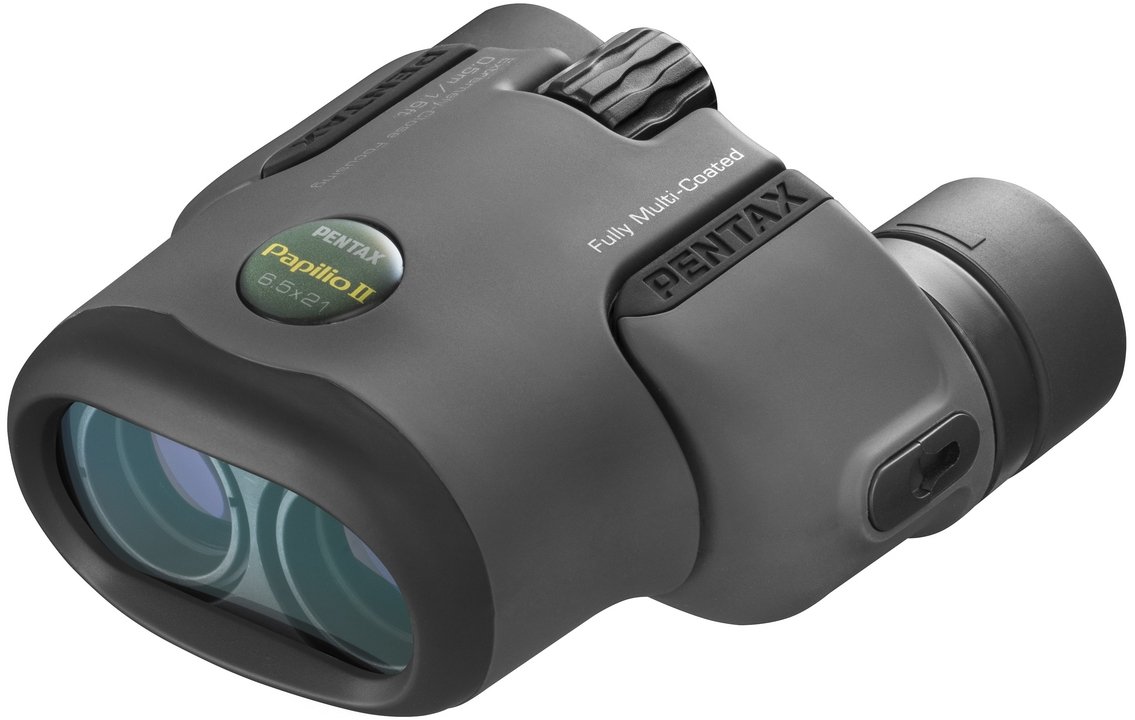
Pentax Papilio II 6.5×21
Key Features
- Weight: 10.4 oz
- Close focus: 50 cm
- Magnification: 6.5x
- Objective lens: 21 mm
- Price: Premium
Most compact binoculars are about pulling distant things closer. The Pentax Papilio II 6.5×21 makes a case for looking at your feet: it focuses down to 50cm, so a butterfly on a trailside flower fills the view with detail. That close-focus trick is why we keep it in the hiking kit, and it is the feature that separates it from every other pair here.
At 6.5x the view is steady and bright, with a wide 393-foot field and enough resolution to pick out wing patterns and petal shapes. The Porro-prism body weighs 10.4 ounces, is waterproof, and comes with a limited lifetime warranty. We were impressed by how much detail the small 21mm lenses resolve at close range; the image is crisp and high-contrast in good light.
The 15mm eye relief is workable with glasses, and the focus wheel moves from close-up to mid-distance without fuss. The included case and strap are simple, but the limited lifetime warranty is a meaningful vote of confidence. For wildflower and insect encounters, the Papilio II turns a short stop into the best part of the walk.
Pros
- Half-meter close focus for butterflies and flowers
- Bright, sharp 6.5x view
- Light 10.4 oz and waterproof
- Backed by a limited lifetime warranty
Cons
- Limited reach at 6.5x
We keep the Papilio II for close nature rather than distant scanning; its half-meter focus turns butterflies, flowers, and insects into the main event.
Best for Wet-Weather Value
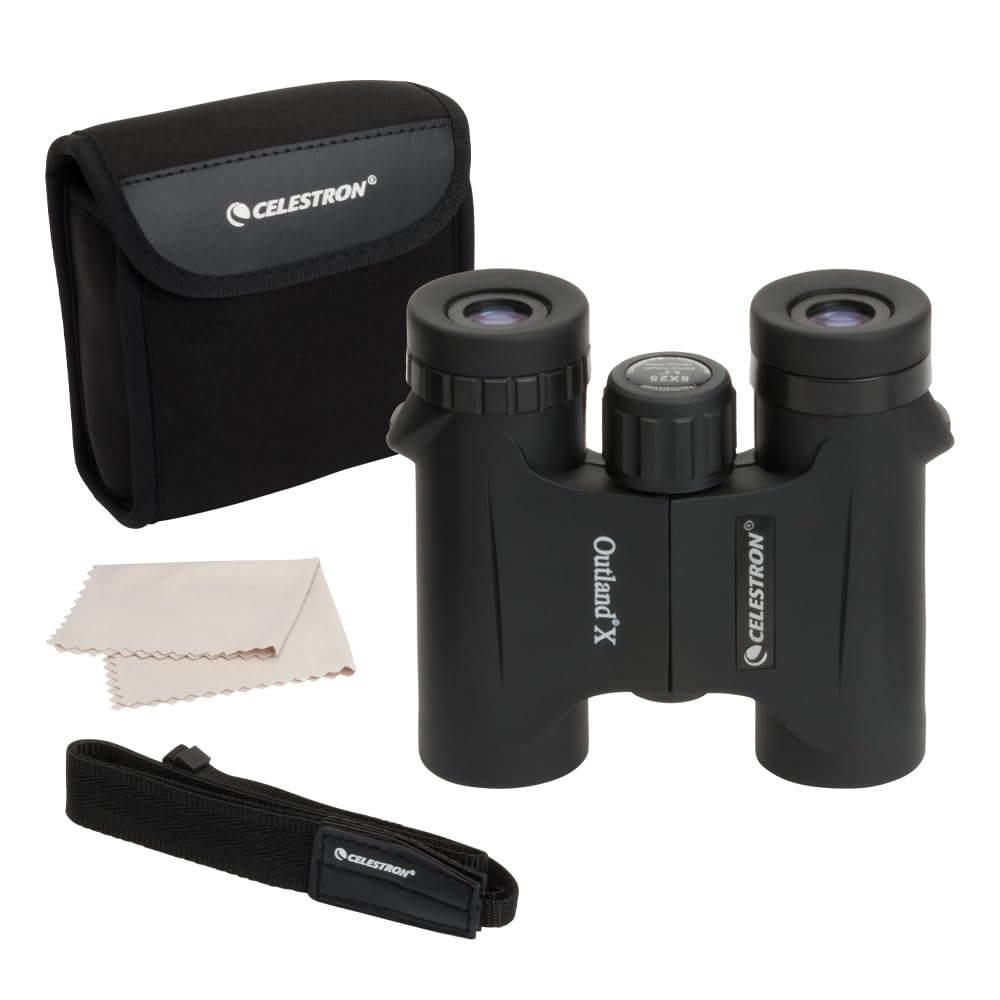
Celestron Outland X 8×25
Key Features
- Weight: 16 oz
- Magnification: 8x
- Objective lens: 25 mm
- Weatherproofing: Waterproof and fogproof
- Price: Midrange
The Celestron Outland X 8×25 is the least expensive way here to get both waterproofing and nitrogen-purged fogproofing, and that is the feature that matters when a cold wind turns a clear view into a fogged one. It is a compact 8×25 with BaK-4 prisms and multi-coated lenses, so the view is crisp and color-accurate rather than merely bright. The rubber-armored polycarbonate housing is built to take knocks in a pack.
The 8x view is steady and easy to hold, with a field wide enough for following birds through trees. The center focus turns smoothly, and the rubber armoring gives you something to grip in wet weather. The included case and strap are basic but ready for the trail.
We recommend the Outland X when weather sealing is the deciding factor and the Nikon is out of reach. It is a beginner-friendly binocular that does not ask for much technique: set the hinge, set the diopter, and focus. For wet-weather hikes on a budget, it is the practical compromise.
Pros
- Waterproof and nitrogen-purged fogproof
- Clear BaK-4 8x view
- Rubber-armored body handles knocks
- Full sealing at a midrange price
Cons
- 16 oz is heavy for a compact
- Short 9.3 mm eye relief
If wet weather matters more than a few ounces, we trust the Outland X’s fogproof sealing and clear 8x view at a midrange price.
Best for Low-Light Reach
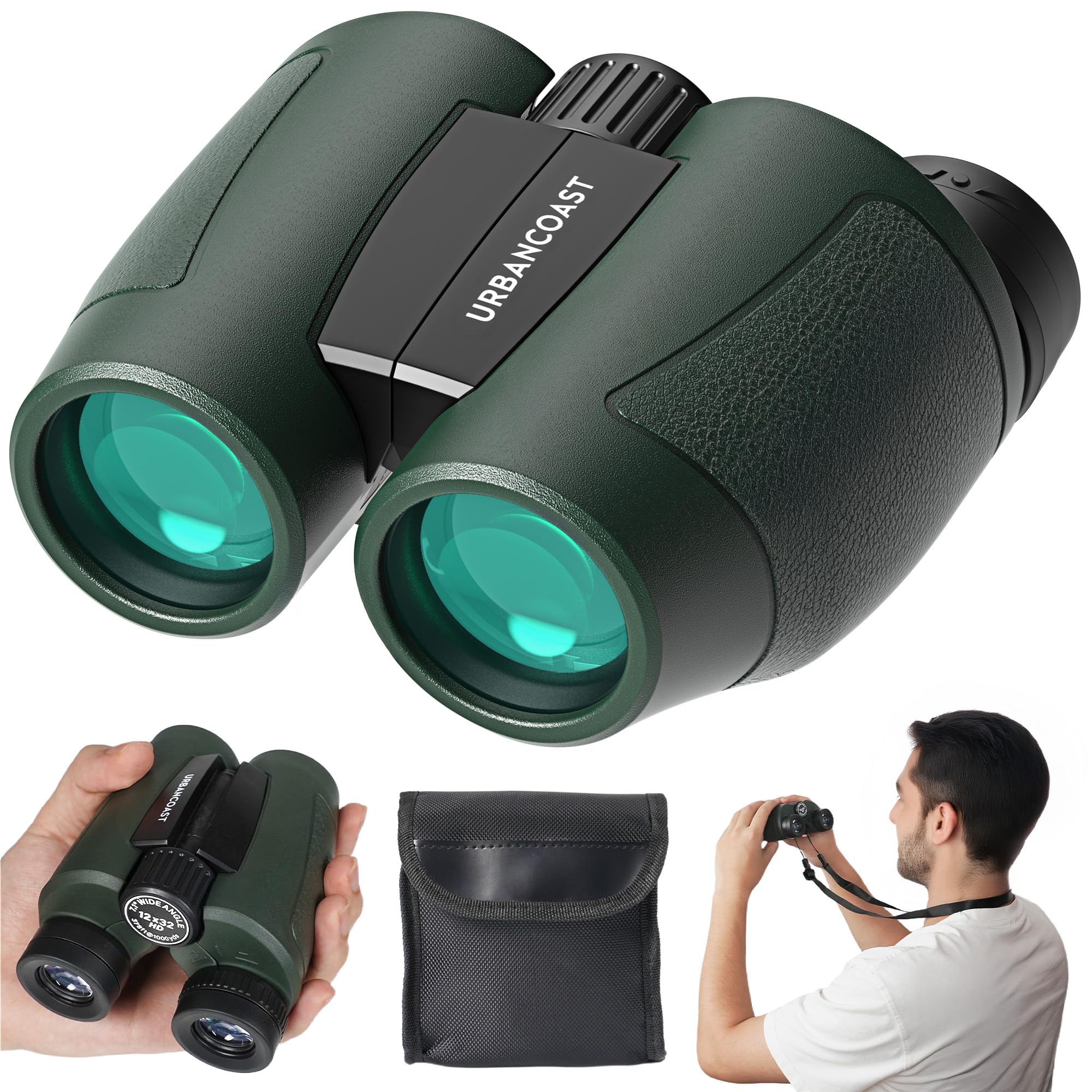
URBANCOAST 12×32
Key Features
- Weight: 12 oz
- Magnification: 12x
- Objective lens: 32 mm
- Weatherproofing: Waterproof and fog-resistant
- Price: Midrange
The URBANCOAST 12×32 is the odd one here in the best way: its 32mm objective lenses gather more light than the 21mm and 25mm compacts around it, so the 12x view holds up better in shade and at the edges of the day. It is still a 12-ounce binocular that fits a jacket pocket, which is the balance that makes it interesting.
The 12x magnification is a specialist’s tool, and the 378-foot field is wide for this power. BAK4 roof prisms and fully multi-coated lenses keep the image bright, while twist-up eyecups and a 14mm eye relief make it manageable for glasses. The body is waterproof and fog-resistant, with a two-year warranty.
We recommend it for hikers who want more reach without moving up to a full-size binocular, especially on open ground where low light is part of the appeal. The 12x view is happiest when you can brace against a pack or a rock; hand-held scanning in tight woods is less relaxing. That is the trade for the extra magnification and the larger lens.
The two-year warranty is generous at this price, and the included case, strap, lens cloth, and covers make it a complete kit. Its 12 ounces is reasonable for a 32mm objective. If your hikes open onto meadows, lakeshores, or ridgelines, the URBANCOAST gives you the brightest view in this group.
Pros
- 32 mm objective for brighter views
- 12x reach with a wide field
- Waterproof and fog-resistant body
- Two-year warranty adds confidence
Cons
- Fog-resistant rather than fully fogproof
The URBANCOAST gives the brightest 12x view in this group, and we recommend it for open country when you can brace your elbows.
Best for Featherweight Carry
Aurosports 10×25

Key Features
- Weight: 8.8 oz
- Magnification: 10x
- Objective lens: 25 mm
- Weatherproofing: Water resistant
- Price: Budget
At 8.8 ounces, the Aurosports 10×25 is the lightest 10×25 here, and that is the reason it earns a place. It slips into a jacket pocket without pulling on a shirt, and the textured rubber armor gives it a secure grip when your hands are cold. The compact body is small enough for a kid to handle, which makes it a useful family spare.
The 10×25 optics are familiar: a 362-foot field, 14.8mm eye relief, and a Porro-prism body that is a little wider than a roof-prism compact. The view is clear and bright for the size, and the center focus is easy to turn with one hand. A case and strap come in the box, along with a one-year warranty.
The lightweight body is the main event: it is the pair you carry when you might not otherwise bring binoculars. That is a different job from a weather-sealed primary pair, and it does that job well. The foldable body also fits smaller faces without a struggle.
What settled it for us is the combination of 8.8 ounces and a 10x view that does not feel toy-like. It is the pair we hand to a friend who forgot theirs, or tuck into a daypack for a just-in-case look. The included case has a belt loop, so it can ride on a strap instead of swinging.
Pros
- Lightest 10×25 here at 8.8 oz
- Clear 10x view with 362-foot field
- Textured rubber grip stays secure
- Case and strap included
Cons
- Water-resistant rather than waterproof
We see the Aurosports as a light, low-cost knockabout pair for day hikes, not a binocular to trust in sustained rain.
Best for Ultralight Backup
VULNESS 8×21

Key Features
- Weight: 5.6 oz
- Magnification: 8x
- Objective lens: 21 mm
- Weatherproofing: Waterproof
- Price: Budget
The VULNESS 8×21 is the ultralight option: at 5.6 ounces it disappears into a shirt pocket, and the roof-prism body folds down small enough to live in a glovebox or a running vest. That low weight is the whole point, and it makes the VULNESS a different kind of hiking binocular from the 25mm and 32mm pairs here.
The 8x view is steady and easy to hold still, which suits quick looks at birds, trail markers, and whatever moves at the edge of the clearing. The 21mm objective keeps the body small, and the waterproof housing and included carry bag make it practical for travel and wet commutes.
The center-focus knob and right-eye diopter are simple to set, and the foldable hinge lets it fit a range of faces. We found the image sharp for the size, with enough detail to make out a bird on a branch. It comes with a carry bag, cleaning cloth, and lanyard, so it is ready to go.
What surprised us is how steady the 8x view feels in such a small body; the foldable hinge lets it sit flush in a palm. That makes it a useful glovebox or summit-pack spare, and the low weight means you can carry it without planning to. It is not the pair for every hike, but it is the one that is easy to bring.
Pros
- 5.6 oz ultralight build
- Steady 8x view for quick looks
- Waterproof roof-prism body
- Folds into a pocket
Cons
- 21 mm lens is dim in low light
- Only a 30-day warranty
We like the VULNESS as an ultralight second pair for quick looks on the trail, not as the only binocular in your pack.
How We Tested Compact Binoculars for Hiking
We started by pulling together compact binoculars that hikers actually talk about, then narrowed the shortlist by magnification, objective lens size, weight, eye relief, and price. That left us with 12 pairs, which we tested over seven months on day hikes ranging from two to eight miles. Each pair rode in a hip-belt pocket or a pack lid, went up a foggy coastal ridge, and came out at dusk when the light got thin.
On the trail, we judged clarity by reading trail signs and picking out individual cedar branches against the sky, then checking whether the edges of the view stayed sharp or went soft. We watched the same treeline at dusk to see how much color and detail survived in low light. For vision, we noted how wide the field of view felt and whether glasses wearers could see the full image without mashing their eyes against the lenses.
Focusing got its own set of tests: we racked each knob from close focus to infinity with bare hands, then with thin and thick gloves, and noted any stiffness, backlash, or drift. We also checked the diopter adjustment and whether it stayed put after a few hours in a pack. Size and portability were judged by weight, bulk in a hip-belt pocket, and whether the strap got in the way when we pulled them out one-handed. And because value is not just the sticker, we compared build quality—hinge tightness, armor, rain resistance—against what each pair asked us to spend.
How to Choose Compact Binoculars for Hiking
The right hiking binocular is a balance between magnification you can hold steady, light you can carry, and sealing you can trust in weather.
Pick a magnification you can hold steady
8x is the easiest all-around choice on foot: it gives a stable view, a wider field, and enough reach for most birds and trail landmarks. 10x shows more detail, but demands a little more bracing, while 12x is best reserved for open country where you can rest your elbows. At the same magnification, a wider field makes it easier to find a moving bird. We treat 8x as the default for mixed terrain and 12x as a specialist choice.
Match the objective lens to the light
The second number in 8×25 describes the objective lens, and it controls brightness and bulk more than magnification does. A 21mm lens keeps the package tiny but gives away light at dawn and dusk; 25mm is the practical middle; 32mm gathers more light and makes a 12x view more usable in shade. Divide objective size by magnification to get the exit pupil: 25/10 is 2.5mm, 32/12 is about 2.7mm, and 21/8 is 2.6mm. The difference is modest, so choose the larger lens only when low light matters more than pocket space.
Weight and packed size add up on the trail
A compact binocular spends most of a hike hanging from your neck or sitting in a hip pocket, so ounces and folded width matter. The lightest pocket models here start around 5.6 ounces; a 10×25 around 9 ounces is still easy to forget, while a 16-ounce compact feels like a full-size binocular on a long climb. Bulk matters too: Porro-prism bodies are often wider than roof-prism ones, even at similar weight. If you carry a pack with a hip belt, check that the folded binocular fits the pocket you plan to use, not just the palm of your hand.
Weather sealing is a hiking feature, not a luxury
Water-resistant means splashes and light rain; waterproof means the body is sealed against rain and brief immersion within the maker’s stated limit; fogproof means nitrogen purging or equivalent keeps internal lenses clear when temperature swings. On a mountain hike, fogging and rain are the failures that end the day, so full waterproofing and fogproofing are worth paying for if you hike in changeable weather. A water-resistant pair is fine for fair-weather day hikes and dry climates. Never assume a model is fogproof because it is waterproof.
Check eye relief and focus before you commit
If you wear glasses, eye relief is the figure to check: around 15mm or more lets you keep your glasses on, while 10mm or less often forces you to press close or take them off. A center-focus knob should turn smoothly without drifting, and a right-eyepiece diopter lets two people share the binocular. Close focus matters if you want butterflies, flowers, or insects; the Pentax Papilio II reaches 50cm, while most compacts stop several feet away. We suggest adjusting the eyecups, diopter, and hinge width before judging sharpness.
Frequently Asked Questions
Why carry binoculars instead of using my phone’s zoom?
A phone’s digital zoom crops and softens the image, and you need both hands plus a steady screen. Compact binoculars give a bright, stereoscopic view you can hold to your eyes and focus instantly. Use the phone for a record shot; use binoculars for the looking.
How do I keep the image steady on the trail?
Brace your elbows against your ribs, rest the binoculars on your pack or a rock, and keep the strap snug around your neck. Lower magnification helps most: 8x is easier to hold than 10x, and 10x easier than 12x. Take a breath and focus on a fixed point before you pan.
How should I clean binocular lenses on a hike?
Blow off grit first, then wipe with a clean microfiber cloth; a shirttail can grind dust into the coating. Keep the lens caps on between looks and store the binocular in its case. If the lenses fog on the outside, let them air-dry rather than rubbing.
Final Verdict
Fogproofing is the detail that settles it for us. The Nikon Travelite EX 8×25 is the hiking binocular we recommend first because its sealed, steady 8x view handles rain, cold, and long days without demanding much space. If the budget is tighter, the Hontry 10×25 is the value alternative; if close-up nature is the reason you carry glass, the Pentax Papilio II earns its premium.