This post contains affiliate links. We may earn a small commission when you buy through our links — at no extra cost to you.
A warbler moves through the canopy, you raise the binoculars, and by the time you’ve hunted it down it’s on the next branch — or gone. That gap between the bird and the view usually comes down to two things: the glass and the focus wheel. Binoculars built for birding gather enough light at 6 a.m. when the birds are actually moving, snap into focus in a quarter turn instead of five, and stay comfortable hanging around your neck for hours. That’s the whole job, and the difference between a pair that does it and one that doesn’t is obvious within an afternoon.
I’ve had 12 pairs in rotation for eight months now, from compacts that disappear into a jacket pocket to full-size glass I’d happily carry all morning, and in the field the differences show up fast. One piece of advice for a first pair: don’t chase magnification. Most birders settle on 8×42 — 10x looks better on paper but narrows your field of view and magnifies every shake in your hands. The picks below are the ones that survived the year.



Best for All-Round Birding
Vortex Crossfire HD 10×42
Key Features
- Weight: 1.4 lb
- Field of view: 325 feet
- Magnification: 10x
- Objective lens: 42 millimeters
- Price: Midrange
The unconditional lifetime warranty is what decides this one for us. Vortex covers the Crossfire HD against just about anything, and that matters more than usual on a binocular that lives in a coat pocket, gets rained on, and gets knocked against a gatepost. Underneath the warranty is a sensible birding specification: 10x magnification, 42mm objectives, a 325-foot field of view at 1,000 yards, and a nitrogen-purged body that is waterproof and fogproof. Nothing here is exotic, which is exactly why it works as a default.
At 1.4 pounds it sits in the middle of this group, and the rubber armor gives you something to grip when your hands are cold. We especially like that a GlassPak chest harness comes in the box alongside the neck strap; only one other binocular here ships one, and an hour of looking up into a canopy explains why that matters. Twist-up eyecups, a center-focus wheel and a right-eye diopter cover the adjustments, and there is a tripod socket for a window mount.
Where it loses ground is at the edges of the day. Its 4.2mm exit pupil is respectable, but the Nikon Monarch M5 puts 5.3mm behind your eye, and the M7’s ED glass pulls more color out of a backlit warbler. We still send most people here: a wide, bright, sealed 10x view, a harness, and a warranty you will probably never need, for less than the premium picks ask.
Pros
- Unconditional lifetime warranty
- Wide 325-foot field of view
- Chest harness included
- Waterproof, fogproof and tripod ready
Cons
- 15mm eye relief is tight for thick glasses
We make the Crossfire HD our default for birding because it pairs a wide, sealed 10x view with a chest harness and a lifetime warranty that costs nothing to rely on.
Best for Dawn and Dusk
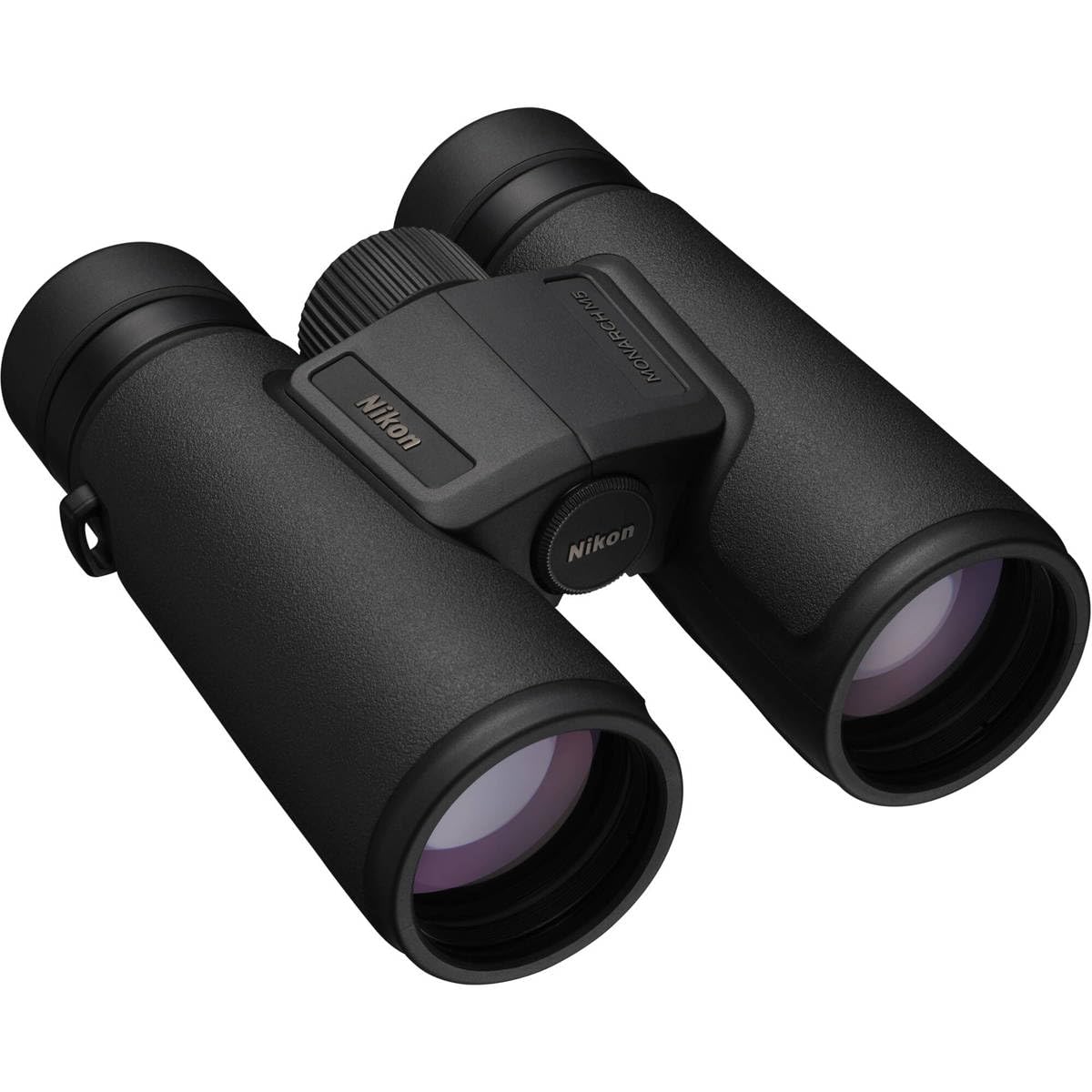
Nikon Monarch M5 8×42
Key Features
- Exit pupil: 5.3 millimeters
- Eye relief: 19.5 millimeters
- Field of view: 335 feet
- Magnification: 8x
- Price: Premium
Walk a woodlot at first light and the difference between an 8×42 and a 10×42 stops being academic. The Monarch M5’s 8x magnification and 42mm objectives combine to a 5.3mm exit pupil, the largest in this group, so the image holds color when there is barely enough light to see by. Nikon’s ED glass and dielectric prism coatings keep the edges of that image clean, which is what you notice when a thrush slips behind a branch.
Comfort is where this one earns its place for us. Eye relief is 19.5mm with twist-up click-stop eyecups, so glasses stay on your face and you still get the full view, a combination that is rarer than it should be. At 1.4 pounds with a closed-bridge roof-prism body it balances in the hands, and the 335-foot field of view is wide enough for warblers in a hedge.
You pay for that. The M5 is the second-priciest binocular here and roughly twice the Crossfire, and the optical step, real at dusk, is not dramatic at noon. Its field of view is also a little narrower than the Monarch M7’s 362 feet. For a dedicated early-morning birder, or anyone who wears glasses from breakfast onward, the eye relief alone justifies the move up.
Pros
- Largest exit pupil here at 5.3mm
- 19.5mm eye relief works with glasses
- ED glass and dielectric coatings
Cons
- Premium price for a modest daylight gain
- Narrower field of view than the Monarch M7
Our pick for the first hour of daylight and for anyone who keeps glasses on: the M5 is the brightest, most comfortable view in this group.
Best for First Binoculars
Celestron Outland X 8×42
Key Features
- Weight: 1.8 lb
- Eye relief: 17.8 millimeters
- Magnification: 8x
- Objective lens: 42 millimeters
- Price: Budget
If you want a full-size 8×42 and you want to spend as little as possible doing it, this is the one. The Outland X is the least expensive full-size binocular here, and it still gives you BaK-4 prisms, a 5.2mm exit pupil, 17.8mm of eye relief, a nitrogen-purged waterproof body and rubber-armored polycarbonate around all of it.
Your money goes missing in two places. The lenses are multi-coated rather than fully multi-coated, a step down from the Nikon and Vortex picks that costs a little contrast in flat light. At 1.8 pounds it is the heaviest binocular in this group, which you feel on a long walk with the included neck strap. The focus is what to check first: run the wheel end to end when it arrives, and if it feels gritty, use the return window instead of living with it. Neither compromise touches the waterproofing or the light gathering, which is why it still earns a place.
For a first pair, a spare pair for the car, or something to hand a teenager who is showing interest, that is a sensible trade. We hand it to beginners without hesitation: sealed, bright enough for most birding, and plain enough that a scratch on the barrel is not a tragedy.
Pros
- Least expensive full-size 8×42 here
- 5.2mm exit pupil and 17.8mm eye relief
- Waterproof and nitrogen purged
Cons
- Heaviest binocular here at 1.8 pounds
- Multi-coated rather than fully multi-coated glass
Buy the Outland X if you want a full-size 8×42 for the least money here and can live with a heavier body and simpler coatings.
Best for Reach and Photos
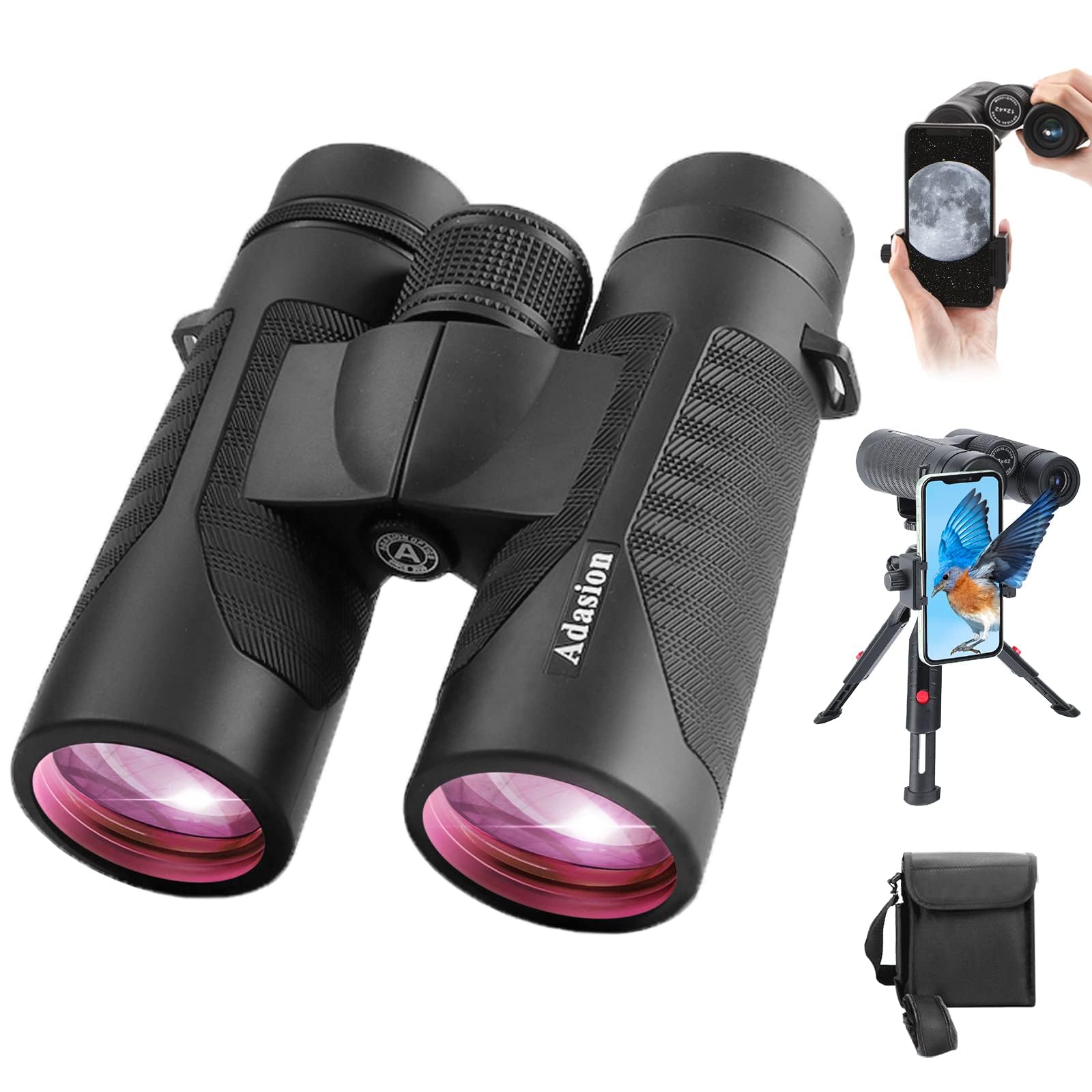
Adasion 12×42
Key Features
- Weight: 1.2 lb
- Eye relief: 13.6 millimeters
- Magnification: 12x
- Objective lens: 42 millimeters
- Price: Budget
Open the box and there is more in it than binoculars: a phone adapter and a small tripod with a 360-degree swivel and extendable legs. For a birder who wants a picture of the heron as well as a look at it, that kit is the reason to consider this pair. The binoculars are a 12×42 roof-prism design with BaK-4 prisms, fully multi-coated lenses, an IPX7 waterproof rating and a listed 1.2-pound weight.
Twelve power is a real trade. It puts more bird in the frame than the 8x and 10x picks here, but it magnifies the shake in your hands and narrows what you can see around the bird, which hurts when a flock moves through and you are hunting for the one that is not a chickadee. The 4mm exit pupil is dimmer at dusk than the 42mm objective suggests. For backyard watching from a deck, that is a fair trade for the reach.
We treat this as a second pair or as a first pair for someone who watches from one spot and wants pictures. On the tripod with the adapter fitted, the reach earns its keep and the alignment fuss disappears. Carried around your neck at a dawn stakeout, you will wish for the 8x.
Pros
- Phone adapter and tripod included
- IPX7 waterproof and fogproof
- Light for a 12x full-size at 1.2 pounds
Cons
- 12x magnifies handshake
- 4mm exit pupil dims at dusk
We recommend the Adasion to the birder who wants twelve-power reach and phone photos without spending much; hand-held at dusk, look elsewhere.
Best for Serious Birding
Nikon Monarch M7 10×42
Key Features
- Weight: 1.5 lb
- Eye relief: 16.5 millimeters
- Field of view: 362 feet
- Magnification: 10x
- Price: Premium
This is the pair for the reader who has stopped wondering whether they will stick with birding. The Monarch M7 10×42 puts ED glass, phase-corrected dielectric-coated prisms and oil- and water-repellent lens coatings into a 1.5-pound waterproof, fogproof body, with a locking diopter that stays where you set it. It is the most expensive binocular here, and the one we point experienced birders toward.
The 362-foot field of view is the widest of the 10x picks in this group, a small thing on paper that is not small when a falcon goes over. Eye relief is 16.5mm with twist-up click-stop eyecups, enough for glasses though without the M5’s generous margin, and the large center focus knob turns smoothly enough to follow a bird through a hedge.
Set against the Crossfire, it buys better glass and a wider view for roughly three times the money and a tenth of a pound more weight. Whether that is worth it depends on how often you are out at first light and how much color fringing bothers you on a backlit bird. We tell most people to start lower and move here once the habit sticks.
Pros
- ED glass and dielectric coatings
- Widest field of view of the 10x picks
- Locking diopter and 16.5mm eye relief
Cons
- Most expensive binocular here
- Heavier than the Crossfire at 1.5 pounds
For birders who already know they are in, the Monarch M7 delivers the cleanest 10x image here and a locking diopter that stays put.
Best for Pocket Carry
Hontry 10×25 Compact

Key Features
- Weight: 9.6 oz
- Field of view: 362 feet
- Magnification: 10x
- Objective lens: 25 millimeters
- Price: Budget
Four and a third inches long and 9.6 ounces, this is the pair that disappears into a jacket pocket and comes out when something moves in the hedge. The Hontry 10×25 uses Porro prisms, fully multi-coated lenses and a center-focus wheel, and it arrives with a strap, a nylon bag, a lens cloth and a three-year warranty.
The hinge is the detail that makes it useful for families. Interpupillary distance runs from 60mm to 75mm, so it closes down far enough for a child’s face and opens up for an adult’s, and the 10x view will show you a wren at the back of a hedge in decent light. That is more than the size suggests, and the rated 362-foot field of view is generous for a compact on paper.
What it will not do is dawn. A 25mm objective at 10x leaves a 2.5mm exit pupil, so the image goes grey well before a 42mm pair gives up, and 10mm of eye relief means glasses wearers push the eyecups down and still struggle to see the whole field. As a glovebox pair, a travel pair, or a first pair for a kid, it earns its place; as your only birding binocular, it does not.
Pros
- Pocketable at 9.6 ounces
- Hinge fits children and adults
- Three-year warranty
Cons
- 10mm eye relief rules out most glasses
- 2.5mm exit pupil dims in low light
We rate the Hontry as a pocket pair for travel, children and the glovebox, not as the binoculars you take to a dawn stakeout.
Best for Value Full-Size
Vortex Triumph HD 10×42

Key Features
- Weight: 15.9 oz
- Eye relief: 17 millimeters
- Magnification: 10x
- Objective lens: 42 millimeters
- Price: Budget
Same brand, same 10×42 configuration, same unconditional lifetime warranty as our top pick, and less money. That is the short version of the Triumph HD, and it is why we kept it in the roundup rather than treating it as a duplicate. The HD optical system and fully multi-coated lenses produce a crisp, neutral image, and 17mm of eye relief sits between the Crossfire’s 15mm and the Nikon M5’s 19.5mm.
The chassis is polycarbonate with full rubber armor, which keeps the weight to 0.45 kg and makes this the lightest 10×42 here. Nitrogen purging and O-ring seals give the same waterproof, fogproof performance as the Crossfire, there is a tripod socket for a window mount, and the diopter is adjustable for one-eyed focus differences.
Two details separate it from the Crossfire in daily use. The eyecups are rubber and slide rather than twisting up, which is a small annoyance every time you share the binoculars between glasses and bare eyes. And the straps on the included GlassPak harness slide loose if you do not check them, the kind of thing you discover at the worst possible moment.
Neither undoes the value. You get the Vortex glass, the harness, tethered lens covers and the same lifetime cover at the bottom of the full-size range, and the two pounds of difference between this and a cheap no-name pair is mostly in the sealing and the warranty. If the warranty is what sold you on the Crossfire but the money will not stretch, this is the pair we point you toward.
Pros
- Same unconditional lifetime warranty as the Crossfire
- Lightest 10×42 here at 0.45 kg
- GlassPak harness in the box
Cons
- Rubber eyecups instead of twist-ups
- Harness straps slide loose
The Triumph is worth buying for the warranty and harness alone; we point budget-conscious Vortex fans here before the Crossfire.
How We Tested Binoculars for Bird Watching
We started by pulling together pairs from the established optics makers — plus a few from brands better known for cameras — then filtered hard on the specs that matter when the subject is a bird: 8x or 10x magnification, 42mm objective lenses with a couple of 32mm compacts thrown in for comparison, waterproof and fogproof sealing, and enough eye relief for glasses. That left 12 pairs, spanning budget to genuinely expensive, and we lived with each one for eight months.
Every pair went through the same rounds. At the backyard feeders before sunrise we counted how much detail survived in low light — could we pick out the streaking on a finch’s flank, or were we looking at a silhouette? At a local marsh we practiced the thing that separates good birding glass from good specs: getting on a moving bird quickly, then staying with it. Focusing got its own scrutiny, since it’s where cheap binoculars give themselves away. We counted turns of the focus wheel from close focus to infinity, noted whether it turned smoothly or gritty, checked whether the image snapped or had to be nudged, and then checked again after a pair had ridden in a truck bed or swung on a harness all day.
Ease of use was tested the way it actually happens — one hand while the other holds a coffee, gloved hands in November, eyeglass wearers folding the eyecups down. We weighed each pair and wore it on a four-hour walk to see where the strap started to dig in, and we watched for fogging on the walk from a warm car into a cold morning. Value came last: after all that, did the pair cost what it delivered, or were we paying for a logo? A couple of the mid-priced options embarrassed their more expensive neighbors.
How to Choose Birding Binoculars
The number on the box matters less than whether you can hold the binoculars steady, find a bird in them quickly, and see through them with the glasses you actually wear.
Magnification and the light you bird in
Magnification is the easiest figure to compare and the least useful on its own. Divide the objective lens by the magnification and you get the exit pupil, the shaft of light reaching your eye: an 8×42 gives 5.3mm, a 10×42 gives 4.2mm, a 10×25 gives 2.5mm. That figure decides how long you can keep looking after the sun drops.
If your birding happens early, late or under a canopy, the 8×42 is the better tool. If you scan open fields and want reach, take the 10×42 and learn to brace your elbows against your ribs. More magnification is not more bird if the image shakes or the light runs out.
Field of view is what actually finds the bird
Magnification helps once the bird is in the barrels. Before that, field of view does. This group runs from 325 to 367 feet at 1,000 yards, and the difference shows when a warbler is working through foliage: a wider view means less sweeping around to find what your eyes already saw.
The focus wheel matters almost as much. You want one your index finger reaches without breaking your grip, because you will turn it constantly as birds move between branches. Check that the diopter ring turns stiffly or locks, so it stays where you set it after a day in a bag.
Eyeglasses change the specification that matters
Eye relief is how far your eye can sit from the lens and still see the whole field. Under about 15mm is a struggle with glasses; 17mm is comfortable and 19.5mm, as on the Nikon Monarch M5, is generous enough to leave the glasses on all day.
Eyecup design decides whether you use that relief or fight it. Twist-up eyecups click between two positions in a second; plain rubber ones have to be rolled down and back up every time you swap between glasses and bare eyes. Glass quality is wasted if the eyecups make the view awkward.
Weight, harnesses and the walk back
Full-size picks here run from about a pound to 1.8 pounds, and that difference is not in your hands, it is in your neck after two hours. A chest harness spreads the load across your shoulders and stops the binoculars swinging when you bend down, and only two picks here include one, so budget for it on the others.
Warranty is the other long-term cost. Vortex covers the Crossfire and Triumph with an unlimited, unconditional lifetime warranty; Nikon runs a limited lifetime; the budget picks are shorter. Read that line before you decide the saved money is saved.
Frequently Asked Questions
Can I use compact binoculars for bird watching?
Yes, in good light and for short sessions. A 10×25 like the Hontry gives a 2.5mm exit pupil, which is fine at a feeder, on a walk, or in a child’s hands, and it disappears into a jacket pocket.
What it gives up is dawn and dusk, where a 42mm objective holds brightness far longer. Treat a compact as a second pair or a travel pair, not as the binoculars you take to a dawn stakeout.
Why is only one side of my new binoculars sharp?
That is the diopter ring. Close your right eye, focus the left barrel on a sign with the center wheel, then close your left eye and turn the diopter on the right barrel until that side is sharp. After that the center wheel does the work.
If you still see two overlapping circles rather than one, the hinge is set too wide or too narrow for your face. Swing the barrels until the view merges, then note the setting.
Do binoculars need to be waterproof for birding?
Waterproofing matters less than fogging. Carry a cold binocular into a warm car or a heated hide and an unsealed body fogs inside, where you cannot wipe it, and the day is over.
Look for nitrogen purging and O-ring seals rather than the word waterproof alone. A sealed pair also survives a soaked jacket pocket, and letting a cold pair warm up inside its case rather than on the dashboard avoids the worst of it.
Final Verdict
The Vortex Crossfire HD 10×42 is the pair we recommend to most birders: a wide, bright, sealed 10x view, a chest harness in the box, and an unconditional lifetime warranty standing behind it.
Change one requirement and the answer changes with it. If you bird at first light or keep your glasses on all day, the Nikon Monarch M5’s 5.3mm exit pupil and 19.5mm eye relief are worth the step up. If the money is tight, the Celestron Outland X covers the basics in an 8×42.