This post contains affiliate links. We may earn a small commission when you buy through our links — at no extra cost to you.
The last 10 minutes of legal light are when the biggest decision of a hunt gets made, and they’re also when cheap glass falls apart. I’ve spent too many of those minutes squinting at a gray shape on a cut cornfield, deciding whether it was a doe or a buck worth waiting on. Good hunting binoculars don’t make you a better hunter. They just stop the woods from lying to you.
My team and I have carried 10 pairs through eight months of pre-dawn walks, soaking Octobers, and long walks back to the truck, and the differences showed up fast. Here’s what nobody tells a first-time buyer: magnification is the least interesting number on the box. A sharp 8×42 out-resolves a mediocre 12×50 in fading light, and glass that fogs at 30 degrees is dead weight no matter what it cost. Clarity under pressure, weight on a harness, and focus that works with gloves on decided more of our picks than specs did. The ones below are what we kept reaching for.


Best for All-Around Hunting
Vortex Diamondback HD 10×42
Key Features
- Weight: 1.3 lb
- Eye relief: 15 millimeters
- Field of view: 330 feet
- Magnification: 10×42
- Price: Premium
The last twenty minutes of legal light are the ones that decide a hunt, and that is the window where the Diamondback HD separated itself from everything else we carried. A bedded buck and the buckbrush around him stayed separate shapes when the rest of the ridge had gone flat, and the color held true with no purple fringe along a backlit skyline. If you want one pair to cover scouting in September and sitting in November, this is the pair we point you toward.
The specification behind that is worth knowing. Dielectric prism coatings push reflectivity past 99%, argon purging and O-ring seals keep the inside dry through a temperature drop, and fully multi-coated lenses make the most of the 42mm objective. At 1.3 pounds with a 330-foot field of view, it is a binocular you can glass with for an hour without your arms quitting on you.
Handling is where Vortex tends to get it right, and this one is no exception. The center wheel turns with a thumb and no wrist, the eyecups twist and hold, and the diopter ring has enough friction to stay where you left it. Fifteen millimeters of eye relief is enough for most eyeglass wearers with the cups down. The included GlassPak harness made the biggest difference for us on long days: the binocular rides against your chest and comes up in one motion instead of swinging free and clonking into whatever you are carrying.
What we keep coming back to is the backing. Vortex’s unlimited, unconditional lifetime warranty covers a binocular that goes off a tailgate onto rock, and that coverage is a real part of what you are paying for here. Buy it once, use it hard, and stop babying it.
Pros
- Holds detail and color after sunset
- 1.3 pounds carries easily on the included harness
- Unlimited, unconditional lifetime warranty
- Familiar, glove-friendly center focus and diopter
Cons
- Narrower field than the 8×42 Athlon
- Most expensive pick in this group
We recommend the Diamondback HD as the one hunting binocular to buy if you want a single do-everything pair: bright past sunset, light on a harness, sealed against weather, and covered for life.
Best for Low-Light Glassing
Athlon Midas UHD 8×42
Key Features
- Weight: 1.6 lb
- Eye relief: 17.2 millimeters
- Field of view: 8.1 degrees
- Magnification: 8×42
Eight power is the magnification we suggest to anyone asking about a first hunting binocular, and the Midas is the best argument for it. An 8×42 gives you a 5.25mm exit pupil and, in this case, an 8.1-degree field — the widest here — so a buck that steps out at sixty yards is already in the frame instead of being chased across the hillside with a focus wheel.
This is the best pure glass in the group. ED elements keep the color fringe off backlit antlers, the dielectric prism coating reflects better than 99% of the light, and argon purging handles the cold. In the half hour after sunset it held detail on a brush line longer than anything else we carried, and the wide view and big exit pupil were doing that together rather than one headline number carrying it.
The eyepiece end is just as considered: 17.2mm of eye relief, eyecups that twist down for glasses, and a focus that falls under a gloved thumb without a reach. The armor is plain and grippy and stays put in wet weather. Set the diopter once, and the only thing you will think about for the rest of the season is what you are looking at.
Pros
- Widest field of view here at 8.1 degrees
- ED glass and dielectric coatings for true color
- 17.2mm eye relief works well with glasses
- Large 5.25mm exit pupil for last light
Cons
- Heaviest full-size pick here at 1.6 pounds
We reach for the Midas when the light is the hard part: the widest view and the brightest image here, if you can live with the extra weight on a long walk in.
Best for First Serious Pair
Vortex Triumph HD 10×42
Key Features
- Weight: 15.9 oz
- Warranty: Unlimited lifetime
- Eye relief: 17 millimeters
- Magnification: 10×42
- Price: Midrange
The Triumph is the pick that gives something up, and it is worth being specific about what. The chassis is polycarbonate rather than aluminum, the purge is nitrogen rather than argon, and the prisms are HD glass with fully multi-coated lenses rather than the dielectric coating on our top pick. In flat daylight you will not notice, and neither will the animal.
What the step down buys you is a lot of the right things: a pound of binocular, 17mm of eye relief — the most generous here — twist-up eyecups, a diopter that adjusts plus or minus five, and a focus wheel smooth enough to run one-handed. It is nitrogen purged and O-ring sealed, so it is genuinely waterproof and fogproof rather than merely splash-proof, and the body is tripod adaptable. The box includes a GlassPak harness, a case, and a neck strap, which is more kit than most budget binoculars come with.
That package is why this is our pick for a first serious binocular. You get the same unlimited, unconditional lifetime warranty as the more expensive Vortex, real sealing instead of a water-resistant claim, and a weight that disappears on a harness. Nothing here feels like the cheap option in your hands, which is not something we can say about most glass in this part of the market.
Pros
- Sealed, purged, and genuinely fogproof
- 17mm eye relief, the roomiest here
- Same unconditional lifetime warranty as the top pick
- Ships with GlassPak harness, case, and strap
Cons
- Polycarbonate chassis, a step below the top pick’s aluminum
This is the pair we hand a new hunter: sealed, light, easy with glasses, and backed by the same lifetime warranty as the top pick for less money.
Best for Budget Big Objective
Bushnell PowerView 10×50
Key Features
- Exit pupil: 5 millimeters
- Eye relief: 10 millimeters
- Focus type: Instafocus
- Magnification: 10×50
- Price: Midrange
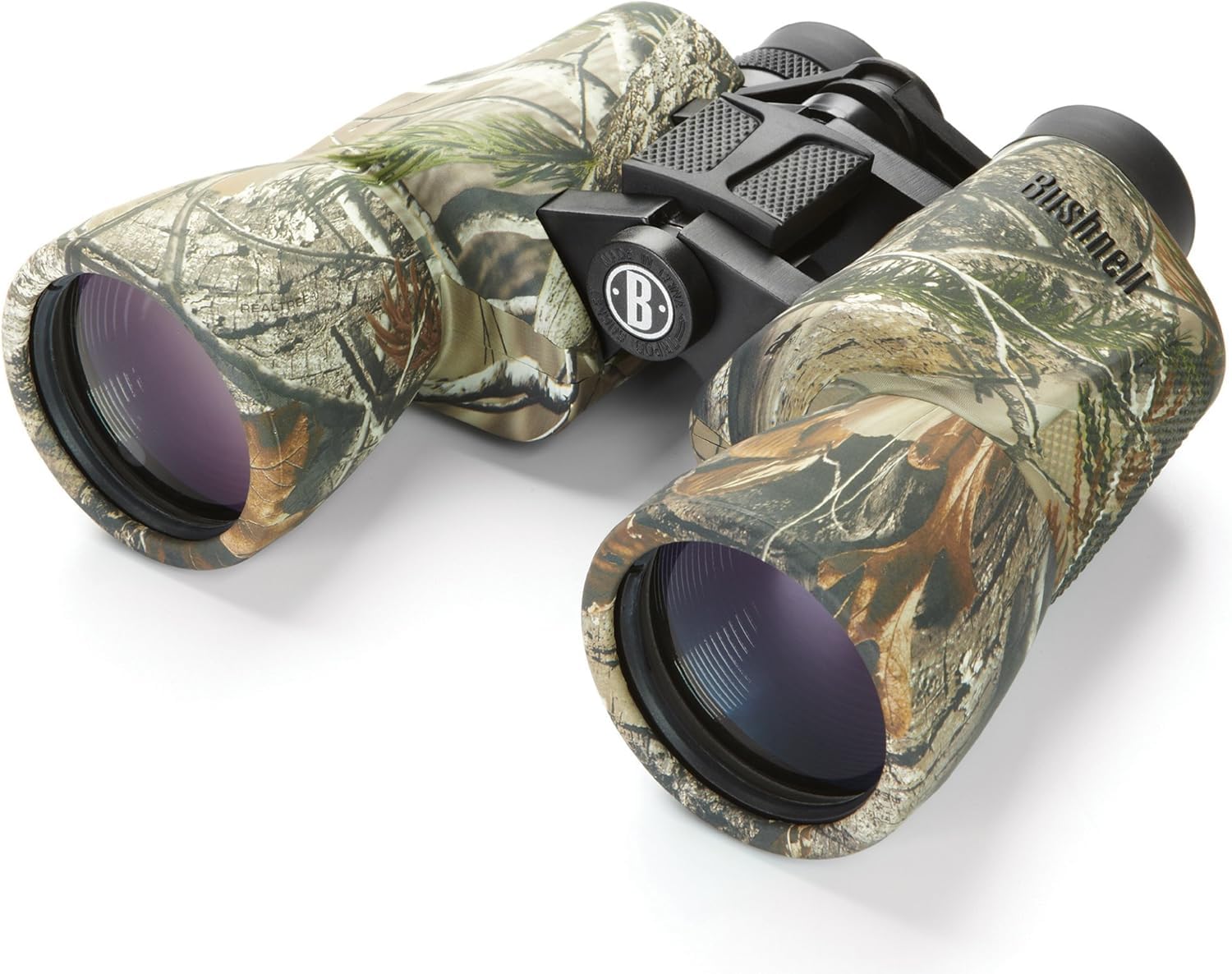
Nothing else here puts a 50mm objective in front of your eyes for the money, and for a lot of hunters that settles the argument. A 5mm exit pupil does more for a deer-shaped shadow at first light than any coating claim on a box, and the Realtree AP camo wrap means the tubes do not flash when you lift them in a bare field.
It is also the fastest binocular here to get onto an animal. Instafocus is exactly what the name suggests: no center wheel to hunt for, just a lever under your fingers that rocks the image in and out. With gloves on, mid-stalk, with the animal moving, that is quicker than any conventional focuser, and we ended up using it one-handed without thinking about it.
The housing is sealed and rubber armored, with a tripod socket and fold-down eyecups, so it shrugs off a truck box, a duck blind, and a wet morning without ceremony. Mud wipes straight off the rubber. The eyecups fold rather than twist, which is the older way of doing it, and they stay folded when you want them to.
Our read is that this is the binocular you buy twice — one for you and one for whoever comes along — and the one you never worry about scratching. If your season is a couple of weekends and your budget is real, it does the thing that matters: putting a legal animal in front of you when the light is going. If you are out forty days a year, the money is better spent higher up this list.
Pros
- 5mm exit pupil gathers light at dawn
- Instafocus gets on moving game fast
- Camo wrap and sealed, armored housing
Cons
- Short 10mm eye relief, awkward with glasses
- BK-7 prisms and multi-coating trail the rest
Buy the PowerView if the budget is tight and the season is short: a sealed, camo 10×50 with a 5mm exit pupil and the fastest focus here.
Best for Spare or Backup
Binoteck 10×42

Key Features
- Weight: 1.1 lb
- Eye relief: 10 millimeters
- Magnification: 10×42
- Water resistance: Water resistant
- Price: Budget
Set the Binoteck beside our top pick and the difference shows up at the edge of the field, where detail softens a little sooner than it does through the Diamondback. Set it beside most of what else is here and it holds its own: a 10×42 roof-prism body at 1.1 pounds, fully multi-coated lenses on BAK4 prisms, smooth focusing, and a diopter ring that adjusts for each eye without fuss.
This is the least expensive full-size 10×42 here that we were happy to carry all day, which makes it the natural second binocular — the pair that lives in the truck, rides in the boat bag, or goes to a kid on a first sit. It focuses down close, inside five yards, so it is useful for more than glassing a ridge, and the twist-up eyecups and center wheel are conventional enough that anyone can pick it up and use it.
Where it stops is weather. The shell is water resistant rather than sealed, so a week of sideways rain in the Cascades is not its assignment; a foggy morning, a snowy sit, and a wet walk back to the truck are. Keep it in the case between trips and it will last a good while.
Pros
- 1.1 pounds makes it an easy all-day carry
- Crisp center image for the money
- Focuses sharply inside five yards
Cons
- Short 10mm eye relief, tight with eyeglasses
We like the Binoteck as a knockaround 10×42: sharp enough for real hunting, light enough to carry daily, and cheap enough that a spare stops being a luxury.
Best for Truck and Boat
Tanaview 10×42
Key Features
- Weight: 14.2 oz
- Warranty: 1 year
- Eye relief: 14 millimeters
- Magnification: 10×42
- Price: Budget
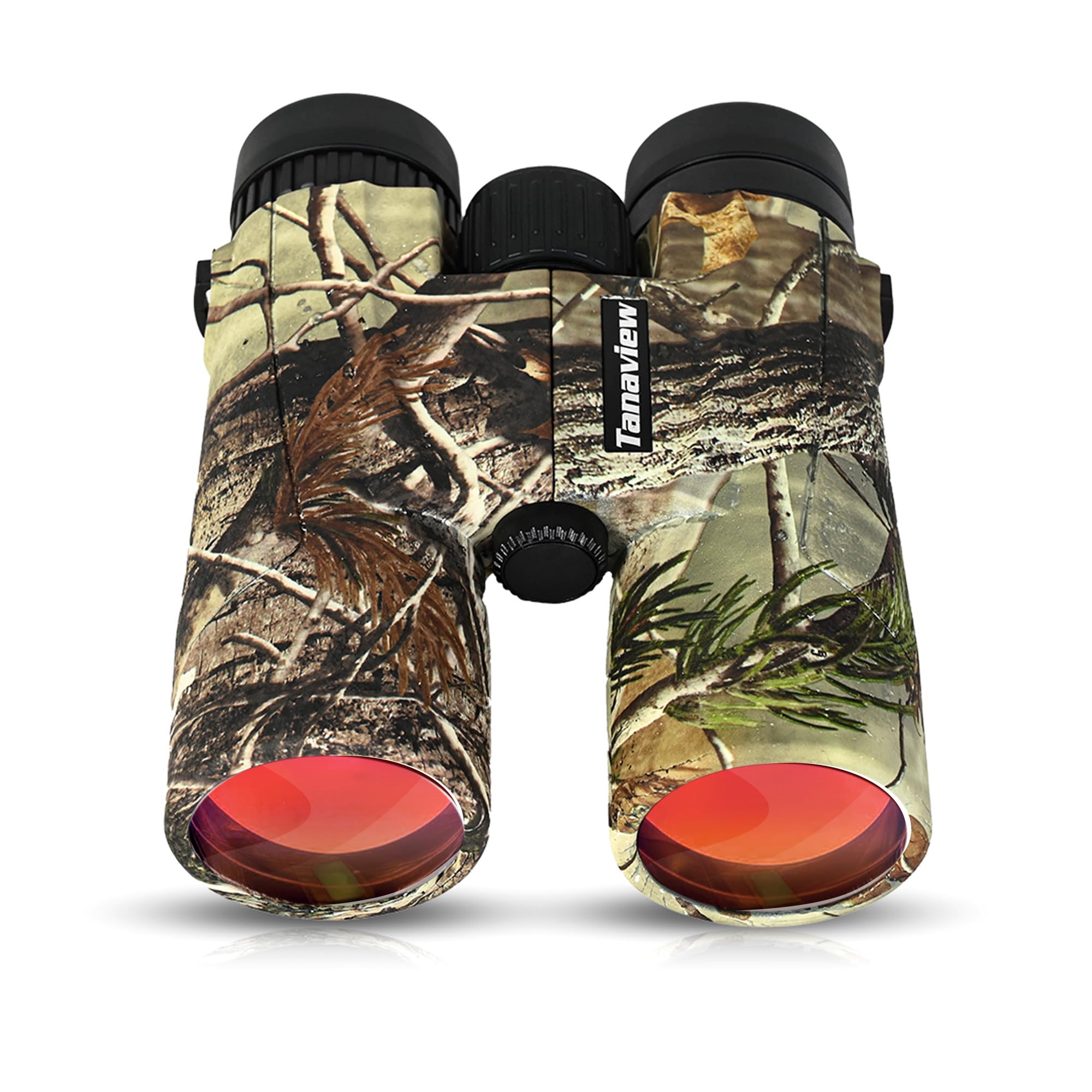
A camo 10×42 that weighs 14.24 ounces is a specific kind of useful. The Tanaview is the lightest full-size binocular here, and the maple-leaf camo wrap disappears against a jacket in a way black rubber tubes never do. It is the pair you grab when you were not planning to carry binoculars at all.
The rest is sensible rather than exciting: fully multi-coated lenses on BAK4 porro prisms, a 4.2mm exit pupil, 14mm of eye relief, a tripod socket, and a center focus with a diopter ring. The eyecups twist and hold, the focus is light enough for a thumb and firm enough not to drift, and the whole thing balances in one hand.
Our read is that this is the truck binocular — behind the seat, out in the boat, not babied — and at this weight it is also the one that comes along on days you would otherwise leave glass at home. The image is decent rather than exceptional, and the eyepieces reward a steady hold. It is a fair-weather companion that happens to be easy to keep around.
The shell is water resistant rather than sealed, so a wet week above treeline is not its assignment; a foggy morning, a snowy sit, and a splash getting in and out of a boat are. Treat it as the second pair and it does everything you ask.
Pros
- Lightest full-size binocular here at 14.24 ounces
- Camo finish that blends against a jacket
- Easy, light focus with a working diopter
Cons
- One-year warranty, the shortest in this group
We keep coming back to it as a truck-box spare: 14 ounces, camo, and easy to focus; the one-year warranty is the trade you make.
Best for Range and Scouting
YUANZIMOO 12×42

Key Features
- Exit pupil: 3.5 millimeters
- Field of view: 383 feet
- Magnification: 12×42
- Water resistance: Waterproof
- Price: Budget
This is a compact 12x built for the range bag, the truck, and the scouting walk rather than the last hour of a November sit, and we think that is the right way to read it. It is small, it folds down, it takes a phone, and it will show you what is on the far side of a field. It is not the binocular you buy for a once-a-year trophy tag.
The specification is respectable for the size: 12×42 with BAK4 prisms and fully multi-coated lenses, a 383-foot field of view, plus or minus five diopters of adjustment, a waterproof shell, and rhombic eyecups that fold to fit a pocket. The included phone adapter clamps most large phones, case and all, and it is genuinely good fun — clamp a phone on and you can grab a photo through the glass instead of dragging a spotting scope out.
Sharpness is where it varies. Center detail is fine at moderate range, the edges soften, and the focus needs working to keep something moving sharp. As a kid’s first binocular, a backup in the pack, or an inexpensive way to try 12x before committing, that is an acceptable trade.
Pros
- Folds small enough for a pack pocket
- Phone adapter included and works with most large phones
- Waterproof shell and wide diopter range
Cons
- 3.5mm exit pupil dims fast at dusk
- 12x is hard to hold steady offhand
Our take: a packable 12x for the range and the scouting walk, with a phone adapter as a genuine bonus — last light is somebody else’s job.
How We Tested Hunting Binoculars
We started with roughly 40 pairs from brands hunters actually carry, narrowed by magnification and objective-lens combinations (8×42, 10×42, 10×50), listed weight, eye relief, and price, and cut the field to 10. Testing ran for eight months, from late-summer scouting through spring turkey season. Most of it happened where these binoculars will actually live: on a ridge before sunrise, in a truck cab at noon, on a harness through a half mile of cattails, and around our necks on the walk back in the dark.
Clarity and image quality got the most scrutiny. We set a resolution chart and a white sign against dark timber at 100 yards and glassed both at first light and last, noting how many minutes past sunset each pair could still separate fine lines, whether the edges stayed sharp or smeared, and whether color fringing crept in along the sign’s border. We also watched for the flat, washed-out look that lesser coatings produce once the light drops.
To judge focus, we racked each binocular from 20 yards out to 400 and back, bare-handed and then in heavy winter gloves, counting how much wheel travel it took and whether the setting held after a mile of walking. Every pair went on a kitchen scale, then spent one full day on a harness and another in a pack so we could feel where the ounces actually hurt. For build quality, we dunked each one in a creek for 30 seconds, left it overnight in a cold truck, and brought it into a warm cab to watch for fogging; we also dropped them, some on purpose, onto a rubber truck-bed mat. Value settled itself at the end: whether the least expensive pair gave up anything a hunter would notice at first light.
How to Choose Hunting Binoculars
The binocular that wins a hunt is the one that is still bright, still sealed, and still on your chest at the end of a long day — everything else is a tiebreaker.
Start With Exit Pupil, Not Magnification
Divide the objective lens by the magnification and you get the exit pupil — the width of the light column reaching your eye. An 8×42 gives 5.25mm, a 10×42 gives 4.2mm, a 10×50 gives 5mm. Your pupil opens to roughly 5mm to 7mm in low light, so the larger numbers keep more usable light in the last twenty minutes of legal shooting time.
That is why we steer hunters who sit until dark toward an 8×42 or a 10×50, and hunters glassing open country in daylight toward a 10×42. A 12×42 sounds like more binocular and is actually dimmer and harder to hold steady. Pick the light you need first, then the power number that delivers it.
Coatings Are Where the Money Goes
Every air-to-glass surface costs light, and coatings buy it back. Multi-coated means some surfaces are treated; fully multi-coated means all of them, and that is the floor for a hunting binocular. Above that, prism coatings matter — dielectric and silver mirror coatings reflect over 99% of the light through the prism, while cheaper aluminum coatings lose some of it. ED glass is the other upgrade worth paying for, because it strips the purple fringe off a backlit ridgeline.
Given the choice, put money into coatings before another power of magnification. A well-coated 10×42 beats a cheap 12×50 every evening of the season.
Weight and How You Carry It
A pound sounds like nothing until it has hung off your neck for six hours. Our picks run from around a pound to 1.6 pounds, and the difference is obvious by mid-afternoon on a long walk in.
The fix is usually not lighter glass but a chest harness. It moves the load onto your shoulders, keeps the binocular out of the way when you crawl, and puts it in your hands in one motion. The Vortex picks here ship with a GlassPak harness; if your pick does not include one, budget for it — it changes a binocular you leave in the truck into one you carry.
Sealing, Cold, and Fogging
Waterproof and water resistant are not the same promise. A sealed, purged binocular — nitrogen or argon, with O-ring seals — keeps moisture out and, just as importantly, keeps the inside dry when the temperature swings. The classic failure is a cold binocular carried into a warm truck cab: an unpurged one fogs inside the barrel and stays that way until it dries, which may be days.
If your season runs into rain, snow, or a boat, buy sealed. If it is a fair-weather backup that lives behind the seat, water resistant will do the job.
Eye Relief, Gloves, and the Warranty
Eye relief is how far your eye can sit behind the eyepiece and still see the whole field. Under about 15mm, eyeglass wearers lose the edges; 17mm gives you room to spare. Twist-down eyecups and a chunky center wheel are what let you focus with gloves on, and a diopter ring with enough friction to hold its setting means you adjust it once and forget it.
Then read the warranty, because it is part of what you are buying. Vortex covers its binoculars unconditionally for life, Athlon’s lifetime coverage transfers with the glass, and several budget models give you a single year. On a tool that rides on your chest through brush and rock, that coverage is worth real money.
Frequently Asked Questions
How do I set binoculars up so both eyes see one image?
Set the spacing first: squeeze or spread the barrels until you see a single circle with no black crescent. Then cover the right objective, focus the center wheel on something far away with your left eye, uncover the right and cover the left, and turn the diopter ring on the right eyepiece until that side is sharp too.
From then on the center wheel handles everything at any distance, and you only touch the diopter again if someone else uses the binocular.
Do these binoculars tell you the range, or do I need a rangefinder too?
They do not. Every pick here is pure optical glass — no laser, no ranging reticle — so distance stays your job. For rifle hunting where an exact yardage changes your hold, carry a separate rangefinder or step up to a laser rangefinding binocular.
Use these to find and judge the animal, then range it before you settle in behind the rifle.
What is the right way to clean the lenses in the field?
Get the grit off before anything touches the glass: brush or blow first, because wiping dust around is how coatings get scratched. Then breathe on the lens and use a clean microfiber cloth in circles from the center out.
Keep the rainguard on between glassing sessions and skip the shirttail and the spit. A scratched coating is permanent and shows up as flare exactly when the light gets low.
Final Verdict
For most hunters we recommend the Vortex Diamondback HD 10×42. It is bright enough to keep working after sunset, light enough to forget on a harness, sealed against the weather, and backed by a warranty that will outlast the truck you keep it in.
If your sits run to the last minute of legal light and you want the widest view in this group, the Athlon Midas 8×42 is the better glass and worth the extra weight. And if this is your first serious pair, the Triumph gives you real sealing and the same lifetime coverage for less money.