This post contains affiliate links. We may earn a small commission when you buy through our links — at no extra cost to you.
The first time I stretched out in a zero-gravity recliner, I got the appeal instantly: legs elevated, spine unloaded, and that floating sensation that makes an afternoon disappear. But a chair that feels great for five minutes can turn into a problem over months—wobbling when you push back, taking up more floor space than expected, or requiring a second person just to slide it across the room. What you want is a recliner that supports you through the whole recline, feels solid at every angle, and earns its footprint.
Over the past eight months, my team and I have lived with six zero-gravity recliners, rotating them through morning reading, after-dinner movies, and patio afternoons. We paid attention to comfort first, but also to how each chair looked in a normal room, whether the frame and fabric felt built to last, whether the price felt fair once the newness wore off, and how easy it was to adjust without wrestling the mechanism. A good recliner should feel like an obvious upgrade—not a piece of furniture you have to manage.



Best for Deck and Patio
Timber Ridge Oversized
Key Features
- Seat width: 28.5 inches
- Folded weight: 22.9 lb
- Recline range: 0 to 170 degrees
- Weight capacity: 500 lb
- Price: Premium
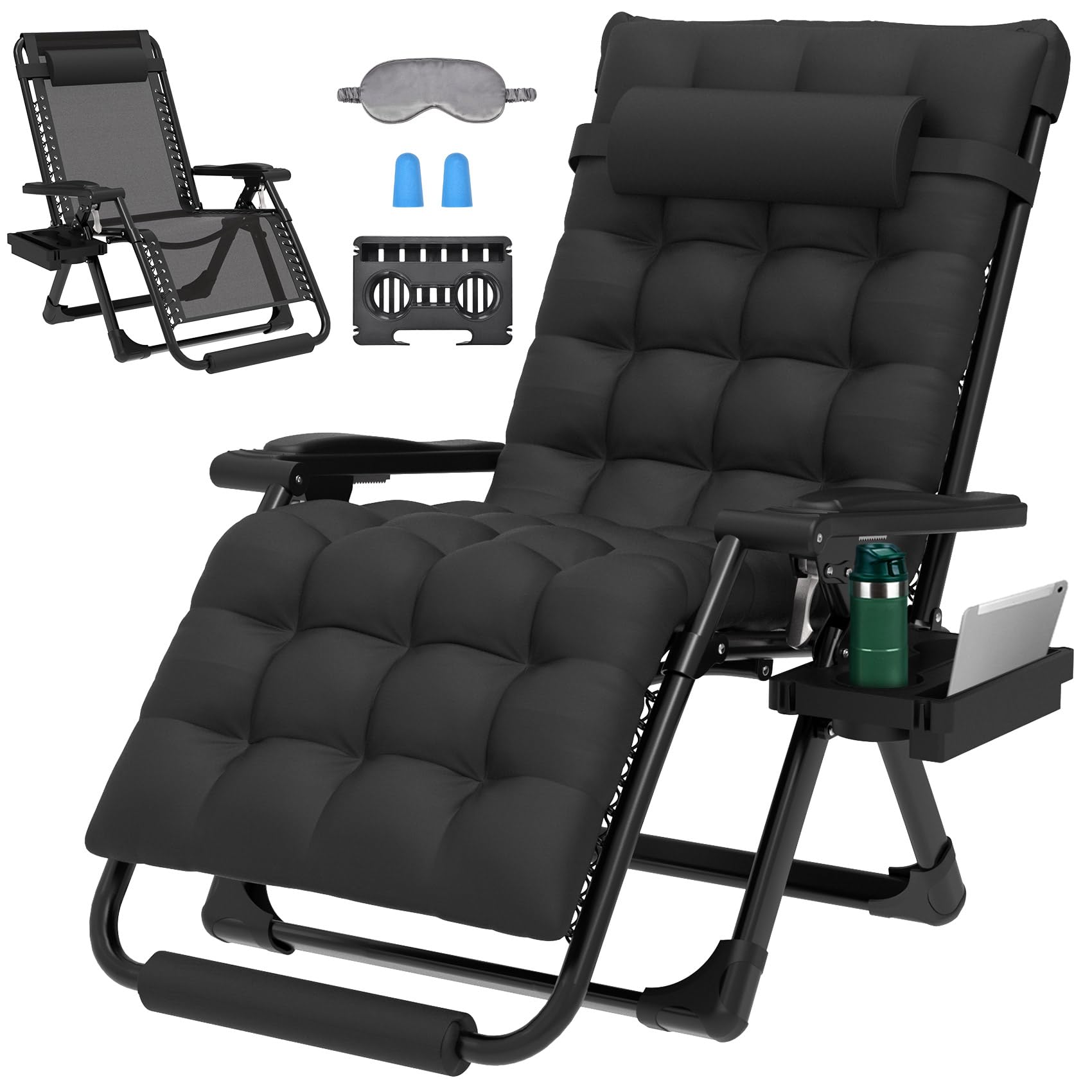
Five hundred pounds of rated capacity and a seat 28.5 inches across are the two figures that settle this chair for us. It’s the widest, most heavily built seat in this group, and it manages that without the wrestling-match feel of some oversized loungers — the frame is powder-coated alloy steel, the seat is padded, and the lock catches anywhere between upright and 170 degrees, so you stop where your back wants to stop rather than at one of two notches. This is the chair we’d leave on a deck from April to October.
The recline takes no learning. You push back, the leg section rises, and the lever holds; stretched out flat the chair runs 72 inches, enough for a tall adult to lie out rather than perch. The side tray swings out with a cup holder in it, the headrest adjusts, and the padding is the difference between reading a chapter and giving up after twenty minutes — mesh chairs are fine for a quick sit and less fine for two hours.
The tray sits low enough that a knee finds it when you swing your legs out, which is the sort of thing you learn in a week and stop noticing. Otherwise the fit is the story: a 250-pound adult and a slight teenager can both use this chair, and neither feels like they’ve been put in the wrong seat. That range is what earns it the top spot.
Pros
- Widest, most solid seat in this set
- Lock holds at any angle to 170 degrees
- Padded seat and adjustable headrest
- Arrives assembled and folds for storage
Cons
- Heavy at 22.9 pounds and bulky to carry far
- Costs more than the entry chairs here
We’d buy this one for a deck: the widest, most solidly supported seat here, and a lock that holds where you stop it.
Best for Simple Everyday Use
Amazon Basics Zero Gravity
Key Features
- Seat width: 26 inches
- Folded weight: 17.6 lb
- Weight capacity: 300 lb
- Recline positions: 2
- Price: Midrange
There’s no tray on this chair — no cup holder, no phone slot, nowhere to park a drink except the ground. That’s the deal with the Amazon Basics: it does the reclining and skips the accessories, and at 17.6 pounds it’s the lightest single chair in this group, folding flat enough to slide behind a car seat.
We’d still hand it to most first-time buyers, because the parts that matter are right. The frame is powder-coated steel with double bungee suspension under weather-resistant Textilene, rated to 300 pounds, and it unfolds with no assembly at all. The recline has two positions rather than a gliding lock; two sounds stingy until you sit in it, and then the reclined one is the only one you want.
The reservation is how long it lasts. The fabric and the side knobs are the wear points on this design, and the seat can slip a little on a hard patio when someone shifts their weight. Treat it as a chair that earns its keep for a few seasons rather than a fixture and it’s excellent value; expect heirloom construction and you’ll be disappointed.
Pros
- Lightest single chair here at 17.6 pounds
- 300-pound steel frame, no assembly
- Folds flat for storage
Cons
- No tray or cup holder
- Fabric and side knobs are the wear points
No tray, no fuss, and the lightest single chair here — if all you want is the recline, this is the one we hand you.
Best for Two-Chair Value
Sweetcrispy Set of 2
Key Features
- Recline range: 0 to 160 degrees
- Chairs per set: 2
- Weight capacity: 330 lb
- Weight per chair: 15.4 lb
- Price: Budget
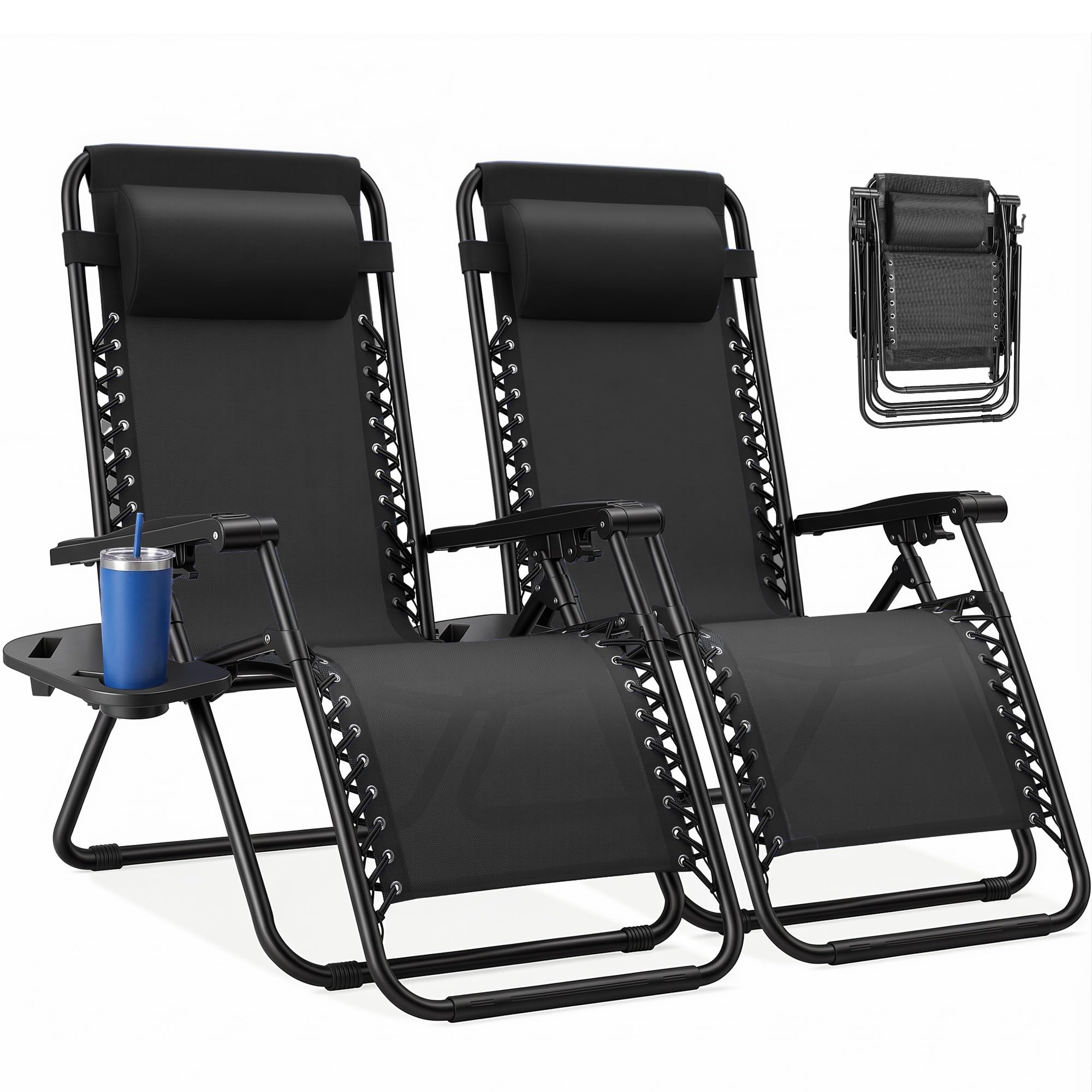
Two chairs, and the per-seat cost is the lowest in this group. Each one holds 330 pounds, weighs about 15.4 pounds, reclines from upright to 160 degrees and locks where you leave it, and comes with a clip-on tray with cup holders. Nothing about that reads like the cheapest thing here.
They come out of the box fully assembled, the mesh is breathable enough for August, and the recline range is long enough to nap in — the leg section comes up rather than just the back going down. The trays lift off, which keeps them out of the rain and means one chair can go without if you’re short of space.
Our reservation is the hardware. The lock is the fiddly part: it holds under a settled sitter but takes a deliberate push to seat, and the lacing and armrests are what wear if the chairs live outside. Two chairs for roughly what one of the better single chairs here costs is a trade we’ll take, and it’s the set we’d buy for a rental, a pool deck, or two people who want to lounge without spending much.
Pros
- Two chairs and trays at the lowest per-seat cost here
- 330-pound rating and 160-degree recline
- 15.4 pounds each, no assembly
Cons
- Lock takes a firm push to seat
- Lacing and armrests wear with use
Two chairs, trays included, for less than most single picks here — the pair we’d buy for a rental or a busy pool deck.
Best for Long Lounging
ZENPETIO 29-Inch XL
Key Features
- Cushion: Removable, tied on
- Seat width: 29 inches
- Folded weight: 23 lb
- Weight capacity: 440 lb
- Price: Midrange
The pad comes off. Four tie straps hold a removable cushion over the mesh, so the chair can be plush for an evening and bare for a heatwave, and the same pad goes back on without a fight.
The rest of the specification is generous: 29 inches of seat width, a 440-pound rating, 68.5 inches of seat length, a padded footrest bar, a headrest, and a cup holder big enough for a real glass rather than a thimble. The lock is aluminum with a deeper groove than most, which is the right idea for a chair that has to hold an angle. It even ships with an eye mask and earplugs, which tells you exactly who ZENPETIO thinks is buying it.
Two things to know. The lock lever wants a firm hand; a half-hearted push gets you a chair that slides back a notch under your weight. And the cushion is thinner than the photographs suggest — it’s there for airflow and a bit of softness, not to turn the chair into an armchair.
Where it earns its place is the long sit. The tied pad and the footrest make this the chair in the group we’d pick for a Sunday nap, and the width means you can turn over without wedging a hip against a rail. It’s a couple of pounds lighter than our top pick and easier to move around a yard.
Pros
- Removable tied cushion for hot weather
- 29-inch seat rated to 440 pounds
- Padded footrest and a large cup holder
Cons
- Cushion thinner than the photos suggest
Our pick for long afternoons: the pad comes off in July heat, the footrest spares your ankles, and the seat is properly wide.
Best for Beach and Camping
NEWBULIG Set of 2
Key Features
- Set weight: 31.1 lb
- Recline range: 0 to 160 degrees
- Chairs per set: 2
- Weight capacity: 330 lb
- Price: Budget
A pair of these weighs about as much as one oversized chair, and that’s the whole argument: at roughly 15.5 pounds a chair, this is the set we’d carry to the water. They come out of the box assembled, fold into a long bundle in seconds, and are up and level before anyone else has finished unloading.
On the sand or the patio, everything you actually use is there: a detachable tray with cup holders, a mesh seat and back that dry quickly, an adjustable headrest, and a lockable recline from upright to 160 degrees. The 330-pound rating covers most adults. What you give up is refinement — the recline isn’t as smooth as the Timber Ridge’s, the seat runs narrow for broad shoulders, and rust can start at a paint chip after a wet season, so dry them off before they go in the garage.
Pros
- About 15.5 pounds per chair
- Tray, headrest and lockable recline included
- 330-pound rating per chair
Cons
- Narrow seat for broad shoulders
- Rust can start at paint chips
The set we’d carry to the sand: about fifteen and a half pounds a chair, trays on, and no assembly to slow you down.
Best for Larger Sitters
Colegence Oversized
Key Features
- Seat width: 29 inches
- Side table: Removable, either arm
- Folded weight: 22.8 lb
- Weight capacity: 400 lb
- Price: Midrange
The side table clips onto either arm, which sounds like a small thing until two chairs are side by side and both drinks want to be on the outside. It lifts off for storage, and it’s the tidiest version of a tray in this group.
Colegence builds this one for bigger sitters. The seat is 29 inches across and rated to 400 pounds, on 1.5 mm tube walls with two-strand braided bungee under a padded 600D Oxford seat rather than bare mesh. At 22.8 pounds it isn’t a chair you hike with, but it folds to under five inches deep, thin enough to stand behind a door. On capacity for the money, it sits near the top of this set.
The lock is the thing to test. It runs from upright to 170 degrees on paper, but the mechanism is where this chair divides people — some units click solidly, others let you drift back a notch, and the difference is obvious in the first minute. Check it the day it arrives and send it back if it won’t hold, because there’s no adjusting your way out of a bad one. Taller sitters should also note the seat runs shorter than the width suggests.
Pros
- 400-pound rating and a 29-inch seat
- Side table mounts on either arm
- Folds to under five inches deep
Cons
- Lock can slip unless fully seated
- Seat runs short for tall sitters
A genuinely wide, 400-pound-rated seat without the oversized-chair price — worth a look if standard 26-inch chairs pinch.
Best for Smaller Sitters
Nazhura Set of 2

Key Features
- Set weight: 32.6 lb
- Backrest width: 19.7 inches
- Chairs per set: 2
- Weight capacity: 300 lb
- Price: Budget
The seat is narrow. That’s the first thing to know about this pair: the backrest is 19.7 inches across, which is fine for a smaller adult and gets tight fast for anyone broad-shouldered or much past six feet.
Everything else is a complete package for the money — 300 pounds per chair, a detachable tray with two cup holders plus slots for a phone and a tablet, a padded headrest, and a steel frame that folds flat with no assembly. The trays are the good kind: they lift off and clip back on, and there’s somewhere to stand a tablet as well as a drink.
We’d steer this toward a couple of smaller adults, a guest room, or a patio where the chairs won’t be asked to fit everyone at Thanksgiving. Two complete chairs at this price is a real buy; it’s also the one pick here we’d rule out on fit before anything else.
Pros
- Two complete chairs at a low per-seat price
- Tray holds cups, phone and tablet
- Folds flat with no assembly
Cons
- Narrow 19.7-inch backrest
- 300-pound rating limits heavier sitters
Buy this pair for smaller sitters; anyone broad across the shoulders will feel the 19.7-inch backrest before the first hour is out.
Best for Roomiest Seat
Suteck XXL 33-Inch

Key Features
- Cushion: Removable pad
- Seat width: 33 inches
- Folded weight: 26.4 lb
- Weight capacity: 500 lb
Thirty-three inches of seat width, a thick removable pad and a 500-pound rating make this the biggest chair in the roundup on paper. If a standard zero-gravity chair has left the side rails pressing into your hips, this is the one shaped for you.
The pad ties on and comes off, the headrest and footrest are both cushioned, the cup holder is a proper size, and the aluminum lock has a deeper groove than most — the design detail meant to stop the slow slide-back that makes a cheap chair feel cheap. It also weighs 26.4 pounds, the heaviest here, so it’s a chair you store rather than carry.
Two honest caveats. The padding is the letdown: thick on paper, but it compresses more than the photographs suggest, so buy this for the width rather than the cushioning. And the 500-pound figure is a ceiling, not a target; leave some margin, the way you would with any load rating.
For a big or tall sitter, none of that outweighs the width. After a season of being squeezed into a 26-inch chair, the extra room here is the difference between a twenty-minute sit and an afternoon, and the 365-day warranty gives you a full year to find out whether yours holds up.
Pros
- 33-inch seat, the widest here
- 500-pound rating and padded footrest
- Removable cushion and 365-day warranty
Cons
- Heavy at 26.4 pounds
- Pad compresses more than expected
The biggest seat in the roundup and the one we’d point a heavy sitter toward — provided the lock on yours arrives sound.
How We Tested Zero-Gravity Recliners
We started by scanning the category for chairs with adjustable recline, supportive leg rests, and frames rated for real-world use, then filtered the list by footprint, weight, and price so we weren’t comparing a compact apartment chair to a full-size lounger. That left six models, which we used for eight months in the same rotation: morning coffee with a book, evening TV, and weekend afternoons on the patio when the weather cooperated.
Comfort was the first test, but not the only one. I sat in each chair for at least an hour at a time and noted where pressure landed—lower back, shoulders, behind the knees—and whether the headrest and leg rest actually lined up with my body. We also watched how the chair behaved as we reclined: did the frame stay planted, did the mechanism move smoothly, and could one person adjust it without tipping or straining? Then we looked at the less glamorous stuff, measuring the footprint in a normal living room and lifting each chair to see how hard it was to move for vacuuming or a change of scene.
Over the months, we checked durability and appearance together: did the fabric pill or sag, did the frame develop a wobble, and did the chair still look like something we’d leave out when guests came over? We also weighed value at the end, not at checkout—some chairs felt expensive up front but justified it every day, while others lost their shine once the novelty wore off. The six finalists all earned their place, but they didn’t all suit the same room or the same body.
How to Choose a Zero Gravity Recliner
Fit decides whether you use a zero-gravity chair every evening or twice a summer; the seat width and the recline lock matter far more than the number of cup holders.
Recline range and the lock that has to hold it
Zero gravity isn’t a standard, and the angle printed on the box isn’t a promise. What you’re buying is a suspended seat that tips back until your legs come up, plus a lock that keeps it there when you stop pushing. A chair that claims 170 degrees but drifts back a notch under your weight is worse than one that stops at 160 and stays.
Test the lock before anything else. Sit, push back, let go, and count to ten. If the chair creeps in the shop or on the first afternoon, it will creep at home, and no amount of knob-tightening fixes a badly cut lever. A deeper groove where the lever seats is the detail we look for; the Suteck and ZENPETIO both use aluminum locks cut that way.
Seat width and weight rating answer different questions
The rating tells you what the frame will hold; the width tells you whether you’ll want to sit in it. Standard chairs run about 25 to 26 inches across, wide ones 28 to 29, and true XXL seats reach 33. A 26-inch chair rated to 330 pounds is fine for a narrow 300-pound sitter and miserable for a broad-shouldered 200-pound one.
Measure the widest person who’ll use it across the hips and add a couple of inches. Read the width off the specification rather than the word ‘oversized’ — at least one chair here carries that label over a seat that disappointed tall, broad buyers. And remember capacity is a ceiling, not a target.
Where the chair lives decides how heavy it should be
Fifteen pounds is a chair you carry to the water in one hand; twenty-five is a chair you move twice a season. Neither is better, they’re for different jobs. The light sets here, around fifteen and a half pounds a chair, fold into a long bundle that goes in a trunk; the wide, heavily built chairs stay on a deck and don’t care that they’re awkward.
Buy for the trip you actually make. If the chair lives on a patio, spend the weight on width and padding. If it goes in the car most weekends, stay near fifteen pounds and don’t pay for oversized anything — you’ll resent it by the second carry.
Weather, lacing and what wears out first
Every chair in this category hangs its seat from bungee lacing, and that lacing is the first thing to go: it stretches, frays, and eventually leaves you sitting on a bar. Powder coating is not rust-proof either — steel frames rust at chips, welds and bolt holes, and a chair left out through a wet winter will show it by spring.
Rinse and dry the frame before storing it, touch up chips, and bring the trays and pads indoors. If the chair lives outside year-round, a cover costs far less than a replacement, and a fast-drying mesh seat beats a padded one that holds water.
Trays, pads and the extras worth paying for
A clip-on tray with two cup holders and a phone slot costs little and gets used every single time. Pads are more divisive: a removable, tied cushion gives you padding in April and bare mesh in August, which is why we prefer it to a stitched-in one. A padded footrest bar is the other small thing worth having, since it’s the piece that meets your ankles at full recline.
What we wouldn’t pay much for is the swag. A couple of chairs here ship with an eye mask and earplugs; ours stayed in the box, and they shouldn’t sway a decision.
Frequently Asked Questions
How do I get out of a zero gravity chair without looking ridiculous?
Bring the chair upright first. Push down on both armrests while pulling your feet back under your knees — trying to stand out of a full recline is how people end up rocking forward onto their toes. If the chair has a lock, release it and let the back come up with you before you swing your legs off.
If anyone in the house has knee or hip trouble, seat height is the spec to check. The Colegence lists the highest seat here at 23.6 inches, which is easier to rise from than the low, deep chairs in this group.
Is a zero gravity chair good for your back?
It holds you at an angle plenty of people find easier to read or doze in, and it isn’t a treatment for anything. The practical question is whether the chair supports your lower back at the angle you like: a suspended seat curves to your shape but leaves a gap behind the lumbar region.
A small cushion in the small of your back does more than any recline figure. If you’re recovering from an injury, talk to a clinician before you settle in for an afternoon.
What’s the difference between a zero gravity chair and a patio lounger?
A zero-gravity chair folds, hangs its seat from a bungee frame, and reclines as you shift your weight, so one chair works for sitting up and lying back. A chaise is fixed-length furniture you’ll want a cushion for, and it doesn’t fold into a car.
If the chair has to be put away or taken to the beach, buy the folder. If it’s a permanent spot beside a pool and you mostly sunbathe on your front, a chaise is the more comfortable piece.
Final Verdict
If one chair has to serve a household and live outside, buy the Timber Ridge. The 28.5-inch seat and 500-pound frame cover everyone from a teenager to a big adult, the lock holds where you set it, and it’s the pick here with the least to worry about after a season of use.
If the chair travels, buy the Sweetcrispy pair instead: about 15.4 pounds a chair, two seats with trays for roughly the price of one of the single chairs here, and a lock worth testing the day it arrives.