This post contains affiliate links. We may earn a small commission when you buy through our links — at no extra cost to you.
A two-burner camp stove earns its keep when breakfast for four is happening at once: bacon on one side, coffee and eggs on the other. The trouble is that plenty look capable on a shelf and then wobble on uneven ground, lose their flame in a breeze, or turn into a pain to carry and clean. I want a small packed footprint and sensible weight, but I also want a low setting that can hold a simmer without scorching the pan.
That balance is what my team chased while cooking on a dozen two-burner stoves over seven months, from damp campsite breakfasts to backyard burgers and tailgates. We watched heat output and boil times, checked how stable the grates felt under a full pot, and noted whether the handles and latches made hauling each stove easy or annoying. Durability lived in the hinges and burner controls; value lived in the stoves that did the basics without extra fuss. The picks below are the ones I’d happily unload from the car at the end of a long day.




Best for Car Camping
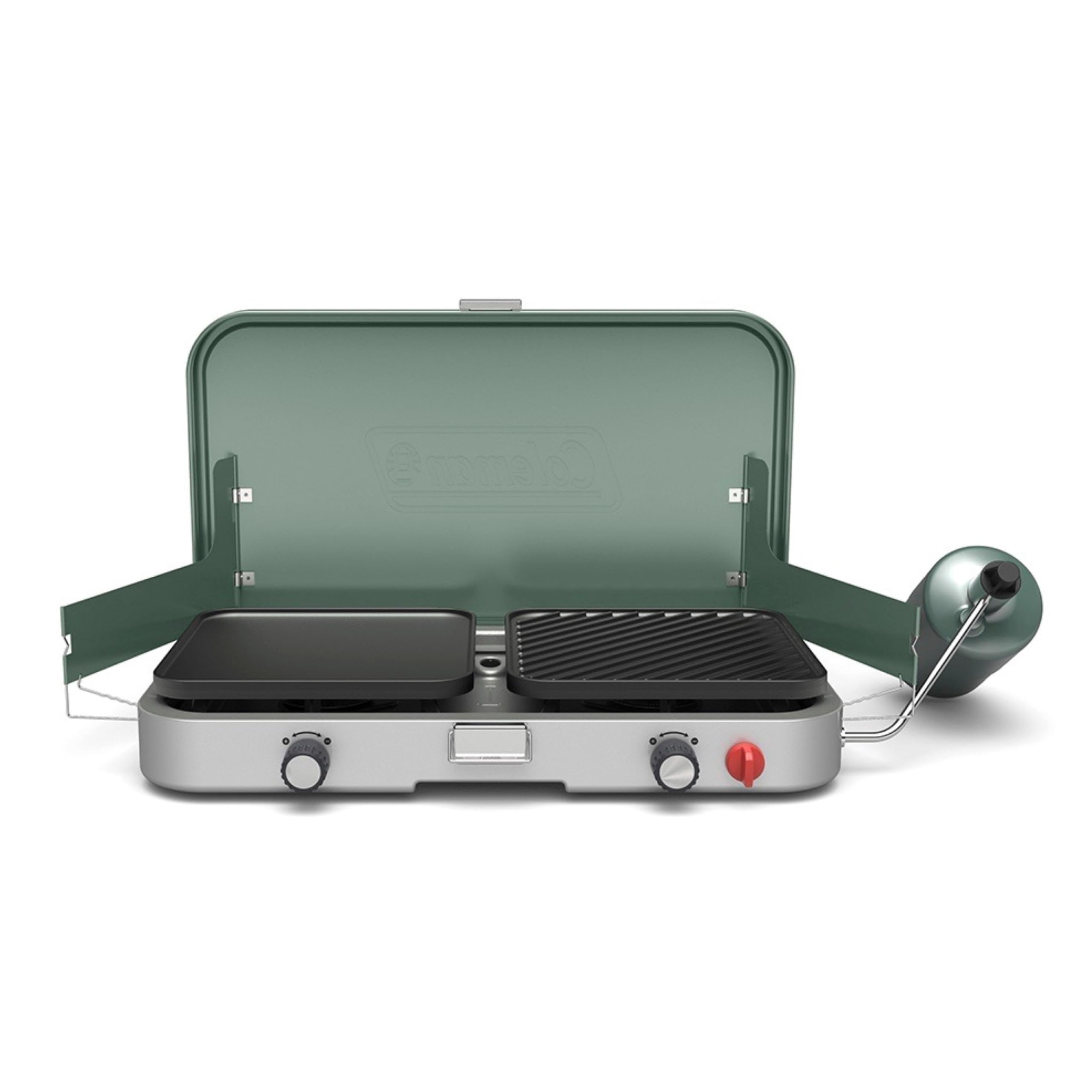
Coleman Triton 2-Burner
Key Features
- Burners: Two, independently adjustable
- Warranty: 3-year limited
- Wind guards: Two
- Total output: 22,000 BTU
- Price: Midrange
A two-burner stove proves itself on the second morning, when the fire has lost its charm and four people want coffee at once. The Triton is the one we keep coming back to: it opens like a suitcase, both burners adjust independently, and the 22,000 BTU it puts out across the pair is enough for a kettle and a skillet side by side. Nothing about setting it up takes thought, which is the highest compliment a camp stove can get.
Two hinged wind guards fold up along the sides, and on a breezy morning they’re the difference between a steady blue ring and a flame that keeps ducking. We also like that the chrome-plated grate lifts out in one piece, so bacon fat and burnt-on egg go straight into the dishpan instead of down into the body of the stove. The lid latches firmly enough to carry it by the handle with a fuel bottle rattling beside it in the trunk.
The compromise is cooking area. Two 12-inch pans crowd each other on the grate and a wide griddle overhangs the edges, so this is a stove for normal pots rather than a full breakfast line. Check the lid and the grate when the box arrives, since that’s where shipping damage shows up, and the three-year limited warranty covers you if it does.
Pros
- Fine simmer control from two adjustable knobs
- Two hinged wind guards keep the flame steady
- Removable chrome grate cleans up fast
- Three-year limited warranty
Cons
- Two 12-inch pans crowd each other
- Lid and grate are the arrival-damage points
We recommend the Triton to nearly every car camper who asks: real simmer control, two wind guards, and a suitcase shape that packs flat.
Best for Group Cooking
Camp Chef Explorer 2-Burner
Key Features
- Burners: Two 30,000 BTU cast aluminum
- Cooking area: 448 sq in
- Total output: 60,000 BTU
- Accessory fit: Camp Chef 14-inch system
- Price: Premium
Four hundred and forty-eight square inches of cooking area is the figure that separates the Explorer from every folding stove here. Two 30,000 BTU cast-aluminum burners sit far enough apart that a 12-inch skillet and a stockpot share the surface without touching, a three-sided windscreen wraps the whole thing, and the steel legs detach so it lies flat in the back of a truck.
This is a basecamp stove rather than a picnic one, and that’s the role we’ve been happiest using it in — a long weekend where cooking is the main event rather than a chore between hikes. At 29 inches tall it puts the burners near counter height, so you stand upright to stir instead of crouching over folding legs. The 14-inch accessory system is the other thing you’re paying for: Camp Chef’s griddles and pans drop into the same frame.
The cost is space. It wants level ground and a real chunk of the vehicle, and nobody carries it any distance from the tailgate. Wide-open burners can also run yellow and soot the bottom of a pot; ease them back to a blue flame and the pots stay clean. If your trips are two people and a kettle, the Triton does that job with a fraction of the footprint.
Pros
- 448 square inches of cooking area
- Two 30,000 BTU cast-aluminum burners
- Three-sided windscreen and detachable legs
- Takes Camp Chef’s 14-inch accessories
Cons
- Needs level ground and serious cargo space
- Wide-open burners can soot pot bottoms
When we cook for a crowd, this is the stove we set up: 448 square inches and 60,000 BTU that no folding stove here matches.
Best for Griddle Breakfasts
Coleman Cascade 3-in-1
Key Features
- Ignition: Rotary, matchless
- Folded size: 22"L x 13"W x 3.7"H
- Total output: 24,000 BTU
- Included surfaces: Cast-iron grill and griddle
- Price: Premium
The Cascade arrives with a cast-iron grill plate, a cast-iron griddle, and a nylon case for the pair, all of which drop into the same two-burner frame. That’s the pitch: one 24,000 BTU stove that can do burgers, pancakes, and a pot of pasta on the same afternoon without a second piece of gear in the truck.
The griddle is what sold us. Bacon and pancakes on a flat cast-iron surface is a different breakfast from anything that comes out of a saucepan, and rotary ignition means you’re not hunting for a lighter with wet hands. Folded, it’s 22 by 13 by 3.7 inches with a recessed carry handle, and the regulator has its own storage slot so the hose isn’t loose in the box.
At the top of this group’s price range it’s a considered buy rather than an obvious one, and we think it justifies the money only if the flat-top cooking is the reason you’re shopping. Two things to know: the griddle’s rough cast surface takes real scrubbing, and the igniter is the part that gives trouble first — light it once at home before you pack it.
Pros
- Cast-iron grill and griddle both included
- Rotary ignition, no matches needed
- Accessory case keeps the plates tidy
- Folds to 22 by 13 by 3.7 inches
Cons
- Rough cast griddle takes real scrubbing
- Igniter is the first part to give trouble
If camp breakfast means a griddle full of pancakes, this is the stove we point you to; for plain pot cooking, the Triton does it for far less money.
Best for Tight Packing
Cofiyard 2-Burner
Key Features
- Included: Regulator and carry bag
- Folded size: 9.5"L x 9"W x 4.6"H
- Pan capacity: Two 10-inch pans
- Total output: 17,000 BTU
- Price: Budget
Folded, the Cofiyard measures 9.5 by 9 by 4.6 inches and about four pounds, small enough that we stopped noticing it in the trunk on a week-long trip. The hexagonal fold is genuinely neat to open and close. It still takes two 10-inch pans, one per burner, which is the trick that makes it worth carrying at all: most stoves this packable give you one usable burner and a suggestion of a second.
Total output is 17,000 BTU, and that’s the trade. A big pot of water takes its time, and heat sits toward the middle of each pan, so a wide skillet browns in a ring rather than edge to edge. Built-in igniters on both burners save you hunting for matches in the dark, and the regulator and carry bag come in the box — pack it, open it, light it, and there’s nothing else to remember.
Pros
- Folds to 9.5 by 9 by 4.6 inches
- Fits two 10-inch pans at once
- Igniters built into both burners
- Regulator and carry bag included
Cons
- 17,000 BTU total limits big-pot cooking
- Paint near the burners can scorch
For a small car, a kayak hatch, or a two-person camp, this is the two-burner we pack when space is the constraint.
Best for Canning and Frying
ROVSUN 2-Burner
Key Features
- Burners: Two 75,000 BTU burners
- Regulator: CSA-listed, adjustable
- Total output: 150,000 BTU
- Assembled size: 30.7"L x 15.7"W x 29.7"H
- Price: Midrange
A 150,000 BTU stand burner isn’t a campsite stove, and ROVSUN doesn’t pretend otherwise. Two 75,000 BTU cast-iron burners sit on a 30-inch frame that stands at hip height once the legs are bolted on, built for the jobs you don’t want in the kitchen — a canner running all afternoon, a turkey fryer in the driveway, a pot of chili for a party.
Where it earns its place here is raw output: nothing else in this group comes close, and the CSA-listed adjustable regulator gives you a wider range than a fixed high-pressure hose. We also appreciated that the legs come off in minutes without tools, which is what turns it from a permanent fixture into something that rides in the trailer to a tailgate.
Control at the bottom end is coarse. The valves go from a whisper to a roar with very little in between, so simmering a sauce on this stove is an exercise in hovering. The knobs are also the part that suffers under a big canner, where heat radiates back down onto them. Both are fine for the batch cooking it’s built for, and neither is fine if you want one stove to do everything.
Pros
- 150,000 BTU across two cast-iron burners
- CSA-listed adjustable regulator
- Legs come off in minutes without tools
- Hip-height frame for big pots
Cons
- Coarse low-end control makes simmering hard
- Knobs suffer under a big pot’s heat
If you’re canning, frying, or boiling for a crowd, this is the cheapest route to this much heat on the list.
Best for Budget Camping
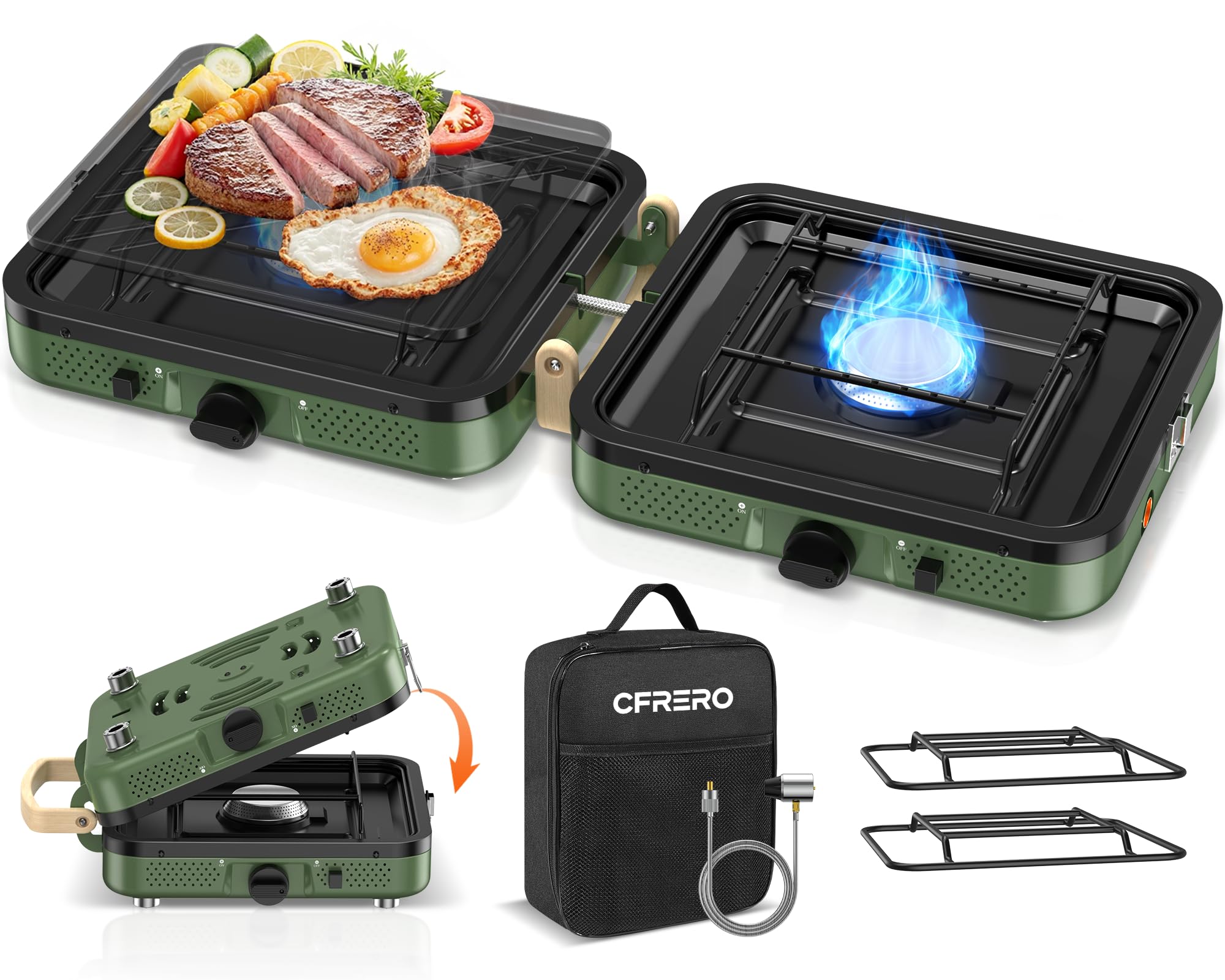
CFRERO 2-Burner
Key Features
- Included: Hose, carry bag
- Folded size: 21"L x 9"W x 3.5"H
- Pan capacity: Two 10-inch pans
- Total output: 16,000 BTU
- Price: Budget
Sixteen thousand BTU, a folded footprint of 21 by 9 by 3.5 inches, and a 5.7-pound body: the CFRERO is the least expensive way into a genuinely usable two-burner folding stove, and it doesn’t strip out the basics to get there. Piezo ignition on both burners, a hose in the box, and grate spacing that takes two 10-inch pans.
What we noticed first is what’s missing. There’s no windshield, so an exposed ridge or a breezy beach eats into the flame and stretches out your cooking. Set it behind the truck, behind a cooler, or any spot that keeps the wind off your back — and if you always camp in shelter, you’ll never think about it again.
Call it the sensible budget pick of the seven. It gives up headroom to the Cofiyard on output, but the body is wider, the price is lower, and it cooks steadily once it’s out of the breeze. If you already own a windscreen or your sites are wooded, the savings are easy to justify.
Pros
- Folds to 21 by 9 by 3.5 inches
- Two 10-inch pans fit side by side
- Piezo ignition and carry bag included
Cons
- No windshield in the box
- 16,000 BTU gives limited headroom
The budget two-burner we recommend: two 10-inch pans, piezo ignition, and a carry bag for less than the midrange stoves.
Best for Two-Person Kit
ODSD 2-Burner

Key Features
- Included: Frying pan, coffee stand, carry bag
- Folded size: 10.63"L x 9.06"W x 5.12"H
- Total output: 20,000 BTU
- Price: Midrange
The box is the argument here: a folding two-burner stove, a frying pan, a small stainless coffee stand, a windshield, and a carry bag — the only stove in this group that arrives as a complete little kitchen. For a couple who want one bag in the car rather than four, that counts for more than a BTU figure.
Twenty thousand BTU across the two burners puts it mid-pack on output, and the magnetic closure is a better detail than it sounds. The case snaps shut on its own when you fold it, so there’s no latch to line up with cold hands in the dark. Folded, it’s 10.63 by 9.06 by 5.12 inches.
The windshield is the weak link. It’s a clip-on panel that doesn’t always stay upright once wind gets under it, and the burners themselves are small, so one large skillet sits on the grate with more wobble than we like. The magnets in the handle are modest too. Keep to 10-inch pans on a sheltered pitch and none of that reaches you.
What keeps it in our kit is the packaging: one bag, one pan, one pot of coffee, and no digging through the trunk for a missing piece at breakfast.
Pros
- Pan, coffee stand, and bag included
- Magnetic closure snaps shut on its own
- Folds to 10.63 by 9.06 by 5.12 inches
Cons
- Clip-on windshield won’t stay upright in wind
- Small burners make a wide skillet wobbly
The one we recommend to couples: a pan, a coffee stand, and a windshield in the same bag, as long as your pans are 10 inches.
How We Tested Two-Burner Camp Stoves
We started with the two-burner stoves sold at major outdoor retailers and camping suppliers, then cut the list by packed dimensions, weight, burner spacing, stated heat output, and whether replacement parts were easy to find. Twelve made the final cut, and I cooked on each one over seven months in places where a camp stove actually lives: weekend car-camping trips, a few rainy mornings under a tarp, tailgate lunches, and backyard dinners on both a picnic table and uneven grass.
At each session we timed how long two quarts of water took to boil with both burners running, then turned one burner as low as it would go to see whether it could hold a simmer without flickering out. We set a full stockpot on one side and a lighter skillet on the other to judge stability and grate wobble, and we carried each stove by its handle, latched and unlatched, to see whether it stayed closed and balanced. Setup and ignition got the same attention: how many steps from latch to lit burner, whether the controls were easy to read with oven mitts on, and if the wind shields felt useful or flimsy.
After each trip we looked for loose hinges, scorched paint, bent grates, and burner knobs that had gone sloppy, since durability is hard to judge in one afternoon. Cleaning was part of the routine because bacon grease and tomato sauce find every seam; we wiped the grates and drip trays and checked whether the folded stove could be cleaned without disassembly. Value went to the stoves whose size, flame control, and build matched what they asked of a car trunk.
How to Choose a Two-Burner Camp Stove
The first decision isn’t a brand or a BTU figure — it’s whether you want a stove that folds into a suitcase or one that stands on legs in your driveway.
Suitcase stove or stand burner
Two-burner propane stoves split into two families that barely overlap. A folding suitcase stove — the Triton, the Cofiyard, the CFRERO — packs into the trunk, weighs a few pounds, and runs on a one-pound bottle or a hose to a bulk tank. A stand burner like the Explorer or the ROVSUN bolts together into a hip-height frame, feeds from a larger tank, and delivers several times the heat.
Buy the folding one for campsites and tailgates; buy the stand one for canning, frying, and cooking outdoors at home. The common mistake is buying a 150,000 BTU stand burner to be a campsite stove, then discovering it takes a quarter of the truck bed and wants a level slab of concrete under it.
What the BTU number actually tells you
Manufacturers quote total output, per-burner output, or both, and the same figure means different things depending on which. The Explorer’s 60,000 BTU is 30,000 per burner; the ROVSUN’s 150,000 is 75,000 each; the Cofiyard’s 17,000 is the pair together, or 8,500 a side.
High output boils a big pot fast and makes low, slow cooking harder. A 17,000 BTU folding stove turned down can produce better scrambled eggs than a 75,000 BTU burner throttled to its minimum. If you cook real meals rather than just boiling water, the low end of the dial matters more than the headline number.
Fit the pans and the packing space
Folded dimensions matter more than open ones, because an open stove has a picnic table to spread onto and your trunk doesn’t. Measure the space you actually have — the Cofiyard folds to 9.5 by 9 by 4.6 inches, the CFRERO to 21 by 9 by 3.5 — then check burner spacing against the pans you own.
Two 10-inch pans is the realistic working capacity for most folding stoves here. A 12-inch skillet will overlap the edge of a small grate and rock on it, which is why the wide-frame stand burners remain the answer for cast iron and stockpots.
Wind protection and flame control
Wind is the difference between a stove that works and one that sulks, and it’s the cheapest thing to get right. The Triton, the Explorer, and the ODSD all ship with some form of wind protection; the CFRERO ships with none, and you feel it on an exposed pitch.
The other half is the low end of the dial. A knob that goes from a roar straight to a splutter, with nothing usable in between, turns every pancake into a negotiation — and no accessory fixes it. Simmering, not boiling, is what separates a good camp breakfast from a burnt one.
Frequently Asked Questions
Is a two-burner stove worth it over a single-burner?
If you cook anything more ambitious than water, yes. Two burners let you run coffee and a skillet, or pasta and a sauce, at the same time — that overlap is what makes camp cooking feel like cooking rather than reheating. Two separate single burners take up more packing space and give you two things to light and level.
The exception is solo backpacking, where the weight of any two-burner stove settles the question before you start comparing.
Can I run one of these off a 20-pound tank?
Usually, but check what’s in the box first. The Camp Chef Explorer includes a three-foot hose and regulator; the ODSD arrives as the stove alone, so the hose is a separate purchase.
Match the hose to the stove’s pressure — a high-pressure stand burner and a low-pressure folding stove do not take the same one — and keep the tank upright, outside the cooking area, and connected with a soapy-water check before the first light.
Why does a new camp stove smell on the first burn?
Factory oils and the finish on the burner parts cook off, and the smell can be strong enough to flavor food. Do the first burn outdoors with nothing on the grates, at a moderate setting, until the smoke stops.
If a smell persists past the first few uses, stop cooking and check the hose and regulator connections with soapy water before you light it again.
Can I use a camp stove in a garage or a tent?
Not in a tent, and not in a garage with the door shut. These stoves burn propane and produce carbon monoxide, which is why every one of them is sold for outdoor use.
Set up on a patio, a driveway, or bare ground, clear of walls, tarps, and anything that can catch, and keep the stove out from under low roofs where heat collects.
Final Verdict
Start with the Coleman Triton. It suits the most people: compact enough for a trunk, controllable enough to simmer, and priced so the extras can wait until you know what you actually cook at camp.
Move up to the Camp Chef Explorer if your cooking happens for six or more at a time, or down to the Cofiyard if your trunk is small and your pans are 10 inches. The rest of the list covers the jobs those three don’t — griddles, canning, and a first stove on a tight budget.