This post contains affiliate links. We may earn a small commission when you buy through our links — at no extra cost to you.
Car camping means bringing the good coffee, the cast-iron skillet, and the six-person tent — right up until 6:30 a.m., when your stove can’t boil water in a breeze. I’ve eaten cold oatmeal because of that exact problem, which is why I care about burners more than most people probably should. My team and I have cooked on 12 car camping stoves over the past seven months, and the gap between a good one and a frustrating one shows up within minutes. A stove that lights on the first click, holds a full pot steady, and still slides into the trunk next to the cooler fixes the whole morning.
The spec sheet only gets you so far. A big heat output number means little if the flame gets blown sideways or the pot supports are so narrow that a 12-inch skillet rocks, and almost no product listing warns you when a folding handle pops loose mid-carry with a hot stove still on it. We factored in all of it, plus how each stove packed next to the cooler, and the picks below are the ones we’d load again.


Best for Two-Burner Car Camping
Coleman Triton 2-Burner
Key Features
- Weight: 5 lb
- Burners: 2
- Warranty: 3 years
- Total output: 22,000 BTU
- Price: Midrange
Two wind guards fold up around the burners, the lid latches like a toolbox, and 22,000 BTUs are split between two independently adjustable knobs. That combination is why the Triton is the stove we recommend to most car campers: it does a two-pan dinner without asking for a table of its own or a second trip back to the car. Five pounds comes off the picnic table one-handed, and the whole thing closes into a package you can wedge beside the cooler.
Cooking on it is undramatic in the best way. Two burners mean rice on a low flame at one end and a skillet at the other, and the knob travel is fine enough to hold an actual simmer rather than jumping from off to roaring, which is the hard part on most camp stoves. The folding guards earn their place on an exposed table, keeping a low flame alive in a breeze that would flatten a bare burner. The chrome grate takes two mid-size pots comfortably.
The one part that feels lighter than the rest of the stove is the fuel pipe feeding the burners, and we handle it carefully when packing up. Pans much wider than a standard skillet start to crowd each other across the two burners. Set against that, the three-year warranty is the longest in this group and covers a stove with very little to go wrong. We keep coming back to it because it never needs a second thought at the end of a long day.
Pros
- Two independently adjustable burners
- Fold-up wind guards on both sides
- Five pounds with a latching lid
- Three-year warranty
Cons
- Large pans crowd the two burners
We recommend the Triton to most car campers: two burners, a real simmer, and five pounds that pack beside the cooler at a midrange price.
Best for Group Cooking
Camp Chef Everest 2X
Key Features
- Weight: 15 lb
- Burners: 2
- Cooking area: 215 sq in
- Total output: 40,000 BTU
- Price: Premium
Two 20,000 BTU cast-aluminum burners under a 215-square-inch grate: the Everest 2X is what you buy when the cooking is the point of the trip and the packing isn’t. Nothing else here comes close on heat, and the width is the other half of the story — a stockpot and a skillet can sit side by side without either one hanging off the edge.
That output changes what’s possible at a campsite. Big pots come to a boil instead of creeping, a cold windy evening doesn’t turn dinner into a waiting game, and the flame still turns down far enough to hold a simmer, which is where high-output stoves usually fall apart.
The windscreen folds out of the lid on three sides and does more than the thin clip-on panels on cheaper stoves, and the lid itself makes a decent windbreak when you’re cooking into the evening.
Fifteen pounds and twenty-seven inches wide is the price of all that: this is a stove that lives on a sturdy table and doesn’t wander far from the car. The copper gas line that feeds the burners is worth a glance each time you pack up — check it where it meets the burner and you’ll spot trouble before it costs you dinner. For a family or a group of four who eat properly at camp, that’s an easy trade; the one-year warranty is the only part that feels thin.
Pros
- Forty thousand BTUs of usable heat
- 215-square-inch grate fits big pots
- Simmers as well as it roars
Cons
- Heavy and wide for a camp table
- One-year warranty on a premium stove
The Everest 2X is for campers who cook for a crowd: 40,000 BTUs, a grate that swallows two big pots, and a simmer that still works. Bring a sturdy table.
Best for Budget Backup Burner
Gas One GS-3400P
Key Features
- Fuel: Butane or propane
- Weight: 3.1 lb
- Burners: 1
- Warranty: 1 year
- Price: Budget
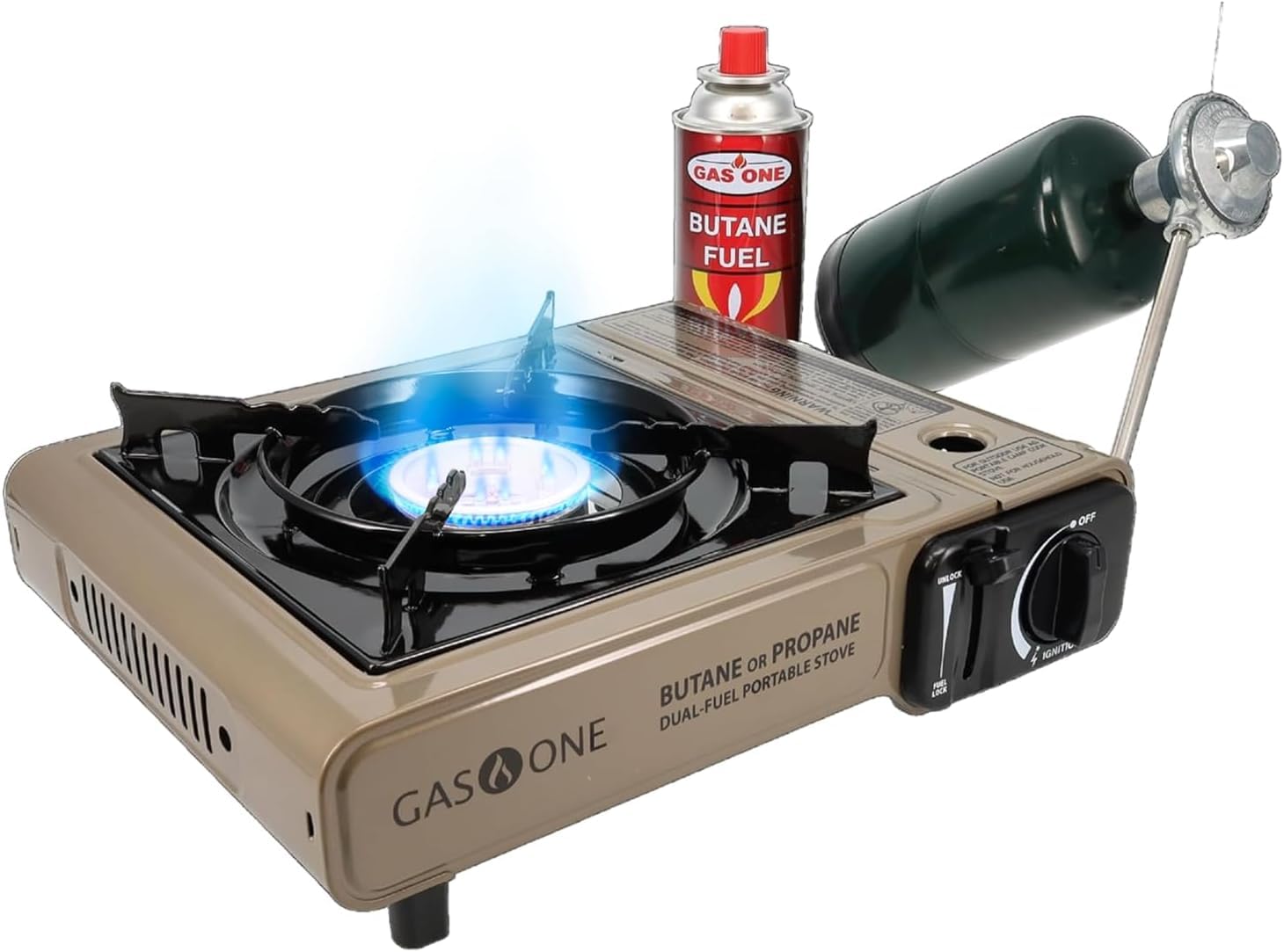
A butane cartridge clicks into the side of the GS-3400P; a one-pound propane cylinder screws on instead. That swap is the whole reason this little stove earns space in a car camping kit: butane is cheap, clean-burning, and quiet for a quick breakfast, and propane is what you reach for when the morning is cold and the cartridge spent the night in the truck.
At three pounds, in a slim case that slides under a seat or into a tote, it takes up almost nothing. The piezo igniter saves you a lighter, the dial has enough travel to hold a low flame, and the cartridge system has a pressure sensor that ejects a canister if something goes wrong — a safety feature we’re glad exists even though we hope never to see it work.
Where it falls down is endurance. The fuel line is the part that has given trouble, and durability is the weakest of anything we recommend here, so check the connection every time you fit a cylinder and treat the hose end gently. As a second burner for a two-pan dinner, or the whole kitchen on a solo trip, nothing cheaper works this well.
Pros
- Runs on butane or propane
- Three pounds with a hard case
- Pressure-sensor cartridge safety
Cons
- One burner means one pan at a time
We keep one in the truck: a three-pound burner that runs on whatever gas you can buy, for the lowest price in this group.
Best for Budget Two-Burner
CFRERO 2-Burner Foldable
Key Features
- Weight: 5.7 lb
- Burners: 2
- Cooking area: Two 10-inch pans
- Total output: 16,000 BTU
- Price: Budget
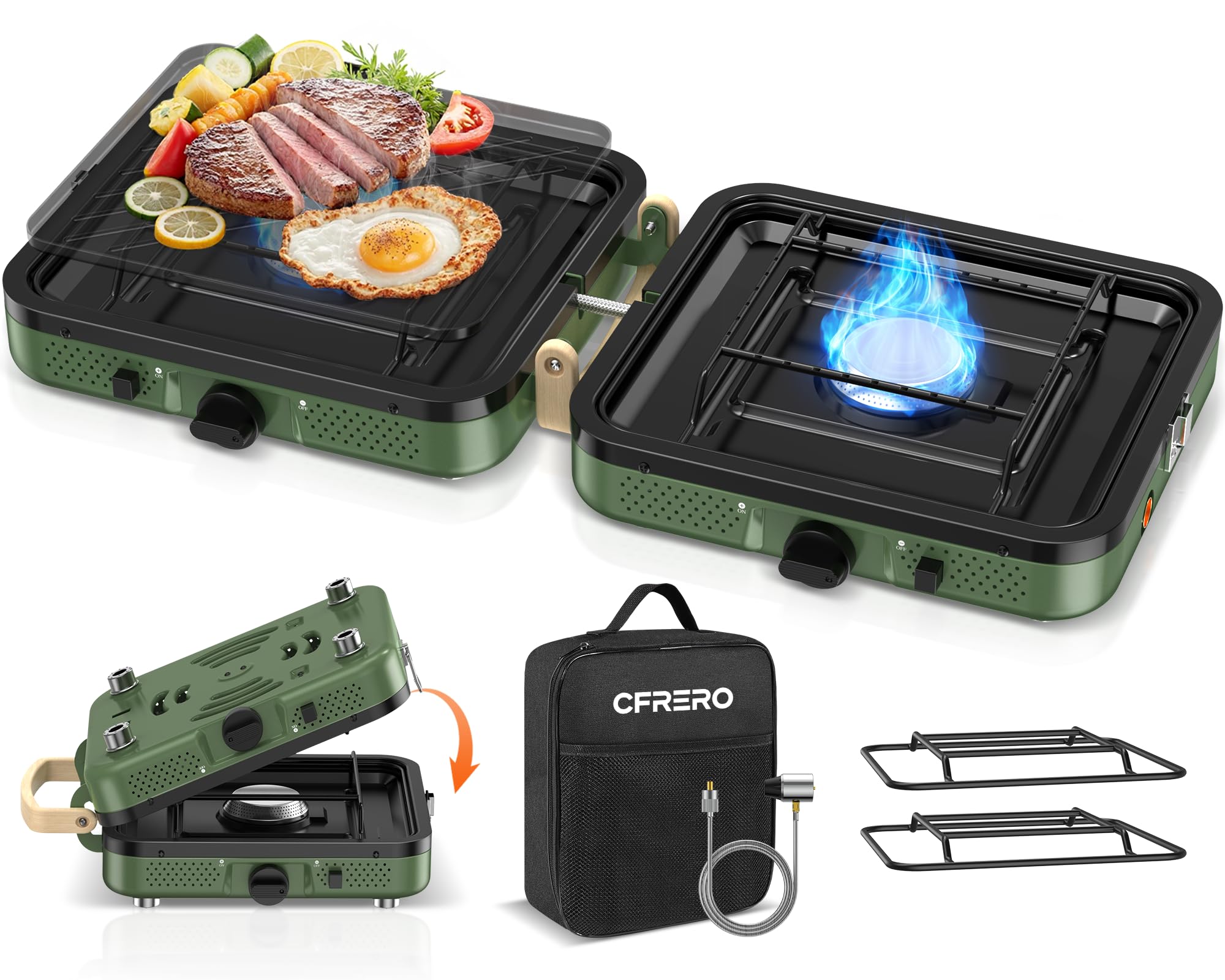
The hose in the box is what makes this one interesting. Sixteen thousand BTUs is modest for two burners, but the CFRERO ships with a gas hose and regulator that let you run it from a 20 lb tank: cheaper fuel, one connection for a whole trip, and no pile of spent one-pound cylinders rattling around the trunk.
Fold it out and you get two burners that take two 10-inch pans at once, piezo ignition, and a separate knob for each side, in a body that folds flat with a carry bag. For a couple or a small family watching the budget, it’s the least expensive route to a genuine two-burner setup in this group, and the heat is even enough for pancakes and a low simmer.
Wind is the trade-off: there’s no windshield, so on a breezy afternoon you want the sheltered side of the car and a spot out of the crosswind. That’s a small thing to manage for a stove that folds this flat and asks this little.
Pros
- Hose for a 20 lb tank included
- Two 10-inch pans at once
- Folds flat with a carry bag
Cons
- Griddle shown in photos is not included
Sixteen thousand BTUs, two pans at once, and a hose for a big tank: the cheapest way into a real two-burner setup here, if you pick a sheltered pitch.
Best for Tight Trunk Space
Gonex 2-Burner
Key Features
- Burners: 2
- Dimensions: 11.2 x 11.2 x 5.5 in
- In the box: Griddle, hose, two grates
- Total output: 16,000 BTU
- Price: Midrange
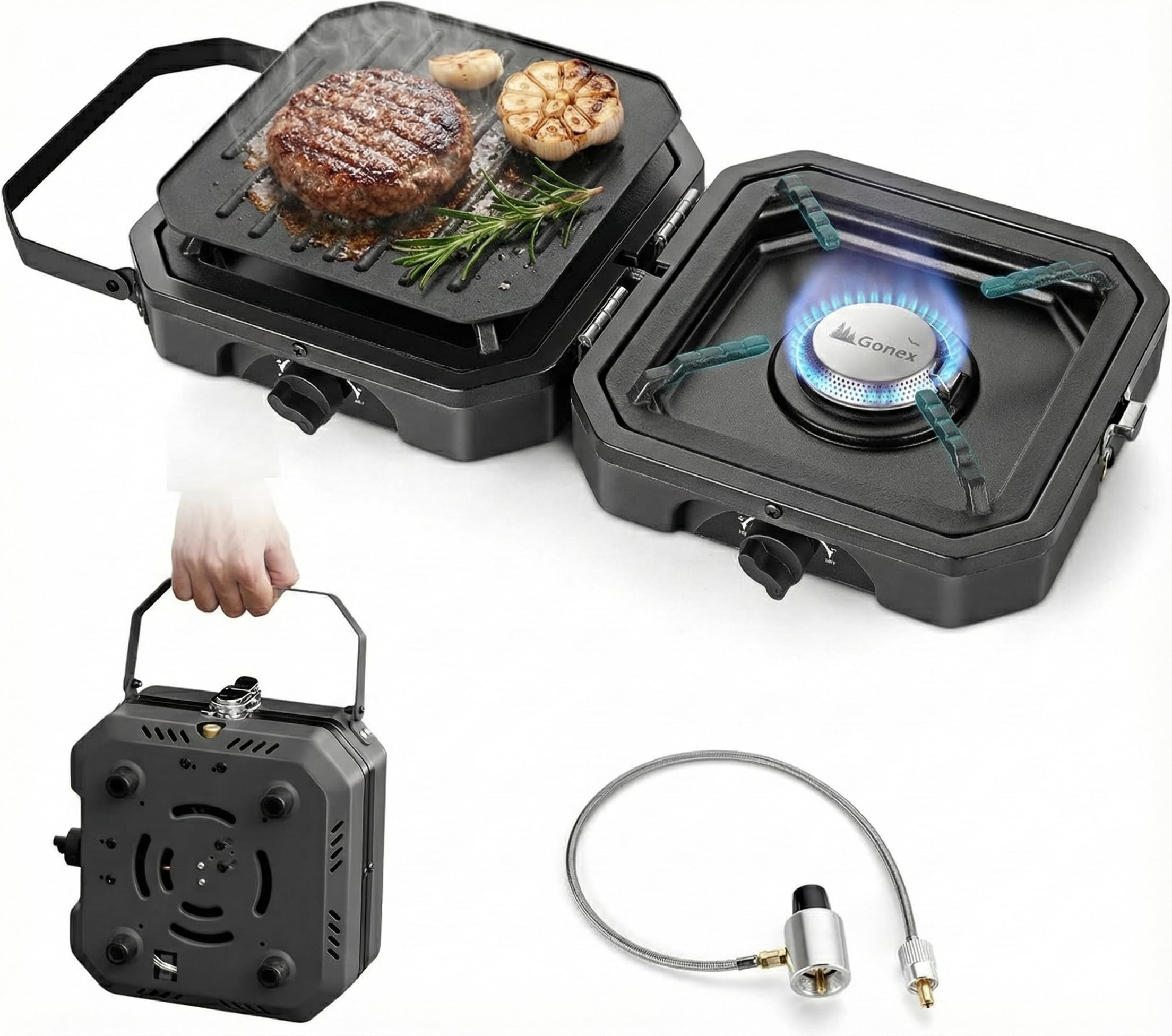
Eleven inches square and five and a half inches tall when it’s closed is the number that earns the Gonex a place here. If your trunk is already full of chairs, a cooler, and a dog, a two-burner that leaves a corner free is worth more than one that runs a few degrees hotter. It goes from bag to table in a couple of moves, and the propane hose stores inside the body.
The griddle that comes with it is the part we didn’t expect to use much. It drops over the burners and does eggs and pancakes in one pass, while the two cast-iron grates underneath are what you want under a pot. The lid, the latch, and the grates all feel more solid than the folded size suggests.
The burners are the other thing to understand: 8,000 BTUs each is plenty for a pot of pasta and a skillet of onions, but it’s not the stove for a stockpot on a cold night. At 6.6 pounds it’s also heavier than the packed size implies — you carry it from the car, not from the trailhead, and that’s exactly how we’ve used it.
Pros
- Small folded footprint
- Griddle and cast-iron grates included
- Solid build for the size
Cons
- Little wind protection around the burners
For a small car, the Gonex earns its place by folding small and bringing a griddle: a compact two-burner for cooking for two or three.
Best for Compact Two-Burner
ODSD 2-Burner

Key Features
- Burners: 2
- Dimensions: 11.42 x 10.43 x 7.48 in
- In the box: Carry bag, pan, coffee stand
- Total output: 20,000 BTU
- Price: Midrange
Wind is what turns a two-burner into an expensive lighter, and the folding shield on this ODSD was the first thing we noticed. It wraps the burner heads on three sides, and on a gusty afternoon that’s the difference between holding a simmer and fighting the flame for twenty minutes.
Twenty thousand BTUs across two burners, a magnetic catch in the handle, and a body that folds into a package you carry by the grip: this is a well-equipped stove for the money, and the burners are spaced generously enough for a big skillet and a saucepan together. The little stainless coffee stand that comes with it is a gimmick we ended up liking more than we expected.
It’s the hardware around the burners that holds it back. The shield is thin enough to fold over in a strong gust, the magnetic latch is weaker than a proper clasp, and one large pan can sit awkwardly on grates built for smaller cookware. Check that the right-hand knob closes fully, too, since it’s the one control worth confirming clicks off cleanly every time. None of that matters much on a stable picnic table in decent weather, which is where most car camping happens.
Pros
- Twenty thousand BTUs from two burners
- Windshield folds around the burners
- Magnetic latch makes packing quick
Cons
- Burner grates are small for large pans
- Magnetic latch is weaker than a clasp
Twenty thousand BTUs, a real windshield, and a magnetic catch: a well-equipped two-burner if you cook in reasonable weather on a level table.
Best for Grill and Griddle
Coleman Cascade 3-in-1
Key Features
- Weight: 15.8 lb
- Burners: 2
- Total output: 24,000 BTU
- Cooking surfaces: Cast-iron grill and griddle
- Price: Premium
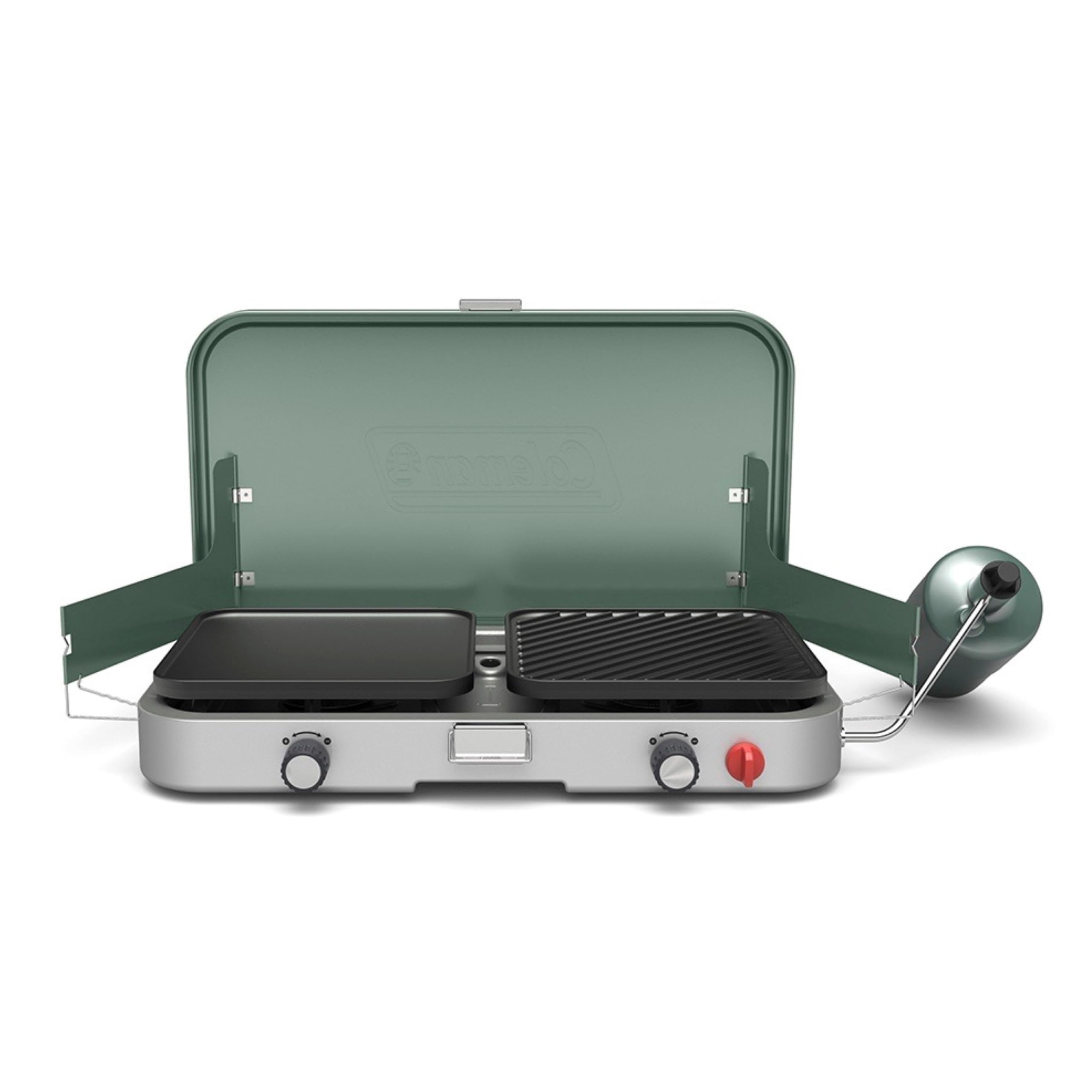
Cast-iron grill plates, a griddle, two 24,000 BTU burners, and a lid that latches: the Cascade 3-in-1 is the priciest stove here, and the only one that turns into something close to a barbecue. Set the griddle in and pancakes happen; drop the grill plates in and you’re cooking burgers over an open grate instead of chasing a skillet around a burner.
The cooking is genuinely good. Twenty-four thousand BTUs is more than the Triton offers, both burners adjust down to a low flame, and the cast-iron surfaces hold heat the way thin stamped steel doesn’t — a proper sear on a steak is achievable here in a way it isn’t on most camp grates. The accessories travel in their own bag, which matters more than it sounds when the plates are still warm.
What you pay for besides the plates is weight: nearly sixteen pounds before the cast iron goes in, so it stays on one table for the whole trip. The price is the part that gives us pause — it’s the most expensive stove in this group, and the cooking is better than the Triton’s without being in a different league. For a family that wants a campsite grill as much as a stove, it earns its spot; everyone else can save the money and the lifting.
Pros
- Cast-iron grill and griddle included
- Twenty-four thousand BTUs
- Three cooking setups in one box
Cons
- Dials have no markings to reference
- Griddle surface is rough and hard to clean
The Cascade 3-in-1 is for the family that wants a grill, a griddle, and two burners in one box, and doesn’t mind carrying nearly sixteen pounds to get it.
How We Tested 12 Car Camping Stoves, From Boil Times to Bacon Grease
We started with roughly 40 stoves from the brands campers actually buy and cut the list to 12 based on fuel type, packed dimensions, price, and availability — there’s no sense recommending something you can’t order. Those 12 spent seven months cooking, most of it in a driveway on Saturday mornings and the rest on weekend trips to state park campgrounds. One blustery morning by a lake sorted the windscreens from the purely decorative faster than any spec sheet did, with two stoves losing their flame at the exact moment the coffee water needed to boil.
Heat output was measured, never assumed. Each stove boiled a quart of tap water with the lid on while we ran a timer, then repeated the test with a box fan blowing across the burner to imitate a campsite breeze. Stability got the loaded treatment: a 12-inch cast-iron skillet first, then a six-quart pot of chili, with a deliberate bump to the table to see whether anything crept toward the edge. We carried every stove by its handle with a full pot aboard, too, checking that latches held and that the grip stayed cool enough to hold without a towel.
Size and portability came down to a scale and a tape measure — packed weight, folded footprint, and whether it slid into the trunk beside a 45-quart cooler without a fight. Durability announced itself over seven months of rattling around in a car: hinge play, rusty grates, one latch that gave up entirely. For ease of cleaning we cooked bacon and eggs, let the mess cool, and noted which drip trays lifted out, which grates came off without a tool, and which corners were simply unreachable. Value was the last calculation — price against how much of the above each stove actually got right.
How to Choose a Car Camping Stove
The right stove is decided less by BTU bragging rights than by how many pans you actually cook in, how much wind your usual sites get, and whether the thing has to fit beside the cooler.
Match the burner count to the meals you cook
One burner is a companion, not a kitchen: it boils water, fries eggs, and heats soup while you do something else, which is why the small dual-fuel stoves here work best as a second burner or a solo setup. Two burners are what make a campsite dinner feel like dinner, with a pot on one side and a skillet on the other. Heat output matters less than you expect until you’re boiling a stockpot or cooking for six — sixteen thousand BTUs across two burners handles a couple comfortably, while the forty thousand BTUs of the Everest 2X is built for big pots and cold evenings.
Wind protection and a grate that holds a full pot
Wind steals more heat than any burner can make up, so a lid that folds into a three-sided screen keeps a flame alive where a bare burner would blow out; thin clip-on panels are better than nothing and not much more. Stability is the other half. A narrow grate that’s fine under a saucepan can wobble under a full Dutch oven, and a stove that slides on a tilting picnic table is a burn waiting to happen. Compare the width between the burner bars and the heft of the grate before you buy.
Fuel: cartridges, one-pound cylinders, or a refillable tank
A one-pound propane cylinder is the simplest thing to carry and the most expensive way to buy gas. Add a hose and a 20 lb tank and the cost per meal drops sharply — worth it for anyone who camps a week at a time, and the CFRERO is the one here that includes the hose. Butane cartridges are cheap, clean, and quiet, but they lose pressure as the temperature falls, which is why we treat propane as the shoulder-season fuel.
Ignition, and the case for a long lighter
Push-button, piezo, and rotary igniters save you a match, and they are also a small breakable mechanism sitting inches from a hot burner. We treat matchless lighting as a convenience rather than a guarantee and keep a long-nose lighter in the stove bag regardless; Coleman’s Triton+ is the version of the Triton that adds push-button InstaStart if that feature matters to you. The other half of control is the knob: unmarked dials make a simmer guesswork, and a stove that jumps from off to roaring burns the rice.
Packed size, weight, and what comes in the box
Compact in a listing usually means it fits a trunk, not a backpack — no two-burner here is a hiking stove, and the lightest still takes a corner of the car and a shelf in the garage. Measure the closed dimensions against the space beside your cooler, and think about the lift: five pounds comes off a picnic table one-handed, fifteen does not. Read the box contents too, because a hose, a carry bag, and a griddle change both what you spend and what you have to remember.
Frequently Asked Questions
Can I use a car camping stove inside a tent or a van?
No. These stoves burn propane or butane and give off carbon monoxide, which is invisible and builds up fast in an enclosed space. Cook outside on a stable table. If the weather turns, pitch a tarp and set the stove at its open edge, well clear of the fabric and anything that can blow into the flame.
Does a camping stove work in cold weather?
Propane does; butane struggles. A butane cartridge loses pressure as the temperature drops, so a frosty morning can leave you with a weak flame or none at all. If your trips run into the shoulder season, choose a propane stove, or the dual-fuel Gas One running on a one-pound propane cylinder. Never warm a cylinder with a flame or a heater.
How do I check a new stove for leaks?
Mix a little dish soap with water, brush it on the cylinder connection and any hose joint, then open the valve without lighting the stove. Bubbles that keep growing mean gas is escaping: shut it off, tighten the joint, and test again. If it still bubbles, stop and replace the part. Never use a flame to look for a leak.
What’s the best way to clean a camp stove?
Wipe the grate with a paper towel while it’s still warm, before the grease sets, and let the whole stove cool completely before you latch the lid. Empty any drip tray at the campsite rather than in the car, and never pack the stove away wet. Cast-iron plates want a scrape and a light oil, not a soak.
Final Verdict
The Coleman Triton is the stove we point most car campers toward: 22,000 BTUs across two burners, wind guards that fold out of the lid, five pounds to lift, and a three-year warranty behind it. It cooks a real dinner without asking for space you don’t have, which is what most vehicle-based trips actually need.
If you regularly feed four or more, or you boil a big stockpot, the Camp Chef Everest 2X is the better buy — twice the heat and a much wider grate, paid for in weight and table space. Everyone else can stop reading and order the Triton.