This post contains affiliate links. We may earn a small commission when you buy through our links — at no extra cost to you.
There’s a specific moment on every road trip when the trunk stops being enough: the cooler won’t fit, the dog crate has claimed the back seat, and someone ends up holding a duffel on their lap for six hours. A car top carrier buys that space back. But the category splits hard between rigid boxes and soft-sided bags, and the difference between a good one and a bad one doesn’t show up in the driveway — it shows up at 70 mph in the rain.
I’ve watched a cheap soft bag flap itself thin on a windy interstate, and I’ve helped a friend wrestle with mounting hardware that never once felt trustworthy. Over the past eight months, my team and I loaded, drove with, and unloaded 10 carriers, and the ones worth the money were solid before we ever left the driveway. Here’s what first-time buyers get wrong: advertised capacity is optimistic, and the number that actually matters is how much still fits after the cooler goes in. The picks below are the ones that earned a permanent spot up top.



Best for Family Road Trips
RoofPax XXL 28 cu ft
Key Features
- Weight: 14.9 lb
- Capacity: 28 cubic feet
- Mounting: With or without roof rack
- Warranty: Lifetime zipper, 5-year fabric
- Price: Midrange
Twenty-eight cubic feet is the sort of number shoppers skim past, so here it is in practice: four medium suitcases, with soft bags pushed into the gaps around them. That’s a family’s luggage off the back seat and onto the roof, which is the whole reason to buy a car top carrier. One bag here is bigger; nothing else matches this combination of volume and a bare-roof mount.
I’d like to say the size is what tips it for us.
Rain is where it gives ground. The zip is double-layered and the fabric is coated, but a drive that stays wet for hours is where water works in at the closure and the seams. Pack anything that has to stay bone dry inside a dry bag and this stops being a problem.
What tips it for us is the mounting. Four door-hook straps drop into the door frames, the webbing runs over the bag, and it goes on without crossbars — the same straps tie to a rack if you have one. RoofPax includes the combination lock and a storage bag rather than selling them separately, which is rarer than it should be. The honest cost is weight: 6.75 kg empty, and a loaded bag is a real lift over a tall roof, so a step stool earns its place. Five years of cover on the fabric and a lifetime warranty on the zip tell you exactly where RoofPax expects trouble, and it’s the same place every soft bag has it.
Pros
- Largest usable volume of the soft bags here
- Fits cars with or without a roof rack
- Folds into its own storage bag
- Lifetime zip and five-year fabric warranty
Cons
- Heavy to lift onto a tall roof at 6.75 kg
We point most buyers here: 28 cubic feet is the most usable space in this group, it mounts without a roof rack, and the fabric warranty is the longest of the soft bags.
Best for Rainy Road Trips
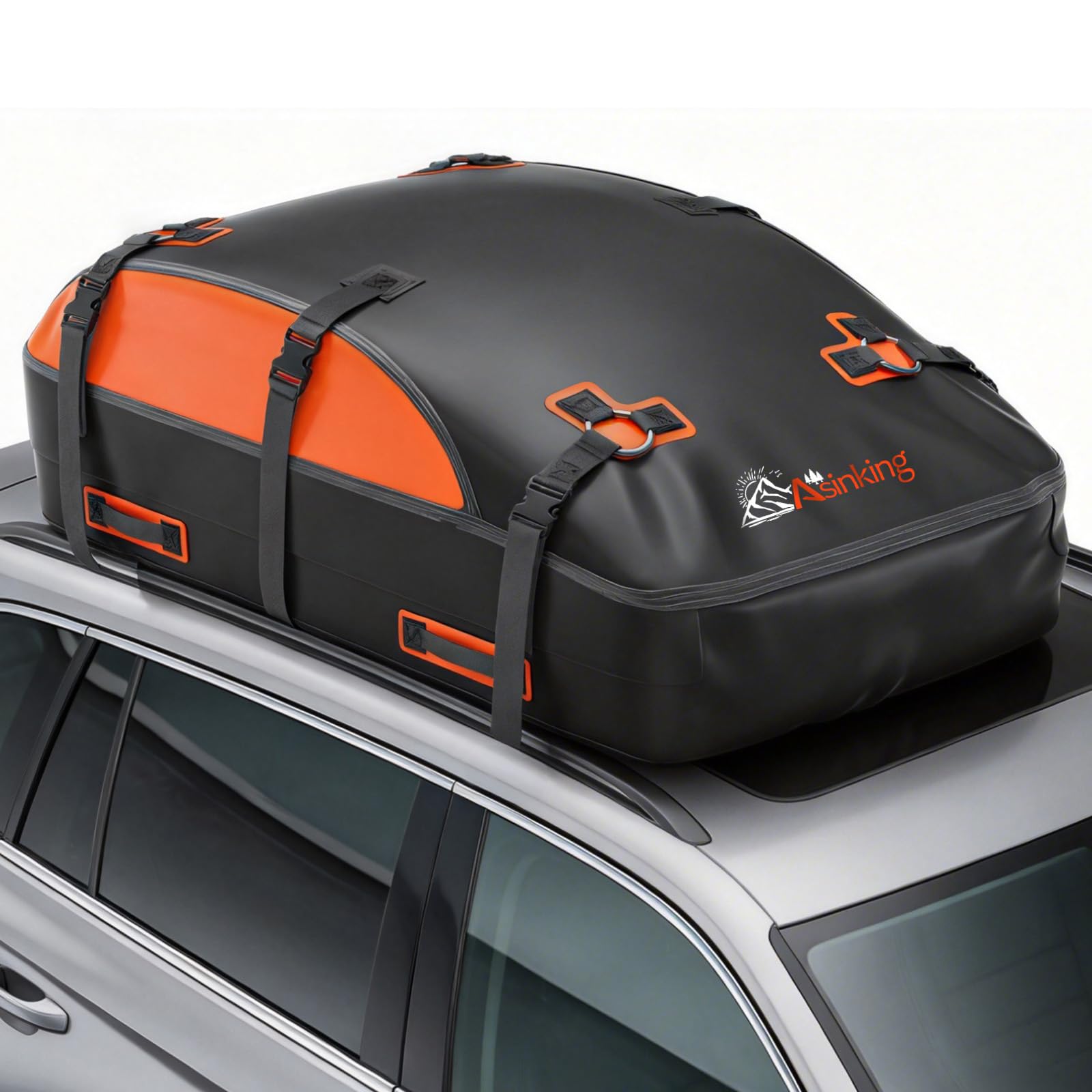
Asinking Ultimate 20 cu ft
Key Features
- Weight: 5.27 lb
- Capacity: 20 cubic feet
- Warranty: 2 years
- Water rating: IPX66
- Price: Midrange
Rain is where soft roof bags usually lose the argument, and this is the one here that takes the problem seriously. The closure is a zip under a wide velcro flap — the exact spot where water gets into most bags — and the fabric is a double-coated PVC tarpaulin rated IPX66, which is a claim about water jets rather than a vague water-resistant label. We reach for it when a trip looks wet.
Twenty cubic feet is a size down from our top pick, and the gap shows with hard-sided luggage: two large suitcases plus a duffel and you’re packing around the edges. Soft bags disappear into it. The arched top isn’t decoration either — a taut, curved bag flaps less at speed, and flapping is what wears a strap thin over a season of driving.
At 2.39 kg it’s the lightest bag in this group by a wide margin, which matters at the moment you’re pushing it over your head in the rain, and it means the bag stores in the trunk rather than on a garage shelf. The two-year warranty is among the longer ones here, and the mat, lock, door hooks and storage bag all come in the box.
Pros
- Sealed zip under a wide velcro flap
- IPX66-rated coated tarpaulin
- Lightest bag in this set at 2.39 kg
- Two-year warranty
Cons
- 20 cubic feet fills fast with hard-sided cases
We recommend it when rain is the worry: the covered zip and coated fabric are the best wet-weather protection in this group, and it’s the lightest bag here to lift.
Best for Year-Round Security
SportRack Vista XL
Key Features
- Capacity: 18 cubic feet
- Warranty: 25 years
- Dimensions: 62.5 x 39 x 19 inches
- Load capacity: 100 lb
- Price: Premium
The Vista XL costs more than any two soft bags here put together, so it has to earn that. What you’re paying for is a shell: rigid ABS, mounted on crossbars, locked with a key, indifferent to weather. It’s indifferent to packing too — no straps to thread, nothing to wrestle off the roof wet at a hotel.
Eighteen cubic feet is the smallest capacity in this group, and with a hard box the figure is honest: 18 cubic feet is what you get, not a litre more. Two large suitcases with duffels around them covers a family of four once the trunk is free. The rear opening is the design decision to think about — on a low car you stand at the bumper and reach straight in, while on a tall SUV you’ll want a step stool, and a very tall car is better served by a side-opening box.
Twenty-five years of warranty is what changes how the price feels, and it’s the longest cover here by a decade. The 100 lb load rating is half the basket’s, so this is a box for luggage rather than firewood. It’s quiet at highway speed too, which we didn’t fully expect from a plastic box.
Pros
- Lockable hard shell shrugs off weather
- 25-year warranty
- Tool-free mounting on crossbars
- Quiet at highway speed
Cons
- Requires crossbars; no door-hook option
- Plastic shell flexes; corners can arrive dented
For crossbar owners who want to stop thinking about weather and security, we think the Vista XL is worth the premium — 25 years of cover makes the price easier to swallow.
Best for Bulky Cargo
WEIZE 64-Inch Roof Basket
Key Features
- Weight: 46 lb
- Included: Bag, net, straps
- Basket size: 64 x 39 x 5 inches
- Load capacity: 200 lb
- Price: Midrange
A bag only takes what you can lift over your head and drop in. A basket takes the cooler, the firewood, the propane tank, the folding chairs still in their bag — the awkward, dirty, non-rectangular cargo no roof bag will ever accept. The WEIZE is that option here, and its 200 lb rating is the highest load figure in this group, double the hard box’s.
It arrives as four welded sections that bolt together, then clamps to crossbars with U-bolts. Measure before you order: it takes bars up to 1.35 inches thick and 4.6 inches wide, and nothing chunkier. The supplied 20 cubic foot waterproof bag, cargo net and ratchet straps make it a hybrid — a sealed load for a wet week, an open deck for the dump run.
We were struck by how much the wind fairing does. A bare basket howls at highway speed; this front deflector cuts most of that, and the powder coating looks smarter than the price suggests. The paint is where it ages, though — chips at the welds and seams are where rust starts, so touch up bare metal before winter and it’ll outlast the car.
Pros
- 200 lb rating, the highest here
- Carries coolers, firewood and awkward loads
- Bag, cargo net and ratchet straps included
- Wind fairing keeps it quiet
Cons
- 46 pounds to lift onto the roof
- Crossbars must be under 1.35 in thick and 4.6 in wide
We keep this one for gear rather than suitcases: 200 pounds of cooler, firewood and chairs, with a waterproof bag and net in the box, provided your crossbars fit.
Best for Tight Budgets
APTY 21 cu ft Roof Bag
Key Features
- Color: Blue
- Weight: 11.6 lb
- Capacity: 21 cubic feet
- Folded size: 24 x 12 x 10 inches
- Price: Budget
Blue is an odd choice for a roof bag until you’ve walked the length of a parking lot looking for your own car. The APTY’s shell stands out at a distance, which sounds trivial until the third stop of a long day, and it’s the only blue bag in this group.
Twenty-one cubic feet puts it level with the mid-size bags here. What we didn’t expect at this price is the closure: a waterproof zip under a wide velcro flap, plus an anti-slip mat, a combination lock and six door hooks in the box. It’s the budget bag that actually stays dry, and the covered zip is why.
What makes it a budget pick rather than a cheap compromise is the folded size — about 24 by 12 by 10 inches, small enough for a shelf or the well of a trunk — and 5.27 kg that one person can manage onto a roof. Watch the strap stitching before a long trip; that’s the part that goes first on bags at this price.
Pros
- Low price for a 21 cubic foot bag
- Covered waterproof zip keeps gear dry
- Folds to about 24 x 12 x 10 inches
- Blue shell is easy to spot
Cons
- Strap stitching is the weak point
We think it’s the best value here: 21 cubic feet, a covered zip that keeps rain out, and a fold small enough for a shelf, all for less than the mid-size bags cost.
Best for Maximum Volume
FIVKLEMNZ 30 cu ft Roof Bag

Key Features
- Weight: 12 lb
- Capacity: 30 cubic feet
- Included: Mat, lock, 6 hooks
- Warranty: 12 months
- Price: Budget
Thirty cubic feet makes this the biggest bag in the group, and the kit is complete: ten reinforced straps, six door hooks, an anti-slip mat, a lock and a storage bag — more than some pricier bags include. If the question is purely how much stuff fits on the roof for the money, this answers it.
What keeps it out of the top tiers is the fabric. Durability is the one place this bag divides, and hard: panels and seams that hold through a season of highway driving tear on a first long trip in other cases. A bag that can come apart at highway speed is not one we’ll put at the top of a list. The 12-month warranty is among the shorter covers here.
Buy it for volume and soft cargo — sleeping bags, duffels, tents — and spend ten minutes strapping it properly rather than trusting the hooks alone. On a roof rack it behaves better than on door hooks, because 30 cubic feet is a lot of sail area to hang off four straps.
Pros
- Largest capacity here at 30 cubic feet
- Mounts with or without a roof rack
- Ten straps, six hooks, mat and lock included
Cons
- Fabric and seams tear on some bags
- 12-month warranty
We rate it for volume above all: it’s the biggest bag here, and worth it if you pack soft gear and take the time to strap it down properly.
Best for Occasional Trips
Asinking 21 cu ft Roof Bag

Key Features
- Weight: 9.48 lb
- Capacity: 21 cubic feet
- Warranty: 3 years
- Price: Budget
This is the lowest-priced full-size bag here, and the specification doesn’t read like a budget one: 21 cubic feet of 900D PVC, a covered zip, a thick rubber anti-slip mat, padded door hooks, a combination lock and a storage bag.
The reason it sits in also-consider rather than up with the runners-up is simple: it’s the newest design here and the least proven, so our confidence rests more on the design than on years of use. That design is sound — a sealed flap over the zip, heavy coated fabric, a mat that stops it walking on the roof, and a footprint that suits most SUVs.
Three years of warranty is the longest cover on any soft bag in this set, and that’s the real argument: at the lowest price here you’re buying capacity and a promise. The 4.3 kg weight and 52 by 40 inch footprint are ordinary for the class, so don’t choose it expecting an easy solo lift onto a very tall roof.
Pros
- Lowest price in this set
- Three-year warranty
- 900D PVC with a covered zip and full kit
Cons
- Least-proven design in this group
We see it as the value play: full-size capacity, a covered zip and the longest soft-bag warranty here, at the lowest price in the group.
How We Tested Car Top Carriers
We started with a list of about 30 models and cut it down to 10 based on published exterior dimensions, crossbar compatibility, whether the mounting hardware suited both factory and aftermarket bars, and price spread across the budget, midrange, and premium tiers. Each carrier lived on a real car for eight months rather than going on and off for a single weekend. We timed the first solo installation with a stopwatch, then timed it again on the fifth and tenth trips to see whether the process got faster or stayed fiddly.
Capacity was measured, not trusted. We loaded every carrier with the same kit — two duffels, a hard cooler, a camp chair, and a sleeping bag — and noted how much room was left over and whether the cooler had to go in first. Water resistance got the hose treatment: five minutes of spray across the lid seams, then a check for dampness on the sleeping bag at the bottom. We opened and closed each one in the rain, with and without gloves, and paid attention to whether the latch felt tight or sloppy and whether a key was even needed to open it.
Sturdiness and durability were judged by repetition — 20 load-unload cycles per carrier, plus whether the lid still aligned with the base afterward and whether the mounting brackets showed play. We checked hatch clearance by raising the liftgate with each box mounted and watched for contact, and we ran each one through weeks of commuting, car washes, and one genuinely nasty storm to see what faded, cracked, or loosened. Finally, we weighed the price against what the carrier actually delivered, because a $600 box that rattles is worse value than a $150 bag that stays put.
How to Choose a Car Top Carrier
Nearly every disappointment with a roof carrier traces back to one of three things: the roof it goes on, how much rain it meets, and whether you’re carrying luggage or gear.
Start with the roof, not the bag
The first question isn’t which carrier, it’s what your roof already has. A soft bag with door-hook straps hangs off the door frames and works on a bare roof, which is why our top pick fits almost anything with four doors. A hard box or a steel basket clamps to crossbars and simply cannot be mounted without them.
The word to distrust is universal. It means the carrier can be adapted, not that it will fit your car: baskets specify a maximum crossbar thickness and width, boxes need bars in the right places, and door hooks need frames the webbing can pass through and a door that still shuts on it. If you have no rack and don’t want one, stay with soft bags.
Read capacity as a range, not a guarantee
Quoted volume runs from 18 cubic feet in a hard box to 30 in the biggest soft bag here, and those numbers don’t compare cleanly. A box gives you exactly what it says because the walls don’t move. A soft bag’s figure assumes soft luggage: pack hard-shell suitcases and you’ll use noticeably less, and a half-empty bag holds its shape badly.
Count suitcases instead of cubic feet. Four medium cases is about the working load of a 28 cubic foot bag. Then check the footprint against your roof — most of these bags run around 52 by 40 inches, which is wide enough that roof width at the very front of the car is worth measuring.
What keeps water out, and what keeps hands out
The closure answers both questions. On a soft bag, look for a zip under a wide flap, ideally velcro-sealed, as on the Asinking Ultimate and the APTY — a bare zip is the first thing to leak. Waterproof on a bag means rain runs off it, not that it survives standing water, so anything that must stay dry goes in a liner bag as well.
Security is modest across the whole type. A combination lock on a soft bag stops the zip creeping open at speed; it won’t stop someone with a knife. A hard box with a key lock is the more secure option, and the only one here that keeps cargo dry without a liner.
Weight, noise and where it lives between trips
Empty weights run from 2.39 kg for a bag to 46 pounds for the steel basket, and you feel every bit of that at the moment you push a full carrier over your head. If you load alone and your roof is tall, the lighter bag is worth more than the extra cubic feet.
Noise follows shape. A hard box is quietest, a basket without its fairing howls, and a taut arched bag is quieter than a slack one. Think about storage too: a soft bag folds to duffel size and lives on a shelf, while a box or basket wants garage space all year.
Frequently Asked Questions
How much weight can a car top carrier hold?
The carrier’s rating is a ceiling, not a target. The hard box here is rated to 100 pounds and the steel basket to 200, but your car’s roof has its own dynamic load limit, typically lower, and it’s printed in the owner’s manual. Load to whichever figure is smaller, and spread the weight rather than putting one heavy case in the middle.
Will a roof bag scratch the paint?
It can, and grit does more damage than the bag. Every soft bag we recommend ships with an anti-slip mat and padded door hooks; the mat protects paint as much as it prevents sliding. Wash and dry the roof first, shake the mat out before it goes down, and lift the bag rather than dragging it across the panel when you load alone.
Why do the straps flap at highway speed, and how do you stop it?
Loose strap ends whip in the wind, and noise is the least of it — a flapping tail frays and can slap the roof. Tuck or tie every loose end once the straps are tensioned, then stop and re-check after the first stretch of driving, because the load settles and the straps go slack. Where a strap passes a door frame, make sure the seal closes on webbing, not on a buckle.
Final Verdict
For most people the RoofPax XXL 28 is the answer: the most usable capacity here, a bare-roof mount that needs no crossbars, and the longest fabric warranty of any soft bag in the group.
If your trips run through real rain, the Asinking Ultimate is the better buy — smaller, but the soft bag here we trust in a downpour. And if you already have crossbars and want to stop thinking about weather and security altogether, the SportRack Vista XL earns its premium over 25 years.