This post contains affiliate links. We may earn a small commission when you buy through our links — at no extra cost to you.
The first time you hoist a 25-pound toddler onto your back, you understand why a proper baby backpack carrier matters. A good one shifts the load to your hips, frees your hands for balance, and gives your kid a padded seat with a view. The wrong one turns a gentle trail into a chiropractor appointment by lunch. Over seven months, my team and I wore 12 carriers on neighborhood walks, hiking trails, grocery runs, and airport terminals.
Fit, stability, and support matter more than any feature list. A carrier should adjust to your torso and your partner’s without a wrestling match, stay steady when you bend to pick up a dropped cup, and keep your baby’s head and hips comfortable mile after mile. Storage capacity is the sleeper concern—a pocket that fits a diaper, wipes, and a snack makes a hike self-contained, and value isn’t the sticker price but how many seasons the buckles and seams survive before they fray. The picks below are the ones that earned a permanent spot by the door.


Best for Long Trail Days
Deuter Kid Comfort
Key Features
- Frame: Rigid with built-in stand
- Harness: Adjusts for child and wearer
- Storage: Pockets plus hydration sleeve
- Child cockpit: Adjustable, with foot stirrups
- Price: Premium
The frame holds the pack upright with a child still in the seat, and we came to rely on that more than any other feature. On a narrow stretch where the trail pinches out, you set it down, lift your toddler out by the waist, and both hands are free. Loading is the same story in reverse: harness on, straps over your shoulders, one bounce to settle it and you’re walking. Less obvious is the cockpit cinch — pull that strap and the child sits tighter against your back, which kills the sway that makes long descents miserable.
Of everything here, this is the carrier we take when the day will run long. Comfort is where it separates itself: it carries a 25-pound toddler for hours without the pack digging in, the seat adjusts for a small baby and for a preschooler, and the wearer’s harness adjusts to match without tools. Pockets are plentiful, there’s a hydration sleeve so a day’s water doesn’t ride on your hip, and a child who nods off in it tends to stay asleep. That combination is what puts it at the top of this group rather than the middle.
What it costs is money and trunk space. This sits in the premium tier, well above the budget carriers, and there’s no folding trick — the rigid frame takes up the back of a small car. If you hike a handful of times a year, the ClevrPlus does the job for much less. If the pack lives by the door from April to October, the difference in comfort is the entire argument.
Pros
- Holds itself up for solo loading
- Comfortable across multi-hour carries
- Adjusts from baby through preschooler
- Pockets plus a hydration sleeve
Cons
- Premium price, well above the budget picks
For families who get out most weekends, this is the carrier we recommend without hedging: the most comfortable in this group, with a stand that makes solo loading realistic.
Best for Tight Budgets
ClevrPlus Cross Country
Key Features
- Included: Sun canopy and rain cover
- Age range: 9–48 months
- Carrier weight: 5.5 lb
- Child weight limit: 33 lb
- Price: Budget
When someone asks us for a framed carrier without a big budget, this is the one we name. It costs less than every other carrier worth buying in this group, and it throws in what the premium packs charge extra for: a sun canopy, a rain cover and a changing pad. We much prefer to see a first-time buyer start here than spend premium money on a pack that gets used four times a year.
The specification is honest for the money: 5.5 pounds, a 33-pound child limit, and a seat that covers about nine months to four years. That ceiling is the lowest here, so a tall three-year-old will meet it before a younger sibling does. Storage is generous — a large main compartment plus pockets for water, snacks and a phone — and the canopy clips on quickly when the sun comes over the ridge. On the trail, the waist belt and lumbar pad take the load off your shoulders, which is the thing budget carriers usually get wrong.
The seat is on the narrow side, and a solid toddler can end up perched rather than sitting in it, so it suits small-to-average builds best. That’s the trade for the price, and it’s the one thing to weigh if your child is already near the top of the weight chart. For everyone else it remains the pack we suggest first when money is the deciding factor.
Pros
- Canopy, rain cover and changing pad included
- Light for a framed carrier at 5.5 lb
- Generous storage for the price
- Waist belt takes weight off the shoulders
Cons
- Hip-belt buckle can fail under load
- 33 lb child limit is the lowest here
Buy this if the budget is fixed and you still want a real framed carrier: canopy, rain cover and changing pad included for the least money in this group.
Best for Bigger Wearers
besrey Toddler Carrier
Key Features
- Seat: 3 height positions
- Total load: 16–44 lb
- Carrier weight: 5.5 lb
- Child weight range: 16–40 lb
- Price: Midrange
Waist belts are where carriers lose half their buyers, and this is the pack in the group built for the wearers who have given up on them. The belt runs generously — comfortably past a 4X shirt size — and the shoulder padding is soft rather than rigid. If one parent is broad and the other narrow, both can use it, though the slimmer one will have the belt cinched near the end of its range.
The seat moves through three heights, which is how the same pack takes a 16-pound one-year-old and a 40-pound four-year-old; the load rating runs to 44 pounds once you count gear. A sunshade and rain cover come in the box, and the storage is deeper than the price suggests, with room for a day’s bottles and snacks. The main buckle has a safety lock, a detail that matters more than it sounds once a toddler has learned to press things.
What we don’t love is the link between the child’s harness and the shoulder straps: it can press into a shoulder blade however you set the torso height. Loosen the shoulder straps fully before you tighten the waist and it largely goes away. That caveat aside, this is the carrier we suggest for taller parents and heavier toddlers, and it covers the widest stated weight range in this group.
Pros
- Waist belt fits plus-size wearers
- Seat adjusts through three heights
- Carries a 40 lb child, 44 lb total
- Sunshade and rain cover included
Cons
- Waist belt runs loose on slim wearers
Our pick for bigger wearers and fast-growing toddlers: the waist belt runs generous, the seat moves through three heights, and it takes a 40-pound child.
Best for Travel and Flights
Osprey Poco LT
Key Features
- Frame: Folding stainless steel
- Sunshade: UPF 50, built in
- Carrier weight: 5.6 lb
- Torso adjustment: 6 in (15 cm)
- Price: Premium
The frame folds, and that one decision changes how you use the thing. Folded down it slides into a trunk beside the stroller instead of on top of it, and on a flight it lies horizontally or diagonally in a standard overhead bin. We have wrestled rigid carriers through airports, and this is a different experience — the pack stops behaving like a separate piece of luggage.
For travel, this is our pick of the group. At 5.6 pounds it’s only a little heavier than the ClevrPlus, and the ventilated backpanel is the reason we noticed it less on a warm climb than the rigid packs here. The UPF 50 sunshade lives in its own zippered pocket, so it’s there when you need it rather than in a drawer at home, and six inches of torso adjustment let a 6-foot parent and a 5-foot-5 one share the pack without swapping parts.
The catch is the price: this is the most expensive carrier here, and the money buys the folding frame and the shade rather than more storage. The compartments are decent but shallower than the WIPHA’s underseat bag. If the pack mostly rides in a car to a local trailhead, the premium buys you little. If it boards planes, it’s the one we take.
Pros
- Folding frame packs flat for travel
- UPF 50 sunshade built in and stowed
- 6 in of torso adjustment for sharing
- Ventilated backpanel for warm climbs
Cons
- The priciest carrier in this group
Worth the money if the carrier travels with you: it folds flat, the UPF 50 shade is always with it, and two parents of different heights can share it.
Best for All-Round Day Hikes
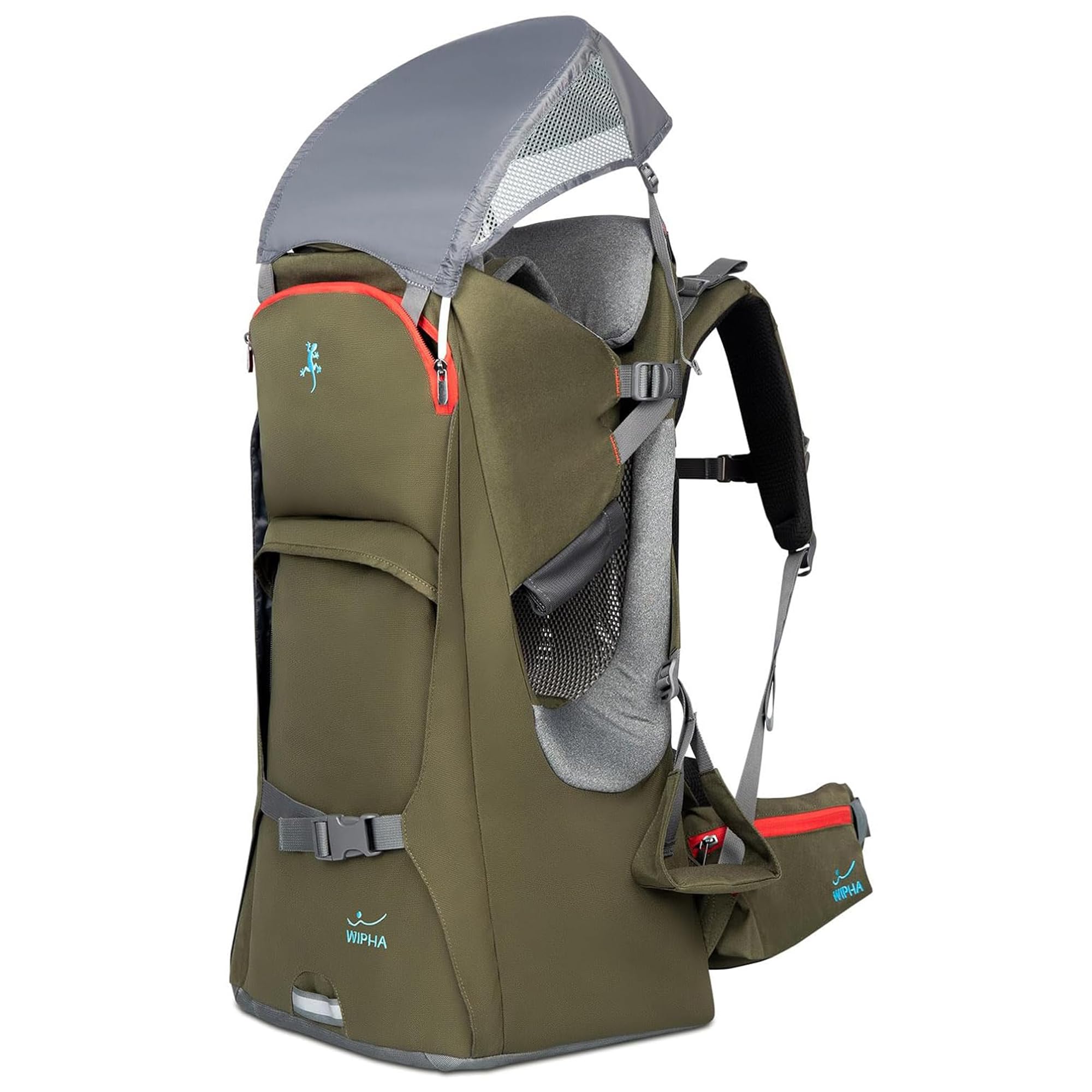
WIPHA Creeper-II
Key Features
- Storage: Underseat bag with insulated pocket
- Dimensions: 12"D x 16"W x 25.6"H
- Washable parts: Removable saliva pads
- Child weight range: 16–40 lb
- Price: Midrange
Premium feel at a midprice is a claim that usually falls apart in the driveway, but this pack mostly delivers it. It has the two features that decide a family hike — a canopy that actually covers a child’s face, and storage big enough that the diaper bag stays in the car — and it does them for noticeably less than the Deuter or the Osprey.
The underseat compartment is one of the roomiest here, with an insulated pocket that keeps a bottle cold and space for a lunch, wipes and a spare layer. The frame locks open from the inside, so the pack props itself up while you settle a toddler in. A detail we appreciated more than expected: the saliva pads unclip and go in the wash, which is the difference between a pack that smells like a snack cup and one that doesn’t.
Loading solo is the wrinkle. Getting a toddler up and onto your back takes a couple of attempts before the motion clicks, and the shoulder straps want a tug to sit flat — practice at home over a bed before you try it on a slope. Once it’s on, the hip belt and lumbar padding carry it well, and the harness adjusts far enough for a 6-foot-2 wearer. For a midprice pack that covers the trail basics, that’s a fair trade.
Pros
- Canopy and insulated underseat storage
- Frame locks open for loading
- Removable washable saliva pads
Cons
- Shoulder straps can be awkward to settle
The sensible middle of this group: canopy, insulated underseat storage and a stand that holds the pack open, for a lot less than the premium picks.
Best for Gear-Heavy Outings
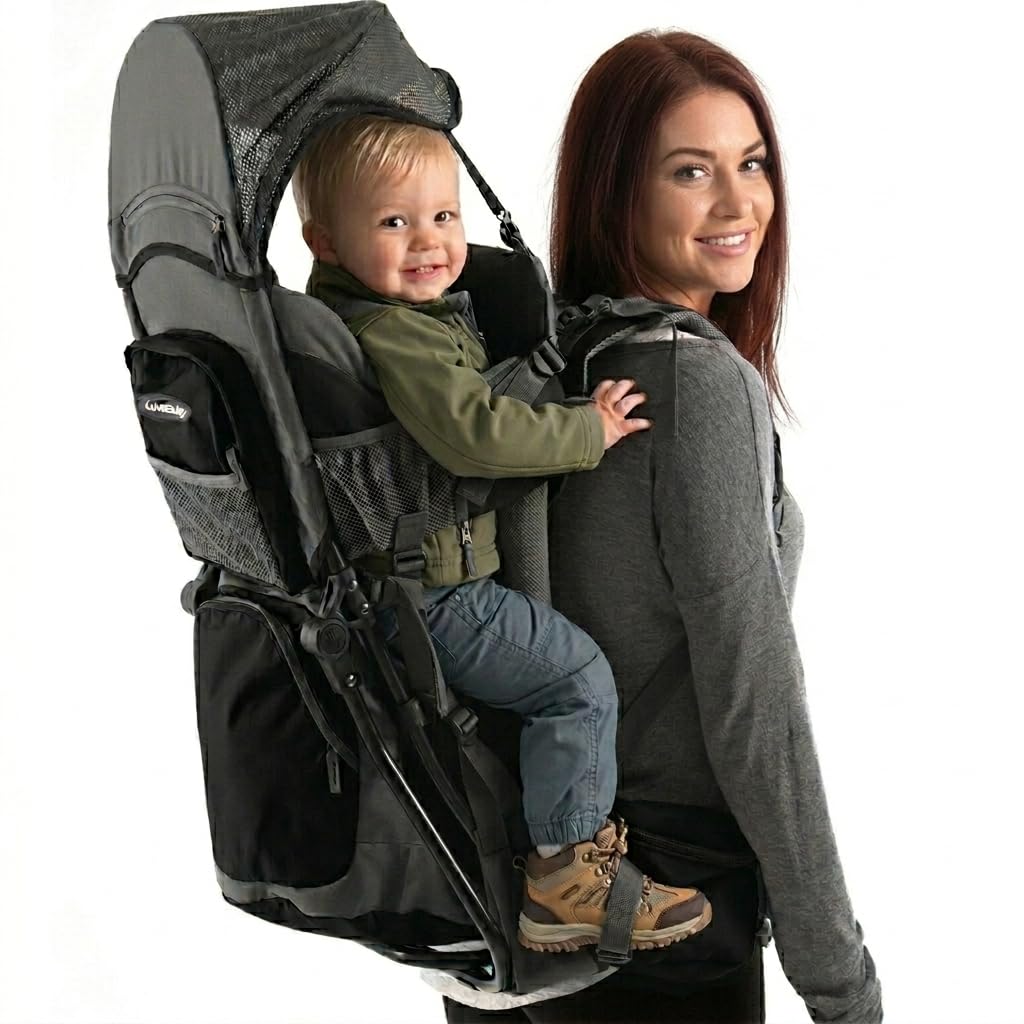
Luvdbaby Hiking Carrier
Key Features
- Included: Changing pad, sun and rain hood
- Dimensions: 9.8"D x 14.3"W x 28.5"H
- Bottle pocket: Insulated
- Child weight range: 16–40 lb
- Price: Midrange
Start with the organization, because that’s the reason to pick this one. There’s an insulated bottle pocket, a fold-out changing pad, mesh side pockets and enough separate compartments that a full day’s bottles, snacks, diapers and a spare sweater disappear into it. We stopped carrying a diaper bag on the days we took this pack, which is the biggest compliment we can pay a carrier.
The fit is unusually forgiving across wearers. The same harness adjusts between a 6-foot parent and a 5-foot-7 one without swapping parts, and the child’s seat takes a 16- to 40-pound toddler, so it covers roughly a year through preschool. The sun and rain hood comes with it rather than as an extra.
Where it gives ground is how firmly it holds a toddler. The seat and frame aren’t as planted as the Deuter’s or the WIPHA’s, and a heavier two-year-old can shift off balance mid-step — you feel it most going downhill, where the load wants to keep moving. Size your child honestly against the 40-pound ceiling and it stays manageable; push past it and the pack gets tiring.
So: farmers’ markets, zoo trips, flat rail trails with a bag full of snacks. That’s where this carrier makes sense, and no other pack here organizes that kind of day as well. It’s the one we hand someone who wants a single bag to do everything, not the one we hand someone planning a mountain day.
Pros
- Insulated bottle pocket and changing pad
- Enough pockets to skip a diaper bag
- Adjusts between very different wearers
Cons
- Harness straps can give way under load
- Frame holds a heavy toddler less firmly
For outings where the carrier doubles as your daypack, the pocket layout here beats everything else in this group, and it takes a 40-pound toddler.
Best for Small Toddlers
WIPHA Antelope-I

Key Features
- Sunshade: Included
- Folded size: 4.3"D x 13.3"W x 17.7"H
- Carrier weight: 3.3 lb
- Child weight range: 18–30 lb
- Price: Midrange
This is the carrier that lives in a suitcase. Fold the frame down and it packs to roughly laptop size — 4.3 by 13.3 by 17.7 inches — and at 3.3 pounds it’s the lightest pack here by a wide margin. Lift it out of a trunk next to a rigid carrier and the difference is obvious before you’ve put it on.
It’s also built for a narrower window than the rest. The child range is 18 to 30 pounds, the smallest here, which suits a first walking toddler and not a great deal beyond. Inside that window it’s a decent ride: padded backrest, sunshade included, and underseat storage that swallows more than the folded size suggests. It’s the only carrier in this group that names a safety-testing standard, TÜV, which counts for something on a first framed purchase.
The carry itself is where it gives ground. There are no load lifters where the shoulder straps meet the top of the frame, so the weight sits back and pulls at your core on a climb, and the 30-pound ceiling means a big two-year-old is already at the limit. Buy it for travel, city days and a small toddler. For hills, take one of the packs above.
Pros
- 3.3 lb, the lightest carrier here
- Folds to roughly laptop size
- Sunshade included
Cons
- 30 lb child limit is the lowest here
- No load lifters, so the load pulls back
The travel carrier in this group: 3.3 pounds, folds to laptop size, and suits a toddler from 18 to 30 pounds — not the pack for big hills.
How We Tested the Best Baby Backpack Carriers
We started by pulling together a shortlist of 12 carriers from brands we trust and models that kept showing up in parent forums and outdoor-gear reviews. We filtered out anything without a five-point harness, a sunshade, or a weight limit below 33 pounds, then compared specs side by side: carrier weight, storage pocket volume, torso adjustability, and price. Each one arrived new, and we assembled, adjusted, and loaded it before the first walk.
Over seven months, we wore them with our own kids, from 6-month-old babies to 30-pound toddlers, on neighborhood walks, local hiking trails, grocery runs, and two airport trips. We took turns with different body types—5’2" to 6’4"—and noted where the hip belt landed, whether the shoulder straps needed constant tugging, and how much of the load actually sat on the hips versus the shoulders. On trails, we paid attention to stability on uneven ground and inclines, and whether the baby’s head and neck stayed supported through a nap.
Storage got a real-world test: we packed a diaper, a full pack of wipes, a water bottle, and a snack into each carrier’s pockets and checked whether the bag still felt balanced. We also bent over to pick up dropped cups, knelt to tie shoes, and navigated curbs and stairs to see if the carrier shifted. After each month, we inspected seams, buckles, and fabric for fraying or fading. Value came down to how each carrier’s price matched its fit, durability, and day-to-day ease.
How to Choose a Baby Backpack Carrier
A framed carrier earns its price only if it fits the adult wearing it, so start with the person carrying the load and work outward from there.
Fit the wearer first
The hip belt is the whole trick. A well-fitted carrier parks most of the child’s weight on the front of your pelvis, with the shoulder straps doing balance rather than lifting. Set the belt so it sits on the crest of your hips, not your waist, and check that the lumbar pad lands flat against your lower back. Torso length matters as much as belt length: if two adults share the pack, look for genuine torso adjustment, like the six inches the Osprey Poco LT offers, or a waist belt that runs long, as the besrey’s does.
The trap is judging fit in a shop doorway. Load the carrier with a bag of rice roughly your child’s weight and walk for twenty minutes before you commit — the shoulder dig that shows up at minute fifteen is the one that ends hikes early.
Match the weight window to how long you plan to use it
Stated child ranges differ more than the marketing suggests: 18 to 30 pounds on the WIPHA Antelope-I, 16 to 40 on the besrey, Luvdbaby and WIPHA Creeper-II, and a 33-pound ceiling on the ClevrPlus Cross Country. When you compare, ignore the total load figure — a 44-pound rating covers child, gear and pack, so the child limit is always lower than the number on the box.
Weigh your toddler, add a few pounds of growing room, and buy for the child you’ll have next summer. The minimum matters too: most framed carriers here start at 16 to 18 pounds, which is roughly where a toddler sits upright confidently for an hour.
Decide whether you’ll load it alone
A rigid frame with a stand, as on the Deuter and the WIPHA Creeper-II, lets you set the pack down, seat the child and swing it on with both hands free. Without one, loading becomes a two-person job or a careful kneel in the dirt. Practice the motion at home over a bed before you try it on a slope, and if you’ll often be out with one adult, don’t buy a carrier you can’t load by yourself.
Storage and weather cover
Think of the carrier as replacing the diaper bag rather than supplementing it. An underseat compartment, an insulated bottle pocket and a hydration sleeve cover most day hikes; the Luvdbaby adds a changing pad, and the WIPHA Creeper-II’s underseat bag is the roomiest of the group.
Confirm the sunshade is actually in the box. Canopies run from a small visor to full coverage, and a shade sold as an extra is the one that stays at home. Rain covers are the other thing to check before a shoulder-season trip.
Packed size, folding frames and travel
A rigid frame is fine if the carrier lives in your car. If it flies, folds, or shares a small trunk with a stroller, packed size counts for more than a few ounces: the Osprey Poco LT folds flat enough for a trunk and lies horizontally or diagonally in a standard overhead bin, while the WIPHA Antelope-I folds to roughly laptop size. We weigh packed size heavily for anyone whose hike starts with a flight, and barely at all for a ten-minute drive to the trailhead.
Frequently Asked Questions
Do I still need a stroller if I buy a backpack carrier?
For dirt, stairs, crowded markets and anywhere with roots or curbs, the carrier replaces the stroller outright — that’s the point of it. A stroller still wins for all-day shade, napping and hauling shopping. If most of your outings are paved and under an hour, keep the stroller and borrow a carrier for the occasional hike.
How do I clean a baby backpack carrier?
Read the care tag first, because the carriers here disagree: most specify hand wash only or wipe down, while the Osprey is machine washable. In practice, wipe the frame and buckles with a damp cloth, spot clean the harness, and air-dry everything out of direct sun. Removable saliva pads, like the ones on the WIPHA Creeper-II, are the easiest thing to keep ahead of.
What’s the difference between a framed carrier and a soft structured carrier?
A framed carrier has a metal frame, a stand and real cargo space; a soft carrier is fabric and straps that fold into a tote. Frames are heavier and bulkier but far kinder to your shoulders for an hour-plus with a heavier toddler. As a rule of thumb, go framed once you’re carrying a toddler on real trails and want both hands free, and stay soft for quick errands and packing light.
Final Verdict
The Deuter Kid Comfort is the carrier we point most hiking families to. It’s the most comfortable pack in this group over a long day, it stands up on its own so one adult can load a toddler, and it adjusts from baby through preschooler. You pay premium money for that, and there’s no folding frame to make it a travel pack.
If the budget decides, the ClevrPlus Cross Country covers the trail basics for the least money here. If the carrier will fly with you, the Osprey Poco LT’s folding frame and included UPF 50 shade are worth the step up.