This post contains affiliate links. We may earn a small commission when you buy through our links — at no extra cost to you.
The night a storm took down half the oak in my backyard, I borrowed a neighbor’s axe and spent 20 minutes bouncing it off the same round. A dull, badly balanced head doesn’t split wood — it bruises your forearms and teaches you bad habits. What a good axe actually fixes is repeatability: the right head weight and grind bite and pop the round on the first or second swing, so you’re finished before your shoulders notice. It’s the safer tool, too, since an edge that sinks cleanly doesn’t glance off the side and find your shin.
Over the past eight months, my team and I have worked through 12 axes — compact kindling splitters, mid-size camp axes, and full-size felling models — on seasoned oak, green poplar, and a stack of knotty elm. The thing that surprised me most is that heavier isn’t better; an extra pound wears you down by the third cord, and a sharp, well-balanced 3-pounder beats a dull 5-pounder every time. The picks below earned a permanent spot by my woodpile.



Best for All-Round Camp Use
Fiskars X15 24-Inch Axe
Key Features
- Handle: FiberComp composite
- Head weight: 2 lb
- Overall length: 23.61 in
- Price: Midrange
A 14-inch hatchet runs out of tool the first time you meet a six-inch branch, and a full-size felling axe is more than most people want to carry to a campsite. The X15 sits between them: 23.6 inches of handle, a 2-pound head, and enough length to put both hands on when a limb needs to come off.
That middle ground is why we keep coming back to it. The handle is long enough to build real swing speed, yet the whole axe is light enough that an hour of kindling and cleanup does not leave your shoulder aching, and the head still bites deep enough for softwood limbs and splitting down firewood from the camp store. Fiskars molds the head over the handle rather than wedging it, so there is no looseness to check and nothing to re-seat after a mis-hit. The trade-off is that a failed handle means a new axe rather than a new handle, which is worth knowing going in.
The blade cover deserves a mention: it locks and has a carry handle, so the axe comes in from the truck like a tool rather than a blade you nurse through the door. The edge arrives workable and takes a file without complaint. As the one axe in the shed, it covers more ground than anything else here.
Pros
- Two-handed swing in a light package
- Molded head and handle shrug off overstrikes
- Ships sharp and touches up easily
- Locking blade cover with a carry handle
Cons
- Lacks the mass for large, knotty rounds
The axe we point most people to: 24 inches and 2 pounds is light enough for an afternoon of kindling and heavy enough to fell small trees.
Best for Big Rounds
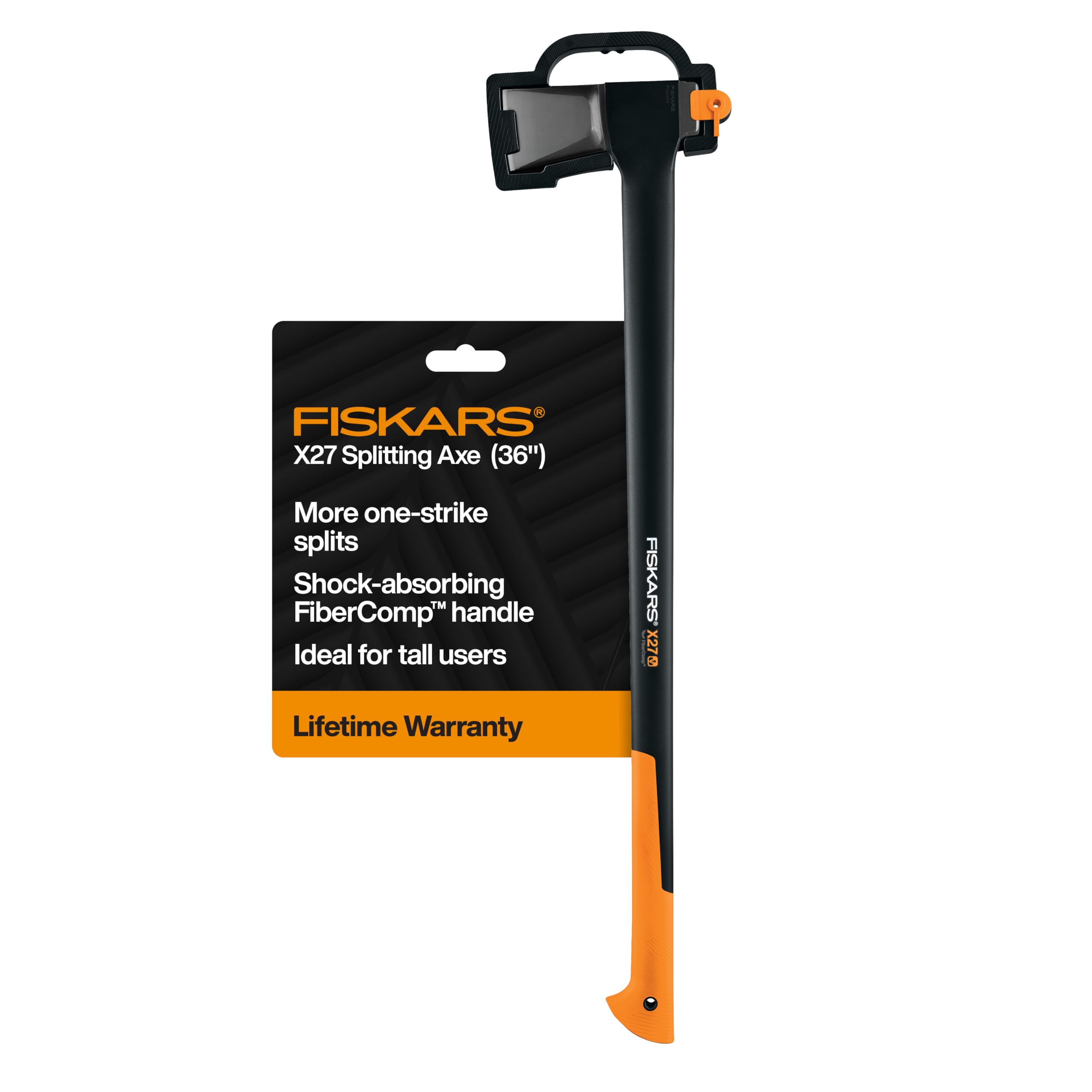
Fiskars X27 36-Inch Axe
Key Features
- Handle: FiberComp composite
- Blade grind: Bevel convex
- Head weight: 4.3 lb
- Overall length: 36 in
- Price: Premium
Twenty-inch oak rounds are not a hatchet problem, and they are not really a 24-inch axe problem either. The X27 is built for the stack of wood that needs a lever: a 4.3-pound head on a 36-inch handle, with a bevel-convex blade that widens behind the edge instead of tapering to a thin, sticky wedge.
The head does most of the talking. Total weight is 6.3 pounds, and the long handle is what makes that manageable — you swing it like a lever and let the arc build the speed, so a round that bounced a hatchet opens on the first or second strike. That convex grind is the quiet hero: it splits on the way in and releases on the way out, which is why you are not standing there wrestling a stuck head out of the block.
It is a specialist, and that is the point. The plain blade cover says it lives beside the splitting block rather than in the back of the truck, and the whole tool is built around a woodpile you work through in sessions, not a branch you meet on a walk. If your winters run on big rounds, this is the axe to buy for them; if you need one axe to do everything, the X15 is the better buy.
Pros
- Opens medium and large rounds in one or two strikes
- Bevel-convex blade releases instead of sticking
- Long handle builds speed without muscling
- Forged head backed by a lifetime warranty
Cons
- Wants a tall swing and clear space
- More axe than you need for kindling and limbs
If your firewood arrives as big rounds, buy this one. The 4.3-pound head and 36-inch handle turn a chore into a handful of swings.
Best for Packing and Travel
Estwing E24A Sportsman’s Axe
Key Features
- Handle: Leather
- Weight: 1.8 lb
- Construction: One-piece forged steel
- Overall length: 14 in
- Price: Budget
There is no head to tighten on the E24A, because there is no separate head: Estwing forges the head, neck and handle from a single piece of American steel, then wraps the grip in leather. That construction is the whole pitch, and it holds up — a hatchet that lives in a pack or under a truck seat is exactly the tool you do not want to think about between trips.
The leather is what we did not expect to care about. It is hand-sanded and lacquered, so it feels like a finished tool handle rather than a rubber sleeve, and the 14-inch length puts the head right where a one-handed swing wants it. At 1.8 pounds there is real steel behind that swing, which is what lets it bite through a wrist-thick branch instead of bouncing off it.
The working end is a hand-sharpened edge, and it is worth checking before your first trip — the grind can want a few passes to reach its best. The ballistic nylon sheath has a belt loop and holds the axe firmly, firmly enough that a new one takes a deliberate pull to draw and loosens with use. Kindling, limbs, tent stakes: it behaves like a small axe rather than a toy version of one.
Pros
- One-piece forged steel, nothing to loosen
- Leather grip that feels like a finished tool
- Compact 14-inch length packs easily
- Belt-loop sheath keeps the edge covered
Cons
- Heavier than a composite hatchet to carry far
A pack hatchet with nothing to come loose: one piece of forged steel, a leather grip, and a 14-inch length that rides easily in a daypack or a truck.
Best for Kindling and Stoves
Estwing Fireside Friend Maul
Key Features
- Handle: Steel with shock-reduction grip
- Blade length: 5.83 in
- Construction: One-piece forged steel
- Overall length: 14.25 in
- Price: Budget
A weighted wedge on a 14-inch handle, the Fireside Friend looks like a hatchet that lost an argument. At a wood stove it is the most useful tool in this group: the short, heavy head does the splitting for you, so you set the edge on a split log, swing once, and kindling drops off the side.
Estwing forges it from one piece of American steel and fits a molded shock-reduction grip, which matters more than it sounds when you are striking something short and hard twenty times in a row. The chisel edge and flat poll make it a wedge as much as an axe: when it buries itself in a knot, drive it home with a mallet instead of wrenching it sideways, and at a fire pit it doubles as a hammer for stakes and stubborn rounds.
We noticed how little strength it asks for — the head carries the swing, which suits anyone who does not want a big backswing beside a hearth. It is the least glamorous tool here, and the one that gets used every cold night.
Pros
- Turns split logs into kindling fast
- One-piece forged steel with a shock-reduction grip
- Flat poll works as a camp hammer
- Lets a light swing do the work
Cons
- Kindling and small logs only, not felling
- Finish varies: blasted on some units, painted on others
We reach for this one at the wood stove, not on the trail: a short, heavy wedge that makes kindling in a couple of swings.
How We Tested: Splitting, Slinging, and Sharpening
We started with a shortlist of more than 40 axes and narrowed it using the specs that actually predict performance: head steel and grind, handle material and grain orientation, advertised head weight, and whether a sheath came in the box. That filter left 12 axes spanning the budget, mid-range, and premium end of the category. Anything with a visibly loose hang, a handle that flexed under hand pressure, or a sheath that wouldn’t stay on was cut before it ever met wood.
Testing ran for eight months, mostly at my backyard splitting block but also on three camping trips and a long weekend at a cabin with a wood stove to feed. We counted swings to halve 16-inch oak rounds, noted whether the bit stuck fast or popped free, and worked through a pile of knotty elm that has defeated more than one maul. Every axe sliced newsprint out of the box, and we rechecked the edge after each session for rolls, chips, and shiny flat spots that meant it was dulling early.
Weight came off the spec sheet and onto a kitchen scale, then into our hands for 30-minute splitting sessions to see when fatigue set in and whether the balance point sat forward of the eye or close to the grip. To test durability we deliberately overstruck onto a rubber mat, tapped the head after every session listening for the loose ring that signals a failing hang, and left two axes out in the rain overnight to watch how the handles and finishes held up. At the end we compared what each one came with — sheath quality, whether it needed reprofiling, how the handle felt after months of use — against what it cost.
How to Choose an Axe for Camp and Firewood
The right axe has less to do with the blade than with the wood you plan to split and how much handle you can swing; get those two right and the rest is detail.
Match the Head to the Wood
Mass is what splits a round; sharpness only decides how cleanly it starts. A 14-inch hatchet with a head under two pounds is a kindling and limbing tool, and no amount of sharpening will push it through a big oak round — the head bounces and the handle stings your palms. For the rounds most fireplaces actually burn, a 24-inch axe with a 2-pound head is the sweet spot.
For anything bigger, step up to a 4-pound head on a 28- to 36-inch handle. A blunt-wedge maul is for the knotty, cross-grained pieces a keen splitting axe cannot release from; a splitting axe is for the straight-grained wood you process by the cord.
One Hand or Two
Handle length decides how you swing, and that has as much to do with your body and your chopping block as with the wood. A 14-inch hatchet is a one-handed tool for close work and shaving kindling; it is also the one most likely to catch a shin, so keep your off hand clear and your swing short.
A 24-inch axe swings with one hand or two, and a 36-inch splitter is a two-handed lever that needs a clear arc and a level block. Shorter users lose most of the advantage of a long handle, and a 28-inch splitting axe is often the better fit.
Composite, Forged Steel, or Wood
Handles are where most of the durability argument lives. Molded composite handles, like the FiberComp on both Fiskars here, soak up shock, shrug off mis-hits, and never loosen at the head — the head is molded on, which also means a failed handle retires the whole axe. One-piece forged steel, as on the Estwings, is the most robust option and the heaviest.
Wood is the traditional choice and the only one you can rehaft yourself, but it wants dry storage and occasional attention. Pick composite for comfort, steel for abuse, wood for repairability.
Edges, Sheaths and What Comes in the Box
Every axe here ships with an edge, and every one of them will cut better after ten minutes with a file. Judge a new edge by whether it bites into a scrap of softwood, not by whether it shaves hair — a working axe edge is thicker than a knife’s because it has to survive knots and the occasional rock.
Sheaths tell you how the maker expects the tool to travel. A locking cover with a carry handle is for the truck bed, a belt-loop nylon sheath is for walking, and a plain blade cover means the axe lives beside the splitting block.
Frequently Asked Questions
How do I stop an axe head from sticking in the log?
Strike through the round rather than stopping at it, and never pry sideways once the blade buries — that is how edges get bent. If it does stick, lift the axe and the log together and bring the butt of the handle down against the block; the round usually drops off.
Blade geometry does more than polish here. A convex grind widens behind the edge and releases far more easily than a flat, thin wedge, which is why splitting axes are ground the way they are.
How should I store an axe between trips?
Dry, sheathed and out of reach. Wipe the blade, put a thin film of light oil on the edge, and keep the sheath on so nobody brushes the edge reaching past it.
Somewhere dry matters more than the method: a damp shed rusts an edge faster than a dry garage corner, and a sheath left on a wet axe traps the moisture against the steel.
Can I bring an axe on a camping trip?
Not in carry-on luggage — pack it in checked baggage inside a rigid case with the sheath on. Beyond the flight, it is a per-place question: many parks restrict cutting standing or fallen wood, so check the rules for the specific park or forest before you count on an axe for firewood.
Plenty of campgrounds sell bundles instead, and a hatchet is usually all you need to turn those into kindling.
Final Verdict
The Fiskars X15 is the axe most people should buy. It is the only one here that handles limbing, camp firewood and kindling without becoming a chore to swing, and its mid-length handle reaches jobs a hatchet cannot.
If your woodpile is built from big rounds, go straight to the X27 — that is exactly what the extra head weight and 36-inch handle are for. And if the axe lives in a pack rather than beside the block, the one-piece Estwing is the one to carry.