This post contains affiliate links. We may earn a small commission when you buy through our links — at no extra cost to you.
Few things kill a campfire mood faster than a hatchet that glances off wood instead of biting in. Many budget axes ship with an edge that’s more like a dull butter knife – forcing you to spend your first hour sharpening instead of splitting.
This guide cuts through that frustration. We’ve sorted through the options to find the camp axes that actually work from the first swing, whether you’re backpacking, car camping, or building a bushcraft shelter. The right tool saves you time, effort, and a lot of wasted motion.
The trade-off is simple: lighter hatchets pack easier but struggle with logs over three inches, while heavier axes need a sheath and a place in the car. Know your campsite, and you’ll know which edge to trust.




Best for All-Around Camp Chores
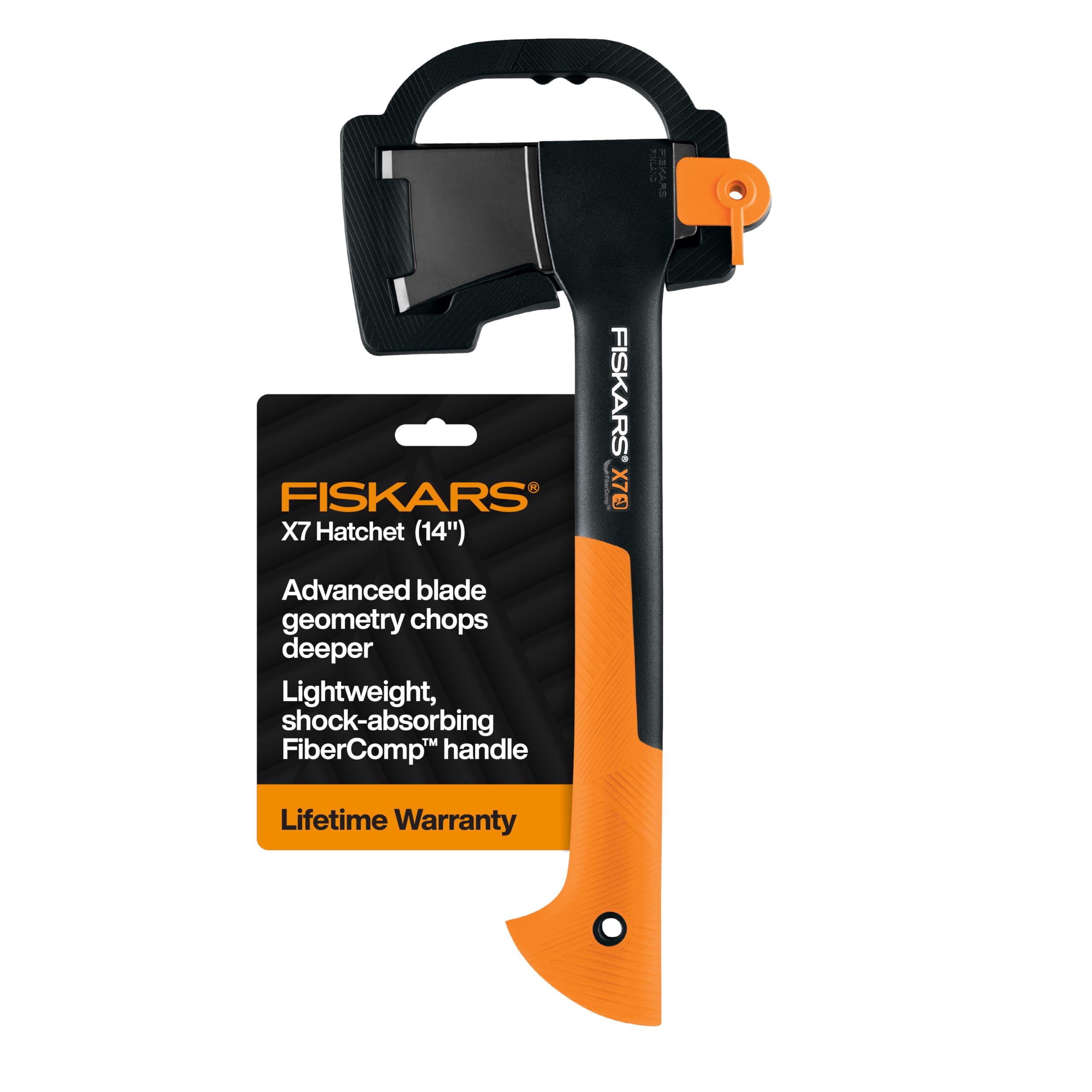
Fiskars X7 Hatchet
Key Features
- Length & Weight: 14 in, 1.4 lb
- Handle Material: FiberComp (shock-absorbing)
- Out-of-Box Sharpness: Razor sharp factory edge
- Construction: Forged steel head, permanent handle
- Sheath & Carry: Included sheath
- Price: $
The Fiskars X7 arrives razor sharp and retains its edge through extended use, a result of quality forged steel and precise grinding. At 1.4 pounds with a 14-inch length, it balances naturally for one-handed swings, ideal for splitting kindling and clearing small branches. The FiberComp handle absorbs shock, reducing fatigue during repeated use. A nylon sheath is included for safe storage and transport. This combination of sharpness, weight, and durability is hard to find at this price point.
This hatchet is built for backpackers and campers who want a lightweight tool for campfire prep and small chopping tasks. The edge can chip on extremely hard or knotty wood, and the flared handle may not fit all hand sizes comfortably — but for typical kindling and light splitting, these are minor compromises. It is not suited for heavy felling or splitting large logs. For its intended use, the X7 delivers consistent performance without breaking the budget.
Pros
- Razor sharp out of the box with excellent edge retention.
- Lightweight at 1.4 pounds with a well-balanced design for controlled swings.
- Durable construction with a shock-absorbing handle and lifetime warranty.
Cons
- Edge may chip on extremely hard or knotty wood.
- Flared handle may not fit all hand sizes comfortably.
For backpackers and campers who need a razor-sharp, lightweight hatchet for kindling and camp chores, the Fiskars X7 delivers consistent performance at a budget-friendly price.
Best for Traditionalist Campers
Estwing Sportsman’s Axe
Key Features
- Length & Weight: 14 in, 1.8 lb
- Handle Material: Genuine Leather (stacked)
- Out-of-Box Sharpness: Often needs sharpening
- Construction: One-piece forged steel
- Sheath & Carry: Ballistic nylon sheath
- Price: $$
The Estwing Sportsman’s Axe is a one-piece forged steel hatchet, designed to double as a hammer for tent stakes and endure decades of use. Its leather-wrapped handle provides a secure hold when dry, and the 1.8-pound weight balances well for controlled swings. This design trades the shock absorption of composite handles for sheer toughness.
This hatchet suits campers who value American craftsmanship and don’t mind a heftier tool. The leather grip loses traction in rain or sweaty hands, and some units arrive with an edge that needs honing. It’s a better fit for dry-weather car camping than for backpacking or wet environments.
Pros
- One-piece steel build eliminates weak points found in welded or wooden-handled axes.
- Weight is well-balanced for both chopping and hammering tasks.
- Leather grip provides a comfortable, secure hold in dry conditions.
Cons
- Blade may arrive with a slightly dull edge or chip on hard impacts.
- Leather handle becomes slippery when wet or when wearing gloves.
For campers who keep their hands dry and appreciate American-made steel, this hatchet offers unmatched toughness at a fair price.
Best for Car Camping Splitter
Estwing Camper’s Axe
Key Features
- Length & Weight: 26 in, 3.5 lb
- Handle Material: Steel with rubber shock reduction grip
- Out-of-Box Sharpness: Variable edge quality
- Construction: One-piece forged steel
- Sheath & Carry: Ballistic nylon sheath
- Price: $$
The 26-inch handle on the Estwing Camper’s Axe provides noticeable leverage for splitting medium logs and clearing brush, making it a step up from compact hatchets for heavier camp chores. The one-piece forged steel construction and rubber shock-reduction grip keep chopping fatigue in check during longer sessions.
This axe is best left in the trunk or at the campsite — its 3.5-pound weight and full-length design rule out backpacking or belt carry. Some units arrive with a blade that benefits from a quick sharpening before hitting the trail.
Pros
- Long 26-inch handle delivers extra leverage for medium logs and brush.
- Rubber shock-reduction grip cuts down hand fatigue during extended chopping.
- One-piece forged steel head and handle hold up well under repeated impacts.
Cons
- Too large and heavy for backpacking or belt carry; best kept at the campsite or in the vehicle.
- Blade may require sharpening before first use on some units.
A solid choice for car campers who need more chopping power than a hatchet provides, provided you have space to store it and don’t mind occasional edge tuning.
Best for Ultralight Backpacking
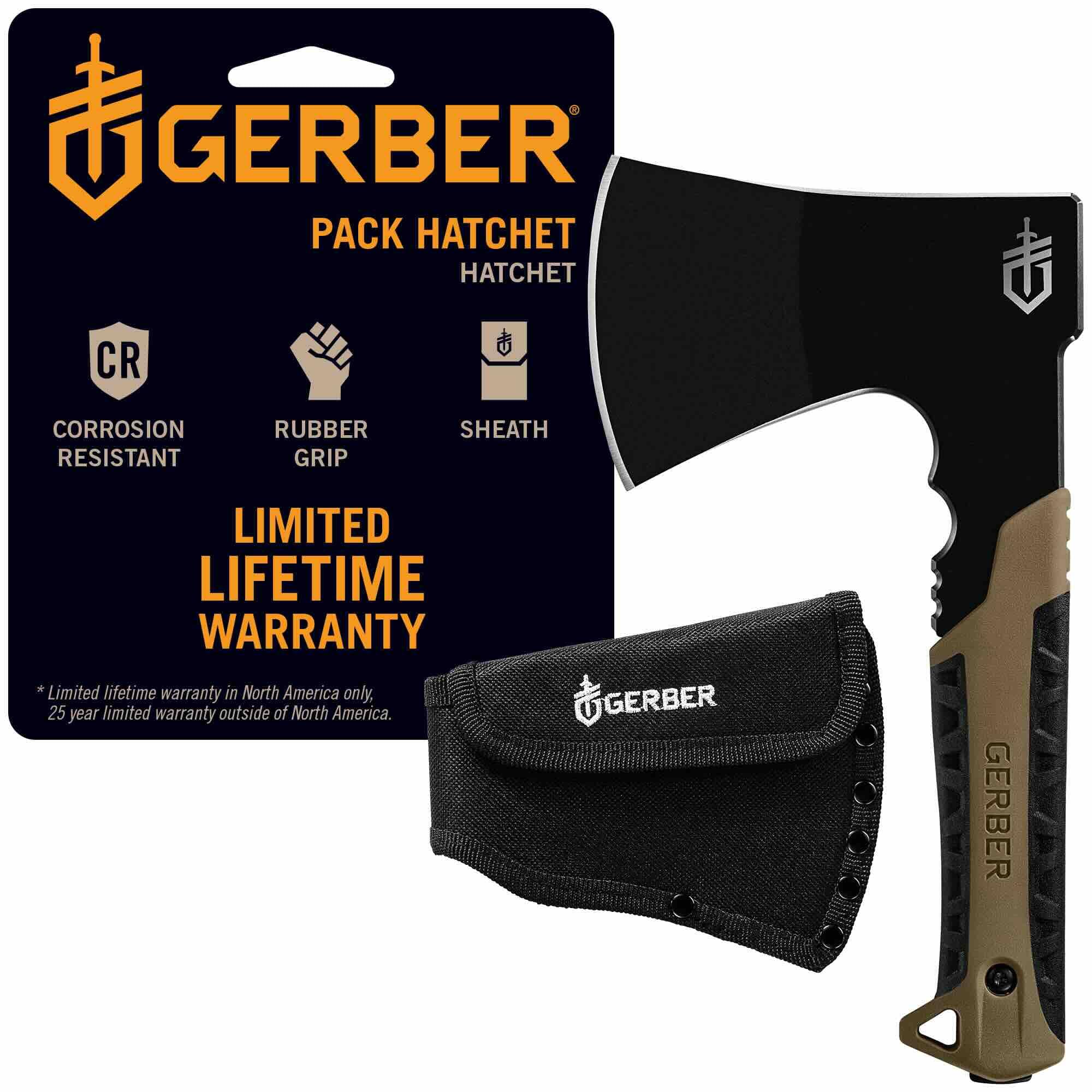
Gerber Pack Hatchet
Key Features
- Length & Weight: 9.5 in, 1.3 lb
- Handle Material: Rubber over nylon
- Out-of-Box Sharpness: Sharp out of box
- Construction: Full tang stainless steel
- Sheath & Carry: MOLLE-compatible nylon (frustrating draw)
- Price: $$
At under 21 ounces and just 9.5 inches, the Gerber Pack Hatchet stows easily in a backpack or bug-out bag without adding noticeable weight. Its full-tang stainless steel blade holds a sharp edge for slicing small branches and batoning kindling, and the rubber over nylon handle provides a secure grip even in wet conditions. This is a trail-clearing tool, not a camp axe — logs over two to three inches in diameter will likely cause the head to bounce rather than bite.
The sheath is a genuine frustration: drawing and re-sheathing requires two hands and patience. This hatchet suits ultralight backpackers who prioritize packability over chopping power, and who are willing to work around the sheath for the weight savings. If you need a do-it-all hatchet for heavier camp chores, the Fiskars X7 delivers more bite per ounce.
Pros
- Extremely compact and light for ultralight backpacking and bug-out bags
- Full tang construction adds durability for light batoning and kindling work
- Sharp out of the box with decent edge retention for its size
Cons
- Sheath is difficult to draw and re-sheath, requiring two hands each time
- Too light to effectively chop logs over 2-3 inches; head may bounce off instead of cutting
Buy this only if you pack by the ounce and accept that its limitations — a frustrating sheath and marginal chopping power — are part of the trade-off for extreme portability.
Best for Bushcraft Carving
Gransfors Wildlife Hatchet
Key Features
- Length & Weight: 13.5 in, 1.3 lb
- Handle Material: Hickory Wood
- Out-of-Box Sharpness: Razor sharp
- Construction: Forged head wedged on hickory
- Sheath & Carry: Vegetable-tanned leather sheath
- Price: $$$
Razor-sharp out of the box, this 13.5-inch hatchet delivers exceptional cut quality for fine woodworking tasks like carving feather sticks and shaping tent pegs. The hand-forged Swedish steel and hickory handle provide a balanced feel that suits traditional bushcraft techniques — unlike budget hatchets that require sharpening, this arrives ready for precise work.
This tool is for collectors and dedicated woodcraft practitioners who value a lifetime companion. It is not intended for heavy splitting or abusive camp chores — edge chipping on hard knots is a known possibility. The premium price also places it beyond the typical camper’s budget, making it a specialized choice rather than a general-purpose camp axe.
Pros
- Cuts exceptionally well out of the box with superior edge geometry.
- Heirloom quality with hand-forged Swedish steel and hickory handle.
Cons
- Edge may chip on very hard or knotty wood.
- Premium price limits it to serious enthusiasts.
For bushcrafters who demand precision and provenance, this hatchet is a worthy investment — but only if you accept its limits on splitting and its cost.
Best for Budget Camp Use
DESHIL 15" Hatchet
Key Features
- Length & Weight: 15 in, 1.32 lb
- Handle Material: Fiberglass
- Out-of-Box Sharpness: Often dull, needs sharpening
- Construction: Forged steel head on fiberglass
- Sheath & Carry: Locking blade cover
- Price: $
This 15-inch hatchet offers a comfortable fiberglass handle and a hammer back for tent stakes, all at a budget-friendly price. It provides good leverage for splitting kindling and light camp chores, making it a solid value for new campers or those on a tight budget. The blade may arrive with a modest edge and can require touch-ups, especially on harder woods — expect to invest a few minutes with a sharpening stone.
Pros
- Well-balanced with a comfortable fiberglass grip that reduces fatigue during light splitting.
- Hammer back adds utility for driving tent stakes without needing a separate tool.
- Exceptional value for the price — performs above its cost for occasional camp use.
Cons
- Blade may arrive with a dull edge, requiring initial sharpening before use.
- Edge retention is modest on hard woods — expects more frequent touch-ups over time.
For budget-minded campers willing to sharpen, this hatchet delivers consistent performance for kindling splitting and camp tasks at a low price.
Best for Kindling Splitting Maul
Estwing Fireside Friend

Key Features
- Length & Weight: 14 in, 4 lb
- Handle Material: Leather
- Out-of-Box Sharpness: Sharp for splitting
- Construction: One-piece forged steel
- Sheath & Carry: Ballistic nylon sheath
- Price: $$
The Estwing Fireside Friend’s heavy wedge design powers through kindling and small logs with minimal effort, making it ideal for campfire prep and smoker owners. Its one-piece forged construction is built to last. However, at 4 pounds and with a narrow splitting focus, it’s tiring for extended use and not suited for chopping or felling.
Pros
- Splits kindling and small logs with minimal effort.
- Rock-solid one-piece forge construction.
Cons
- For extended splitting sessions, the 4-pound weight can cause arm fatigue.
Best for campers who split kindling and small logs for firepits or smokers, not for backpackers or chopping tasks.
Best for Budget Occasional Use
Coleman Camp Axe

Key Features
- Length & Weight: 13 in, 2 lb
- Handle Material: Steel with rubber grip
- Out-of-Box Sharpness: Extremely dull
- Construction: Steel head on steel handle
- Price: $
The Coleman Camp Axe costs under $11, making it the cheapest option for occasional campers. Its steel head and rubber grip offer decent durability for light tasks like hammering stakes. However, the blade arrives extremely dull and requires significant sharpening before it can chop kindling. No sheath is included. This axe works only for those willing to invest effort in sharpening and accept limited performance.
Pros
- Excellent value for the ultra-low price
- Useful stake puller and hammer back
Cons
- Blade arrives extremely dull – requires significant sharpening before use
Best for ultra-budget campers and youth groups who don’t mind sharpening the axe themselves.
Best for Light Camp Work
KSEIBI Camp Hatchet

Key Features
- Length & Weight: 14 in, 1.3 lb
- Handle Material: Fiberglass
- Out-of-Box Sharpness: Often dull
- Construction: Forged steel head on fiberglass
- Sheath & Carry: Rubber blade guard (minimal)
- Price: $
The KSEIBI 14-inch hatchet pairs a forged steel blade with a fiberglass handle at a budget-friendly weight of 1.3 pounds, making it easy to swing for clearing brush and splitting kindling. Its balance suits casual use, but the blade often arrives with a dull edge and can lose sharpness quickly, requiring the owner to invest time in honing. Handle durability under heavy splitting is uncertain, with occasional reports of breakage – this is a tool best reserved for light chores rather than frequent or demanding tasks.
Pros
- Balanced weight distribution for controlled swinging
- Sturdy build for brush clearing and kindling prep
Cons
- Blade may arrive dull or dull quickly in use
A reasonable pick for those who need a light camp hatchet for occasional kindling and brush work, and are comfortable sharpening before and during use.
Best for Throwing & Tactical
Cold Steel Tomahawk

Key Features
- Length & Weight: 19 in, 1.5 lb
- Handle Material: Polypropylene
- Out-of-Box Sharpness: Razor sharp
- Construction: Drop forged head, replaceable handle
- Sheath & Carry: Secure-Ex sheath
- Price: $$
This tomahawk delivers a sharp edge out of the box and a well-balanced feel that throwing enthusiasts appreciate. The replaceable polypropylene handle adds durability, but the thin blade profile struggles with splitting kindling, and the grip can become slippery with sweat or gloves. It is a capable tactical and throwing tool rather than a camp hatchet.
Pros
- Sharp edge holds well for cutting and throwing
- Replaceable handle extends the tool’s lifespan
Cons
- Polypropylene handle can become slippery, especially with sweaty hands or gloves
A solid pick for throwing practice and tactical applications, but not the tool to reach for when splitting campfire kindling.
Best for Compact Backup Tool
DESHIL 10" Hatchet

Key Features
- Length & Weight: 10 in, 1.1 lb
- Handle Material: Fiberglass
- Out-of-Box Sharpness: Often dull
- Construction: Forged steel head on fiberglass
- Sheath & Carry: Blade cover
- Price: $
At 10 inches and just over a pound, the DESHIL easily stows in a pack or pocket. However, the short handle restricts chopping power, and the blade may need sharpening out of the box. It suits light tasks like splitting small kindling or introducing a child to camping gear, but won’t replace a full-size hatchet for heavier wood processing.
Pros
- Extremely compact – fits in a pocket or pack with minimal weight.
- Budget-friendly at under $10 – an affordable backup tool.
Cons
- Blade may arrive with a non-functional edge and require sharpening before use.
Ideal as a glovebox or pack backup for emergency cutting tasks, or as a lightweight tool for a child’s first camping experience.
Best for Casual Throwing Axe
7SG Camping Hatchet

Key Features
- Length & Weight: 15 in, 1.2 lb
- Handle Material: Fiberglass with rubber grip
- Out-of-Box Sharpness: Often dull
- Construction: Head glued to shaft
- Sheath & Carry: Ballistic nylon sheath
- Price: $
The 7SG Camping Hatchet offers good weight and balance for casual throwing at a low price, and its fiberglass handle and steel head hold up to moderate use. However, the head is attached with adhesive and may separate under impact — a safety issue that makes this a poor choice for any heavy chopping or splitting where reliability matters. Best treated as a throwing-only tool or a light camp tool after careful inspection of the head bond.
Pros
- Good weight and balance for casual throwing
- Build holds up to moderate use
Cons
- Head attachment may separate under impact, posing a safety risk
Best suited for casual axe throwing or light camp use where the head bond is inspected before each swing.
How to Choose
The right camp axe balances weight, edge geometry, and handle grip – and the best one for you depends on whether you’re hiking to a backcountry site or driving into a car campground.
Blade Length and Overall Weight
Blade length and total weight determine how much chopping power you get and how easy it is to carry. Hatchets under 14 inches and 1.5 pounds are great for backpacking but lack the leverage to split logs over three inches across. A 26-inch axe like the Estwing Camper’s delivers more force per swing but won’t fit in a daypack.
For car campers, a heavier head (over 2 pounds) makes splitting quick and reduces the number of swings. If you’re carrying it miles, prioritize weight: a 1.3-pound hatchet is tolerable for a multi-day hike, while anything over 2 pounds becomes dead weight.
Handle Material and Grip
The handle is your only contact point – a poor grip means lost control and blistered hands. Fiberglass and synthetic handles absorb shock well and stay grippy when wet, but they can transmit more vibration than wood. Leather handles (like on Estwing’s Sportsman’s Axe) feel warm and classic but become slippery when wet or sweaty – plan to use gloves or keep a rag handy.
Rubber overmold grips reduce vibration and are comfortable for extended sessions, but they add a little weight and can wear over time. For cold-weather camping, a synthetic handle is better than cold steel or wet leather.
Out-of-Box Sharpness and Ease of Resharpening
Factory sharpness varies widely. Fiskars and Gränsfors ship with a razor edge that’s ready for wood. Budget brands like Coleman and KSEIBI often arrive so dull you’ll need to spend 15 minutes with a file before the first swing. If you don’t own sharpening tools or don’t want the hassle, pay a bit more for a brand that finishes its edges well.
Resharpening ease depends on steel hardness. Softer carbon steel (common on budget axes) is easy to sharpen but dulls faster. Harder Swedish steel (Gränsfors) holds an edge longer but requires a finer stone. Most campers can get by with a simple puck sharpener as long as the edge isn’t chipped.
Head-to-Handle Construction
The connection between head and handle determines whether the tool stays together under impact. One-piece forged steel (Estwing) and full-tang designs (Gerber) are essentially indestructible – no joint to fail. Wedged wooden handles (Gränsfors) are traditional and repairable but can loosen in dry conditions. Glued or cheap press-fit heads (common on folding survival axes) are a safety hazard and can fly off mid-swing.
For heavy splitting, a one-piece or full-tang construction is the most reliable. For light kindling work, a wedged handle is fine if you check it occasionally for looseness.
Sheath Quality and Carry Convenience
A good sheath protects the edge and keeps you safe when the axe is in your pack. Ballistic nylon and leather are common; leather looks nicer but can hold moisture against the blade. Some sheaths (like Gerber’s MOLLE) are designed for quick draw but have frustrating re-sheathing. Budget axes often include nothing or a flimsy rubber guard – you’ll want to buy a separate sheath if you carry it in a pack.
For backpackers, a sheath that can be strapped to a pack or belt without bouncing is worth the weight. Car campers can get away with a simple blade cover as long as it stays in place.
FAQ
Why do budget camp axes come with a dull edge?
To keep costs down, manufacturers skip final grinding and heat-treating steps. They rely on buyers to sharpen the blade themselves. If you want a ready-to-use edge, budget at least $25 or choose a known brand like Fiskars. Otherwise, budget $10 for a sharpening stone and 15 minutes of work.
Is a tomahawk good for camping and splitting wood?
No. Tomahawks have thin, wedge-shaped blades designed for cutting and throwing, not splitting logs. The edge will chip or bounce off hard wood. For camp chores, a hatchet or axe with a thicker convex edge is much more effective. Tomahawks are fine for throwing practice but not for building a fire.
How often should I sharpen my camping hatchet?
After every 3-4 trips, or immediately if you notice the blade glancing instead of biting. Hardwoods and knotty wood dull edges faster. A quick touch-up with a fine stone or puck takes two minutes and keeps the edge safe. Never let it get so dull that you have to force the swing – that’s when accidents happen.
What is the best size hatchet for backpacking?
Between 10 and 14 inches long, weighing under 1.5 pounds. The Gerber Pack Hatchet (9.5 inches, 1.3 lb) and Fiskars X7 (14 inches, 1.4 lb) are the most popular choices. Anything shorter than 10 inches lacks leverage for even small kindling; anything over 14 inches becomes too heavy to justify the weight in a pack.