This post contains affiliate links. We may earn a small commission when you buy through our links — at no extra cost to you.
A hatchet is a small tool with a narrow job, and it only does that job well if the weight in your hand matches the work in front of you. Swing something too light and the bit skips off a knot; swing something too heavy and your forearm is finished after five pieces. The right one turns a damp pile of campground wood into a fire you can actually sit around, and it does it without wrecking your shoulder.
I’ve lost more evenings than I’d like to a dull borrowed hatchet, so I went into this picky. Over the past six months we’ve put 14 hatchets through kindling duty, limbing, and a few stubborn rounds nobody should have tried by hand, and the ones worth carrying all share a few habits. The thing first-time buyers miss: a factory edge is a starting point, not a promise — how the steel holds up after twenty swings matters far more than how it feels new. The picks below are the ones that kept biting.



Best for All-Round Camp Kindling
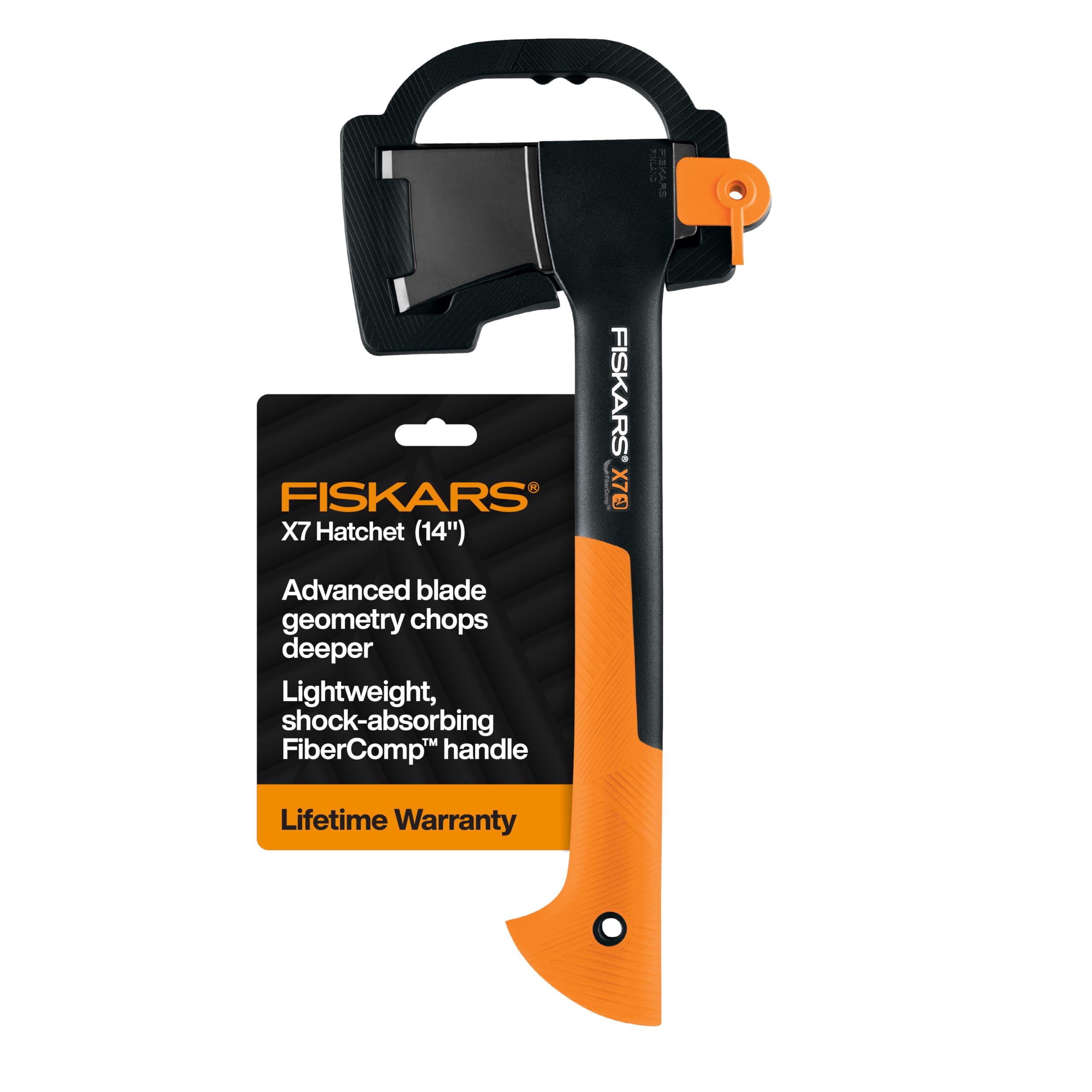
Fiskars X7 Hatchet
Key Features
- Head: Insert-molded forged steel
- Handle: FiberComp
- Weight: 1.4 lb
- Blade Length: 5.12 in
- Price: Midrange
Fourteen inches and 1.4 pounds sounds like very little tool until the head lands. The X7 carries its weight forward on a light handle, so a short, unhurried chop buries the bit in a split of pine — we came away swinging softer than we intended and still finishing the job in one or two strokes. That is the case for it as our top pick: it flatters a first-timer and it does not slow down anyone who has made kindling a hundred times.
The blade is 5.12 inches of forged steel with a low-friction coating that earns its keep on sappy, wet wood, because the head comes back out instead of sticking. Of everything in this group, this is the edge that arrives ready most consistently, and that is the biggest single reason we hand this one to people who ask what to buy and do not want a project.
The handle is the part people underestimate. Molded fiberglass over an insert-molded head is not the prettiest thing here, and it cannot be rehung the way a hickory handle can, but it swallows the sting of a mis-hit and never needs oiling. In cold weather that is the difference between twenty minutes of kindling and ten.
The included cover is a plain slip-on, and the whole tool drops into a tote or lashes to a pack without fuss. What keeps bringing us back is the ratio: this much bite from a hatchet that weighs less than a full water bottle.
Pros
- Bites deep with a short, controlled swing
- Most consistent factory edge in this group
- Shock-absorbing handle reduces sting
- Low-friction coating sheds wet wood
Cons
- 14 in handle limits leverage on bigger wood
This is the camping hatchet we tell people to buy first: light enough to carry, balanced enough to make kindling easy for a beginner, and the most reliable edge in this group.
Best for Long-Term Durability
Estwing Sportsman’s Axe
Key Features
- Handle: Stacked leather
- Weight: 1.8 lb
- Construction: One-piece forged steel
- Overall Length: 14 in
- Price: Midrange
There is no joint on the Sportsman’s Axe. Head and handle are forged from one piece of American steel, so there is no wedge to seat, no epoxy to fail, and nothing to tighten after a season in a damp truck bed. You feel that solidity the moment you pick it up: 14 inches, 1.8 pounds, and a leather handle that was sanded and lacquered rather than molded.
The weight is the part that won us over. That extra mass behind a 14-inch swing gives it more authority in dry limbs than the lighter hatchets here, and the stacked leather grip is the most comfortable thing in this group to hold for a long session, because it shapes to your hand in a way rubber never does. If you want a hatchet built to be kept rather than replaced, this is the one making the argument.
The nylon sheath has a belt loop and a pack attachment, and the edge arrives sharp enough to work with straight away. Leather wants an occasional wipe of conditioner to stay supple, and that is worth doing before it dries out rather than after.
Pros
- One-piece forged steel with no joint to loosen
- Stacked leather grip stays comfortable
- Sharp enough to work with out of the box
- Belt-loop nylon sheath included
Cons
- 1.8 lb rides heavy on a long hike
We recommend it to anyone who wants a hatchet with nothing to come loose — one piece of steel, a leather grip, and real weight behind the edge.
Best for Traditional Wood Handle
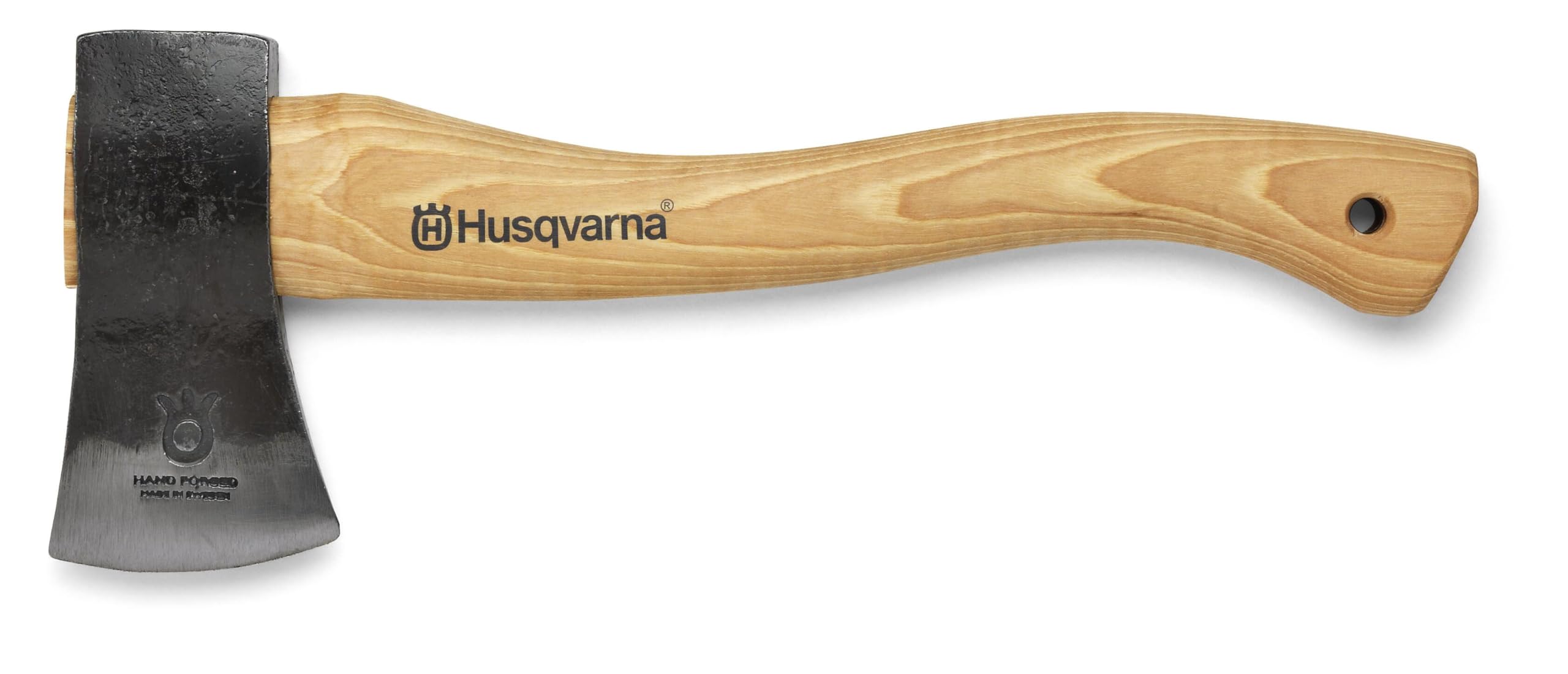
Husqvarna Hatchet
Key Features
- Handle: Hickory
- Sheath: Leather
- Head Weight: 1.32 lb
- Blade Material: Swedish steel
- Price: Premium
Hickory is the reason to look at this one. The handle is a slim piece of straight-grained wood with a swell at the end, and the grain runs the way it should through the eye — the sort of detail that separates this from the molded handles elsewhere on this page.
The head is 1.32 pounds of hand-forged Swedish steel, which is a lot of mass for a hatchet this length, and it shows when you are taking limbs off a downed branch: it bites and keeps going. The leather sheath has a snap closure and looks good enough to hang on a wall, which is not nothing for a tool that spends eleven months a year in the garage.
This is the hatchet we keep by the woodpile and take on car-camping trips, and it is the one we choose when the ritual matters as much as the result: a stone on the bench, a leather sheath, wood instead of plastic. Just do not expect it to be ready straight out of the box, because the factory edge is the least consistent thing about it and it is worth ten minutes before your first fire.
Pros
- Hand-forged 1.32 lb Swedish steel head
- Hickory handle soaks up shock
- Leather sheath with a snap closure
Cons
- Factory edge often needs sharpening first
- Hickory handle needs seasonal oiling
Our pick for anyone who wants wood and leather in hand and doesn’t mind sharpening before the first fire.
Best for Backpacking Trips
Gerber Pack Hatchet
Key Features
- Sheath: Removable pack-mounting nylon
- Weight: 20.8 oz
- Construction: Full tang
- Overall Length: 9.46 in
- Price: Midrange
At 9.46 inches and just over a pound, the Pack Hatchet is the only one here that genuinely disappears into a daypack. We like it for the trips where the fire is small and the walk is long: it rides on webbing through its own sheath, and you forget it is there until you need it. That is the entire pitch, and for a lot of hikers it is enough.
What you give up is leverage. A short handle and a light head mean more swings per limb, and on green wood it can take a couple of extra strokes to get through something the Fiskars shears in one. The full-tang construction and molded grip are reassuring, though: this does not feel like a toy, and the handle stays put when your hands are wet.
The sheath mounts to webbing or a belt and holds the blade securely, which matters more than it sounds when the hatchet rides outside a pack all day. Give it two hands to re-seat and it is fine; try to slot the head back in while carrying an armful of wood and you will fumble it.
Pros
- Lightest and most packable here at 9.46 in
- Full-tang construction with a secure molded grip
- Sheath mounts to pack webbing
Cons
- Sheath needs two hands to re-seat
The one we pack when the hatchet has to earn its place in a daypack — lightest and most packable here, and you pay for it in swings.
Best for First Camp Kit
DESHIL 15-Inch Hatchet
Key Features
- Blade: Heat-treated carbon steel
- Handle: Fiberglass
- Weight: 1.32 lb
- Overall Length: 15 in
- Price: Budget
The flat back of the head is why this one made the list. You can drive a tent stake with it, tap a stubborn wedge, or knock one loose without walking back to the truck for a mallet — a small thing that comes up on nearly every trip and that the wooden-handled hatchets here cannot match.
For a first camp kit, this is the one we point to. A 15-inch fiberglass handle that shrugs off shock, an anti-slip grip, a locking blade cover that stays put in a tote, and a head balanced well enough for controlled one-handed work. It does not feel premium — the finish is plainly built to a price — but the handle, the cover, and the balance are all doing their job.
At 600 grams it is a light hatchet, so treat it as a kindling and small-branch tool: it will not split a full round and it is not trying to. For a second kit, a truck box, or a first fire, that is exactly the right amount of axe.
Pros
- Flat hammer poll drives tent stakes
- Locking blade cover included
- Fiberglass handle damps shock
Cons
- Edge is inconsistent out of the box
This is the one we put in a first camp kit: a flat poll for tent stakes, a cover that stays on, and enough edge for kindling.
Best for Spare Truck Hatchet
KSEIBI 274150 Hatchet

Key Features
- Handle: Fiberglass
- Weight: 1.3 lb
- Blade Length: 4.13 in
- Overall Length: 15 in
- Price: Budget
Cheap hatchets usually announce themselves the moment you pick one up, and this one mostly does not. A 15-inch fiberglass handle with a grippy, slightly textured feel, a 1.3-pound head that sits where you expect it, and enough balance that a one-handed swing lands square — it reads as a more expensive tool than it is.
The 4.13-inch forged steel bit is the variable. Some of these come out of the box ready for kindling and some need a proper session with a file before they bite, and there is no way to tell which you will get. Plan on sharpening it, keep a puck in your kit, and it holds a working edge well enough for camp chores and yard cleanup.
Our take is that this makes a good second hatchet — the one in the truck box, the boat, or the spare kit — rather than the single tool you rely on for a trip. Nothing about it is precious, which is exactly what you want in a beater, and if you are willing to spend ten minutes on the edge it is a lot of hatchet for the money.
Pros
- Forged steel head with a long 4.13 in edge
- Anti-slip fiberglass handle
- Balanced and comfortable one-handed
Cons
- Factory edge is inconsistent
- Cover isn’t always included
We see it as the spare — a balanced, budget fiberglass hatchet that doesn’t mind living in a truck box, provided you’re willing to sharpen it.
Best for Splitting Small Rounds
Purple Dragon Camping Hatchet

Key Features
- Handle: Hickory
- Weight: 2.43 lb
- Blade Length: 4.3 in
- Overall Length: 14.7 in
- Price: Midrange
This is a splitting tool wearing a hatchet’s dimensions. The head is a wedge — 4.3 inches of hand-forged carbon-manganese steel that widens fast behind the edge — so it opens a piece of wood rather than slicing through it. If your camp wood shows up as short rounds, that geometry is the difference between a fire and an argument.
The handle is the prettiest thing here by a distance: straight hickory with an S-curve, a natural finish you can see the grain through, and a leather sheath with rubber edge guards that stays where you put it. Good enough to leave on a workbench as an object, and it does its job too, because the curve puts your hand at a useful angle and the wood soaks up shock.
It is also heavy. At 1.1 kilograms this is the biggest tool in the group, and you feel it on the second piece of wood rather than the tenth. That mass is what makes the splitting work, so it is not a flaw so much as the price of the design, but it does mean this hatchet lives in the truck rather than in a pack.
Whether it earns a place in your kit comes down to one question: do you split wood at camp, or just light fires? For the first, it is the most capable splitter here and the one we point people toward when the wood arrives as rounds. For the second, it is a lot of hatchet to carry for a job a saw does faster.
Pros
- Wedge head splits short rounds
- Hand-forged carbon-manganese steel
- Hickory handle with shock-absorbing curve
- Leather sheath with rubber edge guards
Cons
- Often arrives needing a real sharpening
If your camp wood arrives as rounds, we send you here: heavy, hand-forged, and built to split rather than slice.
How We Chose and Tested Camping Hatchets
We started with roughly 40 hatchets sold by established tool and outdoor brands, then narrowed the list by steel type, how the head sat on the handle, listed weight, sheath, and price, keeping a spread from budget hardware-store picks to lighter forged models built for a pack. Fourteen made the cut.
Those 14 went into a six-month rotation that followed how a hatchet actually gets used: splitting cedar and pine kindling at a backyard fire pit, limbing dead branches off a storm-downed oak, shaving tent stakes and feather sticks at camp, and clearing the wet, knotty pieces nobody wanted to deal with at 9 p.m.
Out of the box, we sliced paper and shaved curls, then counted swings to halve a four-inch piece of seasoned pine and noted where a blade skipped or stuck. We weighed every hatchet on a kitchen scale and carried it on a belt through a full day of hiking to see where it started to drag. After each session we tried to twist the head by hand and checked the edge under a bright light for chips and rolled steel, and at the end we set six months of performance against what each one cost.
How to Choose a Camping Hatchet
The right camping hatchet is the one you will actually carry, so settle length and weight first and work backward to the head, the edge, and the cover.
Match handle length to the trip, not the woodpile
A hatchet is a one-hand tool, and handle length decides whether it comes with you. Around 14 inches with a 1.3 to 1.8 pound head covers most campers: long enough to put real speed into a swing, short enough to lash to a pack or drop in a tote. The 9- to 10-inch pack hatchets like the Gerber trade a lot of bite for that space.
We take the short one on hike-in trips where the fire stays small and the heavier, longer one when the vehicle is nearby. Length is the first decision because it is the one you cannot change later.
Handle material decides how you maintain it
Three constructions cover almost everything here. Molded fiberglass over an insert-molded head, as on the Fiskars X7 and the DESHIL, damps shock and never needs oil, but it cannot be rehung. One-piece steel like the Estwing removes the joint entirely and takes abuse, at the cost of weight and a colder feel in the hand.
Hickory, as on the Husqvarna and Purple Dragon, absorbs vibration best and can be sanded and oiled back to life. It also dries, shrinks, and wants a wipe of oil once a season, so pick wood only if you will actually do that.
Expect to touch up the edge
Factory edges on hatchets are inconsistent, and that is the biggest surprise in this category: a hatchet that arrives shaving sharp and one that bounces off a branch can be the same model. Budget ten minutes and a puck-style sharpener before your first trip rather than discovering it at dusk with a damp pile of wood.
A dull hatchet is more dangerous than a sharp one, because you swing harder to compensate. If you will not sharpen anything, buy the model whose edge arrives ready most often and still keep a small diamond file in your kit.
The cover matters more than it looks
A hatchet loose in a pack dulls itself on the cook pot and slices through a stuff sack on the walk in. Look for a cover that stays on by itself — a snap, a locking lip, a snug fit — and a way to hang it: belt loop, pack straps, or a lanyard hole.
The Gerber’s mountable sheath is the clearest example here of a cover designed to live on a pack. A plain slip cover is fine if the hatchet rides in a tote, but check that it grips rather than rattles.
Know what a hatchet will not do
Nothing in this group is a splitting maul. A 9- to 15-inch hatchet works on kindling, wrist-thin limbs, and shaving down a split for tinder; it will bounce off a full round all afternoon and frustrate you into swinging badly.
If your wood arrives as whole rounds, pack a folding saw for the crosscuts and let the hatchet split what you have sawn. Buying a hatchet to replace a full axe is the most common mis-buy here, and the fix is a second tool, not a bigger swing.
Frequently Asked Questions
How do I sharpen a hatchet at camp?
Carry a puck-shaped stone or a small diamond file. Follow the angle already on the blade — most camping hatchets come with a grind you can match by eye — and work in overlapping strokes from the shoulder of the bevel toward the edge, alternating sides every dozen passes.
Finish with a few light strokes trailing the edge. Ten minutes brings a dull hatchet back to biting; five minutes after each trip keeps it there.
Can I hammer tent stakes with the back of a hatchet?
Only if the head has a flat poll meant for it, like the DESHIL’s hammer back. On a thin-cheeked hatchet the butt end is hard, narrow steel, and glancing blows can chip it or mushroom the metal.
The Estwing’s notch is a stake puller, not a hammer — it hooks under the stake instead of striking it. If your stakes need driving, pack a mallet or use a rock and save the hatchet for wood.
Do I need a hatchet if I already carry a saw?
They do different jobs, and plenty of campers carry both. A saw crosscuts: it takes a limb or a round down to length far faster than any hatchet here. A hatchet splits, turning those sawn pieces into kindling and shaving tinder.
If you carry only one and your fires are small, the saw covers more ground. If you buy dry split wood at the campground, the hatchet is the one that earns its space.
Final Verdict
Start with the Fiskars X7. Fourteen inches and 1.4 pounds is the combination that comes on every trip, and its edge arrives ready more consistently than any other hatchet in this group — that is why it is the default recommendation rather than the most expensive or the most talked about.
If you want one-piece steel with no joint at all, the Estwing Sportsman’s Axe is the buy. If the hatchet has to vanish into a daypack, take the Gerber Pack Hatchet; if a hickory handle and a leather sheath are half the pleasure, the Husqvarna is the one.