This post contains affiliate links. We may earn a small commission when you buy through our links — at no extra cost to you.
A camp axe is a compromise you can feel in your shoulder. Shave weight off the head and it rides easy in a pack but bounces off seasoned oak; add heft and it splits like it means it, then drags you down the trail. What you’re really shopping for is the middle of that trade-off — a tool that carries without complaint, arrives sharp enough to use as-is, and still bites deep after a season of wet weekends. Get it wrong and you spend the evening sawing at kindling with a blade that glances off every knot.
I’ve spent enough damp mornings hacking at soggy campground wood to be picky about this. My team and I spent eight months with 12 camping axes, from compact hatchets up to mid-size felling axes, and the differences showed up fast: a genuinely sharp factory edge is rarer than you’d expect, and the best cutters were rarely the heaviest. Swing speed does more work than mass, which is why a well-balanced head on a longer handle usually beats a heavier head on a stubby one. The picks below are the ones that earned a permanent spot in the truck.




Best for Kindling and Deadfall
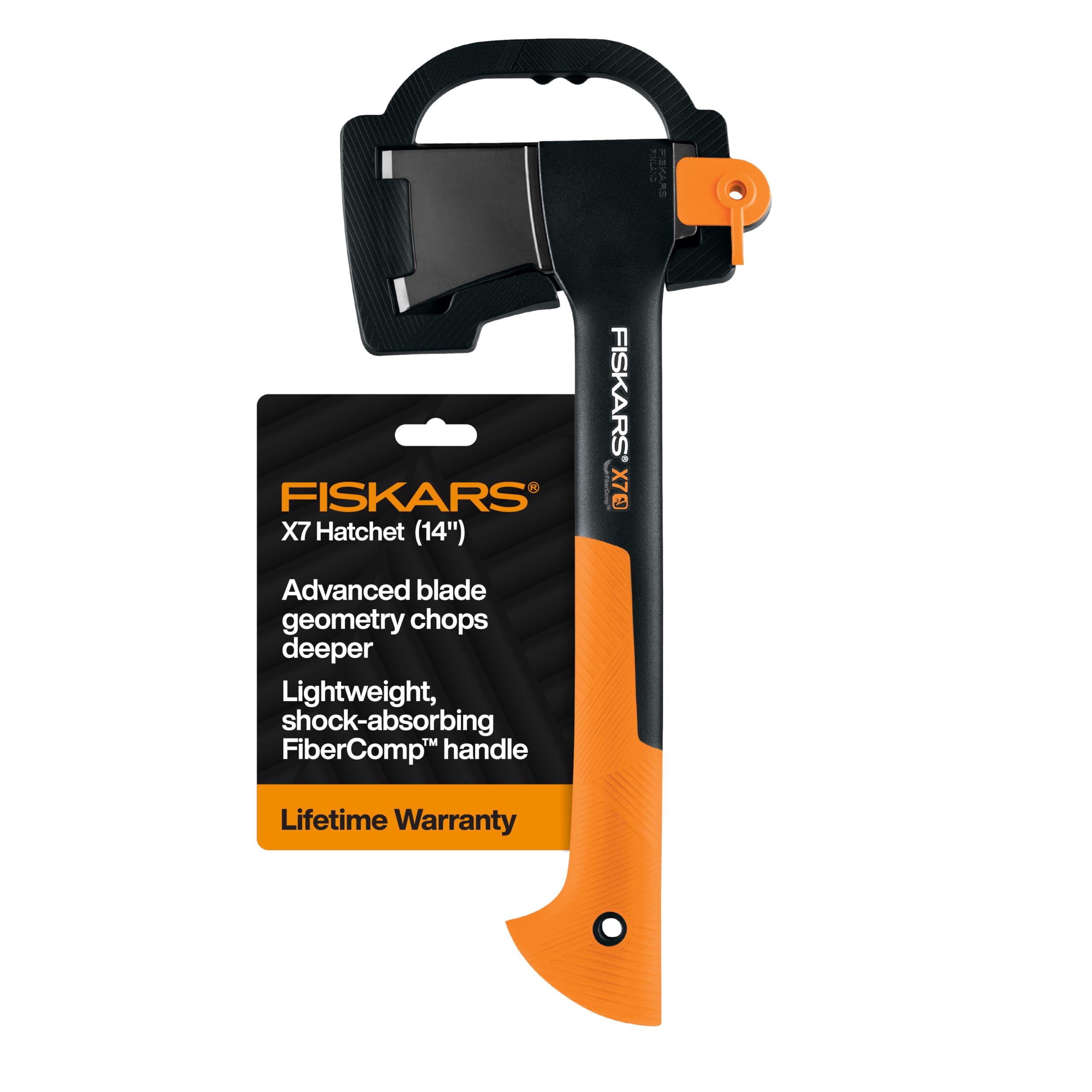
Fiskars X7 Hatchet
Key Features
- Sheath: Included
- Weight: 1.4 lb
- Blade length: 5.12 in
- Overall length: 14 in
- Price: Midrange
Fourteen inches and 1.4 pounds does not sound like much axe. The trick is where that weight sits: almost all of it is forward of your hand, in a head that is small but dense, and the light handle lets you keep swinging one-handed long after a heavier hatchet has your forearm complaining.
That balance is why the X7 is the one we recommend first. It is sharp out of the box, it takes limbs and bark off deadfall, and it splits small rounds down into kindling. The low-friction coating on the blade is the detail we appreciate most, because a coated head slides back out of a half-split piece instead of seizing up and making you lever it free.
The head is insert-molded into the handle rather than wedged onto a wooden shoulder, so there is no eye to loosen and nothing to re-seat after a few seasons. The FiberComp handle takes the sting that would otherwise land in your palm, and a 14-inch swing is easy to control when you are kneeling beside a fire ring in the dark.
The sheath is a proper one that rides on a belt, and the lifetime warranty is the kind you never think about until a handle finally goes. What we keep coming back to is how little room it takes up for how much wood it handles: it goes in the tote with the stove and the coffee, and it is there when the firewood turns out to be bigger than advertised.
Pros
- Light enough to swing one-handed all evening
- Coated blade releases from half-split rounds
- Molded head has no wedge to loosen
- Sharp out of the box and easy to maintain
Cons
- Light head bounces off rounds bigger than your forearm
The hatchet we hand to anyone who asks what to bring camping: light, sharp, and balanced enough to swing one-handed all evening.
Best for Lifetime Camp Axe
Estwing Sportsman’s Axe
Key Features
- Sheath: Nylon, belt loop
- Weight: 1.8 lb
- Construction: One-piece forged steel
- Overall length: 14 in
- Price: Midrange
Where the Fiskars hatchets are molded, this one is a single piece of forged American steel running from the tip of the blade to the end of the handle. That is the reason we recommend it: no wedge, no shoulder, no joint, and nothing that can work loose no matter how badly you miss the log.
The stacked leather handle is the part you notice in the hand. It is sanded and lacquered, warm in cold weather, and it damps the buzz that a bare steel handle sends straight into your wrist. It is also the one thing here that asks for care — leather wants an occasional wipe of conditioner and it records every scratch you give it, which some of us like and some of us do not.
The poll behind the head is shaped to pull tent stakes, which sounds like a gimmick until you are packing up in the rain with three that went in too deep. The nylon sheath has a belt loop and a clip for a pack, though the mouth is stiff enough that seating the head takes a second try — a small annoyance on a tool that otherwise feels like it will outlive you.
Pros
- One-piece forged steel with no joint to fail
- Lacquered leather grip stays comfortable and warm
- Poll shaped to pull tent stakes
Cons
- Heavier than the X7 at the same 14 inches
- Edge can arrive needing a few strokes of a stone
Buy this one if you want an axe that cannot come apart — one piece of steel, a leather grip, and no joint to fail.
Best for Splitting Small Rounds
Fiskars X11 Splitting Axe
Key Features
- Sheath: Included
- Weight: 2.2 lb
- Head type: Splitting wedge
- Overall length: 17 in
- Price: Midrange
A hatchet is a chopping tool: a thin, narrow bit meant to bite across the grain. Ask one to split a round and the head sinks in, grips, and stops, because there is nothing behind the edge to push the wood apart. Most of the frustration people blame on cheap axes is really this mismatch.
The X11 is built around that problem. The head is a wedge — the cheeks flare out behind the edge — so the split opens as the head travels down, and the 2.2-pound head on a 17-inch handle gives you enough mass and reach to drive it one-handed. The bevel-convex grind does the same work at the cutting edge: the wood pops free instead of gripping the blade and riding back up with it.
For campers whose firewood arrives as rounds, we think this is the pick, and it is the only axe here designed around splitting rather than chopping. Thin green branches are not its talent — a wedge does not bite across the grain the way a hatchet does, so keep the X7 for limbing — but when a pile of small rounds keeps swallowing a hatchet head, this is the tool that ends the argument.
Pros
- Flared wedge head pops small rounds apart
- Still light enough to swing with one hand
- Ships sharp with a sheath and lifetime warranty
Cons
- More weight and length to carry than a hatchet
We think of it as a splitting tool that happens to be hatchet-sized, and it is the one to take when camp wood arrives as rounds.
Best for Backpacking
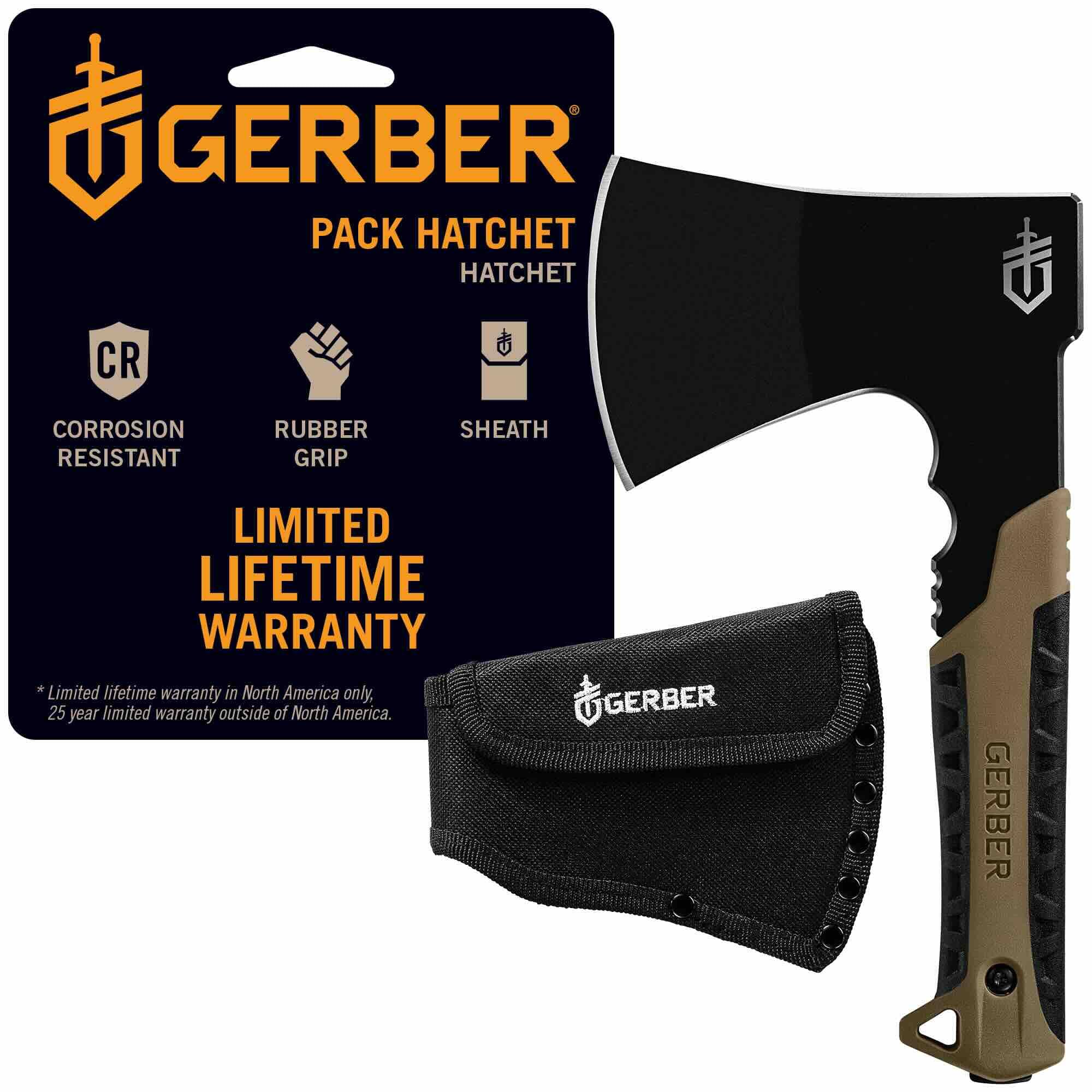
Gerber Pack Hatchet
Key Features
- Sheath: Nylon, pack mount
- Weight: 20.8 oz
- Blade length: 3.5 in
- Overall length: 9.46 in
- Price: Midrange
Nine and a half inches and just over a pound: those numbers are the whole case. The Pack Hatchet is short enough to live in a daypack’s side pocket or hang off a belt without fouling your stride, and the tang runs the full length of the handle, so the weight you do carry is structure rather than a heavy head on a light stick. For hikers who want an axe with them rather than on them, that is the trade we think matters.
Think of it as the axe you carry when you were not planning to carry an axe. The tall grind is shaped for shaving kindling off dry splits, the black oxide coating shrugs off a wet day, and the lanyard hole and pack-mount sheath mean it rides where you put it. It is not a woodpile tool. It is the thing that turns a handful of damp sticks into a fire when the evening is going wrong.
Pros
- Fits a daypack side pocket at 9.46 inches
- Full-tang blade with a pack-mount sheath
- Sharp enough for kindling and small limbs
Cons
- Loses power on branches past wrist thickness
- Sheath takes real fiddling to seat
The axe for people who did not plan to carry an axe: it disappears into a daypack and still handles kindling.
Best for Bigger Camp Wood
Estwing Camper’s Axe
Key Features
- Sheath: Nylon, belt loop
- Weight: 3.5 lb
- Head weight: 2.5 lb
- Overall length: 26 in
- Price: Midrange
Nobody needs a 26-inch axe to make kindling. You need one when the wood is bigger than your wrist, when the bundle from the camp store is all rounds and no splits, and when the only thing between you and a fire is enough mass to reduce them.
The head is a 2.5-pound forged steel wedge on a handle made from pressed steel tube, soldered to the head for a permanent bond. There is no wood in it to swell, dry out or split, and the molded rubber grip does the job FiberComp does on the Fiskars — it takes the vibration out of the strike before it reaches your hands.
It swings like a small felling axe rather than a big hatchet. The length gives you a two-handed grip and a real arc, and the mass sits where the work happens, so a few good swings will open a round that a hatchet would bounce off all evening.
This is a basecamp tool, and we reach for it accordingly. It lives in the truck, comes out when the wood is serious, and never pretends to be the thing you carry up a trail. If your camping is a vehicle, a fire ring and a pile of rounds that need reducing, this is the axe that does what the hatchets cannot.
Pros
- Two-handed swing with real head mass
- All-steel handle cannot swell or loosen
- Shock reduction grip softens the strike
Cons
- 26 inches needs two hands and clear swing room
A basecamp axe for wood a hatchet cannot handle — two hands, real head mass, and a steel handle that will not loosen.
Best for Heirloom Quality
Gransfors Bruks Small Forest Axe
Key Features
- Sheath: Leather
- Weight: 2 lb
- Overall length: 19 in
- Handle material: Hickory
- Price: Premium
The Small Forest Axe is the most expensive tool here by a wide margin, and it does not chop several times better than a hatchet that costs a fraction as much. What it does is feel like something a person made: a hand-forged head, a straight-grained hickory handle, a leather sheath, and a small book about axes in the box.
Nineteen inches is the length that makes it interesting. It is short enough to swing one-handed at a fire, long enough to choke up with two hands when you mean it, and two pounds is light enough that it goes in the pack rather than staying in the car.
The convex edge is the part that changes how it works. It does not so much split as slice — limbs, saplings, kindling, the notch for a pot hook — and it arrives sharp enough to shave with. The handle is hickory rather than composite, so it wants a wipe of oil now and then and it will show the marks of use.
So we say buy it if a well-made tool is part of why you go outside, and if you will enjoy oiling the handle and keeping the leather clean. If you want the wood split and nothing else, the X7 and the X11 do the same work for far less and you will not baby them.
Pros
- Hand-forged head on straight-grained hickory
- 19-inch length works one- or two-handed
- Leather sheath and the Gransfors axe book included
Cons
- Hickory handle can dry and crack if left unoiled
We recommend it to the camper who wants one beautiful tool rather than three practical ones, and who will look after the handle.
Best for Cheap Spare Axe
KSEIBI 274150 Hatchet

Key Features
- Weight: 1.3 lb
- Head weight: 1.32 lb
- Overall length: 15 in
- Handle material: Fiberglass
- Price: Budget
A 600-gram head on a 15-inch handle is a nose-heavy recipe, and it is the right one here: the mass sits forward where it does the chopping, the fiberglass handle soaks up the sting, and the anti-slip grip stays put in a sweaty hand. The balance is better than the price suggests, and 15 inches gives you noticeably more reach than a 14-inch hatchet without turning into a two-handed tool.
What it is, honestly, is a sharpening project with a good axe at the end of it. The edge can arrive blunt, and a file will sort that out; after that it holds up fine for kindling and small rounds. It is a genuinely cheap way into a usable camp axe, and the recipe — forged head, fiberglass handle, 15 inches — is the same one the pricier hatchets use. If you want to unbox it and chop, pay more.
Pros
- Head-forward balance that swings predictably
- Fiberglass handle damps shock well
- 15-inch handle adds reach without bulk
Cons
- No sheath included
We think it is good value if you are willing to finish the edge yourself, and frustrating if you are not.
Best for Stakes and Kindling
DESHIL 15-Inch Hatchet

Key Features
- Cover: Locking blade cover
- Weight: 1.32 lb
- Blade material: Carbon steel
- Overall length: 15 in
- Price: Budget
The flat back of the head is why this one is worth a second look. It is a hammer as well as an axe — driving tent stakes, tapping a peg home, knocking a wedge — and it saves you carrying a second tool for a job that comes up on every trip.
The rest is honest budget hardware: heat-treated carbon steel, a convex edge, a 600-gram build on a 15-inch fiberglass handle with an anti-slip grip, and a locking cover that keeps the edge from biting your pack. It is nose-heavy in the way a chopping tool should be, and the handle takes the vibration out of a mis-hit.
Where it earns its keep is at the end of the evening, when the stakes have pulled loose and the tarp is flapping, and the flat back of the head drives them home without a trip to the truck. We think it makes a sensible second axe for that reason alone — not the tool you plan a trip around, but the one you are glad is in the bag when a peg will not budge.
Pros
- Flat hammer back drives stakes and pegs
- Locking cover protects the edge in a pack
- Cheap enough to keep as a spare
Cons
- Cover is a blade guard, not a belt sheath
- Edge may need sharpening before first use
A cheap second axe with a hammer on the back — the one we leave in the camper rather than carry on the trail.
How We Tested Camping Axes, From Trail to Fire Pit
We started with roughly 40 axes sold by outdoor brands and hardware makers, then narrowed the field by head weight, handle length and material, steel type, whether a sheath came in the box, and price. Twelve of them got bought outright and used for eight months, both at home and on camping trips.
Out of the box, each axe had to slice through a sheet of newsprint held by one corner; a blade that tore rather than cut got written down. In the field we counted strikes to halve six-inch rounds of seasoned oak and dry pine, and we split kindling by hand, watching whether the bit sank in or bounced and how much the handle buzzed when we missed.
Every axe went on a kitchen scale so we could compare claimed weight with actual weight, and each one rode in a daypack on hikes to see whether a long handle snagged on brush or sat awkwardly against the back. For durability, we left them out overnight in dew, checked the wedge and head for loosening after a few hundred strikes, looked for cracks and lifted grain in the handles, and noted rust on the heads and loose stitching on the sheaths. The ones that failed usually failed the same way: a soft edge that rolled on the first knot.
How to Choose a Camping Axe
The first decision is not the brand or the steel — it is what your firewood actually looks like, because that sets the head shape, the length and the weight you should be shopping for.
Chopping heads and splitting heads do different jobs
The shape behind the edge matters more than the steel. A chopping hatchet has a thin, narrow bit that bites across the grain, which makes it fast on limbs, offcuts and shaving kindling off a split. A splitting head flares into a wedge, so the wood opens as the head travels down. If your camp wood arrives as rounds, you want the wedge; if it arrives as branches, the thin bit is quicker. Buying a chopping hatchet to split rounds is the mismatch we see most often, and it is exactly why the X11 exists.
Length decides whether you swing one-handed or two
Under about 15 inches an axe is a one-handed tool — light, controllable, easy to use kneeling beside a fire ring. Between 17 and 19 inches you gain real leverage and can still swing one-handed when you want to. Past 24 inches you are in two-handed territory, with a head heavy enough to reduce bigger rounds and a total weight that usually lands around three and a half pounds. Match the length to the wood first, then check the weight, because a 26-inch axe is a vehicle tool rather than a pack tool.
Handle material is a maintenance decision
Fiberglass and composite handles are light, absorb vibration and do not care about rain; when the head is molded into the handle there is no wedge to loosen. One-piece steel handles are effectively indestructible and heavier for the same length. Hickory and stacked leather are the traditional choices — warmer in the hand, better at soaking up sting, and the only ones that ask for upkeep. Oil a hickory handle, condition a leather one, and never put either away wet or leave it sitting in a damp sheath.
The edge you get and the edge you keep
The cheaper the axe, the more likely you are finishing the edge yourself, and a file or a puck will get any of these working. What matters is matching the grind that is already there. Convex edges, like the ones on the X11 and the Small Forest Axe, are strong, slice cleanly, and forgive a stropping motion rather than demanding a perfect angle. Take light passes, follow the existing bevel, and stop before the edge gets thin enough to roll on a knot.
Sheaths and safe carry
A sheath is not a throw-in. On a belt, a stiff nylon sheath with a loop keeps the head where your hand expects it; on a pack, look for a mount you can thread a strap through. Leather looks better and lasts longer, but it holds moisture against steel, so dry the head before it goes back in. However you carry it, the edge stays covered and the axe stays secured — an unsheathed head rolling around in a pack is how trips end early.
Frequently Asked Questions
Are folding axes any good for camping?
Folding and telescoping axes buy pack length by putting a joint between the head and the handle, and that joint is where the flex and the loosening happen. If packability is the goal, a short fixed hatchet such as the Gerber Pack Hatchet gives you most of the size saving with none of the wobble. A folding axe makes sense as an emergency tool left in a vehicle; it is not what we reach for when there is wood to process.
How do I keep a camping axe from rusting?
Dry the head before it goes back in the sheath, and do not store any axe in a leather sheath for months at a time — leather holds moisture against steel. A thin wipe of oil on the blade and the poll after each trip is enough. If rust does start, fine steel wool and oil will lift it without taking the edge down, then re-oil and put the axe away dry.
Can I take a camping axe into a national park or on a plane?
Rules vary by land manager, so check the specific park or forest’s regulations before you pack it — some developed campgrounds are fine with axes while some backcountry areas restrict them. For air travel, an axe goes in checked baggage and never in a carry-on. If the rules are unclear, call the ranger district; a phone call beats losing the tool at a trailhead.
Final Verdict
The Fiskars X7 is the axe we point people toward, because it covers kindling, deadfall and small rounds in a package that weighs almost nothing and lives happily in a tote. Move up to the X11 if your camp wood comes as rounds and splitting is the whole job, take the Gerber if the pack is small and the axe is a just-in-case item, and choose the Estwing camper’s axe when the wood is bigger than a hatchet can handle. The Gransfors is the one you buy with your heart.