This post contains affiliate links. We may earn a small commission when you buy through our links — at no extra cost to you.
An approach shoe has two jobs that don’t naturally get along: carry you up a trail like a hiking shoe, then grip rock like a climbing shoe. Most pairs pick a side, which is how you end up with something that edges beautifully on granite and leaves your toes bruised on the descent — or feels like a slipper until the ground turns steep. The pair worth buying disappears on the hike in and still holds when things go vertical, and that comes down to fit as much as anything printed on the spec sheet.
My team and I have spent the past eight months in 11 pairs, from wet talus fields to the drive-home errand run. The lesson that surprised me: sticky rubber gets the credit, but fit does the work. A grippy sole on a shoe that lets your heel lift is worse on a slab than a modest sole that holds you snug. Comfort, weight, build quality, and price separated the field from there, and the ones below earned their place on the rock and off.


Best for Technical Approaches
La Sportiva TX4 EVO Leather
Key Features
- Fit: Runs small
- Upper: Leather
- Gender: Men’s
- Traction: High
- Price: Premium
The TX4 EVO Leather is the approach shoe we reach for when the route is more rock than trail. The leather upper wraps the foot securely, and the sole has the kind of grip that lets you stand on small edges instead of skating across them. We also like that the sole separates for resoling: abrasive rock eats rubber, and being able to replace the outsole rather than the whole shoe is a genuinely useful ownership detail.
On steep, rocky ground, the support is what sold us. The heel and forefoot feel locked in once the laces are snug, and the leather gives just enough flex for smearing without turning sloppy. The fit runs small, though, so plan on going up a half size; that is the one adjustment we had to make before the shoe felt right.
At the premium end of this group, the TX4 is the pair we recommend first for technical approaches. The leather and support make it feel like a shoe you can keep for years, and the resoleable sole backs that up. When the route turns rocky, that combination is worth more than a softer, more casual fit. It is the one we trust on the sharp, exposed ground where a slip costs more than a little comfort.
Pros
- Excellent grip on small rock edges
- Supportive leather upper with a secure hold
- Resoleable sole extends usable life
Cons
The TX4 EVO Leather is the approach shoe we recommend first for steep, rocky ground, with secure support and a resoleable sole; just size up.
Best for Wet Rocky Ground
La Sportiva Boulder X
Key Features
- Fit: Runs small
- Gender: Men’s
- Wet grip: Good
- Stability: High
- Price: Midrange
The Boulder X is the bruiser of this group. It feels sturdier underfoot than the TX4, with a solid sole and a stable platform that handles wet, rough ground without feeling flexy. If your approach involves a lot of talus, mud, or rain, that extra beef is reassuring.
Sizing is the catch. These run small, so go up at least a half size and try them with the socks you plan to wear. Once the fit is right, the heel locks in and the toe box has enough room for descents. That is worth doing before you leave the house; a sloppy fit undermines the support.
The support is what makes the Boulder X worth considering. It holds its shape under a loaded pack and keeps the foot from rolling on uneven ground. On wet, rough ground, that stability is the reason to choose it over a lighter shoe. We did not find it as precise on small edges as the TX4, but for slogging up a rough trail with weight on your back, it is the more forgiving platform.
Pros
- Stable on rough, uneven ground
- Durable build for wet weather
- Good grip on wet rock
- Cheaper than the top pick
Cons
- Firm cushioning underfoot on long days
The Boulder X is our pick for wet, rough approaches where stability and durability matter more than a soft ride.
Best for Easy Scrambles
Salewa Women’s Wildfire GTX

Key Features
- Fit: True to size
- Gender: Women’s
- Toe box: Roomy
- Arch support: High
- Price: Midrange
The Wildfire GTX is the women’s shoe we point to when the day is mostly trail with a few rocky steps, not a sustained scramble. The forefoot is roomy enough to keep toes from cramping on descents, and the arch support is generous for a low-cut shoe. It feels supportive without needing a long break-in.
That comfort is the reason it earns a place. The lacing is easy to snug down, and the upper holds the midfoot without pinching. We liked it best for long trail days where the approach is a means to an end, rather than the main event.
The limit is the rock. This is a hiking shoe at heart, and on steep, sticky slabs it does not have the same edging precision as the TX4. For women who want one comfortable shoe for trail and easy rock, it is a sensible choice; for technical scrambling, go with the La Sportiva. It is also the easiest of these to wear straight out of the box, which matters if you want one pair for the approach and the hike back.
Pros
- Roomy forefoot reduces toe cramping
- Strong arch support for long days
- Comfortable with little break-in
Cons
The Wildfire GTX is the women’s pick for long trail days and easy rock, with a roomy forefoot and supportive arch.
Best for Budget Walk-Ins
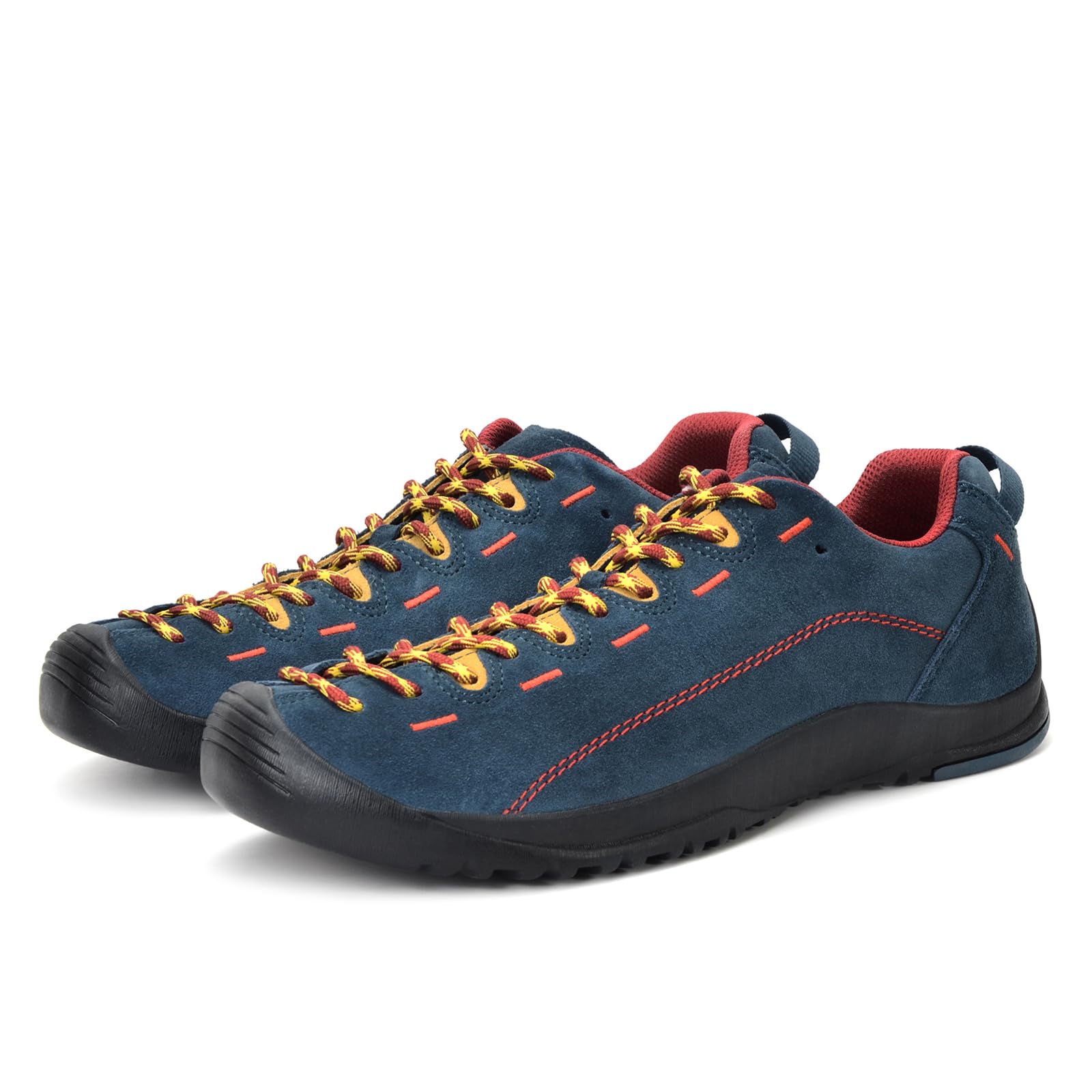
XPETI Men’s Basin
Key Features
- Fit: True to size
- Gender: Men’s
- Toe box: Roomy
- Underfoot feel: Thin
- Price: Budget
The Basin is the budget pick, and it makes the most sense when the approach is really a walk. The insole is soft, the toe box is roomy, and the shoe is light enough to forget you have it on. For town days, easy trails, and short walk-ins to the crag, that is a useful combination.
The sole is thin. You can feel the ground underfoot, which is fine on smooth trail and even helpful for balance, but it is not the shoe for a long talus field or sharp scree. We kept reaching for it on mellow days and left it behind when the route turned rocky.
For the money, it is a comfortable shoe for light approach duty, town wear, and easy trails. It is not the pair we hand someone heading out on a serious alpine approach, but it does not pretend to be. If you want a cheap second pair to leave by the door, this is an easy one to like. The roomy fit also makes it a good match for wide feet, provided you keep it on gentle ground.
Pros
- Roomy toe box and soft insole
- Lightweight for easy trails
- Budget price
Cons
- Durability can fall short over time
The Basin is the budget pick for easy walk-ins and town days, with a roomy fit and soft cushioning.
How We Tested Approach Shoes on Trail and Rock
We started with roughly three dozen pairs that surfaced in searches, on gear-shop shelves, and in conversations with guides, then cut the list using spec sheets: last shape, rubber compound, rand height, claimed weight, and whether a shoe was tuned for trail miles or for rock. Price and return policy narrowed it to 11. Each went to a tester who hikes or climbs most weekends, plus two who mostly walk the dog in theirs.
Fit came first, and we checked it in the least convenient way available: balancing on the edge of a stair to see whether a heel lifted, swapping thin socks for thick ones, and trying a half size up and down in the same model. Then the real work — a four-mile climb with 900 feet of gain, a loose talus field, and wet slabs an hour after rain. We paid attention to comfort at mile three, not mile one, and to whether a pair felt light enough to forget we had it on.
Durability got tracked over the whole eight months: toe rands and seams for fraying, laces for wear at the eyelets, outsoles for the flat spots that appear where the rubber is thinnest. We wore each pair into town with jeans at least twice, since looks matter more than most gear writing admits, and weighed every pair on a kitchen scale before testing and again after — a shoe that soaks up mud and water gets heavier by the end of a wet day. A couple of the lower-priced pairs wore as well as shoes that cost nearly twice as much, which is the kind of thing you only learn by walking in them.
How to Choose Approach Shoes
The right approach shoe matches how much of your day happens on rock, not the one with the longest feature list.
Start With the Rock, Not the Trail
Approach shoes earn their keep on the rocky stretch between the trailhead and the climb. Look for a sole that grips when you edge on small holds, a toe that can smear without rolling, and enough support to carry a light pack. If your day is mostly smooth trail, a hiking shoe or trail runner will be more comfortable; if the last mile is steep and rocky, the extra grip is worth the weight. We treat the TX4 EVO as the benchmark here because its grip and support are built around that rocky finish.
Fit Is the Decision You Can’t Undo
Approach shoes often run small, and the fit is less forgiving than a trail runner’s. Try them with the socks you plan to wear, and go up a half size if your toes touch the front on a steep descent. A secure heel matters as much as toe room: you want the foot locked in without pressure across the instep. The Boulder X and TX4 both run small in our experience, so treat the listed size as a starting point rather than a guarantee.
Support Versus Ground Feel
A stiffer sole protects your foot on sharp scree and edges better on small holds; a thinner sole lets you feel the rock and is more comfortable on easy trails. Neither is better in the abstract. If you carry a heavier pack or walk long approaches over talus, lean toward support. If your approaches are short and mostly smooth, a lighter, more flexible shoe like the Basin can be enough. The trade-off shows up in fatigue: support costs weight, and ground feel costs protection.
Durability, Resoling, and Weather
Rock is abrasive, and approach shoes wear out at the sole before the upper. A resoleable shoe can be worth the premium because it keeps a good upper in service; the TX4 EVO is the clearest example here. Waterproof membranes help in wet, cool weather but make a shoe warmer and slower to dry, so choose them for the conditions you actually walk in. Leather uppers are supportive and durable but need more care than mesh.
Frequently Asked Questions
Do approach shoes work for via ferrata?
They can handle the walk to the cables and easy rock, but via ferrata puts a premium on a stiff sole and ankle protection. For a long route with ladders and scree, use a via ferrata boot or a stiff approach shoe with a protective rand; a low, flexible approach shoe will leave your feet battered.
Are approach shoes safe for actual climbing?
No. Approach shoes are designed for the walk to the climb, not for vertical rock. The sticky rubber helps on slabs and easy scrambles, but the sole is not shaped for edging on small footholds. Bring climbing shoes for the route and save the approach pair for the descent.
Do I need waterproof approach shoes?
Only if you walk in wet, cool conditions. A waterproof membrane keeps out rain and puddle splash, but it also reduces breathability and slows drying. For summer approaches and stream crossings, a non-waterproof shoe that drains and dries fast is often more comfortable. Check the model’s membrane before you buy.
Final Verdict
For technical approaches, the La Sportiva TX4 EVO Leather is the pair we recommend first. Its grip and support are the most convincing here, and the resoleable sole gives it a longer working life than a shoe you throw away when the rubber wears down. It is our first choice for steep, rocky ground.
If wet, rough ground and durability matter more than a soft ride, the Boulder X is the sturdier alternative. Women who split their time between trail and easy rock should look at the Wildfire GTX; the Basin is the budget choice for short walk-ins, not serious scrambling.