This post contains affiliate links. We may earn a small commission when you buy through our links — at no extra cost to you.
There’s a stretch of shoreline I walk every summer where the sand is perfect for about 30 yards and then turns into broken shells and half-buried rocks. That’s where a beach shoe earns its keep — not by looking sporty, but by letting you keep walking when the ground stops cooperating. A decent pair handles hot boardwalk pavement, slick wet rock, and a tide pool or two without filling up with sand or rubbing your heel raw before you get back to your towel.
The trouble is that most of them look identical in a product photo and feel completely different after an hour of wear. My team and I wore 16 pairs — water shoes, sport sandals, closed-toe hybrids — through four months of real beach days, and the gaps in comfort and fit were not subtle. One thing I wish someone had told me sooner: nearly all of these are sold in unisex sizing, so the number on the box is a starting point, not an answer. The picks below are the ones that drained fast, held their shape, and were still worth the money by the end of summer.



Best for Rough Shorelines
Crocs Swiftwater Mesh Sandal
Key Features
- Style: Sport sandal
- Sizing: Men’s
- Toe coverage: Closed mesh
- Price: Premium
A closed toe is the whole argument. Walk the tide line in sock-style water shoes and you feel every broken shell through the sole and every piece of grit against your toes; the Swiftwater’s mesh upper covers the foot completely, so you walk normally instead of picking a path. That is why it is our top pick rather than the cheaper, lighter pairs further down this list: protection is the job, and this one does the job.
The mesh drains rather than holding water, and the webbing straps keep their shape when wet, so the shoe goes back on for the walk to the car without a fight. Comfort holds up over a long day — nothing has rubbed, and there is room across the forefoot for a wider foot. One detail worth knowing: the pale lining on lighter colorways can pick up a tint from chlorinated or park water, so choose a dark colorway if that matters to you.
What you give up is packability. This is a shoe, not a sock, and it takes up roughly the space of a sneaker in a bag. In exchange it lasts: the stitched webbing and the sole are the parts that hold, and this is the pair in this group most likely to still be in service after a couple of summers. It is also listed in men’s sizing, which is worth noting before you order.
Pros
- Closed mesh toe shields against shells and rock
- Drains and dries instead of staying soggy
- Holds up season after season
- Doesn’t look like a water shoe
Cons
- Runs a little large for some feet
- Bulkier to pack than sock-style shoes
Our default pick: the closed mesh toe takes the sting out of shells and rock, and the shoe dries well before the next swim.
Best for Family Beach Trip
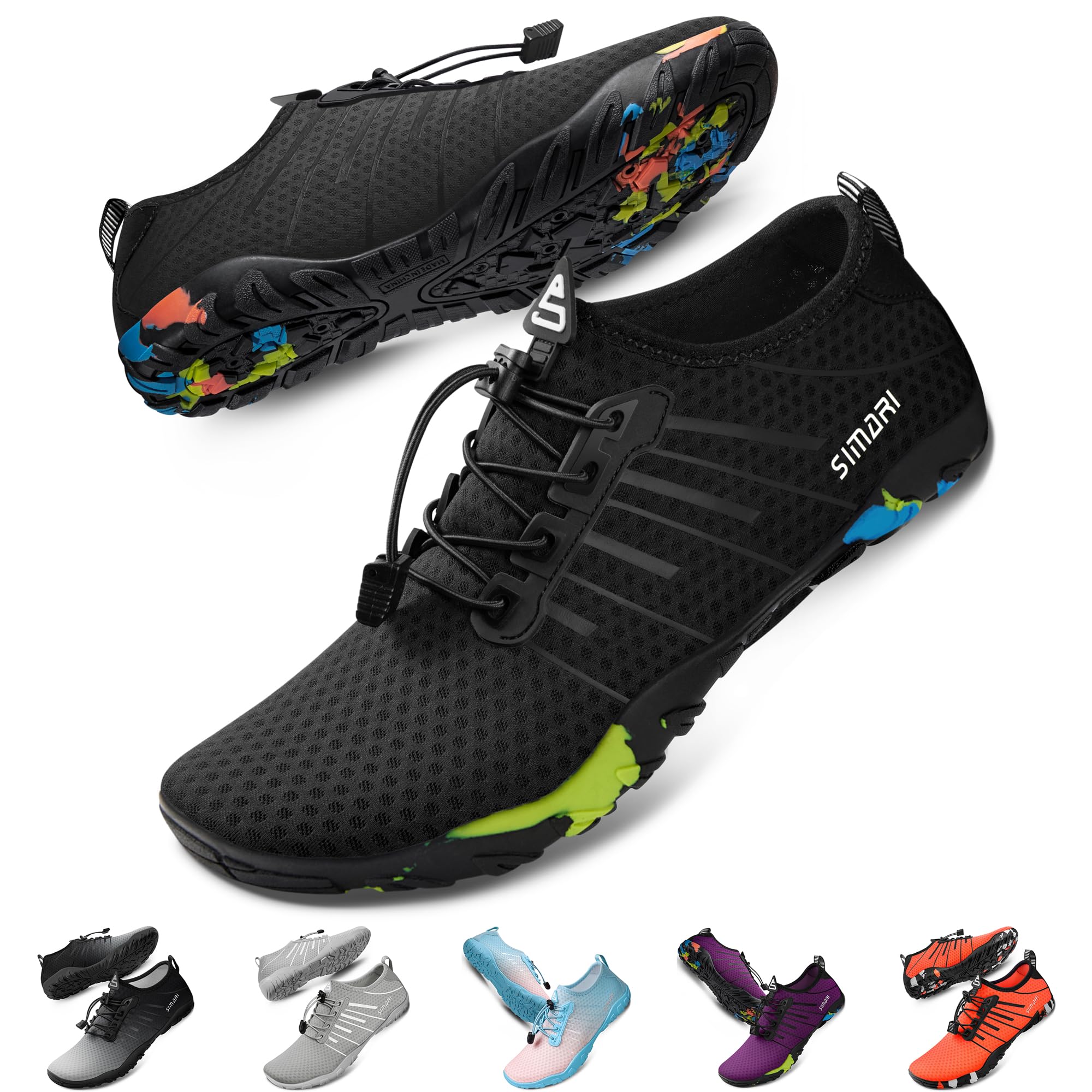
SIMARI Water Shoes
Key Features
- Style: Barefoot water shoe
- Sizing: Unisex adult
- Cleaning: Removable insoles
- Toe coverage: Closed
- Price: Budget
The surprise at this end of the price range is the sole. Cheap sock-style water shoes put you in direct contact with every pebble; this one is thick enough that a rocky lake bed does not come through, and the holes in the bottom let water out with each step instead of sloshing around. The insoles lift out too, which turns rinsing sand out of the channel underneath into a thirty-second job rather than an overnight drying ordeal.
The elastic collar does more than the drain holes for keeping grit out, sitting close to the ankle so sand and small gravel mostly stay outside, though a long walk in soft sand will still let some in. Comfort is decent rather than plush — stretchy upper, easy on and off without a fight, quick to dry — and the shoe stays light when it is soaked, which is the part that matters when you are carrying it back to the car.
Grip is the honest limitation: fine on wet grass, boat decks and packed sand, less convincing on slick, algae-covered rock. None of that gets in the way of the job most people need done, which is walking into the water and back out without wincing. If everyone in the family needs a pair for a week, this is the one we hand out.
Pros
- Thick sole for the money
- Removable insoles rinse and dry fast
- Stays light when soaked
- Elastic collar keeps most grit out
Cons
- Toe seams can part under hard use
We reach for this one when the whole family needs a pair: a sole thick enough for rocks at a price that makes spares painless.
Best for Boardwalks and Town
DOUSSPRT Water Shoes
Key Features
- Style: Water shoe
- Sizing: Men’s
- Closure: Adjustable strap
- Toe coverage: Closed
- Price: Midrange
Sizing is the first thing to sort out: this shoe comes up roomy, and a size down is the right call for most feet. Get that right and the rest is easy — it is the most walking-friendly water shoe in this group, with a wide toe box, an adjustable strap that takes up slack across the instep, and a soft upper that stays comfortable through a full day of pavement and sand.
The look matters more than you might expect. Instead of the neoprene-sock silhouette, this reads as a casual sneaker, which means you can wear it to lunch off the beach without feeling like you forgot your shoes. It is also light — lighter than the heavier closed shoes here — and it drains and dries without turning into a wet sponge.
The wear points are the sole edges and the laces, the sort of thing that shows up after a season of pool decks and hot tarmac rather than in the first week. For a trip built around walking — a long boardwalk, a walk into town, a path down to a cove — this is the pair that keeps you out of your sneakers.
Pros
- Roomy toe box suits wide feet
- Comfortable for hours of walking
- Reads as a normal sneaker
- Light even when wet
Cons
- Sole edges can separate with hard use
A sneaker-like water shoe we are happy to wear all day, with the roomiest toe box of the picks here.
Best for Carry-On Travel
DLGJPA Quick-Dry Water Shoes
Key Features
- Style: Water shoe
- Sizing: Men’s
- Drainage: Perforated sole
- Toe coverage: Closed
- Price: Midrange
The drain holes in the sole are the first thing you notice, and they are why this shoe comes out of the water damp rather than carrying a puddle around your arch. They are also the catch: cross a gravel bar and small stones wedge into the perforations, and you will be digging them out with a finger before you are back on sand. We still think the trade is worth it for beach use — just know what you are signing up for.
Lightness is the real talent. Nothing else here packs as small, and it stays light when soaked, which is the difference between a shoe you carry and a shoe you resent. There is more underfoot than the flat sock-style pairs offer, though the sole is a soft foam; a sharp rock arrives as a nudge rather than a stab.
The tag at the back of the heel is stiff enough to rub on a long first walk, so cut it out before you pack them. Otherwise the upper is friendly to a wide forefoot and there is no seam under the arch to complain about.
Where this earns its place is as the pair that lives in a carry-on. It will not protect you on a shell bank the way the Crocs does, and it will not take daily wear for years, but for a week at the beach with one bag it is the one we pack first.
Pros
- Packs smaller than anything else here
- Perforated sole drains and dries fast
- Enough support for a rough path
Cons
- Runs about a size large
The lightest, quickest-drying pair here, and our first choice when luggage space is the limit.
Best for Wet Rock Approaches
Racqua Beach Water Shoes
Key Features
- Style: Water shoe
- Sizing: Unisex adult
- Outsole: Aggressive lug tread
- Toe coverage: Closed
- Price: Budget
Some beaches start with a climb. If the way down to the water is a wet rock shelf, a set of slimy steps, or a muddy path through trees, this is the shoe in this group built for it: a lugged, fairly aggressive outsole, a closed upper that keeps gravel off the instep, and enough structure that a rough path does not come straight through to your arch.
That makes it our crossover pick — the one pair that handles the walk in as well as the water. It is light enough to swim in, drains well, and the tread bites into wet timber and loose rock in a way the flat-soled sock shoes simply do not. On packed sand and boardwalks it is comfortable for hours, with a soft upper and a generous toe box.
Traction has a limit worth naming. On smooth, algae-slick rock the tread is better than most here but still not a sure thing — slow down on the green stuff, and do not mistake any of these for reef shoes. For a mixed day of trail, rocks and then a swim, it is the most capable pair on this list.
Pros
- Aggressive lug tread for wet rock
- Handles trail and beach in one day
- Roomy, comfortable upper
Cons
- Sizing runs large; insecure in deep water
Built for the rough approach as much as the swim, with the most aggressive tread here and a wide, roomy fit.
Best for Water Parks
ziitop Water Shoes
Key Features
- Style: Water shoe
- Sizing: Women’s
- Toe coverage: Closed
- Price: Budget
A water park is the hardest test a beach shoe gets: slides, wave pools, and a lot of standing around in chlorinated water. This is the pair shaped for that day — the upper sits snug against the foot and the shoe stays on through a ride, then drains by the time you are back in the queue.
Comfort is better than the price suggests. The toe box does not cramp, which is the usual failure of a cheap water shoe, the shoe goes on and off easily when it is wet — worth more than it sounds when your hands are covered in sunscreen — and it is dry by the next morning without a sunny windowsill.
Durability is the gamble. Treat these as a trip shoe rather than a permanent one; they are cheap enough to buy in multiples for a family and shaped to stay put, and that combination is why they are here. For a week built around water rides, that is the right trade.
Pros
- Stays on through rides and waves
- Roomy toe box for the price
- Dry by the next morning
Cons
- Sizing varies between pairs
For water parks and rafting days, this is the pair that stays on through the ride and is dry by morning.
Best for Spare Pair
Vsufim Aqua Socks

Key Features
- Style: Barefoot water shoe
- Sizing: Unisex adult
- Toe coverage: Closed
- Price: Budget
Packs flat, weighs almost nothing, slips on in a second. This is the pair that lives at the bottom of a beach bag and earns its place in the ten minutes between the car park and the water, or in a campground shower block.
As a spare it is the best in this group: the grip is genuinely good for a shoe this thin, the stretch upper goes over a wide foot without a fight, and the fit is generous enough that ordering down a size is the safe move. For a trip where shoes might get left behind, it is the pair that does not hurt to lose.
The limit is underfoot. This is a shoe for sand, pool decks and smooth rock, not the shell bank at the end of the beach, and not a long walk on hot tarmac. Used within that, it is a bargain that dries in the sun and takes up no space at all.
Pros
- Packs flat and adds almost no weight
- Good grip for a thin sole
- Bright, fun look and cheap enough for spares
Cons
- Thin sole lets you feel shells and rock
A cheap second pair to keep in the bag: light enough to forget, good grip for its class, and sized generously.
Best for Pool Deck Strolls
KuaiLu Flip Flops

Key Features
- Strap: Fabric thong
- Style: Flip-flop
- Sizing: Women’s
- Toe coverage: Open
- Price: Budget
Not every beach day needs a water shoe. If the plan is a towel, a book and a walk down to the water for a swim, a flip-flop is the more pleasant thing to wear, and this is the most comfortable one here — a soft fabric toe post that does not saw between your toes, a cushioned footbed, and enough shape that the walk to the cafe is not a chore.
It is also the best-looking sandal in this group by a distance: fabric straps rather than rubber, and colors that work with something other than swimwear. That is not a small thing when the sandal is going to be on your feet from breakfast onward.
The water’s edge is where it stops. Once the fabric strap is wet the foot slides forward with every step, and on the wet, packed sand near the surf line that is a stumble waiting to happen. It is a sandal for the walk to the water, not for the water itself.
So treat it as a dry-sand sandal — pool deck, boardwalk, the path down to the beach — and keep a closed shoe for the shoreline. We keep a pair in the bag for exactly that, and for the drive home.
Pros
- Soft fabric toe post doesn’t rub
- Best-looking option in this group
- Cushioned enough for boardwalk miles
Cons
- Arch support is minimal despite the name
- Straps stretch out with wear
Soft straps and a cushioned footbed make this a lovely dry-sand sandal — just keep it away from the surf.
How We Tested Beach Shoes (and What Fell Apart First)
We started by pulling every pair we could find that claimed to be quick-drying, drainage-friendly, or built for water, then cut anything with a rock-hard sole, a sizing run narrower than a full size, or a price that made a single summer’s use feel extravagant. That left 16 pairs — water shoes, sport sandals, and closed-toe hybrids — which we wore for four months on sand, rock, and pavement.
Each pair went through the same loop: the walk from the car down soft sand to the waterline, a quarter mile of dry sand, the wet rocks at low tide, a hot boardwalk stretch, and the asphalt lot afterward. On the rocks we crossed the same algae-slick patch and noted who slid and who stuck. After the dry sand stretch we dumped each pair out and looked at how much grit stayed trapped in the seams and under the footbed.
Comfort and arch support got judged on the long days, roughly 10 a.m. until dinner, with notes on heel rub, hot spots, and whether the footbed had any actual contour or was just flat foam. We compared each labeled size against our regular street shoe and recorded who had to size up, who sized down, and whose heel slid out in the surf. For water-friendliness we waded in, walked ten minutes, then checked how heavy the shoe felt and how long it squelched.
Durability was mostly repetition: dozens of wet-and-dry cycles, hours left in direct sun, and a few afternoons baking in a hot car trunk, with straps, stitching, and sole glue inspected at the start and again at the end. We also noted which pairs we kept on through lunch off the sand, and whether the price still felt fair once the tread started wearing down.
How to Choose Beach Shoes
The right beach shoe is the one that survives the walk to the water, not the one that looks best lying on the sand.
Start With the Type You Actually Need
There are three families here and they are not interchangeable. Barefoot aqua socks are the lightest and cheapest, and they give you just enough rubber to stop a hot-sand burn. Closed water shoes with a real sole add structure and a proper toe box. Sport sandals and flip-flops rely on straps rather than a full upper.
Pick by the roughest ground you will cross, not the softest. If the day is towel, water, towel, a sock or a flip-flop is plenty. If it includes a shell bank, a rock shelf, a set of steps, or the hot tarmac of a car park, a closed shoe with a thick sole earns its space in the bag.
Protection: Soles and Toes
Sole thickness is the specification that decides whether a shell beach is a pleasant walk or an ordeal, and it is the first thing worth checking. Press your thumb into the sole under the arch; if you can feel your thumb from the inside, you will feel a bottle cap too.
A closed toe is the second half of the same argument. It keeps grit, shells, and hot sand off your toes and means you are not walking the tide line on tiptoe. Aqua socks with a pronounced toe cap give some of that; a mesh upper gives all of it.
Drainage and Dry Time
Water has to leave the shoe, or you are carrying it. Drain holes in the sole, a mesh or quick-dry upper, and removable insoles are the three things that make the difference between a shoe that is dry by dinner and one that smells like a rock pool by day three.
There is a trap attached to drainage. The same perforations that let water out let sand and small gravel in, so a shoe that is brilliant on a lake bed can leave you digging stones out of the sole on a gravel bar. On soft sand, a snug collar matters more than holes.
Grip on Wet Rock, Decks, and Ramps
Ignore the non-slip claim in the title and look at the tread. A lugged outsole with real depth bites into wet timber, boat ramps, and barnacled rock; a smooth one skates. This is the single biggest difference between an aqua sock and a proper water shoe.
The trap here is overconfidence. Aggressive tread still struggles on smooth, algae-covered rock, and no shoe in this group is a reef boot. Test a new pair on a wet tiled floor at home before you trust it on a shoreline, and slow down on the green stuff.
Fit: What Stays On in the Surf
Water shoes are sized inconsistently, and sock-style models are sized like socks rather than shoes, so the size on the box is only a starting point. Several of the picks here run large; one runs small. Read the note on the specific model rather than assuming your sneaker size.
Buy for a snug fit with no heel slip, then wade to knee depth before you trust it in the surf. A loose water shoe is the one that comes off in a wave, and a shoe that comes off is worse than no shoe at all.
Frequently Asked Questions
Do I really need beach shoes, or are flip-flops enough?
For a towel-to-water day, flip-flops are fine and more comfortable on the walk to the café. The moment the plan includes a shell bank, a rocky entry, a long shoreline walk, or a boat, a closed shoe is the better buy: it protects the sole and the toes and it stays on.
If you are only packing one pair, pack the closed shoe and leave the flip-flop for the pool deck.
How long should a pair of beach shoes last?
The cheapest sock-style pairs are a trip rather than a season, with the toe seam and insole going first. The closed shoes last longer, but only if you look after them: rinse in fresh water after salt or chlorine, pull the insoles out, and dry them out of direct sun.
Skip the hot car, which can warp a foam sole. Check the toe seam after each trip and you will see the failure coming.
Can I wear beach shoes for hiking?
Short stretches of packed dirt or wet rock, yes; that is what the lugged pairs here are for. For a real trail with roots, scree, or more than about a mile of climbing, their soft soles and stretch uppers are not enough.
Wear proper shoes and pack the beach pair. Sole thickness is the tell: if the sole bends double in your hand, it is not a hiking shoe.
Final Verdict
Start with the Crocs Swiftwater. It turns a shell-strewn shoreline into an ordinary walk, it dries before the next swim, and it is built to come back for a second summer. That combination is why it is the pair we recommend to most people heading to a beach with anything other than pure soft sand.
If your bag is small, the DLGJPA is the lighter, more packable choice. If you are outfitting a family on a budget, the SIMARI does most of the same job for less. Buy for the roughest ground you will cross, not the softest.