This post contains affiliate links. We may earn a small commission when you buy through our links — at no extra cost to you.
A framed hiking carrier will haul a toddler for miles, but it eats your whole trunk and weighs about as much as the kid. A soft carrier folds into a diaper bag and then buries its straps in your shoulders by mile two. The right carrier for hiking lives between those extremes: it puts the load on your hips instead of your neck, keeps your kid secure and close, and leaves both hands free for trekking poles, rock scrambles, and the constant snack handoffs.
I’ve logged enough of these miles with my own kids to know that fit beats features every time — a pack sized for a 5-foot-4 torso will dig into a 6-foot-2 frame, and no amount of padding rescues a hipbelt that rides too high. Over eight months we put 10 carriers through weekday loops, steep climbs, and a few outings where the weather turned on us. Storage, weight distribution, shoulder comfort, and how each one handled a kid who suddenly wanted down all factored in. The picks below are the ones we kept reaching for.


Best for Long Trail Days
Deuter Kid Comfort
Key Features
- Stand: Built-in
- Stirrups: Included
- Sunshade: Included
- Water bladder pocket: Yes
- Price: Premium
The moment that decides a hiking carrier arrives somewhere on the climb, when your child stops holding themselves up and goes heavy and limp against your back. We watched for exactly that in every pack here, and the Kid Comfort handled it best: the weight stayed on our hips, the child stayed put in a cockpit you can cinch down around them, and the foot stirrups gave a pair of dangling legs somewhere to rest. That is the whole reason it is our top pick.
The stand is the detail we ended up using more than any other. Setting a child down while you peel off a layer is normally a two-person job; this pack stands on its own with the child still strapped in, which turns a quick stop into a real break. Storage runs deep enough that you can leave the daypack at home, with a water bladder pocket and side pockets you can reach without unclipping the hipbelt, and the sunshade goes on and off without a fight.
The harness adjusts far enough that two adults of different heights can share it, and the cockpit tightens around a small rider so they are not swaying on descents. What it costs you is money and space in the car: this is the premium end of the group and it is a bulky pack to live with. If your hiking involves a flight rather than a trailhead parking lot, the Osprey below folds far flatter.
Pros
- Keeps a sleeping child’s weight on your hips
- Cockpit, stirrups and harness adjust as the child grows
- Stands on its own for trail breaks
- Water bladder pocket and deep storage replace a daypack
Cons
- Takes up real room in a car trunk
For most families who hike regularly, this is the carrier to buy: the best load transfer in the group, a cockpit that grows with your child, and a stand that makes trail breaks civil.
Best for Sharing Between Parents
Kelty Journey PerfectFit
Key Features
- Max load: 48.5 lb
- Sunshade: Integrated
- Torso fit: 15.5–21 in
- Carrier weight: 5 lb 6 oz
- Price: Premium
Fifteen and a half to twenty-one inches of torso adjustment is the most useful number on any carrier here, and it is the first thing we check when two adults plan to share one pack.
We think the PerfectFIT suspension is what makes the Journey the easiest carrier in this group to hand between two people of different heights. The torso panel slides on a ladder of slots, so a tall parent and a short one can swap mid-walk without tools, and the aluminum roll cage gives the whole pack a firm, planted feel on loose ground. The 48.5-pound maximum load is the highest we covered, which leaves room for a heavy three-year-old plus the day’s water.
The seat is shaped for a child to slump into rather than perch on, with a wide base and space for legs to stretch, which is what you want when a nap wins. The sunshade is the weak point: it clips on rather than zipping in, and it sits low over a taller toddler’s head, so it suits a small child better than a big one. Storage is one large zippered pocket plus mesh, enough for snacks, water and a layer rather than a full day’s kit.
Pros
- Torso adjusts across 15.5 to 21 inches
- Highest load rating here at 48.5 pounds
- Rigid frame feels steady on rough ground
Cons
- Sunshade clips on loosely and sits low on tall toddlers
If two adults of different sizes will share the carrying, this is the pack we recommend: the widest torso range here, the highest load rating, and a frame that stays planted on rough ground.
Best for Travel and Packing
Osprey Poco LT
Key Features
- Frame: Folding stainless steel
- Sunshade: UPF 50, built in
- Carrier weight: 5.6 lb
- Torso adjustment: 6 in (15 cm)
- Price: Premium
Folding frames are usually a line on a spec sheet. The Poco LT’s is the real thing, with a stainless frame that unlocks, folds and locks again, and the pack ends up flat enough to live in a trunk or a suitcase instead of taking over the hall closet. What we did not expect was how much that changes ownership: the carrier you can stow is the carrier you actually bring.
That fold earns it the travel slot, but the carry is what keeps it in the top tier. The AirScape backpanel is deep-ridged foam under mesh, and on a warm climb it is noticeably less clammy against your back than a flat panel. Six inches of torso adjustment covers two adults, the UPF 50 sunshade hides in its own zippered pocket and deploys without unclipping anything, and there is room for a hydration bladder plus a day’s food.
Where it gives ground is under a heavier child. Twenty-odd pounds plus water and a layer starts to work on your shoulders in the second hour, and no amount of adjustment changes that. For a toddler and a half day on the trail it is the most pleasant of the premium three to wear; for a four-year-old and a full day, the Deuter’s hipbelt does more of the work.
Pros
- Folds flat enough for a trunk or suitcase
- Ventilated backpanel stays cooler on climbs
- UPF 50 sunshade built in and quick to deploy
- Six inches of torso adjustment for two wearers
Cons
- Shoulder strain creeps in with a heavier toddler
Our travel pick: it folds smaller than anything else here, still carries a toddler comfortably on the trail, and ships with the sunshade rather than selling it separately.
Best for Wet-Weather Hikes
besrey Toddler Hiking Carrier
Key Features
- Total load: 16–44 lb
- Seat heights: 3
- Carrier weight: 5.5 lb
- Sun and rain cover: Both included
- Price: Midrange
A sunshade is common. A rain cover in the box is not, and it is the piece families discover they need when the sky turns halfway up a ridge. The besrey ships with both, plus a three-height seat that covers a wide spread of children without extra purchases, which is a large part of why it is our midrange pick.
The waist belt is the detail that decides whether this one fits you. It runs generous, which makes it one of the few framed packs here that a bigger wearer can tighten down comfortably; on a slim waist it can feel loose even cinched. The strap that ties the harness to the pack is the other pressure point, and on some wearers it lands across a shoulder blade no matter how the torso is set, so sort the torso height before you load a child.
Value is where it earns its place. It does the core job, carrying a child, shading them, keeping the rain off and holding a day of snacks, for a midrange outlay rather than a premium one. The 44-pound figure is a total: carrier, gear and child together, so a 30-pound toddler leaves less headroom than the number suggests. What we appreciated most is how little fuss there is in getting a child in and out alone.
Pros
- Sunshade and rain cover both included
- Generous waist belt fits bigger wearers
- Three seat heights cover a wide age range
- Easy to load a child in and out alone
Cons
- Harness-to-pack strap can dig into a shoulder blade
- Waist belt can feel loose on slim wearers
The midrange pick we hand to most families: weather protection in the box, a waist belt that fits bigger wearers, and enough storage for a day out.
Best for First Framed Carrier
ClevrPlus Cross Country
Key Features
- Age range: 9–48 months
- Carrier weight: 5.5 lb
- Max child weight: 33 lb
- Sun and rain cover: Both included
- Price: Budget
A changing pad, a bottle pocket, a place for snacks and a bottom compartment big enough that you stop carrying a second bag: the Cross Country’s storage is why it is our budget pick rather than simply the cheapest framed pack here. It collapses down for storage and it is light for a carrier with a frame, so it is the one that stays in the car on the off chance.
Comfort is decent rather than exceptional. The hipbelt and lumbar padding take the load off your shoulders, which is what matters on a two-hour walk, and the sun canopy and rain cover are both in the box. The seat runs narrow, though, and a bigger toddler will feel that by the last mile; the neck takes the strain on longer carries as well.
The hardware is the part to watch. Buckles and belt clips are the weak link, so check every clip before you load a child and treat the 33-pound limit as a ceiling rather than a target. Bought as a first framed carrier, or as a second pack that lives with the grandparents, it does a lot of work.
Pros
- Storage big enough to replace a second daypack
- Light for a framed carrier and folds down
- Sun canopy and rain cover included
Cons
- Seat runs narrow for bigger toddlers
The budget framed carrier we actually recommend: a day’s gear fits inside it, the weather cover is included, and it is light enough to keep in the car.
Best for Standing Trail Breaks
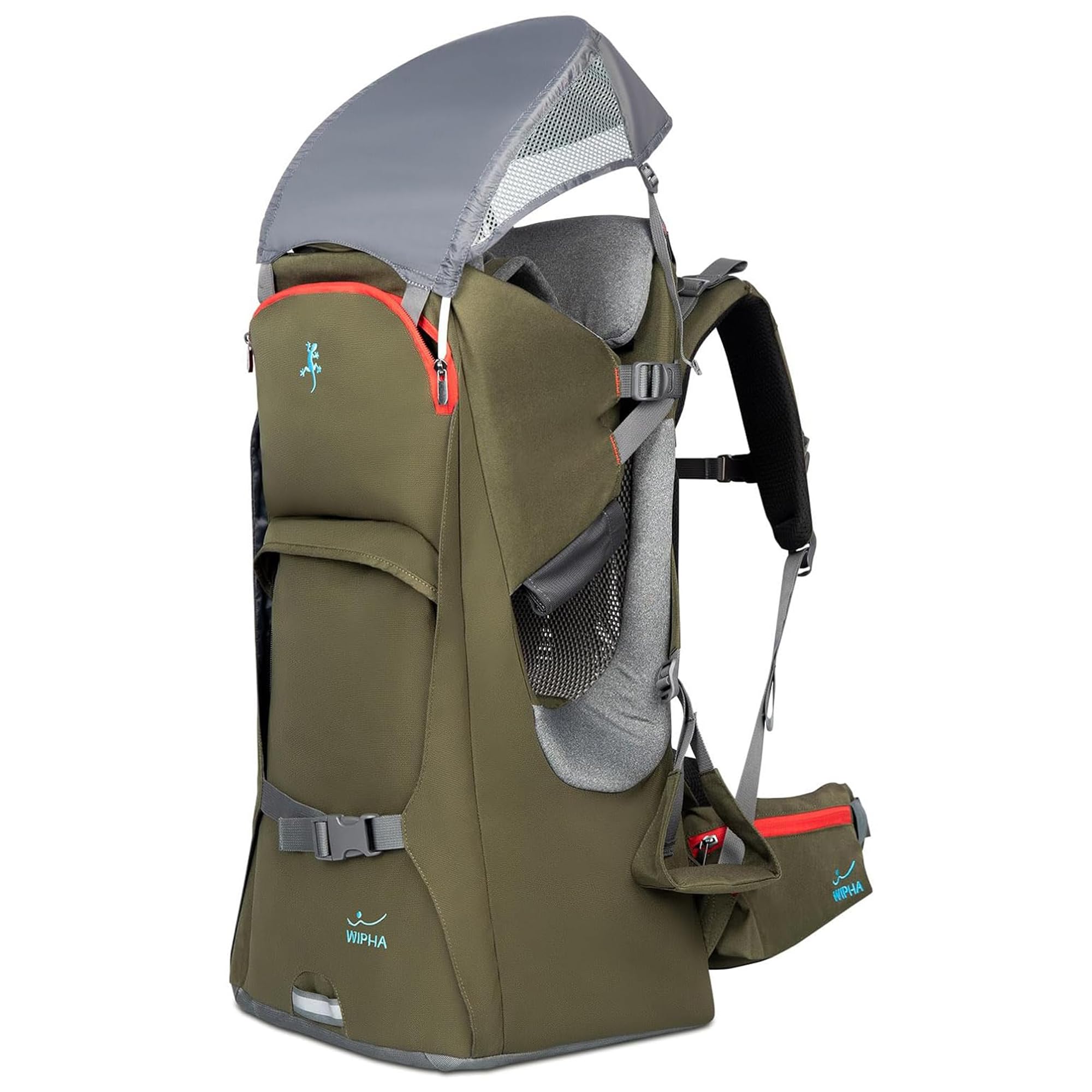
WIPHA Toddler Hiking Carrier
Key Features
- Warranty: 365 days
- Sun canopy: Included
- Minimum weight: 16 lb
- Max child weight: 40 lb
- Price: Midrange
A carrier that stands up on its own sounds like a small thing until you are on a slope with a wriggling two-year-old and need both hands. The WIPHA’s frame locks open from the inside, propping the child upright without tipping, which is the second-best version of this feature in the group after the Deuter’s.
Taller wearers are well served: a six-foot-two parent fits it without the shoulder straps bottoming out, and the padded seat with removable, washable saliva pads is the kind of detail that matters after a snack-heavy mile. The insulated pocket takes a bottle and a few snacks, the sun canopy comes off when you do not want it, and the whole thing is covered for a year.
What holds it out of a runner-up slot is the loading routine. Every framed carrier asks you to lift a child onto your back; this one has the least forgiving version of that lift. With a 40-pound limit and genuinely good storage it is a solid choice if the stand and the pockets are what you are after, but the besrey bundles more for less and the Osprey packs smaller.
Pros
- Frame locks open so the pack stands on its own
- Insulated bottle pocket and removable sun canopy
- Fits tall wearers without straps bottoming out
- Removable, washable saliva pads
Cons
- Awkward to lift onto your back alone
Worth choosing if you want a pack that stands on its own at every stop; otherwise the besrey does most of the same job with a friendlier lift.
Best for Older Toddlers
OE Shoulder Hiking Carrier

Key Features
- Frame: Foldable
- Backpack: Detachable
- Child age: 1–4 years
- Carrier weight: 4.5 lb
- Price: Midrange
The pitch is simple: put the child where they can see everything. The OE carries a one-to-four-year-old on a padded shoulder frame instead of in a seat behind your head, and a toddler who has decided the backpack is for babies will ride in this one happily, pointing at everything.
It asks something in return. A child sitting above your head raises your center of gravity, so this is a carrier for graded paths, town errands and the zoo, not for a rocky descent with a wriggler. Loading takes practice too: the child goes up and over, and the leg straps have to be fastened before you stand.
The detachable backpack is a nice idea that needs care in use. It sits away from your body, so filling it with water pulls your balance forward. Go light in it, or leave it at home on uneven ground.
We like it for a very specific family: a three- or four-year-old who wants the view, on walks short enough that a framed carrier’s seat is overkill. It folds down for travel and the sunshade stows with it, and the child’s enjoyment is the entire point of the design. As a first hiking carrier, or for anything long, a framed pack is the better spend.
Pros
- Child rides high with an unobstructed view
- Folds down for storage and travel
- Detachable backpack and sunshade included
Cons
- Raises your center of gravity on rough ground
- Leg-strap stitching can give way
Choose it for an older toddler who wants to see everything on short, well-graded walks, not as a family’s only hiking carrier.
How We Tested the Best Baby Carriers for Hiking
We started with more than 30 carriers, reading spec sheets and owner reviews and ruling out anything with a weight limit under 30 pounds, a hipbelt that was clearly decorative, or no storage beyond a single card pocket. That left 10, which we used for eight months.
Every carrier got the same outings: a stroller-free neighborhood loop, a steep two-mile climb with a 20-plus-pound toddler, and a longer weekend hike. We loaded each with a weighted sandbag first to judge the frame and belt, then with real kids from 15 to 28 pounds, including one who wanted up and down every few minutes.
We watched where the hipbelt landed on each tester’s hip bones and whether it stayed put on descents, and asked a 5-foot-4 and a 6-foot-1 parent where they felt pressure at the 30-minute and 90-minute marks. We timed solo back carries with a fussy toddler, crouched to tie a shoe on uneven ground to see how much the load shifted, and packed the identical load into every carrier — two diapers, a water bottle, a phone, a handful of crackers — then recorded what wouldn’t fit. Finally, we washed each one twice and checked buckles, seams, and mesh for wear.
How to Choose a Baby Carrier for Hiking
The right carrier is the one you can still stand to wear at the top of the climb, so the adult’s fit matters as much as anything about the child’s seat.
Framed Pack or Soft Carrier
The first decision is not a brand, it is a frame. A framed carrier puts the child’s weight on your hips through a real hipbelt, holds them upright enough to sleep, stands on its own when you stop, and usually brings a canopy. A soft or hip-seat carrier folds into a diaper bag but keeps the load on your shoulders and offers no shade. Our rule: an hour on flat ground is soft-carrier territory; anything longer, or any real climbing, and the frame earns its bulk. Families who drive to a trailhead should default to framed and keep the soft carrier for the supermarket.
Fit the Adult First
Most buying decisions start with the child and should start with you. A framed carrier transfers load through the hipbelt, so the torso length has to match yours; get it wrong and the shoulder straps take everything, which is behind most sore-back hikes. Torso range is the number to compare: the Kelty slides across 15.5 to 21 inches and the Osprey offers six inches of adjustment, both enough for two adults to share.
Measure from the bony bump at the base of your neck to the top of your hip bones before you order, and set the torso height before your first carry rather than after it.
Read the Weight Limit Properly
Carriers quote limits in two different currencies and listings rarely say which. Some give a child weight, as the ClevrPlus does at 33 pounds; others give a total that includes the carrier’s own weight and your gear. The besrey’s 44-pound figure is a total, so the pack’s 5.5 pounds and a couple of water bottles come out of it before your child does. Compare your child’s weight with a child limit, and your child plus pack plus water with a total. A carrier bought against the wrong number runs out of headroom a year early.
Sun, Rain and What’s in the Box
A shade is not a rain cover, and an included canopy is not universal. Several carriers here ship with both, while others treat the canopy as an extra. Canopies also shade a small child far better than a tall toddler, so look at how low the hood sits before you count on it in August. If your hiking is exposed, ridgelines and coast paths and alpine starts, buy the carrier whose box already contains the weather kit, because the add-on tends to be the thing you never get around to ordering.
Loading a Child on Your Own
Every framed carrier asks the same awkward move: lift a child in a rigid pack onto your back without help. The reliable technique is to harness the child first while the pack stands on a tailgate, a wall or a car seat, then face away, sit the pack against your lower back and roll it on with both shoulder straps. Practise twice at home over a sofa before you try it on a slope. If you hike alone with a heavy toddler, the stand and the empty weight matter more than pocket count.
Frequently Asked Questions
Can a baby go in a hiking carrier before they can sit up?
Framed carriers list minimum weights that vary widely across this group, and several pair a low weight figure with an age floor closer to six months. Head and neck control is the gate that actually matters: a child who cannot hold their head steady is not ready for a back carry, whatever the number on the box says.
Use the older of the two figures, and try a short carry at home before you commit to a trail.
Will a hiking carrier fit in an overhead bin?
A fixed-frame carrier will not; plan on the hold or the trunk. The exception here is the Osprey Poco LT, whose folding frame collapses flat enough to lie in a standard bin on its side or diagonally. Check your airline’s rules for carrying a child carrier before you fly, since policies differ.
How do I keep a baby cool in a carrier on a hot hike?
Favour a carrier with a ventilated, mesh-covered backpanel, which keeps the adult cooler, and use the canopy for shade rather than as a cover. Check the back of your child’s neck at every stop rather than their hands, and lift them out at breaks so air reaches their back and their clothing can dry.
Final Verdict
The Deuter Kid Comfort is the pack we point most families to. Nothing else here handles a sleeping child’s weight as well, and the stand, the stirrups and the water bladder pocket are what turn a carrier into a daypack. If two adults of very different heights will trade off, the Kelty’s torso range is worth a small step down in comfort; if the hike starts with a flight, the Osprey Poco LT folds into a suitcase and still carries well on the trail.
Buy framed if you walk more than an hour or climb anything; below that, the soft carrier already in your closet will do the job.