This post contains affiliate links. We may earn a small commission when you buy through our links — at no extra cost to you.
The last mile of that ridge trail is where I learned what a dog carrier is really for. My heeler mix had hiked seven happy miles and then lay down in the dirt, and I ended up carrying 35 pounds of dog in my arms while my own pack slid around behind me. A good carrier fixes both problems at once: it puts the dog’s weight on your hips and shoulders instead of your forearms, and it holds him tethered and upright so he can ride out the boring stretch comfortably.
Over the past eight months my team and I have logged trail time with 12 carriers, from bare-bones slings to structured packs with frames. One thing I’d tell any first-time buyer: the weight rating on the box matters far less than how your dog actually fits inside. A carrier that lets him slump or slide to one side will wreck your shoulders by mile three, no matter how sturdy it is. The picks below are the ones that fit well, held up, and were worth the money.


Best for Small Dogs, Day Hikes
PetAmi 4-Way Entry
Key Features
- Ventilation: Mesh on four sides
- Carry system: Waist belt and chest buckle
- Entry points: 4-way entry
- Weight limit: 18 lb
- Price: Midrange
The waist belt is what sold us. Plenty of carriers in this guide hang from your shoulders alone, and an hour of climbing makes that obvious; this one pulls the load onto your hips and stops the bag swinging when you step over roots. Add the chest buckle and the padded straps and it behaves less like a pet tote and more like a daypack that happens to have a dog in it.
Containment is where we paid closest attention, because a carrier that opens on a climb is worse than no carrier at all. Every zip on this pack buckles shut, there is a leash clip inside, and the mesh runs on all four sides, so a dog that stands up on a switchback still gets air and a view. The reflective strip down the strap matters more on a pre-dawn start than it sounds, and the sherpa-lined pad lifts out for washing after a muddy one.
The four openings are genuinely useful on trail: the top lets a dog stand and poke its head out, and the side panels let you load a nervous one without folding it in half. The listed ceiling is eighteen pounds, and that is a figure for a dog that mostly rides lying down. If your dog sits within a couple of pounds of it and the climb is a long one, the legs-out carriers further down this guide are the better bet.
Pros
- Waist belt and chest strap steady the load
- Zips buckle shut, with a leash clip inside
- Mesh on all four sides keeps air moving
- Removable sherpa pad washes clean
Cons
- Four openings mean more zips to check
For most hikers this is the one: a waist belt that shifts weight to your hips, four-sided mesh and zips that buckle shut. It suits a small dog you can carry for a few hours.
Best for Long Hikes with Gear
Kurgo G-Train
Key Features
- Storage: Laptop sleeve, 2 bottle holders
- Structure: Sewn-in fiberglass rods
- Carry system: Hip belt and sternum strap
- Weight limit: 25 lb
- Price: Midrange
Most carriers here do one job. This one is a hiking pack with a dog compartment at the bottom and room for water, a shell and lunch above it: two bottle holders, a padded sleeve you could put a laptop in, and shoulder straps that stow away so nothing dangles when you set it down at camp.
A hip belt and sternum strap do the load transfer, and sewn-in fiberglass rods stop the bag folding onto the dog when you cinch everything down. The bottom panel is waterproof, the right call for wet fern and stream crossings, and the whole thing reads as gear designed by people who hike with dogs rather than people who fly with cats.
This is the pick for whoever ends up carrying everything. Where it gets harder is near the top of its range: with seventeen pounds of dog plus water, the bag turns bulky and the support thins out, and you feel the difference on the descent. Load a ten-pound dog and a bottle instead and it is the most comfortable carry in this guide.
Pros
- Hip belt and rods transfer weight properly
- Carries water, layers and the dog together
- Waterproof base for wet ground
- Straps stow away when parked
Cons
- Zippers are the first thing to wear
- Tall, narrow interior suits a standing dog
The trail pack of the group: hip belt, real structure and room for water. Best for a ten-to-fifteen-pound dog and a human carrying everything else.
Best for Bigger Small Dogs
Petsfit Pet Backpack
Key Features
- Interior: 13.5 x 12.5 x 17.5 in
- Material: 600D Oxford cloth
- Carry system: Waist and chest buckles
- Weight limit: 18 lb
- Price: Midrange
The interior is the story: thirteen and a half inches long, twelve and a half wide, seventeen and a half tall, with a frame stiff enough that the walls stay up instead of sagging onto the dog the moment you lift it. The floor is solid, the mat lifts out for washing, and the shell is 600D Oxford, the fabric the tougher packs in this group use. Two side pockets swallow a lead and a bag of treats. The product title says twenty-two pounds while the spec table says eighteen, and the smaller figure is the one to trust.
We reach for this when the dog is bigger than a toy breed but still wants to lie down. A fifteen-pound terrier or a long-backed cat fits with room to turn around, and the stiff walls mean it does not fold onto them halfway up a climb. Waist and chest buckles take some of the weight off your shoulders, though this is a soft carrier, not a load-hauler. It costs more than the top pick and gives you less storage; what you are paying for is the shape holding, walk after walk.
Pros
- Stiff frame keeps the walls off the dog
- Largest interior of the soft carriers here
- Lockable zipper and internal safety belt
- Waist and chest buckles spread the load
Cons
- Wide, stiff shoulder straps out of the box
The roomiest box among the soft carriers here, with a frame that will not collapse onto a fifteen-pound dog. Worth the step up if your dog needs to lie down.
Best for Larger Small Dogs
K9 Sport Sack Plus 2
Key Features
- Dog fit: 20-22 in back length
- Storage: Removable pack, 2 bottle holders
- Carry system: Padded straps and back panel
- Weight limit: 30 lb
- Price: Premium
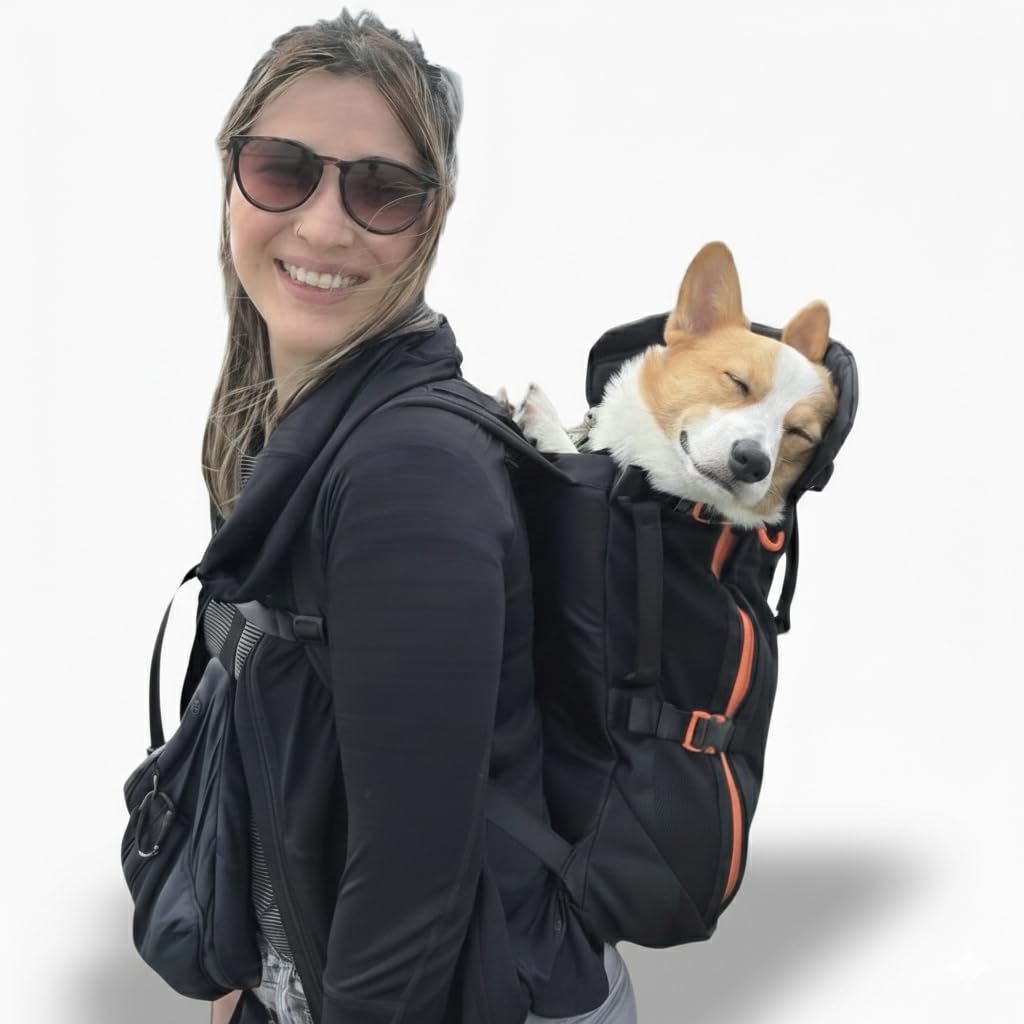
The dog’s front legs come out through two padded openings, so it rides upright against your back with its head over your shoulder instead of zipped into a box. That single design choice is why it can take a dog up to thirty pounds: a corgi, a cockapoo, a stocky terrier that no tote-shaped carrier will hold.
Sizing runs off back length, twenty to twenty-two inches from the base of the neck to the base of the tail for this size, with girth up to thirty-one inches. That is a stricter measure than a weight limit and the reason some people end up with a pack that is too small, since a sixteen-pound dog can still be too long for the size below. Measure a standing dog, twice, before you order.
Padded shoulder straps, a padded back panel, and no hip belt. The last part is what we noticed on a long climb: the weight sits on your shoulders and stays there, which makes this a pack for an hour on a bike, a short approach, or the hot mile at the end of a day. The taper-fit body does hold the dog still, and that counts for a lot when the trail steepens and a shifting dog would otherwise take your balance with it.
For a dog that has outgrown every tote in this guide it is still the answer, and the build, with 600-pound webbing, triple stitching and bar tacks at the wear points, is the kind that survives being pushed through brush. Load it from a tailgate or a rock rather than mid-trail; getting a wriggly dog in while the pack is on your back is the step people abandon.
Pros
- Carries a dog up to thirty pounds
- Taper-fit body keeps the dog from sliding
- Heavy-duty webbing and stitching
- Removable storage pack and bottle holders
Cons
- Loading takes two hands and a calm dog
- Sized by back length, so measure first
The carrier for a dog that has outgrown a tote: legs out, up to thirty pounds, built to last. Accept a shoulder-only carry and measure the back length first.
Best for Medium Dogs
Little Chonk Maxine One
Key Features
- Closure: Locking zipper
- Dog fit: 14-19 in back, 19-30 in girth
- Handles: Tubular grips on all four sides
- Structure: Rigid frame
- Price: Premium
This is the only carrier here built like a seat instead of a bag: a rigid shell that holds a corgi or a pug upright and forward-facing, with a soft collar that moves with the dog’s neck rather than pinning it. The construction is the most rigid in this group, and the grab handles on all four sides mean two people can take a corner each to lift a twenty-five-pound dog into a truck bed without the shell flexing.
Fit is where the money either works or does not. It is cut for a back length of fourteen to nineteen inches and a girth of nineteen to thirty, and dogs at either end of that range sit very differently; the ones that fit perfectly are the ones that were measured twice. There is a tail port at the back so nothing gets pinched, and reflective trim on the collar for evening walks. If your dog is the shape this was drawn around, nothing else here supports it as well.
Pros
- Rigid seat holds a medium dog upright
- Grab handles on all four sides
- Soft collar with reflective detail
Cons
- No pocket for water or treats
- Cut close, so measure back and girth
For a corgi, pug or similarly built medium dog this is the most supportive carrier here: a rigid seat, four grab handles and a soft collar.
Best for Camp and Travel
Lekebobor Expandable Carrier

Key Features
- Expansion: Expandable back panel
- Ventilation: Mesh on four sides
- Entry points: 4 entrances
- Weight limit: 18 lb
- Price: Midrange
Unzip the back panel and the bag grows from an ordinary carrier into a small den. That is the feature to understand before you buy: the expansion is a rest-stop and camp feature, not something you walk with, because a dog sprawled sideways in an open panel is a dog you are carrying off-balance.
It is the expandable carrier we liked most, and the reason is plain: mesh on four sides, four entrances including a top opening, zips that lock, and a roller blind you pull down over the front when the sun is in the dog’s eyes. It costs about what our top pick costs, and what you get for that is more room for a dog that panics in a tight bag.
The base is the soft spot. It is a mat over padding rather than a framed floor, so on rough ground a dog that paws at the bottom will feel it, and the whole bag can rock when a determined animal shoves at the sides. For a calm dog that mostly lies down, that is a trade worth making; for a scrappy terrier, it is not.
Pros
- Expandable back panel for rest stops
- Mesh on four sides, four entrances
- Roller blind shades the front panel
Cons
- Base has less structure than framed packs
- Expanded panel sags when unzipped
The expandable one to buy: mesh on four sides, locking zips and a sunshade for about the same money as the top pick, best for a calm dog that needs room at rest.
Best for Budget First Carrier
Conlun Backpack Carrier

Key Features
- Base: Hard base panel
- Ventilation: 3-side PVC mesh
- Carry system: Padded straps, chest buckle
- Weight limit: 15 lb
- Price: Budget
Three PVC mesh panels, a hard base, a removable pad and a leash clip inside: the Conlun has the safety basics and not much else. No frame, no bottle holders, no sunshade, and a strap-and-buckle harness that gets the job done without any shaping around the wearer.
What it does get right is the shape. The hard base panel stops the bag folding around a small dog, the zips open at the top and on both sides so you can load from whichever end is easier, and the chest buckle keeps the straps together on a short walk. The mesh is the part to think about, since it is the thinnest of these and a dog that scratches at the front panel will find the weak point sooner than you would like.
Our hesitation is the track record rather than the design. It is short next to the PetAmi or the Petsfit, and what durability evidence there is splits both ways, so we treat the bottom as a part to keep an eye on rather than a floor you can trust for seasons. Buy it as a first carrier to find out whether your dog tolerates the whole idea; if you already know it will ride, spend more.
Pros
- Internal leash clip and hard base
- Three mesh sides for airflow
- Folds flat for storage
Cons
- Mesh front is the weak point for a scratcher
- Short durability track record
A budget first carrier with the safety basics: internal leash clip, hard base and three mesh sides, best for a calm small dog on short, easy trails.
How We Tested the Best Dog Backpack Carriers for Hiking
We started with more than 40 carriers sold by major pet and outdoor retailers and cut anything without an internal safety tether, a real hip belt, or openings that let the dog’s legs hang free. From there we ordered 12, ranging from simple slings to framed packs, and spent eight months using them the way a hiking carrier actually gets used.
Testing ran on weekday evening walks and weekend day hikes, with a 35-pound heeler mix and a 14-pound terrier taking turns. We loaded each carrier with a dog, a water bottle, and a layer, and timed how long it took one person to get the dog in, clip the tether to his harness, and snug the straps. On the trail we watched whether the dog could sit upright with his head clear of the opening, whether the pack swayed when we turned or stepped over rocks, and where the shoulder and hip straps dug in after a mile of climbing. We also tried adjusting straps one-handed mid-climb with the pack on, which is where the flimsy buckles gave themselves away.
After every hike we wiped the carriers down, hung them to dry, and checked the stitching at the strap anchors and the zipper pulls; by month four the mesh on two of them had begun to sag. We carried each one empty and folded to see whether it would stash in a daypack, and compared buckles, webbing, and stitching against what each carrier cost.
How to Choose a Dog Backpack Carrier for Hiking
The weight limit printed on the box is the least useful number in this category; what decides whether a carrier works on a climb is whether it holds its shape when your dog shifts its weight on a steep step.
Measure the dog before you read the weight limit
Two carriers here take the same eighteen pounds and fit completely different animals. Back length, measured from the base of the neck to the base of the tail, and chest girth decide far more than the scale does, and the legs-out packs are sized on that basis alone. Measure a standing dog, twice, and buy to the smaller of your two numbers.
The trap: a carrier rated well above your dog’s weight can still be too short in the body, and that shows up on the descent as a dog that cannot lie down. If your dog is long-backed, size up and accept a little more room around the chest.
The carry system decides how far you go
A chest strap stops the bag swinging. A hip belt moves the load onto the frame you already have. They are not the same thing, and only one of them lets you climb for four hours.
Soft carriers with a sternum strap alone are fine for a ten-pound dog on a two-hour trail. Once you are carrying fifteen pounds of dog and a liter of water, look for a hip belt and some structure in the back panel — the Kurgo’s hip belt and fiberglass rods are the clearest example in this set.
Containment is not a detail
Every carrier here has a leash clip inside and every one has zips; the difference is whether those zips buckle or lock shut, and whether an opening is the kind a determined dog can nose wider. Check the closure before you admire the fabric.
The trap: a top opening is the easiest way to load a dog and the easiest way for one to climb out. A top zip that buckles is worth more on a trail than one that only zips.
Airflow, shade and the view
Mesh on three sides is the baseline; four sides is better on a hot climb, and a blind or sunshade over the front panel matters more than it sounds when the trail is exposed. A dog that can see out settles faster than one staring at the back of your head.
In summer, treat the carrier like a dark car in a parking lot: start early, open the panels at every stop, and take the dog out rather than letting it ride through the warmest hour.
Decide whether the pack is also your daypack
A bottle holder, a gear pocket and a waterproof base are worth paying for if the carrier replaces your daypack; those are what separate the Kurgo from the soft totes. If you carry a separate pack, skip them and spend the weight on the dog.
The trap is overloading. A carrier stuffed with three liters of water and a stove stops fitting the dog it was measured for, so weigh the packed bag and the dog together against the limit before you leave the trailhead.
Frequently Asked Questions
How do I get my dog used to riding in a backpack carrier?
Start on the floor at home with the panels open and a treat inside, and let the dog walk in and out for a few days before you close anything. Then lift it a few inches, then wear it around the house, then take a ten-minute walk.
Most dogs that refuse a carrier were closed into one at a trailhead the first time. If yours will not settle after a week of short carries, that is temperament, not sizing.
Can I use one of these as an airline carrier?
Often yes, since several here are sold as under-seat carriers, but the approval that counts is the airline’s rather than the listing’s. These packs stand between 16.2 and 17.5 inches tall before a dog goes in, so check that exterior height against your airline’s published under-seat limit before you book.
How long should a dog stay in a carrier on a hike?
Treat the carrier as transport for the parts your dog cannot do — the scrambly section, the hot exposed mile, the road walk back to the car — rather than a seat for the whole day. Take the dog out at every water stop and let it walk the flat stretches.
A dog carried for four hours straight has not stretched, drunk or toileted, and no amount of mesh fixes that.
Final Verdict
Buy the PetAmi 4-Way Entry if your dog is under about fifteen pounds and you want one carrier that does the whole job: the waist belt takes the weight off your shoulders, the mesh wraps all the way around, and the zips buckle shut. For a day where you are carrying water and layers as well as the dog, the Kurgo G-Train is the better trail pack.
And if your dog has outgrown tote-style carriers altogether, go straight to the K9 Sport Sack Plus 2 — then measure its back length before you order, because that is the number the sizing turns on.