This post contains affiliate links. We may earn a small commission when you buy through our links — at no extra cost to you.
Every dog boot I’ve ever strapped on gets judged twice: once by me, and once by the dog. Some dogs high-step like they’re crossing wet cement, others flatten onto the grass and refuse to move, and a handful trot off as if nothing has changed. That split usually comes down to fit and flex, not drama. A set that works solves the problems you actually bought it for: scorching August asphalt, ice-melt pellets on winter sidewalks, sharp gravel, and the salt irritation that shows up as licking and chewing hours after you’re home.
We spent eight months working through 12 sets, from thin slip-ons to structured boots with real rubber soles, and the differences were obvious within a block. One thing I’d tell any first-time buyer: the number on the box means almost nothing, because sizing charts run differently from brand to brand. Measure across the widest part of your dog’s front paw while they’re standing, then check that specific maker’s chart. Ahead are the sets that stayed on, kept paws clean, and didn’t turn every walk into a negotiation.


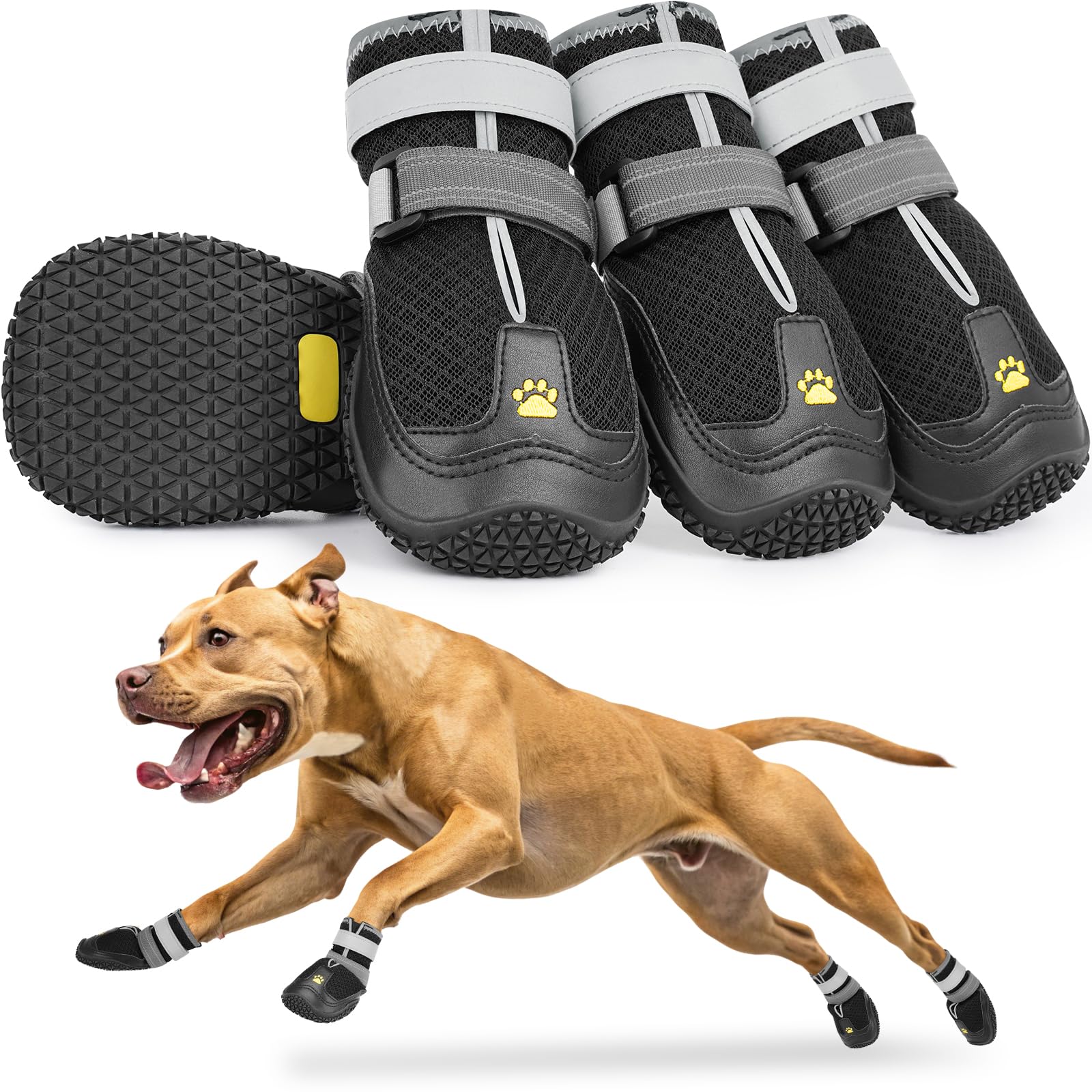

Best for Everyday Walks
QUMY Dog Shoes
Key Features
- Sole: Rugged slip-proof rubber
- Size (W x L): 3.0 x 3.3 in
- Boots per Box: 4
- Opening and Straps: Wide split seam, two reflective straps
- Price: Midrange
Most of the trouble people have with these boots starts a step before the boot goes on: picking a size from the dog’s weight. QUMY’s chart runs on paw width, and the boots that stay put on a walk are the ones ordered from a paw traced on paper and measured across its widest point. Get that right and the design does the rest.
That design is unglamorous and effective. The boot opens along a wide split seam, so a paw slides into something closer to a shoe than a sock, and two reflective straps pull snug at the front and the back. The sole is a thick slip-proof rubber that keeps pads off hot asphalt and out of road salt, and the upper is soft, breathable fabric rather than a rubbery shell. The embroidered paw print is decoration; the opening and the straps are the parts doing the work.
We recommend this set more often than anything else here, and the reason is range. A fast opening, four boots in one box and a sole that copes with hot pavement, slush and gravel covers more dogs and more walks than any single-purpose boot on this list. Senior dogs get grip on tile, city dogs get protection from salt, and a dog who has never worn boots has a decent chance of walking out of these instead of freezing.
Two details we noticed. The straps are reflective, which stops being a marketing line the first time you walk a black dog at five in the afternoon in December. And they are hand wash only, so mud comes off with a brush and a rinse, but these don’t go in with the towels.
Pros
- Four boots arrive in one box
- Wide split seam gets paws in fast
- Thick slip-proof sole for pavement and snow
- Reflective straps front and back
Cons
- One size has to suit all four paws
- Upper and sole can part with hard use
Our default pick for most dogs and most walks: four boots, a forgiving opening, and a sole that handles hot asphalt and salted sidewalks.
Best for Trail Hiking
Ruffwear Grip Trex
Key Features
- Upper: Ripstop polyester
- Outsole: Vibram rubber
- Paw Width: 2.00 in
- Boots per Box: 1 pair (2 boots)
- Price: Premium
Sold in pairs rather than fours, which is the detail that decides whether these are right for you. For hikers it’s the better system: front paws are usually wider than rear ones, so a 2.00-inch pair can go on the back and a wider pair on the front for a fit no four-pack can match. That’s why we point trail walkers and weekend peak-baggers here first, and why we don’t hand them to everyone.
The outsole justifies the price of entry. It’s Vibram rubber, lugged enough to bite on wet granite and loose scree, where a softer budget sole skates. Up top, ripstop polyester breathes on a summer climb and still blocks snow, salt and the fine grit that works into a paw and stays there. Hook-and-loop ankle straps and an ergonomic shape hold them through the kind of zoomies that remove most boots inside a minute.
Shape, not size, is where this boot divides people. Narrow or bony paws can rub at the dew claw, and a thin sock under the boot settles it for most dogs; wide, flat feet seem to do better. Beyond that, these are boots for uneven, sharp ground, and for pavement miles the Summit Trex is lighter and easier to live with. If your dog has never worn footwear, buy something cheaper to find out whether they’ll tolerate it at all, because this is an expensive place to learn.
Pros
- Vibram outsole bites on wet rock and scree
- Ripstop upper blocks snow, salt and grit
- Pairs let front and rear paws be sized apart
- Stays on strong pullers and high-energy dogs
Cons
- Two boots per box; four paws means two purchases
- Sizes run large on some paws
The boot we point hikers to: a real Vibram outsole and a shape that holds, sold in pairs so front and rear paws can be fitted differently.
Best for Budget First Pair
XSY&G Dog Shoes
Key Features
- Closure: Two adjustable straps
- Materials: Fabric upper, rubber sole
- Size (L x W): 2.9 x 2.5 in
- Boots per Box: 4
- Price: Budget
If you don’t yet know whether your dog will wear boots at all, this is the cheapest way to find out and the least painful if the answer is no. Four boots, a fabric upper, two straps, a rubber sole. Nothing here is trying to be clever, and at this end of the market that’s the point.
Protection is where these quietly overdeliver. The sole is thick enough for hot asphalt, the uppers keep stickers, salt and broken glass off the pads, and the wide opening gets a paw in without a wrestling match. Dogs that have never worn anything on their feet tend to walk out of these rather than freeze, and the two straps let you snug the front and the back separately instead of cinching one band around the whole ankle.
We reach for them for short daily walks, for senior dogs who need grip on hardwood, and for anyone who wants protection before committing to a premium boot. Four paws come out of one box, which is the appeal and the catch: all four get the same size, so a dog with visibly wider front paws is compromising somewhere. Wash them by hand and dry them away from a radiator, because heat is what kills the adhesive on any boot built this way.
Pros
- Least expensive way to shoe all four paws
- Thick rubber sole for hot pavement
- Wide opening and two adjustable straps
Cons
- One size has to suit all four paws
- Upper and sole can separate with rough use
The low-cost way to find out whether your dog will wear boots at all, and a genuinely protective set for short daily walks.
Best for Hot Pavement
LUCKYPAW Dog Shoes
Key Features
- Upper: Ultra-mesh with toe guard
- Size (W x L): 2.6 x 3.0 in
- Boots per Box: 4
- Waterproofing: Water-resistant toe only
- Price: Midrange
The mesh upper is the whole argument, and the listing is refreshingly honest about what it costs: these are not fully waterproof. On a July sidewalk that’s exactly right, because air moves through the boot instead of cooking the paw inside it. In January slush it means a damp foot within twenty minutes. Buy them for summer, or for a dog who runs hot, and the trade pays off.
For hot-weather walking, these sit near the top of this set. Two reflective straps and a wide slit make them quick to fit, the rubber sole has enough texture for wet grass and smooth floors, and the toe guard takes the scuffing pavement hands out. Sizing runs off paw width and length rather than breed, which is the only method that works here, and the straps sit far enough apart that you can tighten the boot without pinching the ankle.
What you give up is rough-ground coverage. A mesh and leather boot is at home on pavement, park paths and the beach; on scree, a lugged rubber boot like the Grip Trex is the better tool. For a dog doing the August hot-pavement dance, one paw up then another all the way to the corner, this is the pair we hand over.
Pros
- Mesh upper keeps paws cool on hot days
- Two reflective straps and a wide slit
- Textured sole grips wet grass and floors
Cons
- Mesh soaks through in slush and deep snow
Buy these for summer: breathing mesh, a toe guard and two straps that let you snug the fit without pinching an ankle.
Best for Daily Sidewalk Walks
Ruffwear Summit Trex
Key Features
- Upper: 150D polyester ripstop
- Outsole: Non-marking rubber
- Paw Width: 2.75 in
- Boots per Box: 1 pair (2 boots)
- Price: Midrange
The closure is what sells this boot. A hydrophobic YKK hook-and-loop strap runs through reflective webbing, backed by a raised cuff, which is a dull way of saying it doesn’t spin, doesn’t loosen halfway round the block and doesn’t need re-seating every ten minutes. For a dog doing two miles of sidewalk a day, that reliability matters more than a lug pattern, and it’s why this is our pick for everyday town walking.
The rest is built for weather and pavement: 150-denier polyester ripstop with a PFAS-free water-repellent finish, mesh panels that let the boot breathe while keeping grit out, and a non-marking rubber outsole. Non-marking sounds like a footnote until your dog spends a week skidding around a hallway getting used to them and your floor comes through without black scuffs.
Against the Grip Trex, this is the lighter, lower-profile boot and the easier one to live with on pavement, with less bite on wet rock. It’s also the pair we suggest for a dog with arthritis or a dragging back foot, where the job is a clean protective layer on the ground rather than technical grip.
Pros
- Hook-and-loop closure holds without re-seating
- Ripstop upper with water-repellent finish
- Non-marking sole is kind to indoor floors
Cons
- Fabric upper can rip before the outsole wears
- Two boots per box; four paws is two purchases
Our pick for everyday town walking: a closure that stays put, a cuff that keeps the boot in line, and a lighter build than the trail boot.
Best for Wide Paws
DcOaGt Dog Shoes

Key Features
- Sole: Soft anti-slip rubber
- Upper: Waterproof toe, woven mesh
- Paw Width: 3.2-3.3 in
- Boots per Box: 4
- Price: Midrange
A 3.2- to 3.3-inch paw width is where a lot of boot charts simply run out. That’s the gap this size 9 fills: big shepherds, livestock guardians and dogs with splayed or swollen feet get a boot that closes over the paw instead of perching on top of it.
For very wide paws, this is the fit we trust most in this set. The soft rubber sole is the other half of the argument, because it flexes under a heavy dog instead of clumping, and the tread holds on wet decking, tile and packed snow. Two hook-and-loop straps sit well apart, so the boot closes evenly rather than bunching at the ankle.
The wide slit opening matters more than it sounds: a big paw needs a big hole to go into, and this one has it, which makes a difference on a dog who already dislikes the whole procedure. Measure across the widest part of a standing paw with the claws included, because the step between sizes is the difference between a boot that stays on and one that doesn’t. They’re machine washable too, which is rare enough in this group to say out loud.
Pros
- Fits paw widths others don’t reach
- Soft rubber sole flexes under a heavy dog
- Wide slit opening for big, reluctant paws
- Machine washable
Cons
- Only the toe is waterproof
The pick for very wide paws: a size chart that reaches 3.2 to 3.3 inches, a soft flexing sole and a wide opening for big feet.
Best for Snow and Salt
Dimicoo Winter Dog Boots

Key Features
- Upper: Waterproof fabric, fleece lining
- Closure: Dual straps with drawstring
- Insole Width: 2 in
- Boots per Box: 4
- Price: Midrange
Salt is what usually ends the argument. It packs into the webbing between the toes, stings, and gets licked off later, and a dog who starts limping two blocks from home in January is telling you something. A high top with a sealed upper and a fleece lining is built for that walk: the boot rises above the ankle, a drawstring closes the top against slush, and the reflective strips give a half-asleep driver something to see.
The construction is the most winter-specific in this group. Waterproof fabric outside, fleece inside, a soft anti-slip rubber sole, and two hook-and-loop straps plus the drawstring, which together seal the top far better than straps alone. They’re machine washable, which matters when the alternative is salt residue drying into the lining, and the one-year warranty is longer than most here.
This is a small size, a 2-inch insole aimed at dogs in the 27 to 38 pound range, so trace a paw and match the width rather than trusting the weight band. The fit is meant to be close, since a loose winter boot fills with snow, and the drawstring is the part that takes a couple of tries to get right.
We keep these by the door from December to March. What earns them the spot is the walk that otherwise gets cancelled: the slushy block to the corner and back, the salted stretch between the car and the door, where a warm sealed high top isn’t a luxury but the difference between a dog who gets out and one who doesn’t.
Pros
- Fleece lining and sealed upper for snow
- Drawstring plus two straps seal the top
- Machine washable with a one-year warranty
- Reflective strips for dark walks
Cons
- Sealed fleece build is cold-weather only
A winter specialist for salted sidewalks: sealed upper, fleece lining and a drawstring top that keeps slush out on a January walk.
How We Tested Dog Boots on Asphalt, Salt, and Gravel
To build the shortlist, we read the sizing charts for roughly 40 sets sold in the U.S. and dropped any that skipped half sizes, published no paw-width measurement, or leaned on a fabric sole with no real tread. That left 12 sets, which we tested over eight months on three dogs: a 75-pound Labrador mix, a 20-pound terrier, and a dachshund with wide, awkward front paws.
Before the first walk, we measured the widest part of each dog’s front paw while standing, matched it to the maker’s chart, and noted which sets ran narrow or long once they were on. On go-day we timed how long one person needed to get all four boots onto a wriggling dog and watched the first block for high-stepping, bunny-hopping, or a back foot being dragged. A boot that twisted at the heel within ten minutes got reset and marked; if it twisted twice, we logged it as a fit failure, since a twisted boot is the one a dog chews off.
Walks covered hot midday asphalt in August, salted sidewalks in January, a gravel trail, wet grass, and a snowy morning, and after each one we checked pads and between the toes for redness or chafing. We kept a rough mileage log per set, then inspected soles for wear and seams for fraying at the hundred-mile mark and again at the end. Each set went through the wash as the maker directed and got stuffed in a walk bag for a week to see whether it stayed easy to use. Value had the last word: what a set cost spread over the months it lasted before a boot went missing or split a seam.
How to Choose Dog Boots
Dog boots fail for two reasons, the wrong size and a strap that lets go, and both are decided before your dog takes a step.
Start with a paw print, not a breed chart
Brands size these differently, and the weight ranges on the box are a rough starting point rather than a size. The only method that travels is a traced paw: stand the dog on paper, draw around the weight-bearing paw at its widest point with the claws included, and measure across. That number is what the chart wants, whether the listing quotes width, length or both.
If your dog lands between two sizes, take the smaller one. A slightly snug boot stays on; a roomy one spins, rubs at the dew claw and ends up in a hedge halfway round the block.
What actually keeps a boot on
Two straps beat one, and a cuff that rises above the ankle beats a low shoe. A single band around the middle of the foot lets the boot pivot; a front and a rear strap hold it in line with the leg. High tops and drawstrings, which the Dimicoo winter boot uses together, seal the top against slush, which is why snow boots are cut taller than summer ones.
The trap is compensating for a loose boot by cranking the straps down. If the boot still turns on the paw, the size is wrong, not the tension, and an over-tightened strap is how you end up with a rubbed ankle and a dog who refuses to wear them again.
Waterproof, breathable, or both
These are opposite properties and you generally get one. Mesh uppers let heat out on hot pavement, which is what you want on an August sidewalk; sealed fabric and fleece keep slush out in January but turn a boot into an oven in June. Toe caps are the middle ground, sealing the front of the foot while the rest breathes, which is enough for wet grass and salted streets and not enough for a dog who wades.
Be sceptical of a mesh boot advertised as fully waterproof. The LUCKYPAW listing says plainly that it isn’t, and that honesty makes it easier to choose: buy it for summer, and buy a sealed high top for the months when the pavement is white.
Soles, surfaces, and how long boots last
Rubber is the floor. A lugged sole with real depth, like the Vibram on the Grip Trex, bites on wet rock and packed snow; softer, flatter soles are quieter on pavement, and the Summit Trex’s non-marking outsole saves your hallway during the getting-used-to-it phase. If your dog’s front paws are visibly wider than the rear, pairs make more sense than a four-pack, which is the argument for buying Ruffwear two at a time.
Whatever you buy, treat boots as consumables. The seam where the sole meets the upper is where they fail first, so rinse the salt out rather than letting it dry in, and inspect that join after a muddy walk. Four boots at once also means a lost one doesn’t retire the set.
Frequently Asked Questions
How hot does pavement have to be before my dog needs boots?
Hotter than your hand can stand. Press the back of your hand to the asphalt for seven seconds; if you can’t keep it there, it’s hot enough to burn paw pads. Boots help on those days, but timing helps more, so walk early or late. Asphalt holds heat long after the air cools, which means a pleasant evening can still be a hot-pavement walk.
Can my dog wear boots all day?
For a walk, yes; for a whole day, no. Feet need to dry out and you need to see the paws, so take the boots off at the door and check between the toes for grit and rubbing. The exception is indoor traction for an older dog on hardwood, where a soft-soled pair worn around the house is a reasonable everyday use.
Can I machine wash dog boots?
Check the care label before you commit. Most boots here are hand wash only, and a machine cycle can soften the adhesive holding the sole on; the DcOaGt and Dimicoo pairs are listed as machine washable. By hand it’s a brush, a rinse and air drying away from a radiator, because heat is what kills the glue.
How long does it take a dog to get used to boots?
Usually a handful of short sessions rather than one long one. Put a single boot on indoors, follow it with a treat and a lap of the kitchen, then add another; most dogs walk normally within a few tries, and a few never accept them. If yours still high-steps after a week, check the length of the boot, because too long is the usual culprit.
Final Verdict
For most dogs and most walks, the QUMY set is the one to order: four boots, an opening that takes a wriggling paw, and a sole that handles hot asphalt and salted sidewalks. If your miles happen on rock and root, the Ruffwear Grip Trex earns its premium, and buying pairs means front and rear paws each get a proper fit.
And if your dog has never worn boots, start with the XSY&G set and find out cheaply whether they’ll walk in them at all before spending on a specialist.