This post contains affiliate links. We may earn a small commission when you buy through our links — at no extra cost to you.
The first time I strapped boots on my dog, she walked like she was wearing swim fins and lost one before we’d gone a quarter mile. That’s the dirty secret of dog boots: most fit badly, twist on the paw, or sail off into the bushes, which is why so many sets get worn once and buried in the gear bin. A good pair does the opposite. It keeps paw pads off hot granite and jagged scree, stops ice from balling up between the toes, and lets your dog keep hiking when the trail turns ugly.
Fit is the whole ballgame, and the measurement people get wrong most often is the one taken while the dog is standing. Paws splay under weight, so a size traced while your dog is sprawled on the couch will run narrow. We’ve spent the past six months fitting 12 different pairs on dogs from a 15-pound terrier to an 80-pound shepherd mix, and the ones that made this list are the ones the dogs eventually stopped noticing. Some are built for rocky scrambles, others for slushy trailhead parking lots; you’ll find both below.


Best for Rocky Trails
Ruffwear Grip Trex
Key Features
- Pack: 2 boots, sold in pairs
- Upper: Ripstop polyester
- Closure: Hook-and-loop ankle straps
- Outsole: Vibram rubber
- Price: Premium
A Vibram outsole is the reason the Grip Trex leads this list. Every other boot here runs a generic rubber sole, and on wet granite, loose scree, or a slick boardwalk that difference is the one you feel through the leash. The ripstop upper shrugs off gravel and brush without cooking the paw, and the hook-and-loop ankle strap cinches down hard enough that a determined puller does not simply walk out of it.
Selling them in pairs looks like an upsell until you put a tape to a dog’s front and rear paws. Front paws are nearly always the wider set, so pairs let you fit each end properly instead of compromising on four identical boots. It also means a single worn boot is a single replacement rather than a whole new set.
The catch is that the fit is unforgiving. The shell is structured, the cuff sits close, and a boot that is a little too wide will spin by the first mile. Measure the standing paw across its widest point, and if the dog lands between sizes, take the smaller one. Two short pavement walks before a real hike will tell you whether the cuff rubs, so check the dew claw and the outside of the ankle after each one.
Then there is the arithmetic of shoeing four paws out of two-boot boxes, which is the real reason this one is not for everybody. For a dog that spends weekends on rock and roots, we think it is worth it. For a dog that mostly circles the block, the cheaper mesh boots here will do more than enough.
Pros
- Vibram rubber grips wet rock and gravel
- Pairs let you size front and rear separately
- Ripstop upper resists abrasion and debris
Cons
- Sold as pairs, not a set of four
- Priciest per boot in this group
For dogs that spend real time on rock and roots, the Grip Trex is the boot we recommend first, as long as you measure the paw and expect to buy two boxes.
Best for Everyday Trails
QUMY Dog Shoes
Key Features
- Pack: Set of 4
- Size: Size 8: 3.0” x 3.3” (W*L)
- Sole: Rugged slip-proof rubber
- Closure: Two reflective hook-and-loop straps
- Price: Midrange
The QUMY is what we point a first-timer toward when they want boots on all four paws in one order. The upper opens along a wide split seam, so there is no wrestling a rigid cuff over the wrist joint, and both straps carry reflective webbing, which earns its keep on an evening walk when the light goes early.
As a hiking boot it is a compromise, and we knew that going in. The sole is a rugged slip-proof rubber with real tread, which is plenty on packed dirt, gravel paths, and hot pavement, but it does not hold a wet rock the way the Vibram on our top pick does. The upper is a faux-leather and mesh sandwich that keeps mud out on the trail and then holds onto it afterward.
Fit is the variable. Sized against measured paw width these stay on through a full walk; sized off the weight or breed chart they spin and end up in a hedge. The 3.0-by-3.3-inch size 8 we looked at is a genuinely big boot, so a medium dog needs a smaller band rather than a hopeful strap adjustment. The three-month warranty is also shorter than we like for something that meets rock.
Where these win is volume and convenience: four boots, a fast fit, and enough left over to keep a spare set in the car. That is a sensible buy for a dog doing weekday pavement and weekend dirt, and less sensible for someone whose trails are wet granite and slab.
Pros
- Wide split seam makes them quick to get on
- Two reflective straps adjust front and rear
- Rugged tread handles gravel and hot pavement
Cons
- Hand wash only
- Short three-month warranty
Four boots, reflective straps, and a sole that handles gravel and hot pavement make the QUMY our value pick for everyday trail walks and summer miles.
Best for Hot Weather
Ruffwear Summit Trex
Key Features
- Pack: 2 boots, sold in pairs
- Upper: 150D polyester ripstop
- Closure: YKK hydrophobic hook-and-loop
- Outsole: Non-marking rubber
- Price: Midrange
On a July climb where the rock is too hot to hold a palm against, the Summit Trex is the boot we reach for. Engineered mesh panels run along the sides so heat escapes instead of stewing, the 150-denier ripstop upper carries a water-repellent finish for dew and stream spray, and the whole build feels lighter on a paw than its heavier sibling. It is the boot we put on a dog that runs hot.
It is the cheaper of the two Ruffwear boots here, and the trade shows up in the outsole: a grippy non-marking rubber that handles sidewalk, gravel, and packed trail without the Vibram bite of the Grip Trex. What it does better is the closure, a hydrophobic YKK hook-and-loop strip under reflective webbing, plus a reshaped cuff that sits where it should instead of sliding toward the toes.
Pairs only, same as its sibling, so four paws means two boxes and a bigger outlay than the number on the listing suggests. The 2.75-inch size we looked at measures paw width rather than length, which is the number that actually matters and the one most people get wrong. Measure first: a boot slightly too wide will rub long before it will grip.
Pros
- Mesh panels vent heat on summer trails
- Water-repellent ripstop handles dew and spray
- Hydrophobic closure with reflective webbing
- Lighter on the paw than the Grip Trex
Cons
- Two-boot boxes make a full set costly
- Less aggressive tread than the Grip Trex
For summer trails and hot pavement, the Summit Trex breathes better than anything else here and grips nearly as well, provided you have measured the paw width.
Best for Giant Breeds
DcOaGt Dog Shoes
Key Features
- Toe: Waterproof synthetic leather
- Pack: Set of 4
- Size: Size 8: 3.0-3.2 in paw width
- Sole: Soft anti-slip rubber
- Price: Midrange
Size 8 covers a paw width of 3.0 to 3.2 inches, and that single fact is why the DcOaGt is on this list. Most boots here top out well before a Rottweiler, a Cane Corso, or a Labrador with genuinely broad feet. This is the one that goes on without a fight and still has strap left to cinch.
The build is better than the price suggests. The toe box is a waterproof synthetic leather, so wet grass and shallow puddles stay out, while the rest of the upper is a tight air mesh that stops the boot turning into a sauna. The rubber sole is soft rather than stiff, which matters on a heavy dog: it flexes where the foot flexes instead of levering the whole boot off at the heel. Two hook-and-loop straps and a wide slit opening make for a fast fit.
What gives us pause is sizing. The width bands are narrow enough that a paw near a boundary can go either way, and the boot has to sit snug to stay put, so measure before ordering rather than guessing from breed. At 2.88 ounces a boot they do not drag a tired dog down, and the reflective weave is bright enough for the walk home after the sun drops.
Pros
- Fits paws up to 3.2 inches wide
- Waterproof synthetic leather toe box
- Soft, flexible sole suits heavy dogs
Cons
- Sizing at the band edges is a gamble
Big paws are the whole point: the DcOaGt reaches a 3.2-inch width, keeps the toe dry, and stays put on a heavy dog that pulls.
Best for Winter Trails
Dimicoo Waterproof Boots
Key Features
- Pack: Set of 4
- Size: 3#: 2 in insole width
- Shell: Waterproof high-top
- Lining: Fleece
- Price: Midrange
Most of the boots here are summer tools. Mesh breathes, but it also wicks, and a wet November trail will soak a mesh boot right through. The Dimicoo high-top is the exception in this group: a waterproof shell that rises over the ankle, with a fleece lining behind it.
The height does real work. Mud, slush, and the salt spread on winter paths stay below the cuff instead of working down between the toes, and the fleece holds warmth on frozen ground. A drawstring runs inside the two hook-and-loop straps, so you can pull the whole boot snug rather than just clamping the middle of the foot. At 2.4 ounces a boot, they do not drag a tired dog down either.
The high cuff needs a clean seat, though: thick leg fur can bunch under the top strap, so smooth it down before you fasten. They are also machine washable, which is rare on this list, and a set caked in road salt comes back to life with a cold cycle and an airing rather than an evening of scrubbing.
Pros
- Waterproof high-top keeps snow and slush out
- Fleece lining adds warmth on frozen ground
- Machine washable, unlike most of this list
Cons
- No venting, so they run hot in summer
For snow, slush, and salted sidewalks the Dimicoo high-top is the boot here actually built to keep paws dry, as long as you are not hiking it in summer.
Best for Budget First-Timers
XSY&G Dog Shoes
Key Features
- Care: Hand wash only
- Size: Size 6: 2.9” x 2.5” (L*W)
- Closure: Two hook-and-loop straps
- Material: Fabric with rubber sole
- Price: Budget
If you have never put boots on a dog, the XSY&G is the least expensive way to learn whether yours will tolerate them at all. The design is friendly to a first-timer: two long hook-and-loop straps with slack to spare, a soft fabric upper, and no rigid cuff to fight at the wrist.
What you give up is trail toughness. The upper is soft fabric with paw embroidery, and the sole is a rubber layer rather than a molded hiking tread, which is fine on pavement and packed dirt and less convincing on wet roots and loose scree. Durability is the softer point: the stitched sole and the fabric above it are the parts to watch, and a set that lives on sidewalks will outlast one that spends its weekends on rock.
Where these earn their keep is hot pavement and short city walks. The soft upper does not rub a dog raw the way a structured boot can, they go on in seconds, and a boot lost in tall grass is not a disaster. As a first pair, a spare set for the car, or the boot for a dog in a hot climate, that is a fair trade.
Pros
- Least expensive boot in this group
- Two long straps give plenty of adjustment
Cons
- Stitched sole and fabric upper wear on rock
- Hand wash only
Cheap enough to try, soft enough that most dogs tolerate them, and good on hot pavement: the XSY&G is our budget pick for shorter, gentler walks.
Best for Wide Paws
LUCKYPAW Dog Shoes
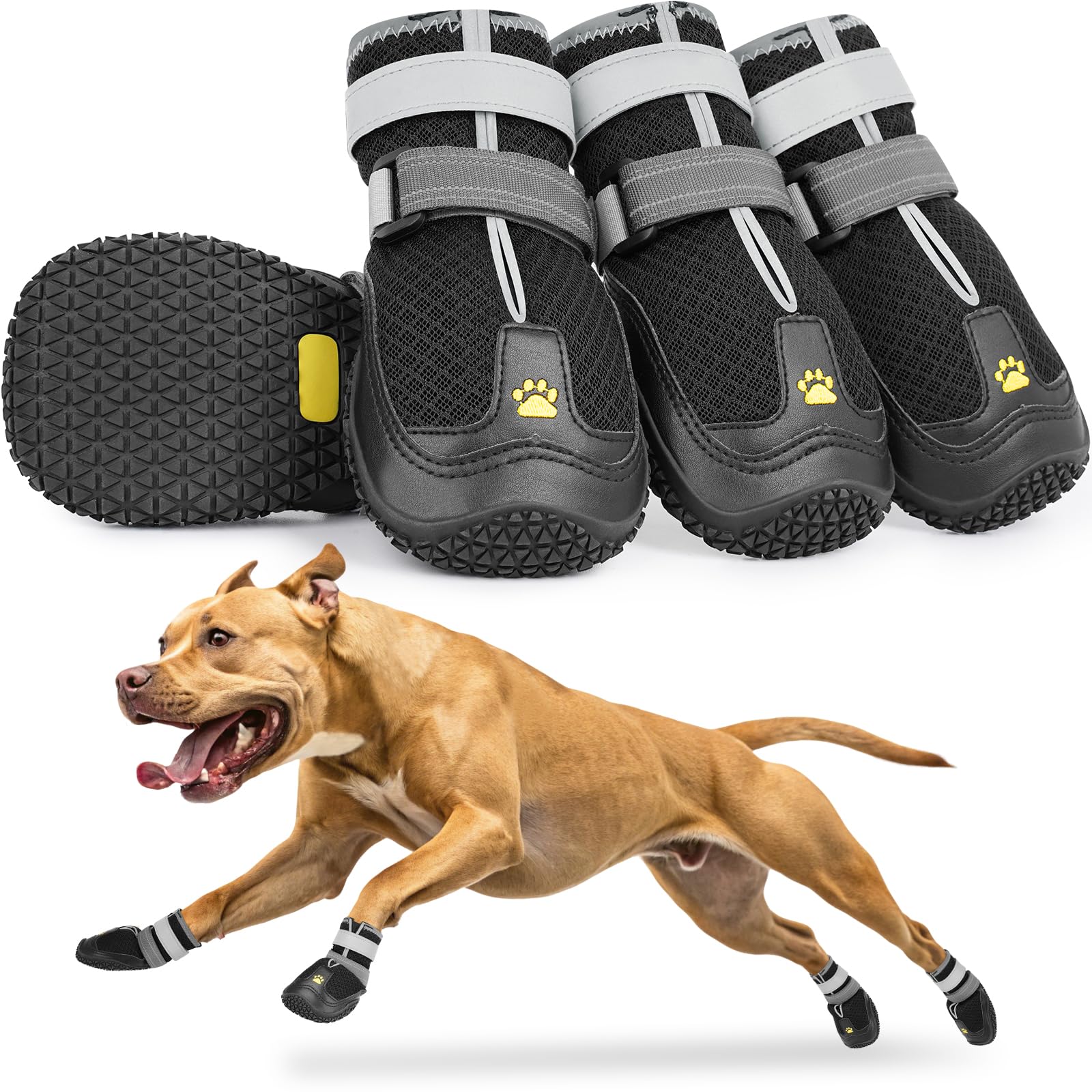
Key Features
- Pack: Set of 4
- Size: Size 6: 2.6” x 3.0” (W*L)
- Sole: Flexible anti-slip rubber
- Upper: Ultra-mesh, water-resistant toe
- Price: Midrange
LUCKYPAW is the only listing here that comes out and says the boot is not fully waterproof. That honesty is worth something: the mesh upper breathes, the toe cap is water-resistant enough for wet grass, and nobody should be buying these for a blizzard.
Sizing is done by paw width and length rather than breed or weight, which is the right way round, and the size 6 we looked at runs 2.6 inches wide by 3.0 long, a genuinely broad foot. Two reflective straps do the securing, and the rubber sole bends where the foot bends instead of staying flat like a plank.
Traction is the piece we are least sure of. It is a textured rubber rather than a lugged hiking sole, so it is happy on hardwood, tile, and packed trail, and less convincing once the rock turns wet and slanted.
Where this one earns its place is the dog that overheats in anything structured. The mesh moves air, the fit is broad rather than tight, and for summer walks on dry trails it does the job without a premium. Four boots, one honest limitation, no surprises in the box.
Pros
- Sized by paw width and length, not breed
- Breathable mesh with a water-resistant toe
Cons
- Not waterproof; mesh lets water through
Broad-pawed dogs that overheat in boots get on well with the LUCKYPAW: breathable mesh, a flexible sole, and an honest limit on water.
Best for Low-Light Walks
CovertSafe Dog Boots

Key Features
- Pack: Set of 4
- Size: Size 6: 2.9” x 2.5” (L*W)
- Straps: Two reflective hook-and-loop
- Warranty: 1 year
- Price: Budget
The reflective webbing on the CovertSafe is the brightest of anything in this roundup. On a dawn walk, or an evening on a road with no shoulder, that is not a small thing: a dark dog in dark boots disappears against the verge, and these do not.
The rest is a familiar formula done well. A soft fabric upper, a rugged rubber sole, and two adjustable reflective straps over a wide split opening so the boot goes on without a fight. The red is cheerful, the fabric is hand washable, and there is a one-year warranty behind it, which is longer than most here.
Where we part company with it is staying power. On a steady lead walk these hold fine. On a dog that brakes, spins, and cuts, the straps work loose and you are stopping mid-walk to re-seat a boot, so check them after the first few minutes and again once the boots are wet.
On lead, in bad light, none of that matters much, and the visibility plus the price make it an easy yes. Off lead on a rocky trail, the money is better spent on grip and a closure that stays where you put it.
Pros
- Brightest reflective webbing in this group
- Wide opening and two straps make fitting quick
- One-year warranty
Cons
- Sizing is inconsistent, so measure yourself
If your walks happen at dawn or dusk, the CovertSafe’s reflective straps are the brightest here, so cinch them well before you unclip the leash.
How We Tested Dog Hiking Boots
We started by gathering every pair we could find that was actually built for trail use rather than sidewalk novelty: rubberized soles with real tread, secure closures, and sizing that goes by paw measurement instead of breed weight. From that pool we cut anything with a glued-on sole or a single universal size, then ordered 12 pairs ourselves, ranging from simple strap-on shells to structured boots with replaceable soles and breathable uppers.
Testing ran from late spring through early fall. Four dogs on our team, including a corgi and a leggy husky, wore each pair on at least six hikes of three to five miles: granite scree, root-covered singletrack, a muddy thaw, a creek crossing, hot afternoon asphalt, and one long weekend of packed snow. We also timed strapping on all four boots solo, then again in the cold with liner gloves on.
Fit was checked with the dog standing and the tape pulled across the widest part of the paw, followed by a two-minute walk on tile to watch for heel lift or toe bunching; after each hike we rolled the boots off and looked for red spots and worn fur between the toes. To judge adhesion, we counted how many boots came off per mile and noted which ones twisted sideways on steep descents. We filmed the dogs on stairs and loose gravel to see whether they bunny-hopped or moved naturally, and clocked how long the break-in sulk lasted. Durability came down to lug wear, seam separation, and strap fraying after each cleaning, while protection was checked by running a hand over the pads and inspecting the uppers after sharp-rock sections. Value was plain math: how many miles a pair covered before the sole smoothed out.
How to Choose Dog Boots for Hiking
Traction and fit decide whether a dog finishes the hike in boots or carries them in your pack, and both come down to the outsole and the tape measure.
Traction starts at the outsole
On dry dirt almost any boot works, which is why so many listings lead with hot pavement. A trail is a different surface: wet granite, roots, slanted slab, loose scree. Look for a molded rubber outsole with real tread depth, and accept that the softer, grippier compounds wear faster. A hard sole that skates on wet rock is a false economy.
The Vibram outsole on our top pick is the reference point in this group. The smooth rubber soles on the budget boots are built for pavement and packed path, not for a rocky descent.
Measure the paw, not the dog
The most common reason a boot comes off is that it was bought by body weight or breed. Measure across the widest part of the standing paw, nails included, and do front and rear separately, because front paws are usually the wider pair. If the number lands between two sizes, go down: a snug boot can be loosened, and a loose one will spin no matter how hard you pull the strap. Re-measure after a nail trim.
How the boot stays on
Two straps beat one, and a wide split opening beats a narrow tube when you are fitting a wriggling dog at a trailhead. The boot should be snug around the ankle rather than clamped across the toes, and the cuff should sit below the wrist joint without pinching. Give a new pair two or three short walks and check the dew claw and the outside of the ankle for pink marks after each one, since that is where a badly fitting boot announces itself.
Breathable or waterproof, rarely both
Mesh moves air and lets water straight through; a coated shell keeps water out and traps heat. For summer hiking and hot pavement, take the mesh and accept that a stream crossing means wet paws. For winter roads, slush, and salt, take the waterproof high-top, whose taller cuff also keeps grit from working down between the toes. One pair cannot do both well, and a boot claiming both usually does neither.
Pairs or four-packs
Four-packs are simpler to order and cheaper per boot. Pairs exist because front and rear paws differ on most dogs, and because the boot that wears out is usually one boot rather than four. If your dog measures the same front and back, buy the four-pack. If the measurements sit a band apart, pairs fit better and last longer overall, even though the up-front cost is higher.
Frequently Asked Questions
How long does it take a dog to get used to boots?
Expect days rather than hours, and up to a couple of weeks for a stubborn dog. Start indoors with one boot and a treat, add the others over a few sessions, then move to grass and finally pavement. The high-stepping walk is normal for the first few minutes. If a dog still plants and refuses after two weeks of short practice, the fit is usually the problem, not the dog.
Can you machine wash dog boots?
Check the label first. Most boots here are hand wash only, and the Dimicoo pairs are the exceptions among our picks. Fasten the hook-and-loop straps before washing so they do not snag the mesh, use cold water and a little mild soap, then air-dry away from a radiator. Heat is what kills a rubber sole and shrinks an upper, so skip the dryer entirely.
Does my dog need boots on every hike?
No. Soft forest duff and plain dirt are fine bare, and boots on a cool shaded trail mostly add heat and rub. They earn their place on hot rock and pavement, sharp scree, frozen ground, and salted winter paths, and on long days where abrasion builds up. Carry them and put them on when the ground changes rather than making them a permanent uniform.
Final Verdict
Start with the Ruffwear Grip Trex. The Vibram outsole is the one piece of gear here that changes what a dog can safely walk on, and buying in pairs lets each end of the dog get a proper fit. Measure carefully and budget for two boxes to shoe four paws.
If you hike in summer heat, the Summit Trex breathes better for less money. If your winter walking happens on salted sidewalks rather than trails, the Dimicoo high-top is the boot that keeps paws dry.