This post contains affiliate links. We may earn a small commission when you buy through our links — at no extra cost to you.
A backcountry ski pack has to do two opposite things at once: carry enough for a full day out and stay close enough to your back that you forget it on the skin track. I’ve had packs that swallowed gear but turned every kick turn into a wrestling match, and I’ve had slim ones that left no room for a puffy, lunch, and a repair kit. The right pack fixes that tension: it holds the day’s essentials, carries skis securely on the bootpack, and still feels quiet on the descent.
This past winter, I tested 10 backcountry ski packs over six months, from pre-work dawn patrols to a soggy spring hut trip, and the differences came down to fit, storage, and how the materials held up. A pack that carries skis well but won’t cinch down is just a duffel with straps—so I paid attention to how each one sat with a helmet, skins, and a full water bladder. The picks below are the ones that stayed comfortable, organized, and easy to use when my fingers were cold.


Best for Full-Day Touring
Osprey Kamber 20
Key Features
- Volume: 20 liters
- Weight: 2.6 lb
- Ski carry: Diagonal
- Rescue storage: Shovel handle and probe sleeves
- Price: Premium
A shovel handle sleeve, a separate probe sleeve, and a front panel that opens wide enough to pull the blade without unpacking everything else. That’s the Kamber’s organizing idea: rescue gear first, the rest arranged around it. On a day tour those tools are the one thing you carry hoping never to use and the one thing that has to come out fast if you do.
We think that focus is what earns it the top spot here. Twenty liters holds a day’s layers, food, and water without becoming a duffel on the skintrack, and having the probe in its own sleeve means you aren’t excavating it from under a sandwich when you stop to dig a pit. The rest of the layout is thought through too: a fleece-lined goggle pocket, a hydration sleeve with an insulated hose route, and seven pockets that each have a job.
The front J-zip is the detail we kept coming back to. Gloves, snacks, a headlamp, a map — all reachable without unclipping and laying the pack in the snow. Helmet carry mounts on the front or the top; front carry is what we used on the climb, top carry keeps the pack tidy in a car or a tent vestibule.
At 2.6 pounds it’s one of the heavier packs here, and that weight is padding and pocket structure rather than a clever suspension. We minded it less than the number suggests, because the trade buys a harness that holds its shape when the pack is full; light-and-fast skiers should look at the Heli Pro instead. Osprey’s All Mighty Guarantee covers the long haul. Where it stops earning its keep is a two-hour lift session, when 20 liters of pocket structure is more pack than the day asks for.
Pros
- Shovel handle and probe each get their own sleeve
- Front J-zip reaches gear without unpacking
- Helmet carry works on the front or the top
- All Mighty Guarantee covers the whole pack
Cons
- Ski carry is diagonal only, with no A-frame option
Our top pick for a full day of touring: 20 liters with a place for everything, a harness that holds up under load, and a guarantee that outlasts the pack.
Best for All-Round Use
Dakine Heli Pro 24
Key Features
- Volume: 24 liters
- Weight: 2.2 lb
- Ski carry: Diagonal or A-frame
- Main access: Back panel zip
- Price: Midrange
Four liters more than our top pick, four tenths of a pound lighter, and cheaper: the Heli Pro 24 is where we send anyone who wants the most pack for the money. It swaps the Osprey’s front J-zip for back panel access and adds A-frame ski carry alongside the diagonal option, which matters the first time you hike an hour with wide skis on your back.
Back panel access is the feature that makes it. The pack lies flat and opens from the harness side, so you can dig for a layer with the shoulder straps face-up and the hip belt out of the snow — a small thing that stops being small in a cold parking lot or on a windy ridge. Add the fleece-lined goggle pocket, the external quick-stash pocket, and the radio sleeve, and 24 liters covers a full day with room for the spare layer you never put on.
Slim is the other word for it. On a chairlift the pack sits close enough that you forget it’s there, and the lower weight shows up on the climb. The trade is a leaner harness: the shoulder straps and back panel are padded more lightly than the Kamber’s, which we noticed with a fully loaded pack on a longer approach but not on an ordinary day out.
The rest is hard to argue with: recycled polyester ripstop with a DWR finish, a deployable helmet carry, and a ten-year limited warranty. Given how much of the Kamber’s cost goes into pocket structure, this is the pack that makes the premium pick look optional.
Pros
- Back panel access keeps the harness out of the snow
- A-frame or diagonal ski carry
- Lighter than the top pick with four liters more room
- Ten-year limited warranty
Cons
- Vertical snowboard carry only
The one we point at for long tours: 24 liters, back panel access, and A-frame ski carry in a pack that rides slim on the lift.
Best for Budget Touring
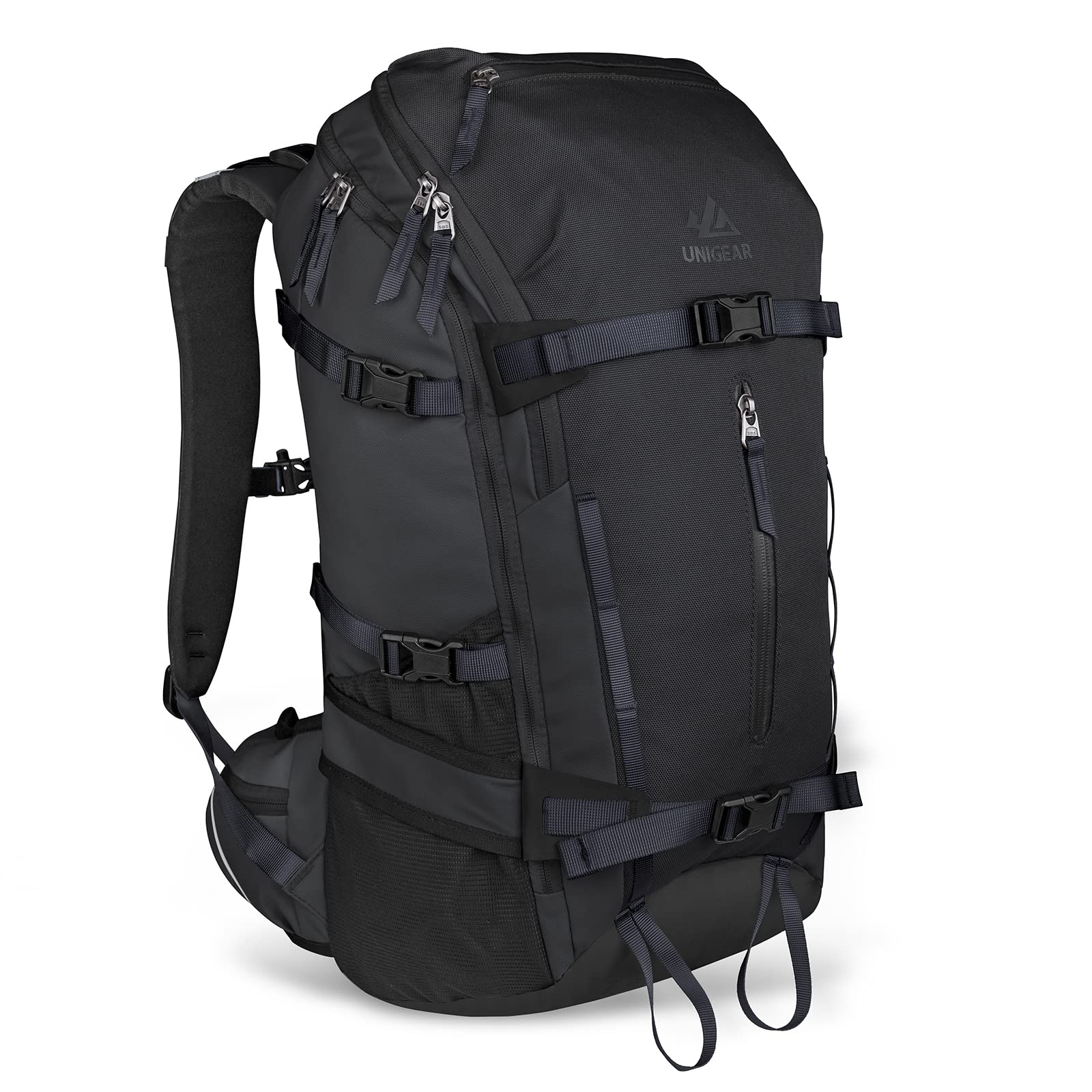
Unigear 30L Ski Pack
Key Features
- Shell: 900D polyester
- Volume: 30 liters
- Weight: 2.34 lb
- Ski carry: A-frame
- Price: Budget
Thirty liters, 900D polyester, A-frame ski carry, vertical snowboard carry — on paper the Unigear looks like it belongs in the middle of this group rather than at the budget end of it. And it isn’t far off. 900D is a heavier, more abrasion-resistant weave than the lightweight ripstop on the Dakines and the Osprey, and the side panels add a PU coating on top.
Capacity is the headline. Thirty liters swallows a full day plus a spare puffy, and the seven pockets include a dedicated goggle pocket and a hydration sleeve. The inverted-Y foam back panel keeps the load off your spine and the S-shaped shoulder straps are cut to stay clear of your arm swing; loaded past 20 liters’ worth of gear, that stiff panel keeps the pack’s shape instead of letting it sag away from your back.
Where the budget shows is fit and finish. The harness doesn’t adjust far, so if you’re at the edges of the size range — broad shoulders or a short torso — this is the one pack here to try before you commit, because there’s little room to compensate. Stitching also varies from pack to pack, with some coming through clean and others showing rough seams. Neither is a dealbreaker at this end of the market, and for a first backcountry pack or a spare to lend a friend, it’s an easy trade.
Pros
- Thirty liters fit a full day plus a spare layer
- 900D polyester resists abrasion
- A-frame ski and vertical snowboard carry
Cons
- Harness adjustment range is narrow
- Stitching quality varies between packs
The budget pick we hand first-timers: 30 liters, 900D fabric, and both ski and board carry, provided the harness fits without much adjustment.
Best for Lift-Served Laps
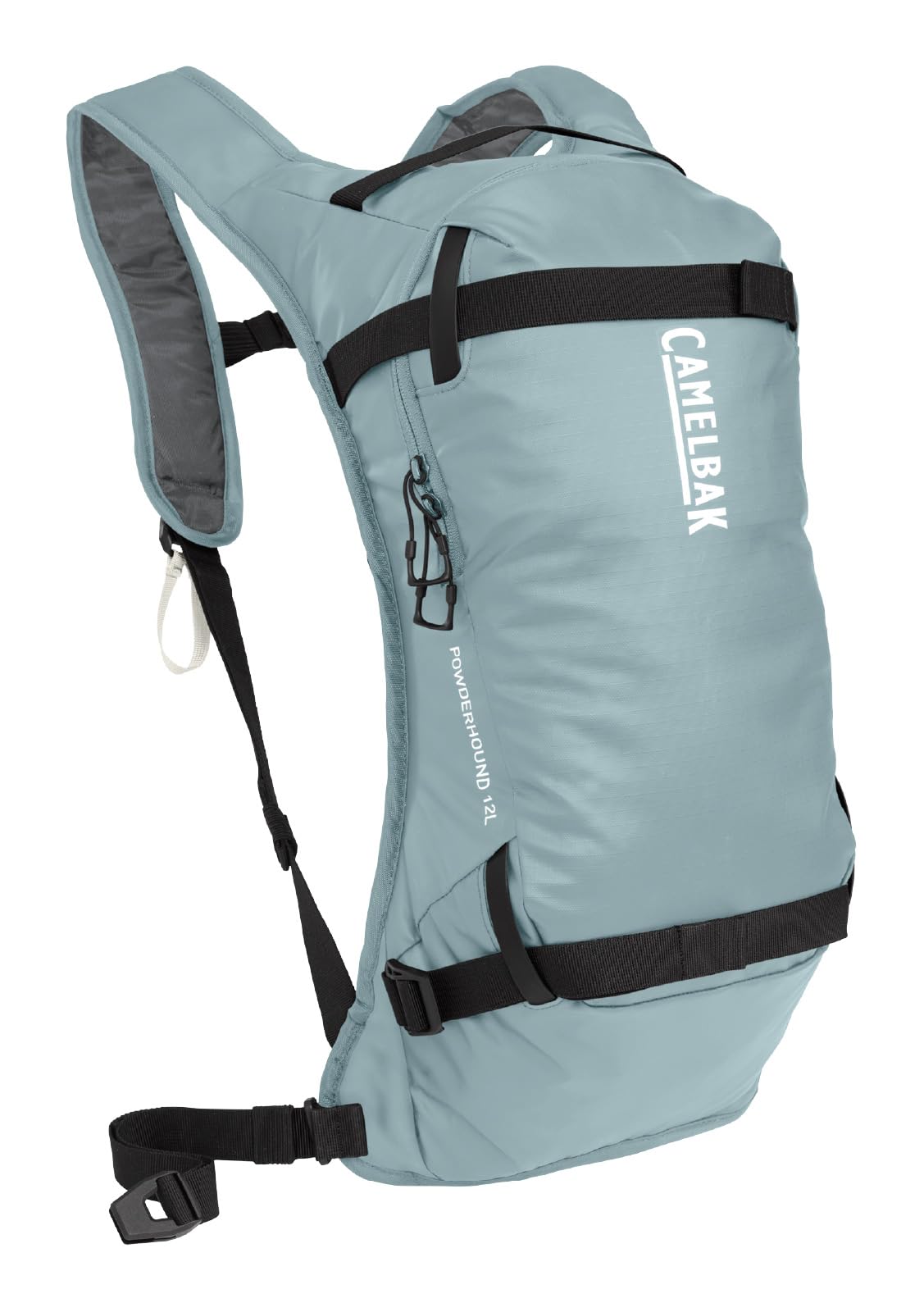
CamelBak Powderhound 12
Key Features
- Weight: 2 lb
- Reservoir: 2 liters (70 fl oz)
- Ski carry: A-frame or diagonal
- Cargo volume: 10 liters
The reservoir comes with it. A two-liter bladder, an insulated sleeve around the hose, and a bite valve are all in the box, in a pack that also carries skis A-frame or diagonally and a snowboard on its back.
For lift-served days and short sidecountry laps, we think that’s a better deal than it sounds. The lift-access harness lets the pack swing around to your chest so you can drink on the chair without unclipping, and the snow-repelling shell keeps the wet stuff from piling up. At two pounds with a removable waist belt, it stays out of the way while you’re actually skiing.
The limit is capacity. Ten liters of cargo is lunch, a spare layer, and not much else, and with two pockets a shovel and probe end up sharing space with your layers rather than sitting in their own sleeves. That’s fine if your backcountry is a bootpack off the lift; it is not a pack for a full day on the skintrack, and CamelBak doesn’t pretend otherwise.
It also does the small things properly — adjustable sternum strap, removable waist belt, snow-repelling fabric — and carries CamelBak’s lifetime warranty. Think of it as a hydration pack that can carry skis, not a touring pack that happens to hold water.
Pros
- Two-liter reservoir and insulated hose included
- Swing-forward harness for drinking on the lift
- A-frame or diagonal ski carry plus board carry
Cons
- Only 10 liters of cargo space
- Two pockets leave little organization
We keep this one for lift days: the two-liter reservoir and insulated hose come with it, and the harness swings forward so you can drink without stopping.
Best for Bootpacks and Sidecountry
Dakine Mission Pro 18

Key Features
- Volume: 18 liters
- Hip belt: 25 mm padded
- Ski carry: Diagonal
- Spine protector: DK Impact compatible (sold separately)
- Price: Midrange
The Mission Pro 18 is the smaller pack that costs more than the bigger one in the same line, and the harness explains where the money went: a 25 mm padded hip belt with a side pocket, a heavyweight recycled nylon shell instead of ripstop, and routing for a two-way radio or an insulated hydration hose.
Eighteen liters is a fast-and-light number and the pack is set up for it: vertical snowboard carry, diagonal ski or splitboard carry, shovel and probe sleeves in a dedicated tool pocket, and a fleece-lined goggle pocket. Four pockets sounds sparse next to the Osprey, but each one is sized for something specific, and the hip belt pocket swallows a phone or a bar without unclipping anything.
The hip belt is the piece that decides it. An hour of bootpacking with skis on your pack is where a padded belt and a real buckle beat an extra couple of liters of volume, and the heavyweight shell is the one we trust against tree branches and ski edges. It also takes Dakine’s DK Impact Spine Protector, sold separately, if you want protection without adding a separate pad.
Pros
- Padded 25 mm hip belt with a side pocket
- Heavyweight recycled nylon resists abrasion
- Shovel and probe sleeves plus a fleece goggle pocket
Cons
- Eighteen liters fills fast with rope or camera gear
We reach for this one when a bootpack is the plan: 18 liters, a heavyweight shell, and a padded hip belt that makes a loaded carry bearable.
How We Tested the Best Backcountry Ski Packs
We built the shortlist by reading specs and reviews, then filtering for capacity ranges that suit day tours and light hut trips, ski-carry systems, back panel access, and fabrics that wouldn’t soak through. We cut anything with fussy straps or a shape that only worked with one ski width, and ended with 10 packs.
I wore each pack for at least three tours over six months: pre-work dawn patrols, full days at a resort sidecountry gate, and a wet spring hut trip. I loaded them with avi gear, spare layers, food, water, and skins; skinned and skied with them; and clipped skis both A-frame and diagonal. I noted where straps bit, where the pack shifted on kick turns, and whether a helmet or goggles fit without unclipping everything.
Freezing mornings were the real test. I left hydration hoses exposed, dunked bladders in the sink to check for leakage into the main compartment, and worked zippers and buckles with gloves on after they’d iced up. I also checked construction at stress points—stitching, buckles, abrasion at ski-carry contacts—and whether the slim profile snagged on trees or lift chairs. Appearance mattered too: I noted which packs looked tidy on the lift and which fabric scuffed immediately. The packs that rose to the top stayed versatile enough for a summer day hike, too.
How to Choose a Backcountry Ski Pack
Decide the pack by the tour you actually ski, because volume, carry configuration, and harness all follow from how long the skis spend on your back.
Size the pack to the tour, not the gear pile
Twelve to 18 liters covers lift-served laps and short sidecountry, and the CamelBak’s 10 liters of cargo is that idea pushed to its limit. Twenty to 24 liters is the sweet spot for a full day of touring: shell, puffy, lunch, water, and rescue tools. Thirty liters and up is for long approaches, rope carry, or overnights.
The trap is buying the biggest pack you might need. An empty 30-liter rides worse than a full 20, and extra volume invites extra weight. Lay your day’s kit on the floor before you shop and size the pack to that pile rather than to a hypothetical tour.
Give rescue gear its own place
A shovel and probe need a home that isn’t the bottom of the main compartment. Dedicated sleeves, like the Osprey’s separate handle and probe sleeves or Dakine’s snow tool pocket, keep the tools together, reachable, and away from the spare layer you may end up wearing.
Pack the shovel the way you would deploy it, put the pack on, and reach for it. If you have to unclip the pack and open two compartments, the layout is wrong for the day you hope never happens. Speed of access matters more than neatness.
Match the carry to how you’ll travel
Diagonal ski carry is one strap and the fastest option for a short bootpack, which is why some packs offer nothing else. A-frame carry is steadier over an hour of hiking and the better choice for wide or heavy skis. Snowboards go on vertically for hiking a ridge and horizontally for lift rides, since a board strapped vertically is awkward on a chair.
Decide which of those describes most of your season before you buy. If long carries are routine, a diagonal-only pack is a compromise you will feel every trip.
Fit and access decide how hour four feels
Two things separate a pack that disappears from one you fight: a harness that matches your torso and a way to reach gear without unpacking. Check the torso range before ordering, because a narrow adjustment window has to fit you out of the box. The Unigear’s limited range is exactly why it is the one pack here worth trying on first.
For access, back panel zips keep the harness out of the snow, front J-zips reach small items with the pack still on your back, and a top lid is the slowest of the three when your hands are cold.
Weight, fabric, and weather
Pack weights here run from 2.0 to 2.6 pounds, and the difference is padding, pocket structure, and fabric weight rather than anything magic. Lighter is nicer on the skintrack; heavier usually buys a harness that behaves with a full load. Pick the side of that trade that matches your tolerance for discomfort.
On fabric, 900D polyester resists abrasion and recycled ripstop with a DWR sheds snow, and neither is waterproof. Buy for abrasion against rock, branches, and ski edges, and treat water resistance as a bonus. A pack liner costs less than a soaked puffy.
Frequently Asked Questions
Can I use a backcountry ski pack as a summer hiking pack?
Yes, and plenty of people do. The catch is the hardware: diagonal ski straps, a shovel pocket, and a helmet carry are dead weight and loose webbing when there is no snow to justify them. The Heli Pro is the least fussy crossover of these because its straps sit close to the body when empty.
If you hike more than you ski, a plain daypack saves weight and a lot of dangling buckles. If you want one bag, cinch every ski strap tight before you head out and check nothing swings.
How do I keep a hydration hose from freezing?
Blow the water back into the reservoir after every drink so the tube and bite valve aren’t sitting full. Keep the bite valve inside the insulated sleeve when you’re not drinking, and start the day with lukewarm water rather than ice water.
An insulated hose buys time but doesn’t make the valve immune, so the blowing habit does most of the work on a cold day.
Can I take a ski pack on a plane as a carry-on?
A 20- to 30-liter pack is well inside the usual carry-on limits, which sit around 22 by 14 by 9 inches, and carrying it on leaves your hands free for boots.
Plan around the shovel and probe: pack those in checked luggage, since a metal blade and a long probe are exactly what security stops to look at. Check your carrier’s rules before you fly, because they vary more than the size limits do.
Final Verdict
The Osprey Kamber 20 is the pack we point most backcountry skiers at, and the reason is simple: at 20 liters it carries a day’s gear with the shovel and probe in their own sleeves, and the harness stays comfortable long after the novelty of the climb wears off.
If you want more room and less weight, the Dakine Heli Pro 24 gives you both plus A-frame carry. On a tight budget, the Unigear 30 does the job as long as the harness fits you without much adjustment. Everything else here is a pack for a narrower kind of day.