This post contains affiliate links. We may earn a small commission when you buy through our links — at no extra cost to you.
A day hike backpack has one job: carry water, layers, and lunch without making your shoulders pay for it. The trouble is that most packs solve half of that equation — the ultralight ones skimp on cushioning, while the roomy ones turn a five-mile loop into a cargo march. Over the past eight months, I’ve worn a dozen daypacks on after-work loops, a wet all-day climb, and a weekend train trip; the keepers disappear on your back until you need the sunscreen you stashed in a side pocket.
First-time buyers tend to size up, thinking 30 liters sounds safer than 18, but a half-empty pack slides and rubs. Start with the volume your usual kit needs, then check whether the harness and back panel earn their weight. Durability is the quieter test: after eight months, I looked at zippers, bottom fabric, and strap stitching before trusting any pack with a long day out. The picks below are the ones that passed.




Best for All-Day Comfort
Osprey Daylite Plus 20L
Key Features
- Shell: 100% recycled 300D polyester
- Weight: 1.3 lb
- Capacity: 20 liters
- Back panel: AirScape mesh
- Price: Premium
Everything in this guide can hold a jacket and a sandwich; the Daylite Plus is the one we trust with a full day’s water and a camera. Osprey’s AirScape back panel is molded foam under mesh, so it holds its shape against your back instead of collapsing the way an unpadded stuff sack does, and the hip belt and sternum strap move the load onto your hips on a long climb. Twenty liters takes a shell, lunch, two bottles and a layer without turning into a bag you have to dig through.
The organization is the other reason it took the top spot. Dual mesh bottle pockets sit where you can reach them without taking the pack off, the stretch shove-it pocket on the front takes a wet shell or a pair of gloves, and the front compartment has a key clip so small things stop migrating to the bottom. Recycled 300D polyester with a PFAS-free DWR shrugs off drizzle and damp brush.
What you pay for is that harness, and the Daylite Plus costs the most of anything here. Care is the small catch: Osprey asks for spot cleaning rather than a washing machine, so mud comes off with a cloth. Neither is a reason to walk past it if you hike regularly, and this is the pack we take when the day is long and the load is real.
Pros
- AirScape panel and a hip belt that carry real weight
- Dual bottle pockets plus a stretch front pocket
- Recycled 300D polyester with PFAS-free DWR
- Adjustment range fits petite and tall hikers
Cons
- Heavier than the packable picks at 1.3 pounds
- Water-repellent finish, not a waterproof shell
We recommend the Daylite Plus to anyone who hikes often enough to want a real harness: it carries a loaded 20 liters comfortably and adjusts to a wide range of bodies.
Best for Budget Day Hikes
SKYSPER 20L Daypack
Key Features
- Weight: 1.1 lb
- Pockets: 10
- Capacity: 20 liters
- Water resistance: Water resistant
- Price: Midrange
Ten pockets, trekking pole loops and a 20-liter body in a pack that weighs about a pound: the SKYSPER packs a lot of hiking detail into its price. The high-density 600D polyester and 210D nylon plaid shell is water resistant, and the zippers are the anti-theft type that tuck their pulls out of reach.
What we appreciate most is how well that organization matches a day on the trail. Bottle holders on both sides, a chest strap that keeps the shoulder straps where you put them, and enough separate compartments that snacks, a shell and a first-aid kit each have a home rather than a heap at the bottom. At 20 liters it is the right size for one person’s day, and it slides under an airplane seat.
The shell is thin, and the strap anchors are where this pack gives trouble: seams at the attachment points can come apart under a heavy load. Stay inside the rated 7 kg, run a thumb over the stitching at the anchors before a long trip, and it earns its place beside the pricier structured packs here.
Pros
- Ten pockets keep a day’s kit organized
- Trekking pole attachments at a budget price
- Water-resistant 600D polyester shell
Cons
- Load rating tops out at 7 kg
- Strap-anchor stitching can come apart under load
The SKYSPER is the day pack we point budget-minded hikers to: 20 liters, ten pockets and pole attachments for a fraction of a premium pack.
Best for Hands-Free Drinking
Teton Oasis Trailrunner 18L
Key Features
- Weight: 2 lb
- Bladder: 2 liters included
- Capacity: 18 liters
- Rain cover: Sewn in
- Price: Midrange
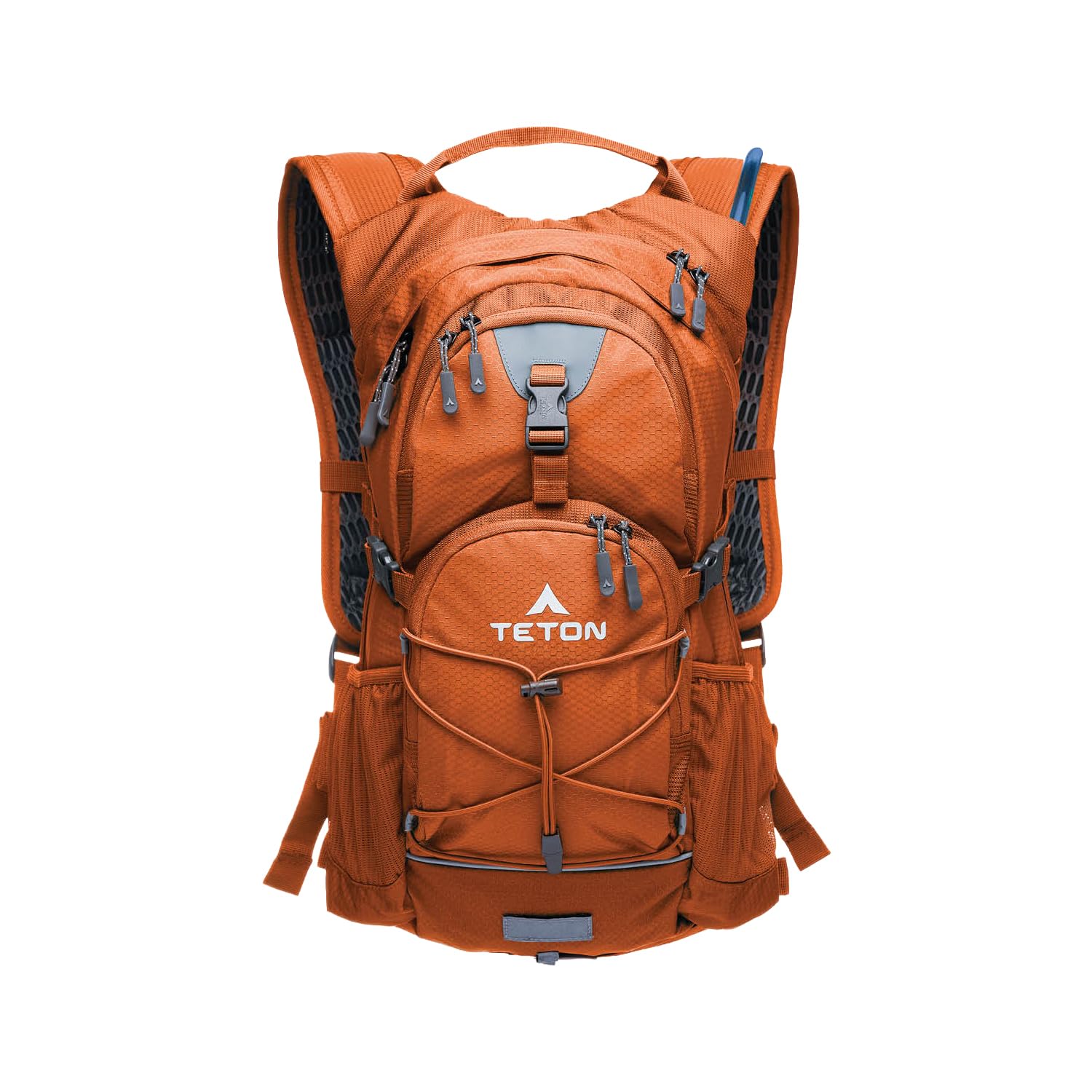
The Trailrunner answers the question most day packs leave you to solve: where the water comes from. A 2-liter bladder, a kink-free sip tube with a cushioned bite valve and a wide opening for ice and cleaning all come in the box, along with a rain cover sewn into the pack. That combination is why it stays on our shortlist — you leave the house with nothing else to buy.
The rest is a competent 18-liter hiking pack: weather-guarded zippers, a bungee cord for a jacket or a helmet, and enough pockets for keys, wallet, snacks and a first-aid kit. At 2 pounds it is heavier than the stuffable packs here, and the bladder pocket is insulated to keep water cooler on a hot climb.
The waist strap is the component that fails when this pack does, so check the stitching where it meets the body and you have covered the main risk. The athletic cut sits best on broader shoulders and longer torsos, and smaller-framed hikers should try the adjustment range before committing to a long day.
Pros
- 2-liter bladder and insulated hose pocket included
- Sewn-in rain cover means no separate purchase
- Weather-guarded zippers and a bungee lash cord
Cons
- Cut suits broader frames better than petite ones
If you want water on tap without buying a reservoir separately, the Trailrunner is the pick: an 18-liter pack, a 2-liter bladder and a rain cover in one purchase.
Best for Gear-Heavy Days
Maelstrom 40L Daypack
Key Features
- Weight: 2.2 lb
- Pockets: 8
- Capacity: 40 liters
- Rain cover: Included
- Price: Midrange
Forty liters is more pack than most day hikes need, and that is exactly the point. On a winter walk, a photography day or a long ridge route with a stove, the Maelstrom swallows what a 20-liter bag cannot and still carries it on a padded hip belt. Ripstop 210D nylon, reflective printing, elastic side cords for trekking poles and eight pockets make it feel like a considerably more expensive pack.
What we noticed first is how much of the load the hip belt takes. The padded back and shoulder straps adjust in several places, and the range runs long enough for taller torsos to sit correctly rather than riding high. The rain cover is a genuine bonus at this price, and it stows in its own pocket instead of vanishing into the main compartment.
The shell is light, and rips at the seams are the failure to watch for. Pack sharp-edged gear away from the fabric and stop loading before the seams look strained, and this one holds up for the handful of big days a year most of us actually walk.
Pros
- 40 liters for gear-heavy days
- Padded hip belt and widely adjustable harness
- Rain cover included and stowed in its own pocket
- Eight pockets plus trekking pole cords and reflective print
Cons
- 2.2 pounds before you put anything in it
- Light shell can rip at the seams under a hard load
The Maelstrom is for the day that outgrows 20 liters, such as winter layers, a stove or camera gear, and it adds a rain cover and a real hip belt.
Best for Travel Plus Trails
Outlander 20L Packable
Key Features
- Packed: Folds into own pocket
- Weight: 7.36 oz
- Capacity: 20 liters
- Water resistance: Water resistant
- Price: Budget
Folded into its own zippered pocket, the Outlander takes up less room in a suitcase than a pair of boots, and the carabiner clip lets it ride on the outside of a bigger bag. Unfolded it is a 20-liter pack with a roomy main compartment, two front zip pockets and mesh bottle pockets, which is enough for a shell, lunch and two bottles on an easy trail.
Hiking with it is a different experience from a structured pack. The shoulder straps are webbing, the back is flat nylon, and the load stays exactly where you put it, which is fine for a two-hour walk and a couple of pounds of gear and not the setup for a long day with a full water load.
For a trip where hiking is one part of the day, this is the pack we reach for. It survives being crushed in a suitcase, it is water resistant enough for a shower, and the ripstop nylon takes a scuff without a mark. The seams are the weak point, so keep the load light and it earns its place in the bag.
Pros
- Folds into its own zippered pocket
- 7.36 ounces empty
- Five pockets including two front zips
Cons
- Seams tear when the pack is overloaded
We keep the Outlander for travel and short hikes: it folds into its own pocket, weighs 7 ounces and opens into a usable 20-liter day pack.
Best for Backup Pack
4Monster 16L Packable

Key Features
- Packed: Folds into attached bag
- Weight: 4.16 oz
- Pockets: 4
- Capacity: 16 liters
- Price: Budget
Folded, the 4Monster is small enough to close a fist around, and it rolls back into its attached stuff bag without a fight. That is the whole pitch: a 16-liter pack, 4.16 ounces empty, that lives in a glovebox or a daypack lid until you need it.
On the trail it behaves like a light stuffable. The 30D nylon is tear resistant with reinforced stitching, and there is a main compartment, a front zip pocket and two mesh side pockets that hold a bottle firmly enough that it stays upright when you bend over.
We were pleasantly surprised by the straps, which are wider than the ones on most packable bags and spread the load instead of cutting a line across your shoulders. There is still no frame and no load transfer, so a day’s water and lunch is about the comfortable limit, and the thin fabric means sharp corners and overstuffing shorten its life.
Pros
- Folds into its attached stuff bag
- 4.16 ounces empty
- Wider shoulder straps than typical stuffables
Cons
- Thin 30D nylon limits it to light loads
The 4Monster is the packable we hand to someone who wants a real 16-liter day bag that disappears into a jacket pocket when the hike is over.
Best for Kids and Minimalists
G4Free 10L Packable

Key Features
- Packed: Folds into own pouch
- Weight: 4.59 oz
- Side pockets: 2 mesh
- Zippered compartments: 2
- Price: Budget
At 4.59 ounces, the G4Free is close to the lightest thing you can put on your back, and it makes the trade that weight implies. Two zip compartments, two mesh side pockets, polyamide fabric and SBS zippers are the whole inventory, and it folds into its own pouch when the day is done.
What it holds is a bottle in each side pocket, a snack, a shell, a phone and keys, which is a fair description of a two-hour hike or an afternoon at a theme park. It is also the size that fits a child’s back without swallowing them, which is why it ends up on family trips more often than the big packs.
Organization is thin. The main compartment has no interior pockets and the side pockets are snug, so a wide bottle is a squeeze and small items end up in a heap unless you pack them in a zip bag.
Where it earns its place is flexibility. It is the least expensive pack in this guide, it stuffs into a glovebox, and it is the one we leave in the car for the walk nobody planned. Treat it as a light-load pack and it will keep earning that spot.
Pros
- 4.59 ounces empty and folds into its pouch
- Two zip compartments and two bottle pockets
- Small enough for a child’s back
Cons
- Side pockets are snug for wide bottles
- No interior pockets in the main compartment
The G4Free is the pack we hand to a kid on a first hike or stuff into a larger bag: it weighs 4.59 ounces and vanishes when it is empty.
Best for Packable Capacity
MIYCOO 35L Packable

Key Features
- Weight: 12.8 oz
- Capacity: 35 liters
- Compartments: 8
- Water resistance: IPX4
- Price: Budget
Thirty-five liters that folds into its own inner pocket is an odd, useful trick, and the MIYCOO does it at 12.8 ounces. Unfolded it is a tall pack with five pockets and eight compartments, plus a wet compartment that separates a soaked shell or a swimsuit from everything else.
The hardware is travel-minded: zipper clips that lock the pulls together so nothing opens in a luggage hold, a survival whistle, and an IPX4 rating that covers splashes and a short shower.
It is a stuffable pack and it carries like one. The shoulder straps are thinly padded for a 35-liter load, so a full pack sits on your shoulders rather than your hips and gets old on a long climb, while a light load of layers and lunch is perfectly comfortable.
For hut trips, budget-airline travel and gear-heavy days where the pack has to disappear afterward, we think it is the most useful shape here: real capacity that flattens into a daypack lid. Just do not expect it to carry like the structured packs above.
Pros
- 35 liters in a pack that folds into itself
- 12.8 ounces empty
- Wet compartment separates damp gear
- Zipper clips and a survival whistle
Cons
- Thinly padded straps for a 35-liter load
- IPX4 splash rating only, not for steady rain
The MIYCOO is for the hiker who wants 35 liters of space without a structured pack’s weight: it folds into its own pocket and weighs 12.8 ounces.
How We Tested Day Hike Backpacks
We started with a long list of daypacks in the 18- to 30-liter range, pulled from outdoor shops and owner reviews, then narrowed it by capacity, harness design, and price to 12 models. Over eight months, we wore each pack on local after-work loops, a wet all-day climb with a 2,000-foot gain, and a weekend train trip where it had to work as a carry-on.
For every hike, we loaded the same kit: a 3-liter water bladder, lunch, a rain shell, and a camera. We weighed each pack empty and again fully loaded, then noted whether it sat close to the back or pulled away on climbs. To test pockets, we tried to reach a phone, snack, and map without taking the pack off; to test capacity, we checked what else fit beyond the baseline kit — a fleece, first-aid pouch, or extra water bottle.
Travel-friendliness got its own trial: we slid each pack under a train seat and into an overhead bin, and checked whether the hip belt and straps stowed out of the way. After each outing, we inspected high-wear spots — zipper pulls, bottom fabric, and strap stitching — and by month eight we could see which packs were still shaped like themselves. The ones that made the list stayed comfortable on long climbs, kept their pockets usable, and showed only minor wear.
How to Choose a Day-Hike Backpack
The right day pack disappears on your back; the wrong one turns a five-mile walk into a shoulder ache, and the difference usually has nothing to do with pocket count.
Match capacity to the day you actually hike
A half-day walk with a bottle, a shell and lunch fits comfortably in 10 to 20 liters. Add layers, a camera and a stove for a full day out and 35 to 40 liters starts to make sense.
The trap is buying for the biggest trip you might take: a 40-liter pack invites you to fill it, and a full 40-liter bag carries very differently from a light 20. Buy for the hike you do most weekends and let the packable packs cover the once-a-year exception.
The harness matters more than the spec sheet
Shoulder straps alone are fine for a bottle and a jacket. Once you add water, lunch and a layer, a hip belt that sits on your hip bones and a back panel that holds its shape start doing real work, and that is the difference between the Osprey Daylite Plus and any stuffable sack here. Fasten the hip belt first, then the shoulder straps, then the sternum strap, so the weight sits low instead of hanging from your neck.
Fit is the other half. The Teton Trailrunner’s athletic cut suits broader shoulders and longer torsos and sits less well on smaller frames, while the Osprey’s adjustment range covers petite and tall hikers alike. Load a pack up before you commit if you can.
Packable or structured: decide where the pack lives
If the bag spends most of its life in a suitcase, a car trunk or a larger pack, a stuffable 16- to 20-liter is the sensible purchase. The Outlander and the 4Monster both fold into their own pockets and weigh under half a pound.
If it is the pack you grab every weekend, pay for structure. The trap with packable bags is reading compact as capable: they fold small, but with no frame and no load transfer they carry light loads only.
Water, bottles and weather
Two one-liter bottles in side pockets cover most day hikes, and you can see how much is left. A bladder is easier to sip from while moving, which matters on a climb, and the Teton Trailrunner includes one with the pack.
On the shell: a DWR finish handles drizzle, an IPX4 rating handles splashes, and a sewn-in rain cover is what keeps gear dry through an afternoon of proper rain. The Maelstrom and the Trailrunner both include one; the rest of these packs rely on the fabric alone.
Frequently Asked Questions
How do I keep my back from sweating under a day pack?
Choose a pack with a mesh-covered back panel rather than flat nylon against your skin, and wear the hip belt snug so the load rides on your hips instead of pressing into your spine. Keep the sternum strap clipped but not tight, because over-tightening pulls the panel flat against your back and traps heat. A stuffable sack will always run hotter on a warm climb than a structured pack like the Daylite Plus.
Can I machine wash a hiking daypack?
Check the tag, because the answers differ across this set: the Outlander is listed as machine washable, while the Osprey asks for spot cleaning and the 4Monster for a wipe with a damp cloth. Empty every pocket, brush off grit, wash with mild soap and cool water, and air-dry the pack out of direct sun. Never put a coated pack in a dryer, since heat breaks down the water-repellent finish.
What should I carry in a day pack?
Water first, then a shell, a warm layer, snacks, a headlamp, a small first-aid kit and a way to navigate. Lay the whole kit out before you leave and check it fits with room to spare, because a pack you have to fight closed is one size too small. A 20-liter bag handles that list for most three-season day hikes.
Final Verdict
Buy the Osprey Daylite Plus if you want one pack that handles a full day comfortably. The AirScape panel and the hip belt are what turn 20 liters of gear into something you stop noticing by mid-morning, and it adjusts to almost any frame.
If the budget is tighter, the SKYSPER does most of the same job for less. If you prefer not to buy a reservoir separately, the Teton Trailrunner comes with one. Everything else here is a specialist: pick it for travel, for a child, or for the days that need 35 liters or more.