This post contains affiliate links. We may earn a small commission when you buy through our links — at no extra cost to you.
A running vest only earns its place if you forget you’re wearing it. The job is to carry water, fuel, a phone, and a layer without your shoulders paying for it, and plenty of vests solve the storage problem by piling on pockets and straps until you’re bouncing down the trail like a packed suitcase. Weight matters more than the spec sheet suggests — four extra ounces is nothing in the store and everything at mile 18.
Fit is where a women’s vest is won or lost, and it’s rarely a matter of sizing down. Vests are sized by chest circumference rather than shirt size, the women’s-specific cuts sit shorter in the torso, and the only honest test is trying one on with both flasks full. I’ve run in 12 vests over the past six months, from stripped-down race models to roomier weekend packs, and the ones that held up through repeated washing and still felt worth the money shared a few quiet virtues. The picks below cover a fast 5K and a long day out.




Best for Everyday Running
SWIFTVEST SV01
Key Features
- Weight: 10.1 oz
- Pockets: 6
- Size options: 3
- Included flask: 500 ml soft flask
- Price: Midrange
Load a vest with a full flask and a phone and you find out quickly what it is made of: most of them start slapping against your collarbone by the second mile. This one stayed quiet for us. Neoprene padding sits under the straps, the body is stretchy enough to sit against your ribs, and at 285 g it never announced itself once the chest strap was set.
That planted feel is why it is our top pick. Six pockets cover the essentials without turning the front into a bulging shelf: a zipped, water-resistant front pocket for the phone, a stretch stash for a windbreaker, and enough small slots for keys and gels. The included 500 ml soft flask collapses as you empty it, so the load does not start sloshing halfway round. Reflective detailing front and back is a genuine bonus for early starts.
Two things to know before ordering. The front phone pocket is snug — a bare iPhone 15 is fine, a cased Galaxy Ultra only just fits — so if you run with a big phone in a thick case, use one of the other stash pockets. And the fit runs generous: measure around your chest and follow the size chart rather than ordering your usual clothing size.
Three sizes rather than one adjustable cut, plus the flask in the box, means there is nothing else to buy before your first run. It is the vest that stays by the door.
Pros
- Stays put with a full flask on board
- Six pockets including a zipped phone pocket
- 500 ml soft flask included
- Light 285 g with three size options
Cons
- Front phone pocket tight for large cased phones
Six pockets, a flask in the box and a ride that stays flat at pace — this is the vest we tell most women to buy first.
Best for Fast, Short Runs
MOKURA Running Vest
Key Features
- Weight: 9.6 oz
- Pockets: 5
- Chest straps: 3 adjustable
- Included flask: 500 ml soft flask
- Price: Midrange
The detail that sold us is the phone pouch: a sweatproof sleeve on a retractable coiled lanyard that pulls out far enough to skip a track or check a map, then snaps back flat against your chest. It is the sort of small idea that turns out to matter at mile three, and at 9.6 ounces this is the lightest vest we carried here — light enough that we stopped registering the straps altogether.
The rest of the package is sensible rather than showy. Soft neoprene and breathable mesh keep air moving across your back, three adjustable chest straps with keepers hold the body against you, and the included 500 ml flask is BPA- and PVC-free with a leakproof high-flow bite valve and an elastic cinch that compresses it as you drink. Reflective accents front and back and a two-year warranty round it out.
The thing to get right is tension. Three straps give you more adjustment than most vests here, and if you set only the top two, the vest shifts once the flask is full; set all three snug before you start and it stays out of the way. Long runs are the other limit — one flask is one flask, though the rear pocket takes a larger bladder if you add one.
Pros
- Lightest vest here at 9.6 ounces
- Retractable phone pouch is useful mid-run
- Three chest straps with keepers hold the fit
- 500 ml flask included with a leakproof bite valve
Cons
- Ships with a single 500 ml flask
The lightest vest we wore here, with a phone pouch you can pull out mid-stride: our pick for fast, short runs.
Best for Gear-Heavy Long Runs
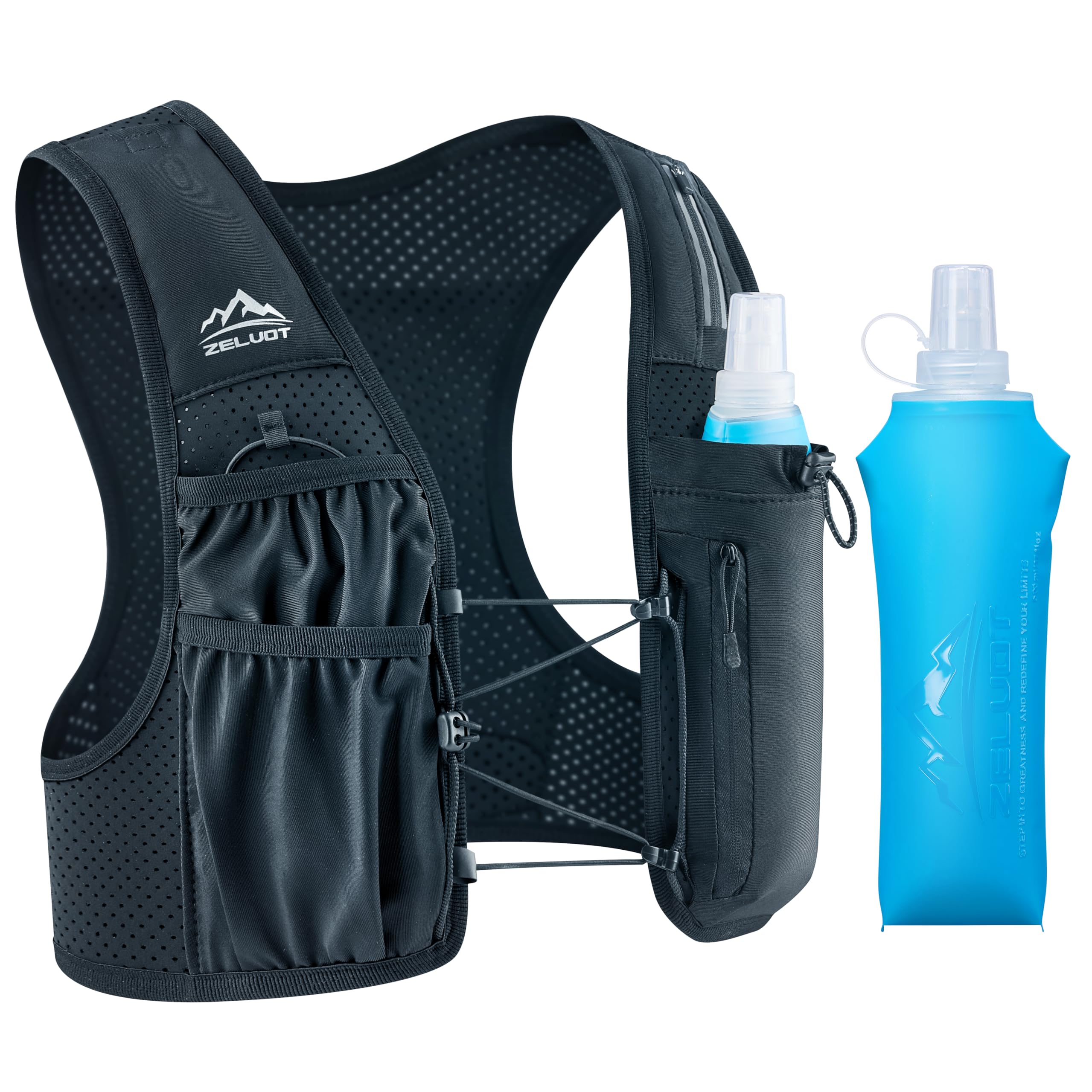
Zelvot RUNV-3
Key Features
- Weight: 12.3 oz
- Pockets: 9
- Chest straps: 3 adjustable
- Included flask: 500 ml soft flask
- Price: Midrange
Of everything here, this is the vest most likely to arrive too small. The panels are cut close to the chest and, while three chest straps give you plenty of adjustment, the shell itself does not stretch far. If you are between sizes, or you plan to wear it over anything thicker than a base layer, go up.
What you get in exchange is the most thorough pocket layout in this set: nine in total, including two quick-access slots on the shoulder straps that put a gel within reach without unzipping anything, a hidden zip pocket, and a large rear compartment with both a zip and a stretch mesh section. The 500 ml soft flask rides in a dedicated front slot.
We kept reaching for it on the gear-heavy days. The capacity means you can carry fuel for an 18-miler or a marathon without a separate belt, and the ventilation holes in the neoprene do keep air moving once you are warm. Bounce was a non-issue for us with all three straps set.
It is heavier than the flask-only vests here at 0.35 kg, and you feel that when you pick it up rather than when you are running. The trade is capacity, and for the runs this vest is built for, that is the right trade.
Pros
- Nine pockets, including two on the shoulder straps
- Holds steady at pace with a full load
- Zipped rear compartment takes a light layer
Cons
- Heaviest flask vest here at 0.35 kg
Nine pockets and stability that held at marathon pace in our runs, for women who carry fuel and a layer — measure your chest first.
Best for Women’s-Specific Fit
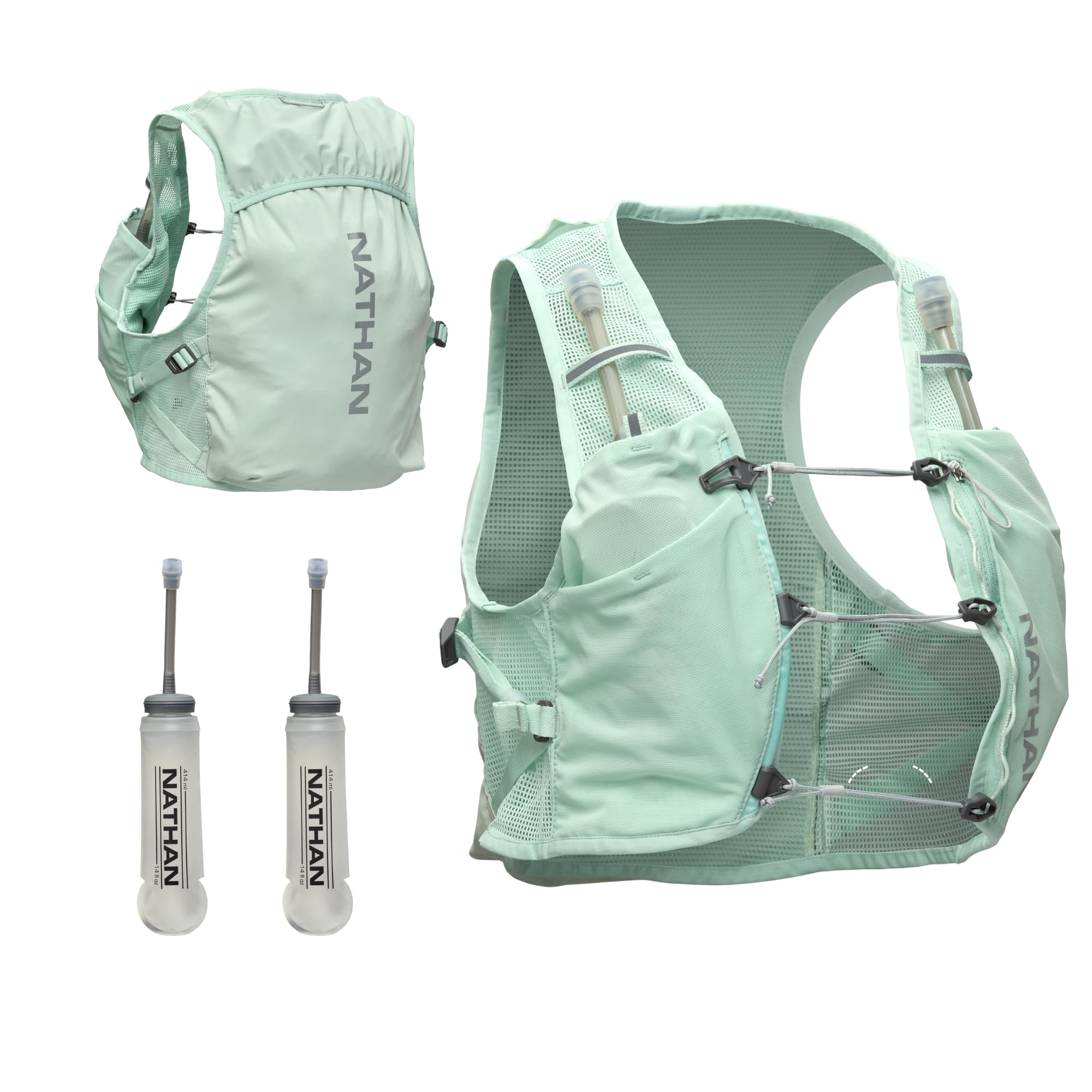
Nathan Pinnacle Breeze
Key Features
- Weight: 8 oz
- Included flasks: 2 × 14 oz
- Chest adjustment: Sternum slider cords
- Reservoir capacity: 2 liters
- Price: Premium
Nathan is the only brand here that builds a vest specifically around a woman’s torso, and the Pinnacle Breeze shows what that buys: shorter, narrower panels, single-layer mesh that breathes hard, and a Quick-Fit size system with sternum slider cords so you can micro-adjust on the move instead of stopping to rethread a strap.
If you have fought with unisex vests that gap at the chest, ride up over a sports bra, or sit too wide in the shoulder, this is the one we point to. The two 14 oz flasks have extended straws, so you drink without pulling a bottle out, and soft flasks do not slosh. There is a large rear sleeve that takes a 2 liter reservoir, reflective elements for 360-degree visibility, and a lifetime warranty.
What you give up is a chunk of budget and some capacity. This sits at the premium end of the group by a wide margin, and the front pockets are shallower than the Zelvot’s — a phone, a couple of gels and a key is the comfortable load, which suits a half marathon better than a full day out.
The flasks take a run or two to get used to: the straws sit at an angle and you will spend the first mile finding the right bite. After that it is the closest thing here to drinking from a bottle without breaking stride.
Pros
- Women’s-specific cut with slider-cord adjustment
- Two 14 oz flasks with straws for drinking on the move
- Holds a 2 liter reservoir in the back
- Lifetime warranty
Cons
- Front pockets are shallow for long-run loads
If unisex vests gap at the chest or ride up on you, this is the one we point to: a women’s cut, slider cords, two straw flasks.
Best for Trail Days
BECOJADDE 5L
Key Features
- Straps: Chest and waist
- Weight: 7.05 oz
- Capacity: 5 liters
- Included: Vest only
- Price: Budget
Five liters is a different job from 500 milliliters. This is the vest for the run that turns into a morning out: a shell, a phone, snacks and two bottles in the rear compartment, with waist straps that put some of that weight on your hips instead of your shoulders.
Construction suits the role. Nylon with ventilated mesh across the back, eight pockets including a waterproof phone pocket and dual rear zippered compartments, and a full set of adjustments — chest strap, waist strap and dual shoulder straps — so you can move the load around until it sits right. It also comes in pink, which is a welcome change from the wall of black vests in this group.
Two caveats, one about the box and one about the outside. This variant is the vest on its own, with no flask or bladder included, so factor hydration into what you spend. And there is no reflective trim on it, which matters if your long days start before sunrise.
Taken as a trail-day vest rather than a race vest, it does more than the flask vests can while weighing less than you would guess at 0.2 kg. For a run-hike or a long morning on easy trails, this is the one we reach for.
Pros
- Five liters with rear compartments for a layer
- Waist straps take weight off the shoulders
- Eight pockets including a waterproof phone pocket
Cons
- Sold without a flask or bladder
- No reflective trim for early starts
For run-hike days, we take this one: five liters and waist straps carry a layer and two bottles better than any flask vest here.
Best for Race-Day Setups
AONIJIE 5L
Key Features
- Weight: 6.7 oz
- Pockets: 9 exterior
- Capacity: 5 liters
- Included: Backpack only
- Price: Budget
Strip the water out and this vest weighs 190 g — barely more than a long-sleeve top — and that is the whole reason to buy it. Nine exterior pockets wrap the front and back of a vest-shaped body, so a phone, keys, gels and a couple of soft flasks all sit within reach, and the whole thing fits close enough that you forget there is a pack on.
The details are thought through for racing: fully adjustable shoulder and chest straps, a high-elastic chest strap and a waist strap to lock the lower edge down, plus a padded back panel that keeps the load off your spine. There are two sizes, and the rose red option is a genuine pleasure in a category that defaults to black.
The catch is in the listing rather than the vest: this link is the backpack alone, with no bladder and no flasks, and the rear sleeve is sized around a 1.5 liter reservoir. Add hydration when you order — a pair of soft flasks in the front pockets plus a bladder in the back is the setup this vest was designed around.
Pros
- 190 g before you add water
- Nine exterior pockets front and back
- Chest and waist straps lock the fit down
Cons
- Sold without a bladder or flasks
We keep coming back to its 190 g and nine pockets: the closest thing here to wearing nothing, though you bring your own hydration.
Best for First Vests
Katroiy Running Vest

Key Features
- Weight: 7.05 oz
- Chest strap: Adjustable buckle
- Included flask: 500 ml soft flask
- Price: Budget
This is the least expensive way here to buy a vest and a flask in one order, and for a first vest or a spare to keep in the car, that is the entire pitch. The body is polyester and mesh — lighter on padding than the neoprene vests in this group, and it feels it in the hand.
Fit is where it surprises. The shoulder straps adjust through a wide range and a chest buckle locks them down, and the harness sits well on a fuller chest, which is not something every unisex vest here manages. It weighs 0.2 kg, there are reflective strips and webbing across the front, and the 500 ml collapsible flask tucks into an elastic front pocket.
For walk-run sessions, short weekday loops and anyone working out whether a vest suits them at all, it earns its place. The flask pocket is the weak point: the bottle can work loose and tip when you are moving fast, so seat it deep and check it before you head out.
It is the vest we hand someone who is not convinced vests are for them yet — cheap enough to try, honest enough to tell you whether the whole idea works.
Pros
- Cheapest complete vest-and-flask kit here
- Adjustable straps suit a fuller chest
- Reflective strips on the front
Cons
- Flask can work loose from its front pocket
The least expensive way here to get a vest and flask together, and we found the straps adjust generously for a fuller chest.
Best for Run-Hike Days
N NEVO RHINO 12L

Key Features
- Weight: 8.5 oz
- Capacity: 12 liters
- Chest strap: Slides 2.4–7.9 in
- Included bladder: 2 liters
- Price: Midrange
Twelve liters puts this in a different category from the rest of the list: it is a small pack shaped like a vest, not a race vest. That is not a criticism — it is why it is here. If your running shares a shelf with hikes and long dog walks, one pack that does both beats two that do not.
The vest-style shoulder straps are the good part: wide, padded, with easy-access pouches on each side for a phone or snacks, and they carry weight better than a narrow race strap. A 2 liter BPA-free bladder and hose are included, the chest strap slides up and down to sit where you want it, and the whole thing weighs 8.5 ounces empty.
Quirks exist. The chest clips can stick when you are taking it off, and the bladder wants a thorough rinse before the first use — the plastic taste is noticeable otherwise.
For an hour on the road it is more pack than you need. For a half-day out where the running is only part of the point, this is the one we take.
Pros
- 12 liters with a 2 liter bladder included
- Wide vest-style straps with side pouches
- Light for its size at 8.5 ounces
Cons
- Chest clips can stick when removing it
A small pack rather than a race vest: 12 liters, a 2L bladder, and straps we found comfortable over long days.
How We Tested 12 Women’s Running Vests
We built the shortlist from scratch: every women’s-specific vest sold by the major running brands, filtered first by published capacity in liters, number of front pockets, listed weight, and whether the flasks were replaceable. Vests offered in only one torso length got cut early, since the reason someone searches for a women’s vest is that the unisex version sits wrong across the chest. That left 12 vests, from minimal race shells to roomy weekend packs.
Testing ran six months and followed a real training calendar rather than a lab bench. Each vest went out on weekday 5-milers around the neighborhood, long Sunday trail runs of two to three hours, and two races, loaded the way they’d actually be used: two soft flasks up front, phone, keys, a windshell, and snacks on the longer days. We filled the flasks before adjusting the straps, since a vest that fits empty is a different vest from one that fits full.
On the run, we watched for bounce on downhills and stairs, whether the flasks crept toward the collarbone, and where seams began to rub after an hour of sweat — usually the sternum strap or under the arms. We weighed each vest on a kitchen scale, empty and loaded, and noted how much we could reach one-handed without breaking stride. Storage got checked honestly: a shell that only fits in the back pocket one particular way is a smaller vest than the spec sheet claims.
Durability took the longest to judge. Every vest was washed after sweaty runs according to its care label, then inspected at the seams, zippers, mesh, and elastic. Two softened around the flask pockets and one phone-pocket zipper gave out; the rest came through month six looking much as they did on the first run.
How to Choose a Running Vest for Women
Fit decides everything else: a vest that is dialed in disappears, and one that is not will bounce and chafe no matter what it costs.
Start with the fit, not the pocket count
A vest is worn tight, so fit decides whether you reach for it. Measure around your chest at the fullest point and compare that number with the maker’s range instead of ordering your clothing size — the SWIFTVEST runs generous, the Zelvot runs small, and both go wrong when you guess. Unisex vests also sit wider through the shoulder, which is fine for many women and wrong for narrow frames; that is the case for a women’s-specific cut like the Nathan Pinnacle Breeze.
Before you commit, load every pocket and tighten the straps. A vest that feels fine empty can sit completely differently with a full flask against your ribs.
Bounce is a strap question more than a weight question
Most bouncing comes from a loose body, not a heavy load. Count the adjustment points: two chest straps hold a 500 ml flask fine, three hold a fuller vest better, and anything carrying five liters or more wants a waist strap as well. Sliding sternum cords let you tune tension mid-run, while fixed straps mean stopping to fiddle. Soft flasks help, because they collapse as you drink instead of sloshing.
A quick test before your first run: hop in place. If the vest settles without a second bounce, it is set right.
Check what is actually in the box
Plenty of listings called a hydration vest arrive with no hydration at all. Two picks here are the pack alone — the BECOJADDE 5L and the AONIJIE — so a flask or bladder is a separate purchase, while the SWIFTVEST, MOKURA and Zelvot all include a flask.
Decide too whether you want a flask you sip from the front or a bladder you drink from a hose. Flasks are easier to refill and clean; a bladder carries more water for a longer day without stopping.
Match volume and weight to your longest regular run
Race vests start around 190 g and carry a phone, keys, gels and a flask or two; the AONIJIE is essentially a pocketed layer. Add capacity and weight climbs — the Zelvot’s nine pockets come at 0.35 kg. Past about five liters you are into pack territory, where a 12 liter design like the NEVO RHINO suits a run-hike but is more than a road run needs.
Buy for your longest regular run, not your once-a-year race. A vest that is over-specified gets left at home.
See and be seen
Reflective trim costs little and matters if you run before work or after dinner. Most vests here carry it front and back — the SWIFTVEST, MOKURA, Katroiy and Nathan all have reflective elements — while the BECOJADDE does not.
Where the detail sits matters as much as whether it exists. A vest on your torso barely moves, so if you run on unlit roads, add something reflective to your shoes or ankles, which do.
Frequently Asked Questions
How do I stop a running vest rubbing under my arms?
Usually it is movement rather than the fabric. Tighten the sternum straps so the vest cannot slide, and wear a fitted technical top instead of cotton, which holds sweat and bunches under the arms. Padded neoprene edging, as on the SWIFTVEST and MOKURA, is gentler than a bare seam against skin.
If one spot keeps rubbing after two or three runs, the cut does not match your shoulders. A women’s-specific vest is a more reliable fix than tape.
How do I clean a soft flask, and how do I get rid of the plastic taste?
Rinse the flask with warm water and a drop of dish soap, scrub the inside with a bottle brush, and air-dry it cap-off and open-side down — a flask stored wet is where the smell comes from.
For a new flask that tastes of plastic, soak it for an hour in water with a spoonful of baking soda, then rinse twice. Do that before your first run rather than discovering it on the trail.
Can I use a running vest for hiking and walking?
Yes. Vest-style packs are popular for fast hiking because the weight sits close to your back and your hands stay free.
The difference is volume and support: hiking wants a waist strap and room for a shell and lunch, which is what the BECOJADDE’s five liters gives you, where a flask vest carries little beyond a phone and gels. If you do both, buy the volume for hiking and accept slightly more fabric on your runs.
Can I put a hydration bladder in a vest that ships with flasks?
Sometimes. The Nathan Pinnacle Breeze has a rear sleeve that takes a 2 liter reservoir, and the MOKURA’s rear pocket will hold a larger bladder than the flask it comes with. Where a listing gives no reservoir capacity at all, plan on flasks.
Check the hose route before you buy: a bladder needs a clip or loop on the shoulder strap, otherwise you will be fishing the hose out mid-run.
Final Verdict
For most women, the SWIFTVEST is the one to buy. It holds a phone, a flask and a handful of gels without moving, it comes in three sizes rather than one adjustable cut, and the flask is in the box — that combination beats everything else here across the ordinary mix of short midweek runs and longer weekend ones.
Change the requirement and the answer changes. If the least possible weight on your back is the priority, the MOKURA at 9.6 ounces is the one we reach for. If unisex sizing has never sat right on you, the Nathan Pinnacle Breeze is worth its premium. And if your runs are really run-hikes, the BECOJADDE’s five liters and waist straps make more sense than any flask vest here — just add hydration before you head out.