This post contains affiliate links. We may earn a small commission when you buy through our links — at no extra cost to you.
A running vest should disappear on your back until the moment you need water, calories, or your phone. The wrong one turns a long run into a negotiation with a bouncing bottle, a strap that saws at your neck, or a soft flask that leaks down your side. I care less about how a vest looks on the rack and more about how it behaves at mile eight.
Over six months, my team and I ran in 12 vests, loading each with the same kit—a full flask, phone, keys, and a few gels—on road loops and trail days. We paid attention to which ones stayed quiet on tempo runs, which rubbed after an hour, and whether the sizing held up when we layered a shell underneath. Leakage showed up more often than you’d expect, usually where a soft flask met a tight chest pocket. The best vests weren’t the ones with the most pockets; they were the ones that made the gear you carry feel weightless. The picks below reflect that balance of fit, storage, durability, and value.

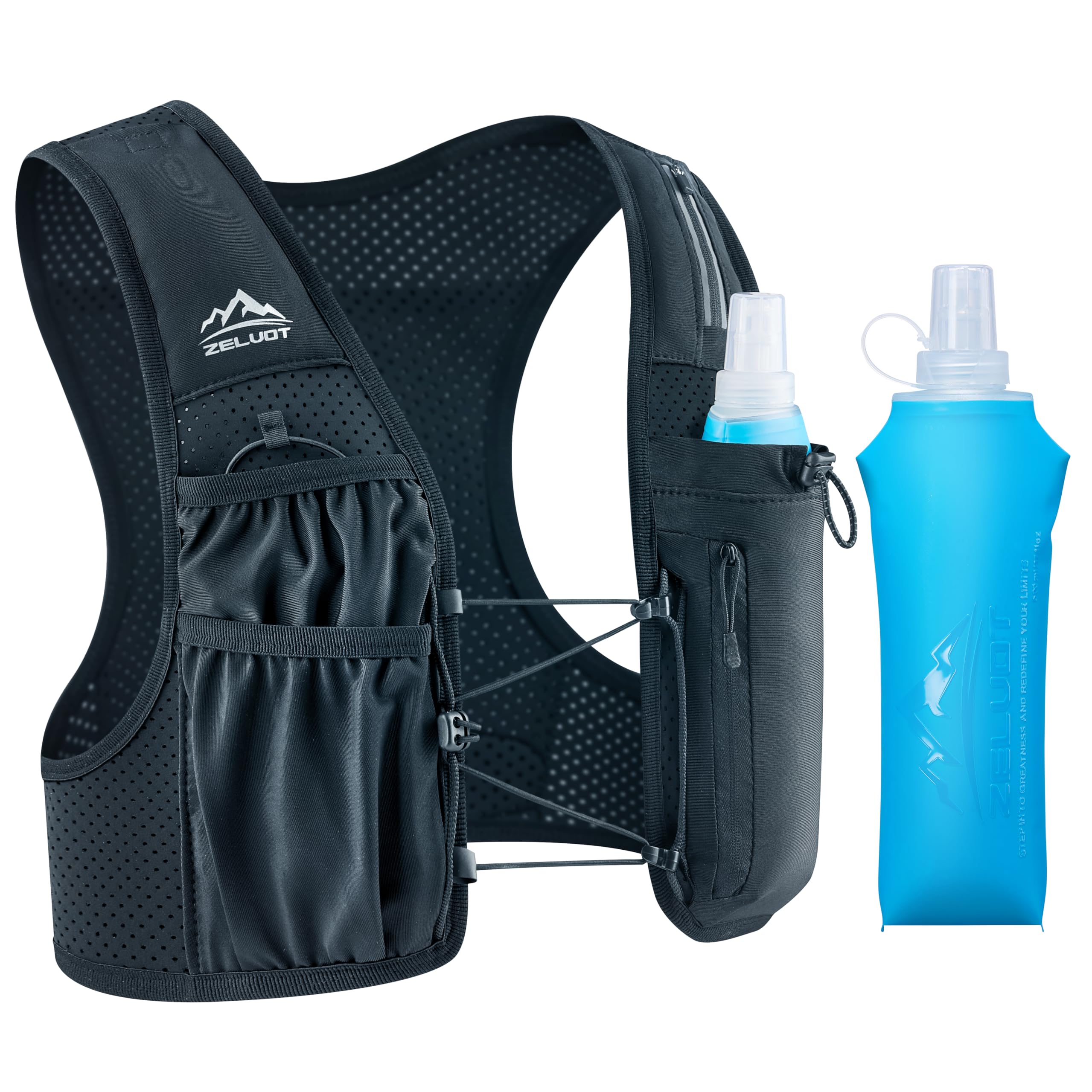


Best for Everyday Runs
SWIFTVEST Running Vest
Key Features
- Weight: 10.1 oz
- Pockets: 6
- Hydration: 500 ml soft flask included
- Phone pocket: Waterproof, zippered
- Price: Midrange
Two hundred and eighty-five grams, a 500 ml soft flask and six pockets: that is the SWIFTVEST, and it is the vest we hand most men first. It covers the ordinary weekday loop — phone, keys, a gel or two, water you can sip while moving — without the bulk of a bladder pack. The flask collapses as you drink, so the front pocket stops sloshing once it is half empty, and that detail is why we kept reaching for it over the bigger vests here.
The phone lives in a zipped, water-resistant front pocket, and that pocket is the tightest part of the design. A large handset in a case goes in, but it is a squeeze, and the zip is what keeps rain and sweat off it. Test your own phone in the pouch with the case on before you commit — it is the one measurement that decides whether this vest suits you.
Neoprene padding under the straps and a choice of three sizes do the rest. Loaded with a full flask, it sat close through tempo work and did not swing; a half-full flask is where a vest starts to flop, and this one held its shape. The material is quick-dry, and the reflective trim runs across the front and back, which counts on early winter mornings.
For 5Ks, club runs and half marathons with aid stations, this is the vest we reach for. Pack for a self-supported day and you will want the Criuage’s 2 L bladder instead; the SWIFTVEST’s job is to disappear while you run, and it does that better than anything else in this group.
Pros
- Six pockets take phone, keys and gels
- Soft flask compresses and does not slosh
- Stays put through tempo work
- Reflective trim front and back
Cons
- Phone pocket tight for large cased phones
- Half-liter flask caps unsupported distance
We recommend it to any man who wants water, a phone and gels on a normal run without thinking about the vest at all.
Best for Long Runs
Zelvot RUNV-3
Key Features
- Weight: 12.3 oz
- Pockets: 9
- Hydration: 500 ml soft flask included
- Chest straps: 3 adjustable
- Price: Midrange
Nine pockets on a vest this size sounds like overkill until you are three hours into a run with empty gel wrappers, a phone, a key and a shell that came off at mile six. The Zelvot RUNV-3 carries all of it and still sits close: seven pockets up front, two at the back, and a 500 ml soft flask in its own sleeve.
We think it is the best-organized vest in this group. Gels and a phone sit where you can reach them without breaking stride, the rear pockets take a shell or a second flask, and the neoprene is punched with ventilation holes that keep air moving across your chest on warm days. Nothing about the layout feels improvised.
The fit is snug by design — three adjustable chest straps, which is what stops a loaded vest rotating — and it stayed put through tempo work without the front pulling down. Breathe out when you tension it and the vest settles rather than riding up on the collar.
At 0.35 kg it is heavier than the lightest vest here, and you notice that on a short easy run more than on hour three of a long one. That is the trade: capacity and organization for a little heft. If you race with aid stations and carry nothing but a flask, the SWIFTVEST is the lighter, simpler answer.
Pros
- Nine pockets organize gels, phone and a shell
- Stays put with a full load
- Ventilated neoprene for warm runs
- Takes a second flask or layer at the back
Cons
- Sizing runs small against chest measurements
Buy it if your long runs involve gels, a shell and a second flask; it is the most organized vest in this set.
Best for All-Day Trail
Criuage Hydration Vest
Key Features
- Weight: 1.65 lb
- Pockets: 8
- Capacity: 5 liters
- Hydration: 2.0 L bladder included
- Price: Premium
Two liters of water is the Criuage’s whole argument, and it is a persuasive one if your long days have no refill point. The bladder sits in a dedicated back compartment, the hose runs to a bite valve on the chest, and there is 5 liters of cargo space and eight pockets built around it. This is the pack to take when the run is really a small expedition.
It is closer to a lightweight hiking pack than a race vest, and the weight says so: 750 g before you fill the bladder, heavier than anything else here. What that buys is a genuine day pack — four front pockets for food and a phone, four at the back, a thick nylon shell and a two-year warranty. The shoulder straps take a little fiddling to sit flat, then they stay.
It is not a road-race vest. A front-flask design is lighter and far quicker at an aid station, where you can hand a bottle over and keep moving, and the SWIFTVEST or the Zelvot will feel like nothing by comparison. The Criuage is for the day you carry your own water from start to finish, and for that job the capacity is worth every gram.
Pros
- 2 L bladder covers long unsupported days
- Eight pockets and 5 liters of cargo space
- Two-year warranty on a thick nylon shell
- Comfortable across hiking, running and riding
Cons
- Bladder refills mean taking the pack off
The one to take when the run is really a small expedition and the next tap is hours away.
Best for Hot-Weather Runs
MOKURA Running Vest
Key Features
- Weight: 9.6 oz
- Pockets: 5
- Hydration: 500 ml soft flask included
- Phone holder: Retractable coiled lanyard
- Price: Budget
The detail that sold us on the MOKURA is the phone holder: a retractable coiled lanyard that lets you pull the phone up to check a route or skip a track without unzipping anything. Small thing, but on an unfamiliar route it is the difference between a glance and a stop.
The rest is a clean soft-flask vest. A 500 ml flask up front, five pockets in total — gel bag, zip pocket, mesh pocket, phone bag and the flask sleeve — three chest straps with keepers so the tails do not flap, and stretch waist panels that pull the whole thing in against your ribs. Reflective accents run across the front and the back.
At 9.6 ounces it is the lightest soft-flask vest in this group, and you feel that on climbs: there is very little to swing. The neoprene and mesh do keep air moving, and the waist panels mean the load does not hang off the chest straps alone. For summer running, that combination is the whole point.
One thing to set up: with a full flask in front, tension the three chest straps evenly. Slack one off and the load shifts to the side, which reads as bounce; get them even and the vest stays quiet at pace. Do that once and you will not touch it again.
Pros
- Lightest soft-flask vest in this group
- Retractable phone lanyard is genuinely handy
- Five pockets plus three chest straps
- Reflective accents front and back
Cons
- Water warms quickly in the uninsulated flask
Our pick for hot, short runs where you want half a liter, your phone and nothing else on your back.
Best for Phone Only
ZelaFit Run Vest
Key Features
- Size: Small-Medium
- Material: Neoprene nylon
- Phone pouch: Waterproof, pull-cord zip
- Package weight: 6.7 oz
- Price: Budget
If you already carry a handheld bottle, the ZelaFit solves the problem you actually have: where the phone goes. It is a flat neoprene chest panel with a zipped, water-resistant phone pouch, a small key pocket and an adjustable strap that runs around your ribs. There is nothing to it — no bottle sleeve, no back panel, no weight to speak of.
We like it best for short, hot runs. The panel is flat enough to wear against skin when it is too warm for a shirt, and the phone sits high on the chest where the strap holds it without the bounce you get from an armband. It also disappears under a jacket, which is more than the bigger vests manage.
The trade is obvious: no water. It is a phone rig, not a hydration vest, so it suits city runs where a fountain is never far away, a parkrun, or the gym. The moment you want a liter on your back, one of the flask vests above is the answer, and the pouch is cut for a phone alone rather than a phone plus a snack.
The pouch takes a big handset — an iPhone Pro Max or a Galaxy Ultra — and the pull-cord zip is quick to work one-handed while you are moving. For the price of a phone carrier, that is the whole job done.
Pros
- Flat panel does not bounce at pace
- Waterproof pouch fits large phones
- Wearable against skin on hot days
- Disappears under a jacket
Cons
- One size listed: small-medium
The right buy if you already carry a bottle and just want your phone and keys off your body.
Best for Rugged Edc
MVRK Chest Pack
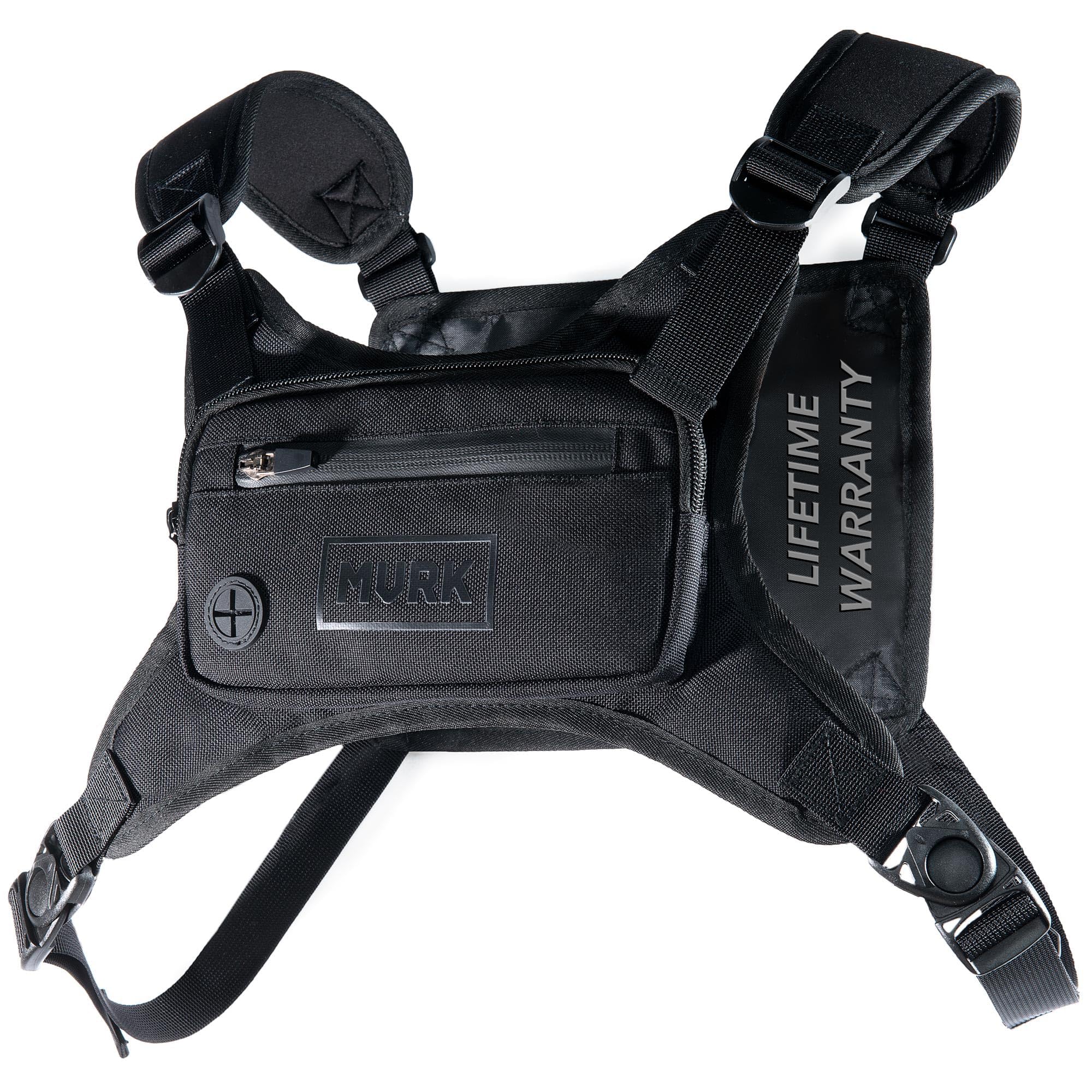
Key Features
- Pockets: 3
- Material: Cordura nylon
- Main pocket: Fits iPhone Plus
- Storage volume: 28 cubic inches
- Price: Midrange
The MVRK is a chest pack rather than a vest: three zipped compartments in water-resistant Cordura, hung on a cross-body strap that adjusts at four points, with a back panel that sits flat against your chest. It is the rugged pick here, and the fabric shrugs off rain and scuffs in a way the soft neoprene vests do not.
We rate the layout. The main zip pocket takes a Plus-sized phone and a wallet, the outer pocket handles cards and keys, and the slim back zip holds a gel without bulging. For commuting, hiking and gym trips it is the one that does not look like running kit, and that is why it stayed in this roundup.
Running is where it asks for patience. The load hangs from one cross-body strap rather than two chest straps, so a full main pocket swings at pace and the strap ends work loose over a few miles. Cinch everything down before a hard effort and it is manageable — but for tempo work, a two-strap vest is simply better.
Pros
- Cordura shell shrugs off rain and scuffs
- Three compartments fit phone, wallet and keys
- Adjusts at four points
- Doubles as an everyday chest pack
Cons
- Seam stitching is the durability weak point
A well-laid-out Cordura chest pack for commuting and hiking that only partly doubles as running kit.
Best for Budget Hydration
Maelstrom Hydration Pack
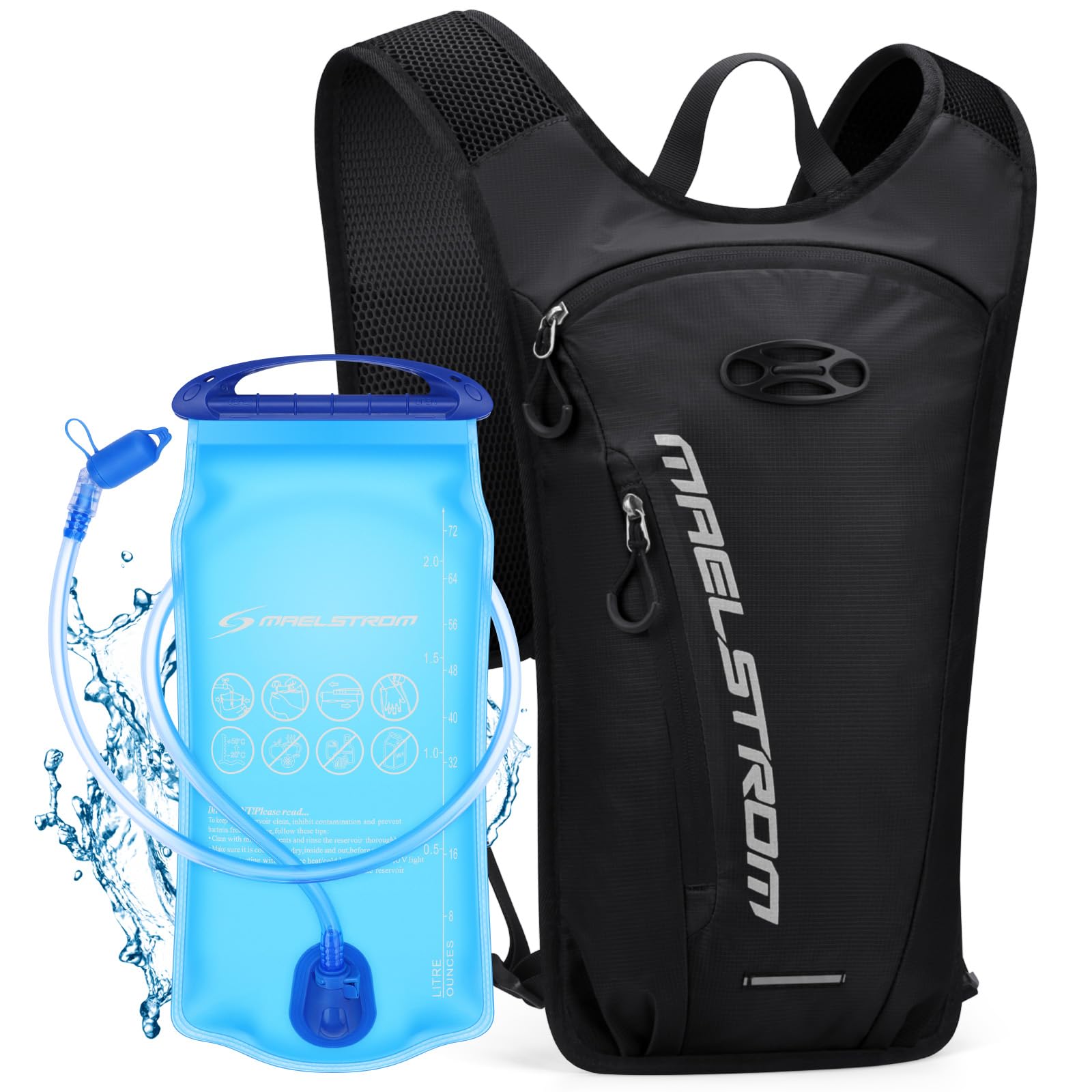
Key Features
- Weight: 1.1 lb
- Pockets: 4
- Hydration: 2 L bladder included
- Chest straps: 22.4–61 inches
- Price: Budget
The Maelstrom is the cheapest route into a full 2 L bladder pack here, and on paper it is not a compromise: a BPA-free bladder, four pockets, a ventilated back panel, reflective strips and chest straps that span 22.4 to 61 inches — a wider range than most vests in this group.
It is closer to a hiking pack than a race vest. At 1.1 lbs it is heavier than the flask vests, the shape sits off your back rather than against it, and a loaded Maelstrom moves more than a snug vest does. Commuters, festival-goers and hikers absorb that easily; anyone doing intervals will feel every ounce of it.
What we like is what the money buys: external clips take a cycling helmet, so it doubles as a ride-to-the-trailhead pack, and the pockets swallow a phone, keys, tools and snacks without a second bag.
Check the bite valve on day one. It is the component that lets an otherwise serviceable pack down, and a leaking valve soaks your back within a mile. Fill it, hang it and watch for drips before you trust it on a long day — if it holds, there is a lot of pack here for the price.
Pros
- Cheapest full 2 L bladder setup here
- Helmet clips make it a ride-to-trail pack
- Chest straps span 22.4–61 inches
- Four pockets plus reflective strips
Cons
- Bulkier and heavier than the vest-style picks
- Bite valve can leak onto your back
The cheapest way into 2 liters of bladder capacity, best for commuters, hikers and riders rather than intervals.
How We Tested 12 Running Vests for Men
We started with a long list of running vests, then narrowed it to 12 by filtering for construction quality, strap design, pocket layout, and whether the sizing matched chest measurements. We ruled out anything with a fixed reservoir, flimsy sternum straps, or a back pocket too small for a modern phone.
For six months, each vest was worn at least three times a week by one of us on road loops, tempo runs, and weekend trails. We loaded each one the same way: two soft flasks up front, a phone and keys in the back, and four gels split between pockets. On the run, we noted whether the vest stayed put on steep descents, whether the sternum strap needed re-tightening after a mile, and where mesh or seams rubbed when worn over a T-shirt and under a rain shell.
Leakage got its own check: we filled each soft flask with water and a drop of food coloring, inverted it in the chest pocket, and squeezed for ten seconds, then looked for damp seams and dye marks. After every three runs, we washed each vest cold and air-dried it, watching for frayed mesh, stretched elastic, and hardware that lost its grip. Value came down to usable storage—not just pocket count—and whether the vest still fit the same after a month of washing.
How to Choose a Running Vest for Men
Fit decides more than features: a vest that bounces against your chest is worse than no vest at all, so settle the size and strap range before you argue about pocket counts.
Soft flask or bladder?
A front soft flask is the faster system. You sip from a bite valve without breaking stride, you can see how much is left, and a volunteer at an aid station can refill it in seconds. The 500 ml flasks in the SWIFTVEST, Zelvot RUNV-3 and MOKURA are that kind of setup: enough for the runs most of us do, light enough to forget.
A bladder moves the weight to your back and holds far more, which is why the Criuage carries 2 L. That is the right call for a self-supported day when the next tap is hours away, but refilling means stopping and pulling the pack off, and a full bladder is the heaviest thing you will carry. Choose the flask for pace and easy refills, the bladder for distance without them.
Measure your chest, then test the bounce
Every vest here adjusts at the chest, and most adjust at the waist too, but no amount of strap tension fixes a shell that is a size wrong. Measure around your chest rather than ordering your T-shirt size and compare that number with the maker’s range; the Zelvot is a good example of a vest that runs small, so go up if you land between sizes.
Then test it the way you will use it. A vest that sits silent when empty can swing once a full flask and a phone are loaded in, so fill it, wear it, and shake it out before a long run. If it moves, tighten the chest straps from the bottom up and pull the waist panels in. If it still moves, the size is wrong, not the tension.
The phone pocket decides more than you think
Phone size is the specification buyers get wrong most often, because a pouch that fits a bare handset may not fit yours in a case. A zipped, water-resistant pocket is the right design, and it is where the SWIFTVEST puts your phone, but that pocket is tight around a large cased phone. Several of the chest rigs here top out around a Plus-sized device.
Measure your phone with the case on and hold that against the pocket description. If you run with a big handset in a rugged case, favour a pack with a dedicated phone compartment over the smallest, flattest rig, and check that you can open the zip one-handed while moving.
How much vest do you actually need?
Weight and capacity travel together. A 500 ml soft-flask vest at around 285 g disappears on your back; a 750 g pack with a 2 L bladder is equipment you notice for the first mile. For runs where water is on the route, a phone rig or a small flask vest is plenty. For two hours and up with no refill, the capacity earns its weight.
The common mistake is buying the biggest pack for a short race. Start from the water you actually drink on your longest regular run, then add one pocket for a shell or a layer, and resist the rest.
Frequently Asked Questions
How do I clean a running vest and its flask or bladder?
Empty and rinse the flask or bladder with warm water and a drop of dish soap after every run, shake it, rinse again, and dry it fully with the cap off. A bottle brush reaches the corners of a bladder; a soft flask just needs a good shake and air.
Wash the vest itself by hand in cool water and air-dry it away from direct heat. Store flasks open rather than sealed and they will not turn stale between runs.
Can I use a running vest for hiking or cycling?
Yes, and the bladder packs cross over most easily. The Criuage and the Maelstrom both take a 2 L bladder and have room for a layer, and the Maelstrom adds clips for a cycling helmet.
For a full day on foot, pick the bladder and the bigger cargo space. For a fast hike or a ride under a couple of hours, a flask vest is lighter and easier to sip from without stopping.
Will a running vest fit over a jacket?
Usually, within limits. Chest straps adjust, but you need to measure your chest over the layer you will actually wear and check that the number sits inside the maker’s range.
Vests with three chest straps, like the Zelvot RUNV-3 and the MOKURA, open up further than a single-strap rig. If you plan to wear a shell through the winter, size to the shell rather than to a base layer.
Final Verdict
For most men the SWIFTVEST is the vest to buy. It carries a 500 ml flask, a phone and a few gels at 285 g, holds still at pace, and asks less of your wallet than the bladder packs here. It is the one we reach for on an ordinary run.
Change the requirement and the answer changes with it: the Zelvot RUNV-3 if your long runs need more pockets, the Criuage if you will be out for hours with nothing to refill from, the MOKURA if weight is what you care about most. And if your water comes from a fountain or a handheld bottle, the ZelaFit solves the only problem left, which is where the phone goes.