This post contains affiliate links. We may earn a small commission when you buy through our links — at no extra cost to you.
A running vest has one job, and it’s harder than it sounds: carry your water, calories, and a wind shell without ever announcing itself. Load too little and you’re rationing sips on a hot climb; load it wrong and the whole thing bounces, rubs, and swings a flask into your ribs by mile eight. The good ones disappear — you notice the water sloshing, not the straps.
I’ve spent enough years on rocky singletrack to have opinions about flask bite valves, and I’ve learned that price and capacity tell you almost nothing about how a vest feels at mile 20. Over the past six months, my team and I ran in 12 vests, from quick after-work loops to a full day above treeline, and the winners were rarely the biggest or priciest — they were the ones that still sat the same way after a hundred miles. One thing first-timers get wrong: size to your chest measurement, not your T-shirt, and judge the fit with the flasks full. The picks below are the ones we kept reaching for.



Best for Daily Trail Runs
SWIFTVEST Running Vest
Key Features
- Sizes: Three sizes
- Weight: 10.1 oz
- Pockets: 6
- Hydration: 500 ml soft flask
- Price: Midrange
Three sizes is the detail that won us over. Almost every vest in this group comes in a single cut and asks you to take up the slack with chest straps, and fit is where single-size vests go wrong. SwiftVest ships in small through large, and the neoprene-padded straps lie flat across the collarbone instead of digging in. We wore it with the flask full on short midweek loops and on a longer weekend outing, and it held its position without a mid-run adjustment.
For something this light — 285 grams before you fill anything — there is more storage than the number suggests. Six pockets include a water-resistant zipped phone pouch and front slots you can reach without breaking stride, and the 500 ml soft flask in the box collapses as you drink, so the last third of the water stops sloshing around behind your ribs. That is the kind of small thing that decides whether a vest gets worn or stays on the hook.
The flask is also the limit. Half a liter is a short-run amount of water, and on a two-hour day in the hills you will be planning a refill or adding a second bottle to a front pocket. Take that as a planning note rather than a flaw: half a liter plus a refill point covers most of the running most of us actually do. Reflective detailing front and back is the other thing we appreciated — it makes a dawn run on a road shoulder feel less like a gamble.
Pros
- Three sizes give a real chance of a proper fit
- Stays put with a full flask on the run
- Water-resistant zipped pocket for a phone
- Soft flask shrinks as you drink, so no slosh
Cons
- Phone pouch is tight for large handsets
Our pick for most trail runners: three sizes for a proper fit, a flask that collapses as you drink, and a hold that survives a loaded run.
Best for Long Training Runs
Zelvot RUNV-3 Hydration Vest
Key Features
- Weight: 12.3 oz
- Pockets: 9
- Hydration: 500 ml soft flask
- Chest straps: 3
- Price: Midrange
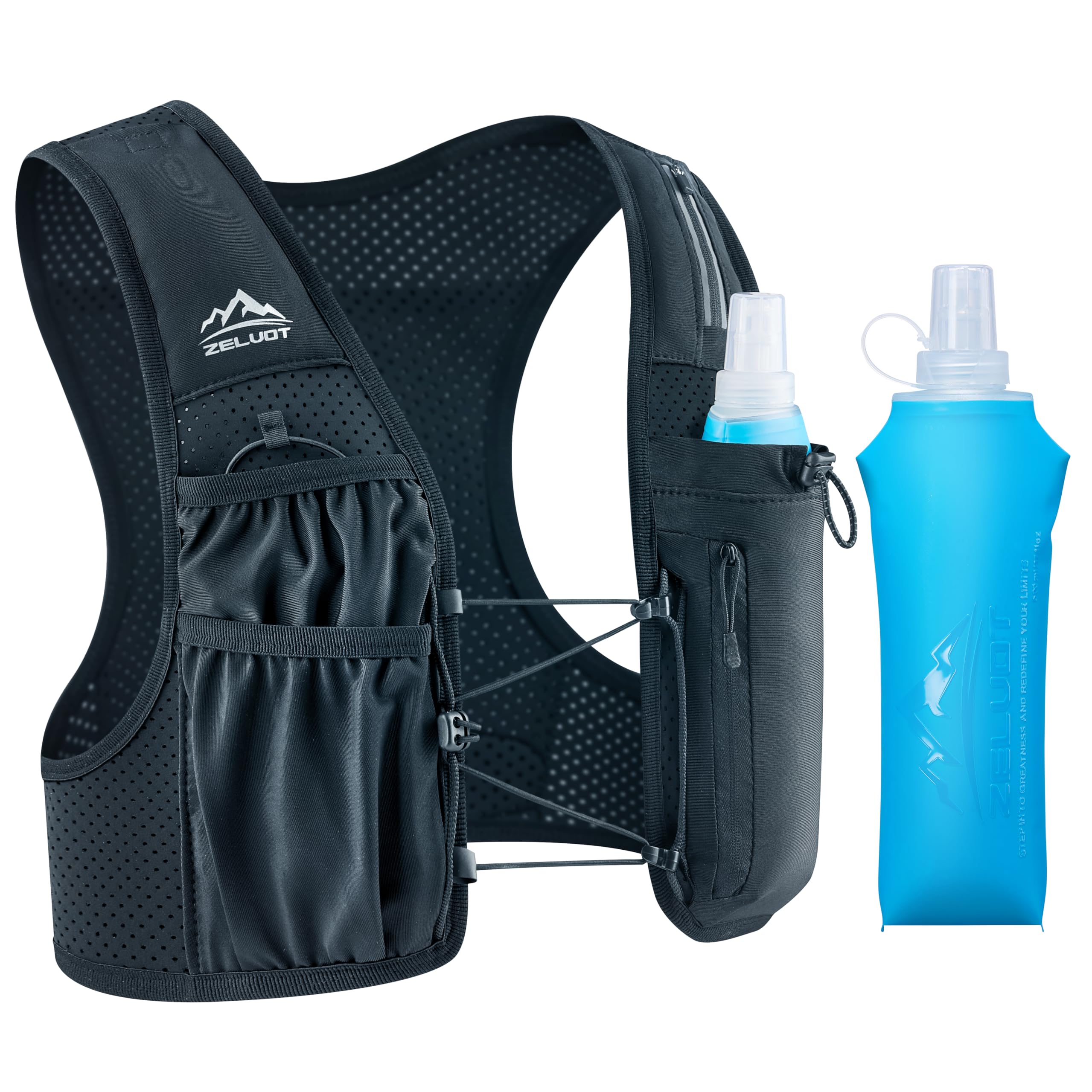
Nine pockets sounds like a spec-sheet boast until you are three hours in and want a gel without unclipping anything. The RUNV-3 puts two stretch pockets on the shoulder straps, a front zip, a hidden zip and a couple of quick-access slots up front, with a large zipped compartment and a mesh dump pocket around the back. In practice that means the things you need while moving never end up behind you.
We think it is the best vest here for long training runs, and the reason is capacity rather than cleverness. The front sleeves take two 500 ml soft flasks, so you can carry a liter without strapping a bladder to your spine, and three chest straps keep the load from shifting when both are full. A liter up front feels different from a liter in a bladder — the weight sits where you can notice it, but it does not swing.
Empty, it weighs 350 grams, which lands in the middle of this group: heavier than the SwiftVest, far lighter than the bladder packs. The triple-vented neoprene back panel is the part we appreciated most on warm days, because it keeps the fabric off your skin and stops sweat pooling at the small of your back. The rear zip swallows a light shell and the mesh takes a hat and gloves, which makes this the vest that goes in the bag for a marathon build.
Pros
- Two flask sleeves carry a liter up front
- Nine pockets, two of them on the straps
- Three chest straps hold a full load still
- Vented neoprene back panel runs cool
Cons
- Single size runs small across the shoulders
For runs long enough to need a liter and a pocket full of gels, this is the vest we hand over first.
Best for Fast and Light Days
AONIJIE 5L Running Vest
Key Features
- Weight: 6.7 oz
- Pockets: 9
- Capacity: 5 liters
- Hydration: 1.5 L bladder sold separately
- Price: Budget
Runners who already own a bladder or a pair of soft flasks get the best deal in this group from the AONIJIE. The 5-liter version arrives as the vest alone, which is where the saving comes from, and it carries more than most of the complete kits here while weighing a fraction of them.
190 grams is the figure that decides it. That is the lightest vest on this list before you put anything in it, and the difference is obvious the moment you put it on — there is no structure fighting your shoulders, just stretch fabric, a chest strap and a waist belt. Nine exterior pockets cover phone, keys, gels and a light shell, and the 5-liter body is sized for a fast day out rather than a fastpacking trip.
What we kept coming back to is how little it interferes. The chest and waist straps cinch in one pull, it rolls up smaller than a pair of gloves when you are done, and the rose red we tried is a welcome change from the black that dominates this shelf. Load it properly before race day, though: a full 1.5-liter bladder is a lot of weight to hang off a 190-gram harness, so fill it and run a descent in it before you commit.
Pros
- Lightest vest here at 190 grams empty
- Nine pockets across a 5-liter body
- Chest and waist straps cinch in one pull
Cons
- Sold without a bladder or flasks
The ultralight choice for trail runners who already own hydration: 190 grams, nine pockets, and nothing you do not need.
Best for First Vest
MOKURA Running Vest
Key Features
- Weight: 9.6 oz
- Pockets: 5
- Hydration: 500 ml soft flask
- Chest straps: 3
- Price: Midrange
For the money, the MOKURA is the easiest complete kit to recommend. It arrives with a 500 ml soft flask, five pockets and a two-year warranty, and it costs less than the two vests above it. That combination is worth taking seriously if you are buying a first vest or a second one to leave in the car.
The front is neoprene, and it does what neoprene is good at: it sits close, spreads pressure across the chest instead of loading two strap lines, and does not chafe at the collarbone. The 9.6-ounce weight disappears once it is on, and the phone pouch takes a full-size handset — worth checking, because it is where several vests here fall down. The retractable coiled lanyard on the phone pocket is a small feature we ended up using more than we expected.
Two years of warranty matches the best in this group, and reflective accents front and back are the sort of thing you stop noticing until a dusk run on a shared path. After a few weeks, what stood out is how fast the mesh dries — a sweaty hour does not leave it clammy for the drive home.
Pros
- Flask, five pockets and warranty in one box
- Neoprene front sits close without chafing
- Cheaper than the other complete vests here
Cons
- Half-liter flask is a short-run water capacity
The one we suggest when you want a flask, pockets and a snug fit without paying premium-vest money.
Best for Run-Hike Crossover
N NEVO RHINO Hydration Backpack
Key Features
- Weight: 8.5 oz
- Bladder: 2 liters
- Capacity: 12 liters
- Dimensions: 11.8 x 16.5 in
- Price: Budget
This is not a race vest, and treating it like one would be a mistake. The Nevo Rhino is a 12-liter daypack with vest-style shoulder straps and a two-liter bladder, and it costs less than every purpose-built vest in this guide.
What you get for that is range. The main compartment takes a shell, lunch, a first-aid kit and a camera; the front pockets hold phone, keys and snacks where you can reach them; and the two-liter bladder covers a hot three-hour walk without a refill. At 8.5 ounces empty it is lighter than most daypacks, and the shoulder straps adjust from 19 to 34 inches, so it fits a genuinely big frame.
The bladder is the part to learn before you rely on it. Fill it past the halfway mark and it can weep at the seam, so stop where the fill line tells you and it behaves. That is a habit rather than a defect, and it is the compromise that comes with a reservoir this size at this end of the market.
Where it earns its place is the crossover day: a run that turns into a hike, a swim with a walk back to the car, a festival where you are on your feet for twelve hours. Set against the vests above, it gives up very little and carries a great deal more — just do not expect it to sit still through a fast descent the way the SwiftVest does.
Pros
- Twelve liters plus a two-liter bladder
- Lighter than most daypacks at 8.5 ounces
- Wide strap adjustment for bigger frames
Cons
- Bottle pockets too narrow for standard bottles
- Bulkier than a race vest when fully loaded
Buy it as one pack for running, hiking and everything in between, not as a race-day vest.
Best for Big Water Days
Criuage Hydration Vest Backpack

Key Features
- Weight: 1.65 lb
- Bladder: 2 liters
- Pockets: 8
- Capacity: 5 liters
- Price: Midrange
If your long day means two liters of water, a shell, tools and a phone, the Criuage is built for that load — it just is not built to be forgotten. It is a chest rig as much as a vest: five liters of pack, eight pockets and a two-liter bladder in a harness that spreads weight across both shoulders.
Pockets are the reason to look at it. Four across the front hold a phone, gels, a map and the small things you want without stopping, and four at the back take a shell and some food. The nylon is thick and does not flap, and the padded harness carries a full bladder without the shoulder ache you get from a thin strap digging in over a couple of hours.
At 750 grams empty it is the heaviest thing on this list, by a margin you notice when you pick it up. What that buys is structure: for hike-run days, fastpacking and long outings where you walk as much as you run, the padding and load distribution earn the weight back. For a fast 10K or a road half, it is simply more pack than the job needs.
Pros
- Eight pockets around a five-liter body
- Two-liter bladder for long days
- Padded harness spreads a full load
Cons
- Shoulder straps sit oddly on narrow frames
The pick for long days when you are carrying two liters and a full set of gear; skip it if you are racing.
Best for Budget Starter
Katroiy Running Vest

Key Features
- Weight: 7.05 oz
- Material: Polyester mesh
- Hydration: 500 ml soft flask
- Chest strap: Adjustable
- Price: Budget
The 500 ml flask that ships with this vest is the weak link. The pocket holding it does not grip hard enough to keep it from working loose when you are moving fast, and once it is loose it rattles against your chest for the rest of the run. Swap in a flask you trust, or cinch the pocket down before you set off, and the rest of the vest makes sense.
Because the rest of it is better than the outlay suggests, and that is where our judgement lands. At 200 grams it is among the lightest here, the polyester mesh breathes, and the chest strap slides far enough to fit a genuinely broad range of bodies. The front sits flat against the chest instead of gaping at the neck, which is more than several pricier vests manage.
It is also the least fussy thing in this group to live with. There is no bladder to rinse, no hose to route, nothing to disassemble after a wet run — you hang it up, and it is dry by morning. For a first season of trail running, that simplicity is worth more than another pocket.
Pros
- Under 200 grams and easy to cinch down
- Chest strap fits a wide range of bodies
- Lowest-cost complete vest in this group
Cons
- Flask pocket lets the bottle work loose
A cheap, light first vest for runners who are not sure yet, and worth it only if you will swap the flask.
How We Tested the Best Trail Running Vests
We started by pulling every trail vest we could find that came in more than one size, carried at least two flasks up front, and stayed out of boutique pricing. Anything with unreachable front pockets or a back panel that wouldn’t compress got cut, which left 12 vests. We ran in all of them for six months — roughly a dozen outings each, from 40-minute lunch loops to a four-hour day in the hills.
Each vest was loaded identically: two flasks, 400 calories, a rain shell, a phone, keys, and a headlamp. On the same 8-mile loop with a long climb and a loose descent, we noted where a vest bounced, whether the straps crept loose, and whether we could pull a flask one-handed at a jog without breaking stride. We weighed each one empty and loaded on a kitchen scale, and checked collarbones and ribs for hot spots after long runs.
Fit got tested both ways — we ran in the size the charts recommended, then a size down, to see how much each vest packed down when it wasn’t stuffed. To test storage capacity we filled each to its stated limit and then a little past it, watching for strained seams and sagging mesh. Build quality and durability were judged the slow way: repeated wash cycles and 100-plus miles per vest, with checks for stretched flask pockets, frayed binding, and zippers that quit running smooth. Functionality came down to small things, like a phone pocket you can reach mid-run and a shell that goes in without a fight.
Value was the last filter. A few of the priciest vests didn’t earn their spot, and one of the least expensive handled a full day out as well as anything we wore. The picks below are the ones still in rotation.
How to Choose a Trail Running Vest
Fit decides everything else: a vest that shifts under a full flask will annoy you long before its pocket layout ever does.
Fit and bounce come first
A vest should sit high and close, with the chest straps taking up small adjustments rather than hauling a loose body in against your ribs. If you are between sizes, go down. A vest that is slightly tight can be let out, but one that gaps at the shoulder cannot be pulled in without compressing your chest. Measure around the widest part of your chest and check that number against the maker’s range before you order.
Then load it. Five minutes of jogging with the flask full tells you more than a mirror does, and it is the test to run while the return window is still open. This is exactly why the SwiftVest’s three sizes matter so much in a category where most vests come in one cut and let the straps sort it out.
Bottles up front or a bladder on your back
Soft flasks in front pockets put the weight where you can see it and refill it in seconds, and they empty as you drink, so the load gets lighter instead of sloshing. A bladder carries more and keeps both hands free, but two liters is two kilograms sitting high on your spine, and you cannot tell how much is left without pulling the hose out.
Under ninety minutes, one 500 ml flask is plenty. Past two hours, or anywhere you cannot count on a refill, carry a liter up front the way the Zelvot RUNV-3 does with two flasks, or fit a 1.5 to 2 liter bladder. The trap with bladders is loading one into a vest with no waist strap: the weight sits above your center of gravity and the whole pack rolls on descents.
Storage you can reach while moving
Five liters is the sweet spot for trail running — a shell, a phone, food and a small first-aid kit. Twelve liters tips into daypack territory, which is useful but changes what the vest is for. Count only the pockets you can open at a trot: a rear compartment is for the layer you shed at the summit, not the gel you want at mile eight.
Lay out everything you carry on a normal long run and check that it fits in the front pockets. If it does not, you are really shopping for a pack, and you want one with a hip belt that puts the load on your hips rather than your shoulders.
What weight and money actually buy
The lightest vest here is 190 grams and the heaviest is 750, and the gap is structure: padding, pocket walls, a bladder sleeve. A light vest with a good harness beats a heavy one with a bad harness, but a heavy load on a thin harness is the worst combination of all. Racing a fast 10K, go light; hike-run days with two liters and kit, the structure earns its weight back.
Extra spend buys sizing options, a water-resistant phone pocket, reflective trim and a longer warranty — the things you notice in week two rather than on the product page.
Frequently Asked Questions
Do I need a vest if I already run with a handheld bottle?
A handheld is fine for an hour on the road. A vest frees both hands, spreads the weight across your torso instead of one shoulder, and gives your phone, keys and a shell somewhere to live. Start cheap — the Katroiy costs little and will tell you within a month whether you like running loaded at all.
Can I use a trail running vest for hiking?
Yes, within limits. A five-liter vest with a shell, a liter and a half of water and lunch covers a fast half-day. Add a stove, a warm layer and a full day of food and you want a pack with a hip belt; the 12-liter Nevo Rhino is roughly where the two overlap. Weigh your kit before you choose.
How much water should I carry on a trail run?
A rough rule is 500 ml an hour in cool conditions and up to a liter an hour in heat or at altitude, adjusted for how much you sweat. Rather than hauling three hours of water, plan the route around a refill point and carry a flask you can top up. Two 500 ml flasks cover most two-hour runs.
How do you clean a soft flask or a bladder?
Rinse both with warm water and a drop of dish soap the same day you use them, scrub with a bottle brush, and dry them fully with the opening propped wide. Store them empty and open, never sealed with water still inside. Check the maker’s care instructions before dishwashing — most bladders are hand-wash only.
Final Verdict
The SwiftVest is the one we point most trail runners toward. Three sizes turn fit into a decision you make rather than a compromise you accept, and a vest that sits still with a full flask is worth more than one with two extra pockets. If your long runs need a liter up front, the Zelvot RUNV-3 carries it without a bladder. If you already own hydration and want the lightest thing here, order the AONIJIE.