This post contains affiliate links. We may earn a small commission when you buy through our links — at no extra cost to you.
I spent years running with a handheld bottle and a waist belt that slowly rotated around my hips, and I assumed the swinging and chafing were just part of carrying water. Then a friend handed me a proper vest on a 20-mile day, and everything sat against my ribs without moving. What a good trail running pack really buys you is silence — water, calories, a shell, and your phone riding close enough that you forget they’re there.
The trouble is that fit is personal — torso length, shoulder shape, and chest size all change what feels locked-in, and a pack that’s perfect on me can rub you raw by mile eight. Over the past nine months, my team and I put 12 packs through short after-work loops, long training runs, and a muddy 50K. Two things you won’t read on the box: soft flasks leak at the cap when they’re overfilled or seated crooked, and pack sizing rarely matches your shirt size, so measure your chest before you order. The picks below are the ones we kept reaching for.



Best for All-Day Trail Runs
Salomon Agile 12 Set
Key Features
- Weight: 13.8 oz
- Harness: 3-point attachment
- Gear carry: Poles and helmet
- Flask capacity: Two 500 ml flasks
- Price: Premium
Two flasks come in the box, and the Agile 12 Set is built around them. The front pockets sit where you can reach them without breaking stride, and the 3-point attachment system links the shoulder straps to the hip belt so the load moves with you. That is the difference between a pack you tolerate on a long climb and one you forget about.
What we like most is the brief: Salomon designed this as a trail-running vest first, not a hiking daypack with a bladder sleeve. The 3D mesh harness, stretch pockets, and helmet or pole carry make it flexible for technical days, while the included 500 ml flasks mean you can head out immediately. It is the one we recommend as the default for all-day trail runs.
The trade-off is that the storage is deliberate rather than endless. If you want nine pockets for every gel wrapper, the Zelvot is the more organized vest. For most trail runners, though, that is the right trade: less fuss, more running.
Pros
- Two 500 ml flasks included
- Stable 3-point harness
- Carries poles and a helmet
- Ready for all-day trail runs
Cons
- Premium price for a specialist pack
We recommend the Agile 12 Set as the default trail pack: it carries a full day’s kit, includes two flasks, and holds close with a proper running harness.
Best for Short Trail Runs
SWIFTVEST Running Vest
Key Features
- Weight: 10.1 oz
- Pockets: 6
- Hydration: 500 ml soft flask
- Phone pocket: Waterproof zippered
- Price: Midrange
The first thing we check on a race vest is the phone pocket, because a flapping phone is worse than a missing gel. SWIFTVEST gives it a zippered, waterproof home and builds the rest of the vest around six pockets and a 500 ml soft flask. That combination makes it our pick for short trail runs and race days.
The reflective detailing is useful for dawn starts, and the neoprene padding is designed to reduce bounce without adding bulk. The fit is adjustable, and the vest comes in three sizes, so measure your chest rather than assuming your usual top size. We also like that the soft flask compresses as you drink, which keeps it from sloshing.
The single 500 ml flask is the trade-off: fine for an hour or two, not for a long unsupported day. If you want more water for less money, the KUYOU is the budget answer; if you want the best pocket organization here, the Zelvot is the gear-heavy choice.
Pros
- Waterproof zippered phone pocket
- Six pockets plus 500 ml flask
- Reflective detailing
- Light 285 g build
Cons
- Snug phone pocket on larger handsets
We pick the SWIFTVEST for short trail runs and race days: the waterproof phone pocket, six pockets, and one flask cover the essentials without a bladder.
Best for Budget Trail Runs
KUYOU Hydration Vest
Key Features
- Fit: Shoulder, chest, waist straps
- Safety: Reflective strips and whistle
- Hydration: 2 L bladder
- Price: Budget
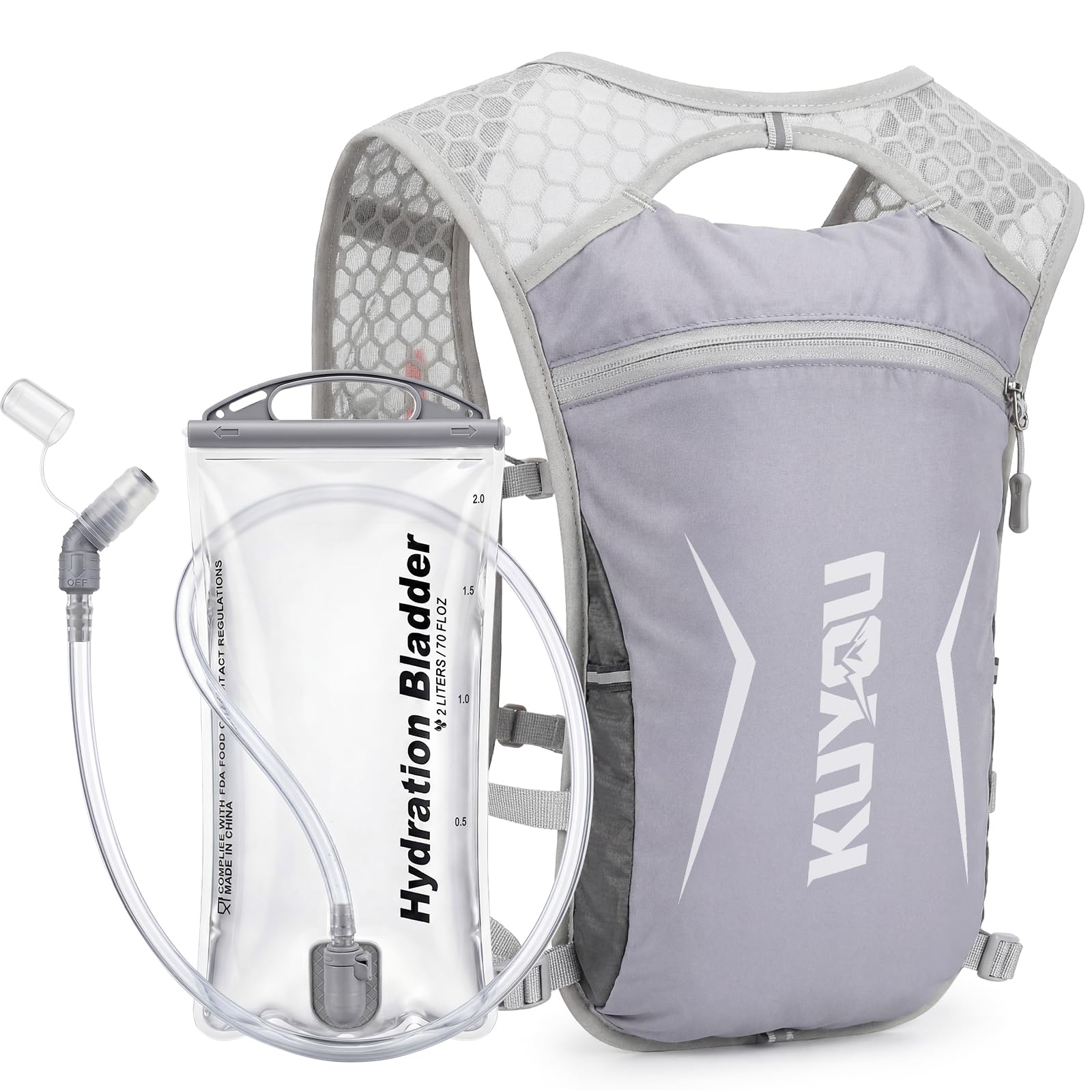
The KUYOU is the simplest answer to a common question: what if you want a bladder included without paying for a specialist race vest? You get a 2-liter bladder, a bottle pocket, a phone pocket, and reflective strips in one package.
The shoulder, chest, and waist straps give you more adjustment than the price suggests, and the whistle is a small safety extra we appreciate on remote paths. The 2-liter bladder is the main draw: enough for a couple of hours, and the high-flow bite valve is designed for drinking without stopping.
We recommend it as the budget pick because it covers the essentials without fuss. The trade-off is that it is a bladder-first vest, so you lose the quick flask access of the SWIFTVEST and the ultralight feel of the AONIJIE. For a first trail pack or a budget backup, that is a fair exchange.
Pros
- 2 L bladder included
- Adjustable shoulder, chest and waist straps
- Reflective strips and emergency whistle
- Budget-friendly complete setup
Cons
We recommend the KUYOU as the value pick: it includes a 2-liter bladder, adjustable harness, and reflective safety details for a first trail pack.
Best for Ultralight Trail Runs
AONIJIE 5L Running Vest
Key Features
- Volume: 5 L
- Weight: 6.7 oz
- Pockets: 9
- Hydration: Not included
- Price: Budget
A 5-liter vest that weighs 190 grams is making a promise: you supply the water, it supplies the pockets. The AONIJIE keeps that promise with nine exterior pockets and mesh shoulder straps that sit close to the body.
We like it best for runners who already own a bladder or prefer bottles, because there is no hydration included. That sounds like a drawback, but it keeps the vest affordable and lets you choose your own setup. The 5-liter main compartment is enough for a shell, phone, and a few gels, and the front pockets are placed for access on the move.
If you want a complete out-of-the-box pack, the KUYOU is the easier buy; if you want the lightest vest here, this is the one. The 5-liter volume is also a useful middle ground: more than a race vest, less bulk than a daypack.
Pros
- Ultralight 190 g body
- Nine exterior pockets
- 5 L capacity for essentials
- Adjustable chest and waist straps
Cons
- Sizing runs close; measure first
We recommend the AONIJIE for runners who own a bladder and want the lightest 5-liter vest here, with nine pockets and a close, adjustable fit.
Best for Gear-Heavy Trail Runs
Zelvot RUNV-3 Running Vest
Key Features
- Weight: 12.3 oz
- Harness: 3 chest straps
- Pockets: 9
- Hydration: 500 ml soft flask
- Price: Midrange
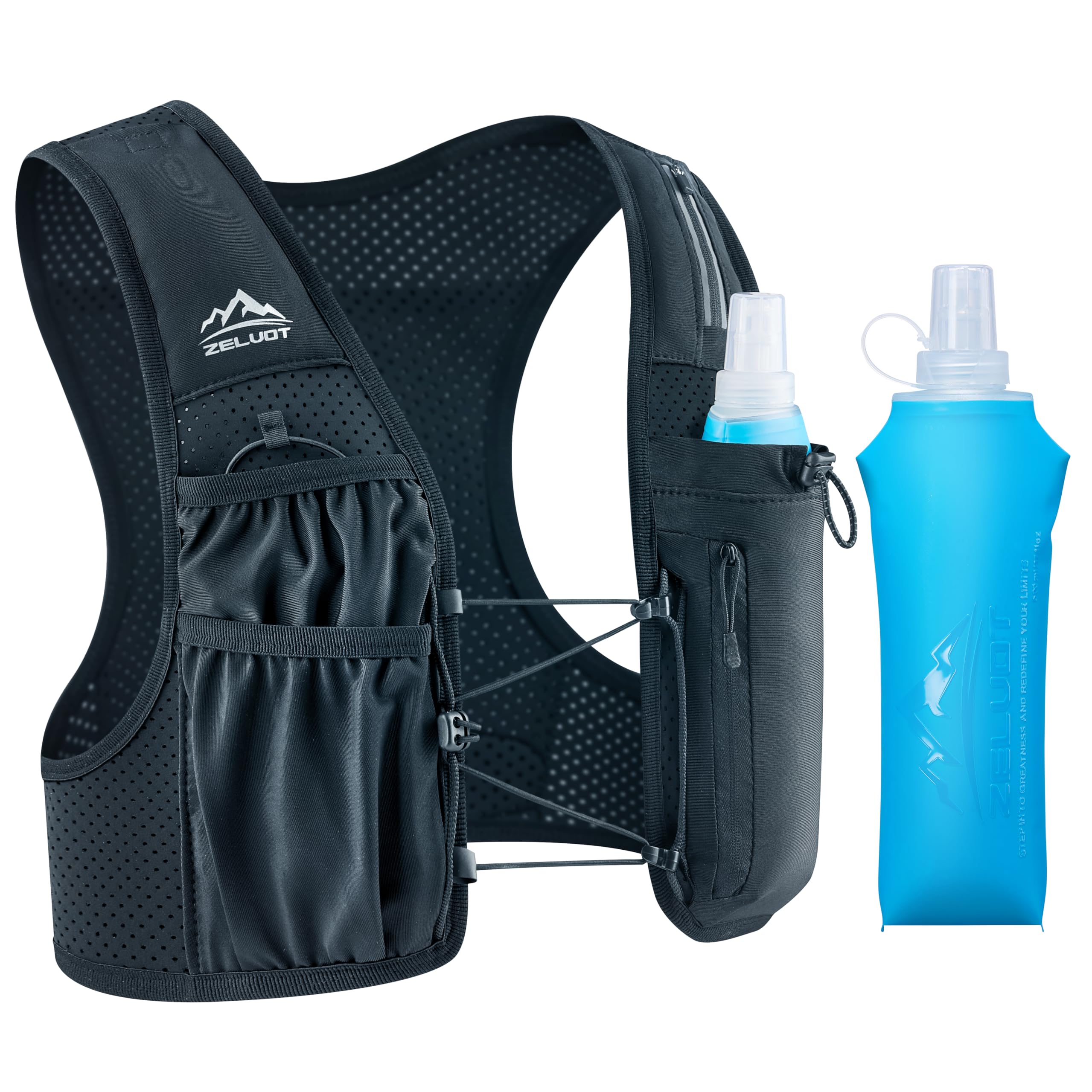
Nine pockets is a lot for a vest that carries half a liter of water, and that is the point. The Zelvot RUNV-3 treats storage as the main event: seven front pockets, two rear pockets, and a 500 ml soft flask.
The 500 ml soft flask sits in a dedicated front pocket, and the three chest straps and neoprene body are designed to keep the load close. For a half marathon or a long training run, the organization is the reason to pick it over the simpler SWIFTVEST. You can carry gels, a phone, keys, and a light layer without stopping to dig.
We recommend it for gear-heavy runs where you want everything within reach. The catch is the fit: this vest runs small, and the chest straps need to be snug without being tight. Measure before you order, especially if you are between sizes; if you want maximum pockets and do not mind a closer fit, it is the best-organized vest here.
Pros
- Nine pockets for gear
- 500 ml soft flask included
- Three adjustable chest straps
- Light 0.35 kg
Cons
- Only one flask included
We recommend the Zelvot for gear-heavy runs: nine pockets keep gels, phone, and a layer within reach, and three chest straps hold it close.
Best for Fast Short Runs
MOKURA Running Vest

Key Features
- Weight: 9.6 oz
- Pockets: 5
- Hydration: 500 ml soft flask
- Phone holder: Retractable lanyard
- Price: Midrange
At 9.6 ounces, the MOKURA vest is light enough that the 500 ml flask becomes the heaviest thing you notice. It has five pockets, a retractable phone lanyard, and three chest straps, and that is exactly the right kit for fast sessions where a bladder feels like overkill.
We like the phone holder more than we expected: the coiled lanyard keeps the screen accessible without unzipping a pocket mid-run, and the touchscreen-friendly holder means you can check a map without taking the phone out. The reflective accents are a bonus for early starts, and the neoprene body is designed to sit close without chafing.
The trade-off is water capacity. One 500 ml flask is fine for an hour or two, but it is not a long-day pack, and there is no bladder included. If your runs are short and you carry a phone, this is a comfortable, light choice; if you need more water, look at the KUYOU.
Pros
- 9.6 oz lightweight build
- Five pockets with retractable phone lanyard
- Three adjustable chest straps
- 500 ml soft flask included
Cons
We recommend the MOKURA for fast, short runs when you want a phone, one flask, and a few gels without a bladder.
Best for Vest-Only Setups
Azarxis 5L Running Vest

Key Features
- Volume: 5 L
- Weight: 8.11 oz
- Pockets: 7
- Hydration: Not included
- Price: Midrange
The Azarxis is a 5-liter vest with seven pockets and a 230-gram harness. It arrives without a bladder, which makes it a kit-building piece rather than a turnkey pack.
The mesh shoulder straps and adjustable waist and chest straps are designed to keep the load close, and the front pockets are placed for phone, keys, and gels. The 5-liter volume is enough for a shell and a few essentials without the bulk of a daypack.
It is not as light or as pocket-rich as the AONIJIE. If you already own a bladder, those compromises are easier to accept.
We recommend the Azarxis as a spare or a budget build for someone who already has a reservoir. It is a straightforward 5-liter shell, and that is the useful part: enough capacity for a short trail day without paying for hydration you do not need.
Pros
- 5 L capacity and seven pockets
- Light 230 g harness
- Adjustable waist and chest straps
- Hydration sold separately keeps it simple
Cons
- Large phones may not fit front pockets
We recommend the Azarxis as a spare 5-liter vest for runners who already own a bladder and want a light, simple shell.
How We Tested the Best Trail Running Packs
We started with roughly 40 packs from brands that show up at start lines and in finisher surveys, filtered by capacity — 5 to 12 liters, the range that covers a two-hour run or a supported 50K — and by price, staying in the range most weekend trail runners can justify. That left 12 vests and belt-and-vest hybrids, each weighed empty on a kitchen scale before it went outside.
Fit came first, because it decides everything else. I measured each tester’s chest at the sternum and matched it to the size chart instead of guessing from a T-shirt size, then adjusted the sternum straps and noted where the shoulder straps landed — high on the collarbone, or low enough to press on the ribs. We also checked whether we could fish a gel out of a front pocket at pace without unclipping anything.
For load, we packed the same kit into every pack: two 500-milliliter flasks filled to the line, a rain shell, a phone, keys, two gels, and a bar. Anything that didn’t fit inside got noted as strapped-on. Leakage surfaced in use rather than on spec sheets — we filled the flasks with water and a bright electrolyte mix, seated the caps, turned them upside down in the chest pockets, and squeezed, then checked seams for damp spots and stains.
Stability was judged on a nine-mile loop with a long, chattery descent, with a partner running behind to watch for sway. Quality and value we assessed over months: seam wear, zipper pulls, elastic that stayed snug or went slack after repeated washing, and how much pack you got for the money.
How to Choose a Trail Running Pack
The right trail pack disappears into your run; the wrong one reminds you it is there with every step.
Start With the Harness, Not the Pockets
A trail vest lives or dies by how it sits. Look for a running-specific harness with chest straps and, ideally, a link from the shoulders to the waist so the load stays close when you climb or descend. A pack that hangs off the shoulders will bounce no matter how light it is. Measure your chest and check the size chart; a close fit is the point, but you still need room to breathe. The Salomon’s 3-point attachment and the Zelvot’s three chest straps are the kind of adjustment that matters.
Choose Flasks or a Bladder
Soft flasks are easy to monitor, refill, and stash in front pockets; a bladder holds more water and keeps the weight on your back, but it is harder to see how much you have left. For short, fast runs, a 500 ml flask is often enough. For longer days, a 2-liter bladder buys range. Think about refill points too: flasks are quicker at a stream, while a bladder suits long stretches without water. The SWIFTVEST and Zelvot are flask-first; the KUYOU is the bladder-first budget pick.
Match Volume to the Run
A 5-liter vest is a sweet spot for trail runs where you carry a shell, phone, food, and a small first-aid kit. A larger all-day pack adds room for a warmer layer, more food, or technical gear, but it can feel like a daypack on short runs. Do not buy the biggest pack you can find; buy the one that fits the runs you actually do. The AONIJIE’s 5 liters and the Salomon’s all-day layout sit at different ends of that decision.
Check the Parts That Fail
Bladders, hoses, buckles, and zippers take more abuse than the fabric. Before a long run, fill the bladder, close the bite valve, and squeeze to check for leaks; then tug the chest straps and zipper pulls. A wide bladder opening is easier to fill and dry. Look for a warranty you can use, and do not assume a pack is waterproof just because the fabric is coated. The category’s weak point is not the idea of a running vest; it is the small parts that give out.
Frequently Asked Questions
Can I use a trail running vest for hiking?
Yes, for fast day hikes where your kit is small and you want it close to your body. A running vest is built to carry water, a shell, and snacks without swaying, but it will not swallow a bulky lunch or a full camera kit. If your pack list fills a daypack, use one.
How do I clean a hydration bladder and hose?
Rinse the bladder and hose with warm water and a little mild soap, then let both air-dry fully with the cap open and the hose hanging. A dedicated brush helps with the corners, and a little baking soda in a full bladder can lift stale tastes. Clean before the first use and after any run where you added a sports drink.
Are hydration vests allowed in trail races?
Most trail races allow them, but the race manual sets the rules: some require a minimum water capacity, a whistle, or a specific mandatory kit. Check the list before you pack, and carry water in the format you have trained with. A vest that bounces or a bladder you cannot refill will cost you more time than a missing gadget.
Final Verdict
The Salomon Agile 12 Set is our default because it carries a full day’s kit, includes two flasks, and keeps the load close with a proper running harness. If you want a complete pack for less, the KUYOU is the value pick; if you already own a bladder and want the lightest vest here, the AONIJIE is the one. Choose the SWIFTVEST for short race days when a phone and one flask are all you need.