This post contains affiliate links. We may earn a small commission when you buy through our links — at no extra cost to you.
A hydration pack is a compromise you wear on your back: every extra liter of water and every extra pocket buys you a longer day out, but it also buys weight, slosh, and a pack that shifts the moment the trail turns steep. The right one mostly disappears — you drink without breaking stride, your layers and snacks stay where you stashed them, and nothing bounces. The wrong one turns a six-mile hike into a slow march with a leaking cooler strapped to your spine.
I’ve carried everything from a bare-bones running vest to a 20-liter daypack, and the differences that actually matter rarely show up on the spec sheet. My team and I have spent the past six months hiking, bike commuting, and trail running with 12 hydration backpacks, paying close attention to how each one sat on different torso lengths and how much gear it swallowed before it started to feel like a lump. Fit beats capacity every time — a dialed-in 8-liter pack will out-carry a sloppy 15-liter one all day. The picks below run from short after-work loops to full days above treeline, and each one earned its place.


Best for Everyday Day Hikes
Vibrelli Hydration Backpack 2L
Key Features
- Pockets: 6
- Warranty: 5 years
- Pack weight: 14 oz
- Reservoir capacity: 2 liters
- Price: Budget
Fourteen ounces is the number that settled this one for us. That’s the empty pack, before two liters of water go in, and a pack that light behaves differently on a climb — it sits against your back, the straps stay where you set them, and nothing swings behind you on the way down. We expected to feel the load by the second hour and mostly didn’t.
What makes it our pick is that the low weight doesn’t cost you anything that matters. Two liters is the right reservoir for most half-day and full-day hikes, the bladder is BPA- and PVC-free and gave us no plastic taste, and the six pockets swallow a phone, keys, a couple of bars, and a shell. On a ride we had room left for a spare tube and tools.
The bite valve is the detail we kept coming back to. It locks with a quarter turn, so it doesn’t dribble down your shoulder when you’re not drinking, and the flow is fast enough that you’re not working a straw for ten seconds at a time. A five-year warranty on a pack this inexpensive is unusual, and it’s part of why we’re comfortable sending people to it.
Two things to check before you order. The harness runs narrow, and larger-framed hikers are the ones who find it tight, so compare the strap range against your chest measurement rather than assuming one size covers everyone. And two liters is the ceiling here: on a shadeless all-day climb in July, plan on moving up to a three-liter pack.
Pros
- Taste-free two-liter bladder
- 14 ounces empty, barely felt when full
- Bite valve locks and doesn’t drip
- Five-year warranty
Cons
- Harness runs narrow for larger frames
The one we point most people to: a taste-free two-liter bladder, a valve that locks instead of dripping, and a 14-ounce pack you forget you’re wearing.
Best for Long Day Hikes
N NEVO RHINO 18L
Key Features
- Warranty: 1 year
- Cargo capacity: 18 liters
- Reservoir capacity: 3 liters
- Bladder compartment: Thermal insulated
- Price: Midrange
Eighteen liters of cargo plus three liters of water is a full day on the mountain by anyone’s math, and this is the pack here that carries that much without turning into a duffel. The load sits low and even, the ventilated mesh across the back and straps keeps sweat from pooling, and the harness spans a genuinely wide range of torsos. On long, exposed days where layers and lunch ride along with the water, it’s the one we take.
The insulated bladder compartment and insulated hose are what separate it from the plain two-liter packs in this group. The spec sheet puts the cool-water window at up to five hours; what we can tell you is that a full bladder is still pleasant to drink in the afternoon, which is rarely true of an unprotected reservoir pressed against your back in the sun. The bladder itself is PEVA and BPA-free.
Where it gives ground is weight. Around 28 ounces empty is roughly double the running-oriented packs here, and three liters on top of that is a load you notice in the first mile. That’s what insulation and 18 liters of cargo cost, and for a day hike it’s the right trade — the people who resent it are moving fast with almost nothing on their backs, and they should look at the 12-liter version instead.
Pros
- Three-liter bladder plus 18 liters of cargo
- Insulated compartment and hose keep water cold
- Harness adjusts across a wide torso range
Cons
- Bottom seam can split under a full load
Load it with three liters and a full day of gear and it still rides evenly — this is the pack for long, exposed hikes where refills are far apart.
Best for Rainy Mountain Days
Teton Oasis Trailrunner 18L
Key Features
- Warranty: Limited lifetime
- Rain cover: Sewn-in
- Cargo capacity: 18 liters
- Reservoir capacity: 2 liters
- Price: Premium
Most packs here leave you to buy a rain cover or line the bag with a dry sack. The Teton sews one in, tucked into its own pocket, and adds weather-guarded zippers and a bungee lash that holds a shell or a helmet. On a day when the weather turns halfway up, that’s the difference between finishing the hike and squelching back to the car.
The rest is proper daypack thinking: 18 liters, six pockets, a butterfly opening that lays the main compartment flat, and high-density foam shoulder straps under breathable mesh. The two-liter bladder has a two-inch opening — wide enough for ice cubes and a brush — and a push-lock cushioned bite valve. At two pounds it isn’t the lightest thing here, but it carries its load comfortably.
It’s the priciest pack in this group, and what that buys is a pack that behaves like a serious daypack rather than a reservoir sleeve with straps. Add a limited lifetime warranty and 210-denier ripstop that shrugs off scrub and rock, and the money is easy to justify if you’re out often. For wet, changeable country, it earns the extra.
Pros
- Sewn-in rain cover and weather-guarded zippers
- Six pockets and a flat-opening main compartment
- Two-inch bladder opening takes ice
- Limited lifetime warranty
Cons
- Athletic cut doesn’t settle on smaller frames
- Waist strap is the wear point
When the forecast is wrong in the wrong direction, the sewn-in rain cover and six-pocket daypack layout are worth the higher price.
Best for Cold-Water Day Hikes
Miracol Insulated 15L
Key Features
- Warranty: 3 months
- Pack weight: 16 oz
- Cargo capacity: 15 liters
- Reservoir capacity: 2 liters
- Price: Midrange
Fifteen liters is the number to think hard about, because this pack is smaller in person than the capacity suggests: a shell, lunch, and the two-liter bladder fill it. What it does with that space is clever, though — waist-belt pockets on both sides that you can reach without stopping, and a mesh pocket up front for a hat or gloves.
Insulation is the reason to choose it. The sleeve and hose keep a filled bladder cold well into a warm afternoon, and on a shadeless climb that’s a real difference rather than a line on the packaging. At 16 ounces it’s light enough to forget you’re wearing it, the sternum strap and waist belt stop it bouncing, and the price sits in the middle of this group.
Two caveats. Taller hikers with long torsos can find the side pockets a stretch to reach, and if you’re carrying for two people you’ll run out of room fast — this is a personal daypack, not a family one. Otherwise it does exactly what a light daypack should, and it costs less than the insulated 18-liter pack without giving up the cold water.
Pros
- Insulated sleeve and hose keep water cold
- Waist-belt pockets on both sides
- 16 ounces and stable at a run
Cons
- Three-month warranty is the shortest here
Cold water is what you’re paying for, and this pack delivers it in a one-pound body with waist pockets you can reach on the move.
Best for Trail Running
N NEVO RHINO 12L
Key Features
- Warranty: 365 days
- Pack weight: 8.5 oz
- Cargo capacity: 12 liters
- Reservoir capacity: 2 liters
- Price: Budget
Same maker, half the pack. The 12-liter N NEVO RHINO trades the insulated compartment and the big cargo volume for 8.5 ounces and a vest-style harness, and for running and fast hiking we prefer it to its bigger sibling. Pouches on the shoulder straps put a phone or a gel within reach without breaking stride, and 12 liters holds a shell, a hat, and lunch.
Two liters is the right match for this body — a full bladder still leaves usable cargo space, which isn’t true of the bigger packs. Rinse the reservoir before your first trip, since a new bladder can carry a plastic smell through a fill or two, and dry it hanging with the cap off. The 365-day warranty is the longest of the budget packs here, and the PU-coated nylon shrugs off brush and drizzle.
Pros
- 8.5 ounces with a 12-liter body
- Vest straps with reachable pouches
- Two-liter bladder leaves usable cargo space
- 365-day warranty
Cons
- Chest buckles can be stiff to release
Runners should start here: 8.5 ounces, vest straps with pouches you can reach mid-stride, and just enough cargo for a fast day.
Best for Tactical Day Hikes
MARCHWAY Tactical 3L

Key Features
- Pockets: 2
- Material: 1000D nylon
- Pack weight: 2 lb
- Reservoir capacity: 3 liters
- Price: Midrange
Thousand-denier nylon with a grid of MOLLE webbing down the back is a different proposition from the thin ripstop the rest of this group uses. It shrugs off abrasion, it takes standard pouches, and it looks like a piece of kit rather than a stuff sack with straps. At two pounds it’s also the heaviest pack here, and that heft is the price of the fabric.
The three-liter bladder sits in its own compartment without shifting, and the two pockets will swallow a windbreaker, snacks, and a wallet. Standard MOLLE pouches attach wherever you want them, so you can build the pack around a hunt, a ride, or a day of trail work. It also fits most hydration reservoirs, which matters if you already own one you trust.
This is the pack for someone whose days are dirty and long — hunting, trail maintenance, a bike rack and a muddy tailgate — and who wants one bag that takes the abuse. Three liters is the largest bladder capacity here alongside the N NEVO RHINO 18L, and on a hot, waterless ridge that’s the difference between finishing the loop and turning around.
Pros
- 1000D nylon resists abrasion
- MOLLE webbing takes standard pouches
- Three-liter bladder for long dry days
Cons
- Hose seal is the leak point
- Strap anchors can tear under load
Built for hunting, trail work, and days that end muddy — 1000-denier nylon, MOLLE webbing, and three liters of water on your back.
Best for Short Hikes
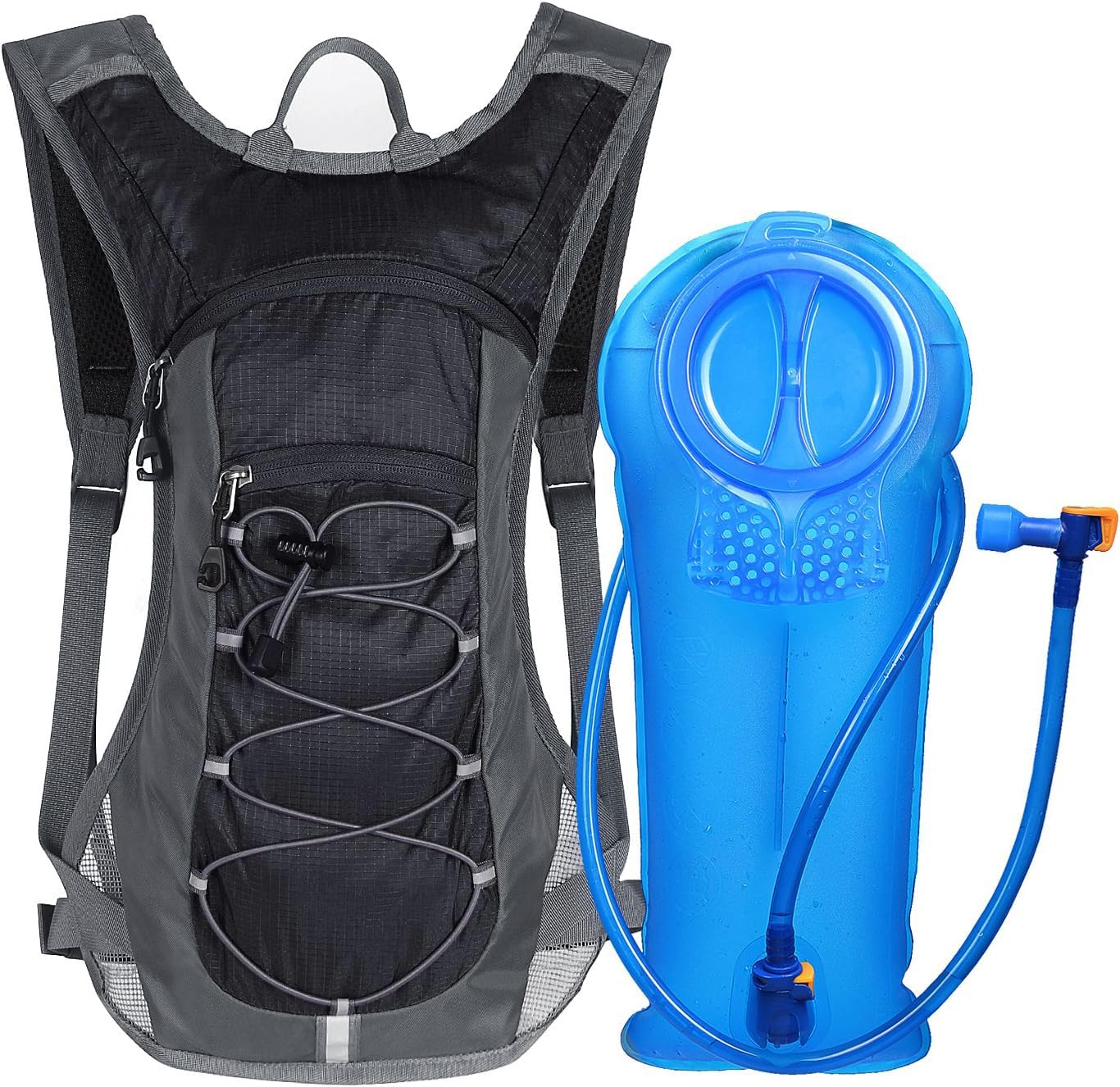
Unigear 2L Hydration Pack
Key Features
- Pockets: 1
- Returns: 30 days
- Pack weight: 1.1 lb
- Reservoir capacity: 2 liters
- Price: Budget
This is the least expensive pack in the group, and it’s also one of the lightest at 1.1 pounds with the bladder in it. That combination is the entire pitch, and for a lot of riders and runners it’s enough.
The two-liter bladder is BPA-free with a wide screw cap that takes ice, and the airflow design keeps the water reasonably cool rather than genuinely cold. The nylon is splash-resistant rather than waterproof, which matters if you’re out in real rain — put your phone in a bag inside it.
The harness adjusts at the shoulder, chest, and waist, and the chest range starts at 27 inches, so it fits teenagers through most adults. Padding on the straps and back means it doesn’t pound you on a ride, and at this weight you barely know it’s there on a climb.
If your outing is a fast hour on the bike, a short trail run, or a commute, this does the job for less money than anything else here, and the 30-day return window takes most of the risk out of trying it. It isn’t a daypack, though, and it isn’t built to be one.
Pros
- 1.1 pounds with the bladder included
- Wide screw cap takes ice cubes
- Least expensive pack here
Cons
- Only one small pocket
- Hose connection is a leak point
Cheapest and lightest here, and honest about it: water, keys, and a bar for a fast hour, nothing more.
How We Chose and Tested Hydration Backpacks
We started with a shortlist of more than 40 packs from brands whose harnesses and bladders we’d had good luck with before, then cut it down to 12 using reservoir volume, torso adjustability, weight, and price spread. We deliberately kept a mix of packs that ship with a bladder and packs that don’t, since that difference alone swings the real cost by $30 to $40. Testing ran six months, from late spring through early fall.
Most of those months were spent on Saturday-morning day hikes of six to nine miles, with weekday bike commutes and a handful of trail runs filling in the gaps. Every reservoir got filled, sealed, laid on its side in a warm car trunk overnight, and checked along the seams with a paper towel in the morning; we also noted which bite valves dribbled down our chins on a climb. To judge wear, we dragged packs across granite at rest stops, zipped and unzipped the main compartments past the point of comfort, and looked for fraying at the shoulder straps by month four.
For fit, each tester logged their torso length and whether they had to stop mid-climb to hike the shoulder straps back up, and whether the sternum strap stayed put or crept. We packed an identical load into every pack — rain shell, lunch, phone, keys, a small first-aid kit — and noted whether it still carried balanced or turned into a brick. We also timed how long it took to refill a bladder trailside and whether the hose clip let us drink without slowing down. The packs that scored best did all of it quietly.
How to Choose a Hydration Backpack
The bag matters less than the bladder and the harness — get those two right and the rest is pockets.
Start With the Reservoir, Not the Pack
Reservoir size sets the shape of everything else. Two liters is the practical default and covers most hikers for a solid half-day out; three liters is for long, exposed routes where a refill isn’t on the menu and you’d rather carry the weight than ration the water. Bigger isn’t automatically better, though — a three-liter bladder you only half fill sloshes on every step and adds weight you never needed.
Be honest about your longest regular day rather than the once-a-year epic. Our top pick carries two liters; the N NEVO RHINO 18L and the MARCHWAY carry three.
Cargo Volume Is Where the Real Differences Sit
Twelve liters is a fastpack: a shell, a hat, lunch, and no more. Fifteen to eighteen liters adds room for a first-aid kit, a filter, and the layer you’ll shed an hour in. The trap is that the reservoir sleeve lives inside that number — a full three-liter bladder can eat most of a small pack’s main compartment, so a pack rated at 15 liters with water aboard behaves more like 12.
Look at the pocket layout, not just the headline volume. Pockets you can reach without taking the pack off are worth more than a bigger compartment you have to stop and unzip.
The Bladder and Hose Decide Whether You’ll Actually Drink
A wide fill opening is the feature you’ll thank yourself for — two inches is enough to add ice and get a brush inside for cleaning. A bite valve with a shut-off lever stops the drip down your shoulder, and a hose that clamps or disconnects makes refilling at a tap far less fiddly.
Expect the failure points to be the cap seal and the junction where the hose meets the bladder, not the bag itself. Insulation on the sleeve and hose slows heat transfer; it doesn’t chill water, so start cold and add ice.
Fit Is What Makes a Pack Disappear
Sizing isn’t clothing sizing. What matters is the strap range: a sternum strap that adjusts vertically as well as horizontally, a waist belt that puts weight on your hips rather than your shoulders, and shoulder straps that still sit flat when the bladder is full. Vest-style harnesses with chest pouches are the most comfortable option for running because you can drink and eat without stopping.
Several packs in this group run narrow through the shoulders, so measure your chest before you order and treat ‘one size’ as a starting point rather than a promise.
Weather Protection and the Warranty
A sewn-in rain cover earns its money if you hike where the weather turns; it weighs almost nothing and it’s the difference between a dry layer and a soaked one. An insulated bladder compartment and hose are the other upgrade that pays off, particularly on exposed summer climbs.
Then check the warranty, because it varies wildly here — from a few months on one pack to a limited lifetime on another. It’s a reasonable proxy for how long the maker expects the seams and straps to hold.
Frequently Asked Questions
Do I need a hydration pack if I already carry a water bottle?
If your outings run a couple of hours and your hands are free, a bottle is fine. The pack earns its place once you’re drinking more than about a liter on the move — on a climb, in heat, or on a bike where reaching for a bottle means letting go of the bar.
The other half of it is frequency. Sipping from a hose little and often beats stopping to unscrew a cap, so most people drink more with one than they do with a bottle in a side pocket.
How do I get the plastic taste out of a new bladder?
Rinse the bladder and hose with warm water and a drop of mild dish soap, then soak for half an hour with a tablespoon of baking soda in a liter of water and rinse until the water runs clean. Repeat once or twice before a big trip rather than on the morning of it.
Between uses, drain the hose and hang the bladder upside down with the cap off. Water left sitting in a closed reservoir is what turns a faint plastic note into a permanent one.
How much does a full hydration pack weigh?
Water is the bulk of it: a liter weighs about 2.2 pounds, so a full two-liter bladder adds roughly 4.4 pounds and a three-liter one about 6.6. Add the pack itself — 8.5 ounces at the lightest here, two pounds at the heaviest — and a loaded daypack lands between about five and nine pounds before you put anything else in it.
That’s the number to weigh up when you’re choosing between a fastpack and an 18-liter daypack. Carrying three liters only pays off if the day is long enough to drink them.
Final Verdict
For most hikers, the Vibrelli is the pack to buy: two liters, a bladder that tastes like nothing, a valve that locks instead of dripping, and a harness light enough to forget. It gets the boring parts right and doesn’t charge much for them.
If your days run longer and hotter, the N NEVO RHINO 18L’s insulated three-liter bladder and 18 liters of cargo are worth the extra weight on your back. And if your hiking happens in wet, changeable country, the Teton’s sewn-in rain cover is the feature you’ll be glad of at three in the afternoon on a ridge.