This post contains affiliate links. We may earn a small commission when you buy through our links — at no extra cost to you.
A hydration bladder is the easiest way to drink on a hike — and, for plenty of people, the reason their pack smells like a pond by August. You fill it, seal it, drink without breaking stride, and then get home to the real work: rinsing the corners, coaxing the hose dry, and wondering whether that faint plastic note in the water is you or the bladder. The right one turns all of that into a two-minute chore instead of a losing battle.
I’ve carried bladders on day hikes and overnighters for years, and my team has spent the past six months rotating 12 of them through packs and kitchen sinks. What emerged surprised me: capacity and price barely predicted which ones we reached for. What separated them was the boring stuff — a seam that held, an opening wide enough to fill from a shallow stream, a cap that sealed on the first try with cold hands, a hose that actually dried overnight. Everything below earned its place on a real trail, unglamorous as that sounds.


Best for Long Days Out
MARCHWAY TPU Bladder 3L
Key Features
- Tube: Insulated, quick-release
- Weight: 9.6 oz
- Capacity: 3 liters
- Fill opening: 3.35-inch inner diameter
- Price: Midrange
A 3.35-inch opening is the first thing we noticed and the reason the MARCHWAY became our default. Ice goes in straight from a scoop, a bottle brush reaches the corners, and a hand comes back out. Three liters is the other half of the case — the largest capacity in this guide — and it is what makes this the bladder for full days and refills from a tap or a stream rather than a bottle. The film is 0.4mm TPU, and on durability it is the strongest of the bladders we covered.
The tube is the part we keep coming back to. It detaches at the bladder through a coupling that shuts itself off, so you can pull the line at a tap and fill without water syphoning out over your boots, and the insulation keeps the first mouthful cool instead of sun-warm on an exposed ridge. The bite valve rotates a full turn, which lets the hose come over either shoulder without a twist in it. Empty, it weighs 9.6 ounces and lies flat in a pack.
The fill cap is the part to look after. The seal relies on an O-ring sitting flat, and a ring that is gritty, kinked, or cross-threaded is how a pack ends up wet; MARCHWAY ships two spares, which tells you they know where the wear happens. Seat it, don’t overtighten, and check it before a long day. Taste is the other thing to get ahead of — flush it once before the first trip and you stop noticing it.
What settles it for us is how many small things have been thought through: the spares, the year of warranty, the upper hook and lower handle for hanging it to dry, the shutoff that lets you pull the tube one-handed. None of it is dramatic. All of it is the difference between a bladder you tolerate and one you forget about.
Pros
- 3.35-inch opening takes ice and a brush
- Insulated quick-release tube with auto shutoff
- Largest capacity here at three liters
- Two spare O-rings and a one-year warranty
Cons
- More water than a short hike needs
Our pick for most camping trips: three liters, an opening wide enough for ice and a brush, and an insulated tube that detaches in a second.
Best for Day Hikes
CHERAINTI Hydration Bladder 2L
Key Features
- Weight: 9.76 oz
- Capacity: 2 liters
- Dimensions: 6.8"W x 14.2"H
- Temperature range: 20 to 50 °C
- Price: Budget
Two liters is where the CHERAINTI stops, and for a day hike that is usually the right place to stop. It is a 2-liter bladder, 14.2 inches tall and 6.8 inches wide, with a wide fill opening and a bite valve that has a proper on/off lever rather than a friction fit. The tube is rated from 20 to 50 degrees Celsius, so a frosty morning does not turn it stiff enough to fight you.
As the value pick of this group, it does the boring things well. The bite valve flows generously and the lever is easy to find without looking, which is what you want when the alternative is stopping to take your pack off. The hose is sturdier than the thin tubing that kinks into a dead line across your chest on some bladders. For a first reservoir, or a second one that lives in a daypack, this is the sensible spend.
Drying is the chore. The wide opening gets air into the bag, but the hose wants hanging somewhere with airflow — over a shower head, from a hook in the garage — or it stays damp and turns stale between trips. A warm rinse and a brush through the tube after anything but water keeps it sweet, and it is worth the two minutes.
Pros
- Bite valve with a real on/off lever
- Wide opening makes filling and rinsing quick
- Hose resists kinking
- Rated for 20 to 50 °C weather
Cons
- Seams and film can fail under hard use
We recommend it as a first bladder or a daypack spare: two liters, a bite valve that behaves, and a price that makes a second one easy to justify.
Best for Camelbak Pack Owners
CamelBak Crux Reservoir 2L
Key Features
- Capacity: 2 liters (70 oz)
- Warranty: 365 days
- Bite valve: Self-sealing with on/off lever
- Dimensions: 3"W x 11"H
- Price: Premium
The Crux valve is the reason people stay with CamelBak packs. It seals itself after every sip, so nothing drips down your shirt between drinks, and the lever on the tube shuts the line with one hand while you are shouldering a pack. Small things, until you have used them — after which a bare bite valve feels like a step backwards.
It is also the shortest bladder here: 11 inches tall against roughly 14 for most of the others, which is the difference between sliding into a small hydration sleeve and not going in at all. The fill handle is shaped to be gripped between your knees while you work the cap, and the cap opens and closes without the cross-threading that turns a lid into a leak. CamelBak covers it for 365 days.
We rate the valve the best here and the value the weakest. Two liters is all you get, at the highest price in this guide, where the MARCHWAY adds a third liter, an insulated quick-release tube, and spare seals for less money.
Where the Crux earns its keep is fit. That 11-inch body goes into short sleeves and small packs that turn a 14-inch bladder into a wrestling match, and it is interchangeable with the CamelBak packs people already own. If either of those describes you, buy it. If neither does, the capacity math is hard to ignore.
Pros
- Self-sealing valve with one-hand shutoff
- 11-inch height fits shallow sleeves
- Easy-fill handle and cross-thread-resistant cap
- 365-day manufacturer warranty
Cons
- Cap gasket needs a clean, dry seat
If your pack is a CamelBak, or you simply want the best bite valve here, we think the Crux is worth the premium.
Best for Two Hikers
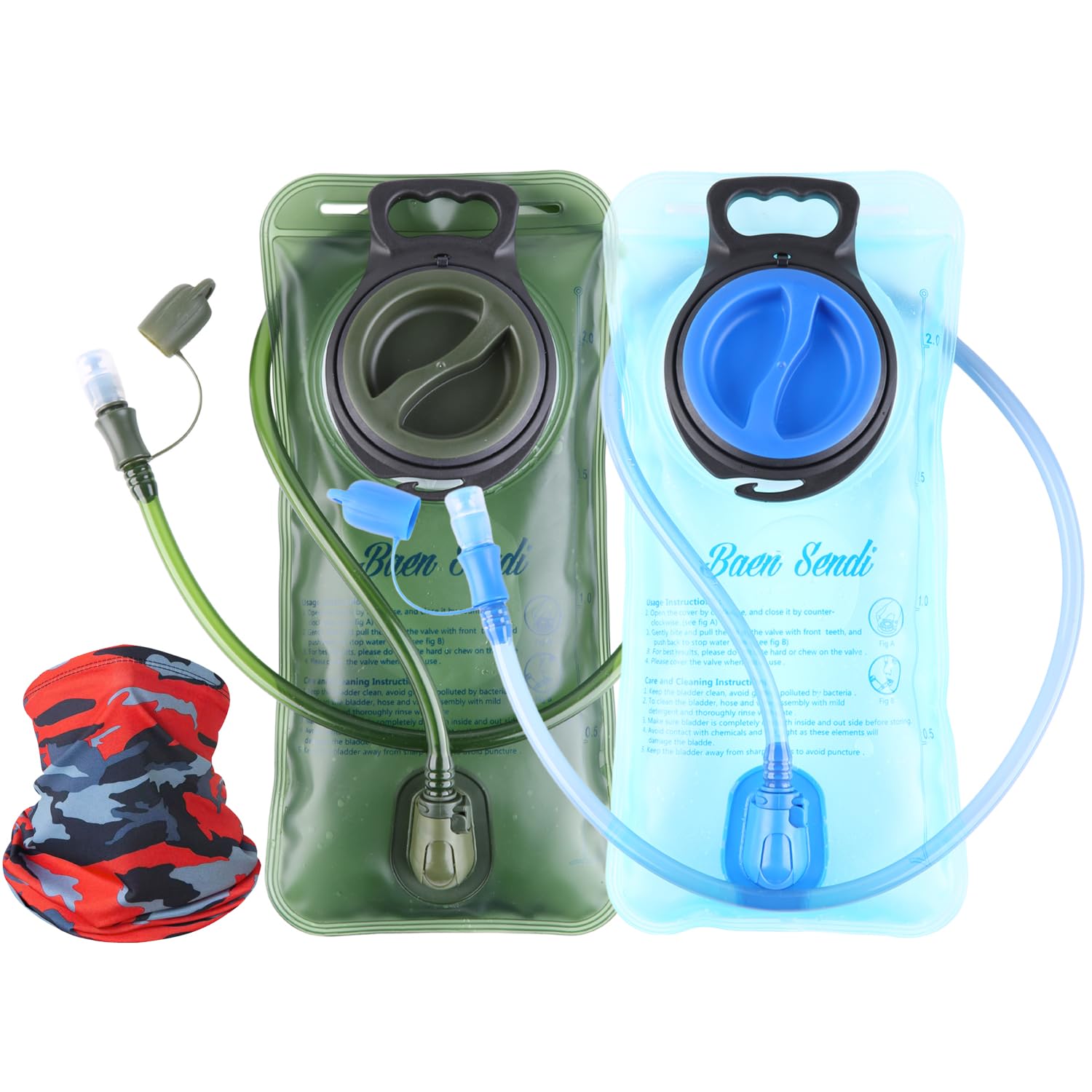
Baen Sendi 2-Pack 2L
Key Features
- Capacity: 2 liters each
- Dimensions: 6.69"W x 14.17"H
- Set weight: 13.6 oz
- Bladders per set: 2
- Price: Midrange
Two bladders in one order is the whole reason to buy the Baen Sendi set, and for a household it is the best idea in this guide. You get a blue 2-liter and an army-green one, so two people heading out — or two kids off to camp — each have their own without a second purchase. We did not expect to care about the colour coding; we do now that it settles whose bladder is whose and makes it obvious which one came home dirty.
Each one holds 2 liters, stands 14.17 inches tall and 6.69 inches wide, and the pair together weighs 13.6 ounces. The tube detaches at a valve that shuts itself, so filling at a tap does not mean draining the line over your boots, and the wide opening takes a bottle brush. The bite valve is the standard bite-and-sip type with an on/off collar, and it fits the sleeves and hose ports of ordinary hiking packs.
The joint where the hose leaves the bladder is where these seep if they are going to, so seat it firmly and check it before you load the pack. Drying takes a couple of days once tubing is involved, and that is where the pair earns its keep: one hangs over the shower while the other goes in the pack.
Pros
- Two bladders for one purchase
- Quick-release tube with a shutoff valve
- Colour coding ends mix-ups
- One can dry while the other is used
Cons
- Cap closure can work loose in a pack
We buy this one when two people need bladders: a pair of color-coded two-liters for about what a single mid-range bladder costs.
Best for Low-Profile Pack Fit
Unigear Hydration Bladder 2L

Key Features
- Capacity: 2 liters
- Material: TPU
- Dimensions: 5.91"W x 14.17"H
- Sizes available: 1.5, 2, 2.5, 3 liters
- Price: Budget
Where the MARCHWAY uses three liters to cover a long day, the Unigear goes the other way: a low-profile 2-liter shape built to sit lower and wider in the pack so the water moves less when you do. That is the right instinct for running and fast hiking, where a sloshing load throws off your rhythm more than the extra liter is worth.
What we like is how much bladder you get for the money. The film is TPU, the fill opening is wide enough for ice and for air to get in when it is drying, and the bite valve is a soft one with a shutoff. The sizing is the real advantage: 1.5, 2, 2.5, or 3 liters, so you can match the sleeve you own instead of buying a pack to fit a bladder.
The 180-day warranty is the shortest in this guide, and hand washing is the only option — normal for a reservoir, but worth knowing if your gear sees hard use. Set against a budget price and a shape that suits fast movement, that is a fair trade for a second bladder or a runner’s pack.
Pros
- Low-profile shape limits sloshing
- Four sizes from 1.5 to 3 liters
- TPU film at a budget price
- Wide opening for ice and drying
Cons
- Shortest warranty here at 180 days
We like the low-profile shape for running and fast hiking, and the four-size range makes it easy to fit the pack you already own.
Best for Cheap Spare Bladder
KUREIDA Hydration Bladder 2L

Key Features
- Weight: 8.1 oz
- Capacity: 2 liters
- Material: EVA
- Dimensions: 6.8" x 6.8" x 14.2"
- Price: Budget
The cheapest bladder in this guide, and the savings show up in two places rather than everywhere. You still get a 2-liter EVA reservoir with a wide fill opening, a soft bite valve with a shutoff collar, and a printed graphic that makes it easy to spot in a pile of gear. What you do not get is a shape that fills easily past the halfway mark.
At 8.1 ounces it is the lightest two-liter here, and it packs down small enough to live in a daypack as a spare. The wide opening does its job — rinsing it out takes a minute, and the bag dries faster than the tube does. It also arrives with a sport cool towel, a small thing that is genuinely useful for a bladder that sits in a hot car between trips.
For a kid’s pack, a festival, or a spare that stays in the boot, the money is well spent and the low weight is a real plus. For a week in the backcountry, no: the graphic and the film are the parts that age first, and a pinhole on day three of a five-day trip is a poor trade for the savings. Buy it to keep a second one loaded, not to be the only one you own.
Pros
- Lightest two-liter in this guide
- Wide opening rinses out fast
- Low cost makes a spare easy
Cons
- Awkward to fill past about 1.5 liters
- Printed graphic wears with use
We treat it as a second bladder, not an only one — light, inexpensive, and fine for a kid’s pack or a festival weekend.
How We Tested Camping Water Bladders
We started with more than 30 bladders from brands campers actually buy, then cut anything with a proprietary hose fitting, a capacity outside the two-to-three-liter range most packs are built around, or no way to buy a replacement bite valve. That left 12, used over six months on day hikes, two overnights, and plenty of kitchen-sink mornings.
Filling came first: we filled each one from a wide kitchen tap, a narrow bottle filler, and a shallow stream with a filter, noting how much water we could scoop and how much landed on our shoes. Then we sealed them bare-handed and again in cold, wet gloves, counting the tries it took to seat the cap without cross-threading. For taste, each got the same tap water, sat in a warm car overnight, and was compared to a fresh glass — two were undrinkable by morning, most were neutral.
Leaks got their own afternoon: filled to the max line, sealed, laid on a dry towel, compressed under a loaded pack, then shaken upside down while we checked seams, cap, and hose junction for wet spots. Durability unfolded across the six months — bladders rode beside tent poles and cook kits, were dropped full on rock, and folded harder than they deserved, while we watched welds and closures for the first sign of wear. Fit we judged on the move: whether a full bladder slumped in a daypack, pressed into a hip belt, or left enough hose to turn your head without yanking the valve sideways.
Cleaning decided most of our rankings. After each trip we washed every bladder with mild soap and a brush, timed how long it took to reach the far corners, then hung it to dry and checked the hose at 12, 24, and 48 hours. Anything still beaded with moisture on day two isn’t coming on a third trip.
How to Choose a Camping Water Bladder
A bladder only earns its place if it fits the sleeve you already own, seals at the two joints that fail, and dries out between trips — so start with the pack, not the liter count.
Start With the Sleeve, Then the Liters
Two liters covers a half day of walking for most people; three liters covers a full day and spares you a refill at a stream. But liters tell you nothing about whether the thing will go into your pack. Height is the number that decides it: most two-liter bladders here run about 14 inches tall, and a shallow sleeve will bulge or refuse them outright. The CamelBak Crux is the exception at 11 inches.
Measure the sleeve’s height, then the distance from the top of the sleeve to where the hose leaves the pack. Under about 13 inches, shop by height rather than capacity and take a two-liter. With a tall sleeve and long days, the three-liter MARCHWAY is the roomier, more comfortable choice.
The Two Places a Bladder Leaks
Nearly every failure that matters starts at one of two joints: the fill cap and the connection where the tube meets the bladder. Both depend on a gasket or O-ring sitting flat, clean, and dry. Grit, a kinked ring, or a cap cranked down too hard will do more damage than any amount of trail use, and a quick-release coupling with an automatic shutoff removes the usual reason people unseat a tube in the first place.
Fill it at home over a dry paper towel, cap it, and squeeze. If the towel stays dry, you have a good seal; if it doesn’t, reseat the ring before you trust it in a pack. MARCHWAY ships two spare O-rings, and that is the part to keep in your repair kit.
Valves and Tubes You Can Work With Gloves On
A bite valve should deliver water on a bite and seal when you let go, and the on/off lever should be findable by feel. A valve that needs two hands is a valve you stop using, so practice the lever with gloves on before a cold morning teaches you the hard way. A rotating valve lets the hose come over either shoulder without a twist in the line.
Two extras are worth paying for depending on your season. Insulation around the tube keeps the first mouthful cool rather than sun-warm on an exposed ridge. A quick-release coupling lets you top up at a tap without hauling the whole bladder out of the sleeve.
Drying Is the Whole Maintenance Job
Every bladder here is hand wash only: warm water, a little mild soap, a bottle brush through the bag, and a rinse until the water runs clear. The part people skip is the tube, and the tube is what turns a reservoir sour. Hang the bladder from its handle with the cap off and let gravity and airflow do the work for a day or two.
Store it open and dry, never sealed and damp. A rolled paper towel pushed through the hose wicks out the last of the moisture, and a dedicated hanger pays for itself in the first month.
Frequently Asked Questions
Is a hydration bladder better than a water bottle for camping?
For drinking while you walk, yes. The tube is right there without unshouldering the pack, so you sip more often and drink more than you would from a bottle you have to stop and dig out. At camp it reverses: a bottle is easier for cooking, measuring, and pouring.
Most backpackers carry both — a bladder for the trail and a one-liter bottle for the evening.
Can I put electrolyte mix or sports drink in a bladder?
Once in a while, yes. Sugar and salts sitting in a tube are what turn a reservoir sour, so rinse it with warm water the same day and hang it to dry. If you won’t be able to clean it that night, keep the mix in a bottle and plain water in the bladder.
How do I get rid of the plastic taste in a new bladder?
Fill it with warm water and a tablespoon of baking soda, leave it an hour, then rinse twice and hang it to dry. One or two rounds usually settles it. Do that at home before your first trip rather than discovering it at the first stream crossing.
Final Verdict
For the camping trips most people actually take — a full day out, a refill at a tap or a stream, a pack that has to be shouldered again — the MARCHWAY is the bladder we send people to. The 3.35-inch opening does more for daily life than any valve, the insulated quick-release tube means filling never involves wrestling a full bladder back into a sleeve, and the spare O-rings and one-year warranty tell you where the wear happens.
Buy the CamelBak Crux instead if your sleeve is shallow or your pack is already a CamelBak; the valve really is better, and 11 inches fits where 14 does not. The Baen Sendi pair is the sensible purchase for two people. And if the budget decides it for a daypack spare, the CHERAINTI gets the fundamentals right.