This post contains affiliate links. We may earn a small commission when you buy through our links — at no extra cost to you.
There’s a particular disappointment in reaching for a sip eight miles into a long run and getting a mouthful of warm, plastic-tasting water — or feeling it trickle down your spine because the cap didn’t seat right. A hydration bladder should be the least interesting piece of gear you own: it holds water, it sits flat against your back, and it lets you drink without breaking stride. What separates a good one from a bad one lives in the details — the closure, the bite valve, the seam welds, and how it all behaves after a dozen washes. Get those right and you stop thinking about it.
I’ve run with reservoirs for years, and over the past six months my team and I put 12 of them through marathon-training long runs, rocky trail loops, and a lot of treadmill miles. The ones worth carrying all share a wide opening you can get a hand into, a closure that clicks shut with authority, and tubing that doesn’t kink when you jam it into a vest. The picks below are the ones we kept reaching for.


Best for Running Vests
Nathan 2L Hydration Bladder
Key Features
- Valve: High-flow bite valve
- Weight: 5.28 oz
- Capacity: 2 liters
- Compatibility: 2L running-vest fit
- Price: Premium
At 5.28 ounces, the Nathan 2L is the lightest bladder in this group, and that is the first reason it earns our top pick for running. The 2L reservoir is built around running vests, with a quick-release hose and a high-flow bite valve rather than the wide, pack-first shape of a general-purpose bladder. For a runner who wants one reservoir for a vest and does not want to feel it before it is full, this is the one we recommend first.
The 2L capacity is the sensible middle for most runs: enough for a couple of hours, not so much that the vest feels loaded before you start. We liked the quick-release hose for filling and cleaning, and the bite valve is easy to drink from without breaking stride. The low weight matters most when you are holding the empty bladder open at a tap; a full 2L is heavy whatever the empty weight says.
The caveat is the seal and the film. Pinholes or a cracked bite valve can develop, and the lower seam is the place to inspect before a race. Run it with plain water over a sink before a long effort, and carry a spare bite valve or a bottle if you are going somewhere remote. That is the cost of the light build; for most training runs, the fit and low weight are worth it.
Pros
- Lightest bladder in this group
- Running-vest compatibility, including Nathan vests
- Quick-release hose simplifies filling and cleaning
- High-flow bite valve for one-handed drinking
Cons
- Pinholes or bite-valve cracks can develop
- Premium price for a 2L reservoir
We recommend the Nathan 2L for runners who want a vest-ready bladder that adds little weight and refills easily on the move.
Best for Pack Replacements
CamelBak Crux 2L
Key Features
- Valve: Self-sealing bite valve
- Weight: 7.41 oz
- Capacity: 2 liters
- Fill Handle: Ergonomic fill handle
- Price: Midrange
The Crux is the bladder we reach for when a familiar pack bladder has died and we do not want to relearn the routine. Its ergonomic fill handle gives you something to hold when the bladder is full and slippery, and the high-flow bite valve plus on/off lever make drinking a one-handed job. At 0.21 kg, it is a solid, familiar build.
We think it is the most straightforward replacement in this set for a standard hydration pack: the 2L size fits the same sleeve, the hose is easy to route, and the fill handle is a genuine help at a tap. The self-sealing valve stops drips between sips, which matters more on a run than it sounds.
The hose is long enough to route over a shoulder, and the on/off lever is easy to find by feel. We appreciate that the valve can be shut off for transport, so a wet pack does not turn into a puddle. The 2L capacity is also the right default for most runners who are not going out for a full day.
Pros
- Ergonomic fill handle helps at taps
- High-flow valve with one-handed on/off lever
- 2L size fits standard pack sleeves
Cons
- Cap can be fussy to seat
We keep the Crux on the shortlist for anyone replacing a pack bladder: its fill handle and high-flow valve make routine refills less fiddly.
Best for Hot-Weather Runs
Water Buffalo Oasis 2L
Key Features
- Hose: Insulated hose
- Weight: 10.6 oz
- Opening: Wide top-fill opening
- Capacity: 2 liters
- Price: Midrange
The Water Buffalo Oasis is the one we choose when heat is the problem. Its insulated hose is designed to keep the water in the tube from turning hot between sips, and the open-top fill makes it easy to add ice without wrestling a narrow cap. The 2L capacity is right for most runs, and the baffle helps the bladder hold a slimmer shape in the vest.
The 0.3 kg weight is the trade-off. This is not the lightest 2L bladder here, and you feel that most when the vest is fully loaded. What you get for it is easier filling and a tube that stays cooler in direct sun. The quick-connect hose is easy to detach for cleaning, and the bite valve has a cap to keep grit off.
The open top is the feature we kept coming back to: it gives you room for ice and a brush, and it is far less fiddly than a small screw cap when you are refilling at a tap. The quick-connect hose and insulated tube are the other practical touches. For a summer run where you will be out for a couple of hours, the Oasis makes the heat easier to manage.
Pros
- Insulated hose keeps water cooler
- Open-top fill makes ice and cleaning easy
- Quick-connect hose detaches for cleaning
- Baffle keeps a slimmer vest profile
Cons
- Top closure can be hard to open and close
We reach for the Water Buffalo when heat is the problem; its insulated hose and open-top fill make long, hot runs easier to manage.
Best for Long-Distance Runs
MARCHWAY TPU 3L
Key Features
- Hose: Quick-release insulated tube
- Weight: 9.6 oz
- Opening: 3.35-inch inner diameter
- Capacity: 3 liters
- Price: Budget
The MARCHWAY is the bladder we pack for a long day when we want more than 2L without paying a premium for it. The 3L reservoir uses 0.4 mm TPU, has an insulated quick-release hose, and opens through a 3.35-inch mouth that takes ice and a brush. The 360-degree bite valve is easy to find without looking down.
We think it is the best long-run value in this group. You get 3L, an insulated hose, and a wide opening for sensible money, and the 9.6-ounce empty weight is reasonable for the capacity. The quick-release fitting has an auto-shutoff valve, so detaching the hose does not drain the bladder; that is a small thing that makes cleaning much less annoying.
Drying takes patience even with the wide opening, and the hose can kink if you route it with a sharp bend. Check the fill lid and hose joint before a long run; MARCHWAY includes two spare O-rings. The wide opening still makes the rinse quicker than a narrow-mouth bladder, and for a full day out, the capacity is worth the extra care.
Pros
- 3L capacity for long runs
- Insulated quick-release hose
- Wide 3.35-inch opening takes ice
- Spare O-rings included
Cons
- 3L body overwhelms small running vests
We choose the MARCHWAY when the day is long and the budget is tight; it gives 3L, an insulated hose, and a wide opening for sensible money.
Best for Large Running Vests
HydraPak Force 3L
Key Features
- Weight: 6.46 oz
- Profile: Dual Shape-Loc baffles
- Capacity: 3 liters
- Warranty: Beyond Lifetime Guarantee
- Price: Premium
The HydraPak Force is the premium option here, and it looks it: a 3L reservoir with dual Shape-Loc baffles, an insulated tube, and a universal hanger that is meant to fit clips, hooks, and loops across a range of vests and packs. At 183 g, it is the lightest 3L bladder in this group.
The baffles are the detail that matters. They flatten the bladder so it sits closer to your back and takes up less depth in a running vest, which is exactly what you want when the load is sloshing. The insulated tube, dust cover, and one-handed bite valve are all well-considered touches, and the welded TPU build feels field-ready.
We recommend the Force for runners with a large vest and a long day who want a low-profile 3L reservoir and will pay for the construction. It is overkill for a 45-minute run, but for an ultra or a full day in the hills, the shape and capacity make a strong case.
The slide-seal can be stiff when new, so work it open and closed a few times before race day. The warranty is generous, and the materials feel a step above the budget bladders here. If you do not need 3L or a low-profile fit, the cheaper picks make more sense.
Pros
- Low-profile dual baffles reduce slosh
- Lightest 3L bladder here at 183 g
- Insulated tube and universal hanger
- Lifetime guarantee
Cons
- Premium price
We recommend the HydraPak Force for runners with a large vest who want a low-profile 3L reservoir and will pay for the build.
Best for Budget Setups
CHERAINTI 2L
Key Features
- Weight: 9.76 oz
- Opening: Large fill opening
- Capacity: 2 liters
- Dimensions: 6.8"W x 14.2"H
- Price: Budget
The CHERAINTI gets the basics right for a budget bladder: a 2L reservoir, a genuinely large fill opening, and a bite valve with an on/off switch. The opening is the standout. It is wide enough to get a hand or a bottle brush inside, which makes filling and rinsing easier than the narrow caps on some cheap reservoirs.
The shape is the thing to check before you buy. At 14.2 inches tall and 6.8 inches wide, it is a long, narrow bladder, so it suits a deep vest sleeve better than a short one. The 9.76-ounce weight is on the heavy side for a 2L, but the wide opening and simple valve keep it easy to live with.
We treated it as a training-run and backup bladder rather than a race-day primary. That is not a knock on the design; it is a reflection of the capacity and the budget build. If you want a cheap second bladder to leave in a pack or rotate through the wash, it does that job without fuss.
We recommend the CHERAINTI to budget-minded runners for short and steady runs. The large opening makes filling and rinsing simple, and the 2L size is right for an hour or two. It is a sensible spare or training bladder, not the one we count on for a race.
Pros
- Very wide opening for filling and cleaning
- 2L capacity suits short and steady runs
- On/off bite valve controls flow
Cons
- Seams and film can leak or puncture
- Plastic taste can linger
We point budget-minded runners to the CHERAINTI: its wide opening makes filling and rinsing simple, and the 2L size suits short and steady runs.
Best for Spare Bladder Rotation
Baen Sendi 2L (2-Pack)
Key Features
- Tube: Quick-release with shutoff
- Capacity: 2 liters each
- Pack Size: 2 bladders
- Set Weight: 13.6 oz
- Price: Budget
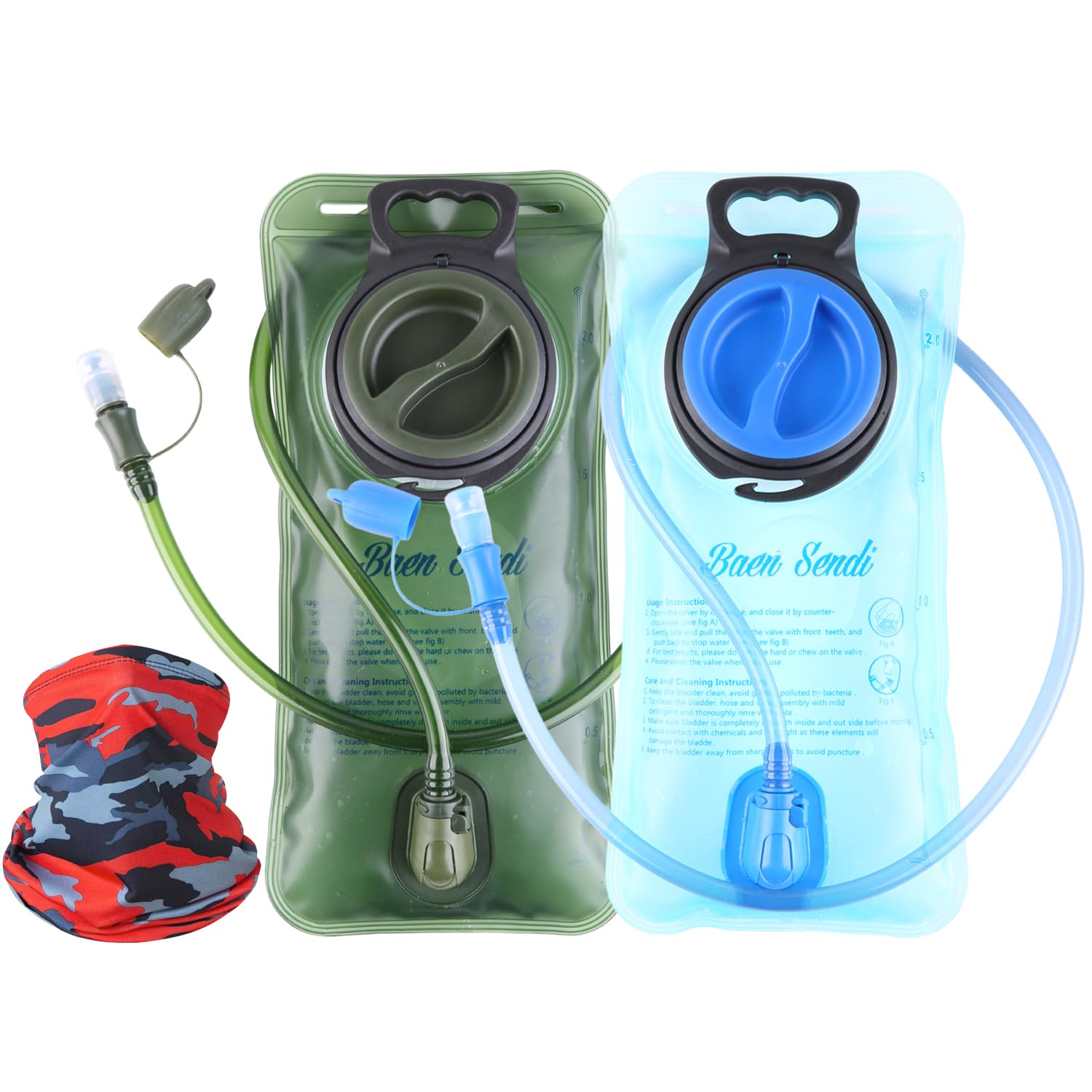
The Baen Sendi package is two 2L bladders, one blue and one army green, each with a quick-release tube and an auto-shutoff valve. The pitch is simple: keep one in the vest and one clean or drying, so you are never waiting on a bladder to be ready for the next run.
The set is listed at 13.6 ounces, and the two bladders share the same large opening and bite-valve design. The quick-release hose is the feature we appreciate most, because it makes the bladder easier to empty, rinse, and hang to dry. The auto-shutoff valve means you can detach the tube without water running out of the bladder.
We recommend the two-pack for runners who want a spare bladder ready to go. It is not the lightest option for a race vest, and the 2L size is not for all-day adventures, but as a training rotation it makes a lot of sense. Having a dry bladder waiting is a small convenience that grows on you.
Pros
- Two 2L bladders in one set
- Quick-release tubes with auto-shutoff
- Large opening for filling and cleaning
Cons
- Cap can loosen too easily
- Leaks can start at the base hose connector
We recommend the Baen Sendi two-pack for runners who want a spare bladder ready to go, so one can dry while the other goes in the vest.
How We Tested 12 Hydration Bladders
We started by gathering every bladder sold on its own, then narrowed to the ones that fit a standard vest sleeve, held between 1.5 and 2.5 liters, and landed in the mid-range price most runners actually pay. Twelve made the cut. For six months they went where we went: weekday tempo runs on pavement, weekend trail loops, and a lot of long treadmill sessions. Each one was filled to its stated capacity and slid into a vest we were already wearing, which is how you find out whether a shape sits high and sloshes or settles flat against your back.
Leaks got their own day. We filled each bladder, sealed it, hung it upside down over a white towel for an hour, then squeezed the body while watching the seams and the cap. Any bladder that left a mark got flagged. We checked the closure by feel and by sound — whether it clicked shut with a positive stop, and whether we could tell it was closed without looking down. For taste, each one sat full in a warm car overnight and got drunk the next morning, a fairer test than a cold fill at the sink.
Cleaning told us as much as anything. After every run we rinsed, washed with a drop of dish soap and a brush, then timed how long each took to dry hanging versus lying flat; narrow openings were harder to get a hand into and slower to dry. We stuffed full bladders into overpacked gym bags and dropped them from waist height onto concrete to see how the welds and bite valves held. At the six-month mark, we compared notes on which ones we’d stopped noticing — which is the whole point.
How to Choose a Running Hydration Bladder
The right running bladder is the one that disappears into your vest, fills without a fight, and keeps its seal when the pack is tight.
Match capacity to the run, not the biggest number
We put 2L first for most runners because it covers a couple of hours without turning the vest into a weight vest. A 3L reservoir like the MARCHWAY or HydraPak Force makes sense when you are out for a full day, refills are scarce, or you sweat heavily, but a full 3L is noticeably heavier and takes more room.
Do not buy the largest bladder your vest can hold and assume it will be comfortable. If you usually run for an hour, the Nathan or Water Buffalo 2L is the more sensible starting point. The extra capacity only helps if you will actually drink it and can carry the weight without the vest shifting.
Fit the bladder to the vest you actually wear
Check the sleeve depth and the position of the hanger or hook, not just the capacity. A long 2L like the CHERAINTI is 14.2 inches tall, so it needs a deep sleeve; the Water Buffalo’s baffle and the HydraPak’s dual baffles are designed to keep a fuller bladder closer to your back.
The hose exit matters too. Route it so the bite valve lands near your hand without a sharp bend. A quick-release hose helps at the tap, but it is not a substitute for a clean route. We look for a bladder that sits still before one that carries an extra liter.
Treat the seal and hose joint as the real weak points
Leaks rarely come from the bite valve alone. The cap, the hose joint, and the seal around the fill opening are the places to inspect, especially before a race. A screw cap needs to seat squarely; a slide-seal needs to be fully closed.
Quick-release fittings with auto-shutoff are worth having because they let you detach the hose without draining the bladder, but check the O-rings. Fill the bladder with plain water over a sink, invert it, and watch the seams and connections before you trust it in a vest.
Plan for cleaning, drying, and the first few sips
A wide opening is the difference between a bladder that dries and one that stays damp and starts to smell. The CHERAINTI and MARCHWAY make this a priority, and the Water Buffalo’s open top is even easier to fill with ice. A removable hose helps, but the bladder still needs air.
Hang it open, keep the bite valve clear, and do not store it sealed and wet. If a plastic taste lingers, a rinse with a little baking soda and warm water is a common reset; repeat if needed, then flush well before your next run.
Decide whether an insulated hose is worth the bulk
An insulated hose is a real comfort feature in heat, and it also slows freezing in cold weather. The Water Buffalo Oasis and MARCHWAY both use one; the HydraPak Force adds an insulated tube to a low-profile 3L body.
The cost is bulk and a little more weight, and the benefit is largest on long, exposed runs. For a short shaded loop, a standard hose is fine; for a summer ultra, we think the insulation earns its place.
Frequently Asked Questions
Can I use a hydration bladder with a regular running vest or daypack?
Yes, if the pack has a sleeve, a hanger or loop, and a hose exit. A bladder without a sleeve can slump and put pressure in the wrong place, so look for a hook at the top and a port near the shoulder.
A 2L bladder is the easier fit in a small daypack. Check the sleeve depth against the bladder’s height before you order; a 14-inch body will not sit well in a shallow pocket.
Can I put electrolytes or a sports drink in a hydration bladder?
You can, but sugary or salty drinks are harder on the valve and hose than plain water. Rinse the bladder and tube with warm soapy water right after use, then flush thoroughly and dry both open.
If the taste lingers, keep one bladder for electrolytes and one for water. A two-pack makes that split easier, and it also gives you a dry spare while the other air-dries.
How long should a hydration bladder last?
There is no fixed replacement interval. Retire a bladder when the film develops pinholes, a seam starts weeping, the bite valve no longer seals, or a persistent taste survives a thorough clean.
Check the O-rings and hose joint first, because those are cheaper to replace than the bladder. If you run often, keep a spare on hand so a failure does not end a training week.
Final Verdict
For most runners, we recommend the Nathan 2L: it is the lightest bladder here, it is built for running vests, and the quick-release hose makes filling and cleaning easy. If your vest has a deep sleeve and you need more water, the MARCHWAY 3L is the better long-run choice. If heat is your main problem, the Water Buffalo’s insulated hose is worth the extra weight.