This post contains affiliate links. We may earn a small commission when you buy through our links — at no extra cost to you.
A long weekend starts with a car already packed to the ceiling. A rooftop cargo carrier buys back the back seat and the trunk, but the wrong one will rattle, leak, or howl on the highway. I’ve driven with a bargain box that whistled so loud we had to shout, and the right carrier should disappear into the background—sturdy at 70 mph, dry after a rainstorm, and simple enough to install without a second set of hands.
We’ve spent 10 months with 10 carriers, from soft-sided bags to hard-shell boxes, and the details that matter are quiet ones. Installation is the first test—we timed solo setups and looked at screw quality and locking mechanisms. Capacity is about shape, not just cubic feet: can it swallow a stroller and two duffels without a fight? Value came down to the carrier you won’t replace after one season of sun and rain—the picks below earned their place.




Best for Maximum Capacity
RoofPax 28 cu ft Roof Bag
Key Features
- Capacity: 28 cubic feet
- Mounting: Door hooks, no rack needed
- Stowed size: Folds into its own bag
- Weather protection: Waterproof fabric, dual zip
- Price: Midrange
Twenty-eight cubic feet is the largest capacity in this group bar one, and it is the number that decided our top pick — not on its own, but because of what comes with it. Four full-size suitcases go in with room left along the top for soft bags, and it does that on a car with no crossbars at all: four padded hooks go through the door frames, the ten straps cinch down, and a bare painted roof carries as much as a racked SUV. One purchase, whichever vehicle is in the driveway.
The build is the most substantial of the bags here. The fabric is a heavier, stiffer polyester than the thin PVC on the cheaper bags, the zip is doubled, and the seams are stitched twice and coated. Where any soft bag gives ground is water, and the mechanism is always the same: the zip flap has to lie flat and stay flat, because once it lifts, water tracks straight through the teeth. Pack so the closure sits away from the windward side and check that flap after the first stretch of driving.
It is listed at 6.75 kg, the heaviest bag here, and we noticed that most when lifting a full one into place on a tall roof, where it wants two people. In return it stows in its own storage bag, folds flat against a garage wall, and never becomes a permanent shell taking up half the garage the way a box does.
The price sits at the top of the soft-bag range, and the warranty is what makes it feel reasonable: lifetime cover on the zippers and buckles, five years on fabric tears. Nothing else in this group comes close, and the zip is exactly the part that goes first on a roof bag.
Pros
- Largest capacity that mounts without a rack
- Four suitcases with room to spare
- Lifetime warranty on zippers and buckles
- Folds into its own storage bag
Cons
- Zip flap needs watching in sustained rain
We recommend the RoofPax to anyone who needs the most roof space a soft bag can give without adding crossbars; it swallows four suitcases and folds into its own bag afterward.
Best for Hard-Shell Protection
SportRack Vista XL
Key Features
- Opening: Rear hinge
- Capacity: 18 cubic feet
- Mounting: Crossbars required
- Load limit: 100 lb
- Price: Premium
The lid hinges up from the back, so you load this box standing at the rear bumper with the tailgate open instead of leaning over the side of the roof. On a wagon or a low SUV that is genuinely comfortable. On something tall the near edge comes to you and the far end still does not, so before ordering, stand behind your car and picture reaching the middle of the roof — some drivers will want a step stool either way.
Eighteen cubic feet and a 100-pound limit make it the smallest carrier we recommend, and it still earns a high place here, because it is the only one that shuts. Rain, snow, dust and road grit stay outside, the key locks the lid and locks the box to the bars, and nothing inside is visible from the parking lot. When the car sits at a trailhead all day, that is worth more than the ten extra cubic feet a bag would give you.
Mounting is tool-free on crossbars and takes minutes. At highway speed there are no straps to hum and no fabric to flap, which is a different experience from any bag on this page. The shell flexes under a hard press and the hinges are the lightest part of the build; the 25-year warranty is the answer to that doubt, and it is the longest cover in this group.
Pros
- Keeps rain, snow and road grit out
- Lockable lid and locked mounting
- Rear hinge loads from the bumper
- 25-year manufacturer warranty
Cons
- Needs crossbars; nothing mounts to a bare roof
- Shell and hinges flex under hand pressure
Buy this one when the gear has to arrive dry and stay locked; it is the only carrier here that closes, and it needs crossbars to do it.
Best for Wet-Weather Trips
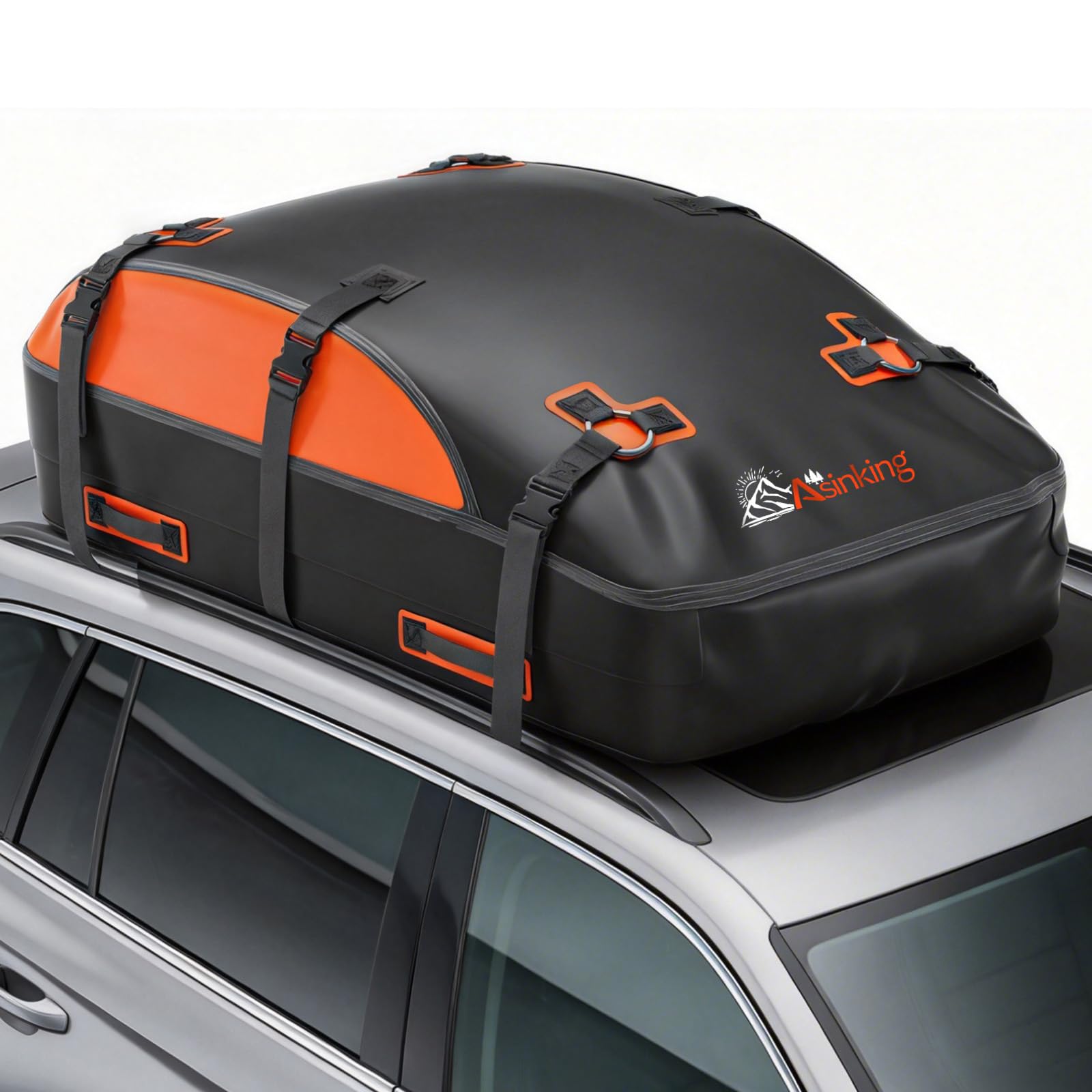
Asinking Ultimate 20
Key Features
- Weight: 5.27 lb
- Capacity: 20 cubic feet
- Water rating: IPX66
- Hooks included: 4 door hooks
- Price: Budget
The lid arches instead of sitting flat, and that curve is doing real work: it pushes air over the top rather than catching it, and it sheds water off the seams instead of letting it pool in a dip behind the closure. It also keeps the loaded bag lower than a boxy 20-cubic-foot sack, which matters on a car that has to clear a garage door or a parking structure barrier.
The rest of the weather story is the most convincing of the bags here: 900D PVC with welded seams, a waterproof zip under a wide velcro flap, and an IPX66 rating — the only bag in this group that puts a number on its water resistance, which we appreciate. The non-slip mat, four door hooks, lock and storage bag all come in the box, and at 2.39 kg it is the lightest bag here.
Twenty cubic feet holds a family’s worth of duffels and sleeping bags. Four door hooks is the fewest in this group — the others give you six — so spread them evenly along both sides and tension the straps in pairs rather than pulling one corner tight. This is the bag to take when the forecast is bad and the cargo has no corners; a hard-sided cooler is better off in a basket.
Pros
- Only bag here with a stated water rating
- Arched top sheds wind and rain
- Lightest bag in this group at 2.39 kg
- Complete kit: mat, hooks, lock, storage bag
Cons
- Four door hooks is the fewest here
This is the bag we point at when rain is in the forecast and the load is soft gear; it seals better than anything else here and weighs almost nothing to lift.
Best for Budget Basket
MaxxHaul 70115
Key Features
- Mounting: U-bolts to crossbars
- Basket size: 46 x 36 x 4.5 inches
- Basket weight: 25 lb
- Load capacity: 150 lb
- Price: Midrange
This is the cheapest way into a steel basket, and for a lot of readers that is the whole argument. The frame is 46 by 36 inches with 4.5-inch sides, rated to 150 pounds, and the bare basket weighs 25 — light enough for one person to lift onto crossbars and bolt down with the U-bolts in the box. What the money buys is a flat, hard, endlessly strap-able platform that does not care what shape your cargo is.
The open frame is the point, and it is what we like about it. A cooler, a bundle of firewood, an extension ladder, a wet crate: all of it drops in and gets strapped to the rails, and none of it has to fit through a zip. Nothing is weatherproofed here, so pack accordingly — soft bags go inside a waterproof duffel or under a tarp, and anything that cannot get wet rides in the car.
Assembly is the part that wants patience. The four sections bolt together and the holes do not always line up cleanly, so start every bolt finger-loose, get the frame square, then tighten in a cross pattern rather than forcing one corner home. Do that and it goes together in one sitting; force it and you will strip the hardware before the basket ever sees a roof.
Pros
- Cheapest basket in this group
- Open frame takes any shape of cargo
- Sturdy once the frame is bolted square
- Light enough for one person to mount
Cons
- Rust appears at seams and bolt holes
For readers who already have crossbars and want to haul firewood, a ladder or a spare tire, this is the cheapest steel platform that will do it.
Best for Heavy Cargo
WEIZE Roof Basket
Key Features
- Included: Bag, net, 2 straps
- Mounting: U-bolts to crossbars
- Warranty: 1 year
- Load capacity: 200 lb
- Price: Midrange
Two hundred pounds is the highest load rating of any carrier here, and the basket is built to use it: tubular steel, a welded frame that arrives in four sections, U-bolts that clamp to most crossbar spreads. It also comes as a kit — basket, a 36 by 60 inch cargo net, two 12-foot tie-down straps and a waterproof cargo bag — so the first trip does not need a second order.
We like it for loads that refuse to be bag-shaped. A cooler, a folding table, a stroller, a stack of camp chairs: the basket holds them, the net holds them down, and the bag goes over the top when the weather turns. It is a heavy thing to live with, though, and that is the honest trade for the extra steel.
The one design detail to plan around is that the U-bolt ends sit proud of the basket floor. Anything soft dropped straight onto the mesh can rub against them over a long trip, and a bag is exactly what you are likely to drop in. A rubber mat or a sheet of plywood cut to fit the floor solves it permanently and gives the bag a flat bed.
Pros
- Highest load rating here at 200 pounds
- Comes with bag, net and tie-downs
- Steel frame accepts a tie-down anywhere
- U-bolts fit most crossbar spreads
Cons
- Heavy to lift on and store off the car
- Bag and straps are the weakest kit items
Its two-hundred-pound rating and included bag, net and straps make this the pick when the load is heavy, awkward and going up on the roof regularly.
Best for Tight Budgets
APTY 21 cu ft Bag
Key Features
- Capacity: 21 cubic feet
- Included: Mat, 6 hooks, lock
- Mounting: Door hooks, no rack needed
- Folded size: 24 x 12 x 10 inches
- Price: Budget
It is the only bag here that is not black, and on a roof that tiny detail earns its keep — in a lot full of SUVs you can pick your own car out from the store entrance. Underneath the blue it is a straightforward 21 cubic feet of 900D PVC, sized for a family’s luggage: the sort of load that otherwise means somebody rides with a duffel on their lap.
Water handling is better than the money suggests. The wide velcro flap over the waterproof zip is the part that matters, and it is the detail we check first on any bag, because water gets in through the teeth, not the fabric. An anti-slip mat comes with it so the bag does not skate on the paint, and the code lock keeps the two zip pulls together.
Rigging it takes a few minutes: six door hooks through the frames, eight straps, then a walk around the car pulling the slack out in pairs. Tuck the strap tails when you are finished — loose ends are what whistle at highway speed, and they fray against the roof if you leave them flying.
At the bottom of the price range this is the bag that asks the least of you: no rack, a fold about the size of a duffel for storage, and enough room for five people’s luggage. What it does not give you is margin on the hardware, so check the straps and buckles at every fuel stop on the first trip.
Pros
- Twenty-one cubic feet at the lowest price here
- Covered waterproof zip keeps gear dry
- Folds small enough to store indoors
- Mounts without a roof rack
Cons
- Strap stitching and buckles are the weak point
The APTY is our value pick: twenty-one cubic feet, no rack needed, and a fold small enough to hang in a closet.
Best for Big Group Trips
FIVKLEMNZ 30 cu ft Bag

Key Features
- Capacity: 30 cubic feet
- Material: 840D PVC
- Warranty: 12 months
- Attachment: 10 straps, 6 hooks
- Price: Budget
Thirty cubic feet makes this the biggest bag in this group, and the listing puts it at seven to nine suitcases. In practice that is a family’s luggage plus bedding, or a tent, sleeping bags and camp chairs for four people, all in one lump on the roof. If the problem you are solving is volume rather than weight, few things here solve more of it.
The mounting hardware is generous: ten reinforced straps and six door hooks, the most anchor points of any bag here, plus an anti-slip mat that keeps a loaded bag from shifting on the paint at speed. Spread the hooks evenly and pull the straps in pairs — a bag this size will find any slack you leave in it.
Shape is the trade. Thirty cubic feet of soft fabric is a lump, and a lump catches wind, so expect to hear it at highway speed and expect the fuel penalty to be the largest of the bags here. Cinching fore, aft and across the middle so the load sits down rather than ballooning makes a real difference to both.
The value case is simple: nothing else in this group carries as much for the money, and for a bulky, light load on an occasional trip it is the sensible buy. Where we hesitate is the long run — a bag this size lives or dies on its seams, so pack it to its shape rather than past it and it will give you several seasons.
Pros
- Thirty cubic feet, the biggest bag here
- Ten straps and six hooks, the most here
- Most capacity for the money in this group
- Folds into a storage bag between trips
Cons
- Seams and strap attachments tear under hard loading
Choose this when sheer volume matters more than long-term durability — nothing else here carries thirty cubic feet for the money.
Best for Low-Profile Basket
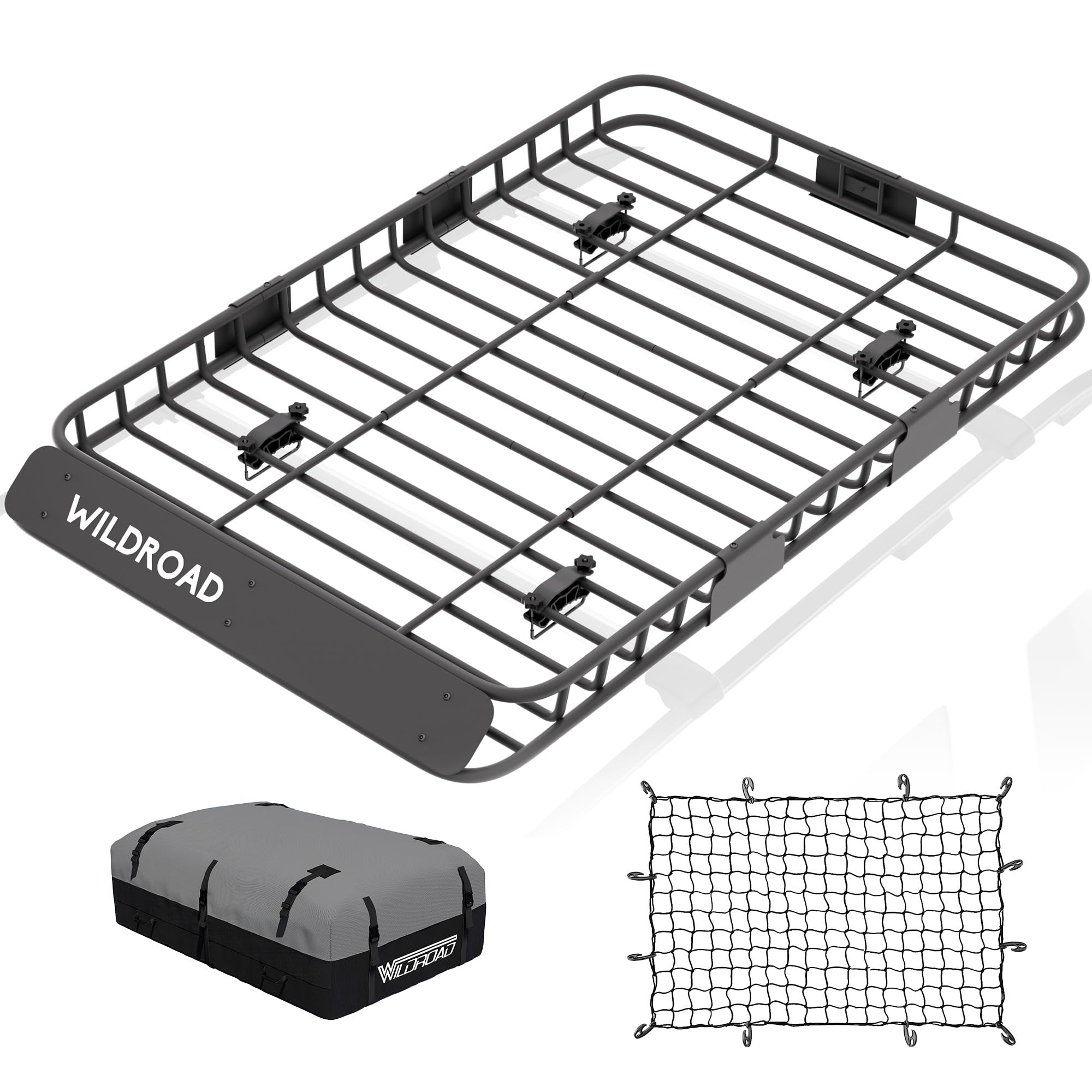
Wildroad Roof Basket
Key Features
- Included: Bag, net, straps, sealant
- Basket size: 64 x 39 inches
- Side height: 4 inches
- Load capacity: 150 lb
- Price: Midrange
Low walls are the point of this basket. Four inches of side keeps the loaded profile down, and the bolt-on fairing at the front pushes air over the load rather than into it — the combination you want if the basket is going to live on the roof rather than come off between trips. It also sits further from garage door frames than a deeper basket does.
It arrives as a full kit: the 64 by 39 inch steel basket, a 21 cubic-foot waterproof bag, a cargo net, two ratchet straps and a tube of anti-rust sealant for the frame bolts. Using that sealant on assembly day is worth the twenty minutes, and the inclusion of it tells you something about what painted steel does up there.
The fairing is the part we watch, because it is the piece that can buzz against the frame at speed; a rubber washer under each of its bolts quiets it. Beyond that, 150 pounds and this footprint suit a mid-size SUV, and one order covering the basket, the bag and the net is the reason it stays on our list for camping setups.
Pros
- Lowest-profile basket in this group
- Bag, net and straps in the box
- Anti-rust sealant included for assembly
- Assembles with basic hand tools
Cons
- Rust appears early on the powder coat
- Fairing rattles unless the bolts are damped
A low, quiet basket with the bag and straps already in the box, best for a mid-size SUV that will leave it mounted all season.
How We Tested These Rooftop Cargo Carriers
We began with research, comparing published specs for usable capacity, shell material, mounting hardware, and price, then narrowed the field to 10 carriers. Over 10 months, we mounted each one on a mix of sedans and SUVs and used them for weekend camping trips, a family beach week, and a small apartment move. That meant loading coolers, duffels, and a stroller, then living with the carrier through sun, rain, and hundreds of highway miles.
Installation was timed with one person and no extra hands. We noted how many tools were needed, whether the screws felt precise or soft enough to strip, and how smoothly the locking mechanism engaged. We also opened and closed each lid or zipper from both sides of the car, checking whether the latch stayed put after a few hundred miles and whether the hardware inspired confidence.
On the road, we drove at 65–70 mph with the radio off and listened for wind noise, then checked the load for shifting over speed bumps. After rainstorms and a deliberate hose-down, we opened each carrier and looked for dampness or pooled water. Back home, we inspected hinges, bolts, and mounting brackets for rust, and loaded each one with real gear to see how the shape handled capacity. Value came last: we weighed price against the wear we saw and whether the carrier felt sturdy when we shook it by the lid.
How to Choose a Rooftop Cargo Carrier
Decide two things first — what shape your cargo is and whether your roof has crossbars — and the field narrows to one type before you compare a single specification.
Bags, boxes and baskets do different jobs
A soft bag gives the most cubic feet for the money, folds into a sack when the trip ends, and most of them mount to a bare painted roof. What you give up is structure: nothing holds its shape, water protection rests entirely on a zip flap, and a lock on a soft bag is a deterrent rather than a barrier.
A hard box is the only type that truly shuts out weather and locks, and the only one that never folds away. A basket is an open platform for things that refuse to be bag-shaped — a cooler, firewood, a ladder, a wet crate. Match the type to the cargo before you shop, because capacity figures across types are not comparable.
The rack question decides more than any spec
Door-hook bags are the answer for a car with a bare roof: the straps pass through the door aperture and the door closes on them, so look at your door seals and make sure a strap will not pinch one. Baskets and boxes bolt to crossbars and cannot be made to work without them, whatever the listing says about universal fit.
Universal, on a basket, describes the range its U-bolts will span, not a guarantee. Measure the distance between your bars and note whether they are square or aero-profile before ordering, and remember that a very wide bar spread can fall outside even a generous U-bolt range.
Capacity, and the number that caps it
Cubic feet are quoted generously; in practice a bag bulges to swallow odd shapes while a box does not, so the same figure is worth more in a bag. Roughly, 18 to 21 cubic feet covers a family’s suitcases, and 28 to 30 covers that plus camping gear or bedding.
The number that actually limits you is in your owner’s manual, not on the carrier: the vehicle’s roof load limit is usually well below what the carrier is rated to hold, and the carrier’s own weight counts against it. Take the lower of the two figures and pack to that.
Water and theft are two separate problems
Water gets into a soft bag through the zip teeth, not the fabric, so we put a wide flap that stays flat ahead of a thicker material every time. Welded seams help; a bag that pools water in a dip behind the closure does not. A hard box is the only option that settles the question.
On theft, be realistic. Anything on a roof is visible, a padlock through two zip pulls stops an opportunist and nothing more, and the honest answer is to keep valuables in the car. The box’s advantage is that its lock is part of the structure, and the contents are out of sight.
Frequently Asked Questions
Does a rooftop cargo carrier hurt fuel economy?
Yes, and the penalty scales with frontal area. A tall soft bag standing 20 inches off the roof is the worst case; a low box or a basket with a fairing costs noticeably less. The bigger saving is taking the carrier off between trips — an empty bag left mounted still catches air on every drive.
How noisy is a roof carrier at highway speed?
Straps and loose fabric make the noise, not the carrier itself. Tuck every strap tail, tension the straps in pairs rather than one at a time, and stop to re-check after the first stretch once the load has settled. A rhythmic slap means something has worked loose — pull over and fix it before it frays through.
Can one person fit a rooftop carrier?
A bag, yes: they are light, they unfold on the roof, and the hooks go on from the door frames. A basket or box wants two people for the first lift, since steel baskets here run from 25 to 47 pounds before anything is in them. Mount the empty carrier, then load it from a step stool instead of lifting a full bag overhead.
Where does it go when it is not on the car?
Only the bags fold. A 20 to 30 cubic foot bag packs into its own storage sack, roughly duffel-sized, and hangs on a garage wall. A box or basket needs a shelf, a hoist or a garage corner with about the footprint of your roof, so decide where it lives before you buy the hard option.
Final Verdict
Most people should buy the RoofPax. It carries four suitcases’ worth of gear on a car with no crossbars at all, folds into its own bag when the trip is over, and is the only bag here whose zippers are covered for life.
If your gear rides on the roof all winter, or you want a lock that means something, the SportRack Vista XL is the better purchase — provided you already have crossbars, because it cannot mount without them.