This post contains affiliate links. We may earn a small commission when you buy through our links — at no extra cost to you.
I stopped hauling bagged ice the summer I spent a three-day weekend eating lukewarm cheese and watching a $6 bag melt into a puddle by Saturday morning. A 12-volt cooler fixes that: it plugs into your car’s socket on the drive and keeps running at camp, so food stays properly cold without you draining anything. Over the past seven months, my team and I have run nine of them through real trips, and the gap between a good one and a frustrating one is wider than the prices suggest.
Here’s what nobody tells a first-time buyer: "12V cooler" covers two very different machines. Thermoelectric models cool roughly 30 to 40 degrees below the surrounding air — fine for drinks on a mild day, hopeless in a hot car — while compressor coolers genuinely refrigerate and can freeze, at a higher price and power draw. Everything below earned its place on cooling performance, reliability, value, portability, and how little noise it made while we slept two feet away. One night or seven, there’s a pick here for it.


Best for Couples and Families
Feelfunn 61QT Dual Zone
Key Features
- Zones: Two, independent
- Weight: 42.2 lb
- Capacity: 61 quarts (58 liters)
- Temperature range: -4°F to 68°F
- Price: Midrange
Two compartments with their own thermostats is what puts the Feelfunn 61QT at the top of this guide. Freeze a couple of meals on one side at -4°F, hold the other at 36°F for drinks and produce, and nothing in the box picks up the smell of anything else. That split changes how you pack: instead of one compromise temperature for everything, the food you plan to cook later stays frozen while today’s lunch stays cold.
Feelfunn quotes 15 minutes from a 77°F start down to 32°F, and the rest of the design is unusually well sorted for vehicle use. Four fixing holes let you rope the box down so it doesn’t walk across the cargo area on a rough track, the basket lifts out to carry a load to the table, and a drain in the bottom turns the end-of-trip clean-up into a rinse. Internal LEDs help when you’re rummaging after dark. We noticed the freezer side holds two or three frozen meals rather than a week of meat, so plan the split accordingly.
The flip side of 61 quarts is bulk: 42.2 pounds empty, 28.74 inches across and 22.05 high, which means a two-hand lift and a wide, flat floor with room for the lid to swing. Measure your cargo area before ordering, and think about where it lives, because this is a fridge that stays in the vehicle rather than one you carry to the fire.
Between trips it takes 100-240V AC as well as 12/24V DC, so it can sit in a garage or a basement as overflow freezer space. A fridge that spends eleven months a year in a closet is money badly spent, and this one has a second life.
Pros
- Two zones with independent temperature control
- Four mounting points for tie-downs
- Removable basket and a bottom drain
- Runs on 12/24V DC or wall power
Cons
- One-year warranty is thin coverage
We make this the top pick for anyone feeding two or more people from a vehicle for days at a time: two independent zones and steady cooling earn the extra weight.
Best for Small Cars
BougeRV CR22
Key Features
- Weight: 22.3 lb
- Capacity: 23 quarts (22 liters)
- Power draw: Under 45W in ECO
- Temperature range: -8°F to 50°F
- Price: Budget
At 12.6 inches across, the BougeRV CR22 is the narrowest full compressor fridge here, and that one dimension decides where it lives. It drops into gaps the big boxes can’t touch — the footwell behind a seat, the space between two captain’s chairs, the corner of a small hatchback. At 22.3 pounds empty, one person can carry it in and set it down without a plan.
We reach for it on short trips and in small cars. It sits at the budget end of this group, runs on under 45W in ECO mode so a modest power station keeps up, and the three-level battery protection lets it run from the vehicle socket without flattening the battery you need to start the engine. BougeRV covers it for two years, twice what several of these carry, and the pull-down is quick — the spec sheet claims 77°F to 32°F in about 15 minutes.
Twenty-three quarts is a weekend for a couple: drinks, a few meals, a bag of ice for the box that holds the rest. It won’t feed a family for four days, and the -8°F floor is enough for ice packs or a small joint of meat rather than a week’s frozen food. Treat it as the fridge for two people who pack light, and pack it full, because a full box holds temperature better than a half-empty one.
Pros
- Narrow 12.6-inch body fits tight spaces
- 22.3 pounds, easy for one person
- Under 45W in ECO mode
- Two-year warranty
Cons
- Set temperature drifts a few degrees
We keep this one in the small-vehicle slot: 12.6 inches wide, 22.3 pounds, and easy to run from a modest power station.
Best for Wheeled Hauling
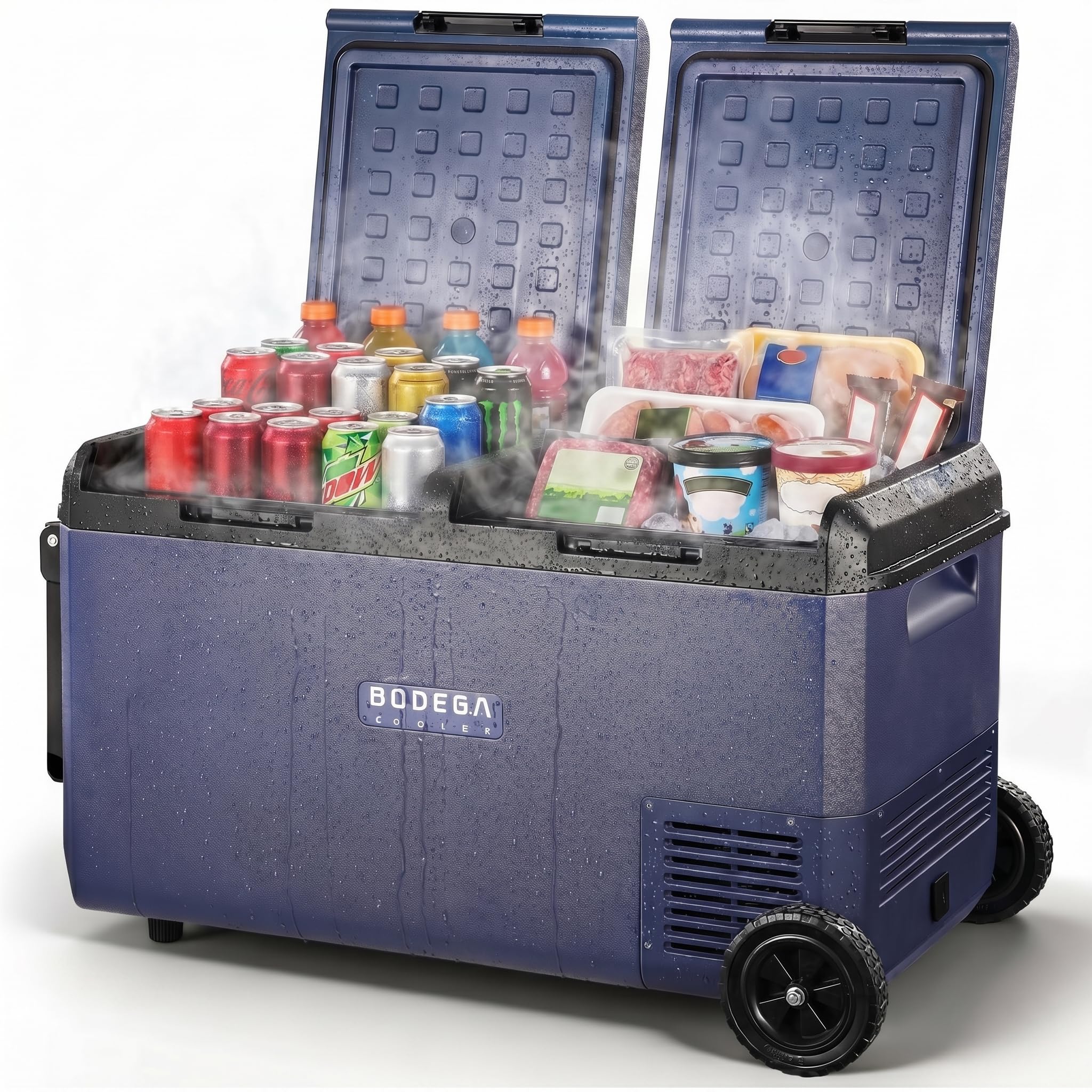
BODEGA 53QT
Key Features
- Weight: 26.5 lb
- Capacity: 53 quarts (50 liters)
- Temperature range: -4°F to 68°F
- Compressor warranty: 5 years
- Price: Midrange
Wheels and a pull handle sound like a small thing until you’re parked forty yards from the tent with 53 quarts of food to move. BODEGA built this one around that trip, and the shape helps: 28.5 inches deep, 15.5 high and 14.8 wide, so it lies along a trunk floor instead of standing up in the middle of it. It holds 57 cans, which is a party, or a long weekend’s food for two.
One zone means one temperature, so you pick fridge or freezer for the trip rather than both. For a lot of campers that’s the right trade, and performance is where this one impressed us most: it comes down to temperature quickly, holds it on AC and on the vehicle socket, and the Bluetooth app lets you check the number from the front seat without opening the lid.
BODEGA covers the compressor for five years and the rest of the box for one, which is the longest compressor cover in this guide and the reason it’s easy to suggest to someone who plans to keep a fridge for a decade. The interior LED, the two detachable doors and the supplied AC adapter round it out — this is the mid-size pick that asks the least of you.
Pros
- Wheels and a pull handle for moving
- Five-year compressor warranty
- Cools fast and holds its setting
- Bluetooth app control
Cons
- Handle and plastic fittings are the weak point
We recommend it to anyone who moves the fridge between car, tent and cabin — the wheels and long, low body make it the least annoying 50-quart box here.
Best for Unplugged Stops
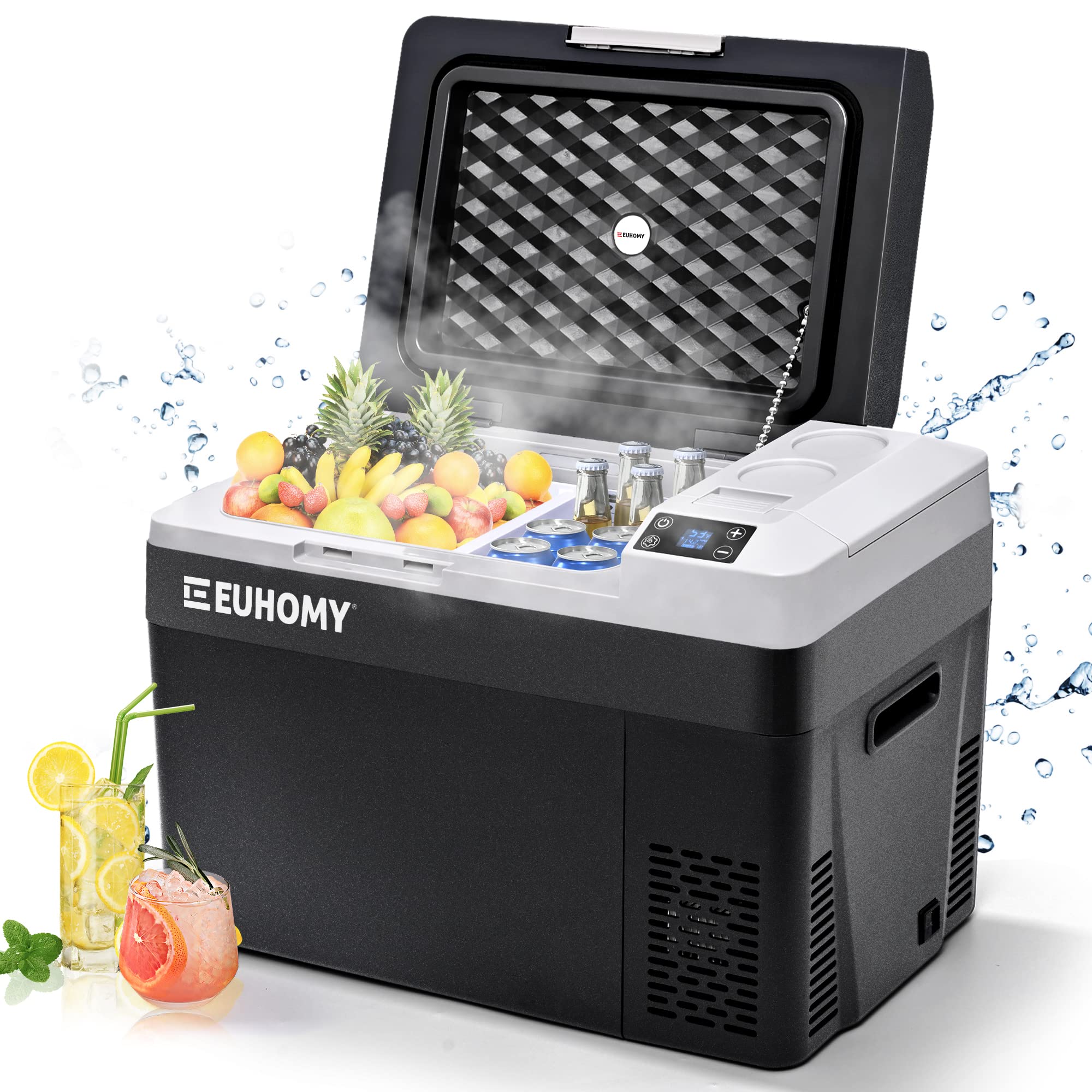
EUHOMY 31QT
Key Features
- Weight: 26.6 lb
- Capacity: 32 quarts (30 liters)
- Battery run time: Up to 6 hours
- Temperature range: -4°F to 68°F
- Price: Midrange
Most 12V fridges stop being fridges the moment you unplug them. This one carries a battery in a compartment at the end of the box and, on a full charge, EUHOMY says it runs for about six hours on its own. That covers the hike, the boat ride, the market run, or the two hours before you remember to plug it back in.
Thirty liters is the other half of the pitch: enough food for a couple over a few days, small enough at 23.18 inches wide and 16.28 tall to live behind a seat, and light enough at 26.6 pounds that getting it out of the car isn’t a project. Two recessed handles and a set of hooks give you something to grab, and the three-level battery protection is adjustable from 9.6V to 12.4V, so you decide how much of the starter battery it may use before it cuts out.
We think it’s the pick for anyone whose camp moves in the middle of the day. It also runs as an ordinary 12V fridge from the supplied DC cord, or from a wall socket with the AC adapter, so the battery is a bonus rather than a requirement for ownership — and when it is charged, that end compartment doubles as a charging station for other devices.
Pros
- Runs about six hours on its own battery
- Compartment doubles as a charging station
- Recessed handles and a 26.6-pound body
- Battery protection from 9.6V to 12.4V
Cons
- Battery is sold separately on some listings
We pick it for campers whose day moves: it’s the only fridge here that keeps cooling with no cord attached, for about six hours on a charge.
Best for Long Road Trips
BODEGA 79QT Dual Zone
Key Features
- Noise: ≤31 dB
- Zones: Two, independent
- Weight: 49 lb
- Capacity: 79 quarts (75 liters)
- Price: Premium
There are two 75-liter fridges here and they ask different questions. The other is a single-zone box that does one job; this one splits into two independently controlled compartments, shrugs off splashes to IPX4, and claims the lowest noise figure in this guide at 31 dB or under. If the fridge sits a few feet from where you sleep, that last number is the one you’ll notice.
Two zones mean a week of frozen meat on one side and drinks at 36°F on the other, and the pull-down is quick — BODEGA quotes -4°F in 72 minutes from ambient. The app lets you change a set point without opening a lid, and the ECO and MAX modes give you a choice between quiet efficiency and a fast chill when you’ve just loaded warm groceries. We appreciate that kind of detail on a box this size, because a 75-liter fridge you can’t move is a fridge you stop taking.
Moving it is the part they got right: wheels, a pull handle, ten side expansion holes for strapping it to a frame, two removable doors you can swap for whichever side of the vehicle you park on, and a drain hole for cleaning. Between trips it runs on wall power as happily as on the 12V cord.
Pros
- Two zones with independent control
- Lowest noise claim here at ≤31 dB
- IPX4 splash resistance
- Wheels, pull handle and a drain hole
Cons
- 49 pounds and 33.5 inches wide
- One-year warranty at the top of the price range
For long trips in a big vehicle, we take this one: the lowest noise claim here, two independent zones, and splash resistance for wet weather.
Best for Day Trips
Alpicool C15

Key Features
- Height: 10.2 inches
- Weight: 18.9 lb
- Capacity: 16 quarts (15 liters)
- Temperature range: -4°F to 68°F
- Price: Budget
Fifteen liters is twenty cans of soda, or a couple of days of drinks, sandwiches and a bag of coffee for one or two people. It is not a week of food, and nobody should buy it expecting otherwise. What it is: the smallest and cheapest compressor fridge in this guide, at 10.2 inches tall, so it slides under a cargo cover or behind the last row of seats.
Day trips are where this one makes sense to us — a tailgate, a run to the coast, the long drive home from the grocery store. It chills to -4°F, remembers your setting through a stop with its temperature memory function, and carries the same three-level battery protection as the bigger units. At 18.9 pounds it’s a one-hand carry, and the 12/24V DC and 100-240V AC inputs mean it can move indoors between trips.
Durability is the thing to manage. Some of these run for years and some die within months, so the sensible first move is a shakedown trip close to home with nothing precious inside. Alpicool covers it for a year, and the shell is light plastic — fine on a seat, less fine under a stack of firewood.
Pros
- Smallest and cheapest compressor fridge here
- 10.2 inches tall, 18.9 pounds
- Temperature memory holds your setting
- Three-level battery protection
Cons
- Set temperature can be a few degrees off
We see it as a second fridge for day trips and short runs, not the only cold storage for a week in the woods.
Best for Big Groups
EUHOMY 80QT

Key Features
- Noise: 42 dB
- Weight: 41.2 lb
- Capacity: 80 quarts (75 liters)
- Temperature range: 0°F to 68°F
- Price: Premium
Eighty quarts is 75 liters, and against a real cargo area that’s a piece of furniture: 35 inches front to back, 20 wide, 21 tall, and 41.2 pounds before anything goes in. It takes the back of an SUV or the floor of a trailer, and it takes it permanently — this is not a box you lift out at every stop.
What you get for the footprint is a lot of cold. The single compartment runs from 0°F to 68°F, so it’s a freezer for a week’s meat or a fridge for a party’s worth of drinks, and the four wheels and handles mean you roll it rather than carry it. The inverter compressor is quiet at a claimed 42 dB, and the anti-shock design and three-level battery protection are there for washboard roads and cold mornings.
A week with it works like this: load it once at the start, plug it into the vehicle on the drive, then into a power station at camp, and stop buying ice. The unpartitioned interior takes a full grocery run in one go, including tall bottles that don’t fit under a low lid.
What we like about it is the simplicity. For a family basecamp or a trailer that stays put for a week, this is the easiest way to buy a lot of cold, and the wheels mean one person can reposition it without emptying it first.
Pros
- 75 liters, the biggest single compartment here
- Four wheels and built-in handles
- Quiet at a claimed 42 dB
- Reaches 0°F for frozen food
Cons
- One temperature for the entire box
We point group campers at this one: the biggest single compartment here, and the simplest way to keep a week of food cold for a crowd.
How We Chose and Tested the Best 12V Coolers
We started with every 12-volt cooler we could find from the established overlanding names and the big camping brands, then filtered by capacity, power draw, and price so a 20-quart weekend box wasn’t being judged against a 75-quart expedition fridge. Nine made the cut.
Each unit spent the full seven months with us, beginning on a kitchen counter running on AC to establish a baseline and then moving into the back of a hatchback for weekend trips. We logged interior temperatures with a probe thermometer at startup, at six hours, and at 24 hours, once in direct sun and once in shade, noting how far each drifted from its set point. On the road we ran them off the 12-volt socket with the engine on and off, then switched to a power station at camp and timed how long each held temperature before the battery quit.
Portability got tested the honest way: we filled each one with food and drinks, carried it up a flight of stairs, and weighed it packed. Noise was measured with a decibel meter at arm’s length around the fire and again from inside a tent at bedtime — most you’d never notice, one you could hear over conversation. For durability we dropped lids, slammed them shut, wedged them against tailgates, and cleaned out every spill.
Value came last, once we knew what each cooler actually did: price against usable capacity, draw, and how steadily it held temperature across all seven months. A box that’s brilliant on trip one and dead by trip four isn’t a deal at any price.
How to Choose a 12V Cooler for Car Camping
The fridge that ruins a trip is rarely the one that cools badly on day one — it’s the one that can’t hold a temperature, drains a battery overnight, or doesn’t fit where it has to sit.
Compressor first, everything else second
Two technologies carry the same 12V label. Thermoelectric coolers drop a fixed number of degrees below the air around them — a few tens of degrees at best — which is fine for drinks on a mild day and hopeless for a week of food in a hot car. Compressor fridges hold an absolute temperature you set, and most reach below freezing. Every pick here is a compressor model.
The tell is how the cooling figure is phrased. Relative to ambient means it isn’t a fridge. A range such as -4°F to 68°F means it is. We won’t spend car-camping money on the first kind, however cheap the box looks.
Quarts, people and nights
Capacity is the easiest thing to overbuy and the easiest to underbuy. Fifteen to 23 quarts suits one person or a couple for a weekend of drinks and a few meals. Fifty to 60 quarts is a weekend for two with room to freeze, or several days for one. Seventy-five to 80 quarts is a family week or a group basecamp. A full box holds temperature better than a half-empty one, so a small fridge works best when you’re chilling drinks rather than provisioning.
The second decision is zones. A dual-zone box freezes on one side and chills on the other, which is the biggest practical upgrade available here — but the split is never even, and the freezer side of a 61-quart unit holds a few frozen meals rather than a week of meat. If everything you carry can live at one temperature, a single-zone box gives you more liters for the same footprint.
Power draw and battery protection
A 45-to-60W running figure sounds alarming until you remember the compressor cycles on and off. Over a full day these fridges use a fraction of what the wattage suggests, which is why people run them for days from a power station. Heat is the variable: the same fridge in an 85°F car works far harder than one in a shaded trailer.
Every unit here has three-level battery protection, which cuts the fridge off before the voltage falls far enough to strand you. Set it to the highest level when you’re drawing from the socket you start the engine with, and relax it only on a dedicated deep-cycle battery or a power station.
Fit, weight and the sound at 2 a.m.
Measure the space twice — the body is one number, and the lid needs room to swing above it. Weight in this group runs from just under 19 pounds to 49, and it grows once the box is full. Past about 40 pounds, wheels help more than handles do.
Noise is the spec people forget. Claims here run from 31 dB to 45 dB, which matters enormously in a camper shell or a van you sleep in and barely at all in a trailer. One more check: how tightly the DC plug fits your socket. A loose cigarette-lighter connection is one of the most common complaints about these fridges, and a velcro tie around the plug fixes most of it.
Frequently Asked Questions
How long will a 12V cooler run on a portable power station?
Start from the annual energy figure. Across these fridges it works out to roughly 0.1 to 0.6 kWh a day, so a 500 Wh power station covers anywhere from most of a day to several days depending on which one you buy. Halve whatever you calculate for a heatwave or for a campsite where the lid is open every ten minutes.
Can I plug a 12V cooler into a normal wall outlet?
Yes. All seven fridges here ship with a 100-240V AC adapter alongside the 12V cord, so the same box that runs in the car can run in a garage, a spare room or a cabin. That is worth weighing when you choose: a fridge that doubles as overflow storage gets used twelve months a year instead of six weekends.
Why is water collecting in the bottom of the fridge?
Condensation, usually. Humid air gets in each time you open the lid and pools on the floor of the box. Wipe it out at the end of every trip, load pre-chilled food, and keep the lid shut while the fridge runs in the sun. The Feelfunn 61QT and the BODEGA 79QT have drain plugs that turn emptying it into a thirty-second job.
Does a 12V fridge need to sit perfectly level?
Close to level is enough; a slight slope on a campsite isn’t a problem. What you avoid is running it on its side or tipped far enough that the compressor can’t sit in its oil. If it has travelled on its side, stand it upright for a while before plugging it in, and strap it down so it can’t slide on rough roads.
Final Verdict
Most car campers should buy the Feelfunn 61QT. Two independent zones end the trade between frozen and cold, the temperature holds, and the tie-down points and drain show someone thought about how the box gets used in a vehicle. The cost is 42 pounds and a 28.7-inch footprint, so measure the space before you commit.
If your vehicle is small, the BougeRV CR22’s 12.6-inch body is the reason to pick it instead. If you’re on the road for weeks rather than weekends, the BODEGA 79QT’s second zone and 31 dB are worth the extra bulk and the extra money.