This post contains affiliate links. We may earn a small commission when you buy through our links — at no extra cost to you.
A long weekend at the lake sounds great until you’re kneeling in meltwater, shifting soggy sandwiches aside to reach the last cold drink. Electric coolers solve that specific misery: they’re essentially 12-volt refrigerators that run off a car outlet, a portable power station, or a wall plug, holding a set temperature instead of slowly losing ground to a bag of ice. What you get is a cooler that’s still cold on day four, with no ice runs and nothing floating in the bottom.
The gap between a good one and a frustrating one has little to do with the badge on the lid. I’ve spent ten months living with seven of them — in a hatchback, on a tent platform, and beside the backyard grill — and the ones worth owning chill down fast, hold within a degree or two of the setting, and stay quiet enough that you forget they’re running. Ignore the quart ratings, too, and picture your actual fridge shelves: upright bottles eat space faster than the numbers suggest. The picks below are separated by exactly that kind of real-world detail.


Best for Two-Person Trips
BougeRV CR22
Key Features
- Power: 12/24V DC and 110V AC
- Weight: 22.3 lb
- Capacity: 23 quarts
- Temperature range: -8°F to 50°F
- Price: Budget
We recommend the BougeRV CR22 as the default for two-person trips. The 23-quart box takes up about as much trunk space as a large duffel, and at 22.3 pounds it is light enough to lift in and out without help. That matters more than raw capacity when the cooler moves from car to campsite and back every day.
The compressor is rated to pull the interior from 77°F to 32°F in about 15 minutes, and that speed shows up when you load warm drinks. At 45 dB and a 60W maximum draw, it is easy to leave running on a power station without watching the battery. The 12/24V DC and 110V AC cords cover the car and the wall, and the three-level battery protection is the feature we trust most when the engine is off.
Temperature holding is the one caveat. The set point can wander, so we pre-chill the box on AC power, pack it full, and keep the vents clear; that routine keeps the swings from mattering on short trips. The two-year warranty is longer than most here, and the low price leaves room in the budget for a power station.
Pros
- Light 22.3-pound body
- Fast 15-minute cool-down
- Low 60W maximum draw
- Two-year warranty
Cons
- Small 23-quart capacity
For couples and solo campers, the BougeRV CR22 is the default we recommend: it cools quickly, draws little power, and stays light enough to move without help.
Best for Family Road Trips
EUHOMY CF-55
Key Features
- Power: 12/24V DC and 110/240V AC
- Weight: 33.1 lb
- Capacity: 59 quarts
- Temperature range: -4°F to 68°F
- Price: Midrange
A 59-quart cooler is where an electric cooler stops being a personal drinks box and starts replacing the family cooler. The EUHOMY CF-55 holds a weekend of food, or 58 standard cans, and still fits across the back of an SUV. That makes it a different purchase from the 23-quart boxes here: you are buying capacity and a bit of permanence.
We recommend it for families and road-trippers who want one box rather than a cooler plus a separate freezer bag. The compressor pulls the interior down quickly, the app lets you check the temperature from the front seat, and the 45W average draw is low for this much space. We also appreciated the LCD panel and the removable basket, which make it easier to live with than a bare-bones box.
The handle is the part we watch most closely. Lift from the base when the box is full and it avoids the stress point. The rest of the ownership experience is straightforward: the single compartment is easy to pack, the basket comes out for cleaning, and the AC/DC cords switch between car and hookup without drama. If your trips revolve around feeding four people, the capacity is worth the effort.
Pros
- Large 59-quart capacity
- Quiet compressor with app control
- Low 45W average draw
Cons
- Two-person lift once loaded
- One-year warranty
The EUHOMY 59QT is our family-trip pick: big enough for a week of food, quiet in camp, and easy to check from the front seat.
Best for Frequent Moves
BODEGA T50T
Key Features
- Power: 12/24V DC and 100-240V AC
- Capacity: 53 quarts
- Handling: Wheels and retractable handle
- Temperature range: -4°F to 68°F
- Price: Midrange
The BODEGA T50T is the cooler we reach for when the parking spot is nowhere near the picnic table. A retractable handle and two wheels turn a loaded 53-quart box into something one person can roll instead of carry, and that changes how often we bother to bring it. For RVers and car campers who move the cooler often, that convenience is the reason to choose it.
The rest of the package is sensible: a single 53-quart compartment, app control, a -4°F to 68°F range, and both 12/24V DC and AC power. It cools quickly and holds temperature well when it is packed full. We also like the built-in LED light and the removable basket—small details that make a dark campsite or a hasty repack less annoying.
What it gives up is zone flexibility. You get one compartment, so a fridge-and-freezer setup is not on the menu. The five-year compressor warranty is the strongest here, which takes some of the worry out of the electronics. If you need both a fridge and a freezer at the same time, choose a dual-zone model instead; if you mostly chill food and drinks, the BODEGA’s wheels are worth more than a second zone.
Pros
- Wheels and retractable handle
- Five-year compressor warranty
- App control and LED light
Cons
- Plastic handle is the weak point
When a loaded cooler has to move, we reach for the BODEGA T50T and its wheels; the retractable handle makes a 53-quart box far less of a chore.
Best for Dual-Zone Weekends
Feelfunn 61QT
Key Features
- Zones: Dual independent
- Weight: 42.2 lb
- Capacity: 61 quarts
- Temperature range: -4°F to 68°F
- Price: Midrange
Two independent compartments are the reason to look at the Feelfunn 61QT. You can set one side as a fridge and the other as a freezer, or run both as fridges for a crowd, without the two zones fighting over one thermostat. At this price, that flexibility is the feature that separates it from the single-zone boxes here.
We think the Feelfunn is the dual-zone bargain of this group. The 61-quart interior is big enough for a long weekend, the compressor cools fast, and the tie-down holes and anti-shake design make it feel intended for a vehicle rather than a kitchen counter. We also appreciated the removable basket and bottom drain; cleaning a cooler is never fun, but those details shorten the job.
The catch is the freezer side. It is smaller than the headline capacity suggests, so a gallon of ice cream and a few frozen meals are realistic, but a week of frozen food is not. The dual doors keep the cold air from spilling between zones when you open one side, which makes the split more usable than a single lid over two compartments. That is the detail that earns the Feelfunn its place.
Pros
- Dual independent temperature zones
- Fast compressor cooling
- Tie-down points for vehicle use
- Removable basket and bottom drain
Cons
- 42.2-pound body before food
- One-year warranty
We think the Feelfunn 61QT is the dual-zone bargain here: two independently controlled compartments without the premium price.
Best for Rv Stays
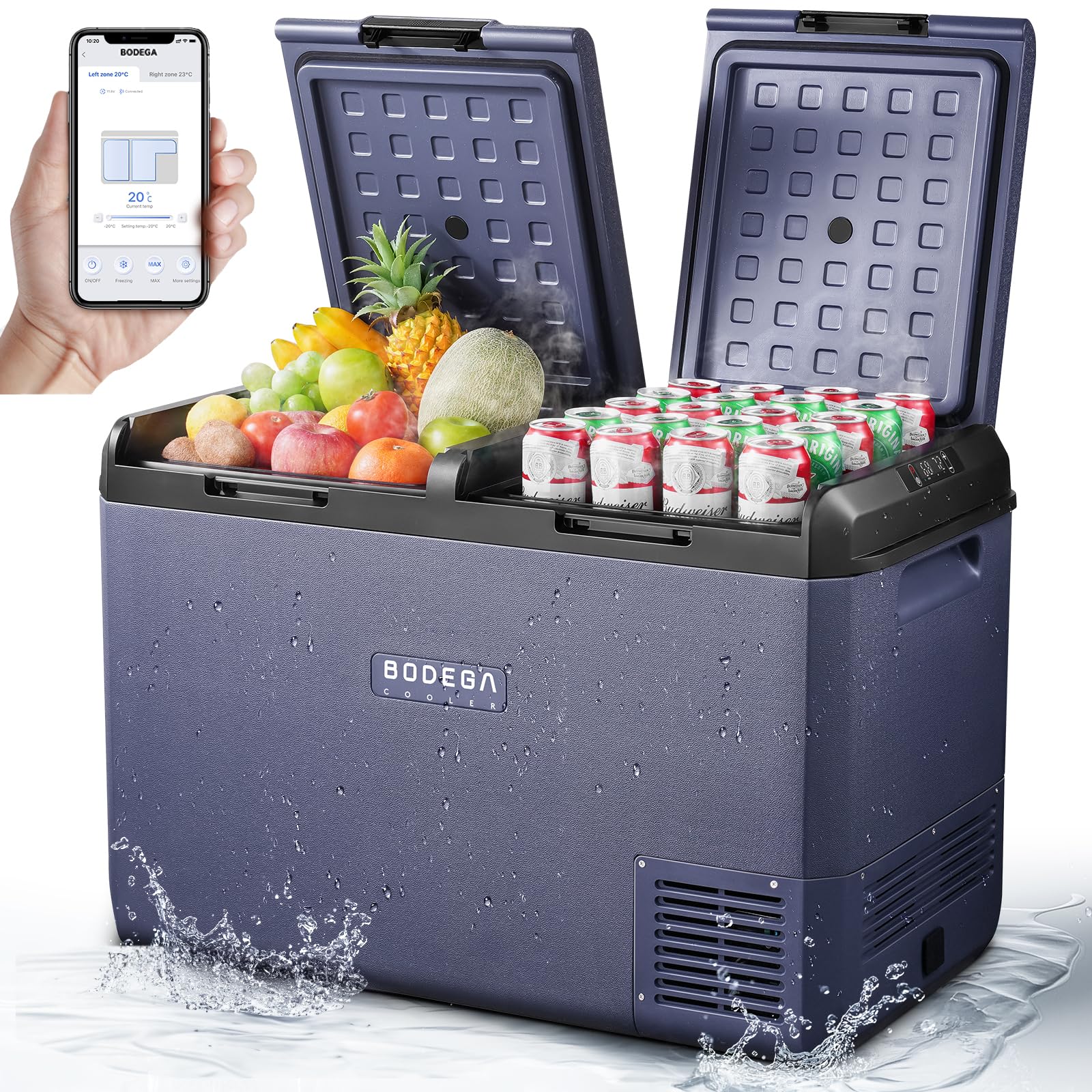
BODEGACOOLER 79QT
Key Features
- Zones: Dual independent
- Capacity: 79 quarts
- Temperature range: -4°F to 68°F
- Weather protection: IPX4
- Price: Premium
The BODEGACOOLER 79QT is a 79-quart dual-zone box with a footprint that takes up real space in an SUV. It has two independent compartments, app control, and an IPX4 rating. The two doors open independently, and the interior is laid out for a fridge-and-freezer split rather than a single deep well. That combination puts it in small-RV territory rather than day-trip territory.
The capacity is the draw. We set one side at freezer temperature and the other as a fridge, and the 79-quart interior swallowed a long weekend of food without constant repacking. It runs quietly for its size, and the app is genuinely useful when the cooler is in the back of a vehicle. The 12/24V DC and AC cords cover both vehicle and hookup power, and the IPX4 rating matters if it lives in a truck bed or gets rained on at camp.
We recommend it to travelers who want a true fridge-and-freezer pair and can spare the space. The dual-zone control is the reason to choose it over the cheaper single-zone boxes, and the quiet running makes it easy to live with in a camper. If you mostly chill drinks, a simpler box will do; if you cook from the cooler, the BODEGACOOLER earns its footprint.
Pros
- Large 79-quart dual-zone capacity
- Quiet running for its size
- IPX4 protection and app control
Cons
- Premium price in this group
- 42.1-pound body before food
We recommend the BODEGACOOLER 79QT to travelers who want a true fridge-and-freezer pair and can spare the space.
Best for Group Basecamps
VEVOR 100.4QT
Key Features
- Zones: Dual independent
- Capacity: 100.4 quarts
- Handling: Wheels and handle
- Temperature range: -4°F to 68°F
- Price: Premium
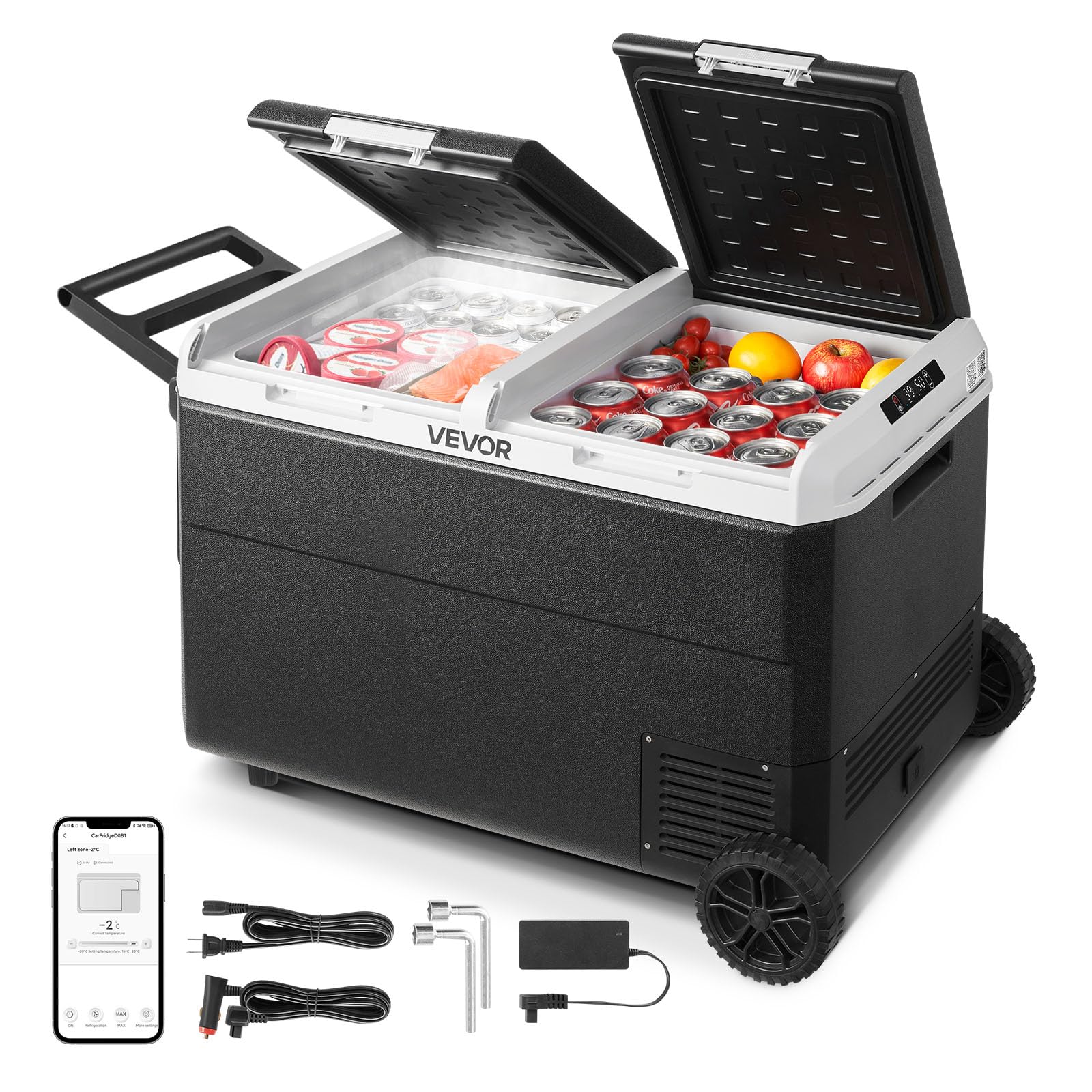
The VEVOR 100.4QT is not a cooler you buy for a couple’s weekend. It is a 95-liter dual-zone box with wheels and a handle. The size is the point: this is group gear, built to hold a long weekend of food for a crowd rather than a few sandwiches.
We found the two zones useful for a basecamp setup—one side for drinks and produce, the other for frozen meals—and the wheels make a loaded box movable across a flat campsite. The compressor cools quickly, and the 12/24V DC and AC power options let it run from a vehicle or a hookup. The 100.4-quart capacity means fewer resupply runs on a long stay.
The dual-zone control is what makes the size worthwhile: you can keep ice cream solid on one side and salad crisp on the other, and the drain plug simplifies cleanup after a long trip. We also appreciated the sturdy handles, though they do not change the fact that this is group gear.
We recommend the VEVOR for group camps, long RV stays, and anyone who wants fridge-and-freezer space without paying the premium BODEGACOOLER price. The dual-zone control is the reason to choose it over a single-zone box of the same size, and the wheels make it manageable once it is on the ground. If you mostly carry drinks for a tailgate, a smaller cooler is easier to live with.
Pros
- 100.4-quart dual-zone capacity
- Wheels and handle for moving
- AC/DC power with battery protection
Cons
- 53.1 pounds empty is a two-person lift
- Needs a dedicated vehicle space
We see the VEVOR 100.4QT as basecamp equipment: it holds a group’s food and drinks, rolls into place, and undercuts the premium dual-zone boxes.
Best for Tight Car Spaces
Megiu HC-22P2
Key Features
- Power: 12/24V DC and 100-240V AC
- Weight: 20.6 lb
- Capacity: 23 quarts
- Temperature range: -0.4°F to 59°F
- Price: Budget
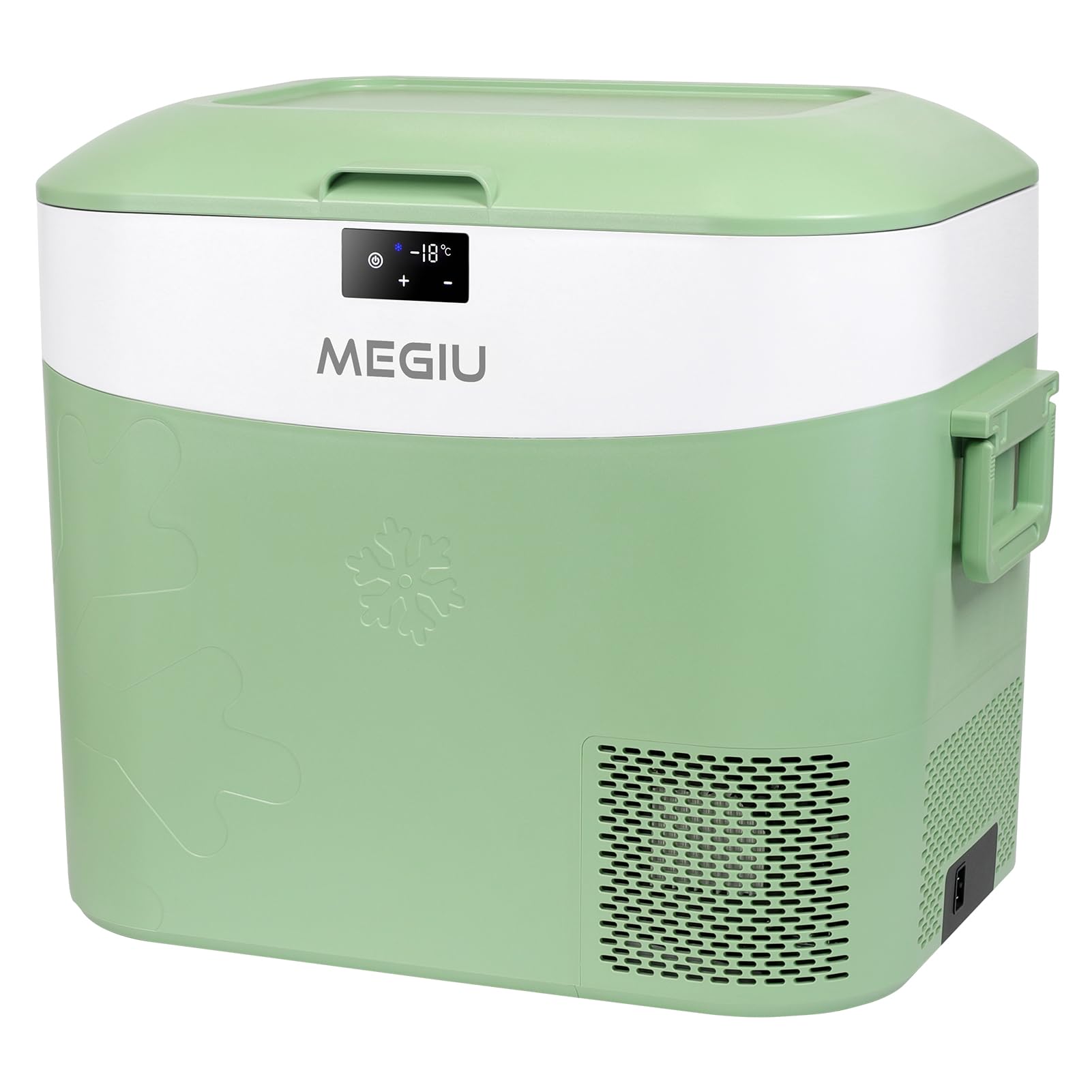
The Megiu HC-22P2 is a 23-quart compressor cooler with a compact body, a 20.6-pound weight, and a price that sits at the bottom of this group. The 18.3-inch depth helps it sit behind a seat or in a small trunk, and one person can carry it without help. That makes it a different proposition from the big family boxes.
The cooling package is the same basic idea as the BougeRV: a compressor, a -0.4°F to 59°F range, AC and DC power, and a removable basket. It runs quietly, and we liked the touch-screen controls and the three-year compressor warranty, which is longer than most here. The 23-quart capacity is realistic for drinks and a few meals, not a week of groceries for a family.
For a solo traveler or a couple with a small car, the Megiu is the compact budget pick we recommend. It does the core job for less than the other compressor boxes here, and it is easier to live with than a thermoelectric cooler that only drops below ambient. The three-year compressor coverage is the part that makes the budget buy feel reasonable.
Pros
- Lowest price in this group
- Compact 23-quart footprint
- Three-year compressor warranty
Cons
- Temperature setting can be inaccurate
- One-year accessory warranty
We recommend the Megiu HC-22P2 for solo travelers and small cars: it is quiet, light, and the least expensive compressor cooler here.
How We Tested the Best Electric Coolers
We started with the specs that actually constrain a purchase — compressor type, power draw at 12 volts, capacity, and warranty length — and cut anything that couldn’t hold 35°F in a hot car or that one person couldn’t realistically carry. That left seven coolers, which we ran for ten months across two camping trips, a tailgate season, a week of van travel, and a two-day power outage at my house. Each was loaded with the same grocery haul — two gallons of water, a dozen cans, and a pack of chicken — so the comparisons were about the cooler, not the packing.
Cooling speed was measured, not guessed: every unit started in a 78-degree garage, and we logged how long it took to reach 38°F, with a second sensor buried at the bottom to see whether the cold actually reached the lower third. Once there, we set each to 35°F and checked the overnight drift, since a cooler that swings five degrees is a cooler that freezes your lettuce. We also took decibel readings at three feet and noted which units were audible from inside a tent at 2 a.m. versus the ones you had to touch to confirm were on.
Portability was judged loaded, not empty — we carried each up a flight of stairs, lifted it into a trunk alone, and noted which handles dug into a palm after 30 feet. Durability came from repetition: latches opened and closed a few hundred times, lids dropped on pavement, seals checked for mold after a wet week, and every unit watched to see whether it resumed its set temperature on its own after the outage. Value, finally, came down to whether the paid extras were things we still used in month six.
How to Choose an Electric Cooler
The first decision is not brand or quart count; it is whether you need a true compressor fridge or just a chilled box for drinks.
Match capacity to the trip, then check the interior
We start with the trip length because capacity is the easiest thing to overbuy. A 23-quart box such as the BougeRV or Megiu suits two people for a long weekend of drinks and simple meals; a 59-quart EUHOMY is the family-weekend size; 79 to 100 quarts is group or RV territory. The trap is assuming the quart rating tells you what fits: tall bottles, a gallon jug, and a freezer basket all eat into usable space. Measure the trunk opening and the interior height before you commit.
Choose compressor cooling for hot weather
Compressor models are the ones that act like a fridge: they can hold temperatures near freezing or below in a hot car, and they are what we recommend for food safety on multi-day trips. Thermoelectric coolers only drop a fixed number of degrees below ambient, so they struggle in a sunbaked vehicle and are better for drinks on a short drive. If a listing does not say compressor, do not assume it can freeze. Check the temperature range and whether the unit is rated for fridge and freezer use.
Look at power draw and battery protection
Every pick here runs on 12/24V DC and AC power, but the ownership difference is in battery protection and average draw. A 45W to 60W cooler is manageable on a car outlet or a modest power station; a big dual-zone box draws more and needs a plan. Use the battery-protection setting when running from a vehicle, and test an overnight run before you rely on it. The AC adapter matters too: it lets you pre-chill at home, which takes load off the vehicle battery.
Decide whether you need one zone or two
Dual-zone control is worth paying for when you want frozen food and fresh food in the same trip. It lets you run one side as a freezer and the other as a fridge, and it avoids the compromise of a single set point. The catch is that the freezer compartment is often smaller than the headline capacity suggests, and dual-zone boxes cost more and weigh more. If you mostly chill drinks and sandwiches, a single-zone model is simpler and easier to pack. If you want ice cream and salad, choose dual.
Plan for weight, cleaning, and the weak points
A full cooler is much heavier than its listed weight, so check the lift into your vehicle before you fill it. Wheels help on flat ground, but you still have to lift the box over a tailgate. Look for a removable basket and a drain plug if cleaning matters to you; they make a long trip’s cleanup much less unpleasant. Handles and power cords are the parts that fail first, so a longer warranty is worth real money. The BougeRV and BODEGA warranties are the standout examples here.
Frequently Asked Questions
Is an electric cooler worth it over a regular cooler and ice?
For multi-day trips, yes. A compressor cooler eliminates ice runs, keeps food dry, and can hold frozen meals if you choose a freezer-capable model. For a single afternoon, a standard cooler is simpler and cheaper. Count how many nights you camp and how often you buy ice; two or more nights a month is where the convenience starts to pay back.
Can I use an electric cooler in a hotel room or cabin?
Yes, with the AC adapter. Put it on a hard surface, keep the vents clear, and expect the compressor to cycle on and off. It works well as an overflow fridge for groceries or a road-trip base. Check where the outlet sits before you fill it, because a loaded cooler is awkward to move across a room.
How do I clean and store an electric cooler?
Empty it, defrost the freezer, and wipe the interior with mild soap and water. Open the drain plug if your model has one, then dry the lid seal and leave the lid ajar for storage. Storing it sealed and damp traps odors. A quick wipe after each trip is easier than a deep clean at the start of the season.
Final Verdict
We recommend the BougeRV CR22 as the best default for most campers. It cools fast, draws little power, and stays light enough to move alone, which matters more on a real trip than a bigger quart rating.
Choose the EUHOMY 59QT if you feed a family and need the space, or the BODEGA T50T if you move a full cooler often and want wheels. For a true fridge-and-freezer pair, the BODEGACOOLER 79QT is the large dual-zone pick; the VEVOR 100.4QT is the group basecamp box. Capacity, not a spec-sheet winner, decides the right answer.