This post contains affiliate links. We may earn a small commission when you buy through our links — at no extra cost to you.
The first time I trusted a portable fridge with a weekend’s food, I checked the temperature display every hour like it was a newborn. That anxiety is the real hurdle: a cooler full of ice is simple, but a 12-volt fridge has to earn your trust. A good one eliminates the ice run, keeps food out of a soggy puddle, and lets you carry frozen steaks and greens to a site with no power. I’ve spent eight months with seven of them, and the differences in cooling, noise, and battery draw are real.
Price is only part of the value story. They hold a steady temperature through a hot afternoon, run quietly enough that you don’t hear them from the tent, and still feel manageable loaded—because an awkward fridge rarely leaves the garage. Reliability matters just as much: I want a compressor that keeps its cool after months of gravel roads. Ignore advertised capacity until you’ve packed one with real food; interior shape matters as much as quart count. The picks below are the ones I’d trust with a weekend’s provisions.


Best for Couples’ Weekend Trips
BougeRV CR22
Key Features
- Weight: 22.3 lb
- Capacity: 23 quarts
- Power input: 12/24V DC, 100–240V AC
- Temperature range: -8°F to 50°F
- Price: Budget
A 23-quart fridge is the Goldilocks size for plenty of camping couples: enough for a weekend of food and drinks, small enough to slide behind a seat or carry into a cabin. The CR22 is the one we recommend first because it pairs that useful size with a 12.6-inch-wide body, a 22.3-pound weight, and a two-year support window. The 12V compressor is rated to pull down from 77°F to 32°F in about 15 minutes, and its eco draw stays under 45W, which is friendly to a modest power station.
We appreciate the 12/24V DC and 100–240V AC inputs because the same fridge can run in the car and then off a wall socket at home. The 45dB rating is not silent, but it is low enough that we are comfortable sleeping near it in a van. The long 10.8-foot DC cord is a small thing until you are threading it through a packed wagon. For weekend trips, the simple single-zone layout is a feature: load it, set it, and stop thinking about it.
Pros
- Practical 23-quart size for couples
- Fast 15-minute cool-down to 32°F
- Under-45W eco draw
- Two-year support and long DC cord
Cons
- Fridge setpoint can drift at times
For couples in a small vehicle, the CR22 is the default: 23 quarts, a narrow body, low draw, and two-year support in one easy-to-carry box.
Best for Family Camping
EUHOMY 59QT
Key Features
- Weight: 33.1 lb
- Capacity: 59 quarts
- Power input: 12/24V DC, 100–240V AC
- Temperature range: -4°F to 68°F
- Price: Midrange
The 59-quart EUHOMY is the pick for a family or a long road trip where one fridge has to do the work of a cooler and a pantry. Its 55-liter box is big enough for a week of food, and the 45W average draw is modest for this capacity. That combination is why it sits near the top of this group for sheer space per watt.
The biggest practical catch is weight: at 15 kg, this is a two-person lift once it is loaded, and the 27.4-inch depth takes up real cargo space. We do not call it portable in the throw-it-on-the-back-seat sense, but it is easy enough to leave in an SUV or camper. The LCD and app make setting it easier, and the internal basket helps keep smaller items from disappearing.
Durability is the other thing to weigh: the handle and lid hardware are the parts to check on arrival. If you mostly drive to a campsite and leave the fridge in the vehicle, that risk matters less; if you need to haul it into a cabin every night, the wheeled EUHOMY or a smaller model is friendlier. For capacity relative to the rest of this group, it earns its place.
Pros
- Family-sized 59-quart capacity
- About 45W average draw
- LCD and app temperature control
- Basket keeps food organized
Cons
- Single-zone layout cannot hold two temperatures
Buy the 59-quart EUHOMY when feeding a family or a long trip matters more than lifting weight, and you want big capacity without a big power draw.
Best for Dual-Zone Trips
BODEGACOOLER 64QT
Key Features
- Capacity: 64 quarts
- Dimensions: 28.5 x 14.1 x 21.6 in
- Power input: 12/24V DC, 100–240V AC
- Dual-zone split: 36 + 28 quarts
- Price: Midrange
A 64-quart box with separate 36- and 28-quart zones is the reason to look at the BODEGACOOLER. You can run one side near freezing for drinks and the other below zero for meat or ice cream, which is a more useful arrangement for a long trip than a single big cavity. The split is controlled independently, and the app lets you adjust each side without opening the lid.
The 12/24V DC and 100–240V AC inputs cover vehicle and hookup use, and the 60-liter capacity is enough for a family weekend or a couple’s week. The app makes more sense than reaching over a full lid, and the basket gives smaller items a place to ride. For a dual-zone box, the layout is straightforward: set each side, then leave it alone.
We rate the dual-zone flexibility near the top of this set, and the five-year compressor warranty is a meaningful vote of confidence. Set it in its final spot before filling it, use the app for temperature changes, and the BODEGACOOLER makes sense for campers who want real freezer space without carrying two separate fridges.
Pros
- Independent 36- and 28-quart zones
- 64-quart capacity for group trips
- App control for each zone
- Five-year compressor warranty
Cons
- Wide 28.5-inch footprint needs cargo room
- Lid and handles are weak points under load
The BODEGACOOLER is for campers who need a real freezer and a fridge at the same time, and can spare the cargo width.
Best for Rolling into Camp
EUHOMY 52QT Wheeled
Key Features
- Weight: 35.7 lb
- Capacity: 52 quarts
- Mobility: Wheels and pull handle
- Temperature range: -4°F to 68°F
- Price: Midrange
The reason to pick the 52-quart EUHOMY over the cheaper box fridges here is the set of off-road wheels and a pull handle. A fridge full of food is awkward to carry through a muddy field, and rolling it from the tailgate to the tent is a genuine convenience. We like that the wheels are paired with a single 50-liter zone rather than a complicated dual-zone layout; this one is about getting a useful amount of cold food to the campsite and back.
Cooling is fast, and the 45dB rating is low enough for a quiet camp. The single zone keeps loading simple: pack it like a cooler, set one temperature, and go. The 12/24V DC and 110–240V AC inputs cover the usual car-to-cabin switch, and the basket keeps small items from sliding to the bottom. The 35.7-pound body is still a two-person lift into a high truck bed, but the wheels take over once it is on the ground.
Pros
- Wheels and pull handle for camp moves
- 52-quart single-zone capacity
- 45dB noise rating
- AC and DC power inputs
Cons
- Pull handle feels vulnerable under a full load
- Temperature control can wander
If you move a loaded fridge between car and camp, the EUHOMY 52QT’s wheels and pull handle do the job that capacity alone cannot.
Best for Van Builds
ICECO VL45
Key Features
- Weight: 49.2 lb
- Capacity: 45 liters
- Compressor: SECOP
- Temperature range: 0°F to 50°F
- Price: Premium
The ICECO VL45 is the premium build case in this group: a metal shell, a Secop compressor, and a five-year compressor warranty. That is a different proposition from the plastic-bodied value fridges. At 45 liters, it is also a fridge you install rather than one you toss in the back seat on a whim.
We think the build is the reason to pay the premium. The metal shell and folding lock give it a more planted feel, and the thickened inner wall should help it hold temperature between compressor cycles. The 0°F to 50°F range covers fridge and freezer use, and the 127 kWh annual figure is reasonable for a 45-liter box. The fold-down lock also keeps the lid secure in a moving vehicle.
Cooling performance is strong but not the most consistent in the group, so if you need precise dual temperatures, the BODEGACOOLER or a smaller ICECO is the more flexible choice. For a van build, a garage setup, or a basecamp fridge that stays put, the VL45’s build and warranty are worth the extra space and money.
Pros
- Metal shell and solid build
- Secop compressor
- Five-year compressor warranty
- Efficient 127 kWh annual use
Cons
- 49.2 pounds empty is a two-person lift
- Ships without an insulated cover
The ICECO VL45 is the premium choice for a van or basecamp setup where build, a Secop compressor, and a five-year compressor warranty justify the weight.
Best for Tight Vehicle Spaces
BougeRV CR28
Key Features
- Weight: 24.3 lb
- Capacity: 30 quarts
- Power input: 12/24V DC, 100–240V AC
- Temperature range: -8°F to 50°F
- Price: Midrange
The CR28 is the CR22’s taller sibling, and the comparison is the useful part. It keeps the same 12.6-inch width and 22.68-inch depth, so it fits where the smaller BougeRV fits, but the extra height raises capacity from 23 to 30 quarts. For a solo camper or a couple who wants a little more food without losing the narrow footprint, that is a tidy upgrade.
The 24.3-pound weight is still manageable for one person, and the 15-minute cool-down to 32°F is the same quick performance. The two-year support and 12/24V DC plus 100–240V AC inputs carry over as well. The taller body does make the bottom harder to reach when the fridge is deep in a trunk, so a basket or a soft-sided organizer makes sense.
We prefer the CR28 when the vehicle space is fixed but the food list is not; the extra seven quarts disappear quickly into a week’s groceries. It is the practical step up from our top pick for one person or a couple, and the long DC cord remains welcome in a tightly packed vehicle.
Pros
- Thirty quarts in the same width
- Fast 15-minute cool-down
- Manageable 24.3-pound weight
- Two-year support
Cons
- Single-zone control limits fridge-and-freezer use
The CR28 is the better BougeRV for a solo camper or couple who wants seven more quarts without giving up the narrow footprint.
Best for Small Dual-Zone Trips
ICECO GO20
Key Features
- Weight: 25.5 lb
- Capacity: 21 quarts
- Zone setup: Dual zone with removable divider
- Temperature range: 0°F to 50°F
- Price: Premium
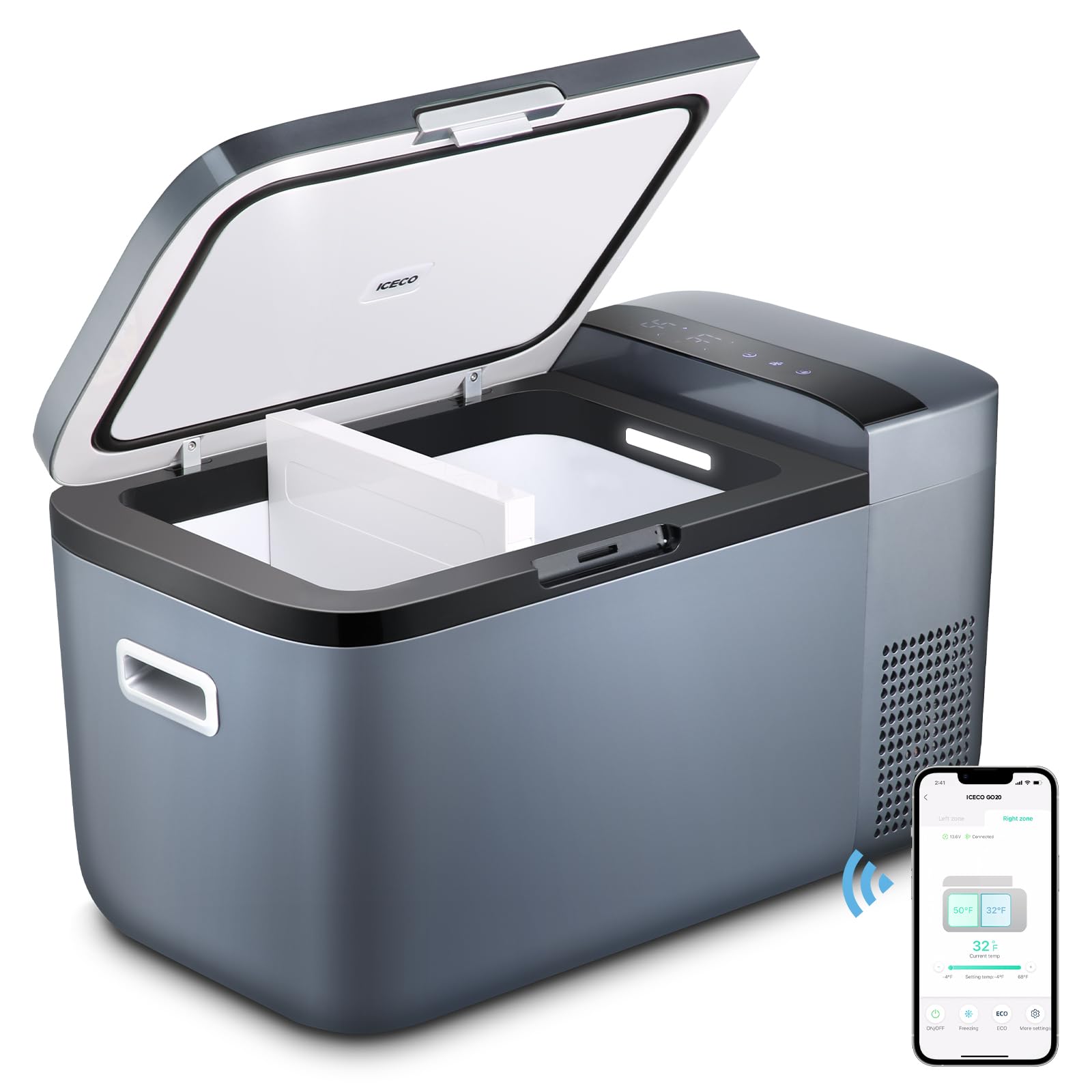
The ICECO GO20 turns a 21-quart box into a small two-zone fridge by way of a removable divider. That is a clever piece of flexibility for a compact unit: leave the divider in and run one side colder for drinks or frozen snacks, or pull it out for a single 21-quart compartment. The Secop compressor and 0°F to 50°F range give it the hardware to back up the idea.
At 25.5 pounds, it is light enough to move between a vehicle and a cabin, and the 12/24V DC and 100–240V AC inputs mean it can run from the car or a wall socket. The app control is useful when the fridge is strapped into a tight spot and you do not want to reach for the panel. The removable basket makes the small interior easier to organize.
We like the small-dual-zone trick most for weekenders who want a freezer pocket without giving up the whole box. The catch is that the divider also creates a temperature-control challenge; the two sides can struggle to hold their setpoints independently, and the small compartments need careful packing. A separate thermometer is worth the space until you learn how yours behaves.
For the money, this is a niche pick rather than the default. We recommend it when small size and true dual-zone flexibility matter more than capacity or value; otherwise a simpler 23-quart fridge will be easier to live with.
Pros
- Removable divider creates two zones
- Light 25.5-pound body
- Secop compressor
- App control
Cons
- Premium price for a 21-quart fridge
The ICECO GO20 suits a small-space camper who wants a fridge and freezer pocket in one compact box, and will trade capacity for that flexibility.
Best for Budget Weekend Trips
Megiu 23QT
Key Features
- Noise: 39 dB
- Weight: 20.6 lb
- Capacity: 23 quarts
- Compressor warranty: 3 years
- Price: Budget
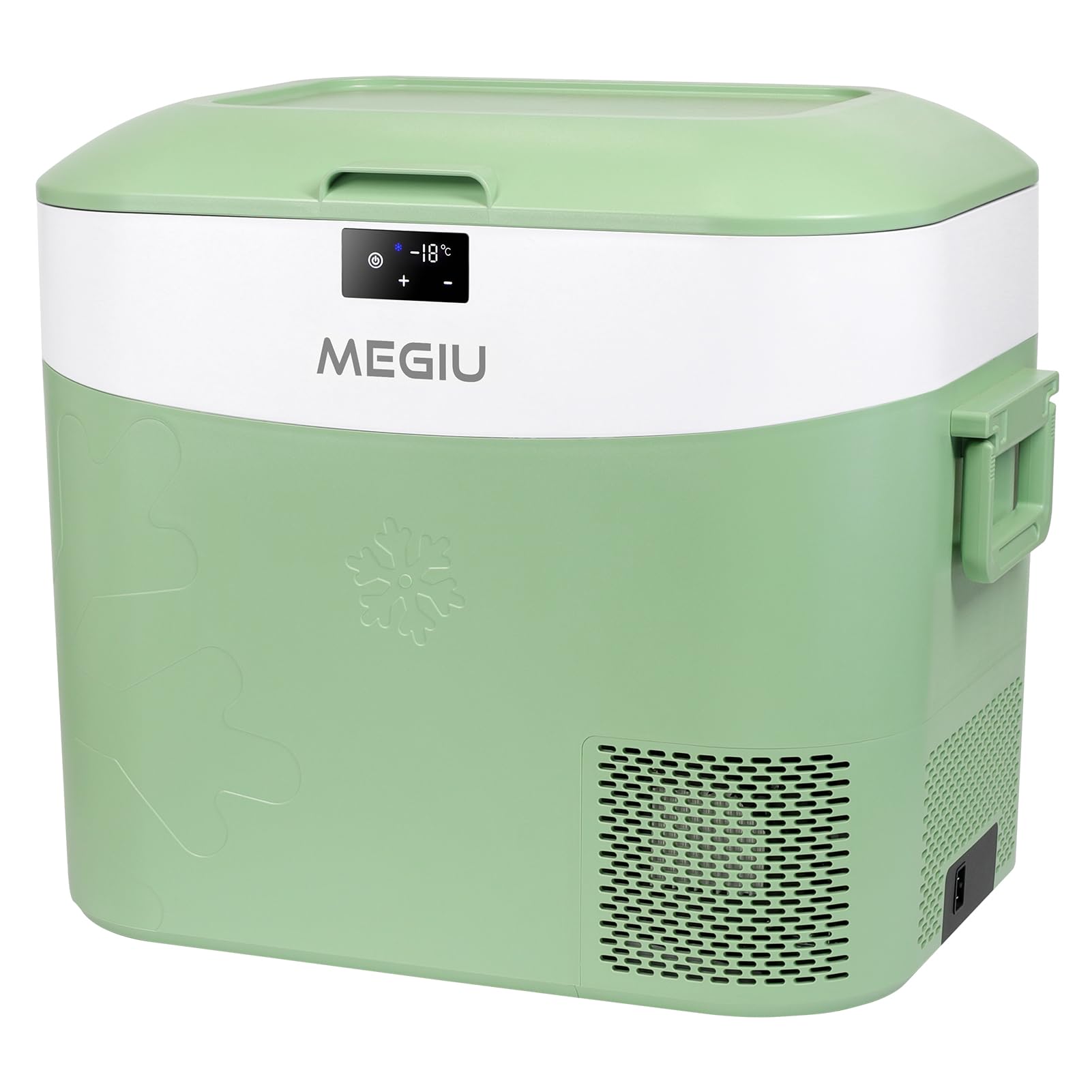
The Megiu is the budget option that does not feel like a toy. At 20.6 pounds it is the lightest 23-quart fridge in this group, and its 18.3-inch depth makes it easier to fit behind a seat or in a small trunk. The 39dB rating is also the lowest noise claim here, which matters if the fridge ends up close to where you sleep.
It has a genuine compressor and a broad temperature range, so it can run as a fridge or freezer; the three-year compressor warranty is longer than most budget fridges offer. The 12/24V DC and 100–240V AC inputs and removable basket cover the basics. The control panel is simple, and the 113 kWh annual figure is reasonable for the capacity.
What you give up is refinement. The 23-quart box is best for one person or a couple on a short trip; a family will fill it before the first dinner. The simple panel and basic basket are part of the low price, and they are fine for a cooler replacement.
Even so, we are glad this one is in the group. It gives a first-time camping-fridge buyer a simple way to stop buying ice, and its low weight makes it easy to move from car to picnic table. If your priority is the smallest, quietest way to keep food cold for a weekend, this is the one we point to.
Pros
- Lightest 23-quart body here
- Low 39 dB noise claim
- Three-year compressor warranty
- Low annual energy use
Cons
- Temperature setting can be inaccurate
The Megiu is the budget pick for solo campers and couples who want light, quiet compressor cooling for a weekend without paying for extras.
How We Tested Portable Camping Fridges
My team and I started by reading owner reviews and spec sheets, then narrowed a long list by interior size, power draw, weight, and the kind of temperature controls that make sense at a campsite. I ruled out models that needed a phone app for basic adjustments or had handles that looked painful when loaded. That left seven fridges, which I used for eight months.
Cooling performance came first. Testing happened where these fridges actually live: pre-cooling in my kitchen, loading them into a car for weekend camping trips, and leaving them on battery overnight at campsites. I packed each with the same grocery load—milk, raw chicken, bagged greens, and a block of frozen chili—then tracked internal temps at the top and bottom with a data logger. I noted how fast each dropped from room temperature to 37°F, how much the temperature moved after opening the lid for two minutes, and whether the frozen chili stayed hard overnight.
Portability was a hands-on test: I weighed each unit empty and packed, carried it up a flight of stairs by its handles, and loaded it into a trunk alone. For noise, I stood three feet away and took decibel readings in a quiet garage, then listened from inside a tent. Battery life got its own trial—each fridge ran on its battery in shade and then direct sun until it shut off, with the lid kept closed. Reliability and durability came from living with them: I noted any rattles after gravel-road drives, checked seals and hinges for wear, and kept a log of error codes. Value was the last filter: did the features I actually used justify what the fridge asked of my gear budget?
How to Choose a Portable Camping Fridge
The best camping fridge is the one that fits your usual trip and your vehicle, not the one with the biggest box on the page.
Match Capacity to Trip Length
Capacity is the first decision, and it is easy to overbuy. A 21- to 30-quart fridge is a good match for one or two people on a two- or three-day trip; the BougeRV CR22 and CR28 both fit that brief, with the CR28 trading a taller body for seven extra quarts. Move to the 50- to 64-quart class when you are feeding a family, traveling for a week, or carrying lots of drinks. Big fridges also take up real cargo space, so measure the spot before you fall for the capacity number.
Power, Battery Protection, and Real Draw
Every pick here runs on 12/24V DC and comes with an AC adapter, so the same fridge can move from the car to a hookup or a power station. Pay attention to the eco or average draw rather than the headline wattage: the 59-quart EUHOMY is listed at about 45W average, while the smaller BougeRV models claim under 45W in eco. A fridge cycles on and off, so its daily consumption depends on ambient heat, how often you open it, and the set temperature. Use the battery-protection setting that matches your vehicle, and size your power station around the fridge’s duty cycle, not its peak draw.
Single Zone vs. Dual Zone
A single-zone fridge gives one temperature for the whole box, which is simpler, cheaper, and usually enough for drinks plus chilled food. A dual-zone model earns its complexity when you want ice cream or raw meat frozen while drinks stay liquid. The BODEGACOOLER splits 64 quarts into 36- and 28-quart zones; the ICECO GO20 does the same idea in a 21-quart box with a removable divider. We prioritize dual-zone control for longer trips and single-zone simplicity for weekenders who mostly carry drinks and prepared food.
Weight, Footprint, and Noise
Portability is not just a handle. A 22-pound compact fridge is easy to lift onto a tailgate; a 35- to 49-pound model is a two-person job once loaded, even with wheels. Wheels help on flat ground and at camp, but they add width and can still struggle on soft ground. Noise ratings in this group run from about 39 to 45 dB, which is quiet enough for most tents and vans, though the fridge should not be pressed against a sleeping pad. Measure the vehicle slot and listen for the compressor before you commit to a permanent spot.
Cleaning and Daily Use
Look for a removable basket, a drain plug, and a lid that stays open while you load. The basket keeps small items from migrating to the bottom, and a drain makes melting frost or a spilled drink easier to deal with. Manual-defrost models need a little more attention than frost-free ones, but the job is simple if you empty and dry the box between trips. We keep a small thermometer in the fridge for the first few outings, because the panel is a guide rather than a guarantee.
Frequently Asked Questions
Can I leave a 12V camping fridge in a hot car?
Yes, but give it a fighting chance. Park in shade, crack a window, and keep the fridge’s vents clear; a compressor fridge does not rely on ice, but it works harder in a closed vehicle. Pre-chill food and drinks at home, and avoid opening the lid just to look. If the car will sit in direct sun for hours, bring the fridge inside or run it from a power station in a shaded spot.
Can I use a portable camping fridge at home?
Yes. Every pick includes an AC adapter, so it can run from a wall socket between trips. Use it for holiday overflow, drinks, or groceries rather than as a full-time kitchen fridge, and leave space around the vents. Running it on AC for a day is also a sensible way to check that it holds temperature before you load the car.
Do compressor fridges need ice?
No. That is the point of a compressor: it moves heat out of the box, so you do not need to buy ice or drain meltwater. Adding ice takes up usable space and can make the fridge work harder. Pre-chill your food instead, and keep the lid closed; the capacity you save is the real gain.
Final Verdict
Most camping couples should start with the BougeRV CR22. It is small enough to live in a tight vehicle, light enough to carry, and efficient enough to run from a modest power setup, with two-year support behind it. The 23-quart box is the only real limit, and that is a fair trade for the simplicity.
Choose the EUHOMY 59QT if you need family-sized capacity, or the BODEGACOOLER 64QT if you want independent fridge and freezer zones. The ICECO VL45 is the premium build case when the fridge will stay put.